Blog

  • NYC’s Real Estate Market: Roaring Housing Prices Show No Signs of Slowdown

    “The story that I’m seeing across the board: All segments are transacting. New York [real estate] is back, and people want to be here.”

    – Christopher Kromer, Brown Harris Stevens

    Statistically, that’s an excellent summation of New York City’s real estate market. While real estate was least of all financial asset classes hit by the COVID-19 pandemic, it’s not really “recovering”. Quite amazingly, it’s heating up. It has been for months now, but experts predict that was just a warm up (Singh, CNBC).

    “We’re coming off a record number of signed contracts in the second quarter, and what’s driving that is buyers are seeing value. They’re sensing opportunity, and there’s a real sense of hope for an economic boom in September when it opens up.”

    – Christopher Kromer, Brown Harris Stevens

    In other words, even reasonable rental prices are getting nearly impossible to find almost anywhere in New York City. The buyer’s market is a different story. As Kromer put it, “For the most part, if you’re buying today, it’s probably less expensive than it would have been three or four years ago”. For these purposes, suppose we break New York City’s real estate market into two distinct elements. The profit opportunity for cash buyers has been there and will continue to be there for a prolonged time. Conversely, the residential real estate market for renters, who are mostly living paycheck-to-paycheck, is a nightmare (Nasdaq).

    A Contradictory Study

    Although, a recent Douglas Elliman and Miller Samuel report appeared to somewhat contradict this philosophy. The report showed median resale prices for Manhattan apartments reached an all-time high in Q2 2021 (Douglas Elliman). Average sale prices rose 12% in the quarter (Douglas Elliman). They topped $1.9 million and there was also a 150% gain in sales during that same time period, compared to 2020. In Q2 of 2020, Manhattan apartment sales had their largest percentage decline in 30 years. Residents fled Manhattan during the COVID-19 pandemic, so brokers largely weren’t even able to show apartments to prospective buyers.

    Kromer had a response to the data presented by the Douglas Elliman and Miller Samuel report.

    “I think it’s probably tilted with a lot of high-end closings. The luxury market has been booming lately with a lot of discounts.”

    – Christopher Kromer, Brown Harris Stevens

    The recent activity in Manhattan’s luxury housing market still hasn’t wiped away the excess inventory created by COVID-19. In the luxury market, sellers are coming down on asking prices to meet buyers on their side. This in turn gives buyer’s even more buying power because they have options.

    “What’s driving this are more realistic sellers and softer prices. We still are at near-record levels of inventory. So, the sellers are going down to meet the buyers at their prices. The buyers have options.”

    – Christopher Kromer, Brown Harris Stevens

    Moving Beyond Manhattan

    Astoundingly, markets in the outer boroughs of New York, such as Brooklyn, showed far more resilience through the pandemic. This is again compared to the luxury, upscale housing market in Manhattan; a very significant geographic market difference.

    “People were looking for value, for space and less dense areas, and you did not see the discounts that you saw in Manhattan in the outer boroughs”.

    – Christopher Kromer, Brown Harris Stevens

    A few of Kromer’s own listings in Queens and Brooklyn recently sold above asking price, after receiving multiple offers. One two-bedroom co-op in Brooklyn even sold at roughly 8-9% above the price it sold at three years ago.

    “A single-family home in Queens was overwhelmed with interest. We had about 50 showings within the first week, with it selling for about 10% above the asking price”.

    – Christopher Kromer, Brown Harris Stevens

    In Conclusion

    Despite the study from Douglas Elliman and Miller Samuel, data shows NYC’s housing market is prospering. Housing rental prices on luxurious Manhattan properties are barely affordable. Rental prices outside the heart of New York are still steep and the availability of affordable housing is shrinking. This is nearly all attributed to the “buyer’s market” NYC real estate is clearly in the midst of. Prospective renters need to act fast to avoid losing out on any decent affordable housing in the five boroughs. Prices will only continue to increase, while availability will only continue to decrease.
  • How Real Estate Impacts the US Economy

    Real estate, commonly known as the largest asset class in the world, would intuitively play an integral role in the US economy. Residential real estate properties provide a vital pillar of the “American Dream”: private housing for families. Separately, they can also be the greatest source of wealth and savings for many Americans. Commercial real estate (CRE) – including apartment buildings – creates jobs and rented spaces for retail stores, offices, and manufacturing warehouses. Real estate business and investment provides a source of revenue for millions of Americans.

    In 2018, real estate construction contributed $1.15 trillion to the US national economy output (BEA.gov). That accounts for 6.2% of the US economy GDP over the same year, which is quite a significant proportion. For comparison’s sake, it’s more than the $1.13 trillion in 2017, however less than the 2006-peak of $1.19 trillion. Back in 2006, real estate construction was an even heftier 8.9% component of US GDP (Amadeo, The Balance).

    While there’s some politicization over whether these qualify as “good” jobs, real estate construction is obviously labor-intensive. It plays a major force in job creation. The decline in housing construction was undoubtedly a major contribution to the COVID-19 Recession’s high unemployment rate.

    The Ripple Effect in the US Economy of Real Estate

    Construction is the only part of real estate that’s directly calculated into US GDP (Amadeo, The Balance). Nonetheless, real estate affects many other areas of the US economy, which aren’t captured by US GDP metrics. As an example, a decline in real estate sales inevitably leads to a decline in real estate prices. This effect lowers the value of all homes, irrespective of whether owners are actively selling or not. Furthermore, this causes a reduction in the overall number of home equity loans available to owners. Ultimately, the market impact is reduced consumer spending, as more homeowner cash is tied up in housing projects.

    As many are aware, nearly 70% of the US economy is based on personal consumption (BEA.gov). Consequently, a reduction in consumer spending is directly linked to a downward spiral in the US economy. The downward spiral causality is easily witnessed. This macroeconomic phenomenon leads to further drops in employment, income, and consumer spending (Amadeo, The Balance). The primary concern about the US economy falling into a deep recession stems from concerns about Federal Reserve policy. The Federal Reserve received widespread accreditation for keeping rates very low throughout the COVID-19 pandemic. Many experts argue a further cut to interest rates are still necessary (Amadeo, The Balance). There is one positive takeaway regarding lower home prices. They lessen the chance of inflation.

    Real Estate and the 2008 US (Global) Economy Recession

    Of course, no better example exists of real estate’s impact on the US economy than the 2008 recession. While very few immediately realized it, falling home prices triggered the downturn and subsequent broad, ill effects. According to the National Association of Realtors (NAR), by July 2007, the median price of an existing single-family home in the US was down 4% since its peak in October 2005 (National Association of Realtors). Macroeconomists, risk analysts, credit analysts, and economists as a whole couldn’t reconcile how concerning this was. Clear definitions and numeric parameters of recession, bear market, and a stock market correction are well standardized. The same is still, not yet true for the housing market.

    For perspective and comparison, many likened it to the 24% decline during the Great Depression of 1929. Others compared it to the decline ranging from 22% to 40% in US, oil-producing areas in the early 1980s. Incorrectly using these as benchmarks, the 2008 housing “slump” could appear barely newsworthy. To the contrary, the crash quickly gained steam. Economic studies have shown that even fairly small declines between 10% and 15% are enough to eliminate the homeowner’s equity. We saw this occur in early 2007 within communities in Florida, Nevada, and Louisiana.

    Death by Derivatives

    Staggeringly, nearly half the loans issued between 2005 and 2007 were subprime. Of course, this means homebuyers are much more likely to default. Far worse for the national economy, banks used these loans to finance trillions of dollars of derivatives. Banks infamously packaged these loans into mortgage-backed securities. They peddled them as “safe” investments to pension funds, corporations, and retirees. Moreover, they were thought of as “insured” from default by a new insurance product called a credit default swap. The biggest issuer was American International Group, Inc. (AIG).

    Once borrowers defaulted, the mortgage-backed securities had very questionable value. A huge number of investors began to exercise their credit default swaps, such that AIG ran out of cash. They were ready to default themselves, until the Federal Reserve bailed them out.

    Investment banks with a large number of mortgage-backed securities on their books – most notably Bear Stearns and Lehman Brothers – were rejected by other banks. Without cash to continue operations, they ran to the Fed for help. The Fed wound up finding a buyer for Bear Sterns, but not the latter, Lehman. The bankruptcy of Lehman Brothers kicked off the 2008 financial crisis, officially.

    Are We on The Brink?

    Studies show investors are seriously questioning whether another real estate market crash will happen in the next two years. Housing prices are more or less stagnant, while the Fed is beginning to drop interest rates. This is indicative of a bubble and historically we know that bubbles burst.

    However, there are many structural differences to consider when evaluating today’s market with the housing market in 2005. Firstly, the volume of subprime loans makes up a smaller percentage of the mortgage market. Interestingly, however, these are growing under the “nonprime loans” name. In 2005, they contributed roughly 20% (Amadeo, The Balance). Additionally, banks have greatly increased lending standards. Investors, those who flip houses, have to provide between 20% to 45% of the cost of a home. Compared to during the subprime crisis, buyers needed to provide 20% or less.

    Most importantly, homeowners are not taking as much equity out of their homes. Home equity skyrocketed at $85 billion in 2006. Subsequently, it collapsed to less than $10 billion in 2010 and remained around that level until 2015. By 2017, it had only risen to $14 billion (Amadeo, The Balance). A major reason behind that is fewer people are filing for bankruptcy (Allen, Consumer Reports). In 2016, only 770,846 filed for bankruptcy; by comparison in 2010, only 1.5 million people did (Allen, Consumer Reports). Many economists, quite surprisingly, attribute this to “Obamacare”.

    The Bottom Line

    Concisely, we’re very unlikely to see anything close to what we witnessed in 2008 for a number of reasons. Primarily, structural changes in the economy – such as volatility ratio mandates for investment and retail banks – would prevent a widespread financial epidemic, even if the housing market were to suffer a significant downturn. Equally important to the housing market, mandates for homeowners and active real estate investors are more stringent. Finally, cost-cutting measures, such as the ACA, make it less likely for homeowners to default on mortgage payments.

    This is not even considering that while some reputable economists believe we may see prices decline in the next two years, we’ve yet to see it. In fact, as we continue to recover from COVID-19 economically, we’re seeing a housing market recovery. There’re multiple reasons we don’t need to worry about a repeat of 2008.

  • How Real Estate Impacts the US Economy

    Real estate, commonly known as the largest asset class in the world, would intuitively play an integral role in the US economy. Residential real estate properties provide a vital pillar of the “American Dream”: private housing for families. Separately, they can also be the greatest source of wealth and savings for many Americans. Commercial real estate (CRE) – including apartment buildings – creates jobs and rented spaces for retail stores, offices, and manufacturing warehouses. Real estate business and investment provides a source of revenue for millions of Americans.

    In 2018, real estate construction contributed $1.15 trillion to the US national economy output (BEA.gov). That accounts for 6.2% of the US economy GDP over the same year, which is quite a significant proportion. For comparison’s sake, it’s more than the $1.13 trillion in 2017, however less than the 2006-peak of $1.19 trillion. Back in 2006, real estate construction was an even heftier 8.9% component of US GDP (Amadeo, The Balance).

    While there’s some politicization over whether these qualify as “good” jobs, real estate construction is obviously labor-intensive. It plays a major force in job creation. The decline in housing construction was undoubtedly a major contribution to the COVID-19 Recession’s high unemployment rate.

    The Ripple Effect in the US Economy of Real Estate

    Construction is the only part of real estate that’s directly calculated into US GDP (Amadeo, The Balance). Nonetheless, real estate affects many other areas of the US economy, which aren’t captured by US GDP metrics. As an example, a decline in real estate sales inevitably leads to a decline in real estate prices. This effect lowers the value of all homes, irrespective of whether owners are actively selling or not. Furthermore, this causes a reduction in the overall number of home equity loans available to owners. Ultimately, the market impact is reduced consumer spending, as more homeowner cash is tied up in housing projects.

    As many are aware, nearly 70% of the US economy is based on personal consumption (BEA.gov). Consequently, a reduction in consumer spending is directly linked to a downward spiral in the US economy. The downward spiral causality is easily witnessed. This macroeconomic phenomenon leads to further drops in employment, income, and consumer spending (Amadeo, The Balance). The primary concern about the US economy falling into a deep recession stems from concerns about Federal Reserve policy. The Federal Reserve received widespread accreditation for keeping rates very low throughout the COVID-19 pandemic. Many experts argue a further cut to interest rates are still necessary (Amadeo, The Balance). There is one positive takeaway regarding lower home prices. They lessen the chance of inflation.

    Real Estate and the 2008 US (Global) Economy Recession

    Of course, no better example exists of real estate’s impact on the US economy than the 2008 recession. While very few immediately realized it, falling home prices triggered the downturn and subsequent broad, ill effects. According to the National Association of Realtors (NAR), by July 2007, the median price of an existing single-family home in the US was down 4% since its peak in October 2005 (National Association of Realtors). Macroeconomists, risk analysts, credit analysts, and economists as a whole couldn’t reconcile how concerning this was. Clear definitions and numeric parameters of recession, bear market, and a stock market correction are well standardized. The same is still, not yet true for the housing market.

    For perspective and comparison, many likened it to the 24% decline during the Great Depression of 1929. Others compared it to the decline ranging from 22% to 40% in US, oil-producing areas in the early 1980s. Incorrectly using these as benchmarks, the 2008 housing “slump” could appear barely newsworthy. To the contrary, the crash quickly gained steam. Economic studies have shown that even fairly small declines between 10% and 15% are enough to eliminate the homeowner’s equity. We saw this occur in early 2007 within communities in Florida, Nevada, and Louisiana.

    Death by Derivatives

    Staggeringly, nearly half the loans issued between 2005 and 2007 were subprime. Of course, this means homebuyers are much more likely to default. Far worse for the national economy, banks used these loans to finance trillions of dollars of derivatives. Banks infamously packaged these loans into mortgage-backed securities. They peddled them as “safe” investments to pension funds, corporations, and retirees. Moreover, they were thought of as “insured” from default by a new insurance product called a credit default swap. The biggest issuer was American International Group, Inc. (AIG).

    Once borrowers defaulted, the mortgage-backed securities had very questionable value. A huge number of investors began to exercise their credit default swaps, such that AIG ran out of cash. They were ready to default themselves, until the Federal Reserve bailed them out.

    Investment banks with a large number of mortgage-backed securities on their books – most notably Bear Stearns and Lehman Brothers – were rejected by other banks. Without cash to continue operations, they ran to the Fed for help. The Fed wound up finding a buyer for Bear Sterns, but not the latter, Lehman. The bankruptcy of Lehman Brothers kicked off the 2008 financial crisis, officially.

    Are We on The Brink?

    Studies show investors are seriously questioning whether another real estate market crash will happen in the next two years. Housing prices are more or less stagnant, while the Fed is beginning to drop interest rates. This is indicative of a bubble and historically we know that bubbles burst.

    However, there are many structural differences to consider when evaluating today’s market with the housing market in 2005. Firstly, the volume of subprime loans makes up a smaller percentage of the mortgage market. Interestingly, however, these are growing under the “nonprime loans” name. In 2005, they contributed roughly 20% (Amadeo, The Balance). Additionally, banks have greatly increased lending standards. Investors, those who flip houses, have to provide between 20% to 45% of the cost of a home. Compared to during the subprime crisis, buyers needed to provide 20% or less.

    Most importantly, homeowners are not taking as much equity out of their homes. Home equity skyrocketed at $85 billion in 2006. Subsequently, it collapsed to less than $10 billion in 2010 and remained around that level until 2015. By 2017, it had only risen to $14 billion (Amadeo, The Balance). A major reason behind that is fewer people are filing for bankruptcy (Allen, Consumer Reports). In 2016, only 770,846 filed for bankruptcy; by comparison in 2010, only 1.5 million people did (Allen, Consumer Reports). Many economists, quite surprisingly, attribute this to “Obamacare”.

    The Bottom Line

    Concisely, we’re very unlikely to see anything close to what we witnessed in 2008 for a number of reasons. Primarily, structural changes in the economy – such as volatility ratio mandates for investment and retail banks – would prevent a widespread financial epidemic, even if the housing market were to suffer a significant downturn. Equally important to the housing market, mandates for homeowners and active real estate investors are more stringent. Finally, cost-cutting measures, such as the ACA, make it less likely for homeowners to default on mortgage payments.

    This is not even considering that while some reputable economists believe we may see prices decline in the next two years, we’ve yet to see it. In fact, as we continue to recover from COVID-19 economically, we’re seeing a housing market recovery. There’re multiple reasons we don’t need to worry about a repeat of 2008.

  • How to Best Invest in Real Estate in the Midwest

    The most surprising feature about housing markets in the Midwest is that home prices – in most of them – are still below the level where local incomes dictate they should be (Winzer, Forbes). If you’re a real estate investor, this means two things. Firstly, there are bargains still available in these markets. Secondly, demand for housing not been very strong, at least not yet.

    Midwest Housing Market Overview

    The lack of rebound in the Midwest housing market following 2008 is largely due to the specific types of local economic growth that prevailed before that (Winzer, Forbes). The housing recession came coupled with a lengthy, slow decline in manufacturing. The availability of an educated but low-cost labor force had encouraged the growth of big financial operations in Des Moines, Minneapolis, Omaha, Sioux Falls and Green Bay. However, manufacturing still has a large role in Fayetteville, Davenport, Peoria, Rockford, Gary, Fort Wayne, South Bend, Wichita, Milwaukee and Green Bay (Millsap, Forbes).

    This makes these markets a bit riskier to invest in. The markets with a large finance sector are also risky because automation is responsible for an increasing amount of work. Despite structural problems, growth is now returning to many Midwest markets, as it did prior to COVID-19. Especially in areas that function as regional centers – Fayetteville and Peoria, for example – the expansion of jobs is due to an increase in healthcare and business services. Similarly, to the country, these services are becoming concentrated in large urban centers, creating opportunities for investors in rental housing.

    An uncharacteristic feature housing investors contend with is many Midwest markets have agricultural roots, with manufacturing later added on top. Since land was readily and easily available during their growth, they tend to be spread out. This combination produces low home prices, but increased difficulty for investors to select a locality. After all, the saying “real estate is about location, location, location”, rings true in most cases.

    Now that we’ve established some fundamental generalities, let’s get to the specifics and numbers.

    Established Demand

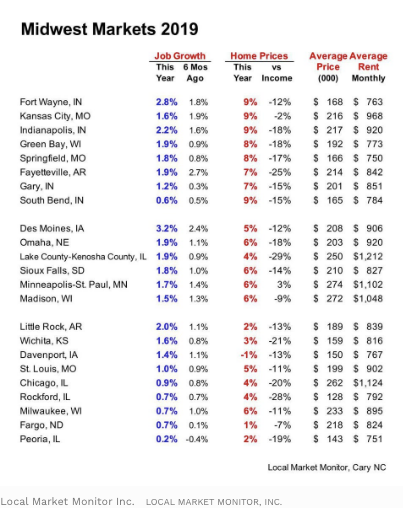
    Fort Wayne, Kansas City, Indianapolis, Green Bay, Springfield, Fayetteville, Gary and South Bend.

    In these markets, it appears home prices increased relatively broadly in the past year, indicating good demand not just for single-family homes, but rentals as well. With prices still well below income levels and above average job growth, demand is likely to keep raising prices higher. Though the trend depicted below shows the housing market pre-COVID, that trend is pretty much identical today. The housing market didn’t really suffer the same volume of consequences as other markets, but the small parts that did are steadily recovering (Winzer, Forbes).

    Source: Local Market Monitor, Inc.

    South Bend and Gary are at the bottom of this list because their job growth had been less reliable. Before bargains evaporate, investors should move quickly into these markets. Straight, single-family rentals – with minor improvements – are the best bet (Winzer, Forbes).

    Growing Demand

    Des Moines, Omaha, Lake County-Kenosha County, Sioux Falls, Minneapolis, Madison.

    These markets are showing solid job growth, but only moderate increases in demand thus far. Apartments appear to be a good investment in Lake County-Kenosha County and Minneapolis, due to higher density and prices. Since their dependence on the financial sector is comparably very high, most of these markets are also slightly riskier, so investors should be very careful to find properties towards the middle of the renter pool and definitely avoid the higher end.

    Uncertain Demand

    Little Rock, Wichita, Davenport, St. Louis, Chicago, Rockford, Milwaukee, Fargo, Peoria.

    In these markets either demand or job growth are weak, or even more likely, both. Low home prices are also far more commonly found in these markets. This may tempt investors to purchase a low-cost property and rent it out for cheap, without spending another dime. However, renting at the low-end is a specialty that most investors should avoid. In uncertain real estate markets, it makes sense to first look for the safest geographic areas in that market. Then you can perhaps expand and renovate a really inexpensive property, turning it into a profitable rental. That definitely involves more work, but it has potential to give you a bigger return for less risk.

    The Bottom Line

    Concisely, there’s clearly room for excellent returns on housing market investments in the Midwest. While some areas have more opportunity, depending on what strategy you choose, there’s solid return on investment potential all-around. The more time that passes from the start of the COVID-19 pandemic, the less attractive prospects will exist. Active real estate investors would be wise to look strongly into the Midwest and move quickly on specifically the kinds of properties with the features described above. Considering the housing rental market is excellent and still growing, there are definite, safe strategies to fall back on.

  • How to Best Invest in Real Estate in the Midwest

    The most surprising feature about housing markets in the Midwest is that home prices – in most of them – are still below the level where local incomes dictate they should be (Winzer, Forbes). If you’re a real estate investor, this means two things. Firstly, there are bargains still available in these markets. Secondly, demand for housing not been very strong, at least not yet.

    Midwest Housing Market Overview

    The lack of rebound in the Midwest housing market following 2008 is largely due to the specific types of local economic growth that prevailed before that (Winzer, Forbes). The housing recession came coupled with a lengthy, slow decline in manufacturing. The availability of an educated but low-cost labor force had encouraged the growth of big financial operations in Des Moines, Minneapolis, Omaha, Sioux Falls and Green Bay. However, manufacturing still has a large role in Fayetteville, Davenport, Peoria, Rockford, Gary, Fort Wayne, South Bend, Wichita, Milwaukee and Green Bay (Millsap, Forbes).

    This makes these markets a bit riskier to invest in. The markets with a large finance sector are also risky because automation is responsible for an increasing amount of work. Despite structural problems, growth is now returning to many Midwest markets, as it did prior to COVID-19. Especially in areas that function as regional centers – Fayetteville and Peoria, for example – the expansion of jobs is due to an increase in healthcare and business services. Similarly, to the country, these services are becoming concentrated in large urban centers, creating opportunities for investors in rental housing.

    An uncharacteristic feature housing investors contend with is many Midwest markets have agricultural roots, with manufacturing later added on top. Since land was readily and easily available during their growth, they tend to be spread out. This combination produces low home prices, but increased difficulty for investors to select a locality. After all, the saying “real estate is about location, location, location”, rings true in most cases.

    Now that we’ve established some fundamental generalities, let’s get to the specifics and numbers.

    Established Demand

    Fort Wayne, Kansas City, Indianapolis, Green Bay, Springfield, Fayetteville, Gary and South Bend.

    In these markets, it appears home prices increased relatively broadly in the past year, indicating good demand not just for single-family homes, but rentals as well. With prices still well below income levels and above average job growth, demand is likely to keep raising prices higher. Though the trend depicted below shows the housing market pre-COVID, that trend is pretty much identical today. The housing market didn’t really suffer the same volume of consequences as other markets, but the small parts that did are steadily recovering (Winzer, Forbes).

    Source: Local Market Monitor, Inc.

    South Bend and Gary are at the bottom of this list because their job growth had been less reliable. Before bargains evaporate, investors should move quickly into these markets. Straight, single-family rentals – with minor improvements – are the best bet (Winzer, Forbes).

    Growing Demand

    Des Moines, Omaha, Lake County-Kenosha County, Sioux Falls, Minneapolis, Madison.

    These markets are showing solid job growth, but only moderate increases in demand thus far. Apartments appear to be a good investment in Lake County-Kenosha County and Minneapolis, due to higher density and prices. Since their dependence on the financial sector is comparably very high, most of these markets are also slightly riskier, so investors should be very careful to find properties towards the middle of the renter pool and definitely avoid the higher end.

    Uncertain Demand

    Little Rock, Wichita, Davenport, St. Louis, Chicago, Rockford, Milwaukee, Fargo, Peoria.

    In these markets either demand or job growth are weak, or even more likely, both. Low home prices are also far more commonly found in these markets. This may tempt investors to purchase a low-cost property and rent it out for cheap, without spending another dime. However, renting at the low-end is a specialty that most investors should avoid. In uncertain real estate markets, it makes sense to first look for the safest geographic areas in that market. Then you can perhaps expand and renovate a really inexpensive property, turning it into a profitable rental. That definitely involves more work, but it has potential to give you a bigger return for less risk.

    The Bottom Line

    Concisely, there’s clearly room for excellent returns on housing market investments in the Midwest. While some areas have more opportunity, depending on what strategy you choose, there’s solid return on investment potential all-around. The more time that passes from the start of the COVID-19 pandemic, the less attractive prospects will exist. Active real estate investors would be wise to look strongly into the Midwest and move quickly on specifically the kinds of properties with the features described above. Considering the housing rental market is excellent and still growing, there are definite, safe strategies to fall back on.

  • What is a Private Equity Real Estate Fund?

    In the simplest terms, a real estate private equity fund is a partnership established to raise equity for ongoing real estate investments (Bond, NAIOP). A general partner (GP), most frequently referred to as the “sponsor”, creates the fund. The sponsor asks investors, known as limited partners (LPs), to invest equity in the fund or partnership. Those funds, along with money borrowed from commercial banks, investment banks, public institutions, asset managers, and other lenders, are supposed to be invested in a variety of real estate development or acquisition opportunities.

    Typically, the LPs provide the bulk of the equity capital and are passive investors, who have actively chosen to invest in an offering, which was presented by the sponsor. LPs earn an early return of capital and a preferred return on capital invested (Bond, NAIOP). Sponsors are in charge of providing the equity capital, securing investment opportunities, managing the real estate and the fund, and earning fees (that typically are based on performance).

    A real estate private equity fund differs from capital that comes from friends and family and joint ventures. A differentiating example of a joint venture could be among a landowner, a developer, and a money partner. None could complete the investment without the others, and the joint venture is specific to just one investment. Real estate private equity funds, on the other hand, are created to invest in a series of deals with a standardized risk and reward structure created for the overall fund in which the sponsor and LP participate unequally (Bond, NAIOP).

    What are the Sponsor’s Motivations?

    While there are arguments for a laundry list of motivations, we’ll highlight the general motivating factors for sponsors.

    • Diversify and expand funding sources, as well as holdings

    A sponsor with a pipeline of potential investments can use a fund to take advantage of a portfolio consisting of a variety of deals that would not otherwise be available. The capital-raising strategy should, however, focus on the sponsor’s history, the experience of the team, the potential for returns, alignment of interests and clearly identified opportunities. The most reputable developers with the best track records are able to find investment opportunities in their home markets that are outside their traditional property type focus, opportunities outside their historical geographic focus, or some combination of both (Bond, NAIOPI). A private equity fund has the potential to provide the scale that will allow the sponsor to fully take advantage of these opportunities, thereby generating returns over a much larger capital base and likely even lowering the risk of the firm.

    • Invest in larger and higher quality projects

    A sponsor that has capital constraints can use funds to invest in larger and more complex projects. Conversely, more partners also enable the developer to share the risks with their investors to create a better risk-return balance on large, complex projects that the sponsor would not be able to take on alone.

    • Obtain better terms from banks and other lenders.
    • Provide an alternative to mezzanine capital.
    • Develop projects using fund-level financing in lieu of project-by-project financing.
    • Earn fees from the fund, including a promoted interest. 

    The “Three Key” Considerations to a Private Equity Real Estate Fund

    While an argument could be made for a myriad of factors that are critical to take into account when setting up a private equity fund, three key considerations standout. These are pillars to success in establishing the fund and efficiently raising capital from the limited partners.

    1) Amount of Equity Capital to Raise

    The first consideration is the amount of equity capital that ought to be raised. This should include organizational fees. The minimum private equity fund size is generally considered to be $20 million. While organizational costs are generally proportional to fund size, the floor for organizational fees is about $400,000. While the sponsor recoups these fees from the fund once the capital is raised, the sponsor must carry these costs during the fund’s formation period. Examples of these costs include: formation costs for the legal entity or entities, filing fees, accounting fees, regulatory brokerage costs, clearing costs and the cost of producing marketing documents (Bond, NAIOP).

    While the fund’s equity capital is typically combined with debt capital to create a total pool for investing, a successful fund needs to balance potential deal flow with the fund’s size to ensure that the fund can produce sustainable returns for the LPs, and that it doesn’t become too small, such that a follow-on fund might need to be launched. The timing of flows to and from the fund should also be considered. In general, LPs begin earning a preferred return on their capital as soon as the funds are invested. Therefore, in addition to obtaining a commitment from each LP for the total investment amount, astute sponsors stage the pay-in to match the fund’s anticipated timing of investments.

    2) Realistic Amount of Time, Energy, and Seed Funding Required

    Sponsors must be clear-eyed about the time, energy and seed funding required to launch a fund (Bond, NAIOP). The sponsor is responsible for all aspects of the fund: organizing the fund, which includes generating a partnership agreement, offering and subscription documents; securing investment opportunities; securing loans and other financing; managing the fund; operating the properties; preparing partners’ tax returns; and responding to accounting and audit matters, and this is to name only a few of the highlights. These responsibilities put the sponsor is under a constant, daunting amount of pressure. You may have the financial acumen, but you may not have other traits essential to being a successful sponsor.

    3) Clear Investment Fund Strategy

    It’s imperative for sponsors to have a clear and easily understood investment fund strategy. This differs from the market fundamentals, property type, and location strategies that dominate traditional real estate investing assessments. Though experienced sponsors and the largest funds may be able to raise funds for a “blind pool” – a fund for which no individual investments are identified – first-time sponsors typically must identify specific investments that are included in the fund’s offering memorandum.

    Concisely, there’s a lot of complexity to operating or owning a private equity fund that we didn’t get to. However, our goal was to cover the core basics. What is a private equity fund, how is it set up, and what are the key takeaways? We hope this piece was helpful and educational for those interested in private equity.

  • What is a Private Equity Real Estate Fund?

    In the simplest terms, a real estate private equity fund is a partnership established to raise equity for ongoing real estate investments (Bond, NAIOP). A general partner (GP), most frequently referred to as the “sponsor”, creates the fund. The sponsor asks investors, known as limited partners (LPs), to invest equity in the fund or partnership. Those funds, along with money borrowed from commercial banks, investment banks, public institutions, asset managers, and other lenders, are supposed to be invested in a variety of real estate development or acquisition opportunities.

    Typically, the LPs provide the bulk of the equity capital and are passive investors, who have actively chosen to invest in an offering, which was presented by the sponsor. LPs earn an early return of capital and a preferred return on capital invested (Bond, NAIOP). Sponsors are in charge of providing the equity capital, securing investment opportunities, managing the real estate and the fund, and earning fees (that typically are based on performance).

    A real estate private equity fund differs from capital that comes from friends and family and joint ventures. A differentiating example of a joint venture could be among a landowner, a developer, and a money partner. None could complete the investment without the others, and the joint venture is specific to just one investment. Real estate private equity funds, on the other hand, are created to invest in a series of deals with a standardized risk and reward structure created for the overall fund in which the sponsor and LP participate unequally (Bond, NAIOP).

    What are the Sponsor’s Motivations?

    While there are arguments for a laundry list of motivations, we’ll highlight the general motivating factors for sponsors.

    • Diversify and expand funding sources, as well as holdings

    A sponsor with a pipeline of potential investments can use a fund to take advantage of a portfolio consisting of a variety of deals that would not otherwise be available. The capital-raising strategy should, however, focus on the sponsor’s history, the experience of the team, the potential for returns, alignment of interests and clearly identified opportunities. The most reputable developers with the best track records are able to find investment opportunities in their home markets that are outside their traditional property type focus, opportunities outside their historical geographic focus, or some combination of both (Bond, NAIOPI). A private equity fund has the potential to provide the scale that will allow the sponsor to fully take advantage of these opportunities, thereby generating returns over a much larger capital base and likely even lowering the risk of the firm.

    • Invest in larger and higher quality projects

    A sponsor that has capital constraints can use funds to invest in larger and more complex projects. Conversely, more partners also enable the developer to share the risks with their investors to create a better risk-return balance on large, complex projects that the sponsor would not be able to take on alone.

    • Obtain better terms from banks and other lenders.
    • Provide an alternative to mezzanine capital.
    • Develop projects using fund-level financing in lieu of project-by-project financing.
    • Earn fees from the fund, including a promoted interest. 

    The “Three Key” Considerations to a Private Equity Real Estate Fund

    While an argument could be made for a myriad of factors that are critical to take into account when setting up a private equity fund, three key considerations standout. These are pillars to success in establishing the fund and efficiently raising capital from the limited partners.

    1) Amount of Equity Capital to Raise

    The first consideration is the amount of equity capital that ought to be raised. This should include organizational fees. The minimum private equity fund size is generally considered to be $20 million. While organizational costs are generally proportional to fund size, the floor for organizational fees is about $400,000. While the sponsor recoups these fees from the fund once the capital is raised, the sponsor must carry these costs during the fund’s formation period. Examples of these costs include: formation costs for the legal entity or entities, filing fees, accounting fees, regulatory brokerage costs, clearing costs and the cost of producing marketing documents (Bond, NAIOP).

    While the fund’s equity capital is typically combined with debt capital to create a total pool for investing, a successful fund needs to balance potential deal flow with the fund’s size to ensure that the fund can produce sustainable returns for the LPs, and that it doesn’t become too small, such that a follow-on fund might need to be launched. The timing of flows to and from the fund should also be considered. In general, LPs begin earning a preferred return on their capital as soon as the funds are invested. Therefore, in addition to obtaining a commitment from each LP for the total investment amount, astute sponsors stage the pay-in to match the fund’s anticipated timing of investments.

    2) Realistic Amount of Time, Energy, and Seed Funding Required

    Sponsors must be clear-eyed about the time, energy and seed funding required to launch a fund (Bond, NAIOP). The sponsor is responsible for all aspects of the fund: organizing the fund, which includes generating a partnership agreement, offering and subscription documents; securing investment opportunities; securing loans and other financing; managing the fund; operating the properties; preparing partners’ tax returns; and responding to accounting and audit matters, and this is to name only a few of the highlights. These responsibilities put the sponsor is under a constant, daunting amount of pressure. You may have the financial acumen, but you may not have other traits essential to being a successful sponsor.

    3) Clear Investment Fund Strategy

    It’s imperative for sponsors to have a clear and easily understood investment fund strategy. This differs from the market fundamentals, property type, and location strategies that dominate traditional real estate investing assessments. Though experienced sponsors and the largest funds may be able to raise funds for a “blind pool” – a fund for which no individual investments are identified – first-time sponsors typically must identify specific investments that are included in the fund’s offering memorandum.

    Concisely, there’s a lot of complexity to operating or owning a private equity fund that we didn’t get to. However, our goal was to cover the core basics. What is a private equity fund, how is it set up, and what are the key takeaways? We hope this piece was helpful and educational for those interested in private equity.

  • As Fall 2021 Approaches, Will the Housing Market Cool Off?

    Today’s hot housing market is one of the peculiar outliers to the pandemic (Campisi, Forbes). Housing supply was already low before COVID-19, however it was even further hampered, as lockdowns took place, enticing people to begin looking for new homes. Experts have attributed this to a desire to leave populated cities for better home offices during the pandemic.

    The Federal Reserve’s steps in 2020 to keep financial markets liquid and ensure mortgage rates stayed low have continued. The Federal Reserve really deserves tremendous credit for keeping the housing market solidly afloat, virtually throughout the entire pandemic.

    Housing prices nationwide, including distressed sales, grew by 17.2% in June 2021 compared with June 2020 (CoreLogic). According to the latest CoreLogic housing market report, that’s a record high. While there have undoubtedly been “hot seller’s markets” in the past, experts argue they don’t quite compare to the current market, where more than 50% of homes for sale have fetched over the asking price (Campisi, Forbes).

    “We’ve been tracking housing prices for over 20 years, and we’ve never seen anything like this.”


    – Frank Nothaft, Chief Economist at CoreLogic

    Historically, the fall ushers in less competition and thereby better deals, as children return to school and the holidays overtake schedules. But the pandemic altered that trend last year, and many cities are going through double-digit percentage increases in housing prices (Campisi, Forbes).

    Are Housing Prices Starting to Slow Down?

    While a full-fledged celebration might be too easy, prospective homebuyers can breathe a little easier. Based on predictions from real estate experts, prices are beginning to decelerate in some areas. As more inventory of single-family homes becomes available, investors can expect consumer prices to decrease further. According to the National Association of Realtors (NAR), unsold homes rose 3.3% to 1.25 million from May to June this year (National Association of Realtors). Marginally increased inventory isn’t enough to handle demand; it might give buyers hope and potentially buying leverage with more options.

    “Mortgage applications have dropped to an 18-month low, and we are seeing some real buyer fatigue in the market. Sellers are responding to lower buyer enthusiasm with price reductions.”


    – Tamar Asken, Real Estate Agent at Avenue 8, Los Angeles

    In Northern Virginia, housing prices increased 10.9% year-over-year (YOY) in June 2021, compared to the same time last year. The more affordable areas of Northern Virginia, like Fairfax City, saw a sharper rise in YOY median housing price gains like 15.1%, compared to their more expensive nearby areas like Falls Church, which experienced a significantly smaller rise of just 3.2% (Andrews, Virginia Business).

    “The market in Northern Virginia has slowed significantly during the past month, with fewer offers and longer days on market. While this would be a normal pattern in a typical year, given the intensity of the spring market, it is surprising. It could well be due to an uptick in travel as pandemic restrictions eased.”


    –Ryan McLaughlin, CEO at the Northern Virginia Association of Realtors (NVAR)

    Buyer Behavior is Becoming More Predictable and Rationale

    Succinctly, consumers flocked out to the real estate market last year (Lake, Forbes). As demand for houses picked up, interested buyers have pulled out all the stops to outbid the competition.

    This caused all sorts of strange and certainly even reckless behavior, including buyers forgoing contingencies in the sales contract meant to protect themselves and their earnest money, which can amount to thousands of dollars (Treece, Forbes). Some buyers were using retirement savings, while others were getting loans, so they could appear to be all-cash buyers.

    The good news is that experts seem to agree this “go-for-broke” approach could be declining. Whether it’s because inventory is beginning to ramp up or home prices are flattening, some buyers realize that they might be putting too much on the line. Even Asken says she is noticing that more buyers are now proceeding with caution. Keep in mind she works at a real estate company based in Los Angeles, a notoriously expensive and competitive market.

    “I do not see the same level of desperation and urgency we saw a few months ago. After large price increases, many properties just don’t feel like such a good deal anymore.”


    – Tamar Asken, Real Estate Agent at Avenue 8, Los Angeles

    Mortgage Rates and Housing Price Forecasts for Fall 2021

    While history generally indicates that during a fall is when you can get a better deal on real estate, last year contested all trends with enormous housing market sales growth recorded in the fall season. So, are we likely to see a repeat later this year? Some experts claim demand will go back to its usual cooling-off period in the fall, noting the recent expansion of inventory and retreating home prices (Ralph B. McLaughlin, Chief Economist & SVP of Analytics, Haus, Inc.).

    “I think it’s absolutely likely that price growth will slow throughout the end of the year, as they’re already slowing from their peak in June. We expect price growth to moderate to the mid-high single digits by December.”


    – Ralph B. McLaughlin, Chief Economist & SVP of Analytics, Haus, Inc.

    Nevertheless, McLaughlin added that he doesn’t expect inventory to recover fully until next spring. This is instructive specifically for current, prospective buyers. The best course of action for patiently waiting buyers is to start getting their finances in order now. Waiting to do that until a deal comes along often means you’ll be too late. This is a good time to work on your credit score. A higher score means lower interest rates, which extends to a lower monthly payment. Keep in mind that as home prices rise, so does your down payment requirement. While we’re yet to see a true “cool off” in the housing market, there is plenty of reason to suspect it will continue to slow down substantially.

  • Liquidity for India’s REIT Market to Improve Based on Revised SEBI Norms

    As we’ve highlighted before, real estate is by far the biggest asset class in the world. A short time back, there was a relaxation in investment norms and real estate investment trusts by the Securities and Exchange Board of India (SEBI). Real estate investment companies directly impacted praised SEBI’s initiative (Nandy, MINT). Specifically, they were grateful SEBI took a proactive approach to address a growing, local real estate market problem (Nandy, MINT). Typically, when looking at financial markets regulated by a government’s central compliance department, it’s very rare to see them proactively intervene with the intent of improving liquidity conditions for market participants. Aside from major global economic catastrophes, which always require a unique centralized response, regulators are thought of as “watchdogs”. Here, a regulator intervened to create opportunities for investors to get simpler, quicker access to larger sums of cash. 

    Indian REITS are expecting to bring in more retail investors and encourage more public listings in the future. SEBI recently revised the minimum subscription and trading lot for publicly issued REITS and infrastructure investment trusts (InvITs). with the minimum application value to be brought down from ₹50,000 now to a range of Rs.10,000-15,000 and the revised trading lot shall be of one unit.

    Support for SEBI Initiative from Major Indian REIT Investment Manager and CEO

    “We welcome SEBI’s regulation to reduce the minimum application value from ₹50,000 to Rs. 10,000-15,000, and trading lot to one unit. The earlier ₹50,000 cap restricted participation to only a certain set of investors. We believe that this amendment makes investment in REITs at par with other equity options in India. Reduction in minimum application amount will further bring in more investors thus improving the liquidity in REITs”.

    – Vinod Rohira, CEO, Mindspace Business Parks REIT

    In late 2020, it was first reported that SEBI was considering opening up REITs and InvITs to small investors by lowering the minimum trading lot size of REIT units from ₹50,000 to the value of just a single unit, much like how stocks are traded.

    Presently, there are just three publicly listed office REITs in the country – Embassy REIT, Mindspace Business Parks REIT, and the most recently listed Brookfield India REIT (Yadav, MINT).

    “We commend this proactive initiative by the regulator to reduce the trading lots of both REITs and InVITs. Embassy REIT’s listing in 2020, coupled with our strong and resilient performance since then, has paved the way for Indian REITs to evolve a mainstream asset class. With approximately $2 billion of primary REIT equity having listed in India in the last two years, leading global and domestic asset managers and growing numbers of retail holders now form the foundation of REIT unit holder registers. The reduction in lot size will increase liquidity for the entire REIT market, enable REITs to be included into benchmark domestic indices and allow greater participation from newer pools of institutional and retail investors.”

    – Michael Holland, CEO, Embassy REIT

    Impact to CRE Investing in India

    With India being on every investor’s radar as a country with potential lucrative returns, this should be welcome news. It’s also clear both Vinod and Michael, CEOs of two-thirds of India’s publicly listed REITs, echo each other’s statements. Revisions and relaxation to SEBI norms will improve liquidity conditions for REITs. This should encourage foreign investment and furthermore, the kind of investment India wants to see an increase in (Yadav, MINT).

    India has steadily been growing in CRE investment, something they telegraphed they would try to do. In India, CRE has grown at a 16 percent compound annual growth rate (CAGR) over the last five years. India was one of the few countries who avoided significant CRE investment decline resulting from COVID-19 (Sinha, Financial Express). All-in-all, while India’s real estate investment market (commercial or residential) obviously can’t be compared to the United States, the numbers paint a clear picture. The most influential Indian industry executives double down on what the numbers show. The aforementioned actions recently taken by SEBI will only continue that trajectory. How quickly India’s CRE market specifically will grow is definitely debatable, but for now there’s no doubt, investment is increasing. Again, SEBI altering norms to improve liquidity conditions for Indian REITs will continue to attract increasing investment to India.

  • Liquidity for India’s REIT Market to Improve Based on Revised SEBI Norms

    As we’ve highlighted before, real estate is by far the biggest asset class in the world. A short time back, there was a relaxation in investment norms and real estate investment trusts by the Securities and Exchange Board of India (SEBI). Real estate investment companies directly impacted praised SEBI’s initiative (Nandy, MINT). Specifically, they were grateful SEBI took a proactive approach to address a growing, local real estate market problem (Nandy, MINT). Typically, when looking at financial markets regulated by a government’s central compliance department, it’s very rare to see them proactively intervene with the intent of improving liquidity conditions for market participants. Aside from major global economic catastrophes, which always require a unique centralized response, regulators are thought of as “watchdogs”. Here, a regulator intervened to create opportunities for investors to get simpler, quicker access to larger sums of cash. 

    Indian REITS are expecting to bring in more retail investors and encourage more public listings in the future. SEBI recently revised the minimum subscription and trading lot for publicly issued REITS and infrastructure investment trusts (InvITs). with the minimum application value to be brought down from ₹50,000 now to a range of Rs.10,000-15,000 and the revised trading lot shall be of one unit.

    Support for SEBI Initiative from Major Indian REIT Investment Manager and CEO

    “We welcome SEBI’s regulation to reduce the minimum application value from ₹50,000 to Rs. 10,000-15,000, and trading lot to one unit. The earlier ₹50,000 cap restricted participation to only a certain set of investors. We believe that this amendment makes investment in REITs at par with other equity options in India. Reduction in minimum application amount will further bring in more investors thus improving the liquidity in REITs”.

    – Vinod Rohira, CEO, Mindspace Business Parks REIT

    In late 2020, it was first reported that SEBI was considering opening up REITs and InvITs to small investors by lowering the minimum trading lot size of REIT units from ₹50,000 to the value of just a single unit, much like how stocks are traded.

    Presently, there are just three publicly listed office REITs in the country – Embassy REIT, Mindspace Business Parks REIT, and the most recently listed Brookfield India REIT (Yadav, MINT).

    “We commend this proactive initiative by the regulator to reduce the trading lots of both REITs and InVITs. Embassy REIT’s listing in 2020, coupled with our strong and resilient performance since then, has paved the way for Indian REITs to evolve a mainstream asset class. With approximately $2 billion of primary REIT equity having listed in India in the last two years, leading global and domestic asset managers and growing numbers of retail holders now form the foundation of REIT unit holder registers. The reduction in lot size will increase liquidity for the entire REIT market, enable REITs to be included into benchmark domestic indices and allow greater participation from newer pools of institutional and retail investors.”

    – Michael Holland, CEO, Embassy REIT

    Impact to CRE Investing in India

    With India being on every investor’s radar as a country with potential lucrative returns, this should be welcome news. It’s also clear both Vinod and Michael, CEOs of two-thirds of India’s publicly listed REITs, echo each other’s statements. Revisions and relaxation to SEBI norms will improve liquidity conditions for REITs. This should encourage foreign investment and furthermore, the kind of investment India wants to see an increase in (Yadav, MINT).

    India has steadily been growing in CRE investment, something they telegraphed they would try to do. In India, CRE has grown at a 16 percent compound annual growth rate (CAGR) over the last five years. India was one of the few countries who avoided significant CRE investment decline resulting from COVID-19 (Sinha, Financial Express). All-in-all, while India’s real estate investment market (commercial or residential) obviously can’t be compared to the United States, the numbers paint a clear picture. The most influential Indian industry executives double down on what the numbers show. The aforementioned actions recently taken by SEBI will only continue that trajectory. How quickly India’s CRE market specifically will grow is definitely debatable, but for now there’s no doubt, investment is increasing. Again, SEBI altering norms to improve liquidity conditions for Indian REITs will continue to attract increasing investment to India.