As we’ve covered in the last couple weeks, the current trend seems to be moving towards the buyer’s direction. Rising rates and other consequences from inflation are certainly a motivating factor. However, that does not mean there is no room for the average investor to make money. This is particularly true for CRE (Commercial Real Estate) investors. There’s always money to be made in the real estate market, that is, if you’re a seasoned and skilled buyer.
“You can’t add value to bonds — and unless you own a VC firm or you’re Warren Buffett or Elon Musk, you really can’t create value by owning stocks. Other than owning a company or a franchise, only real estate allows investors to roll up their sleeves, either physically or metaphorically, and create value in an investment.”
Not only that, but in the CRE marketplace specifically, investors have so many options. From REITs, REIGs, non-traded REIT sponsors, mini-tender offers, all the way to even direct CRE property management. The latter is what Chang illuded to in his quote above. Having a “do it yourself” attitude in real estate can allow to you avoid hiring FTE’s. Thus, you’re much more likely to have room for a positive return. What will every intelligent macroeconomist suggest to businesses when monetary policy is geared towards inflationary times, or a potential recession? Minimize business costs (Wan, CloserIQ). That applies directly to CRE investors too. If you can minimize your business cost, by acting as your own property manager for example, you are undoubtably more likely to succeed irrespective of turbulent financial times.
With an official from the Fed quoted as saying he sees the Fed raising rates through the end of 2023, investors should prepare for a tightening economy (Saphir & Dunsmuir, Reuters). Rising prices with relatively unchanged labor market conditions. If you invest in FX, that likely means the dollar will be disadvantaged. But in CRE, as in the whole real estate asset class, positive returns are always on the table. To reiterate, investors who are willing to cut costs will make out well in a recessionary economic period.
It’s been covered extensively, but the COVID-19 pandemic has not been kind to CRE investment. Unfortunately, from looking at Real Capital Analytics CRE investment numbers for July 2021 and the general trajectory over a longer-term period, the CRE investing landscape in the US is not likely to change anytime soon (Clark, 2021). That considers far more than the decline in CRE investment we witnessed during the COVID-19 pandemic. It largely considers the reality that the world’s leading financial giants are contemplating a permanent hybrid work schedule. Real estate still continued to dominate as an investor-friendly asset class, in fact the largest in the world. However there’s no doubt CRE subsector investment dropped significantly and is continuing to, as a result of the pandemic.
How the US Fell Behind in CRE Investment
When the COVID-19 pandemic created a recessionary period March 2020 for the United States economy, the EU began flourishing. According to the same Real Capital Analytics report, “US investment volume for deals priced $10 million and greater slipped behind those in Europe by $19 billion” (Clark, 2021). Unfortunately for the US economy, this occurred in simultaneous months. As soon as the EU began to pick up momentum in deals, they grew quicker and larger. The United States economy – largely attributed to government political infighting – was placed on the back burner at that time. Then President Trump was in the heat of his re-election celebrations, until a global pandemic that’s been pegged as worse than the Spanish Flu, came around (Cox, USA Today).
This understandably sidetracked the Trump administration into both shock and damage control. While lawmakers in the United States were looking for who to blame for the pandemic’s “miss”, a Brookings University study concluded other countries were busy seizing on the opportunity to attract new business. Predominantly African countries, but definitely also many of those previously really hurting in the EU.
Jim Costello, Senior Vice President at Real Capital Analytics, described how investors are facing greater uncertainty around “underwriting future income trends for a property” because of the then relatively novel coronavirus.
“The social safety nets of European countries can look more expensive, but in a time of crisis, they can also help investors understand how economic losses will be distributed. A single large entity-level transaction boosted quarterly European deal activity ahead of that of the US in late 2017, but otherwise the U.S. has been a larger investment market.”
– Jim Costello, Real Capital Analytics
Where CRE Investment in the US Currently Stands and the Outlook Moving Forward
It’s worth noting the report states that in under normal circumstances, the US is the world’s “most liquid region” for commercial real estate activity. However, in the second quarter of the 2020, Europe moved past the US as a “hub for investment” (Clark, 2021). The trend is yet to discontinue. As CRE investing, raising capital through debt issuances, crowdfunding, and other methods of obtaining credit for CRE projects are rapidly declining, investor confidence is dropping in parallel. While data hasn’t favored bullish CRE investors since the onset of COVID-19, we’ve continued to cover hypothetical positive CRE resurgences.
Nearing the conclusion of Jim Costello’s findings, different calculations tell the same story. Commercial real estate holdings in the US are not the most advisable investment presently (Costello, 2021). The early figures for July show a double-digit decline in the number of commercial real estate deals in the US. However, deal volume for July is projected to be more than $10 billion. In 2009 – the last officially recorded recession – deal activity averaged around $6 billion per month for the whole year and was closer to $5 billion for July (Costello, 2021).
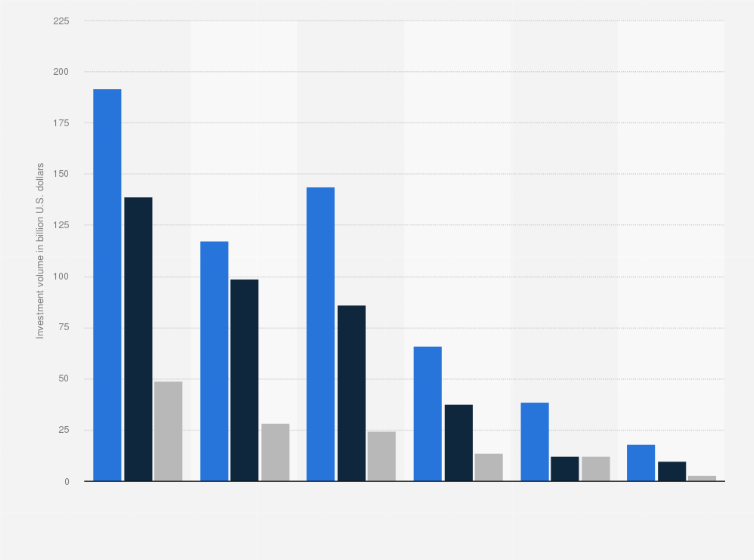
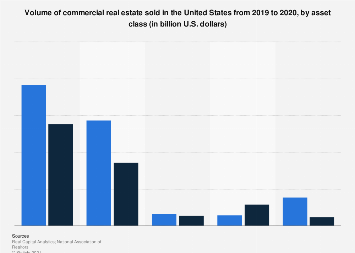
The findings Jim Costello referred to align with data collected by Statista, a well-known statistics portal for large market data.
Figure 1 – Commercial Real Estate Investment Volume in US, 2019-2020 ($B of USD)
Source: Statista Consumer Data, 2021
Figure 2 – Totaled Values of Commercial Real Estate Sold in US, 2019-2020 ($B of USA)
Source: Statista Consumer Data, 2021
“So while conditions in the US are poor, as of yet, investment activity is not as bad as the last downturn, the commercial real estate data suggests that there is less confidence in the US at the moment.”
– Jim Costello, Real Capital Analytics
Those final words from Jim Costello in this piece concisely summarize the point we’ve been driving home. While you may not agree with Jim’s rationale, the data does not lie. CRE investments in the US have been going downward since the start of COVID-19 and furthermore, the vast majority of reputable real estate financial analysts would not agree CRE is the best real estate vehicle to invest in at this time, at least relatively passively. It’s perhaps most important to conclude by reminding investors of the 2008 recession, ultimately collapsing from a massive residential housing market bubble. The lessons of 2008 not only taught investors, but also regulators to be vigilant of potential bubbles with systemic risks. However in this case, all the experts suggest the “crash” of US CRE investing during COVID-19 had to do with consumer confidence.
Once it began to fall, CRE investing opportunities essentially bottomed out because investors ran to relocate their assets. From placing investments much more frequently in REITS and other well diversified real estate vehicles, direct CRE investors became harder and harder to come by. When you add hybrid work schedules, to a push for more productive work-at-home time, and bottom line cost cuts from closing down “brick-and-mortar” offices, at best, the uncertainty of the delta variant in the COVID-19 virus is continuing to hold back CRE investing in the US. At worst – or most likely – CRE investing in the US is, at least temporarily, does not appear to favor any realistic bullish outlook.