Tag: cre investment

  • Liquidity for India’s REIT Market to Improve Based on Revised SEBI Norms

    As we’ve highlighted before, real estate is by far the biggest asset class in the world. A short time back, there was a relaxation in investment norms and real estate investment trusts by the Securities and Exchange Board of India (SEBI). Real estate investment companies directly impacted praised SEBI’s initiative (Nandy, MINT). Specifically, they were grateful SEBI took a proactive approach to address a growing, local real estate market problem (Nandy, MINT). Typically, when looking at financial markets regulated by a government’s central compliance department, it’s very rare to see them proactively intervene with the intent of improving liquidity conditions for market participants. Aside from major global economic catastrophes, which always require a unique centralized response, regulators are thought of as “watchdogs”. Here, a regulator intervened to create opportunities for investors to get simpler, quicker access to larger sums of cash. 

    Indian REITS are expecting to bring in more retail investors and encourage more public listings in the future. SEBI recently revised the minimum subscription and trading lot for publicly issued REITS and infrastructure investment trusts (InvITs). with the minimum application value to be brought down from ₹50,000 now to a range of Rs.10,000-15,000 and the revised trading lot shall be of one unit.

    Support for SEBI Initiative from Major Indian REIT Investment Manager and CEO

    “We welcome SEBI’s regulation to reduce the minimum application value from ₹50,000 to Rs. 10,000-15,000, and trading lot to one unit. The earlier ₹50,000 cap restricted participation to only a certain set of investors. We believe that this amendment makes investment in REITs at par with other equity options in India. Reduction in minimum application amount will further bring in more investors thus improving the liquidity in REITs”.

    – Vinod Rohira, CEO, Mindspace Business Parks REIT

    In late 2020, it was first reported that SEBI was considering opening up REITs and InvITs to small investors by lowering the minimum trading lot size of REIT units from ₹50,000 to the value of just a single unit, much like how stocks are traded.

    Presently, there are just three publicly listed office REITs in the country – Embassy REIT, Mindspace Business Parks REIT, and the most recently listed Brookfield India REIT (Yadav, MINT).

    “We commend this proactive initiative by the regulator to reduce the trading lots of both REITs and InVITs. Embassy REIT’s listing in 2020, coupled with our strong and resilient performance since then, has paved the way for Indian REITs to evolve a mainstream asset class. With approximately $2 billion of primary REIT equity having listed in India in the last two years, leading global and domestic asset managers and growing numbers of retail holders now form the foundation of REIT unit holder registers. The reduction in lot size will increase liquidity for the entire REIT market, enable REITs to be included into benchmark domestic indices and allow greater participation from newer pools of institutional and retail investors.”

    – Michael Holland, CEO, Embassy REIT

    Impact to CRE Investing in India

    With India being on every investor’s radar as a country with potential lucrative returns, this should be welcome news. It’s also clear both Vinod and Michael, CEOs of two-thirds of India’s publicly listed REITs, echo each other’s statements. Revisions and relaxation to SEBI norms will improve liquidity conditions for REITs. This should encourage foreign investment and furthermore, the kind of investment India wants to see an increase in (Yadav, MINT).

    India has steadily been growing in CRE investment, something they telegraphed they would try to do. In India, CRE has grown at a 16 percent compound annual growth rate (CAGR) over the last five years. India was one of the few countries who avoided significant CRE investment decline resulting from COVID-19 (Sinha, Financial Express). All-in-all, while India’s real estate investment market (commercial or residential) obviously can’t be compared to the United States, the numbers paint a clear picture. The most influential Indian industry executives double down on what the numbers show. The aforementioned actions recently taken by SEBI will only continue that trajectory. How quickly India’s CRE market specifically will grow is definitely debatable, but for now there’s no doubt, investment is increasing. Again, SEBI altering norms to improve liquidity conditions for Indian REITs will continue to attract increasing investment to India.
  • Liquidity for India’s REIT Market to Improve Based on Revised SEBI Norms

    As we’ve highlighted before, real estate is by far the biggest asset class in the world. A short time back, there was a relaxation in investment norms and real estate investment trusts by the Securities and Exchange Board of India (SEBI). Real estate investment companies directly impacted praised SEBI’s initiative (Nandy, MINT). Specifically, they were grateful SEBI took a proactive approach to address a growing, local real estate market problem (Nandy, MINT). Typically, when looking at financial markets regulated by a government’s central compliance department, it’s very rare to see them proactively intervene with the intent of improving liquidity conditions for market participants. Aside from major global economic catastrophes, which always require a unique centralized response, regulators are thought of as “watchdogs”. Here, a regulator intervened to create opportunities for investors to get simpler, quicker access to larger sums of cash. 

    Indian REITS are expecting to bring in more retail investors and encourage more public listings in the future. SEBI recently revised the minimum subscription and trading lot for publicly issued REITS and infrastructure investment trusts (InvITs). with the minimum application value to be brought down from ₹50,000 now to a range of Rs.10,000-15,000 and the revised trading lot shall be of one unit.

    Support for SEBI Initiative from Major Indian REIT Investment Manager and CEO

    “We welcome SEBI’s regulation to reduce the minimum application value from ₹50,000 to Rs. 10,000-15,000, and trading lot to one unit. The earlier ₹50,000 cap restricted participation to only a certain set of investors. We believe that this amendment makes investment in REITs at par with other equity options in India. Reduction in minimum application amount will further bring in more investors thus improving the liquidity in REITs”.

    – Vinod Rohira, CEO, Mindspace Business Parks REIT

    In late 2020, it was first reported that SEBI was considering opening up REITs and InvITs to small investors by lowering the minimum trading lot size of REIT units from ₹50,000 to the value of just a single unit, much like how stocks are traded.

    Presently, there are just three publicly listed office REITs in the country – Embassy REIT, Mindspace Business Parks REIT, and the most recently listed Brookfield India REIT (Yadav, MINT).

    “We commend this proactive initiative by the regulator to reduce the trading lots of both REITs and InVITs. Embassy REIT’s listing in 2020, coupled with our strong and resilient performance since then, has paved the way for Indian REITs to evolve a mainstream asset class. With approximately $2 billion of primary REIT equity having listed in India in the last two years, leading global and domestic asset managers and growing numbers of retail holders now form the foundation of REIT unit holder registers. The reduction in lot size will increase liquidity for the entire REIT market, enable REITs to be included into benchmark domestic indices and allow greater participation from newer pools of institutional and retail investors.”

    – Michael Holland, CEO, Embassy REIT

    Impact to CRE Investing in India

    With India being on every investor’s radar as a country with potential lucrative returns, this should be welcome news. It’s also clear both Vinod and Michael, CEOs of two-thirds of India’s publicly listed REITs, echo each other’s statements. Revisions and relaxation to SEBI norms will improve liquidity conditions for REITs. This should encourage foreign investment and furthermore, the kind of investment India wants to see an increase in (Yadav, MINT).

    India has steadily been growing in CRE investment, something they telegraphed they would try to do. In India, CRE has grown at a 16 percent compound annual growth rate (CAGR) over the last five years. India was one of the few countries who avoided significant CRE investment decline resulting from COVID-19 (Sinha, Financial Express). All-in-all, while India’s real estate investment market (commercial or residential) obviously can’t be compared to the United States, the numbers paint a clear picture. The most influential Indian industry executives double down on what the numbers show. The aforementioned actions recently taken by SEBI will only continue that trajectory. How quickly India’s CRE market specifically will grow is definitely debatable, but for now there’s no doubt, investment is increasing. Again, SEBI altering norms to improve liquidity conditions for Indian REITs will continue to attract increasing investment to India.

  • The United States NO LONGER Leads the World in CRE Investing

    It’s been covered extensively, but the COVID-19 pandemic has not been kind to CRE investment. Unfortunately, from looking at Real Capital Analytics CRE investment numbers for July 2021 and the general trajectory over a longer-term period, the CRE investing landscape in the US is not likely to change anytime soon (Clark, 2021). That considers far more than the decline in CRE investment we witnessed during the COVID-19 pandemic. It largely considers the reality that the world’s leading financial giants are contemplating a permanent hybrid work schedule. Real estate still continued to dominate as an investor-friendly asset class, in fact the largest in the world. However there’s no doubt CRE subsector investment dropped significantly and is continuing to, as a result of the pandemic. 

    How the US Fell Behind in CRE Investment

    When the COVID-19 pandemic created a recessionary period March 2020 for the United States economy, the EU began flourishing. According to the same Real Capital Analytics report, “US investment volume for deals priced $10 million and greater slipped behind those in Europe by $19 billion” (Clark, 2021). Unfortunately for the US economy, this occurred in simultaneous months. As soon as the EU began to pick up momentum in deals, they grew quicker and larger. The United States economy – largely attributed to government political infighting – was placed on the back burner at that time. Then President Trump was in the heat of his re-election celebrations, until a global pandemic that’s been pegged as worse than the Spanish Flu, came around (Cox, USA Today).

    This understandably sidetracked the Trump administration into both shock and damage control. While lawmakers in the United States were looking for who to blame for the pandemic’s “miss”, a Brookings University study concluded other countries were busy seizing on the opportunity to attract new business. Predominantly African countries, but definitely also many of those previously really hurting in the EU. 

    Jim Costello, Senior Vice President at Real Capital Analytics, described how investors are facing greater uncertainty around “underwriting future income trends for a property” because of the then relatively novel coronavirus.

    “The social safety nets of European countries can look more expensive, but in a time of crisis, they can also help investors understand how economic losses will be distributed. A single large entity-level transaction boosted quarterly European deal activity ahead of that of the US in late 2017, but otherwise the U.S. has been a larger investment market.”

    – Jim Costello, Real Capital Analytics

    Where CRE Investment in the US Currently Stands and the Outlook Moving Forward

    It’s worth noting the report states that in under normal circumstances, the US is the world’s “most liquid region” for commercial real estate activity. However, in the second quarter of the 2020, Europe moved past the US as a “hub for investment” (Clark, 2021). The trend is yet to discontinue. As CRE investing, raising capital through debt issuances, crowdfunding, and other methods of obtaining credit for CRE projects are rapidly declining, investor confidence is dropping in parallel. While data hasn’t favored bullish CRE investors since the onset of COVID-19, we’ve continued to cover hypothetical positive CRE resurgences.

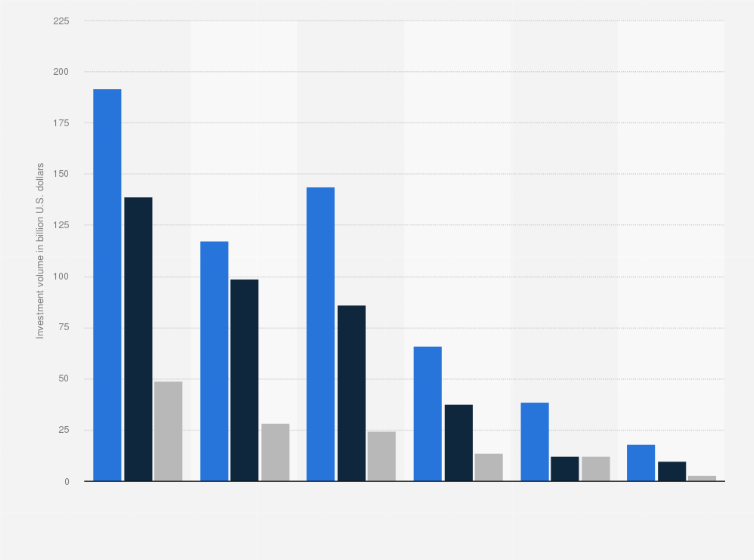
    Nearing the conclusion of Jim Costello’s findings, different calculations tell the same story. Commercial real estate holdings in the US are not the most advisable investment presently (Costello, 2021). The early figures for July show a double-digit decline in the number of commercial real estate deals in the US. However, deal volume for July is projected to be more than $10 billion. In 2009 – the last officially recorded recession – deal activity averaged around $6 billion per month for the whole year and was closer to $5 billion for July (Costello, 2021).

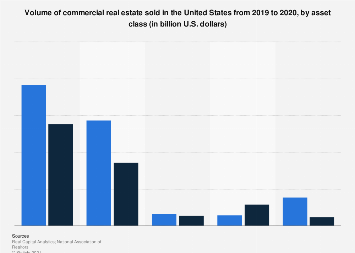
    The findings Jim Costello referred to align with data collected by Statista, a well-known statistics portal for large market data.

    Figure 1 – Commercial Real Estate Investment Volume in US, 2019-2020 ($B of USD)
    Source: Statista Consumer Data, 2021
    Figure 2 – Totaled Values of Commercial Real Estate Sold in US, 2019-2020 ($B of USA)
    Source: Statista Consumer Data, 2021

    “So while conditions in the US are poor, as of yet, investment activity is not as bad as the last downturn, the commercial real estate data suggests that there is less confidence in the US at the moment.”

    – Jim Costello, Real Capital Analytics

    Those final words from Jim Costello in this piece concisely summarize the point we’ve been driving home. While you may not agree with Jim’s rationale, the data does not lie. CRE investments in the US have been going downward since the start of COVID-19 and furthermore, the vast majority of reputable real estate financial analysts would not agree CRE is the best real estate vehicle to invest in at this time, at least relatively passively. It’s perhaps most important to conclude by reminding investors of the 2008 recession, ultimately collapsing from a massive residential housing market bubble. The lessons of 2008 not only taught investors, but also regulators to be vigilant of potential bubbles with systemic risks. However in this case, all the experts suggest the “crash” of US CRE investing during COVID-19 had to do with consumer confidence.

    Once it began to fall, CRE investing opportunities essentially bottomed out because investors ran to relocate their assets. From placing investments much more frequently in REITS and other well diversified real estate vehicles, direct CRE investors became harder and harder to come by. When you add hybrid work schedules, to a push for more productive work-at-home time, and bottom line cost cuts from closing down “brick-and-mortar” offices, at best, the uncertainty of the delta variant in the COVID-19 virus is continuing to hold back CRE investing in the US. At worst – or most likely – CRE investing in the US is, at least temporarily, does not appear to favor any realistic bullish outlook.