Tag: cryptocurrencies

  • What Happened to the Cryptocurrency Market on Black Friday?

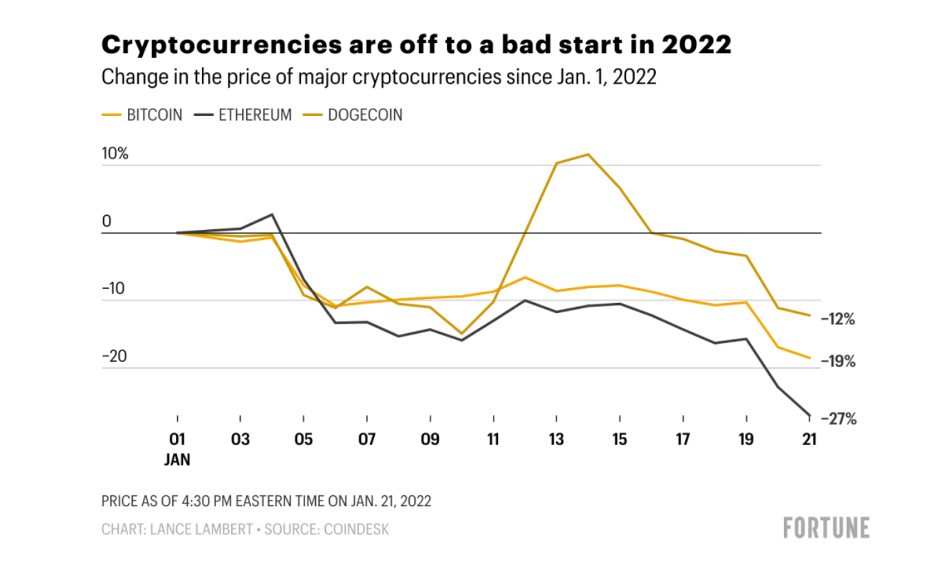
    On a Friday that surely won’t be forgotten anytime soon, on January 21st, 2022, according to CoinMarketCap, cryptocurrencies lost $205 billion in combined market capitalization. Bitcoin was trading at $38,440 as of 10AM Eastern Time on the day many are already calling “Black Friday”. This represents a 16.6% year-to-date drop for the most widely recognized cryptocurrency (Morris, Fortune). Furthermore, Bitcoin has already successfully erased 75% of their gains from 2021 and we’re less than a month into 2022.

    Additional noteworthy cryptocurrencies that suffered substantial setbacks were Ethereum, Solana, and Cardano. Ethereum is especially relevant here, as they received a monumental endorsement from Goldman Sachs in mid-2021. It plummeted 13.5% on Black Friday (-24% YTD), while Solana crashed 16% the same day (-30% YTD), and Cardano dropped 15% (Morris, Fortune). Cardano is also unique since their early gains make their current -8.5% YTD slip seem almost unscathed by comparison.
    Fortune

    Dodgecoin and Shiba Inu, classified as “meme coins”, weren’t exempt from the carnage either, falling 10% and 13%, respectively (Shrivastava, Yahoo Finance). According to CoinMarketCap, judging by overall market cap, they are by far the two largest meme coins. With that, let’s dig into the question investors around the world are actively pondering; what happened?

    Russia’s Central Bank Proposed a Cryptocurrency Ban

    Let’s start with the most obvious. On Black Friday, Reuters reported Russia, one of the world’s largest economies the third-largest Bitcoin miner in the world, proposed banning the use and mining of cryptocurrencies via their central bank. This is eerily similar to a move China pulled at the end of May 2021. We similarly witnessed Bitcoin and other major crypto’s suffer short-term dips, while quickly rebounding in the immediate weeks that followed.

    Russia’s central bank argued cryptocurrencies pose a substantial threat to the country’s financial stability. Additionally, they highlighted reasons pertaining to citizens’ wellbeing and its monetary policy sovereignty (Reuters). Ultimately, Russia’s central bank didn’t mince words, concluding with:

    “The best solution is to introduce a ban on cryptocurrency mining in Russia”

    -The Central Bank of Russian Federation (CBR)

    What’s lacking coverage right now is Russia has been arguing against cryptocurrency adoption for years. Russia’s been extremely vocal in raising concerns about the ease of cryptocurrency markets being used for money laundering and even financing global terrorism. It wasn’t until 2020 that they were given legal status, despite still being banned as a means of payment.

    Specific to events that unfolded on Black Friday, Russia’s central bank focused heavily on the long-term stability of cryptocurrencies. To be blunt, it tore them apart. The central bank determined their rapid growth was reflective of potentially perilous instability. Essentially, the central bank issued stern warnings of the cryptocurrency market being one enormous bubble. They went so far as to indicate cryptocurrencies carried similar characteristics to a financial pyramid.

    Large Market Liquidations Led by Bitcoin

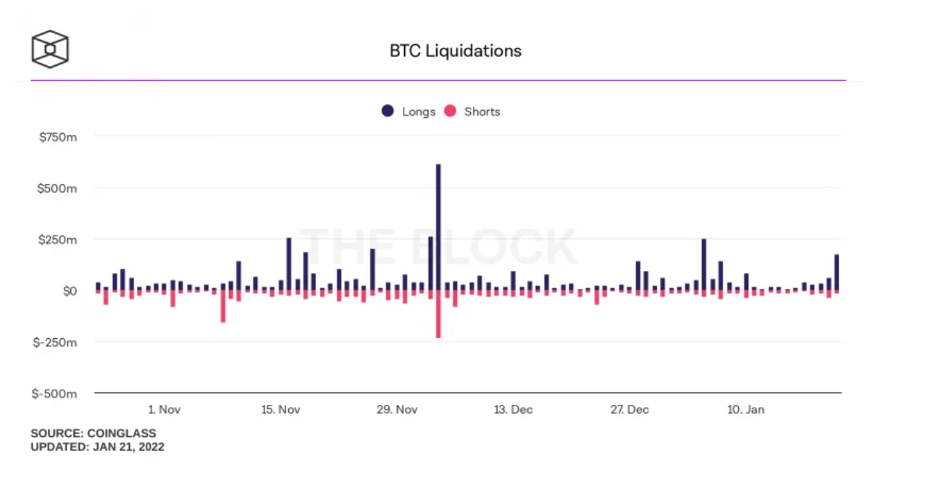
    As one would expect, Black Friday was one of the highest ever single-day cryptocurrency liquidations. The significance of losing a combined $205 billion in market capitalization over a 24-hour period cannot be underscored. Leading that effort was Bitcoin, with Ethereum not far behind. The two lost over $281 billion and $207 billion in 24 hours, respectively.

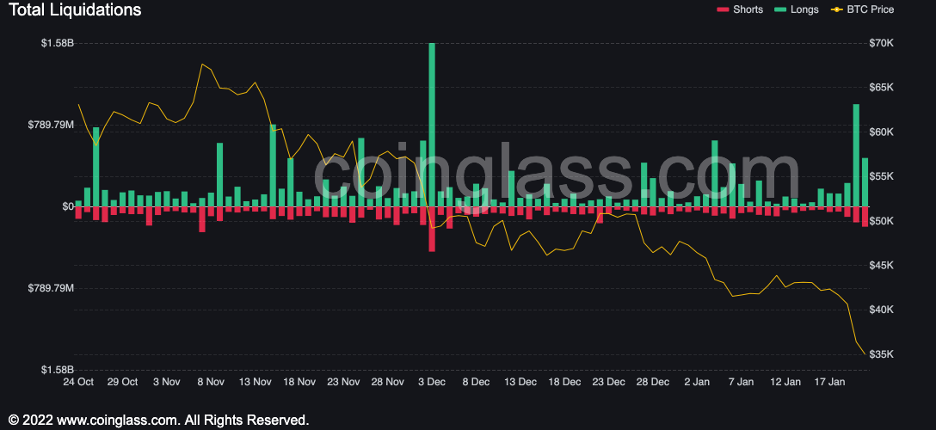
    The below chart, derived from CoinGlass Liquidation Data, does an excellent job in illustrating how Bitcoin’s price is impacted by investors taking a short position on crypto’s. As investors begin to show skepticism, it appears Bitcoin (BTC) begins to snowball downwards at an increasing rate.
    CoinGlass

    As the largest and most well-known cryptocurrency, historically Bitcoin’s performance dictates the overall crypto market trend. The same proved to be true on Black Friday.
    CoinGlass/Yahoo Finance

    Wall Street’s Weak Overall Weekly Performance

    Looking to recent history again, the US stock market performance has had a direct relationship with the crypto market’s performance. Before Black Friday, the S&P 500 Index (SPX) dropped nearly 4% over the course of 72 hours (Shrivastava, Yahoo Finance). When this was covered in real-time by Yahoo Finance, MacroAxis’ model had a maximum correlation of 0.59 between BTC and SPX. This is considered a significant correlation. The macroeconomic models from MacroAxis now show an existing correlation as high as 0.64, a stunning daily increase.

    While Russia’s central bank is undeniably the primary catalyst, Bitcoin’s rapid liquidation created an expected snowball effect. That made for terrible timing for historically safe, reliable US stock market investments to have a noticeably subpar week. Many investors, who were already feeling the pressure of safer investments in their portfolio losing value, were put in an even more precarious situation with their more speculative investments nosediving, causing many to quickly liquidate before further damage was done.

    Unsurprisingly, what’s next for Bitcoin and the cryptocurrency market is continuing to be widely debated. Multiple highly credible analysts and institutions remain firmly bullish, claiming Bitcoin will surpass $100,000. While a very wide network of high-net-worth individuals and financial giants still backing Bitcoin and crypto’s exists, it’s hard to imagine we won’t see another rebound yet again.

  • What Happened to the Cryptocurrency Market on Black Friday?

    On a Friday that surely won’t be forgotten anytime soon, on January 21st, 2022, according to CoinMarketCap, cryptocurrencies lost $205 billion in combined market capitalization. Bitcoin was trading at $38,440 as of 10AM Eastern Time on the day many are already calling “Black Friday”. This represents a 16.6% year-to-date drop for the most widely recognized cryptocurrency (Morris, Fortune). Furthermore, Bitcoin has already successfully erased 75% of their gains from 2021 and we’re less than a month into 2022.

    Additional noteworthy cryptocurrencies that suffered substantial setbacks were Ethereum, Solana, and Cardano. Ethereum is especially relevant here, as they received a monumental endorsement from Goldman Sachs in mid-2021. It plummeted 13.5% on Black Friday (-24% YTD), while Solana crashed 16% the same day (-30% YTD), and Cardano dropped 15% (Morris, Fortune). Cardano is also unique since their early gains make their current -8.5% YTD slip seem almost unscathed by comparison.

    Fortune

    Dodgecoin and Shiba Inu, classified as “meme coins”, weren’t exempt from the carnage either, falling 10% and 13%, respectively (Shrivastava, Yahoo Finance). According to CoinMarketCap, judging by overall market cap, they are by far the two largest meme coins. With that, let’s dig into the question investors around the world are actively pondering; what happened?

    Russia’s Central Bank Proposed a Cryptocurrency Ban

    Let’s start with the most obvious. On Black Friday, Reuters reported Russia, one of the world’s largest economies the third-largest Bitcoin miner in the world, proposed banning the use and mining of cryptocurrencies via their central bank. This is eerily similar to a move China pulled at the end of May 2021. We similarly witnessed Bitcoin and other major crypto’s suffer short-term dips, while quickly rebounding in the immediate weeks that followed.

    Russia’s central bank argued cryptocurrencies pose a substantial threat to the country’s financial stability. Additionally, they highlighted reasons pertaining to citizens’ wellbeing and its monetary policy sovereignty (Reuters). Ultimately, Russia’s central bank didn’t mince words, concluding with:

    “The best solution is to introduce a ban on cryptocurrency mining in Russia”

    -The Central Bank of Russian Federation (CBR)

    What’s lacking coverage right now is Russia has been arguing against cryptocurrency adoption for years. Russia’s been extremely vocal in raising concerns about the ease of cryptocurrency markets being used for money laundering and even financing global terrorism. It wasn’t until 2020 that they were given legal status, despite still being banned as a means of payment.

    Specific to events that unfolded on Black Friday, Russia’s central bank focused heavily on the long-term stability of cryptocurrencies. To be blunt, it tore them apart. The central bank determined their rapid growth was reflective of potentially perilous instability. Essentially, the central bank issued stern warnings of the cryptocurrency market being one enormous bubble. They went so far as to indicate cryptocurrencies carried similar characteristics to a financial pyramid.

    Large Market Liquidations Led by Bitcoin

    As one would expect, Black Friday was one of the highest ever single-day cryptocurrency liquidations. The significance of losing a combined $205 billion in market capitalization over a 24-hour period cannot be underscored. Leading that effort was Bitcoin, with Ethereum not far behind. The two lost over $281 billion and $207 billion in 24 hours, respectively.

    The below chart, derived from CoinGlass Liquidation Data, does an excellent job in illustrating how Bitcoin’s price is impacted by investors taking a short position on crypto’s. As investors begin to show skepticism, it appears Bitcoin (BTC) begins to snowball downwards at an increasing rate.

    CoinGlass

    As the largest and most well-known cryptocurrency, historically Bitcoin’s performance dictates the overall crypto market trend. The same proved to be true on Black Friday.

    CoinGlass/Yahoo Finance

    Wall Street’s Weak Overall Weekly Performance

    Looking to recent history again, the US stock market performance has had a direct relationship with the crypto market’s performance. Before Black Friday, the S&P 500 Index (SPX) dropped nearly 4% over the course of 72 hours (Shrivastava, Yahoo Finance). When this was covered in real-time by Yahoo Finance, MacroAxis’ model had a maximum correlation of 0.59 between BTC and SPX. This is considered a significant correlation. The macroeconomic models from MacroAxis now show an existing correlation as high as 0.64, a stunning daily increase.

    While Russia’s central bank is undeniably the primary catalyst, Bitcoin’s rapid liquidation created an expected snowball effect. That made for terrible timing for historically safe, reliable US stock market investments to have a noticeably subpar week. Many investors, who were already feeling the pressure of safer investments in their portfolio losing value, were put in an even more precarious situation with their more speculative investments nosediving, causing many to quickly liquidate before further damage was done.

    Unsurprisingly, what’s next for Bitcoin and the cryptocurrency market is continuing to be widely debated. Multiple highly credible analysts and institutions remain firmly bullish, claiming Bitcoin will surpass $100,000. While a very wide network of high-net-worth individuals and financial giants still backing Bitcoin and crypto’s exists, it’s hard to imagine we won’t see another rebound yet again.

  • Twitter is the Ultimate Cryptocurrency Stock to BUY NOW

    Twitter (NYSE:TWTR) shares have soared more than 55% and counting in the past year, 2021 (Sun, The Motley Fool). An iconic platform best known as a micro-blogging social network, Twitter is quickly evolving. Moreover, it’s developing into something that’s likely even more influential and lucrative with the rise of cryptocurrencies. 

    Back in July 2021, Chief Executive Officer (CEO) Jack Dorsey announced that Bitcoin would become a “big part” of Twitter, specifically via integration with the company’s products and services. While this may not be well-known to investors, Twitter has already seen a huge rise in its bottom line due to the influx of cryptocurrency developers (Sun, The Motley Fool).

    An Extremely Unique Advantage for Twitter

    Unlike with stocks, there isn’t a centralized Securities and Exchange Commission (SEC) database (called EDGAR), where investors can go and get the latest information and financials for cryptocurrencies; until now. Twitter is quickly beginning to play the role of a “decentralized SEC” for the crypto community. Users can follow developer teams on Twitter, thereby getting the newest information on material changes in protocol, new partnerships, and significant events (the equivalent of 8-Ks at the SEC), as well as regular financial reports (10-Qs and 10-Ks). Furthermore, individuals can even report cryptocurrency tweets deemed to be scams or pump-and-dump schemes. A common practice in the vast majority of equity markets, this leads to a prototype of self-regulation (CFA Institute).

    Due to this phenomenon, Twitter is becoming exceedingly popular among altcoin networks such as Ethereum, Avalanche, Solana, Reserve Rights, Chainlink, Monero, and PirateChain, amongst many others. Their setup has attracted likely millions of users specifically desiring to stay up-to-date with the development of their latest tokens. Twitter’s capitalized on this financially by charging developers to promote their accounts via advertisement spending. Developers are incentivized into this because traffic is organic and directly within their target audience. Through this process, Twitter doesn’t even need to spend money on their own advertising. Celebrities, such as Tesla’s CEO Elon Musk, repeatedly use the platform to tout digital currencies such as Dogecoin to his fans, obviously generating substantial viewing activity.

    Financials Back Up Recent Boost in Success and Future Hype for Twitter

    During the second quarter of 2021, Twitter grew its monetizable daily active user base by 10.8% year over year to 206 million (Twitter, Inc – Financial Information). During the same time, revenue grew by a stunning 74% to $1.19 billion (Twitter, Inc – Financial Information). The company’s earnings have recouped their losses from the pandemic recession. Moreover, they more than doubled in the quarter ending June 30th (Twitter, Inc – Financial Information). They’re very clearly currently on track for stellar growth.

    Additionally, Twitter is doing well in terms of liquidity, with cash and investments outweighing its debt plus convertible notes by a factor of two (Twitter, Inc – Financial Information). Most experts agree it is both a great tech and crypto stock to buy at 10 times revenue. Expect continued profits and share gains as part of the boom in cryptocurrencies.

  • Twitter is the Ultimate Cryptocurrency Stock to BUY NOW

    Twitter (NYSE:TWTR) shares have soared more than 55% and counting in the past year, 2021 (Sun, The Motley Fool). An iconic platform best known as a micro-blogging social network, Twitter is quickly evolving. Moreover, it’s developing into something that’s likely even more influential and lucrative with the rise of cryptocurrencies. 

    Back in July 2021, Chief Executive Officer (CEO) Jack Dorsey announced that Bitcoin would become a “big part” of Twitter, specifically via integration with the company’s products and services. While this may not be well-known to investors, Twitter has already seen a huge rise in its bottom line due to the influx of cryptocurrency developers (Sun, The Motley Fool).

    An Extremely Unique Advantage for Twitter

    Unlike with stocks, there isn’t a centralized Securities and Exchange Commission (SEC) database (called EDGAR), where investors can go and get the latest information and financials for cryptocurrencies; until now. Twitter is quickly beginning to play the role of a “decentralized SEC” for the crypto community. Users can follow developer teams on Twitter, thereby getting the newest information on material changes in protocol, new partnerships, and significant events (the equivalent of 8-Ks at the SEC), as well as regular financial reports (10-Qs and 10-Ks). Furthermore, individuals can even report cryptocurrency tweets deemed to be scams or pump-and-dump schemes. A common practice in the vast majority of equity markets, this leads to a prototype of self-regulation (CFA Institute).

    Due to this phenomenon, Twitter is becoming exceedingly popular among altcoin networks such as Ethereum, Avalanche, Solana, Reserve Rights, Chainlink, Monero, and PirateChain, amongst many others. Their setup has attracted likely millions of users specifically desiring to stay up-to-date with the development of their latest tokens. Twitter’s capitalized on this financially by charging developers to promote their accounts via advertisement spending. Developers are incentivized into this because traffic is organic and directly within their target audience. Through this process, Twitter doesn’t even need to spend money on their own advertising. Celebrities, such as Tesla’s CEO Elon Musk, repeatedly use the platform to tout digital currencies such as Dogecoin to his fans, obviously generating substantial viewing activity.

    Financials Back Up Recent Boost in Success and Future Hype for Twitter

    During the second quarter of 2021, Twitter grew its monetizable daily active user base by 10.8% year over year to 206 million (Twitter, Inc – Financial Information). During the same time, revenue grew by a stunning 74% to $1.19 billion (Twitter, Inc – Financial Information). The company’s earnings have recouped their losses from the pandemic recession. Moreover, they more than doubled in the quarter ending June 30th (Twitter, Inc – Financial Information). They’re very clearly currently on track for stellar growth.

    Additionally, Twitter is doing well in terms of liquidity, with cash and investments outweighing its debt plus convertible notes by a factor of two (Twitter, Inc – Financial Information). Most experts agree it is both a great tech and crypto stock to buy at 10 times revenue. Expect continued profits and share gains as part of the boom in cryptocurrencies.

  • Mining Bitcoin: Tech Energy and Power

    For years, Bitcoin has been popularized as the face of cryptocurrency. After Bitcoin was introduced, it received critical backing from several prominent celebrity investment advisors and other notable figures, significant popularity followed. Once Bitcoin gained a platform, it gave rise to tens of thousands of other cryptocurrencies being mined and traded daily. Whether you believe in crypto’s or not, it’s hard to argue we’re not in the middle of one of the most exciting cryptocurrency trading times. While many participate in daily trading on platforms like Robinhood, Coinbase, CashApp, etc., not many of them have any insight into the technological know-how on creating a Bitcoin, or the Bitcoin energy required.

    In reality, the computer-based miners who create bitcoins use vast amounts of electrical power and energy in the process. The energy-heavy process even leads some experts to suggest that Bitcoin harms the environment. The process, known as “mining,” requires computers around the world to complete rapid calculations to try to solve the same puzzle. It always takes 10 minutes, and the winner is rewarded with some digital bitcoin. Then a new puzzle is generated, and the whole process repeats for another 10 minutes (Bradbury, The Balance).

    Breakdown of Bitcoin’s Power & Energy Output

    As more people learn about Bitcoin and mining—and as the price of Bitcoin increases—more are using their computers to mine Bitcoins. As more people join the network and try to solve these math puzzles, you might expect each puzzle to be solved sooner, but Bitcoin is not designed that way. The software that mines bitcoin is designed so that it always will take 10 minutes for everyone on the network to solve the puzzle. As more people join the Bitcoin network and try to mine Bitcoins, it becomes harder, and more computing power and electricity are used for each Bitcoin produced. It minimizes downtime, so you can mine more efficiently. That means a near-constant cycle of electricity use.

    To understand how to calculate the electrical energy used to power the bitcoin network, you’ll need to learn how Bitcoin creation works. First, you calculate how many sums are conducted per second to solve the puzzles. Then find out how much electricity it takes to do each sum. These sums are called “hashes” (Faife, CoinDesk). In early 2020, the computers on the Bitcoin network were cranking out close to 120 exahashes per second (Redman, BTC News). To calculate the cost of how much power it would take you to create a bitcoin, you need to know a few things first (Bradbury, The Balance). First, what is the cost of electricity where you live? Second, how much power would you consume? More efficient computer equipment uses less power, which means lower power bills. The lower the price of electricity, the less cost there is to miners. This increases the value of the Bitcoin to miners where the costs are lower to produce.

    The Conclusion: To Be Determined

    This is meant to emphasize that the energy and power utilized by Bitcoin and other cryptocurrency miners is a real, potential danger to the future global environment. Conversely, it may also leave a very low impact. The price that Bitcoin extracts in terms of energy use and environmental impact depends on how useful it will be to society (Bradbury, The Balance). Judging an ever-moving target is hard. The interest in Bitcoin continues to rise, which in turn leads to more power used to serve more people in the market. Therefore, ultimately deciding whether Bitcoin mining is worth the cost to the environment is still a very open question.