Tag: Cryptocurrency Investing

  • Grayscale Investments, LLC Presents: Grayscale Bitcoin Trust (GBTC), Bitcoin’s First Spot ETF?

    Amongst the latest “hot topics” in the Financial Technology (FinTech) space is a cryptocurrency product aimed at changing the receptiveness of the international investment community to cryptocurrencies. Grayscale Investments, LLC has created the GBTC (Grayscale Bitcoin Trust), in an attempt to make a cryptocurrency product more marketable to institutional investors, pension funds, and other more traditional investment vehicles. Whether this approach will work in the long-term seems to be very hotly contested at the moment, for a number of reasons.

    The Grayscale Bitcoin Trust (GBTC)

    Surprisingly – though maybe not to many in the crypto community – Grayscale largely markets the GBTC for its “robust security and storage”. You would think that as an asset manager, even a crypto asset manager, Grayscale would be more excited about presenting numbers that investors are typically hungry for. However, they lead by offering the following:

    “Grayscale Bitcoin Trust’s assets are stored in offline or “cold” storage with Coinbase Custody Trust Company, LLC, as Custodian. The Custodian is a fiduciary under § 100 of the New York Banking Law and a qualified custodian for purposes of Rule 206(4)-2(d)(6) under the Investment Advisers Act of 1940, as amended.”

    Grayscale Investments, LLC (2022)

    Additional benefits, advertised by Grayscale, to purchase the GBTC include tax-advantaged account eligibility, “titled, auditable ownership [of a crypto asset] through a traditional investment vehicle”, publicly quoted price (OTCQX®: GBTC), and support from a network of trusted providers (this is where they let you know they have hired global financial services legal tycoon Davis Polk & Wardwell LLP). Why is that relevant?

    The SEC’s Ruling on Grayscale’s Bitcoin Spot ETF

    At the top of Grayscale’s website, you’ll see a banner with a hyperlink stating, “We’ve received a decision in our application to convert GBTC to an ETF”. That’s the real storyline here. It’s not the GBTC, it’s the fact that the SEC has disallowed Grayscale to convert the GBTC into a Bitcoin spot ETF. The concise version of the SEC’s 86-page decision can be captured in the following paragraph:

    “This order disapproves the proposed rule change, as modified by Amendment No. 1. The Commission concludes that NYSE Arca has not met its burden under the Exchange Act and the Commission’s Rules of Practice to demonstrate that its proposal is consistent with the requirements of Exchange Act Section 6(b)(5), which requires, in relevant part, that the rules of a national securities exchange be ‘designed to prevent fraudulent and manipulative acts and practices’ and ‘to protect investors and the public interest.’’’

    SEC, Release No. 34-95180; File No. SR-NYSEArca-2021-90 (July 22, 2022)

    Grayscale immediately responded by hiring former U.S. Solicitor General, Donald B. Verrilli, Jr. – best known for arguing President Obama’s ACA (Affordable Care Act) successfully before the US Supreme Court – who filed an appeal of the SEC’s ruling. Grayscale says they had no choice but to escalate the matter, given the “SEC’s arbitrary and capricious actions and discriminatory treatment of issuers”. The appeal seems to be almost exclusively relying on the argument that the SEC has allowed multiple Bitcoin futures ETFs into the marketplace. Furthermore, since their treatment of futures and spots of derivatives is generally similar, they are unjustly denying investors access to a new marketplace: Bitcoin spot ETFs. GBTC has the potential to become the first Bitcoin spot ETF to be approved by the SEC.

    A High-Level Look at GBTC’s Financials

    Below you can see some basic financials on GBTC from Grayscale’s website. They include the CUSIP (389637109), where we’ll use Bloomberg to investigate GBTC’s high-level financials.
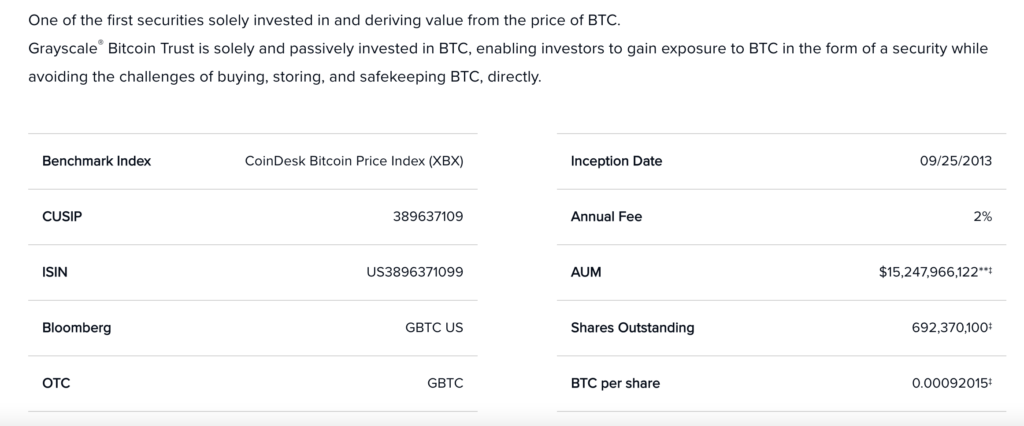
    Source: Grayscale Investments, LLC (August 2022)

    The “Key Statistics” from Bloomberg for CUSIP 389637109 as of Tuesday August 9th, 2022 (GBTC US) are below.
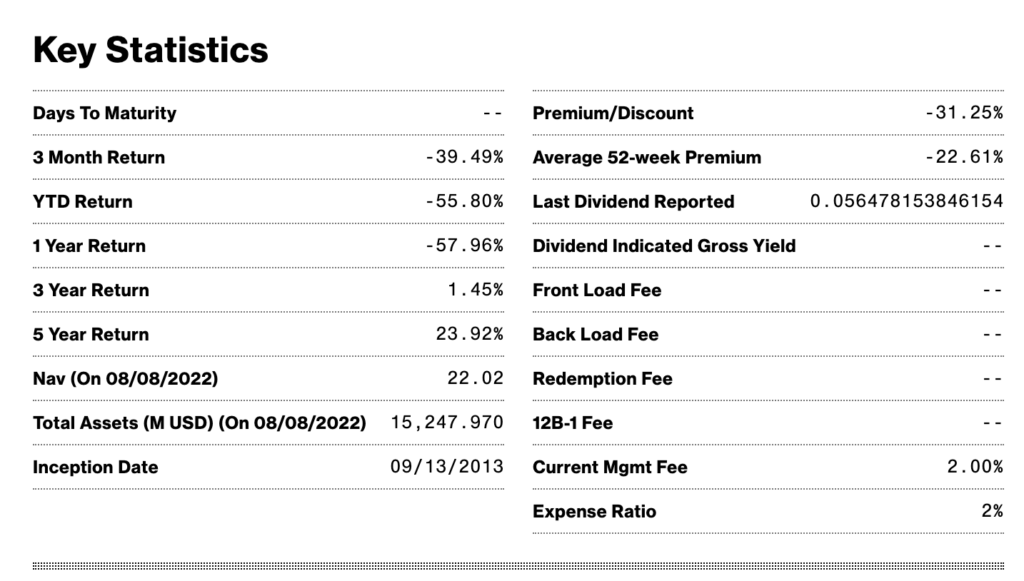
    Source: Bloomberg L.P. (August 2022)

    Looking at the YTD, 1-year, 3-year, and 5-year average returns, in the context of converting this Bitcoin asset to a spot ETF, is the SEC wrong when they say Grayscale is breaking an SEC rule that “requires, in relevant part, that the rules of a national securities exchange be ‘designed to prevent fraudulent and manipulative acts and practices’ and ‘to protect investors and the public interest’”? In other words, is introducing a Bitcoin spot ETF into the marketplace more dangerous than a Bitcoin futures ETF?

    Bitcoin Futures ETFs vs. Bitcoin Spot ETFs

    While we’re not opining on a question that’s currently an open legal issue, perhaps understanding the difference would help. A spot Bitcoin ETF brings many (almost all) of the benefits of a futures ETF. Some include investing in Bitcoin without using an exchange, paying less in fees than on a crypto exchange, and streamlining the overall process (Moeller, Cointelegraph). However, a spot ETF invests in Bitcoin on the spot.

    With a Bitcoin spot ETF, you invest in Bitcoin at its spot price, meaning buyers will be holding Bitcoin within their portfolio. In practice, it’d be very much like buying a stock. Crypto enthusiasts view a spot ETF as a more legitimate method of investment, therefore Bitcoin would become more legitimized with a SEC-approved Bitcoin spot ETF product.

    Futures are defined as “derivative financial contracts that obligate parties to buy or sell an asset at a predetermined future date and price” (Investopedia, 2022). So, what’s the key difference? With a Bitcoin spot ETF, you have immediate ownership of Bitcoin. When you purchase a Bitcoin futures ETF, you’re effectively just betting on the market, depending on if you choose to take a long or short position. But purchasing a Bitcoin futures ETF by no means entails immediate ownership of Bitcoin as an asset. If you’re going to purchase a SEC-approved Bitcoin spot ETF in the future, as one does not exist today, it’s critical to understand you’ll immediately add Bitcoin to your asset portfolio.

    GBTC’s Primary Differentiator: Security

    That seems to circle back to Grayscale’s initial pitch of the GBTC having “robust security and storage”. The SEC appears to be making less of a comment on the GBTC than they are about Bitcoin in general. A Bitcoin spot ETF can only be rejected for the reasons given by the SEC if they felt that Bitcoin was too susceptible to “fraudulent and manipulative acts”. Through strategic marketing, Grayscale is looking to differentiate their potential Bitcoin spot ETF product as completely secure. Furthermore, they’ve had the longest and most hopeful petition to the SEC for a Bitcoin spot ETF, with initial efforts dating back to 2016 (Moeller, Cointelegraph). Over six years later, Grayscale remains just as committed to convert the GBTC to Bitcoin’s first SEC-approved spot ETF. Whether or not they’ll be successful is still very much an open question. It’s worth noting that Grayscale’s Bitcoin Trust (GBTC) is the world’s only SEC-approved, publicly traded “Bitcoin Trust”. A “Bitcoin Trust” can be very closely compared to a private-placement trust. It trades just like a stock over the counter. That existing confidence, along with potential first-mover market advantage, would certainly give Grayscale a huge reason to seek to overturn the SEC’s latest official ruling.

    For reference, if you want to investigate a few of the best-known Bitcoin futures ETFs, they include ProShares BITO Bitcoin futures ETF, Valkyrie Bitcoin Strategy ETF, and VanEck Bitcoin Strategy ETF. The ProShares BITO Bitcoin futures ETF currently holds around $1B in investments (Moeller, Cointelegraph). For a look closer at information and BITO’s financials, they’re listed on the New York Stock Exchange (NYSE: Arca). For additional information on Grayscale Investments or the GBTC, their website can be found here.
  • Grayscale Investments, LLC Presents: Grayscale Bitcoin Trust (GBTC), Bitcoin’s First Spot ETF?

    Amongst the latest “hot topics” in the Financial Technology (FinTech) space is a cryptocurrency product aimed at changing the receptiveness of the international investment community to cryptocurrencies. Grayscale Investments, LLC has created the GBTC (Grayscale Bitcoin Trust), in an attempt to make a cryptocurrency product more marketable to institutional investors, pension funds, and other more traditional investment vehicles. Whether this approach will work in the long-term seems to be very hotly contested at the moment, for a number of reasons.

    The Grayscale Bitcoin Trust (GBTC)

    Surprisingly – though maybe not to many in the crypto community – Grayscale largely markets the GBTC for its “robust security and storage”. You would think that as an asset manager, even a crypto asset manager, Grayscale would be more excited about presenting numbers that investors are typically hungry for. However, they lead by offering the following:

    “Grayscale Bitcoin Trust’s assets are stored in offline or “cold” storage with Coinbase Custody Trust Company, LLC, as Custodian. The Custodian is a fiduciary under § 100 of the New York Banking Law and a qualified custodian for purposes of Rule 206(4)-2(d)(6) under the Investment Advisers Act of 1940, as amended.”

    Grayscale Investments, LLC (2022)

    Additional benefits, advertised by Grayscale, to purchase the GBTC include tax-advantaged account eligibility, “titled, auditable ownership [of a crypto asset] through a traditional investment vehicle”, publicly quoted price (OTCQX®: GBTC), and support from a network of trusted providers (this is where they let you know they have hired global financial services legal tycoon Davis Polk & Wardwell LLP). Why is that relevant?

    The SEC’s Ruling on Grayscale’s Bitcoin Spot ETF

    At the top of Grayscale’s website, you’ll see a banner with a hyperlink stating, “We’ve received a decision in our application to convert GBTC to an ETF”. That’s the real storyline here. It’s not the GBTC, it’s the fact that the SEC has disallowed Grayscale to convert the GBTC into a Bitcoin spot ETF. The concise version of the SEC’s 86-page decision can be captured in the following paragraph:

    “This order disapproves the proposed rule change, as modified by Amendment No. 1. The Commission concludes that NYSE Arca has not met its burden under the Exchange Act and the Commission’s Rules of Practice to demonstrate that its proposal is consistent with the requirements of Exchange Act Section 6(b)(5), which requires, in relevant part, that the rules of a national securities exchange be ‘designed to prevent fraudulent and manipulative acts and practices’ and ‘to protect investors and the public interest.’’’

    SEC, Release No. 34-95180; File No. SR-NYSEArca-2021-90 (July 22, 2022)

    Grayscale immediately responded by hiring former U.S. Solicitor General, Donald B. Verrilli, Jr. – best known for arguing President Obama’s ACA (Affordable Care Act) successfully before the US Supreme Court – who filed an appeal of the SEC’s ruling. Grayscale says they had no choice but to escalate the matter, given the “SEC’s arbitrary and capricious actions and discriminatory treatment of issuers”. The appeal seems to be almost exclusively relying on the argument that the SEC has allowed multiple Bitcoin futures ETFs into the marketplace. Furthermore, since their treatment of futures and spots of derivatives is generally similar, they are unjustly denying investors access to a new marketplace: Bitcoin spot ETFs. GBTC has the potential to become the first Bitcoin spot ETF to be approved by the SEC.

    A High-Level Look at GBTC’s Financials

    Below you can see some basic financials on GBTC from Grayscale’s website. They include the CUSIP (389637109), where we’ll use Bloomberg to investigate GBTC’s high-level financials.

    Source: Grayscale Investments, LLC (August 2022)

    The “Key Statistics” from Bloomberg for CUSIP 389637109 as of Tuesday August 9th, 2022 (GBTC US) are below.

    Source: Bloomberg L.P. (August 2022)

    Looking at the YTD, 1-year, 3-year, and 5-year average returns, in the context of converting this Bitcoin asset to a spot ETF, is the SEC wrong when they say Grayscale is breaking an SEC rule that “requires, in relevant part, that the rules of a national securities exchange be ‘designed to prevent fraudulent and manipulative acts and practices’ and ‘to protect investors and the public interest’”? In other words, is introducing a Bitcoin spot ETF into the marketplace more dangerous than a Bitcoin futures ETF?

    Bitcoin Futures ETFs vs. Bitcoin Spot ETFs

    While we’re not opining on a question that’s currently an open legal issue, perhaps understanding the difference would help. A spot Bitcoin ETF brings many (almost all) of the benefits of a futures ETF. Some include investing in Bitcoin without using an exchange, paying less in fees than on a crypto exchange, and streamlining the overall process (Moeller, Cointelegraph). However, a spot ETF invests in Bitcoin on the spot.

    With a Bitcoin spot ETF, you invest in Bitcoin at its spot price, meaning buyers will be holding Bitcoin within their portfolio. In practice, it’d be very much like buying a stock. Crypto enthusiasts view a spot ETF as a more legitimate method of investment, therefore Bitcoin would become more legitimized with a SEC-approved Bitcoin spot ETF product.

    Futures are defined as “derivative financial contracts that obligate parties to buy or sell an asset at a predetermined future date and price” (Investopedia, 2022). So, what’s the key difference? With a Bitcoin spot ETF, you have immediate ownership of Bitcoin. When you purchase a Bitcoin futures ETF, you’re effectively just betting on the market, depending on if you choose to take a long or short position. But purchasing a Bitcoin futures ETF by no means entails immediate ownership of Bitcoin as an asset. If you’re going to purchase a SEC-approved Bitcoin spot ETF in the future, as one does not exist today, it’s critical to understand you’ll immediately add Bitcoin to your asset portfolio.

    GBTC’s Primary Differentiator: Security

    That seems to circle back to Grayscale’s initial pitch of the GBTC having “robust security and storage”. The SEC appears to be making less of a comment on the GBTC than they are about Bitcoin in general. A Bitcoin spot ETF can only be rejected for the reasons given by the SEC if they felt that Bitcoin was too susceptible to “fraudulent and manipulative acts”. Through strategic marketing, Grayscale is looking to differentiate their potential Bitcoin spot ETF product as completely secure. Furthermore, they’ve had the longest and most hopeful petition to the SEC for a Bitcoin spot ETF, with initial efforts dating back to 2016 (Moeller, Cointelegraph). Over six years later, Grayscale remains just as committed to convert the GBTC to Bitcoin’s first SEC-approved spot ETF. Whether or not they’ll be successful is still very much an open question. It’s worth noting that Grayscale’s Bitcoin Trust (GBTC) is the world’s only SEC-approved, publicly traded “Bitcoin Trust”. A “Bitcoin Trust” can be very closely compared to a private-placement trust. It trades just like a stock over the counter. That existing confidence, along with potential first-mover market advantage, would certainly give Grayscale a huge reason to seek to overturn the SEC’s latest official ruling.

    For reference, if you want to investigate a few of the best-known Bitcoin futures ETFs, they include ProShares BITO Bitcoin futures ETF, Valkyrie Bitcoin Strategy ETF, and VanEck Bitcoin Strategy ETF. The ProShares BITO Bitcoin futures ETF currently holds around $1B in investments (Moeller, Cointelegraph). For a look closer at information and BITO’s financials, they’re listed on the New York Stock Exchange (NYSE: Arca). For additional information on Grayscale Investments or the GBTC, their website can be found here.
  • What Happened to the Cryptocurrency Market on Black Friday?

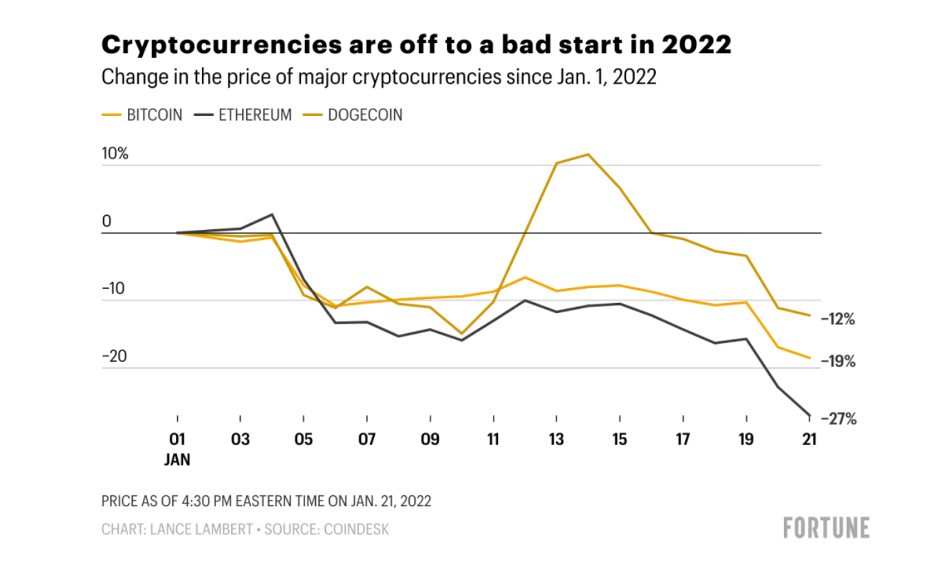
    On a Friday that surely won’t be forgotten anytime soon, on January 21st, 2022, according to CoinMarketCap, cryptocurrencies lost $205 billion in combined market capitalization. Bitcoin was trading at $38,440 as of 10AM Eastern Time on the day many are already calling “Black Friday”. This represents a 16.6% year-to-date drop for the most widely recognized cryptocurrency (Morris, Fortune). Furthermore, Bitcoin has already successfully erased 75% of their gains from 2021 and we’re less than a month into 2022.

    Additional noteworthy cryptocurrencies that suffered substantial setbacks were Ethereum, Solana, and Cardano. Ethereum is especially relevant here, as they received a monumental endorsement from Goldman Sachs in mid-2021. It plummeted 13.5% on Black Friday (-24% YTD), while Solana crashed 16% the same day (-30% YTD), and Cardano dropped 15% (Morris, Fortune). Cardano is also unique since their early gains make their current -8.5% YTD slip seem almost unscathed by comparison.

    Fortune

    Dodgecoin and Shiba Inu, classified as “meme coins”, weren’t exempt from the carnage either, falling 10% and 13%, respectively (Shrivastava, Yahoo Finance). According to CoinMarketCap, judging by overall market cap, they are by far the two largest meme coins. With that, let’s dig into the question investors around the world are actively pondering; what happened?

    Russia’s Central Bank Proposed a Cryptocurrency Ban

    Let’s start with the most obvious. On Black Friday, Reuters reported Russia, one of the world’s largest economies the third-largest Bitcoin miner in the world, proposed banning the use and mining of cryptocurrencies via their central bank. This is eerily similar to a move China pulled at the end of May 2021. We similarly witnessed Bitcoin and other major crypto’s suffer short-term dips, while quickly rebounding in the immediate weeks that followed.

    Russia’s central bank argued cryptocurrencies pose a substantial threat to the country’s financial stability. Additionally, they highlighted reasons pertaining to citizens’ wellbeing and its monetary policy sovereignty (Reuters). Ultimately, Russia’s central bank didn’t mince words, concluding with:

    “The best solution is to introduce a ban on cryptocurrency mining in Russia”

    -The Central Bank of Russian Federation (CBR)

    What’s lacking coverage right now is Russia has been arguing against cryptocurrency adoption for years. Russia’s been extremely vocal in raising concerns about the ease of cryptocurrency markets being used for money laundering and even financing global terrorism. It wasn’t until 2020 that they were given legal status, despite still being banned as a means of payment.

    Specific to events that unfolded on Black Friday, Russia’s central bank focused heavily on the long-term stability of cryptocurrencies. To be blunt, it tore them apart. The central bank determined their rapid growth was reflective of potentially perilous instability. Essentially, the central bank issued stern warnings of the cryptocurrency market being one enormous bubble. They went so far as to indicate cryptocurrencies carried similar characteristics to a financial pyramid.

    Large Market Liquidations Led by Bitcoin

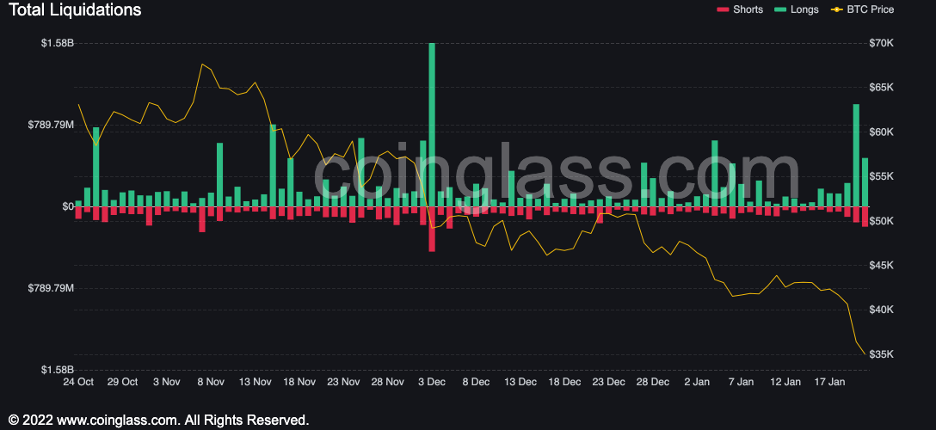
    As one would expect, Black Friday was one of the highest ever single-day cryptocurrency liquidations. The significance of losing a combined $205 billion in market capitalization over a 24-hour period cannot be underscored. Leading that effort was Bitcoin, with Ethereum not far behind. The two lost over $281 billion and $207 billion in 24 hours, respectively.

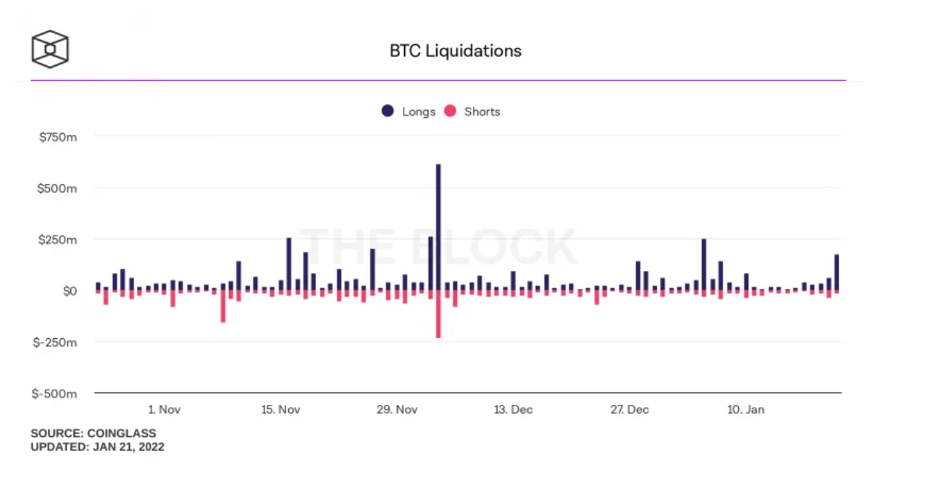
    The below chart, derived from CoinGlass Liquidation Data, does an excellent job in illustrating how Bitcoin’s price is impacted by investors taking a short position on crypto’s. As investors begin to show skepticism, it appears Bitcoin (BTC) begins to snowball downwards at an increasing rate.

    CoinGlass

    As the largest and most well-known cryptocurrency, historically Bitcoin’s performance dictates the overall crypto market trend. The same proved to be true on Black Friday.

    CoinGlass/Yahoo Finance

    Wall Street’s Weak Overall Weekly Performance

    Looking to recent history again, the US stock market performance has had a direct relationship with the crypto market’s performance. Before Black Friday, the S&P 500 Index (SPX) dropped nearly 4% over the course of 72 hours (Shrivastava, Yahoo Finance). When this was covered in real-time by Yahoo Finance, MacroAxis’ model had a maximum correlation of 0.59 between BTC and SPX. This is considered a significant correlation. The macroeconomic models from MacroAxis now show an existing correlation as high as 0.64, a stunning daily increase.

    While Russia’s central bank is undeniably the primary catalyst, Bitcoin’s rapid liquidation created an expected snowball effect. That made for terrible timing for historically safe, reliable US stock market investments to have a noticeably subpar week. Many investors, who were already feeling the pressure of safer investments in their portfolio losing value, were put in an even more precarious situation with their more speculative investments nosediving, causing many to quickly liquidate before further damage was done.

    Unsurprisingly, what’s next for Bitcoin and the cryptocurrency market is continuing to be widely debated. Multiple highly credible analysts and institutions remain firmly bullish, claiming Bitcoin will surpass $100,000. While a very wide network of high-net-worth individuals and financial giants still backing Bitcoin and crypto’s exists, it’s hard to imagine we won’t see another rebound yet again.

  • What Happened to the Cryptocurrency Market on Black Friday?

    On a Friday that surely won’t be forgotten anytime soon, on January 21st, 2022, according to CoinMarketCap, cryptocurrencies lost $205 billion in combined market capitalization. Bitcoin was trading at $38,440 as of 10AM Eastern Time on the day many are already calling “Black Friday”. This represents a 16.6% year-to-date drop for the most widely recognized cryptocurrency (Morris, Fortune). Furthermore, Bitcoin has already successfully erased 75% of their gains from 2021 and we’re less than a month into 2022.

    Additional noteworthy cryptocurrencies that suffered substantial setbacks were Ethereum, Solana, and Cardano. Ethereum is especially relevant here, as they received a monumental endorsement from Goldman Sachs in mid-2021. It plummeted 13.5% on Black Friday (-24% YTD), while Solana crashed 16% the same day (-30% YTD), and Cardano dropped 15% (Morris, Fortune). Cardano is also unique since their early gains make their current -8.5% YTD slip seem almost unscathed by comparison.

    Fortune

    Dodgecoin and Shiba Inu, classified as “meme coins”, weren’t exempt from the carnage either, falling 10% and 13%, respectively (Shrivastava, Yahoo Finance). According to CoinMarketCap, judging by overall market cap, they are by far the two largest meme coins. With that, let’s dig into the question investors around the world are actively pondering; what happened?

    Russia’s Central Bank Proposed a Cryptocurrency Ban

    Let’s start with the most obvious. On Black Friday, Reuters reported Russia, one of the world’s largest economies the third-largest Bitcoin miner in the world, proposed banning the use and mining of cryptocurrencies via their central bank. This is eerily similar to a move China pulled at the end of May 2021. We similarly witnessed Bitcoin and other major crypto’s suffer short-term dips, while quickly rebounding in the immediate weeks that followed.

    Russia’s central bank argued cryptocurrencies pose a substantial threat to the country’s financial stability. Additionally, they highlighted reasons pertaining to citizens’ wellbeing and its monetary policy sovereignty (Reuters). Ultimately, Russia’s central bank didn’t mince words, concluding with:

    “The best solution is to introduce a ban on cryptocurrency mining in Russia”

    -The Central Bank of Russian Federation (CBR)

    What’s lacking coverage right now is Russia has been arguing against cryptocurrency adoption for years. Russia’s been extremely vocal in raising concerns about the ease of cryptocurrency markets being used for money laundering and even financing global terrorism. It wasn’t until 2020 that they were given legal status, despite still being banned as a means of payment.

    Specific to events that unfolded on Black Friday, Russia’s central bank focused heavily on the long-term stability of cryptocurrencies. To be blunt, it tore them apart. The central bank determined their rapid growth was reflective of potentially perilous instability. Essentially, the central bank issued stern warnings of the cryptocurrency market being one enormous bubble. They went so far as to indicate cryptocurrencies carried similar characteristics to a financial pyramid.

    Large Market Liquidations Led by Bitcoin

    As one would expect, Black Friday was one of the highest ever single-day cryptocurrency liquidations. The significance of losing a combined $205 billion in market capitalization over a 24-hour period cannot be underscored. Leading that effort was Bitcoin, with Ethereum not far behind. The two lost over $281 billion and $207 billion in 24 hours, respectively.

    The below chart, derived from CoinGlass Liquidation Data, does an excellent job in illustrating how Bitcoin’s price is impacted by investors taking a short position on crypto’s. As investors begin to show skepticism, it appears Bitcoin (BTC) begins to snowball downwards at an increasing rate.

    CoinGlass

    As the largest and most well-known cryptocurrency, historically Bitcoin’s performance dictates the overall crypto market trend. The same proved to be true on Black Friday.

    CoinGlass/Yahoo Finance

    Wall Street’s Weak Overall Weekly Performance

    Looking to recent history again, the US stock market performance has had a direct relationship with the crypto market’s performance. Before Black Friday, the S&P 500 Index (SPX) dropped nearly 4% over the course of 72 hours (Shrivastava, Yahoo Finance). When this was covered in real-time by Yahoo Finance, MacroAxis’ model had a maximum correlation of 0.59 between BTC and SPX. This is considered a significant correlation. The macroeconomic models from MacroAxis now show an existing correlation as high as 0.64, a stunning daily increase.

    While Russia’s central bank is undeniably the primary catalyst, Bitcoin’s rapid liquidation created an expected snowball effect. That made for terrible timing for historically safe, reliable US stock market investments to have a noticeably subpar week. Many investors, who were already feeling the pressure of safer investments in their portfolio losing value, were put in an even more precarious situation with their more speculative investments nosediving, causing many to quickly liquidate before further damage was done.

    Unsurprisingly, what’s next for Bitcoin and the cryptocurrency market is continuing to be widely debated. Multiple highly credible analysts and institutions remain firmly bullish, claiming Bitcoin will surpass $100,000. While a very wide network of high-net-worth individuals and financial giants still backing Bitcoin and crypto’s exists, it’s hard to imagine we won’t see another rebound yet again.