Tag: cryptocurrency technology

  • Grayscale Investments, LLC Presents: Grayscale Bitcoin Trust (GBTC), Bitcoin’s First Spot ETF?

    Amongst the latest “hot topics” in the Financial Technology (FinTech) space is a cryptocurrency product aimed at changing the receptiveness of the international investment community to cryptocurrencies. Grayscale Investments, LLC has created the GBTC (Grayscale Bitcoin Trust), in an attempt to make a cryptocurrency product more marketable to institutional investors, pension funds, and other more traditional investment vehicles. Whether this approach will work in the long-term seems to be very hotly contested at the moment, for a number of reasons.

    The Grayscale Bitcoin Trust (GBTC)

    Surprisingly – though maybe not to many in the crypto community – Grayscale largely markets the GBTC for its “robust security and storage”. You would think that as an asset manager, even a crypto asset manager, Grayscale would be more excited about presenting numbers that investors are typically hungry for. However, they lead by offering the following:

    “Grayscale Bitcoin Trust’s assets are stored in offline or “cold” storage with Coinbase Custody Trust Company, LLC, as Custodian. The Custodian is a fiduciary under § 100 of the New York Banking Law and a qualified custodian for purposes of Rule 206(4)-2(d)(6) under the Investment Advisers Act of 1940, as amended.”

    Grayscale Investments, LLC (2022)

    Additional benefits, advertised by Grayscale, to purchase the GBTC include tax-advantaged account eligibility, “titled, auditable ownership [of a crypto asset] through a traditional investment vehicle”, publicly quoted price (OTCQX®: GBTC), and support from a network of trusted providers (this is where they let you know they have hired global financial services legal tycoon Davis Polk & Wardwell LLP). Why is that relevant?

    The SEC’s Ruling on Grayscale’s Bitcoin Spot ETF

    At the top of Grayscale’s website, you’ll see a banner with a hyperlink stating, “We’ve received a decision in our application to convert GBTC to an ETF”. That’s the real storyline here. It’s not the GBTC, it’s the fact that the SEC has disallowed Grayscale to convert the GBTC into a Bitcoin spot ETF. The concise version of the SEC’s 86-page decision can be captured in the following paragraph:

    “This order disapproves the proposed rule change, as modified by Amendment No. 1. The Commission concludes that NYSE Arca has not met its burden under the Exchange Act and the Commission’s Rules of Practice to demonstrate that its proposal is consistent with the requirements of Exchange Act Section 6(b)(5), which requires, in relevant part, that the rules of a national securities exchange be ‘designed to prevent fraudulent and manipulative acts and practices’ and ‘to protect investors and the public interest.’’’

    SEC, Release No. 34-95180; File No. SR-NYSEArca-2021-90 (July 22, 2022)

    Grayscale immediately responded by hiring former U.S. Solicitor General, Donald B. Verrilli, Jr. – best known for arguing President Obama’s ACA (Affordable Care Act) successfully before the US Supreme Court – who filed an appeal of the SEC’s ruling. Grayscale says they had no choice but to escalate the matter, given the “SEC’s arbitrary and capricious actions and discriminatory treatment of issuers”. The appeal seems to be almost exclusively relying on the argument that the SEC has allowed multiple Bitcoin futures ETFs into the marketplace. Furthermore, since their treatment of futures and spots of derivatives is generally similar, they are unjustly denying investors access to a new marketplace: Bitcoin spot ETFs. GBTC has the potential to become the first Bitcoin spot ETF to be approved by the SEC.

    A High-Level Look at GBTC’s Financials

    Below you can see some basic financials on GBTC from Grayscale’s website. They include the CUSIP (389637109), where we’ll use Bloomberg to investigate GBTC’s high-level financials.
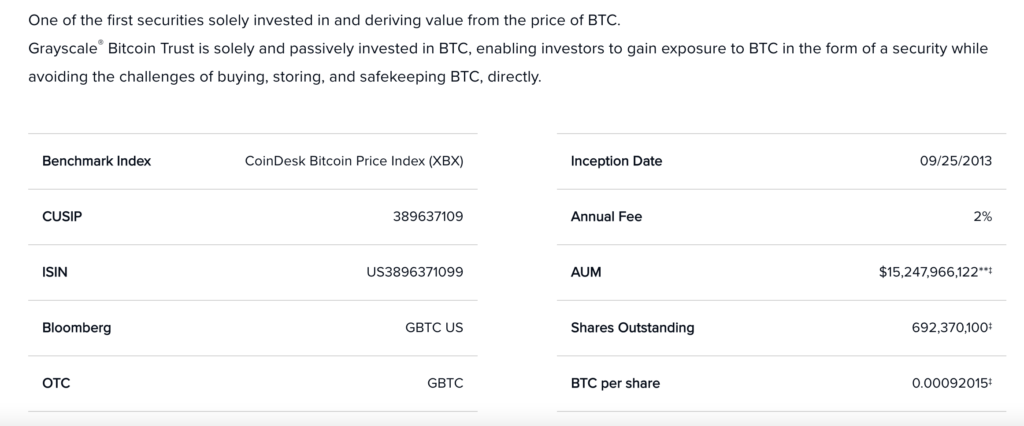
    Source: Grayscale Investments, LLC (August 2022)

    The “Key Statistics” from Bloomberg for CUSIP 389637109 as of Tuesday August 9th, 2022 (GBTC US) are below.
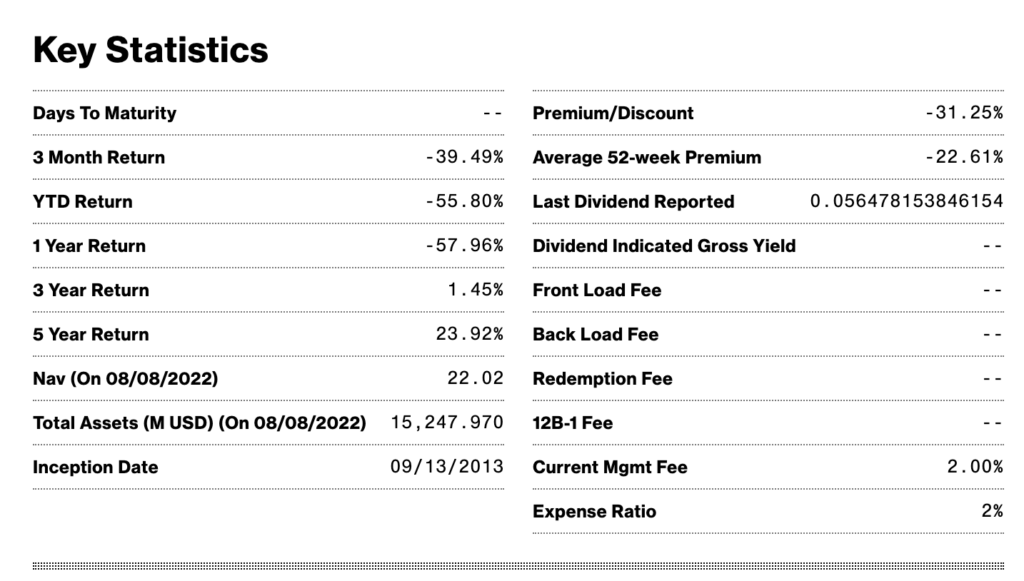
    Source: Bloomberg L.P. (August 2022)

    Looking at the YTD, 1-year, 3-year, and 5-year average returns, in the context of converting this Bitcoin asset to a spot ETF, is the SEC wrong when they say Grayscale is breaking an SEC rule that “requires, in relevant part, that the rules of a national securities exchange be ‘designed to prevent fraudulent and manipulative acts and practices’ and ‘to protect investors and the public interest’”? In other words, is introducing a Bitcoin spot ETF into the marketplace more dangerous than a Bitcoin futures ETF?

    Bitcoin Futures ETFs vs. Bitcoin Spot ETFs

    While we’re not opining on a question that’s currently an open legal issue, perhaps understanding the difference would help. A spot Bitcoin ETF brings many (almost all) of the benefits of a futures ETF. Some include investing in Bitcoin without using an exchange, paying less in fees than on a crypto exchange, and streamlining the overall process (Moeller, Cointelegraph). However, a spot ETF invests in Bitcoin on the spot.

    With a Bitcoin spot ETF, you invest in Bitcoin at its spot price, meaning buyers will be holding Bitcoin within their portfolio. In practice, it’d be very much like buying a stock. Crypto enthusiasts view a spot ETF as a more legitimate method of investment, therefore Bitcoin would become more legitimized with a SEC-approved Bitcoin spot ETF product.

    Futures are defined as “derivative financial contracts that obligate parties to buy or sell an asset at a predetermined future date and price” (Investopedia, 2022). So, what’s the key difference? With a Bitcoin spot ETF, you have immediate ownership of Bitcoin. When you purchase a Bitcoin futures ETF, you’re effectively just betting on the market, depending on if you choose to take a long or short position. But purchasing a Bitcoin futures ETF by no means entails immediate ownership of Bitcoin as an asset. If you’re going to purchase a SEC-approved Bitcoin spot ETF in the future, as one does not exist today, it’s critical to understand you’ll immediately add Bitcoin to your asset portfolio.

    GBTC’s Primary Differentiator: Security

    That seems to circle back to Grayscale’s initial pitch of the GBTC having “robust security and storage”. The SEC appears to be making less of a comment on the GBTC than they are about Bitcoin in general. A Bitcoin spot ETF can only be rejected for the reasons given by the SEC if they felt that Bitcoin was too susceptible to “fraudulent and manipulative acts”. Through strategic marketing, Grayscale is looking to differentiate their potential Bitcoin spot ETF product as completely secure. Furthermore, they’ve had the longest and most hopeful petition to the SEC for a Bitcoin spot ETF, with initial efforts dating back to 2016 (Moeller, Cointelegraph). Over six years later, Grayscale remains just as committed to convert the GBTC to Bitcoin’s first SEC-approved spot ETF. Whether or not they’ll be successful is still very much an open question. It’s worth noting that Grayscale’s Bitcoin Trust (GBTC) is the world’s only SEC-approved, publicly traded “Bitcoin Trust”. A “Bitcoin Trust” can be very closely compared to a private-placement trust. It trades just like a stock over the counter. That existing confidence, along with potential first-mover market advantage, would certainly give Grayscale a huge reason to seek to overturn the SEC’s latest official ruling.

    For reference, if you want to investigate a few of the best-known Bitcoin futures ETFs, they include ProShares BITO Bitcoin futures ETF, Valkyrie Bitcoin Strategy ETF, and VanEck Bitcoin Strategy ETF. The ProShares BITO Bitcoin futures ETF currently holds around $1B in investments (Moeller, Cointelegraph). For a look closer at information and BITO’s financials, they’re listed on the New York Stock Exchange (NYSE: Arca). For additional information on Grayscale Investments or the GBTC, their website can be found here.

  • Grayscale Investments, LLC Presents: Grayscale Bitcoin Trust (GBTC), Bitcoin’s First Spot ETF?

    Amongst the latest “hot topics” in the Financial Technology (FinTech) space is a cryptocurrency product aimed at changing the receptiveness of the international investment community to cryptocurrencies. Grayscale Investments, LLC has created the GBTC (Grayscale Bitcoin Trust), in an attempt to make a cryptocurrency product more marketable to institutional investors, pension funds, and other more traditional investment vehicles. Whether this approach will work in the long-term seems to be very hotly contested at the moment, for a number of reasons.

    The Grayscale Bitcoin Trust (GBTC)

    Surprisingly – though maybe not to many in the crypto community – Grayscale largely markets the GBTC for its “robust security and storage”. You would think that as an asset manager, even a crypto asset manager, Grayscale would be more excited about presenting numbers that investors are typically hungry for. However, they lead by offering the following:

    “Grayscale Bitcoin Trust’s assets are stored in offline or “cold” storage with Coinbase Custody Trust Company, LLC, as Custodian. The Custodian is a fiduciary under § 100 of the New York Banking Law and a qualified custodian for purposes of Rule 206(4)-2(d)(6) under the Investment Advisers Act of 1940, as amended.”

    Grayscale Investments, LLC (2022)

    Additional benefits, advertised by Grayscale, to purchase the GBTC include tax-advantaged account eligibility, “titled, auditable ownership [of a crypto asset] through a traditional investment vehicle”, publicly quoted price (OTCQX®: GBTC), and support from a network of trusted providers (this is where they let you know they have hired global financial services legal tycoon Davis Polk & Wardwell LLP). Why is that relevant?

    The SEC’s Ruling on Grayscale’s Bitcoin Spot ETF

    At the top of Grayscale’s website, you’ll see a banner with a hyperlink stating, “We’ve received a decision in our application to convert GBTC to an ETF”. That’s the real storyline here. It’s not the GBTC, it’s the fact that the SEC has disallowed Grayscale to convert the GBTC into a Bitcoin spot ETF. The concise version of the SEC’s 86-page decision can be captured in the following paragraph:

    “This order disapproves the proposed rule change, as modified by Amendment No. 1. The Commission concludes that NYSE Arca has not met its burden under the Exchange Act and the Commission’s Rules of Practice to demonstrate that its proposal is consistent with the requirements of Exchange Act Section 6(b)(5), which requires, in relevant part, that the rules of a national securities exchange be ‘designed to prevent fraudulent and manipulative acts and practices’ and ‘to protect investors and the public interest.’’’

    SEC, Release No. 34-95180; File No. SR-NYSEArca-2021-90 (July 22, 2022)

    Grayscale immediately responded by hiring former U.S. Solicitor General, Donald B. Verrilli, Jr. – best known for arguing President Obama’s ACA (Affordable Care Act) successfully before the US Supreme Court – who filed an appeal of the SEC’s ruling. Grayscale says they had no choice but to escalate the matter, given the “SEC’s arbitrary and capricious actions and discriminatory treatment of issuers”. The appeal seems to be almost exclusively relying on the argument that the SEC has allowed multiple Bitcoin futures ETFs into the marketplace. Furthermore, since their treatment of futures and spots of derivatives is generally similar, they are unjustly denying investors access to a new marketplace: Bitcoin spot ETFs. GBTC has the potential to become the first Bitcoin spot ETF to be approved by the SEC.

    A High-Level Look at GBTC’s Financials

    Below you can see some basic financials on GBTC from Grayscale’s website. They include the CUSIP (389637109), where we’ll use Bloomberg to investigate GBTC’s high-level financials.

    Source: Grayscale Investments, LLC (August 2022)

    The “Key Statistics” from Bloomberg for CUSIP 389637109 as of Tuesday August 9th, 2022 (GBTC US) are below.

    Source: Bloomberg L.P. (August 2022)

    Looking at the YTD, 1-year, 3-year, and 5-year average returns, in the context of converting this Bitcoin asset to a spot ETF, is the SEC wrong when they say Grayscale is breaking an SEC rule that “requires, in relevant part, that the rules of a national securities exchange be ‘designed to prevent fraudulent and manipulative acts and practices’ and ‘to protect investors and the public interest’”? In other words, is introducing a Bitcoin spot ETF into the marketplace more dangerous than a Bitcoin futures ETF?

    Bitcoin Futures ETFs vs. Bitcoin Spot ETFs

    While we’re not opining on a question that’s currently an open legal issue, perhaps understanding the difference would help. A spot Bitcoin ETF brings many (almost all) of the benefits of a futures ETF. Some include investing in Bitcoin without using an exchange, paying less in fees than on a crypto exchange, and streamlining the overall process (Moeller, Cointelegraph). However, a spot ETF invests in Bitcoin on the spot.

    With a Bitcoin spot ETF, you invest in Bitcoin at its spot price, meaning buyers will be holding Bitcoin within their portfolio. In practice, it’d be very much like buying a stock. Crypto enthusiasts view a spot ETF as a more legitimate method of investment, therefore Bitcoin would become more legitimized with a SEC-approved Bitcoin spot ETF product.

    Futures are defined as “derivative financial contracts that obligate parties to buy or sell an asset at a predetermined future date and price” (Investopedia, 2022). So, what’s the key difference? With a Bitcoin spot ETF, you have immediate ownership of Bitcoin. When you purchase a Bitcoin futures ETF, you’re effectively just betting on the market, depending on if you choose to take a long or short position. But purchasing a Bitcoin futures ETF by no means entails immediate ownership of Bitcoin as an asset. If you’re going to purchase a SEC-approved Bitcoin spot ETF in the future, as one does not exist today, it’s critical to understand you’ll immediately add Bitcoin to your asset portfolio.

    GBTC’s Primary Differentiator: Security

    That seems to circle back to Grayscale’s initial pitch of the GBTC having “robust security and storage”. The SEC appears to be making less of a comment on the GBTC than they are about Bitcoin in general. A Bitcoin spot ETF can only be rejected for the reasons given by the SEC if they felt that Bitcoin was too susceptible to “fraudulent and manipulative acts”. Through strategic marketing, Grayscale is looking to differentiate their potential Bitcoin spot ETF product as completely secure. Furthermore, they’ve had the longest and most hopeful petition to the SEC for a Bitcoin spot ETF, with initial efforts dating back to 2016 (Moeller, Cointelegraph). Over six years later, Grayscale remains just as committed to convert the GBTC to Bitcoin’s first SEC-approved spot ETF. Whether or not they’ll be successful is still very much an open question. It’s worth noting that Grayscale’s Bitcoin Trust (GBTC) is the world’s only SEC-approved, publicly traded “Bitcoin Trust”. A “Bitcoin Trust” can be very closely compared to a private-placement trust. It trades just like a stock over the counter. That existing confidence, along with potential first-mover market advantage, would certainly give Grayscale a huge reason to seek to overturn the SEC’s latest official ruling.

    For reference, if you want to investigate a few of the best-known Bitcoin futures ETFs, they include ProShares BITO Bitcoin futures ETF, Valkyrie Bitcoin Strategy ETF, and VanEck Bitcoin Strategy ETF. The ProShares BITO Bitcoin futures ETF currently holds around $1B in investments (Moeller, Cointelegraph). For a look closer at information and BITO’s financials, they’re listed on the New York Stock Exchange (NYSE: Arca). For additional information on Grayscale Investments or the GBTC, their website can be found here.

  • Twitter is the Ultimate Cryptocurrency Stock to BUY NOW

    Twitter (NYSE:TWTR) shares have soared more than 55% and counting in the past year, 2021 (Sun, The Motley Fool). An iconic platform best known as a micro-blogging social network, Twitter is quickly evolving. Moreover, it’s developing into something that’s likely even more influential and lucrative with the rise of cryptocurrencies. 

    Back in July 2021, Chief Executive Officer (CEO) Jack Dorsey announced that Bitcoin would become a “big part” of Twitter, specifically via integration with the company’s products and services. While this may not be well-known to investors, Twitter has already seen a huge rise in its bottom line due to the influx of cryptocurrency developers (Sun, The Motley Fool).

    An Extremely Unique Advantage for Twitter

    Unlike with stocks, there isn’t a centralized Securities and Exchange Commission (SEC) database (called EDGAR), where investors can go and get the latest information and financials for cryptocurrencies; until now. Twitter is quickly beginning to play the role of a “decentralized SEC” for the crypto community. Users can follow developer teams on Twitter, thereby getting the newest information on material changes in protocol, new partnerships, and significant events (the equivalent of 8-Ks at the SEC), as well as regular financial reports (10-Qs and 10-Ks). Furthermore, individuals can even report cryptocurrency tweets deemed to be scams or pump-and-dump schemes. A common practice in the vast majority of equity markets, this leads to a prototype of self-regulation (CFA Institute).

    Due to this phenomenon, Twitter is becoming exceedingly popular among altcoin networks such as Ethereum, Avalanche, Solana, Reserve Rights, Chainlink, Monero, and PirateChain, amongst many others. Their setup has attracted likely millions of users specifically desiring to stay up-to-date with the development of their latest tokens. Twitter’s capitalized on this financially by charging developers to promote their accounts via advertisement spending. Developers are incentivized into this because traffic is organic and directly within their target audience. Through this process, Twitter doesn’t even need to spend money on their own advertising. Celebrities, such as Tesla’s CEO Elon Musk, repeatedly use the platform to tout digital currencies such as Dogecoin to his fans, obviously generating substantial viewing activity.

    Financials Back Up Recent Boost in Success and Future Hype for Twitter

    During the second quarter of 2021, Twitter grew its monetizable daily active user base by 10.8% year over year to 206 million (Twitter, Inc – Financial Information). During the same time, revenue grew by a stunning 74% to $1.19 billion (Twitter, Inc – Financial Information). The company’s earnings have recouped their losses from the pandemic recession. Moreover, they more than doubled in the quarter ending June 30th (Twitter, Inc – Financial Information). They’re very clearly currently on track for stellar growth.

    Additionally, Twitter is doing well in terms of liquidity, with cash and investments outweighing its debt plus convertible notes by a factor of two (Twitter, Inc – Financial Information). Most experts agree it is both a great tech and crypto stock to buy at 10 times revenue. Expect continued profits and share gains as part of the boom in cryptocurrencies.

  • Twitter is the Ultimate Cryptocurrency Stock to BUY NOW

    Twitter (NYSE:TWTR) shares have soared more than 55% and counting in the past year, 2021 (Sun, The Motley Fool). An iconic platform best known as a micro-blogging social network, Twitter is quickly evolving. Moreover, it’s developing into something that’s likely even more influential and lucrative with the rise of cryptocurrencies. 

    Back in July 2021, Chief Executive Officer (CEO) Jack Dorsey announced that Bitcoin would become a “big part” of Twitter, specifically via integration with the company’s products and services. While this may not be well-known to investors, Twitter has already seen a huge rise in its bottom line due to the influx of cryptocurrency developers (Sun, The Motley Fool).

    An Extremely Unique Advantage for Twitter

    Unlike with stocks, there isn’t a centralized Securities and Exchange Commission (SEC) database (called EDGAR), where investors can go and get the latest information and financials for cryptocurrencies; until now. Twitter is quickly beginning to play the role of a “decentralized SEC” for the crypto community. Users can follow developer teams on Twitter, thereby getting the newest information on material changes in protocol, new partnerships, and significant events (the equivalent of 8-Ks at the SEC), as well as regular financial reports (10-Qs and 10-Ks). Furthermore, individuals can even report cryptocurrency tweets deemed to be scams or pump-and-dump schemes. A common practice in the vast majority of equity markets, this leads to a prototype of self-regulation (CFA Institute).

    Due to this phenomenon, Twitter is becoming exceedingly popular among altcoin networks such as Ethereum, Avalanche, Solana, Reserve Rights, Chainlink, Monero, and PirateChain, amongst many others. Their setup has attracted likely millions of users specifically desiring to stay up-to-date with the development of their latest tokens. Twitter’s capitalized on this financially by charging developers to promote their accounts via advertisement spending. Developers are incentivized into this because traffic is organic and directly within their target audience. Through this process, Twitter doesn’t even need to spend money on their own advertising. Celebrities, such as Tesla’s CEO Elon Musk, repeatedly use the platform to tout digital currencies such as Dogecoin to his fans, obviously generating substantial viewing activity.

    Financials Back Up Recent Boost in Success and Future Hype for Twitter

    During the second quarter of 2021, Twitter grew its monetizable daily active user base by 10.8% year over year to 206 million (Twitter, Inc – Financial Information). During the same time, revenue grew by a stunning 74% to $1.19 billion (Twitter, Inc – Financial Information). The company’s earnings have recouped their losses from the pandemic recession. Moreover, they more than doubled in the quarter ending June 30th (Twitter, Inc – Financial Information). They’re very clearly currently on track for stellar growth.

    Additionally, Twitter is doing well in terms of liquidity, with cash and investments outweighing its debt plus convertible notes by a factor of two (Twitter, Inc – Financial Information). Most experts agree it is both a great tech and crypto stock to buy at 10 times revenue. Expect continued profits and share gains as part of the boom in cryptocurrencies.

  • Mining Bitcoin: Tech Energy and Power

    For years, Bitcoin has been popularized as the face of cryptocurrency. After Bitcoin was introduced, it received critical backing from several prominent celebrity investment advisors and other notable figures, significant popularity followed. Once Bitcoin gained a platform, it gave rise to tens of thousands of other cryptocurrencies being mined and traded daily. Whether you believe in crypto’s or not, it’s hard to argue we’re not in the middle of one of the most exciting cryptocurrency trading times. While many participate in daily trading on platforms like Robinhood, Coinbase, CashApp, etc., not many of them have any insight into the technological know-how on creating a Bitcoin, or the Bitcoin energy required.

    In reality, the computer-based miners who create bitcoins use vast amounts of electrical power and energy in the process. The energy-heavy process even leads some experts to suggest that Bitcoin harms the environment. The process, known as “mining,” requires computers around the world to complete rapid calculations to try to solve the same puzzle. It always takes 10 minutes, and the winner is rewarded with some digital bitcoin. Then a new puzzle is generated, and the whole process repeats for another 10 minutes (Bradbury, The Balance).

    Breakdown of Bitcoin’s Power & Energy Output

    As more people learn about Bitcoin and mining—and as the price of Bitcoin increases—more are using their computers to mine Bitcoins. As more people join the network and try to solve these math puzzles, you might expect each puzzle to be solved sooner, but Bitcoin is not designed that way. The software that mines bitcoin is designed so that it always will take 10 minutes for everyone on the network to solve the puzzle. As more people join the Bitcoin network and try to mine Bitcoins, it becomes harder, and more computing power and electricity are used for each Bitcoin produced. It minimizes downtime, so you can mine more efficiently. That means a near-constant cycle of electricity use.

    To understand how to calculate the electrical energy used to power the bitcoin network, you’ll need to learn how Bitcoin creation works. First, you calculate how many sums are conducted per second to solve the puzzles. Then find out how much electricity it takes to do each sum. These sums are called “hashes” (Faife, CoinDesk). In early 2020, the computers on the Bitcoin network were cranking out close to 120 exahashes per second (Redman, BTC News). To calculate the cost of how much power it would take you to create a bitcoin, you need to know a few things first (Bradbury, The Balance). First, what is the cost of electricity where you live? Second, how much power would you consume? More efficient computer equipment uses less power, which means lower power bills. The lower the price of electricity, the less cost there is to miners. This increases the value of the Bitcoin to miners where the costs are lower to produce.

    The Conclusion: To Be Determined

    This is meant to emphasize that the energy and power utilized by Bitcoin and other cryptocurrency miners is a real, potential danger to the future global environment. Conversely, it may also leave a very low impact. The price that Bitcoin extracts in terms of energy use and environmental impact depends on how useful it will be to society (Bradbury, The Balance). Judging an ever-moving target is hard. The interest in Bitcoin continues to rise, which in turn leads to more power used to serve more people in the market. Therefore, ultimately deciding whether Bitcoin mining is worth the cost to the environment is still a very open question.