Tag: cryptocurrency

  • The World’s Oldest and Largest Custodian Bank – BNY Mellon – Builds Platform to Revolutionize Digital Asset Custody Services

    BNY Mellon, founded by Alexander Hamilton in 1784 – the first US Treasury Secretary – has announced they are continuing to build out a highly advanced, robust, and secure digital assets custody business.

    “Touching more than 20% of the world’s investable assets, BNY Mellon has the scale to help our clients reimagine financial markets through blockchain technology and digital assets. We are still in the early days of this evolution, but the possibilities are exciting. Today’s announcement marks a step in what we see as an ongoing innovation journey for our firm, our clients and the rest of the financial industry.”

    -Robin Vince, CEO of BNY Mellon

    BNY’s custodianship business is based on some of the very principles Hamilton wrote about in the late 1700s. They are both the largest and the oldest custodian bank in the world, with approximately $45T (Trillion) in Assets Under Custody (AUC). With their experience, brand recognition, and unique ability to utilize economies of scale – coupled with what appears to be a recent renewed peaking interest in digital assets – this move is an example of exceptional business strategy.

    The Timing of BNY Mellon’s Announcement

    The timing of the announcement is interesting for a number of reasons. Firstly (likely the primary reason), the Sibos Update conference, which initially lasted from 10/10-10/13. BNY had a very large presence and rolled this news out in parallel. Secondly, we’re at an absolutely critical point in macroeconomic policy. Will the Fed’s decision to hike up rates to deflate the inflation work? Did they start too late? What’s the impact on US and global financial markets? Presently, those questions are central to investors every single day.

    Generally, during recessionary cyclical economic times, at-risk assets don’t do well (to say the least). Cryptocurrencies and digital assets are in the heart of today’s at-risk assets category – though that may be slowly changing. Regardless, during such a time of economic uncertainty, rolling out a high-tech, revolutionary custodianship service for digital assets is interesting. That leads me to the next timing overlap.

    The SEC’s Ongoing Persistence of Rejecting Bitcoin Spot ETF Proposals

    The SEC has been on a roll with rejecting Bitcoin spot ETFs. Coverage of this began intensifying when they rejected Grayscale GBTC’s conversion request from a SEC-approved Bitcoin Trust to an SEC-approved Bitcoin spot ETF. Grayscale immediately retained Donald Verrilli Jr., who subsequently filed a quick appeal. Verrilli is best known for making a successful oral argument to the US Supreme Court in favor of the ACA (Obamacare). Afterwards, any new Bitcoin ETF – especially spot ETFs – were widely covered by the media and enthused investors. This announcement came on October 11th, 2022, the same day WisdomTree’s Bitcoin spot ETF application was rejected by the SEC, which is also coincidentally the same date the SEC had a deadline to respond to VanEck’s appeal of their previously rejected Bitcoin spot ETF. To note, the SEC has now missed their 45-day deadline to respond.

    Bear in mind, VanEck is not heavily exposed in digital assets at all. They are a highly reputable institutional investment firm, with one SEC-approved Bitcoin Strategy ETF on the market. As all other currently SEC-approved Bitcoin ETFs, VanEck’s Strategy ETF is a Bitcoin futures ETF. Nonetheless, BNY Mellon – very likely coincidentally, admittedly – announced this launch on the same day as two highly anticipated SEC rulings on digital asset products.

    Expected Impact for the Digital Asset Market

    The impact, especially in the longer-term, is potentially massive. Let’s remember the primary, above-and-beyond, number one reason the SEC is rejecting Bitcoin spot ETFs: security. Grayscale’s SEC-approved GBTC Bitcoin Trust advertises and details the product’s custodianship. The custodian is Coinbase Custody Trust Company, LLC. In other words, at least from the branding, the custodian of the cryptocurrency product is a cryptocurrency-specific custodian. Continuing with the Grayscale example, this makes their rebuttal to the SEC more difficult. Is there any remotely tangible security added if a cryptocurrency product is in the custody of another cryptocurrency-specific firm? I don’t doubt Grayscale’s ability to make a compelling and technically robust argument, but I seriously doubt the SEC’s acceptance.

    What if the scenario remains the same, with the only change being the custodian. With very few exceptions, in my opinion nothing really changes. That is, unless the custodian is BNY Mellon. Some, including myself, might argue that turns the dynamic in the other direction. If GBTC is held in the custody of BNY Mellon, would the SEC still cite security concerns? Unimaginable. BNY Mellon’s brand is iconic when it comes to custodianship services in global banking. Through this core offering, BNY Mellon alone winds up touching over 20% – or more than 1 out of every 5 USD (or global currency equivalent) – throughout the entire world. That’s astounding. Keeping in mind they are the oldest bank and the oldest publicly traded company, BNY must be doing something right in custodianship services.

    Security Has Always Been Paramount in Custodian Banking

    With custodianship banking generally, security is definitely mission critical. BNY has provided this service, highly successfully, arguably longer than any other service offered by any institution. They’ve been evolving the custody banking sector since the late 1700s. Back to the SEC, if I’m looking at GBTC in the custody of BNY Mellon, I don’t see any compelling argument for security concerns. If anything, I’d see that as more of comical reasoning. The SEC could always pivot to another, more plausible concern if (when) that were to happen, but it’s still a huge win for the digital asset market – as well as BNY Mellon.

    As a final note here, the SEC is rejecting Bitcoin spot ETFs at an increasing rate, meaning applications are growing. More and more firms are attempting to get SEC-approved Bitcoin products into the marketplace. Clearly, they’re prognosticating an increase in investor demand for digital asset products and are attempting to respond accordingly. Let’s also be clear – investors and investment firms aren’t required to get SEC clearance to sell Bitcoin derivatives.

    That said, of course it’s highly preferred. In an asset class still largely plagued by uncertainty, SEC approval is an immediate, gigantic game-changer. BNY Mellon holding custody of digital assets on an in-house, BNY Mellon digital assets custody platform changes cryptocurrency market dynamics. It also likely puts cryptocurrency-specific custodians out of business, amongst other market effects. One would think it’d have to alter the SEC’s position substantially and broadly on digital assets. In turn, that should similarly substantially and broadly alter investor perception of digital assets.

    Could Anything Go Wrong?

    Always. On a more serious note, even Alexander Hamilton was famously quoted saying, “I never expect a perfect work from an imperfect man”. From my perspective, BNY Mellon is not only the biggest risk-taker here; they are the biggest by a landslide. This is a company that was founded by the first US Treasury Secretary and has only improved their initial, core offering over time. The SEC also isn’t raising concerns over security as a completely illegitimate excuse. We’ve seen Ethereum wallets hacked, viruses created to successfully steal Bitcoin, cyber-attacks against crypto exchanges, and more. BNY Mellon will have the sole responsibility to ensure none of that occurs on their watch, so to speak. What if they fail? That’s exactly the point at which this could all go terribly wrong.

    BNY Mellon built a brand with the core focus on custodian banking spanning the course of over 225 years. They are widely considered to be the most prestigious and critical institutional investment services firm in the world. Now they’ve made a major move into the digital asset space, an admittedly enticing and potentially extremely lucrative strategy. However, in banking, all it takes to bring down a reputation built over 225 years is one mistake in seconds.

    To be sure, there’s added nuance here. Digital assets are naturally going to be more susceptible to evolving technologies as digital assets themselves are an evolving technology. Cybersecurity preventability measures and the sophistication of cybersecurity attacks have both increased. In the age of digital transformation, I believe this is a correctly calculated risk for BNY Mellon.

    Extent a Momentary Error Could Hurt BNY Mellon’s Core Business

    While there can be little to no doubt a security issue coming from BNY’s digital asset custody platform would be detrimental to the company – potentially in a very large way – the same can be said for the likelihood of that instance actually bringing down what BNY’s built in over 225 years. Even if the world’s most secure custodian has a security malfunction, I don’t believe it would even impact their current business model. It may take them out of digital asset custody services – I think even that is reaching – but again, I don’t see it majorly tarnishing the brand.

    All-in-all, this is a win-win scenario, statistically speaking. Yes, something could go wrong. When this platform is ready for go-live and it’s used broadly, we’ll get a better sense of the impact. But BNY especially would not dramatically – out of character – launch a futuristic digital assets custody platform that didn’t meet the mark from a technology perspective.

    There shouldn’t be doubt BNY made budgetary concerns a main priority, or even an obstacle, of this project. The team they’ve assembled is comprised of the brightest, most experienced, innovative SME’s in their respective areas. This continuing work-in-progress originated in 2019 and is just now starting to be publicly rolled out in a significant way. BNY likely took 3 years to ensure they had capacity to build a product worthy of publicly announcing is work-in-progress. They notably take perfection seriously; I doubt many disbelieve they’re going to rollout an incredible product. Whether perfection in digital assets custody is attainable is a separate discussion, but if anyone could, it’s BNY Mellon.
  • The World’s Oldest and Largest Custodian Bank – BNY Mellon – Builds Platform to Revolutionize Digital Asset Custody Services

    BNY Mellon, founded by Alexander Hamilton in 1784 – the first US Treasury Secretary – has announced they are continuing to build out a highly advanced, robust, and secure digital assets custody business.

    “Touching more than 20% of the world’s investable assets, BNY Mellon has the scale to help our clients reimagine financial markets through blockchain technology and digital assets. We are still in the early days of this evolution, but the possibilities are exciting. Today’s announcement marks a step in what we see as an ongoing innovation journey for our firm, our clients and the rest of the financial industry.”

    -Robin Vince, CEO of BNY Mellon

    BNY’s custodianship business is based on some of the very principles Hamilton wrote about in the late 1700s. They are both the largest and the oldest custodian bank in the world, with approximately $45T (Trillion) in Assets Under Custody (AUC). With their experience, brand recognition, and unique ability to utilize economies of scale – coupled with what appears to be a recent renewed peaking interest in digital assets – this move is an example of exceptional business strategy.

    The Timing of BNY Mellon’s Announcement

    The timing of the announcement is interesting for a number of reasons. Firstly (likely the primary reason), the Sibos Update conference, which initially lasted from 10/10-10/13. BNY had a very large presence and rolled this news out in parallel. Secondly, we’re at an absolutely critical point in macroeconomic policy. Will the Fed’s decision to hike up rates to deflate the inflation work? Did they start too late? What’s the impact on US and global financial markets? Presently, those questions are central to investors every single day.

    Generally, during recessionary cyclical economic times, at-risk assets don’t do well (to say the least). Cryptocurrencies and digital assets are in the heart of today’s at-risk assets category – though that may be slowly changing. Regardless, during such a time of economic uncertainty, rolling out a high-tech, revolutionary custodianship service for digital assets is interesting. That leads me to the next timing overlap.

    The SEC’s Ongoing Persistence of Rejecting Bitcoin Spot ETF Proposals

    The SEC has been on a roll with rejecting Bitcoin spot ETFs. Coverage of this began intensifying when they rejected Grayscale GBTC’s conversion request from a SEC-approved Bitcoin Trust to an SEC-approved Bitcoin spot ETF. Grayscale immediately retained Donald Verrilli Jr., who subsequently filed a quick appeal. Verrilli is best known for making a successful oral argument to the US Supreme Court in favor of the ACA (Obamacare). Afterwards, any new Bitcoin ETF – especially spot ETFs – were widely covered by the media and enthused investors. This announcement came on October 11th, 2022, the same day WisdomTree’s Bitcoin spot ETF application was rejected by the SEC, which is also coincidentally the same date the SEC had a deadline to respond to VanEck’s appeal of their previously rejected Bitcoin spot ETF. To note, the SEC has now missed their 45-day deadline to respond.

    Bear in mind, VanEck is not heavily exposed in digital assets at all. They are a highly reputable institutional investment firm, with one SEC-approved Bitcoin Strategy ETF on the market. As all other currently SEC-approved Bitcoin ETFs, VanEck’s Strategy ETF is a Bitcoin futures ETF. Nonetheless, BNY Mellon – very likely coincidentally, admittedly – announced this launch on the same day as two highly anticipated SEC rulings on digital asset products.

    Expected Impact for the Digital Asset Market

    The impact, especially in the longer-term, is potentially massive. Let’s remember the primary, above-and-beyond, number one reason the SEC is rejecting Bitcoin spot ETFs: security. Grayscale’s SEC-approved GBTC Bitcoin Trust advertises and details the product’s custodianship. The custodian is Coinbase Custody Trust Company, LLC. In other words, at least from the branding, the custodian of the cryptocurrency product is a cryptocurrency-specific custodian. Continuing with the Grayscale example, this makes their rebuttal to the SEC more difficult. Is there any remotely tangible security added if a cryptocurrency product is in the custody of another cryptocurrency-specific firm? I don’t doubt Grayscale’s ability to make a compelling and technically robust argument, but I seriously doubt the SEC’s acceptance.

    What if the scenario remains the same, with the only change being the custodian. With very few exceptions, in my opinion nothing really changes. That is, unless the custodian is BNY Mellon. Some, including myself, might argue that turns the dynamic in the other direction. If GBTC is held in the custody of BNY Mellon, would the SEC still cite security concerns? Unimaginable. BNY Mellon’s brand is iconic when it comes to custodianship services in global banking. Through this core offering, BNY Mellon alone winds up touching over 20% – or more than 1 out of every 5 USD (or global currency equivalent) – throughout the entire world. That’s astounding. Keeping in mind they are the oldest bank and the oldest publicly traded company, BNY must be doing something right in custodianship services.

    Security Has Always Been Paramount in Custodian Banking

    With custodianship banking generally, security is definitely mission critical. BNY has provided this service, highly successfully, arguably longer than any other service offered by any institution. They’ve been evolving the custody banking sector since the late 1700s. Back to the SEC, if I’m looking at GBTC in the custody of BNY Mellon, I don’t see any compelling argument for security concerns. If anything, I’d see that as more of comical reasoning. The SEC could always pivot to another, more plausible concern if (when) that were to happen, but it’s still a huge win for the digital asset market – as well as BNY Mellon.

    As a final note here, the SEC is rejecting Bitcoin spot ETFs at an increasing rate, meaning applications are growing. More and more firms are attempting to get SEC-approved Bitcoin products into the marketplace. Clearly, they’re prognosticating an increase in investor demand for digital asset products and are attempting to respond accordingly. Let’s also be clear – investors and investment firms aren’t required to get SEC clearance to sell Bitcoin derivatives.

    That said, of course it’s highly preferred. In an asset class still largely plagued by uncertainty, SEC approval is an immediate, gigantic game-changer. BNY Mellon holding custody of digital assets on an in-house, BNY Mellon digital assets custody platform changes cryptocurrency market dynamics. It also likely puts cryptocurrency-specific custodians out of business, amongst other market effects. One would think it’d have to alter the SEC’s position substantially and broadly on digital assets. In turn, that should similarly substantially and broadly alter investor perception of digital assets.

    Could Anything Go Wrong?

    Always. On a more serious note, even Alexander Hamilton was famously quoted saying, “I never expect a perfect work from an imperfect man”. From my perspective, BNY Mellon is not only the biggest risk-taker here; they are the biggest by a landslide. This is a company that was founded by the first US Treasury Secretary and has only improved their initial, core offering over time. The SEC also isn’t raising concerns over security as a completely illegitimate excuse. We’ve seen Ethereum wallets hacked, viruses created to successfully steal Bitcoin, cyber-attacks against crypto exchanges, and more. BNY Mellon will have the sole responsibility to ensure none of that occurs on their watch, so to speak. What if they fail? That’s exactly the point at which this could all go terribly wrong.

    BNY Mellon built a brand with the core focus on custodian banking spanning the course of over 225 years. They are widely considered to be the most prestigious and critical institutional investment services firm in the world. Now they’ve made a major move into the digital asset space, an admittedly enticing and potentially extremely lucrative strategy. However, in banking, all it takes to bring down a reputation built over 225 years is one mistake in seconds.

    To be sure, there’s added nuance here. Digital assets are naturally going to be more susceptible to evolving technologies as digital assets themselves are an evolving technology. Cybersecurity preventability measures and the sophistication of cybersecurity attacks have both increased. In the age of digital transformation, I believe this is a correctly calculated risk for BNY Mellon.

    Extent a Momentary Error Could Hurt BNY Mellon’s Core Business

    While there can be little to no doubt a security issue coming from BNY’s digital asset custody platform would be detrimental to the company – potentially in a very large way – the same can be said for the likelihood of that instance actually bringing down what BNY’s built in over 225 years. Even if the world’s most secure custodian has a security malfunction, I don’t believe it would even impact their current business model. It may take them out of digital asset custody services – I think even that is reaching – but again, I don’t see it majorly tarnishing the brand.

    All-in-all, this is a win-win scenario, statistically speaking. Yes, something could go wrong. When this platform is ready for go-live and it’s used broadly, we’ll get a better sense of the impact. But BNY especially would not dramatically – out of character – launch a futuristic digital assets custody platform that didn’t meet the mark from a technology perspective.

    There shouldn’t be doubt BNY made budgetary concerns a main priority, or even an obstacle, of this project. The team they’ve assembled is comprised of the brightest, most experienced, innovative SME’s in their respective areas. This continuing work-in-progress originated in 2019 and is just now starting to be publicly rolled out in a significant way. BNY likely took 3 years to ensure they had capacity to build a product worthy of publicly announcing is work-in-progress. They notably take perfection seriously; I doubt many disbelieve they’re going to rollout an incredible product. Whether perfection in digital assets custody is attainable is a separate discussion, but if anyone could, it’s BNY Mellon.
  • What’s Next for Cryptocurrencies and Digital Assets, Post-2020s Recession

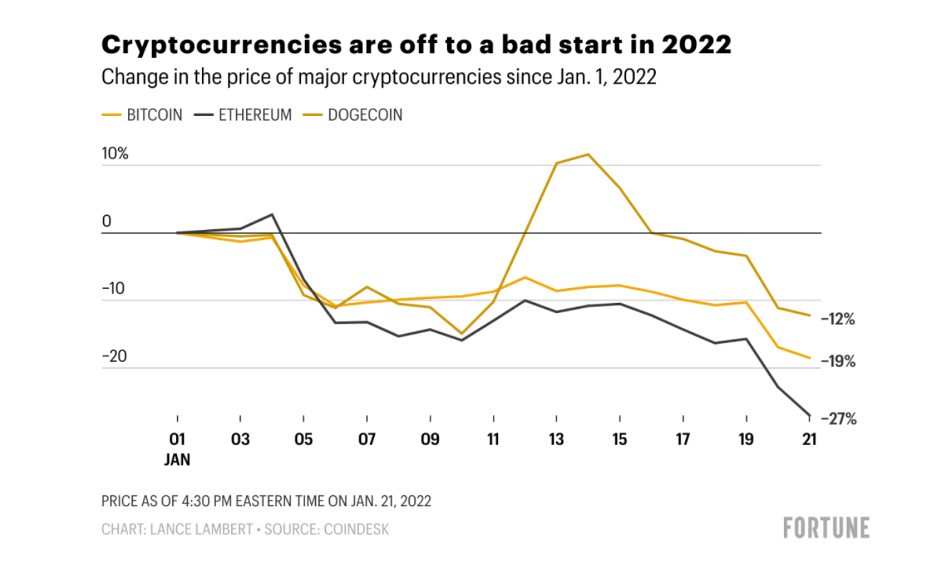
    The macroeconomic outlook for the cryptocurrency/digital asset market is definitely not looking good, at this time. There are a multitude of reasons. I think this is largely because Cryptocurrencies are considered “trendy” in financial services, however I’ve recently been asked for my take on specific Crypto’s (Bitcoin primarily) and what I’ve come to refer to as “Complex Crypto’s” (ETFs, other Exchange Traded Crypto Securities, Crypto IRA’s, etc.). Of course, at the center of this conversation is Cryptocurrency mining and trading. As most who follow this market even casually know, the two are intimately related.

    Standpoint on Cryptocurrency and Digital Assets Throughout the Recession

    Disclaimer: Pro-crypto enthusiasts will not be happy. This is how I’d put it, favorably. I see the cryptocurrency market, coming out of the recession – assuming it does – with entirely new technologies, marketing strategies, market dynamics, etc. To elaborate, let’s take what we can all agree to be true about the cryptocurrency fan base today, largely speaking. They’re a) not long-term strategists, b) very weak (or completely incoherent) when it comes to basic knowledge of financial markets and even more complex financial instruments, and c) the composition of cryptocurrency investors is not one you’d generally – or ever – consider “cash rich” compared to other investors (both individual and institutional).

    We’re looking at a market with the majority of participants being short-term, stubborn and perhaps unqualified thinkers, with little to no savings to boot. Market dynamics aside, Bitcoin has been religiously dropping for quite a while now. If conceptually it doesn’t make sense and the numbers aren’t there, investors are in deep trouble.

    Fast forward a few months. The Fed continues their ongoing strategy of “deflating the inflation” with historically “aggressive” rate hikes. The participants in the market described above would generally be considered high in terms of price elasticity. Meaning, their sensitivity to pricing changes is above average. In prices rise, they are more likely to sell quicker than someone who is more price inelastic, perhaps because they have a larger savings (as an example). On average, the same cryptocurrency enthusiasts who decided to invest in a Crypto ITF are the ones who will be forced to sell off their digital asset portfolio the quickest.

    When the average cryptocurrency enthusiast starts to get more and more burdened by everyday essentials, their digital wallet’s intrinsic value will diminish rapidly. Are you willing to struggle to pay rent to hold onto Bitcoin at the price you bought it? If you’re already a short-term thinker, the answer is more or less common sense. No. Nor are you willing to sell your house to maintain a bullish position on Bitcoin (if you’ll be in one of the unfortunate groups that lose their job in the recession).

    The Cryptocurrency Enthusiasts with Never-ending Dedication

    Cryptocurrency enthusiasts will undoubtably disagree with the short-term thinking narrative, but it’s respectfully backwards. There’s no other asset in financial markets you’ve analyzed as a better bet for the long-term. Really? Not the S&P 500 Index? US Treasuries that have never defaulted? If you’re looking for enhanced potential for extravagant short-term returns, cryptocurrency is an area for you. But that’s a complete contradiction to the long-term value proposition. There is none.

    Their last standing argument: Blockchain Technology. This is debated in part, but the general consensus among the Crypto community appears to be along the lines of, “Blockchain technology is considered a commodity and regulated by the CFTC that we simply cannot live without as a society. Therefore, Bitcoin will survive and prosper through any recession, since we have propriety technology that will revolutionize the world” [I’m paraphrasing]. This technology is by no means universally accepted in traditional financial markets. Bill Murray’s Ethereum wallet was recently infamously hacked. This will no doubt bolster the SEC’s position against institutionalizing digital assets.

    It’s relied on even less so by traditional financial investors. Let’s not forget, the SEC is still unwilling to budge on a Bitcoin spot ETF with the number one concern being lack of technological innovation to eliminate jacking and market manipulation. If the SEC says it’s too dangerous, where do you think institutional investors will fall with the current macroeconomic trajectory? Why is Bill Murray’s Ethereum wallet suddenly the focus of all the daily financial newsletters?

    Near and Long-Term Cryptocurrency and Digital Assets Outlook

    In the near term (3-4 months), look for prices to continue dropping steadily. This goes across the board for all digital assets. In the long term (1.5-2+ years), that becomes a very complicated question when you dig into potential hypotheticals. Digital assets and cryptocurrencies are almost completely unregulated. There are no remotely serious regulatory requirements or disclosures of any information about holdings reports, portfolio allocation, investor reports, or any other typically standard financial accounting. That was part of the initial pitch: anonymity.

    Now, when purely digital asset portfolio managers like Grayscale want to get through to institutional investors, they start to create SEC approved Bitcoin Trusts, strategically push for Bitcoin spot ETFs, make it publicly known they own roughly 4% of all of Bitcoin, etc. That goes back to an original point. Bitcoin and cryptocurrencies may not get completely cratered like the dinosaurs did, but will we have thousands – or tens of thousands – of different cryptocurrencies, trading on infinite different platforms, with an unlimited amount of different marketed benefits? I don’t see it.

    Are Cryptocurrencies and Digital Assets Going to Crash from the Recession?

    To the more interesting question, can digital assets become the modern-day dinosaurs? It’s vaguely possible, but unlikely. This is where global politics, luck, and irrational/unconventional investor behavior tend to make the largest impacts. Let’s say Bitcoin drops below $5,000 and Grayscale, owning roughly 4%, assesses a further drop to $3,000 by next month. What does Grayscale do? Every financial product they sell is a digital asset and they’ve marketed Bitcoin as the obvious face. They get absolutely no protections from bankruptcy and neither do their investors. Yet, with the amount of Bitcoin they own, could they theoretically have backdoor discussions that would lead to the price of Bitcoin artificially being propped up? It’s a definite theoretical possibility.

    Again, we don’t know who Grayscale would be in the room and how much bargaining power they’d have. To the cryptocurrency enthusiasts who think it’s “cool” to invest in cryptocurrencies specifically because executives at traditional investment institutions are known for appeasing shareholders (in other words, doing their jobs) and “throwing investors under the bus”, well what do you think will happen to you? Will the CEO responsible for making those decisions that has the potential to change investors lives do the “ethical” thing because they don’t have shareholders to protect? I think the fair and impartial response is that remains to be seen. That’s the truth.

    Let’s face it: cryptocurrencies and digital assets are in for the fight for their existence. This is newfound territory for this comparatively new market. It will absolutely shed so much more light than we have today about investors true perspectives and feelings on digital assets. At the end of the day, in a world where quantitative data leads investment decisions, rather than personal belief and alleged loyalty, we’ll have to see what executives and cryptocurrency holders alike do on a broad scale.

    The Bottom Line and What to Do

    The “correct” decision – meaning the decision statistically likely to have the most favorable outcome – would be to reinvest your holdings elsewhere. The risk is way too big, while the reward is way too small or nonexistent. Of the at-risk assets on the chopping block, digital assets are first in line. There is no remotely likely scenario where cryptocurrency supporters get to say “I told you so” anytime soon.

    In reality, what you do is listen to the experts, at least in this case. No one’s saying you need to get your IRA, or any other investment vehicle out for that matter, but you can’t think of a more prudent investment given the economic climate you’re being explained? What about real estate? You have the benefit of a physical asset, upside to earn capital gains if market prices increase, and at the simplest level, housing is essential. Individuals will never not need housing. If the recession impact results in a catastrophic scenario, you have an asset with no real danger of going to zero.

    If you’re going to hunker down and stay invested in digital assets until the end, you can still diversify and reduce your exposure. There are Bitcoin futures ETFs, like the VanEck Bitcoin Strategy ETF we discussed last time. There is the SEC-backed Bitcoin Trust; Grayscale’s GBTC. You can invest in hard currencies that would offset your exposure to digital currencies.

    There’s a plethora of options of the astute investor, but the question in my mind continues to be, why? Why go through an agonizing recession, where you’ll make difficult financial choices just to maintain your current cryptocurrency holdings? Again, if you’re so over-the-top for Blockchain technology, it will be available for purchase at a lower price in the future. But the near future? No chances from the present. Bitcoin will continue to systematically drop daily until there is major turnaround. There’s no telling what that will look like yet.

    The Warren Buffett Philosophy

    Consider this quote from Warren Buffett and how it applies to this debate. Buffett is universally known as the most intelligent and disciplined value-based investor of our generation.

    “People should only [make investments] in companies that exhibit solid fundamentals, strong earnings power, and the potential for continued growth.”

    -Warren Buffett, Unpublished

    Does the cryptocurrency market currently a) exhibit solid fundamentals, b) has strong earnings power, or c) has a solid potential for future growth? The answer to all three is no. That’s likely why Buffet has always remained a staunch opponent to digital assets. Buffet’s average holdings are somewhere from 10-34 years. It’s more than fair to say he views investing as a marathon, not a race.

    Concisely, as all other major financial news agree, the cryptocurrency market is at a crucial testing point, at bare minimum. We know crypto products aren’t going to gain market value during a recession, for sure. However, the extent of the damages digital assets will take compared to other “at-risk” assets remains to be seen. Time, Forbes, CNBC, and Reuters all predicted major cryptocurrency market tumbles during the recession just this week. Again, a lot of it will depend on luck and how things play out, but there are actions you can take as an investor to mitigate your exposure to the bullish side of the crypto/digital asset market during a recession.

    I’ll end with one final argument against cryptocurrencies and digital assets. Ironically, this goes against Warren Buffett’s main investing principle (at least in part). I believe he’s said that during a recession, his investment philosophy changes, but I was unable to find that quote.

    “Over the long term, the stock market news will be good. In the 20th century, the United States endured two world wars and other traumatic and expensive military conflicts; the Depression; a dozen or so recessions and financial panics; oil shocks; a fly epidemic; and the resignation of a disgraced president. Yet the Dow rose from 66 to 11,497.”

    -Warren Buffett, Unpublished

    The Secret Behind Buffett’s Legacy: Some Deals are Simply too Risky

    Whether you agree with the risks to digital assets now or not, Buffett is spot on as usual. He has more famous quotes regarding investing in the stock market for the long-term, which is what he starts with. Buffett has held AXP (American Express) since 1964, KO (Coca-Cola) since 1988, and Wells Fargo (WFC) since 1989. Buffett’s outlook on the stock market is almost exclusively dependent on his analysis of that specific business. He’ll look at the financials in extensive detail, but he’ll also study the business model. How the company generates profits, what kinds of costs they incur. He’s the third richest person in the world off investments alone. Warren Buffett – rather than major investment banks or cash lenders – is known to have plenty of available cash during a recession or financial panic.

    Why? He hedges anywhere he’s far too overexposed and to boot, he has a knack for taking good bets on massively successful companies. In the context of cryptocurrency and digital assets, are they going to withstand all those arduous times? WWI & WWII, Vietnam, the Great Depression, over a dozen recessions and financial panics, oil shocks, a fly epidemic, and a political catastrophe? That wasn’t just an ego-trip; Buffett lived through those eras and more so, he prospered through them. Very few, if any, can say the same. Buffett stays away from a certain level of risk, period. No matter what the potential or hypothetical reward is, Buffett doesn’t execute the deal unless it’s met his standards.

    In Conclusion…

    With the way Blockchain was initially pitched, then repurposed, and gained little traction since is worrisome to me. The bottom line is cryptocurrency and digital assets have nowhere to go but down during an impactful recession. What you should do, in full sincerity, depends almost exclusively on your investing goals and available capital. In common, everyday situations – for example purchasing an overpriced digital currency – you should still mitigate your losses.

    You don’t want to be taking a bigger loss because you were too stubborn to take a much smaller one initially. I believe we’ll wind up seeing a lot of cryptocurrency investors in that boat. At what point will they be willing to toss it in and accept this investment just didn’t work out? Will they get to that point? Time will tell. What’s certain is the magnitude the recession’s impact will have on the cryptocurrencies and digital assets markets.

  • What’s Next for Cryptocurrencies and Digital Assets, Post-2020s Recession

    The macroeconomic outlook for the cryptocurrency/digital asset market is definitely not looking good, at this time. There are a multitude of reasons. I think this is largely because Cryptocurrencies are considered “trendy” in financial services, however I’ve recently been asked for my take on specific Crypto’s (Bitcoin primarily) and what I’ve come to refer to as “Complex Crypto’s” (ETFs, other Exchange Traded Crypto Securities, Crypto IRA’s, etc.). Of course, at the center of this conversation is Cryptocurrency mining and trading. As most who follow this market even casually know, the two are intimately related.

    Standpoint on Cryptocurrency and Digital Assets Throughout the Recession

    Disclaimer: Pro-crypto enthusiasts will not be happy. This is how I’d put it, favorably. I see the cryptocurrency market, coming out of the recession – assuming it does – with entirely new technologies, marketing strategies, market dynamics, etc. To elaborate, let’s take what we can all agree to be true about the cryptocurrency fan base today, largely speaking. They’re a) not long-term strategists, b) very weak (or completely incoherent) when it comes to basic knowledge of financial markets and even more complex financial instruments, and c) the composition of cryptocurrency investors is not one you’d generally – or ever – consider “cash rich” compared to other investors (both individual and institutional).

    We’re looking at a market with the majority of participants being short-term, stubborn and perhaps unqualified thinkers, with little to no savings to boot. Market dynamics aside, Bitcoin has been religiously dropping for quite a while now. If conceptually it doesn’t make sense and the numbers aren’t there, investors are in deep trouble.

    Fast forward a few months. The Fed continues their ongoing strategy of “deflating the inflation” with historically “aggressive” rate hikes. The participants in the market described above would generally be considered high in terms of price elasticity. Meaning, their sensitivity to pricing changes is above average. In prices rise, they are more likely to sell quicker than someone who is more price inelastic, perhaps because they have a larger savings (as an example). On average, the same cryptocurrency enthusiasts who decided to invest in a Crypto ITF are the ones who will be forced to sell off their digital asset portfolio the quickest.

    When the average cryptocurrency enthusiast starts to get more and more burdened by everyday essentials, their digital wallet’s intrinsic value will diminish rapidly. Are you willing to struggle to pay rent to hold onto Bitcoin at the price you bought it? If you’re already a short-term thinker, the answer is more or less common sense. No. Nor are you willing to sell your house to maintain a bullish position on Bitcoin (if you’ll be in one of the unfortunate groups that lose their job in the recession).

    The Cryptocurrency Enthusiasts with Never-ending Dedication

    Cryptocurrency enthusiasts will undoubtably disagree with the short-term thinking narrative, but it’s respectfully backwards. There’s no other asset in financial markets you’ve analyzed as a better bet for the long-term. Really? Not the S&P 500 Index? US Treasuries that have never defaulted? If you’re looking for enhanced potential for extravagant short-term returns, cryptocurrency is an area for you. But that’s a complete contradiction to the long-term value proposition. There is none.

    Their last standing argument: Blockchain Technology. This is debated in part, but the general consensus among the Crypto community appears to be along the lines of, “Blockchain technology is considered a commodity and regulated by the CFTC that we simply cannot live without as a society. Therefore, Bitcoin will survive and prosper through any recession, since we have propriety technology that will revolutionize the world” [I’m paraphrasing]. This technology is by no means universally accepted in traditional financial markets. Bill Murray’s Ethereum wallet was recently infamously hacked. This will no doubt bolster the SEC’s position against institutionalizing digital assets.

    It’s relied on even less so by traditional financial investors. Let’s not forget, the SEC is still unwilling to budge on a Bitcoin spot ETF with the number one concern being lack of technological innovation to eliminate jacking and market manipulation. If the SEC says it’s too dangerous, where do you think institutional investors will fall with the current macroeconomic trajectory? Why is Bill Murray’s Ethereum wallet suddenly the focus of all the daily financial newsletters?

    Near and Long-Term Cryptocurrency and Digital Assets Outlook

    In the near term (3-4 months), look for prices to continue dropping steadily. This goes across the board for all digital assets. In the long term (1.5-2+ years), that becomes a very complicated question when you dig into potential hypotheticals. Digital assets and cryptocurrencies are almost completely unregulated. There are no remotely serious regulatory requirements or disclosures of any information about holdings reports, portfolio allocation, investor reports, or any other typically standard financial accounting. That was part of the initial pitch: anonymity.

    Now, when purely digital asset portfolio managers like Grayscale want to get through to institutional investors, they start to create SEC approved Bitcoin Trusts, strategically push for Bitcoin spot ETFs, make it publicly known they own roughly 4% of all of Bitcoin, etc. That goes back to an original point. Bitcoin and cryptocurrencies may not get completely cratered like the dinosaurs did, but will we have thousands – or tens of thousands – of different cryptocurrencies, trading on infinite different platforms, with an unlimited amount of different marketed benefits? I don’t see it.

    Are Cryptocurrencies and Digital Assets Going to Crash from the Recession?

    To the more interesting question, can digital assets become the modern-day dinosaurs? It’s vaguely possible, but unlikely. This is where global politics, luck, and irrational/unconventional investor behavior tend to make the largest impacts. Let’s say Bitcoin drops below $5,000 and Grayscale, owning roughly 4%, assesses a further drop to $3,000 by next month. What does Grayscale do? Every financial product they sell is a digital asset and they’ve marketed Bitcoin as the obvious face. They get absolutely no protections from bankruptcy and neither do their investors. Yet, with the amount of Bitcoin they own, could they theoretically have backdoor discussions that would lead to the price of Bitcoin artificially being propped up? It’s a definite theoretical possibility.

    Again, we don’t know who Grayscale would be in the room and how much bargaining power they’d have. To the cryptocurrency enthusiasts who think it’s “cool” to invest in cryptocurrencies specifically because executives at traditional investment institutions are known for appeasing shareholders (in other words, doing their jobs) and “throwing investors under the bus”, well what do you think will happen to you? Will the CEO responsible for making those decisions that has the potential to change investors lives do the “ethical” thing because they don’t have shareholders to protect? I think the fair and impartial response is that remains to be seen. That’s the truth.

    Let’s face it: cryptocurrencies and digital assets are in for the fight for their existence. This is newfound territory for this comparatively new market. It will absolutely shed so much more light than we have today about investors true perspectives and feelings on digital assets. At the end of the day, in a world where quantitative data leads investment decisions, rather than personal belief and alleged loyalty, we’ll have to see what executives and cryptocurrency holders alike do on a broad scale.

    The Bottom Line and What to Do

    The “correct” decision – meaning the decision statistically likely to have the most favorable outcome – would be to reinvest your holdings elsewhere. The risk is way too big, while the reward is way too small or nonexistent. Of the at-risk assets on the chopping block, digital assets are first in line. There is no remotely likely scenario where cryptocurrency supporters get to say “I told you so” anytime soon.

    In reality, what you do is listen to the experts, at least in this case. No one’s saying you need to get your IRA, or any other investment vehicle out for that matter, but you can’t think of a more prudent investment given the economic climate you’re being explained? What about real estate? You have the benefit of a physical asset, upside to earn capital gains if market prices increase, and at the simplest level, housing is essential. Individuals will never not need housing. If the recession impact results in a catastrophic scenario, you have an asset with no real danger of going to zero.

    If you’re going to hunker down and stay invested in digital assets until the end, you can still diversify and reduce your exposure. There are Bitcoin futures ETFs, like the VanEck Bitcoin Strategy ETF we discussed last time. There is the SEC-backed Bitcoin Trust; Grayscale’s GBTC. You can invest in hard currencies that would offset your exposure to digital currencies.

    There’s a plethora of options of the astute investor, but the question in my mind continues to be, why? Why go through an agonizing recession, where you’ll make difficult financial choices just to maintain your current cryptocurrency holdings? Again, if you’re so over-the-top for Blockchain technology, it will be available for purchase at a lower price in the future. But the near future? No chances from the present. Bitcoin will continue to systematically drop daily until there is major turnaround. There’s no telling what that will look like yet.

    The Warren Buffett Philosophy

    Consider this quote from Warren Buffett and how it applies to this debate. Buffett is universally known as the most intelligent and disciplined value-based investor of our generation.

    “People should only [make investments] in companies that exhibit solid fundamentals, strong earnings power, and the potential for continued growth.”

    -Warren Buffett, Unpublished

    Does the cryptocurrency market currently a) exhibit solid fundamentals, b) has strong earnings power, or c) has a solid potential for future growth? The answer to all three is no. That’s likely why Buffet has always remained a staunch opponent to digital assets. Buffet’s average holdings are somewhere from 10-34 years. It’s more than fair to say he views investing as a marathon, not a race.

    Concisely, as all other major financial news agree, the cryptocurrency market is at a crucial testing point, at bare minimum. We know crypto products aren’t going to gain market value during a recession, for sure. However, the extent of the damages digital assets will take compared to other “at-risk” assets remains to be seen. Time, Forbes, CNBC, and Reuters all predicted major cryptocurrency market tumbles during the recession just this week. Again, a lot of it will depend on luck and how things play out, but there are actions you can take as an investor to mitigate your exposure to the bullish side of the crypto/digital asset market during a recession.

    I’ll end with one final argument against cryptocurrencies and digital assets. Ironically, this goes against Warren Buffett’s main investing principle (at least in part). I believe he’s said that during a recession, his investment philosophy changes, but I was unable to find that quote.

    “Over the long term, the stock market news will be good. In the 20th century, the United States endured two world wars and other traumatic and expensive military conflicts; the Depression; a dozen or so recessions and financial panics; oil shocks; a fly epidemic; and the resignation of a disgraced president. Yet the Dow rose from 66 to 11,497.”

    -Warren Buffett, Unpublished

    The Secret Behind Buffett’s Legacy: Some Deals are Simply too Risky

    Whether you agree with the risks to digital assets now or not, Buffett is spot on as usual. He has more famous quotes regarding investing in the stock market for the long-term, which is what he starts with. Buffett has held AXP (American Express) since 1964, KO (Coca-Cola) since 1988, and Wells Fargo (WFC) since 1989. Buffett’s outlook on the stock market is almost exclusively dependent on his analysis of that specific business. He’ll look at the financials in extensive detail, but he’ll also study the business model. How the company generates profits, what kinds of costs they incur. He’s the third richest person in the world off investments alone. Warren Buffett – rather than major investment banks or cash lenders – is known to have plenty of available cash during a recession or financial panic.

    Why? He hedges anywhere he’s far too overexposed and to boot, he has a knack for taking good bets on massively successful companies. In the context of cryptocurrency and digital assets, are they going to withstand all those arduous times? WWI & WWII, Vietnam, the Great Depression, over a dozen recessions and financial panics, oil shocks, a fly epidemic, and a political catastrophe? That wasn’t just an ego-trip; Buffett lived through those eras and more so, he prospered through them. Very few, if any, can say the same. Buffett stays away from a certain level of risk, period. No matter what the potential or hypothetical reward is, Buffett doesn’t execute the deal unless it’s met his standards.

    In Conclusion…

    With the way Blockchain was initially pitched, then repurposed, and gained little traction since is worrisome to me. The bottom line is cryptocurrency and digital assets have nowhere to go but down during an impactful recession. What you should do, in full sincerity, depends almost exclusively on your investing goals and available capital. In common, everyday situations – for example purchasing an overpriced digital currency – you should still mitigate your losses.

    You don’t want to be taking a bigger loss because you were too stubborn to take a much smaller one initially. I believe we’ll wind up seeing a lot of cryptocurrency investors in that boat. At what point will they be willing to toss it in and accept this investment just didn’t work out? Will they get to that point? Time will tell. What’s certain is the magnitude the recession’s impact will have on the cryptocurrencies and digital assets markets.

  • Why the SEC will Ultimately Deny VanEck’s Third Application for a Bitcoin Spot ETF and What it Means for Digital Assets

    Late last month, August 2022, the SEC announced a 45-day delay to rule on VanEck’s third Bitcoin Spot ETF application. This comes on the heels of the SEC denying Grayscale’s GBTC – an SEC backed Bitcoin Trust – conversion to a spot ETF, as well as Bitwise Asset Management’s application for a spot ETF, on the same day in late June 2022. VanEck currently has an SEC-backed Bitcoin futures ETF, the “VanEck Bitcoin Strategy ETF” (Cboe: XBTF). Their two previous applications for a Bitcoin spot ETF were rejected first in 2017, then late in 2021. VanEck is considered somewhat of an “investment giant”, with roughly $65B currently in AUM.

    Grayscale, with roughly $20M in AUM and a digital asset manager giant themselves, a subsidiary of Digital Currency Group (DCG) – who’s also the parent company of CoinDesk – sued the SEC immediately after they rejected the GBTC’s conversion from a SEC-backed Bitcoin Trust to a SEC-backed spot ETF. A ruling from a Federal Appellate Court is expected sometime in Q4 2023 or Q1 2024.

    Why Will the SEC Reject VanEck’s Application for a Bitcoin Spot ETF a Third Time?

    A better way to phrase the question is: why wouldn’t they? Has anything dramatically changed about either the SEC’s mandates, Bitcoin, market conditions, or is VanEck’s application unique? No, for all the above. VanEck’s Bitcoin spot ETF, which they’ve proposed to list on the Cboe BZX Exchange, would still create direct Bitcoin ownership for investors who purchased it. In my opinion, the SEC’s had to issue a 45-day delay because VanEck’s argument appears to differ from Grayscale’s. VanEck isn’t relying on a futures versus spot Exchanged Traded Fund [ETF] derivative comparison. Rather, they’re urging the SEC to reconsider because investors can access Bitcoin spot ETFs through our neighbors in Canada.

    They’re not wrong. As early as February 2021, Canada became one of the first countries in the world to place a Bitcoin spot ETF on one of their national exchanges. But given that was back in February 2021, the question remains: what’s changed? It’s completely unrealistic for the SEC to admit they weren’t aware of a Bitcoin spot ETF on a Canadian exchange. Hypothetically, it would very likely give Grayscale the green light to pursue further, more substantial legal action against the SEC.

    At the time Grayscale’s GBTC was rejected, many analysts cited the heightened potential for fraud and malpractice amongst digital assets being a key reason institutional investors, who generally purchase far more spot products than futures derivatives (as part of their traditional investment strategies), should not get access to an SEC-backed Bitcoin spot ETF yet. They said digital currency exchanges needed total transparency inside their marketplaces, like the DOW and NASDAQ. While this flies in the face of many reasons investors purchase digital assets and it’s not practical, it didn’t matter. That’s what the institutional investor community who was with the SEC just two months back demanded. VanEck is not purely a digital asset manager like Grayscale and in terms of AUM, they’re over 3 times larger.

    As another interesting reference point VanEck currently has 3 CO (Commodity) ETFs. The first is XBFT (Bitcoin Strategy ETF) and the second is OUNZ (VanEck Merk Gold ETF). XBFT has $19.2M in total net assets, while OUNZ has $600.4M. Interestingly, VanEck offers 65 EFT products and only 3 fall in the Commodities Asset Class. The other 62 are split between Fixed Income (Corporate, International, & Municipal Bonds, Rates products, etc.) and Equity ETFs. VanEck’s GDX has $9.4B in total net assets, while their ITM has 1,939 holdings (September 2, 2022). The XBFT has just $19.2M in total net assets and only 8 people holding it (September 2, 2022). Of the roughly $65B VanEck has in AUM, XBFT – a Bitcoin futures ETF – represents around .002% of their investment portfolio.

    Concisely, VanEck is a bigger, more established firm that has broader appeal to institutional investors already compared to Grayscale, who owns roughly 3.5% of all of Bitcoin and is purely a digital asset manager. They have the first SEC-approved Bitcoin Trust ETF with GBTC, trading on the NASDAQ. They are doing their best to bring digital assets to institutional investors. That’s why they’ve gone all out for a Bitcoin spot ETF, whereas VanEck seems to have strategically made a push when they’ve felt they had a compelling case.

    Does the SEC’s 45-Delay Mean VanEck has a Real Chance?

    I believe it means they have a better chance, but will ultimately suffer the same fate as Grayscale and Bitwise. I don’t even think it gives them much of a better chance; only if the SEC makes an unexpected blunder. Nothing has changed about their concerns related to GBTC that would warrant VanEck’s application to get approved.

    “The Commission [SEC] finds that it is appropriate to designate a longer period within which to take action on the proposed rule change so that it has sufficient time to consider the proposed rule change and the issues raised therein.”
    -SEC Spokesperson, in a letter to VanEck (August 2022)
    Tweet

    The verbiage in this quote seems to be hinting that the SEC is actually considering accepting VanEck’s argument. However, the SEC issuing a delay on a ruling isn’t exactly breaking news. They’ve shot down over a dozen attempts at a Bitcoin spot ETF in the last 12-month calendar year alone. There is no new information to indicate Bitcoin is any less susceptible to fraud – thereby posting inherent investor risk – than two months ago. The SEC is buying time in hopes of making a more compelling case regarding Bitcoin spot ETF’s in Canadian markets. What’s going to make more headlines in 45 days, the macroeconomic conditions from rising rates, inflation, and other recessionary indicators, or the SEC rejected the 15th (or so) Bitcoin spot ETF in the last year? After all, the SEC isn’t completely unaware of the current dynamics in financial markets.

    If VanEck is Ultimately Denied, What Does that Mean for Cryptocurrency?

    The overall impact is unlikely to be large, unless the SEC gets unpredictable here. Assuming they stay consistent with their rationale, this matter will go back to the DC Appellate Courts. But if you’re an institutional investor of SEC-approved Bitcoin assets, you’re not going to be majorly impacted by this. Inflation and rising interest rates? That will likely negatively impact at risk assets across the board and digital assets are certainly in that category. But the long-term ramifications for Bitcoin from this latest SEC ruling are likely to be very minimal.

    Just to end with a key point we just touched on, watch out for at risk assets considering this is very likely going to be the realest felt recession since 2008. There won’t be a major economic downturn because we’ve learned our lessons from 2008, but investors will sell off at-risk assets as soon as financial markets show signs of destabilization. Digital assets in an investor’s portfolio will be one of the first to go. Combined with the seasonality of Bitcoin slumps, expect the price to drop below 15,000 and who knows how much lower. How much lower would it take for the strongest crypto asset enthusiasts to wave the red flag? Would that ever happen? Only time will tell, but again, considering we have a lot of indications a recession is coming, taking a bullish position on Bitcoin in the short-term is unwise at best.

  • Why the SEC will Ultimately Deny VanEck’s Third Application for a Bitcoin Spot ETF and What it Means for Digital Assets

    Late last month, August 2022, the SEC announced a 45-day delay to rule on VanEck’s third Bitcoin Spot ETF application. This comes on the heels of the SEC denying Grayscale’s GBTC – an SEC backed Bitcoin Trust – conversion to a spot ETF, as well as Bitwise Asset Management’s application for a spot ETF, on the same day in late June 2022. VanEck currently has an SEC-backed Bitcoin futures ETF, the “VanEck Bitcoin Strategy ETF” (Cboe: XBTF). Their two previous applications for a Bitcoin spot ETF were rejected first in 2017, then late in 2021. VanEck is considered somewhat of an “investment giant”, with roughly $65B currently in AUM.

    Grayscale, with roughly $20M in AUM and a digital asset manager giant themselves, a subsidiary of Digital Currency Group (DCG) – who’s also the parent company of CoinDesk – sued the SEC immediately after they rejected the GBTC’s conversion from a SEC-backed Bitcoin Trust to a SEC-backed spot ETF. A ruling from a Federal Appellate Court is expected sometime in Q4 2023 or Q1 2024.

    Why Will the SEC Reject VanEck’s Application for a Bitcoin Spot ETF a Third Time?

    A better way to phrase the question is: why wouldn’t they? Has anything dramatically changed about either the SEC’s mandates, Bitcoin, market conditions, or is VanEck’s application unique? No, for all the above. VanEck’s Bitcoin spot ETF, which they’ve proposed to list on the Cboe BZX Exchange, would still create direct Bitcoin ownership for investors who purchased it. In my opinion, the SEC’s had to issue a 45-day delay because VanEck’s argument appears to differ from Grayscale’s. VanEck isn’t relying on a futures versus spot Exchanged Traded Fund [ETF] derivative comparison. Rather, they’re urging the SEC to reconsider because investors can access Bitcoin spot ETFs through our neighbors in Canada.

    They’re not wrong. As early as February 2021, Canada became one of the first countries in the world to place a Bitcoin spot ETF on one of their national exchanges. But given that was back in February 2021, the question remains: what’s changed? It’s completely unrealistic for the SEC to admit they weren’t aware of a Bitcoin spot ETF on a Canadian exchange. Hypothetically, it would very likely give Grayscale the green light to pursue further, more substantial legal action against the SEC.

    At the time Grayscale’s GBTC was rejected, many analysts cited the heightened potential for fraud and malpractice amongst digital assets being a key reason institutional investors, who generally purchase far more spot products than futures derivatives (as part of their traditional investment strategies), should not get access to an SEC-backed Bitcoin spot ETF yet. They said digital currency exchanges needed total transparency inside their marketplaces, like the DOW and NASDAQ. While this flies in the face of many reasons investors purchase digital assets and it’s not practical, it didn’t matter. That’s what the institutional investor community who was with the SEC just two months back demanded. VanEck is not purely a digital asset manager like Grayscale and in terms of AUM, they’re over 3 times larger.

    As another interesting reference point VanEck currently has 3 CO (Commodity) ETFs. The first is XBFT (Bitcoin Strategy ETF) and the second is OUNZ (VanEck Merk Gold ETF). XBFT has $19.2M in total net assets, while OUNZ has $600.4M. Interestingly, VanEck offers 65 EFT products and only 3 fall in the Commodities Asset Class. The other 62 are split between Fixed Income (Corporate, International, & Municipal Bonds, Rates products, etc.) and Equity ETFs. VanEck’s GDX has $9.4B in total net assets, while their ITM has 1,939 holdings (September 2, 2022). The XBFT has just $19.2M in total net assets and only 8 people holding it (September 2, 2022). Of the roughly $65B VanEck has in AUM, XBFT – a Bitcoin futures ETF – represents around .002% of their investment portfolio.

    Concisely, VanEck is a bigger, more established firm that has broader appeal to institutional investors already compared to Grayscale, who owns roughly 3.5% of all of Bitcoin and is purely a digital asset manager. They have the first SEC-approved Bitcoin Trust ETF with GBTC, trading on the NASDAQ. They are doing their best to bring digital assets to institutional investors. That’s why they’ve gone all out for a Bitcoin spot ETF, whereas VanEck seems to have strategically made a push when they’ve felt they had a compelling case.

    Does the SEC’s 45-Delay Mean VanEck has a Real Chance?

    I believe it means they have a better chance, but will ultimately suffer the same fate as Grayscale and Bitwise. I don’t even think it gives them much of a better chance; only if the SEC makes an unexpected blunder. Nothing has changed about their concerns related to GBTC that would warrant VanEck’s application to get approved.

    “The Commission [SEC] finds that it is appropriate to designate a longer period within which to take action on the proposed rule change so that it has sufficient time to consider the proposed rule change and the issues raised therein.”
    -SEC Spokesperson, in a letter to VanEck (August 2022)
    Tweet

    The verbiage in this quote seems to be hinting that the SEC is actually considering accepting VanEck’s argument. However, the SEC issuing a delay on a ruling isn’t exactly breaking news. They’ve shot down over a dozen attempts at a Bitcoin spot ETF in the last 12-month calendar year alone. There is no new information to indicate Bitcoin is any less susceptible to fraud – thereby posting inherent investor risk – than two months ago. The SEC is buying time in hopes of making a more compelling case regarding Bitcoin spot ETF’s in Canadian markets. What’s going to make more headlines in 45 days, the macroeconomic conditions from rising rates, inflation, and other recessionary indicators, or the SEC rejected the 15th (or so) Bitcoin spot ETF in the last year? After all, the SEC isn’t completely unaware of the current dynamics in financial markets.

    If VanEck is Ultimately Denied, What Does that Mean for Cryptocurrency?

    The overall impact is unlikely to be large, unless the SEC gets unpredictable here. Assuming they stay consistent with their rationale, this matter will go back to the DC Appellate Courts. But if you’re an institutional investor of SEC-approved Bitcoin assets, you’re not going to be majorly impacted by this. Inflation and rising interest rates? That will likely negatively impact at risk assets across the board and digital assets are certainly in that category. But the long-term ramifications for Bitcoin from this latest SEC ruling are likely to be very minimal.

    Just to end with a key point we just touched on, watch out for at risk assets considering this is very likely going to be the realest felt recession since 2008. There won’t be a major economic downturn because we’ve learned our lessons from 2008, but investors will sell off at-risk assets as soon as financial markets show signs of destabilization. Digital assets in an investor’s portfolio will be one of the first to go. Combined with the seasonality of Bitcoin slumps, expect the price to drop below 15,000 and who knows how much lower. How much lower would it take for the strongest crypto asset enthusiasts to wave the red flag? Would that ever happen? Only time will tell, but again, considering we have a lot of indications a recession is coming, taking a bullish position on Bitcoin in the short-term is unwise at best.

  • Grayscale Investments, LLC Presents: Grayscale Bitcoin Trust (GBTC), Bitcoin’s First Spot ETF?

    Amongst the latest “hot topics” in the Financial Technology (FinTech) space is a cryptocurrency product aimed at changing the receptiveness of the international investment community to cryptocurrencies. Grayscale Investments, LLC has created the GBTC (Grayscale Bitcoin Trust), in an attempt to make a cryptocurrency product more marketable to institutional investors, pension funds, and other more traditional investment vehicles. Whether this approach will work in the long-term seems to be very hotly contested at the moment, for a number of reasons.

    The Grayscale Bitcoin Trust (GBTC)

    Surprisingly – though maybe not to many in the crypto community – Grayscale largely markets the GBTC for its “robust security and storage”. You would think that as an asset manager, even a crypto asset manager, Grayscale would be more excited about presenting numbers that investors are typically hungry for. However, they lead by offering the following:

    “Grayscale Bitcoin Trust’s assets are stored in offline or “cold” storage with Coinbase Custody Trust Company, LLC, as Custodian. The Custodian is a fiduciary under § 100 of the New York Banking Law and a qualified custodian for purposes of Rule 206(4)-2(d)(6) under the Investment Advisers Act of 1940, as amended.”

    Grayscale Investments, LLC (2022)

    Additional benefits, advertised by Grayscale, to purchase the GBTC include tax-advantaged account eligibility, “titled, auditable ownership [of a crypto asset] through a traditional investment vehicle”, publicly quoted price (OTCQX®: GBTC), and support from a network of trusted providers (this is where they let you know they have hired global financial services legal tycoon Davis Polk & Wardwell LLP). Why is that relevant?

    The SEC’s Ruling on Grayscale’s Bitcoin Spot ETF

    At the top of Grayscale’s website, you’ll see a banner with a hyperlink stating, “We’ve received a decision in our application to convert GBTC to an ETF”. That’s the real storyline here. It’s not the GBTC, it’s the fact that the SEC has disallowed Grayscale to convert the GBTC into a Bitcoin spot ETF. The concise version of the SEC’s 86-page decision can be captured in the following paragraph:

    “This order disapproves the proposed rule change, as modified by Amendment No. 1. The Commission concludes that NYSE Arca has not met its burden under the Exchange Act and the Commission’s Rules of Practice to demonstrate that its proposal is consistent with the requirements of Exchange Act Section 6(b)(5), which requires, in relevant part, that the rules of a national securities exchange be ‘designed to prevent fraudulent and manipulative acts and practices’ and ‘to protect investors and the public interest.’’’

    SEC, Release No. 34-95180; File No. SR-NYSEArca-2021-90 (July 22, 2022)

    Grayscale immediately responded by hiring former U.S. Solicitor General, Donald B. Verrilli, Jr. – best known for arguing President Obama’s ACA (Affordable Care Act) successfully before the US Supreme Court – who filed an appeal of the SEC’s ruling. Grayscale says they had no choice but to escalate the matter, given the “SEC’s arbitrary and capricious actions and discriminatory treatment of issuers”. The appeal seems to be almost exclusively relying on the argument that the SEC has allowed multiple Bitcoin futures ETFs into the marketplace. Furthermore, since their treatment of futures and spots of derivatives is generally similar, they are unjustly denying investors access to a new marketplace: Bitcoin spot ETFs. GBTC has the potential to become the first Bitcoin spot ETF to be approved by the SEC.

    A High-Level Look at GBTC’s Financials

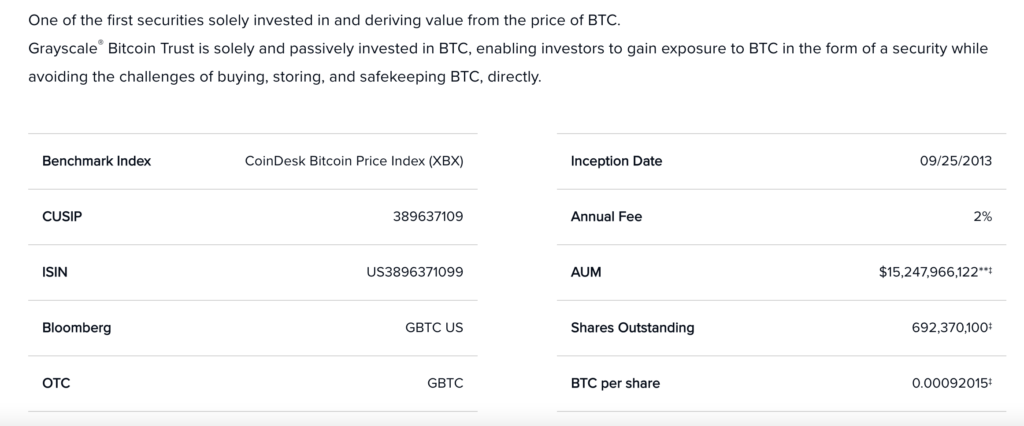
    Below you can see some basic financials on GBTC from Grayscale’s website. They include the CUSIP (389637109), where we’ll use Bloomberg to investigate GBTC’s high-level financials.

    Source: Grayscale Investments, LLC (August 2022)

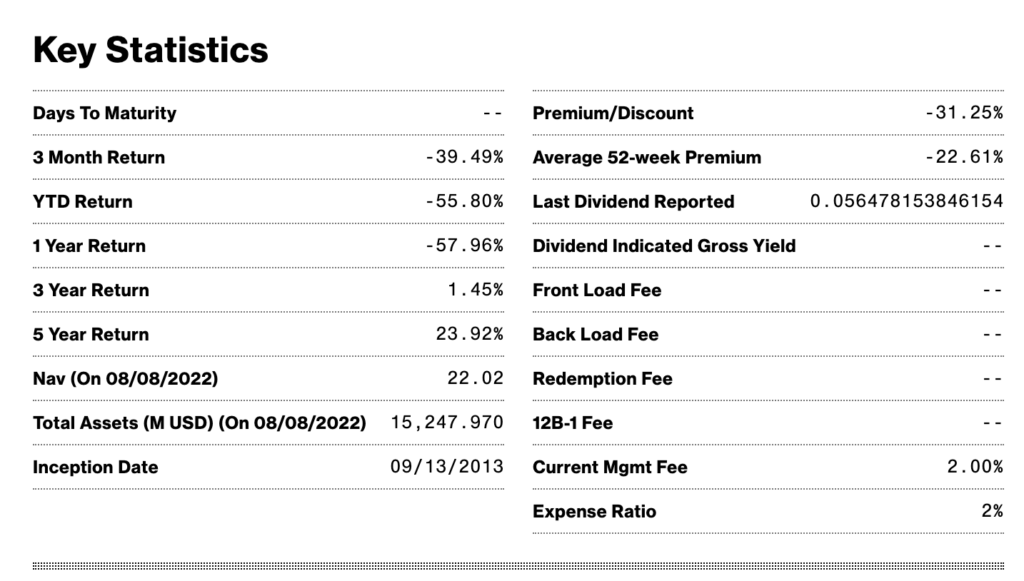
    The “Key Statistics” from Bloomberg for CUSIP 389637109 as of Tuesday August 9th, 2022 (GBTC US) are below.

    Source: Bloomberg L.P. (August 2022)

    Looking at the YTD, 1-year, 3-year, and 5-year average returns, in the context of converting this Bitcoin asset to a spot ETF, is the SEC wrong when they say Grayscale is breaking an SEC rule that “requires, in relevant part, that the rules of a national securities exchange be ‘designed to prevent fraudulent and manipulative acts and practices’ and ‘to protect investors and the public interest’”? In other words, is introducing a Bitcoin spot ETF into the marketplace more dangerous than a Bitcoin futures ETF?

    Bitcoin Futures ETFs vs. Bitcoin Spot ETFs

    While we’re not opining on a question that’s currently an open legal issue, perhaps understanding the difference would help. A spot Bitcoin ETF brings many (almost all) of the benefits of a futures ETF. Some include investing in Bitcoin without using an exchange, paying less in fees than on a crypto exchange, and streamlining the overall process (Moeller, Cointelegraph). However, a spot ETF invests in Bitcoin on the spot.

    With a Bitcoin spot ETF, you invest in Bitcoin at its spot price, meaning buyers will be holding Bitcoin within their portfolio. In practice, it’d be very much like buying a stock. Crypto enthusiasts view a spot ETF as a more legitimate method of investment, therefore Bitcoin would become more legitimized with a SEC-approved Bitcoin spot ETF product.

    Futures are defined as “derivative financial contracts that obligate parties to buy or sell an asset at a predetermined future date and price” (Investopedia, 2022). So, what’s the key difference? With a Bitcoin spot ETF, you have immediate ownership of Bitcoin. When you purchase a Bitcoin futures ETF, you’re effectively just betting on the market, depending on if you choose to take a long or short position. But purchasing a Bitcoin futures ETF by no means entails immediate ownership of Bitcoin as an asset. If you’re going to purchase a SEC-approved Bitcoin spot ETF in the future, as one does not exist today, it’s critical to understand you’ll immediately add Bitcoin to your asset portfolio.

    GBTC’s Primary Differentiator: Security

    That seems to circle back to Grayscale’s initial pitch of the GBTC having “robust security and storage”. The SEC appears to be making less of a comment on the GBTC than they are about Bitcoin in general. A Bitcoin spot ETF can only be rejected for the reasons given by the SEC if they felt that Bitcoin was too susceptible to “fraudulent and manipulative acts”. Through strategic marketing, Grayscale is looking to differentiate their potential Bitcoin spot ETF product as completely secure. Furthermore, they’ve had the longest and most hopeful petition to the SEC for a Bitcoin spot ETF, with initial efforts dating back to 2016 (Moeller, Cointelegraph). Over six years later, Grayscale remains just as committed to convert the GBTC to Bitcoin’s first SEC-approved spot ETF. Whether or not they’ll be successful is still very much an open question. It’s worth noting that Grayscale’s Bitcoin Trust (GBTC) is the world’s only SEC-approved, publicly traded “Bitcoin Trust”. A “Bitcoin Trust” can be very closely compared to a private-placement trust. It trades just like a stock over the counter. That existing confidence, along with potential first-mover market advantage, would certainly give Grayscale a huge reason to seek to overturn the SEC’s latest official ruling.

    For reference, if you want to investigate a few of the best-known Bitcoin futures ETFs, they include ProShares BITO Bitcoin futures ETF, Valkyrie Bitcoin Strategy ETF, and VanEck Bitcoin Strategy ETF. The ProShares BITO Bitcoin futures ETF currently holds around $1B in investments (Moeller, Cointelegraph). For a look closer at information and BITO’s financials, they’re listed on the New York Stock Exchange (NYSE: Arca). For additional information on Grayscale Investments or the GBTC, their website can be found here.

  • Grayscale Investments, LLC Presents: Grayscale Bitcoin Trust (GBTC), Bitcoin’s First Spot ETF?

    Amongst the latest “hot topics” in the Financial Technology (FinTech) space is a cryptocurrency product aimed at changing the receptiveness of the international investment community to cryptocurrencies. Grayscale Investments, LLC has created the GBTC (Grayscale Bitcoin Trust), in an attempt to make a cryptocurrency product more marketable to institutional investors, pension funds, and other more traditional investment vehicles. Whether this approach will work in the long-term seems to be very hotly contested at the moment, for a number of reasons.

    The Grayscale Bitcoin Trust (GBTC)

    Surprisingly – though maybe not to many in the crypto community – Grayscale largely markets the GBTC for its “robust security and storage”. You would think that as an asset manager, even a crypto asset manager, Grayscale would be more excited about presenting numbers that investors are typically hungry for. However, they lead by offering the following:

    “Grayscale Bitcoin Trust’s assets are stored in offline or “cold” storage with Coinbase Custody Trust Company, LLC, as Custodian. The Custodian is a fiduciary under § 100 of the New York Banking Law and a qualified custodian for purposes of Rule 206(4)-2(d)(6) under the Investment Advisers Act of 1940, as amended.”

    Grayscale Investments, LLC (2022)

    Additional benefits, advertised by Grayscale, to purchase the GBTC include tax-advantaged account eligibility, “titled, auditable ownership [of a crypto asset] through a traditional investment vehicle”, publicly quoted price (OTCQX®: GBTC), and support from a network of trusted providers (this is where they let you know they have hired global financial services legal tycoon Davis Polk & Wardwell LLP). Why is that relevant?

    The SEC’s Ruling on Grayscale’s Bitcoin Spot ETF

    At the top of Grayscale’s website, you’ll see a banner with a hyperlink stating, “We’ve received a decision in our application to convert GBTC to an ETF”. That’s the real storyline here. It’s not the GBTC, it’s the fact that the SEC has disallowed Grayscale to convert the GBTC into a Bitcoin spot ETF. The concise version of the SEC’s 86-page decision can be captured in the following paragraph:

    “This order disapproves the proposed rule change, as modified by Amendment No. 1. The Commission concludes that NYSE Arca has not met its burden under the Exchange Act and the Commission’s Rules of Practice to demonstrate that its proposal is consistent with the requirements of Exchange Act Section 6(b)(5), which requires, in relevant part, that the rules of a national securities exchange be ‘designed to prevent fraudulent and manipulative acts and practices’ and ‘to protect investors and the public interest.’’’

    SEC, Release No. 34-95180; File No. SR-NYSEArca-2021-90 (July 22, 2022)

    Grayscale immediately responded by hiring former U.S. Solicitor General, Donald B. Verrilli, Jr. – best known for arguing President Obama’s ACA (Affordable Care Act) successfully before the US Supreme Court – who filed an appeal of the SEC’s ruling. Grayscale says they had no choice but to escalate the matter, given the “SEC’s arbitrary and capricious actions and discriminatory treatment of issuers”. The appeal seems to be almost exclusively relying on the argument that the SEC has allowed multiple Bitcoin futures ETFs into the marketplace. Furthermore, since their treatment of futures and spots of derivatives is generally similar, they are unjustly denying investors access to a new marketplace: Bitcoin spot ETFs. GBTC has the potential to become the first Bitcoin spot ETF to be approved by the SEC.

    A High-Level Look at GBTC’s Financials

    Below you can see some basic financials on GBTC from Grayscale’s website. They include the CUSIP (389637109), where we’ll use Bloomberg to investigate GBTC’s high-level financials.

    Source: Grayscale Investments, LLC (August 2022)

    The “Key Statistics” from Bloomberg for CUSIP 389637109 as of Tuesday August 9th, 2022 (GBTC US) are below.

    Source: Bloomberg L.P. (August 2022)

    Looking at the YTD, 1-year, 3-year, and 5-year average returns, in the context of converting this Bitcoin asset to a spot ETF, is the SEC wrong when they say Grayscale is breaking an SEC rule that “requires, in relevant part, that the rules of a national securities exchange be ‘designed to prevent fraudulent and manipulative acts and practices’ and ‘to protect investors and the public interest’”? In other words, is introducing a Bitcoin spot ETF into the marketplace more dangerous than a Bitcoin futures ETF?

    Bitcoin Futures ETFs vs. Bitcoin Spot ETFs

    While we’re not opining on a question that’s currently an open legal issue, perhaps understanding the difference would help. A spot Bitcoin ETF brings many (almost all) of the benefits of a futures ETF. Some include investing in Bitcoin without using an exchange, paying less in fees than on a crypto exchange, and streamlining the overall process (Moeller, Cointelegraph). However, a spot ETF invests in Bitcoin on the spot.

    With a Bitcoin spot ETF, you invest in Bitcoin at its spot price, meaning buyers will be holding Bitcoin within their portfolio. In practice, it’d be very much like buying a stock. Crypto enthusiasts view a spot ETF as a more legitimate method of investment, therefore Bitcoin would become more legitimized with a SEC-approved Bitcoin spot ETF product.

    Futures are defined as “derivative financial contracts that obligate parties to buy or sell an asset at a predetermined future date and price” (Investopedia, 2022). So, what’s the key difference? With a Bitcoin spot ETF, you have immediate ownership of Bitcoin. When you purchase a Bitcoin futures ETF, you’re effectively just betting on the market, depending on if you choose to take a long or short position. But purchasing a Bitcoin futures ETF by no means entails immediate ownership of Bitcoin as an asset. If you’re going to purchase a SEC-approved Bitcoin spot ETF in the future, as one does not exist today, it’s critical to understand you’ll immediately add Bitcoin to your asset portfolio.

    GBTC’s Primary Differentiator: Security

    That seems to circle back to Grayscale’s initial pitch of the GBTC having “robust security and storage”. The SEC appears to be making less of a comment on the GBTC than they are about Bitcoin in general. A Bitcoin spot ETF can only be rejected for the reasons given by the SEC if they felt that Bitcoin was too susceptible to “fraudulent and manipulative acts”. Through strategic marketing, Grayscale is looking to differentiate their potential Bitcoin spot ETF product as completely secure. Furthermore, they’ve had the longest and most hopeful petition to the SEC for a Bitcoin spot ETF, with initial efforts dating back to 2016 (Moeller, Cointelegraph). Over six years later, Grayscale remains just as committed to convert the GBTC to Bitcoin’s first SEC-approved spot ETF. Whether or not they’ll be successful is still very much an open question. It’s worth noting that Grayscale’s Bitcoin Trust (GBTC) is the world’s only SEC-approved, publicly traded “Bitcoin Trust”. A “Bitcoin Trust” can be very closely compared to a private-placement trust. It trades just like a stock over the counter. That existing confidence, along with potential first-mover market advantage, would certainly give Grayscale a huge reason to seek to overturn the SEC’s latest official ruling.

    For reference, if you want to investigate a few of the best-known Bitcoin futures ETFs, they include ProShares BITO Bitcoin futures ETF, Valkyrie Bitcoin Strategy ETF, and VanEck Bitcoin Strategy ETF. The ProShares BITO Bitcoin futures ETF currently holds around $1B in investments (Moeller, Cointelegraph). For a look closer at information and BITO’s financials, they’re listed on the New York Stock Exchange (NYSE: Arca). For additional information on Grayscale Investments or the GBTC, their website can be found here.

  • What Happened to the Cryptocurrency Market on Black Friday?

    On a Friday that surely won’t be forgotten anytime soon, on January 21st, 2022, according to CoinMarketCap, cryptocurrencies lost $205 billion in combined market capitalization. Bitcoin was trading at $38,440 as of 10AM Eastern Time on the day many are already calling “Black Friday”. This represents a 16.6% year-to-date drop for the most widely recognized cryptocurrency (Morris, Fortune). Furthermore, Bitcoin has already successfully erased 75% of their gains from 2021 and we’re less than a month into 2022.

    Additional noteworthy cryptocurrencies that suffered substantial setbacks were Ethereum, Solana, and Cardano. Ethereum is especially relevant here, as they received a monumental endorsement from Goldman Sachs in mid-2021. It plummeted 13.5% on Black Friday (-24% YTD), while Solana crashed 16% the same day (-30% YTD), and Cardano dropped 15% (Morris, Fortune). Cardano is also unique since their early gains make their current -8.5% YTD slip seem almost unscathed by comparison.

    Fortune

    Dodgecoin and Shiba Inu, classified as “meme coins”, weren’t exempt from the carnage either, falling 10% and 13%, respectively (Shrivastava, Yahoo Finance). According to CoinMarketCap, judging by overall market cap, they are by far the two largest meme coins. With that, let’s dig into the question investors around the world are actively pondering; what happened?

    Russia’s Central Bank Proposed a Cryptocurrency Ban

    Let’s start with the most obvious. On Black Friday, Reuters reported Russia, one of the world’s largest economies the third-largest Bitcoin miner in the world, proposed banning the use and mining of cryptocurrencies via their central bank. This is eerily similar to a move China pulled at the end of May 2021. We similarly witnessed Bitcoin and other major crypto’s suffer short-term dips, while quickly rebounding in the immediate weeks that followed.

    Russia’s central bank argued cryptocurrencies pose a substantial threat to the country’s financial stability. Additionally, they highlighted reasons pertaining to citizens’ wellbeing and its monetary policy sovereignty (Reuters). Ultimately, Russia’s central bank didn’t mince words, concluding with:

    “The best solution is to introduce a ban on cryptocurrency mining in Russia”

    -The Central Bank of Russian Federation (CBR)

    What’s lacking coverage right now is Russia has been arguing against cryptocurrency adoption for years. Russia’s been extremely vocal in raising concerns about the ease of cryptocurrency markets being used for money laundering and even financing global terrorism. It wasn’t until 2020 that they were given legal status, despite still being banned as a means of payment.

    Specific to events that unfolded on Black Friday, Russia’s central bank focused heavily on the long-term stability of cryptocurrencies. To be blunt, it tore them apart. The central bank determined their rapid growth was reflective of potentially perilous instability. Essentially, the central bank issued stern warnings of the cryptocurrency market being one enormous bubble. They went so far as to indicate cryptocurrencies carried similar characteristics to a financial pyramid.

    Large Market Liquidations Led by Bitcoin

    As one would expect, Black Friday was one of the highest ever single-day cryptocurrency liquidations. The significance of losing a combined $205 billion in market capitalization over a 24-hour period cannot be underscored. Leading that effort was Bitcoin, with Ethereum not far behind. The two lost over $281 billion and $207 billion in 24 hours, respectively.

    The below chart, derived from CoinGlass Liquidation Data, does an excellent job in illustrating how Bitcoin’s price is impacted by investors taking a short position on crypto’s. As investors begin to show skepticism, it appears Bitcoin (BTC) begins to snowball downwards at an increasing rate.

    CoinGlass

    As the largest and most well-known cryptocurrency, historically Bitcoin’s performance dictates the overall crypto market trend. The same proved to be true on Black Friday.

    CoinGlass/Yahoo Finance

    Wall Street’s Weak Overall Weekly Performance

    Looking to recent history again, the US stock market performance has had a direct relationship with the crypto market’s performance. Before Black Friday, the S&P 500 Index (SPX) dropped nearly 4% over the course of 72 hours (Shrivastava, Yahoo Finance). When this was covered in real-time by Yahoo Finance, MacroAxis’ model had a maximum correlation of 0.59 between BTC and SPX. This is considered a significant correlation. The macroeconomic models from MacroAxis now show an existing correlation as high as 0.64, a stunning daily increase.

    While Russia’s central bank is undeniably the primary catalyst, Bitcoin’s rapid liquidation created an expected snowball effect. That made for terrible timing for historically safe, reliable US stock market investments to have a noticeably subpar week. Many investors, who were already feeling the pressure of safer investments in their portfolio losing value, were put in an even more precarious situation with their more speculative investments nosediving, causing many to quickly liquidate before further damage was done.

    Unsurprisingly, what’s next for Bitcoin and the cryptocurrency market is continuing to be widely debated. Multiple highly credible analysts and institutions remain firmly bullish, claiming Bitcoin will surpass $100,000. While a very wide network of high-net-worth individuals and financial giants still backing Bitcoin and crypto’s exists, it’s hard to imagine we won’t see another rebound yet again.

  • What Happened to the Cryptocurrency Market on Black Friday?

    On a Friday that surely won’t be forgotten anytime soon, on January 21st, 2022, according to CoinMarketCap, cryptocurrencies lost $205 billion in combined market capitalization. Bitcoin was trading at $38,440 as of 10AM Eastern Time on the day many are already calling “Black Friday”. This represents a 16.6% year-to-date drop for the most widely recognized cryptocurrency (Morris, Fortune). Furthermore, Bitcoin has already successfully erased 75% of their gains from 2021 and we’re less than a month into 2022.

    Additional noteworthy cryptocurrencies that suffered substantial setbacks were Ethereum, Solana, and Cardano. Ethereum is especially relevant here, as they received a monumental endorsement from Goldman Sachs in mid-2021. It plummeted 13.5% on Black Friday (-24% YTD), while Solana crashed 16% the same day (-30% YTD), and Cardano dropped 15% (Morris, Fortune). Cardano is also unique since their early gains make their current -8.5% YTD slip seem almost unscathed by comparison.

    Fortune

    Dodgecoin and Shiba Inu, classified as “meme coins”, weren’t exempt from the carnage either, falling 10% and 13%, respectively (Shrivastava, Yahoo Finance). According to CoinMarketCap, judging by overall market cap, they are by far the two largest meme coins. With that, let’s dig into the question investors around the world are actively pondering; what happened?

    Russia’s Central Bank Proposed a Cryptocurrency Ban

    Let’s start with the most obvious. On Black Friday, Reuters reported Russia, one of the world’s largest economies the third-largest Bitcoin miner in the world, proposed banning the use and mining of cryptocurrencies via their central bank. This is eerily similar to a move China pulled at the end of May 2021. We similarly witnessed Bitcoin and other major crypto’s suffer short-term dips, while quickly rebounding in the immediate weeks that followed.

    Russia’s central bank argued cryptocurrencies pose a substantial threat to the country’s financial stability. Additionally, they highlighted reasons pertaining to citizens’ wellbeing and its monetary policy sovereignty (Reuters). Ultimately, Russia’s central bank didn’t mince words, concluding with:

    “The best solution is to introduce a ban on cryptocurrency mining in Russia”

    -The Central Bank of Russian Federation (CBR)

    What’s lacking coverage right now is Russia has been arguing against cryptocurrency adoption for years. Russia’s been extremely vocal in raising concerns about the ease of cryptocurrency markets being used for money laundering and even financing global terrorism. It wasn’t until 2020 that they were given legal status, despite still being banned as a means of payment.

    Specific to events that unfolded on Black Friday, Russia’s central bank focused heavily on the long-term stability of cryptocurrencies. To be blunt, it tore them apart. The central bank determined their rapid growth was reflective of potentially perilous instability. Essentially, the central bank issued stern warnings of the cryptocurrency market being one enormous bubble. They went so far as to indicate cryptocurrencies carried similar characteristics to a financial pyramid.

    Large Market Liquidations Led by Bitcoin

    As one would expect, Black Friday was one of the highest ever single-day cryptocurrency liquidations. The significance of losing a combined $205 billion in market capitalization over a 24-hour period cannot be underscored. Leading that effort was Bitcoin, with Ethereum not far behind. The two lost over $281 billion and $207 billion in 24 hours, respectively.

    The below chart, derived from CoinGlass Liquidation Data, does an excellent job in illustrating how Bitcoin’s price is impacted by investors taking a short position on crypto’s. As investors begin to show skepticism, it appears Bitcoin (BTC) begins to snowball downwards at an increasing rate.

    CoinGlass

    As the largest and most well-known cryptocurrency, historically Bitcoin’s performance dictates the overall crypto market trend. The same proved to be true on Black Friday.

    CoinGlass/Yahoo Finance

    Wall Street’s Weak Overall Weekly Performance

    Looking to recent history again, the US stock market performance has had a direct relationship with the crypto market’s performance. Before Black Friday, the S&P 500 Index (SPX) dropped nearly 4% over the course of 72 hours (Shrivastava, Yahoo Finance). When this was covered in real-time by Yahoo Finance, MacroAxis’ model had a maximum correlation of 0.59 between BTC and SPX. This is considered a significant correlation. The macroeconomic models from MacroAxis now show an existing correlation as high as 0.64, a stunning daily increase.

    While Russia’s central bank is undeniably the primary catalyst, Bitcoin’s rapid liquidation created an expected snowball effect. That made for terrible timing for historically safe, reliable US stock market investments to have a noticeably subpar week. Many investors, who were already feeling the pressure of safer investments in their portfolio losing value, were put in an even more precarious situation with their more speculative investments nosediving, causing many to quickly liquidate before further damage was done.

    Unsurprisingly, what’s next for Bitcoin and the cryptocurrency market is continuing to be widely debated. Multiple highly credible analysts and institutions remain firmly bullish, claiming Bitcoin will surpass $100,000. While a very wide network of high-net-worth individuals and financial giants still backing Bitcoin and crypto’s exists, it’s hard to imagine we won’t see another rebound yet again.