Tag: custodian bank

  • The World’s Oldest and Largest Custodian Bank – BNY Mellon – Builds Platform to Revolutionize Digital Asset Custody Services

    BNY Mellon, founded by Alexander Hamilton in 1784 – the first US Treasury Secretary – has announced they are continuing to build out a highly advanced, robust, and secure digital assets custody business.

    “Touching more than 20% of the world’s investable assets, BNY Mellon has the scale to help our clients reimagine financial markets through blockchain technology and digital assets. We are still in the early days of this evolution, but the possibilities are exciting. Today’s announcement marks a step in what we see as an ongoing innovation journey for our firm, our clients and the rest of the financial industry.”

    -Robin Vince, CEO of BNY Mellon

    BNY’s custodianship business is based on some of the very principles Hamilton wrote about in the late 1700s. They are both the largest and the oldest custodian bank in the world, with approximately $45T (Trillion) in Assets Under Custody (AUC). With their experience, brand recognition, and unique ability to utilize economies of scale – coupled with what appears to be a recent renewed peaking interest in digital assets – this move is an example of exceptional business strategy.

    The Timing of BNY Mellon’s Announcement

    The timing of the announcement is interesting for a number of reasons. Firstly (likely the primary reason), the Sibos Update conference, which initially lasted from 10/10-10/13. BNY had a very large presence and rolled this news out in parallel. Secondly, we’re at an absolutely critical point in macroeconomic policy. Will the Fed’s decision to hike up rates to deflate the inflation work? Did they start too late? What’s the impact on US and global financial markets? Presently, those questions are central to investors every single day.

    Generally, during recessionary cyclical economic times, at-risk assets don’t do well (to say the least). Cryptocurrencies and digital assets are in the heart of today’s at-risk assets category – though that may be slowly changing. Regardless, during such a time of economic uncertainty, rolling out a high-tech, revolutionary custodianship service for digital assets is interesting. That leads me to the next timing overlap.

    The SEC’s Ongoing Persistence of Rejecting Bitcoin Spot ETF Proposals

    The SEC has been on a roll with rejecting Bitcoin spot ETFs. Coverage of this began intensifying when they rejected Grayscale GBTC’s conversion request from a SEC-approved Bitcoin Trust to an SEC-approved Bitcoin spot ETF. Grayscale immediately retained Donald Verrilli Jr., who subsequently filed a quick appeal. Verrilli is best known for making a successful oral argument to the US Supreme Court in favor of the ACA (Obamacare). Afterwards, any new Bitcoin ETF – especially spot ETFs – were widely covered by the media and enthused investors. This announcement came on October 11th, 2022, the same day WisdomTree’s Bitcoin spot ETF application was rejected by the SEC, which is also coincidentally the same date the SEC had a deadline to respond to VanEck’s appeal of their previously rejected Bitcoin spot ETF. To note, the SEC has now missed their 45-day deadline to respond.

    Bear in mind, VanEck is not heavily exposed in digital assets at all. They are a highly reputable institutional investment firm, with one SEC-approved Bitcoin Strategy ETF on the market. As all other currently SEC-approved Bitcoin ETFs, VanEck’s Strategy ETF is a Bitcoin futures ETF. Nonetheless, BNY Mellon – very likely coincidentally, admittedly – announced this launch on the same day as two highly anticipated SEC rulings on digital asset products.

    Expected Impact for the Digital Asset Market

    The impact, especially in the longer-term, is potentially massive. Let’s remember the primary, above-and-beyond, number one reason the SEC is rejecting Bitcoin spot ETFs: security. Grayscale’s SEC-approved GBTC Bitcoin Trust advertises and details the product’s custodianship. The custodian is Coinbase Custody Trust Company, LLC. In other words, at least from the branding, the custodian of the cryptocurrency product is a cryptocurrency-specific custodian. Continuing with the Grayscale example, this makes their rebuttal to the SEC more difficult. Is there any remotely tangible security added if a cryptocurrency product is in the custody of another cryptocurrency-specific firm? I don’t doubt Grayscale’s ability to make a compelling and technically robust argument, but I seriously doubt the SEC’s acceptance.

    What if the scenario remains the same, with the only change being the custodian. With very few exceptions, in my opinion nothing really changes. That is, unless the custodian is BNY Mellon. Some, including myself, might argue that turns the dynamic in the other direction. If GBTC is held in the custody of BNY Mellon, would the SEC still cite security concerns? Unimaginable. BNY Mellon’s brand is iconic when it comes to custodianship services in global banking. Through this core offering, BNY Mellon alone winds up touching over 20% – or more than 1 out of every 5 USD (or global currency equivalent) – throughout the entire world. That’s astounding. Keeping in mind they are the oldest bank and the oldest publicly traded company, BNY must be doing something right in custodianship services.

    Security Has Always Been Paramount in Custodian Banking

    With custodianship banking generally, security is definitely mission critical. BNY has provided this service, highly successfully, arguably longer than any other service offered by any institution. They’ve been evolving the custody banking sector since the late 1700s. Back to the SEC, if I’m looking at GBTC in the custody of BNY Mellon, I don’t see any compelling argument for security concerns. If anything, I’d see that as more of comical reasoning. The SEC could always pivot to another, more plausible concern if (when) that were to happen, but it’s still a huge win for the digital asset market – as well as BNY Mellon.

    As a final note here, the SEC is rejecting Bitcoin spot ETFs at an increasing rate, meaning applications are growing. More and more firms are attempting to get SEC-approved Bitcoin products into the marketplace. Clearly, they’re prognosticating an increase in investor demand for digital asset products and are attempting to respond accordingly. Let’s also be clear – investors and investment firms aren’t required to get SEC clearance to sell Bitcoin derivatives.

    That said, of course it’s highly preferred. In an asset class still largely plagued by uncertainty, SEC approval is an immediate, gigantic game-changer. BNY Mellon holding custody of digital assets on an in-house, BNY Mellon digital assets custody platform changes cryptocurrency market dynamics. It also likely puts cryptocurrency-specific custodians out of business, amongst other market effects. One would think it’d have to alter the SEC’s position substantially and broadly on digital assets. In turn, that should similarly substantially and broadly alter investor perception of digital assets.

    Could Anything Go Wrong?

    Always. On a more serious note, even Alexander Hamilton was famously quoted saying, “I never expect a perfect work from an imperfect man”. From my perspective, BNY Mellon is not only the biggest risk-taker here; they are the biggest by a landslide. This is a company that was founded by the first US Treasury Secretary and has only improved their initial, core offering over time. The SEC also isn’t raising concerns over security as a completely illegitimate excuse. We’ve seen Ethereum wallets hacked, viruses created to successfully steal Bitcoin, cyber-attacks against crypto exchanges, and more. BNY Mellon will have the sole responsibility to ensure none of that occurs on their watch, so to speak. What if they fail? That’s exactly the point at which this could all go terribly wrong.

    BNY Mellon built a brand with the core focus on custodian banking spanning the course of over 225 years. They are widely considered to be the most prestigious and critical institutional investment services firm in the world. Now they’ve made a major move into the digital asset space, an admittedly enticing and potentially extremely lucrative strategy. However, in banking, all it takes to bring down a reputation built over 225 years is one mistake in seconds.

    To be sure, there’s added nuance here. Digital assets are naturally going to be more susceptible to evolving technologies as digital assets themselves are an evolving technology. Cybersecurity preventability measures and the sophistication of cybersecurity attacks have both increased. In the age of digital transformation, I believe this is a correctly calculated risk for BNY Mellon.

    Extent a Momentary Error Could Hurt BNY Mellon’s Core Business

    While there can be little to no doubt a security issue coming from BNY’s digital asset custody platform would be detrimental to the company – potentially in a very large way – the same can be said for the likelihood of that instance actually bringing down what BNY’s built in over 225 years. Even if the world’s most secure custodian has a security malfunction, I don’t believe it would even impact their current business model. It may take them out of digital asset custody services – I think even that is reaching – but again, I don’t see it majorly tarnishing the brand.

    All-in-all, this is a win-win scenario, statistically speaking. Yes, something could go wrong. When this platform is ready for go-live and it’s used broadly, we’ll get a better sense of the impact. But BNY especially would not dramatically – out of character – launch a futuristic digital assets custody platform that didn’t meet the mark from a technology perspective.

    There shouldn’t be doubt BNY made budgetary concerns a main priority, or even an obstacle, of this project. The team they’ve assembled is comprised of the brightest, most experienced, innovative SME’s in their respective areas. This continuing work-in-progress originated in 2019 and is just now starting to be publicly rolled out in a significant way. BNY likely took 3 years to ensure they had capacity to build a product worthy of publicly announcing is work-in-progress. They notably take perfection seriously; I doubt many disbelieve they’re going to rollout an incredible product. Whether perfection in digital assets custody is attainable is a separate discussion, but if anyone could, it’s BNY Mellon.

  • The World’s Oldest and Largest Custodian Bank – BNY Mellon – Builds Platform to Revolutionize Digital Asset Custody Services

    BNY Mellon, founded by Alexander Hamilton in 1784 – the first US Treasury Secretary – has announced they are continuing to build out a highly advanced, robust, and secure digital assets custody business.

    “Touching more than 20% of the world’s investable assets, BNY Mellon has the scale to help our clients reimagine financial markets through blockchain technology and digital assets. We are still in the early days of this evolution, but the possibilities are exciting. Today’s announcement marks a step in what we see as an ongoing innovation journey for our firm, our clients and the rest of the financial industry.”

    -Robin Vince, CEO of BNY Mellon

    BNY’s custodianship business is based on some of the very principles Hamilton wrote about in the late 1700s. They are both the largest and the oldest custodian bank in the world, with approximately $45T (Trillion) in Assets Under Custody (AUC). With their experience, brand recognition, and unique ability to utilize economies of scale – coupled with what appears to be a recent renewed peaking interest in digital assets – this move is an example of exceptional business strategy.

    The Timing of BNY Mellon’s Announcement

    The timing of the announcement is interesting for a number of reasons. Firstly (likely the primary reason), the Sibos Update conference, which initially lasted from 10/10-10/13. BNY had a very large presence and rolled this news out in parallel. Secondly, we’re at an absolutely critical point in macroeconomic policy. Will the Fed’s decision to hike up rates to deflate the inflation work? Did they start too late? What’s the impact on US and global financial markets? Presently, those questions are central to investors every single day.

    Generally, during recessionary cyclical economic times, at-risk assets don’t do well (to say the least). Cryptocurrencies and digital assets are in the heart of today’s at-risk assets category – though that may be slowly changing. Regardless, during such a time of economic uncertainty, rolling out a high-tech, revolutionary custodianship service for digital assets is interesting. That leads me to the next timing overlap.

    The SEC’s Ongoing Persistence of Rejecting Bitcoin Spot ETF Proposals

    The SEC has been on a roll with rejecting Bitcoin spot ETFs. Coverage of this began intensifying when they rejected Grayscale GBTC’s conversion request from a SEC-approved Bitcoin Trust to an SEC-approved Bitcoin spot ETF. Grayscale immediately retained Donald Verrilli Jr., who subsequently filed a quick appeal. Verrilli is best known for making a successful oral argument to the US Supreme Court in favor of the ACA (Obamacare). Afterwards, any new Bitcoin ETF – especially spot ETFs – were widely covered by the media and enthused investors. This announcement came on October 11th, 2022, the same day WisdomTree’s Bitcoin spot ETF application was rejected by the SEC, which is also coincidentally the same date the SEC had a deadline to respond to VanEck’s appeal of their previously rejected Bitcoin spot ETF. To note, the SEC has now missed their 45-day deadline to respond.

    Bear in mind, VanEck is not heavily exposed in digital assets at all. They are a highly reputable institutional investment firm, with one SEC-approved Bitcoin Strategy ETF on the market. As all other currently SEC-approved Bitcoin ETFs, VanEck’s Strategy ETF is a Bitcoin futures ETF. Nonetheless, BNY Mellon – very likely coincidentally, admittedly – announced this launch on the same day as two highly anticipated SEC rulings on digital asset products.

    Expected Impact for the Digital Asset Market

    The impact, especially in the longer-term, is potentially massive. Let’s remember the primary, above-and-beyond, number one reason the SEC is rejecting Bitcoin spot ETFs: security. Grayscale’s SEC-approved GBTC Bitcoin Trust advertises and details the product’s custodianship. The custodian is Coinbase Custody Trust Company, LLC. In other words, at least from the branding, the custodian of the cryptocurrency product is a cryptocurrency-specific custodian. Continuing with the Grayscale example, this makes their rebuttal to the SEC more difficult. Is there any remotely tangible security added if a cryptocurrency product is in the custody of another cryptocurrency-specific firm? I don’t doubt Grayscale’s ability to make a compelling and technically robust argument, but I seriously doubt the SEC’s acceptance.

    What if the scenario remains the same, with the only change being the custodian. With very few exceptions, in my opinion nothing really changes. That is, unless the custodian is BNY Mellon. Some, including myself, might argue that turns the dynamic in the other direction. If GBTC is held in the custody of BNY Mellon, would the SEC still cite security concerns? Unimaginable. BNY Mellon’s brand is iconic when it comes to custodianship services in global banking. Through this core offering, BNY Mellon alone winds up touching over 20% – or more than 1 out of every 5 USD (or global currency equivalent) – throughout the entire world. That’s astounding. Keeping in mind they are the oldest bank and the oldest publicly traded company, BNY must be doing something right in custodianship services.

    Security Has Always Been Paramount in Custodian Banking

    With custodianship banking generally, security is definitely mission critical. BNY has provided this service, highly successfully, arguably longer than any other service offered by any institution. They’ve been evolving the custody banking sector since the late 1700s. Back to the SEC, if I’m looking at GBTC in the custody of BNY Mellon, I don’t see any compelling argument for security concerns. If anything, I’d see that as more of comical reasoning. The SEC could always pivot to another, more plausible concern if (when) that were to happen, but it’s still a huge win for the digital asset market – as well as BNY Mellon.

    As a final note here, the SEC is rejecting Bitcoin spot ETFs at an increasing rate, meaning applications are growing. More and more firms are attempting to get SEC-approved Bitcoin products into the marketplace. Clearly, they’re prognosticating an increase in investor demand for digital asset products and are attempting to respond accordingly. Let’s also be clear – investors and investment firms aren’t required to get SEC clearance to sell Bitcoin derivatives.

    That said, of course it’s highly preferred. In an asset class still largely plagued by uncertainty, SEC approval is an immediate, gigantic game-changer. BNY Mellon holding custody of digital assets on an in-house, BNY Mellon digital assets custody platform changes cryptocurrency market dynamics. It also likely puts cryptocurrency-specific custodians out of business, amongst other market effects. One would think it’d have to alter the SEC’s position substantially and broadly on digital assets. In turn, that should similarly substantially and broadly alter investor perception of digital assets.

    Could Anything Go Wrong?

    Always. On a more serious note, even Alexander Hamilton was famously quoted saying, “I never expect a perfect work from an imperfect man”. From my perspective, BNY Mellon is not only the biggest risk-taker here; they are the biggest by a landslide. This is a company that was founded by the first US Treasury Secretary and has only improved their initial, core offering over time. The SEC also isn’t raising concerns over security as a completely illegitimate excuse. We’ve seen Ethereum wallets hacked, viruses created to successfully steal Bitcoin, cyber-attacks against crypto exchanges, and more. BNY Mellon will have the sole responsibility to ensure none of that occurs on their watch, so to speak. What if they fail? That’s exactly the point at which this could all go terribly wrong.

    BNY Mellon built a brand with the core focus on custodian banking spanning the course of over 225 years. They are widely considered to be the most prestigious and critical institutional investment services firm in the world. Now they’ve made a major move into the digital asset space, an admittedly enticing and potentially extremely lucrative strategy. However, in banking, all it takes to bring down a reputation built over 225 years is one mistake in seconds.

    To be sure, there’s added nuance here. Digital assets are naturally going to be more susceptible to evolving technologies as digital assets themselves are an evolving technology. Cybersecurity preventability measures and the sophistication of cybersecurity attacks have both increased. In the age of digital transformation, I believe this is a correctly calculated risk for BNY Mellon.

    Extent a Momentary Error Could Hurt BNY Mellon’s Core Business

    While there can be little to no doubt a security issue coming from BNY’s digital asset custody platform would be detrimental to the company – potentially in a very large way – the same can be said for the likelihood of that instance actually bringing down what BNY’s built in over 225 years. Even if the world’s most secure custodian has a security malfunction, I don’t believe it would even impact their current business model. It may take them out of digital asset custody services – I think even that is reaching – but again, I don’t see it majorly tarnishing the brand.

    All-in-all, this is a win-win scenario, statistically speaking. Yes, something could go wrong. When this platform is ready for go-live and it’s used broadly, we’ll get a better sense of the impact. But BNY especially would not dramatically – out of character – launch a futuristic digital assets custody platform that didn’t meet the mark from a technology perspective.

    There shouldn’t be doubt BNY made budgetary concerns a main priority, or even an obstacle, of this project. The team they’ve assembled is comprised of the brightest, most experienced, innovative SME’s in their respective areas. This continuing work-in-progress originated in 2019 and is just now starting to be publicly rolled out in a significant way. BNY likely took 3 years to ensure they had capacity to build a product worthy of publicly announcing is work-in-progress. They notably take perfection seriously; I doubt many disbelieve they’re going to rollout an incredible product. Whether perfection in digital assets custody is attainable is a separate discussion, but if anyone could, it’s BNY Mellon.

  • What is a Tri-Party Repo (TREPS)and How Did the Market Operate?

    What is a Tri-Party Repo (TREPS)and How Did the Market Operate?

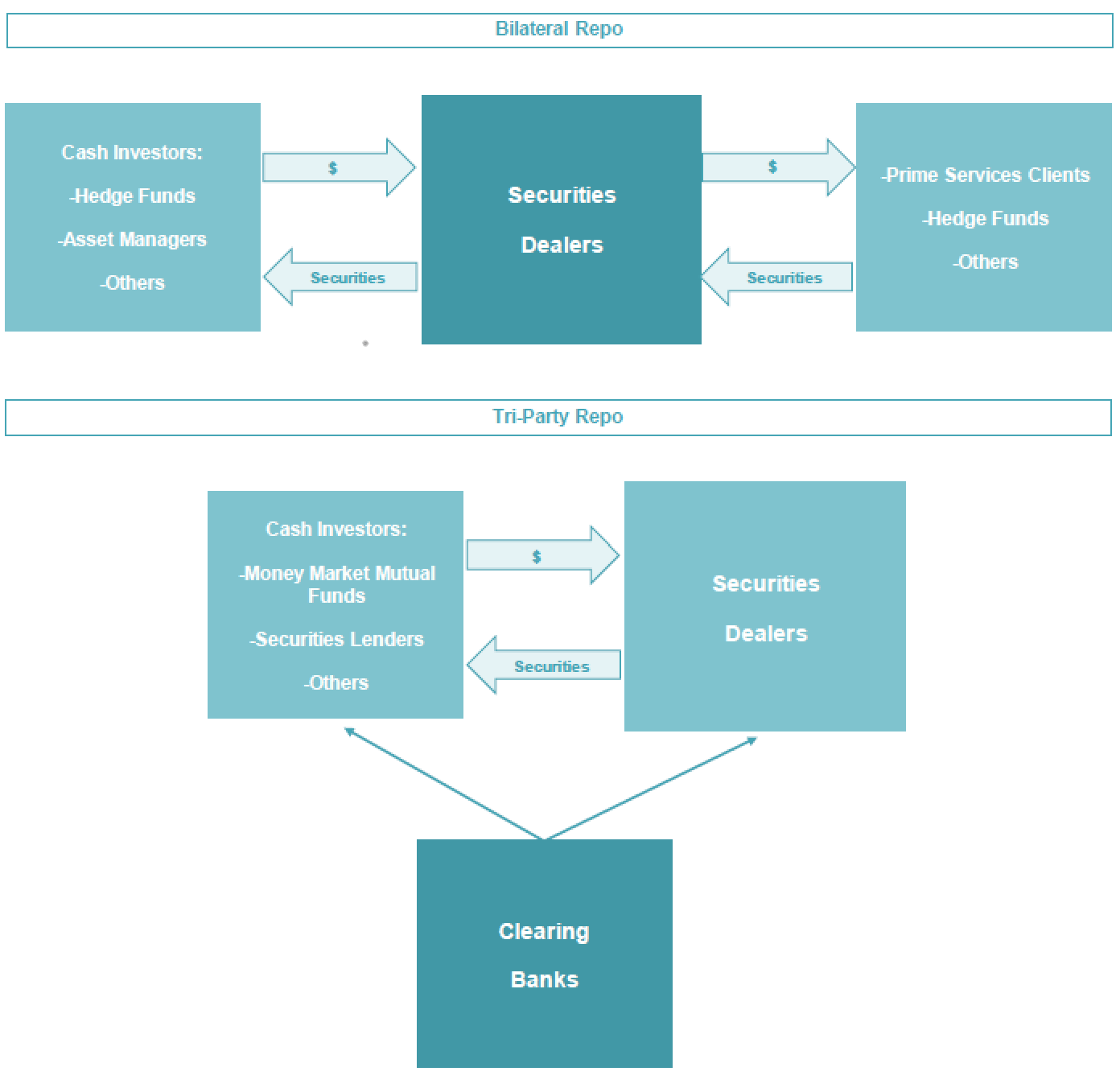
    The simplest way to understand a tri-party repo (TREPS) is to think of it as a simple repurchase agreement between two parties, where a third-party – historically a very large and reputable bank (only JPM Chase or BNY Mellon, during the time these transactions were widely common) – processes administrative work and even guarantees the cash provided by Company A to Company B and the collateral Company B secures the cash from Company A with. These third parties, commonly referred to as clearing banks, also performed valuation services to ensure the collateral put up by Company B was within the approximate fair market value of the cash lent by Company A.

    Tri-Party Repos in the Derivative Era

    These transactions actually became popular at the “boom” of the derivative trading era – even though they had a comparatively low-yield percentage for both companies – mainly because of mechanics of how these transactions occurred. They were typically cleared and settled overnight, so the investment banker would have the cash available in the morning when the trading day began. The “unwinding” process of this repo would also happen after the trading day was complete; the dealer (Company B) would finance the broker (Company A) with cash and the third-party clearing bank would take care of the rest for a small fee.

    To be clear, the responsibilities of the clearing banks weren’t minuscule, they were tasked with: taking custody of the securities involved in the repo, valuing the securities and making sure that the specified margin is applied, settling the transaction on their books, and offer services to help dealers optimize the use of their collateral. However as mentioned, to give dealers access to their securities during the day, the clearing banks settle all repos very early each day, returning cash to cash investors and collateral to dealers. This would lead to a delay in real-time settlement, therefore in reality the clearing banks wind up extending hundreds of billions of intraday credit to the dealers until new repos are settled in the evening.

    Role in 2008 Financial Crisis

    It’s argued by many to have played an underscored role in the 2008 US Financial Crisis, primarily because between 2007-2009 these repurchase agreements became a common daily routine for almost all of the largest brokers and dealers in the world. This was for several logical reasons. Firstly, it made sense for securities brokers to engage in because they have access to cash immediately, the second the daily trading day begins.

    It equally makes sense for dealers. They are receiving a profit from lending cash and they have the comfort of knowing their cash is backed by collateral that was signed off on by either JPMC or BNYM. Finally, it makes sense for the clearing bank to use their economies of scale and human resources to make a couple percentage points. At the time this was thought to be routine administrative clearing bank procedure. However, it turned out to be a much bigger nightmare than ever imagined.

    The nightmare catch is best described by the following scenario. Contemplate what happens if you have a very large and highly levered broker, like Bear Sterns as the famous example. You then encounter a situation where financial markets they have heavy exposure in drop sharply. The collateral a broker like Bear Sterns would put up would be in the form of a portfolio of securities. They wouldn’t contribute any physical assets, or guaranteed/risk-less investments (like T-Notes).

    Where Systemic Financial Fragility and Potential Crisis Begins

    Now you have a situation where the dealer (Company B) may not feel as comfortable providing liquid cash financing to Bear Sterns anymore. Then you essentially have the clearing bank – JPM Chase or BNY Mellon – incurring the loss because the process was done so hastily. They almost certainly never took the time to deeply look into whether the collateral put up by Bear Sterns was equal in liquid valuation to the cash provided by their various dealers (who by the way would usually be institutions like secondary education private schools, or institutions in a medical (or other) field with a surplus of cash), so the settlement process only occurred on paper for them.

    When things went south, even though the clearing banks do not match dealers with cash investors. Nor do they play the role of broker in that market. They had to settle disproportionately valued securities with the most liquid form of financial currency: cash. Looking at Bear Sterns, they would’ve used dozens of cash lenders to diversify. Even more so the clearing banks would be incentivized to not look too closely at their spotted collateral. Picture what happens if you have Lehman Brothers, Goldman Sachs, and Morgan Stanley incurring the same scenarios. The same day, as well. Of course Goldman Sachs and Morgan Stanley are two of the most prestigious investment banks in the world. Likely not enough of their total portfolio was invested in the tri-party repo market to cause them to fail.

    Conclusion

    However when that market did ultimately fail, things went that route for Lehman and Bear Sterns. Concisely, while on the surface a tri-party repo is a simple repurchase agreement where a third party provides administrative surfaces at a small fee for the two companies engaged in the repo, understanding the mechanics of it are invaluable to appreciating how some financial markets collapsed so rapidly in late 2008.

  • What is a Tri-Party Repo (TREPS)and How Did the Market Operate?

    What is a Tri-Party Repo (TREPS)and How Did the Market Operate?

    The simplest way to understand a tri-party repo (TREPS) is to think of it as a simple repurchase agreement between two parties, where a third-party – historically a very large and reputable bank (only JPM Chase or BNY Mellon, during the time these transactions were widely common) – processes administrative work and even guarantees the cash provided by Company A to Company B and the collateral Company B secures the cash from Company A with. These third parties, commonly referred to as clearing banks, also performed valuation services to ensure the collateral put up by Company B was within the approximate fair market value of the cash lent by Company A.

    Tri-Party Repos in the Derivative Era

    These transactions actually became popular at the “boom” of the derivative trading era – even though they had a comparatively low-yield percentage for both companies – mainly because of mechanics of how these transactions occurred. They were typically cleared and settled overnight, so the investment banker would have the cash available in the morning when the trading day began. The “unwinding” process of this repo would also happen after the trading day was complete; the dealer (Company B) would finance the broker (Company A) with cash and the third-party clearing bank would take care of the rest for a small fee.

    To be clear, the responsibilities of the clearing banks weren’t minuscule, they were tasked with: taking custody of the securities involved in the repo, valuing the securities and making sure that the specified margin is applied, settling the transaction on their books, and offer services to help dealers optimize the use of their collateral. However as mentioned, to give dealers access to their securities during the day, the clearing banks settle all repos very early each day, returning cash to cash investors and collateral to dealers. This would lead to a delay in real-time settlement, therefore in reality the clearing banks wind up extending hundreds of billions of intraday credit to the dealers until new repos are settled in the evening.

    Role in 2008 Financial Crisis

    It’s argued by many to have played an underscored role in the 2008 US Financial Crisis, primarily because between 2007-2009 these repurchase agreements became a common daily routine for almost all of the largest brokers and dealers in the world. This was for several logical reasons. Firstly, it made sense for securities brokers to engage in because they have access to cash immediately, the second the daily trading day begins.

    It equally makes sense for dealers. They are receiving a profit from lending cash and they have the comfort of knowing their cash is backed by collateral that was signed off on by either JPMC or BNYM. Finally, it makes sense for the clearing bank to use their economies of scale and human resources to make a couple percentage points. At the time this was thought to be routine administrative clearing bank procedure. However, it turned out to be a much bigger nightmare than ever imagined.

    The nightmare catch is best described by the following scenario. Contemplate what happens if you have a very large and highly levered broker, like Bear Sterns as the famous example. You then encounter a situation where financial markets they have heavy exposure in drop sharply. The collateral a broker like Bear Sterns would put up would be in the form of a portfolio of securities. They wouldn’t contribute any physical assets, or guaranteed/risk-less investments (like T-Notes).

    Where Systemic Financial Fragility and Potential Crisis Begins

    Now you have a situation where the dealer (Company B) may not feel as comfortable providing liquid cash financing to Bear Sterns anymore. Then you essentially have the clearing bank – JPM Chase or BNY Mellon – incurring the loss because the process was done so hastily. They almost certainly never took the time to deeply look into whether the collateral put up by Bear Sterns was equal in liquid valuation to the cash provided by their various dealers (who by the way would usually be institutions like secondary education private schools, or institutions in a medical (or other) field with a surplus of cash), so the settlement process only occurred on paper for them.

    When things went south, even though the clearing banks do not match dealers with cash investors. Nor do they play the role of broker in that market. They had to settle disproportionately valued securities with the most liquid form of financial currency: cash. Looking at Bear Sterns, they would’ve used dozens of cash lenders to diversify. Even more so the clearing banks would be incentivized to not look too closely at their spotted collateral. Picture what happens if you have Lehman Brothers, Goldman Sachs, and Morgan Stanley incurring the same scenarios. The same day, as well. Of course Goldman Sachs and Morgan Stanley are two of the most prestigious investment banks in the world. Likely not enough of their total portfolio was invested in the tri-party repo market to cause them to fail.

    Conclusion

    However when that market did ultimately fail, things went that route for Lehman and Bear Sterns. Concisely, while on the surface a tri-party repo is a simple repurchase agreement where a third party provides administrative surfaces at a small fee for the two companies engaged in the repo, understanding the mechanics of it are invaluable to appreciating how some financial markets collapsed so rapidly in late 2008.