Tag: digital transformation

  • The World’s Oldest and Largest Custodian Bank – BNY Mellon – Builds Platform to Revolutionize Digital Asset Custody Services

    BNY Mellon, founded by Alexander Hamilton in 1784 – the first US Treasury Secretary – has announced they are continuing to build out a highly advanced, robust, and secure digital assets custody business.

    “Touching more than 20% of the world’s investable assets, BNY Mellon has the scale to help our clients reimagine financial markets through blockchain technology and digital assets. We are still in the early days of this evolution, but the possibilities are exciting. Today’s announcement marks a step in what we see as an ongoing innovation journey for our firm, our clients and the rest of the financial industry.”

    -Robin Vince, CEO of BNY Mellon

    BNY’s custodianship business is based on some of the very principles Hamilton wrote about in the late 1700s. They are both the largest and the oldest custodian bank in the world, with approximately $45T (Trillion) in Assets Under Custody (AUC). With their experience, brand recognition, and unique ability to utilize economies of scale – coupled with what appears to be a recent renewed peaking interest in digital assets – this move is an example of exceptional business strategy.

    The Timing of BNY Mellon’s Announcement

    The timing of the announcement is interesting for a number of reasons. Firstly (likely the primary reason), the Sibos Update conference, which initially lasted from 10/10-10/13. BNY had a very large presence and rolled this news out in parallel. Secondly, we’re at an absolutely critical point in macroeconomic policy. Will the Fed’s decision to hike up rates to deflate the inflation work? Did they start too late? What’s the impact on US and global financial markets? Presently, those questions are central to investors every single day.

    Generally, during recessionary cyclical economic times, at-risk assets don’t do well (to say the least). Cryptocurrencies and digital assets are in the heart of today’s at-risk assets category – though that may be slowly changing. Regardless, during such a time of economic uncertainty, rolling out a high-tech, revolutionary custodianship service for digital assets is interesting. That leads me to the next timing overlap.

    The SEC’s Ongoing Persistence of Rejecting Bitcoin Spot ETF Proposals

    The SEC has been on a roll with rejecting Bitcoin spot ETFs. Coverage of this began intensifying when they rejected Grayscale GBTC’s conversion request from a SEC-approved Bitcoin Trust to an SEC-approved Bitcoin spot ETF. Grayscale immediately retained Donald Verrilli Jr., who subsequently filed a quick appeal. Verrilli is best known for making a successful oral argument to the US Supreme Court in favor of the ACA (Obamacare). Afterwards, any new Bitcoin ETF – especially spot ETFs – were widely covered by the media and enthused investors. This announcement came on October 11th, 2022, the same day WisdomTree’s Bitcoin spot ETF application was rejected by the SEC, which is also coincidentally the same date the SEC had a deadline to respond to VanEck’s appeal of their previously rejected Bitcoin spot ETF. To note, the SEC has now missed their 45-day deadline to respond.

    Bear in mind, VanEck is not heavily exposed in digital assets at all. They are a highly reputable institutional investment firm, with one SEC-approved Bitcoin Strategy ETF on the market. As all other currently SEC-approved Bitcoin ETFs, VanEck’s Strategy ETF is a Bitcoin futures ETF. Nonetheless, BNY Mellon – very likely coincidentally, admittedly – announced this launch on the same day as two highly anticipated SEC rulings on digital asset products.

    Expected Impact for the Digital Asset Market

    The impact, especially in the longer-term, is potentially massive. Let’s remember the primary, above-and-beyond, number one reason the SEC is rejecting Bitcoin spot ETFs: security. Grayscale’s SEC-approved GBTC Bitcoin Trust advertises and details the product’s custodianship. The custodian is Coinbase Custody Trust Company, LLC. In other words, at least from the branding, the custodian of the cryptocurrency product is a cryptocurrency-specific custodian. Continuing with the Grayscale example, this makes their rebuttal to the SEC more difficult. Is there any remotely tangible security added if a cryptocurrency product is in the custody of another cryptocurrency-specific firm? I don’t doubt Grayscale’s ability to make a compelling and technically robust argument, but I seriously doubt the SEC’s acceptance.

    What if the scenario remains the same, with the only change being the custodian. With very few exceptions, in my opinion nothing really changes. That is, unless the custodian is BNY Mellon. Some, including myself, might argue that turns the dynamic in the other direction. If GBTC is held in the custody of BNY Mellon, would the SEC still cite security concerns? Unimaginable. BNY Mellon’s brand is iconic when it comes to custodianship services in global banking. Through this core offering, BNY Mellon alone winds up touching over 20% – or more than 1 out of every 5 USD (or global currency equivalent) – throughout the entire world. That’s astounding. Keeping in mind they are the oldest bank and the oldest publicly traded company, BNY must be doing something right in custodianship services.

    Security Has Always Been Paramount in Custodian Banking

    With custodianship banking generally, security is definitely mission critical. BNY has provided this service, highly successfully, arguably longer than any other service offered by any institution. They’ve been evolving the custody banking sector since the late 1700s. Back to the SEC, if I’m looking at GBTC in the custody of BNY Mellon, I don’t see any compelling argument for security concerns. If anything, I’d see that as more of comical reasoning. The SEC could always pivot to another, more plausible concern if (when) that were to happen, but it’s still a huge win for the digital asset market – as well as BNY Mellon.

    As a final note here, the SEC is rejecting Bitcoin spot ETFs at an increasing rate, meaning applications are growing. More and more firms are attempting to get SEC-approved Bitcoin products into the marketplace. Clearly, they’re prognosticating an increase in investor demand for digital asset products and are attempting to respond accordingly. Let’s also be clear – investors and investment firms aren’t required to get SEC clearance to sell Bitcoin derivatives.

    That said, of course it’s highly preferred. In an asset class still largely plagued by uncertainty, SEC approval is an immediate, gigantic game-changer. BNY Mellon holding custody of digital assets on an in-house, BNY Mellon digital assets custody platform changes cryptocurrency market dynamics. It also likely puts cryptocurrency-specific custodians out of business, amongst other market effects. One would think it’d have to alter the SEC’s position substantially and broadly on digital assets. In turn, that should similarly substantially and broadly alter investor perception of digital assets.

    Could Anything Go Wrong?

    Always. On a more serious note, even Alexander Hamilton was famously quoted saying, “I never expect a perfect work from an imperfect man”. From my perspective, BNY Mellon is not only the biggest risk-taker here; they are the biggest by a landslide. This is a company that was founded by the first US Treasury Secretary and has only improved their initial, core offering over time. The SEC also isn’t raising concerns over security as a completely illegitimate excuse. We’ve seen Ethereum wallets hacked, viruses created to successfully steal Bitcoin, cyber-attacks against crypto exchanges, and more. BNY Mellon will have the sole responsibility to ensure none of that occurs on their watch, so to speak. What if they fail? That’s exactly the point at which this could all go terribly wrong.

    BNY Mellon built a brand with the core focus on custodian banking spanning the course of over 225 years. They are widely considered to be the most prestigious and critical institutional investment services firm in the world. Now they’ve made a major move into the digital asset space, an admittedly enticing and potentially extremely lucrative strategy. However, in banking, all it takes to bring down a reputation built over 225 years is one mistake in seconds.

    To be sure, there’s added nuance here. Digital assets are naturally going to be more susceptible to evolving technologies as digital assets themselves are an evolving technology. Cybersecurity preventability measures and the sophistication of cybersecurity attacks have both increased. In the age of digital transformation, I believe this is a correctly calculated risk for BNY Mellon.

    Extent a Momentary Error Could Hurt BNY Mellon’s Core Business

    While there can be little to no doubt a security issue coming from BNY’s digital asset custody platform would be detrimental to the company – potentially in a very large way – the same can be said for the likelihood of that instance actually bringing down what BNY’s built in over 225 years. Even if the world’s most secure custodian has a security malfunction, I don’t believe it would even impact their current business model. It may take them out of digital asset custody services – I think even that is reaching – but again, I don’t see it majorly tarnishing the brand.

    All-in-all, this is a win-win scenario, statistically speaking. Yes, something could go wrong. When this platform is ready for go-live and it’s used broadly, we’ll get a better sense of the impact. But BNY especially would not dramatically – out of character – launch a futuristic digital assets custody platform that didn’t meet the mark from a technology perspective.

    There shouldn’t be doubt BNY made budgetary concerns a main priority, or even an obstacle, of this project. The team they’ve assembled is comprised of the brightest, most experienced, innovative SME’s in their respective areas. This continuing work-in-progress originated in 2019 and is just now starting to be publicly rolled out in a significant way. BNY likely took 3 years to ensure they had capacity to build a product worthy of publicly announcing is work-in-progress. They notably take perfection seriously; I doubt many disbelieve they’re going to rollout an incredible product. Whether perfection in digital assets custody is attainable is a separate discussion, but if anyone could, it’s BNY Mellon.
  • The World’s Oldest and Largest Custodian Bank – BNY Mellon – Builds Platform to Revolutionize Digital Asset Custody Services

    BNY Mellon, founded by Alexander Hamilton in 1784 – the first US Treasury Secretary – has announced they are continuing to build out a highly advanced, robust, and secure digital assets custody business.

    “Touching more than 20% of the world’s investable assets, BNY Mellon has the scale to help our clients reimagine financial markets through blockchain technology and digital assets. We are still in the early days of this evolution, but the possibilities are exciting. Today’s announcement marks a step in what we see as an ongoing innovation journey for our firm, our clients and the rest of the financial industry.”

    -Robin Vince, CEO of BNY Mellon

    BNY’s custodianship business is based on some of the very principles Hamilton wrote about in the late 1700s. They are both the largest and the oldest custodian bank in the world, with approximately $45T (Trillion) in Assets Under Custody (AUC). With their experience, brand recognition, and unique ability to utilize economies of scale – coupled with what appears to be a recent renewed peaking interest in digital assets – this move is an example of exceptional business strategy.

    The Timing of BNY Mellon’s Announcement

    The timing of the announcement is interesting for a number of reasons. Firstly (likely the primary reason), the Sibos Update conference, which initially lasted from 10/10-10/13. BNY had a very large presence and rolled this news out in parallel. Secondly, we’re at an absolutely critical point in macroeconomic policy. Will the Fed’s decision to hike up rates to deflate the inflation work? Did they start too late? What’s the impact on US and global financial markets? Presently, those questions are central to investors every single day.

    Generally, during recessionary cyclical economic times, at-risk assets don’t do well (to say the least). Cryptocurrencies and digital assets are in the heart of today’s at-risk assets category – though that may be slowly changing. Regardless, during such a time of economic uncertainty, rolling out a high-tech, revolutionary custodianship service for digital assets is interesting. That leads me to the next timing overlap.

    The SEC’s Ongoing Persistence of Rejecting Bitcoin Spot ETF Proposals

    The SEC has been on a roll with rejecting Bitcoin spot ETFs. Coverage of this began intensifying when they rejected Grayscale GBTC’s conversion request from a SEC-approved Bitcoin Trust to an SEC-approved Bitcoin spot ETF. Grayscale immediately retained Donald Verrilli Jr., who subsequently filed a quick appeal. Verrilli is best known for making a successful oral argument to the US Supreme Court in favor of the ACA (Obamacare). Afterwards, any new Bitcoin ETF – especially spot ETFs – were widely covered by the media and enthused investors. This announcement came on October 11th, 2022, the same day WisdomTree’s Bitcoin spot ETF application was rejected by the SEC, which is also coincidentally the same date the SEC had a deadline to respond to VanEck’s appeal of their previously rejected Bitcoin spot ETF. To note, the SEC has now missed their 45-day deadline to respond.

    Bear in mind, VanEck is not heavily exposed in digital assets at all. They are a highly reputable institutional investment firm, with one SEC-approved Bitcoin Strategy ETF on the market. As all other currently SEC-approved Bitcoin ETFs, VanEck’s Strategy ETF is a Bitcoin futures ETF. Nonetheless, BNY Mellon – very likely coincidentally, admittedly – announced this launch on the same day as two highly anticipated SEC rulings on digital asset products.

    Expected Impact for the Digital Asset Market

    The impact, especially in the longer-term, is potentially massive. Let’s remember the primary, above-and-beyond, number one reason the SEC is rejecting Bitcoin spot ETFs: security. Grayscale’s SEC-approved GBTC Bitcoin Trust advertises and details the product’s custodianship. The custodian is Coinbase Custody Trust Company, LLC. In other words, at least from the branding, the custodian of the cryptocurrency product is a cryptocurrency-specific custodian. Continuing with the Grayscale example, this makes their rebuttal to the SEC more difficult. Is there any remotely tangible security added if a cryptocurrency product is in the custody of another cryptocurrency-specific firm? I don’t doubt Grayscale’s ability to make a compelling and technically robust argument, but I seriously doubt the SEC’s acceptance.

    What if the scenario remains the same, with the only change being the custodian. With very few exceptions, in my opinion nothing really changes. That is, unless the custodian is BNY Mellon. Some, including myself, might argue that turns the dynamic in the other direction. If GBTC is held in the custody of BNY Mellon, would the SEC still cite security concerns? Unimaginable. BNY Mellon’s brand is iconic when it comes to custodianship services in global banking. Through this core offering, BNY Mellon alone winds up touching over 20% – or more than 1 out of every 5 USD (or global currency equivalent) – throughout the entire world. That’s astounding. Keeping in mind they are the oldest bank and the oldest publicly traded company, BNY must be doing something right in custodianship services.

    Security Has Always Been Paramount in Custodian Banking

    With custodianship banking generally, security is definitely mission critical. BNY has provided this service, highly successfully, arguably longer than any other service offered by any institution. They’ve been evolving the custody banking sector since the late 1700s. Back to the SEC, if I’m looking at GBTC in the custody of BNY Mellon, I don’t see any compelling argument for security concerns. If anything, I’d see that as more of comical reasoning. The SEC could always pivot to another, more plausible concern if (when) that were to happen, but it’s still a huge win for the digital asset market – as well as BNY Mellon.

    As a final note here, the SEC is rejecting Bitcoin spot ETFs at an increasing rate, meaning applications are growing. More and more firms are attempting to get SEC-approved Bitcoin products into the marketplace. Clearly, they’re prognosticating an increase in investor demand for digital asset products and are attempting to respond accordingly. Let’s also be clear – investors and investment firms aren’t required to get SEC clearance to sell Bitcoin derivatives.

    That said, of course it’s highly preferred. In an asset class still largely plagued by uncertainty, SEC approval is an immediate, gigantic game-changer. BNY Mellon holding custody of digital assets on an in-house, BNY Mellon digital assets custody platform changes cryptocurrency market dynamics. It also likely puts cryptocurrency-specific custodians out of business, amongst other market effects. One would think it’d have to alter the SEC’s position substantially and broadly on digital assets. In turn, that should similarly substantially and broadly alter investor perception of digital assets.

    Could Anything Go Wrong?

    Always. On a more serious note, even Alexander Hamilton was famously quoted saying, “I never expect a perfect work from an imperfect man”. From my perspective, BNY Mellon is not only the biggest risk-taker here; they are the biggest by a landslide. This is a company that was founded by the first US Treasury Secretary and has only improved their initial, core offering over time. The SEC also isn’t raising concerns over security as a completely illegitimate excuse. We’ve seen Ethereum wallets hacked, viruses created to successfully steal Bitcoin, cyber-attacks against crypto exchanges, and more. BNY Mellon will have the sole responsibility to ensure none of that occurs on their watch, so to speak. What if they fail? That’s exactly the point at which this could all go terribly wrong.

    BNY Mellon built a brand with the core focus on custodian banking spanning the course of over 225 years. They are widely considered to be the most prestigious and critical institutional investment services firm in the world. Now they’ve made a major move into the digital asset space, an admittedly enticing and potentially extremely lucrative strategy. However, in banking, all it takes to bring down a reputation built over 225 years is one mistake in seconds.

    To be sure, there’s added nuance here. Digital assets are naturally going to be more susceptible to evolving technologies as digital assets themselves are an evolving technology. Cybersecurity preventability measures and the sophistication of cybersecurity attacks have both increased. In the age of digital transformation, I believe this is a correctly calculated risk for BNY Mellon.

    Extent a Momentary Error Could Hurt BNY Mellon’s Core Business

    While there can be little to no doubt a security issue coming from BNY’s digital asset custody platform would be detrimental to the company – potentially in a very large way – the same can be said for the likelihood of that instance actually bringing down what BNY’s built in over 225 years. Even if the world’s most secure custodian has a security malfunction, I don’t believe it would even impact their current business model. It may take them out of digital asset custody services – I think even that is reaching – but again, I don’t see it majorly tarnishing the brand.

    All-in-all, this is a win-win scenario, statistically speaking. Yes, something could go wrong. When this platform is ready for go-live and it’s used broadly, we’ll get a better sense of the impact. But BNY especially would not dramatically – out of character – launch a futuristic digital assets custody platform that didn’t meet the mark from a technology perspective.

    There shouldn’t be doubt BNY made budgetary concerns a main priority, or even an obstacle, of this project. The team they’ve assembled is comprised of the brightest, most experienced, innovative SME’s in their respective areas. This continuing work-in-progress originated in 2019 and is just now starting to be publicly rolled out in a significant way. BNY likely took 3 years to ensure they had capacity to build a product worthy of publicly announcing is work-in-progress. They notably take perfection seriously; I doubt many disbelieve they’re going to rollout an incredible product. Whether perfection in digital assets custody is attainable is a separate discussion, but if anyone could, it’s BNY Mellon.

  • Technological & Digital Disruption

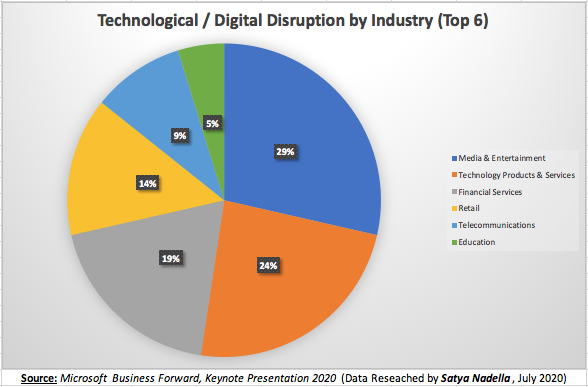
    While it’s commonly known that tech disruption is rapidly occurring, are you aware of which sectors of the US economy are being transformed the most? Initially presented in a Microsoft Business Forward forum, this research is key to assessing the sectors that need to gear up and prepare to deal with the newest technologies. The chart below substantiates just how much technological innovation and digital transformation are disrupting critical, traditional sectors within the nation’s economy.

    Top 6 Industries Impacted by Technological & Digital Disruption

    Microsoft: Top 6 Sectors Affected by Tech / Digital Disruption (Satya Nadella, 2020)

    PropTech addresses technological innovation specifically in the real estate segment. Moreover, you’ll notice that the Top 6 industries affected are most likely ones you come across in your everyday life. What does this mean for management, consumers, and the working class (specifically in these industries)? The article that complements Satya’s research shares a grim prognostication:

    “Digital disruption is well upon us. While a survey conducted by the Global Center for Digital Business Transformation for the large and mid-sized private sector companies agreed, to varying degrees, that digital disruption comes with its own set of benefits, it is also true that Digital Disruption is threatening the survival of many businesses and industries.

    Futuristic businesses and start-ups are exploring new avenues of re-inventing their business activities and industries all together to compete with and dislodge incumbents. The last decade alone has witnessed some exponential progress in technological disruption – think Airbnb, Paytm, Netflix and Uber.

    And this disruption is gradually influencing every industry, including banking, healthcare, hospitality, construction, manufacturing, packaging, logistics, and insurance amongst others (discussed in detail by Satya in Microsoft’s 2020 Keynote Forum).”

    Embee Staff

    Conclusion: What Does This Mean for Real Estate Investors?

    Succinctly, to have longevity in a given industry, the necessity for technological innovation has proven to be non-negotiable. Avoiding this reality will get you nowhere – or worse, out of business – quickly. As the abundance of digital and cloud transformation technologies are increasing, many are finding themselves playing catch-up. The information Microsoft presented suggests nearly all industries will be behind if they refuse to acknowledge technological progress. Not only acknowledge it, but make drastic changes, as necessary, to adapt alongside it.

    We’ve summarized the role technological innovation will play at length in the real estate market moving forward, specifically. Finally, ponder this. Imagine the impact to real estate markets, even globally, if critical industries and large corporations were to fall ‘behind-the-curve‘. What would this mean for CRE investors, who have continued to struggle as of late? The data study produced by Microsoft illustrates just how cataclysmic failures to adapt to new technologies – no matter the reason – can cause widespread fragility beyond the individual companies, or even those particular industry segments. It’s imperative to always look at the bigger picture. In this case, failure to adapt to new technologies will almost certainly cause broad, undesired consequences for investors.

  • The Future of Capital Markets Technology

    Capital Markets are where savings and investments are channeled between suppliers, people, or institutions with capital to lend or invest — as well as those in need (Hayes, Investopedia). Suppliers typically include banks and investors while those who seek capital are businesses, governments, and individuals. Capital markets are composed of primary and secondary markets.

    The most common capital markets are the stock market and the bond market. However other, more complex, markets include the CRE (Commercial Real Estate) Market, Equity Capital Market (ECM), as well as many others that are typically geared towards a specific investor. Therefore there is not as much trading volume or frequency, since the broader excitement is not the same. Even though real estate is the world’s largest asset class, we’ve seen a recent decline in CRE investment. Medium recently posted an article detailing the advantages of a platform called Beacon Platform, Inc, which was a critical, major acquisition for Centena.

    Medium: Modernizing the Capital Markets Technology Stack: Centana’s Investment in Beacon Platform, Inc.

    Why do customers choose Beacon?

    Time-to-Value and ROI. Today, companies continue to deal with cumbersome internal applications that have been stitched together, often with legacy code and/or 3rd party vendors in the Trading and Risk Management space, which are “black box” and difficult, if not impossible, to alter.

    Beacon’s entire code base is flexible and transparent (i.e. the code is made available to customers) and seamlessly integrates with existing software and other 3rd party solutions (like Murex and Calypso), or in-house proprietary solutions, which helps drive quick time-to-value and high utility.

    In a fraction of the time and cost of alternative solutions, Beacon has helped customers achieve objectives such as migrating workloads to the cloud, expanding into new markets, upgrading legacy code by placing it within a modern developer wrapper and extending analytics and applications to customers’ end-users.

    -Matt Alfieri
    Key Takeaways

    When it comes to capital markets technology, the evolving nature of the tech space all but ensures we will see new technologies introduced into capital markets operations. Additionally, while this may sound like an advertisement for Beacon (though FinYork has absolutely no affiliation to it), the critical feature to note is this is an exemplary illustration of where capital markets technology appears to be heading.

    Vertical SaaS or cloud industry solutions, instead of legacy or proprietary in-house solutions, are showing us that they’re easier to replace than many executives originally thought. You should expect to see a similar effect here as with PropTech, as it becomes more widely available and accepted by savvy executives and high net worth real estate investors. You definitely do not want to be the firm who is continuing to use antiquated capital markets technologies. This puts you at an immediate, huge disadvantage. It makes it that much harder to catch up with your competitors, who have a leg-up as they’ve already implemented innovative technologies.

    All this goes to say that SaaS, digital transformation, cloud technologies, PropTech, and even niche technologies that aim to improve efficiency in capital markets are going to play an integral part of the future. The success of firms who will adapt them largely depends on the success those firms will have in the implementation process. To be sure, capital markets technology is only going to continue getting more efficient, robust, and easier to adapt.

  • The Future of Capital Markets Technology

    Capital Markets are where savings and investments are channeled between suppliers, people, or institutions with capital to lend or invest — as well as those in need (Hayes, Investopedia). Suppliers typically include banks and investors while those who seek capital are businesses, governments, and individuals. Capital markets are composed of primary and secondary markets.

    The most common capital markets are the stock market and the bond market. However other, more complex, markets include the CRE (Commercial Real Estate) Market, Equity Capital Market (ECM), as well as many others that are typically geared towards a specific investor. Therefore there is not as much trading volume or frequency, since the broader excitement is not the same. Even though real estate is the world’s largest asset class, we’ve seen a recent decline in CRE investment. Medium recently posted an article detailing the advantages of a platform called Beacon Platform, Inc, which was a critical, major acquisition for Centena.

    Medium: Modernizing the Capital Markets Technology Stack: Centana’s Investment in Beacon Platform, Inc.

    Why do customers choose Beacon?

    Time-to-Value and ROI. Today, companies continue to deal with cumbersome internal applications that have been stitched together, often with legacy code and/or 3rd party vendors in the Trading and Risk Management space, which are “black box” and difficult, if not impossible, to alter.

    Beacon’s entire code base is flexible and transparent (i.e. the code is made available to customers) and seamlessly integrates with existing software and other 3rd party solutions (like Murex and Calypso), or in-house proprietary solutions, which helps drive quick time-to-value and high utility.

    In a fraction of the time and cost of alternative solutions, Beacon has helped customers achieve objectives such as migrating workloads to the cloud, expanding into new markets, upgrading legacy code by placing it within a modern developer wrapper and extending analytics and applications to customers’ end-users.

    -Matt Alfieri
    Key Takeaways

    When it comes to capital markets technology, the evolving nature of the tech space all but ensures we will see new technologies introduced into capital markets operations. Additionally, while this may sound like an advertisement for Beacon (though FinYork has absolutely no affiliation to it), the critical feature to note is this is an exemplary illustration of where capital markets technology appears to be heading.

    Vertical SaaS or cloud industry solutions, instead of legacy or proprietary in-house solutions, are showing us that they’re easier to replace than many executives originally thought. You should expect to see a similar effect here as with PropTech, as it becomes more widely available and accepted by savvy executives and high net worth real estate investors. You definitely do not want to be the firm who is continuing to use antiquated capital markets technologies. This puts you at an immediate, huge disadvantage. It makes it that much harder to catch up with your competitors, who have a leg-up as they’ve already implemented innovative technologies.

    All this goes to say that SaaS, digital transformation, cloud technologies, PropTech, and even niche technologies that aim to improve efficiency in capital markets are going to play an integral part of the future. The success of firms who will adapt them largely depends on the success those firms will have in the implementation process. To be sure, capital markets technology is only going to continue getting more efficient, robust, and easier to adapt.

  • What’s Holding Back PropTech?

    While PropTech has seen some growth in recent years, more so before the COVID-19 pandemic, we still haven’t seen the manifestation of the scale of technological revolution in the property industry we were once promised. The vast majority of buildings we come across in our daily lives are still operating in traditional ways, using outdated but proven equipment. Let’s dive into why we are yet to see the kind of transformative innovation we were expecting on a broader scale.

    Real estate is widely recognized as the world’s largest financial asset class. However, in today’s world, we often see companies rise to prominence before crashing and burning in a matter of a few short years. Most of the biggest corporations in the world today didn’t have a trace of existence 30 years ago. The real estate asset class could not be categorized more differently. It’s not only the largest asset class (by far), it’s also the oldest asset class (Hagerty, Propmodo). Historically, the property industry is a very slow, cautious sector. Unlike an App, such as Uber for example, buildings and other construction projects take many years from the design process to the completion of the physical structure. This is attributed partially to the reality that protecting buildings and the occupants inside them is paramount. In both the residential and commercial real estate sub-sectors, moving too fast and making a mistake that may lead to a potential building collapse is simply out of the question. Due to real estate’s conservative business model, even the most sophisticated PropTech products are having a difficult time gaining broad, large-scale traction (Hagerty, Propmodo).

    Ernst & Young’s Comprehensive PropTech Study

    An Ernst & Young (E&Y) survey recently found that 43% of those who provide PropTech products are majorly struggling with widespread adoption across a given client’s business. Additionally, the same research discovered that 35% of PropTech providers are seeing a very sizable lack of scaling, as a direct result of their application being adopted. Perhaps the biggest shock from this study is 39% of respondents are yet to adopt even a single PropTech tool.

    In addition to safety concerns, the attitude of business managers has been noted as a key opponent to PropTech’s success. Value in real estate is most frequently determined by three factors: 1) location, 2) size, and 3) finishes [amenities]. Reducing costs and increasing efficiency plays a major role in the construction industry, but we don’t typically see those same levels of concern in asset management. PropTech is actually attempting to change that. With the right technology, savings from efficiency, integration, and automation can start to pile up (Hagerty, Propmodo). Having the ability to tap into data generated by buildings is providing actionable insights that are too big of a potential game-changer to ignore. For individuals or companies that already have a real estate strategy in place, implementing innovative PropTech is only putting them further ahead of the pack. Executives, board members, and direct real estate investors alike clearly understand the need for PropTech. The biggest challenge remains in implementation.

    Conclusions Drawn From Ernst & Young’s Study

    We can conclude from the E&Y study that the remedy starts with ensuring the right people are in place. E&Y found 53 percent of real estate owners don’t feel they have the in-house talent to successfully adopt new technology. It’s worth taking a moment to let that sink in. More than half of executives, or very senior personnel in a position to make these decisions, are not confident in their own teams’ implementation ability. Without technology-minded talent and leadership, it’s hard to see the light at the end of the tunnel. Traditional real estate leadership has often been hesitant – or perhaps more precisely, even negligent – in scrapping outdated systems and processes they’ve relied on for decades. Again, PropTech aims to alter that mindset entirely. Leveraging technology is about focusing on future potential, rather than cost. There are undoubtedly sizable upfront costs associated with widespread PropTech adoption across a portfolio. What makes executives and board members in particular hesitant with implementing PropTech is the mindset about their obligation to stakeholders being centered around cost cutting. Why bother spending money “fixing something” that isn’t broken? Buildings are operating just fine without the need for any sweeping, technological overhaul. That’s the position traditional real estate leadership has taken; they are extremely hesitant to tolerate large capital expenditures on risky, bold technologies that don’t have a clear trajectory of return on investment. Succinctly, from the E&Y analysis we can clearly deduce that executives and board members need to ensure there are enough personnel focused on technology to help senior management understand there in fact is a return on investment from implementing various PropTech products. It’s not as clear-cut, but the long-term financial benefits are there.

    Again, referring back to the same E&Y data, almost 60% of real estate companies surveyed responded that they find new systems difficult to integrate with existing platforms. This is viewed as a further hinderance for executives because this translates to times and resources in order to get things set up, further disincentivizing them by piling on additional costs and additionally clouding the potential return on investment. The rapid pace of development and deployment is leading to piecemeal technology strategies instead of full end-to-end solutions, which is easier for leadership to recognize. As the PropTech industry matures, consolidations, acquisitions, and a wider array of products to service every aspect of portfolios could help solve some of those problems (Hagerty, Propmodo).

    “As investors begin to see the benefit of companies adopting technology, we believe they will help drive the industry forward more rapidly in the same way that investor pressure has encouraged companies to do more and report more on ESG related issues”.

    Mark Grinis, Ernst & Young Global Real Estate, Hospitality, & Construction Leader

    Perhaps an unpopular opinion, but some have compelling arguments that growing pains in PropTech industry is actually a good thing. The real estate industry was stagnating for decades, perhaps centuries. In a few short years, technology has worked its way into practically every executive conversation or board member meeting. With that being said, retrofitting existing buildings will not be a viable solution for every – or most – property owners.  Building technology into the bedrock of the property industry is a ground-up exercise, literally, which makes taking stock of progress that’s been made that much more important. That’s where PropTech comes in. There’s plenty of obstacles in the industry slowing down PropTech at the moment, but there’s no stopping it, especially it in the long-term as we’ve seen companies rapidly expand cloud and digital transformation technologies.  

  • How the Green New Deal Would Impact Real Estate Investors

    Depending on your views on climate change, the Green New Deal framework will either conjure up enthusiasm, anxiety, or perhaps a combination of the two. The proposed bill, which has since been explained as a framework towards what we ought to work towards, calls for “maximum energy efficiency”. Based on scientific research, which concludes climate change is imminent and potentially disastrous, the proposal aims for net-zero emissions in the United States by 2050. As part of the plan to get there, this means every building in the country would need to be upgraded for maximal energy efficiency, water efficiency, safety, affordability, comfort, and durability.

    As of the start of 2020, approximately 40% of the United States’ carbon monoxide emissions come from either commercial or residential real estate buildings (Neiditch, Forbes). Many of the political proponents of the Green New Deal were pushing it behind the idea that up to $1 trillion of infrastructure and coastal real estate could be damaged by global warming by 2050. According to the Energy Information Administration (EIA), currently, there are approximately 5.6 million commercial real estate buildings in the United States. Specifically in New York City, as part of an ongoing effort to combat climate change, legislation was passed to force buildings that are larger than 25,000 square feet to make energy efficient alterations. The legislation mandates cutting down greenhouse gas emissions 40% by 2030 and 80% by 2050. While the parameters for smaller, residential buildings aren’t as explicit, it’s estimated 95 million homes will be impacted and the cost to owners will be in excess of $400 billion (Neiditch, Forbes).

    While the Green New Deal did not come close to passing as it was originally written and there is unlikely to be sweeping legislation on a national level to overhaul climate change, many cities and states are finding a balance between clean air and economic productivity. Unfortunately, a lot of this conversation tends to be intertwined with politics, but the reality is a rural area in Kentucky (as an example) is not going to have the same availability of economic or human capital resources as a metropolis, like New York or Los Angeles. The lack of availability of these resources puts constraints on the ability of certain regions to advance their technological capabilities, thereby making the real estate investment opportunities unattractive to potential investors.

    Though preparations to meet the 2030 and 2050 targets have begun, there are some more immediate upgrades property owners can make that aren’t as long-term oriented, including switching out lightbulbs for “smart” lighting, upgrading HVAC systems, installing remote-controlled window shades, painting roofs with light-reflecting paint, planting trees, and installing photovoltaics. Additionally, preparation for weatherization is key to having a more energy efficient property. Windows, doors, and insulation can all be switched out and there is legislation to include different types of incentives for property owners to make these changes. Upgrading electric and plumbing systems, as well as installing solar panels can make homes more marketable, considering these changes are becoming more prevalent to the point of necessity. Finally, the Green New Deal framework focuses heavily on “green spaces” – or lawns – that cover more than 40 million acres of land in the United States. Lawns limit biodiversity and encourage pesticide usage and emissions from lawnmowers. The Green New Deal supporters encourage the conversion of these spaces to victory gardens and the expansion of green landscape architecture practices. An example of this is xeriscaping, or sustainable, easy-to-maintain landscaping first used in arid regions, which uses native plants and limits turf areas. This can reduce outdoor water use by as much as 50%, saving water as well as the environment (Neiditch, Forbes).

    So, what does the ambitious Green New Deal framework and the implications it will have on commercial and residential real estate mean for investors? Firstly, investors should focus on high-tech, climate-resilient opportunities in the real estate market. Secondly, residential real estate owners who are not under pressure from legislators to make climate change friendly adjustments to their properties should do so anyway, otherwise they will be far less attractive to prospective investors. Finally, commercial real estate investors, who are under pressure to begin implementing climate change measures mandated by signed legislation, are going to face major hurdles with regards to cost cutting. This legislation poses further challenges to commercial real estate investors, who are already in a difficult position coming out of the pandemic, in addition to facing the necessity to transform their assets to handle the push towards digital transformation. One thing is for sure: the conversation will continue. Being prepared for change is the best way to not only save the environment, but your long-term financial stability as well.

  • How the Green New Deal Would Impact Real Estate Investors

    Depending on your views on climate change, the Green New Deal framework will either conjure up enthusiasm, anxiety, or perhaps a combination of the two. The proposed bill, which has since been explained as a framework towards what we ought to work towards, calls for “maximum energy efficiency”. Based on scientific research, which concludes climate change is imminent and potentially disastrous, the proposal aims for net-zero emissions in the United States by 2050. As part of the plan to get there, this means every building in the country would need to be upgraded for maximal energy efficiency, water efficiency, safety, affordability, comfort, and durability.

    As of the start of 2020, approximately 40% of the United States’ carbon monoxide emissions come from either commercial or residential real estate buildings (Neiditch, Forbes). Many of the political proponents of the Green New Deal were pushing it behind the idea that up to $1 trillion of infrastructure and coastal real estate could be damaged by global warming by 2050. According to the Energy Information Administration (EIA), currently, there are approximately 5.6 million commercial real estate buildings in the United States. Specifically in New York City, as part of an ongoing effort to combat climate change, legislation was passed to force buildings that are larger than 25,000 square feet to make energy efficient alterations. The legislation mandates cutting down greenhouse gas emissions 40% by 2030 and 80% by 2050. While the parameters for smaller, residential buildings aren’t as explicit, it’s estimated 95 million homes will be impacted and the cost to owners will be in excess of $400 billion (Neiditch, Forbes).

    While the Green New Deal did not come close to passing as it was originally written and there is unlikely to be sweeping legislation on a national level to overhaul climate change, many cities and states are finding a balance between clean air and economic productivity. Unfortunately, a lot of this conversation tends to be intertwined with politics, but the reality is a rural area in Kentucky (as an example) is not going to have the same availability of economic or human capital resources as a metropolis, like New York or Los Angeles. The lack of availability of these resources puts constraints on the ability of certain regions to advance their technological capabilities, thereby making the real estate investment opportunities unattractive to potential investors.

    Though preparations to meet the 2030 and 2050 targets have begun, there are some more immediate upgrades property owners can make that aren’t as long-term oriented, including switching out lightbulbs for “smart” lighting, upgrading HVAC systems, installing remote-controlled window shades, painting roofs with light-reflecting paint, planting trees, and installing photovoltaics. Additionally, preparation for weatherization is key to having a more energy efficient property. Windows, doors, and insulation can all be switched out and there is legislation to include different types of incentives for property owners to make these changes. Upgrading electric and plumbing systems, as well as installing solar panels can make homes more marketable, considering these changes are becoming more prevalent to the point of necessity. Finally, the Green New Deal framework focuses heavily on “green spaces” – or lawns – that cover more than 40 million acres of land in the United States. Lawns limit biodiversity and encourage pesticide usage and emissions from lawnmowers. The Green New Deal supporters encourage the conversion of these spaces to victory gardens and the expansion of green landscape architecture practices. An example of this is xeriscaping, or sustainable, easy-to-maintain landscaping first used in arid regions, which uses native plants and limits turf areas. This can reduce outdoor water use by as much as 50%, saving water as well as the environment (Neiditch, Forbes).

    So, what does the ambitious Green New Deal framework and the implications it will have on commercial and residential real estate mean for investors? Firstly, investors should focus on high-tech, climate-resilient opportunities in the real estate market. Secondly, residential real estate owners who are not under pressure from legislators to make climate change friendly adjustments to their properties should do so anyway, otherwise they will be far less attractive to prospective investors. Finally, commercial real estate investors, who are under pressure to begin implementing climate change measures mandated by signed legislation, are going to face major hurdles with regards to cost cutting. This legislation poses further challenges to commercial real estate investors, who are already in a difficult position coming out of the pandemic, in addition to facing the necessity to transform their assets to handle the push towards digital transformation. One thing is for sure: the conversation will continue. Being prepared for change is the best way to not only save the environment, but your long-term financial stability as well.

  • PropTech: What is it and Who Are the Primary Investors?

    Property Technology, commonly known as PropTech, refers to the use of Information Technology (IT) to assist both individuals and companies buy, sell, research, and manage real estate. While still a relatively new field, the convergence of technologies, cloud, and digital transformation are key forces driving PropTech forward. The goals of PropTech include: minimizing the cost and resources associated with real estate transactions, maximizing efficiency, saving time, and personalizing property management. This concept is similar to FinTech, where the focus is on the use of technology in finance. PropTech utilizes digital innovation and other technologies to address real estate market participants’ needs in the property industry.

    Efficient PropTech is specifically devised to streamline processes and connect market participants in all aspects of real estate. Therefore, PropTech directly impacts buyers, sellers, brokers, lenders, landlords, as well as others. One of the most popular current PropTech technology is virtual reality software, which allows prospective buyers to virtually walk through properties, construction sites, and more. Additional well-known PropTech technologies include software for reporting repairs, splitting rent payments, and crowdfunding new real estate projects.

    At this time, PropTech consists of three major market segments: (1) smart home, (2) sharing real estate, and (3) real estate FinTech.

    Smart Home

    A smart home is equipped with digital platforms that monitor, manage, or operate specific property assets. Amazon Echo’s Alexa is an example of something in a smart home. Generally, they are comprised of digital platforms that monitor, manage or operate specific property assets. Other examples could be something a security surveillance system that warns property owners of a threat, a smart thermostat that regulates the temperature of uninhabited units, or smart light bulbs that can be turned on by a smartphone app or digital assistant.

    Sharing Real Estate

    This refers to technology that facilitates the processes involved with sharing or renting real estate assets, such as land, offices, storage, apartments, parking lots, and more. For example, there could be a software that facilitates automatic online payments for retail spaces occupied in a building owned by a property management company.

    Real Estate FinTech

    This segment of PropTech includes applications that involve buying and selling real estate assets. A platform that reduces the amount of physical paperwork and documentation involved in a home purchase can be thought of as an example. Stay tuned for a deeper conversation regarding the relationship between PropTech and FinTech.

    With PropTech still being a relatively new field, the investors are largely comprised of wealthy, seasoned real estate investing experts (or at least those with a real estate investing background). In addition to being backed by some of the world’s largest real estate giants, it would be fair to say most of the individuals behind the world’s biggest tech companies, agree that future technology is pushing towards digital transformation (Donati, Forbes). Therefore, you’ll find investors that are interested in a sort of ‘futuristic’ technology category when it comes to financial investments. For example, PropTech investors would be very likely to also be interested in FinTech and Cryptocurrency. While the latter two seem to be more popular at the moment, PropTech is definitely something well worth looking into, especially if you have a specific interest in real estate investing.

  • PropTech: What is it and Who Are the Primary Investors?

    Property Technology, commonly known as PropTech, refers to the use of Information Technology (IT) to assist both individuals and companies buy, sell, research, and manage real estate. While still a relatively new field, the convergence of technologies, cloud, and digital transformation are key forces driving PropTech forward. The goals of PropTech include: minimizing the cost and resources associated with real estate transactions, maximizing efficiency, saving time, and personalizing property management. This concept is similar to FinTech, where the focus is on the use of technology in finance. PropTech utilizes digital innovation and other technologies to address real estate market participants’ needs in the property industry.

    Efficient PropTech is specifically devised to streamline processes and connect market participants in all aspects of real estate. Therefore, PropTech directly impacts buyers, sellers, brokers, lenders, landlords, as well as others. One of the most popular current PropTech technology is virtual reality software, which allows prospective buyers to virtually walk through properties, construction sites, and more. Additional well-known PropTech technologies include software for reporting repairs, splitting rent payments, and crowdfunding new real estate projects.

    At this time, PropTech consists of three major market segments: (1) smart home, (2) sharing real estate, and (3) real estate FinTech.

    Smart Home

    A smart home is equipped with digital platforms that monitor, manage, or operate specific property assets. Amazon Echo’s Alexa is an example of something in a smart home. Generally, they are comprised of digital platforms that monitor, manage or operate specific property assets. Other examples could be something a security surveillance system that warns property owners of a threat, a smart thermostat that regulates the temperature of uninhabited units, or smart light bulbs that can be turned on by a smartphone app or digital assistant.

    Sharing Real Estate

    This refers to technology that facilitates the processes involved with sharing or renting real estate assets, such as land, offices, storage, apartments, parking lots, and more. For example, there could be a software that facilitates automatic online payments for retail spaces occupied in a building owned by a property management company.

    Real Estate FinTech

    This segment of PropTech includes applications that involve buying and selling real estate assets. A platform that reduces the amount of physical paperwork and documentation involved in a home purchase can be thought of as an example. Stay tuned for a deeper conversation regarding the relationship between PropTech and FinTech.

    With PropTech still being a relatively new field, the investors are largely comprised of wealthy, seasoned real estate investing experts (or at least those with a real estate investing background). In addition to being backed by some of the world’s largest real estate giants, it would be fair to say most of the individuals behind the world’s biggest tech companies, agree that future technology is pushing towards digital transformation (Donati, Forbes). Therefore, you’ll find investors that are interested in a sort of ‘futuristic’ technology category when it comes to financial investments. For example, PropTech investors would be very likely to also be interested in FinTech and Cryptocurrency. While the latter two seem to be more popular at the moment, PropTech is definitely something well worth looking into, especially if you have a specific interest in real estate investing.