Tag: housing market

  • Financial Markets Are Suffering, But What About Real Estate?

    As recent signals that the Fed’s “soft landing” recession isn’t going to come to fruition, financial markets responded accordingly. In addition to covering financial markets impact, we’re going to look into real estate. The DOW Jones and S&P 500 both dropped steadily Friday 10/7. The S&P has been on such a steady decline, the last 12 months of gains have officially completely canceled out. While some have speculated that we’re at a “bottoming out” in the equities market, which is supported by historic S&P 500 trends, market participants don’t seem to fully buy in. In fact, quantitatively the Top 5 stocks by market cap in the S&P 500 (Apple, Microsoft, Amazon, Tesla, and Alphabet Inc/Google, i.e., “Big Tech”) have been overpriced for years, compared to S&P 500 P/E [Price-to-Earnings] averages.

    Either way, turmoil is very likely to continue for capital markets and equities investors. Even if the net result is positive, there will be a lot of sleepless nights in the process. Let’s shift gears and take a look at a completely different, but critical (remember 2008) market: real estate.

    The Real Estate Market was Effectively COVID-proof; is it Recession-proof?

    This is the ultimate question for investors will look at real estate – both passive and active investments – in the longer-term. Foreign investors are already starting to see massive benefits to American real estate investments. That’s certainly one of the primary catalysts for steadily high real estate prices, while other assets are devalued. While we’re going to address the current and future state of the real estate market, the heading was rhetorical. Never forget 2008. That’s going to be a critical lesson investors takeaway from this coming recession, as well. 

    Real estate and related assets are certainly not recession, or even depression proof. It’s always good to be reminded of this fact: real estate is the world’s largest asset class. That means the most money (in all forms of currency, worldwide) is being spent in this market, as compared to any other segment in global finance. With real estate-related securities, we now know we must pay extra close attention to the value of the underlying assets. That goes back to a key differentiator when you’re discussing real estate in the context of an investment strategy. People and families will always need shelter. The landscape may have been altered due to COVID-19, but corporations still need office buildings.

    Physical Real Estate Will Always Have Some Value

    The critical point is real estate will continue to have some value, regardless of what happens in financial markets. Moving away from the combination of greed – both on the part of homeowners and lenders – that led up to the 2008 financial crisis, real estate is still something society will always need. Remember how truly heartbreaking some of the stories of families losing their homes during that 2008 recession was? When tangible assets that we get daily utility from as in the equation, it’s an entirely different scenario from an illiquid financial asset. The types of investors are different, their goals are different, their interests vary, etc. This is all to say that while there’s no doubt there’s a level of positive correlation between financial markets and real estate prices, by no means is it absolute. The dynamics are far too dissimilar.

    However, not being recession-proof is actually one of the common denominators that always holds true for the pair. 

    The Pandemic Housing Boom

    As we’ve recently shared, experts started questioning how long this “seller’s market” we’ve seen explode since COVID-19 will last. Since then, there have been major developments. First and foremost, from the Fed. In late September 2022, the Fed announced they are going to “reset” the real estate market through a ‘difficult’ correction. In June 2022, Fed Chair Jerome Powell said he sees spiking mortgages rates fizzling out the Pandemic Housing Boom as a “good thing”. During what’s referred to as the Pandemic Housing Boom, housing prices soared in growth by 42%. We’ll now certainly see some of those gains erased.

    With increased rates, we should expect to see a diminished potential buyer pool. In April 2022, prices peaked at 21% – according to Zillow’s home value index – however by this fall they fell to just 14%. According to Zillow senior economist Jeff Tucker, “it’s too soon to tell” how big of an impact the reset will have on home prices. In July 2022, the S&P Case-Shiller index, which measures house prices in 20 US cities, recorded its first monthly decline in a decade, dropping by 0.44%. Mortgage rates (30-year, fixed rate) are currently sitting at roughly 6.7%, according to guarantor Freddie Mae. Just a year ago however, the same 30-year, fixed rate mortgage was 2.99%.

    The Impact of the Current Correction in Housing Market Prices

    “The market is shifting, but a correction was needed”, said real estate agent Junior Torres. “It was not a sane market, what we were having in the pandemic”. This is causing sellers, who were driving the early 2020s pandemic market, to face a new reality. Fewer properties are receiving fewer offers. Sellers are going to continue getting more and more ‘desperate’ the longer the correction lasts. In other words, until we’ve reached a point where supply and demand is back at an equilibrium price, median selling prices will continue to decrease.

    Additionally, a correction in the housing market typically incentivizes homeowners to ‘stay put’. Investors and home flippers might feel pressure to sell quickly, however homeowners will simply keep their house. If we do reach that point sometime in 2023 – but more likely 2024 – they will then reassess their situation. However, when the Fed is verbally communicating that rates aren’t down – the opposite – homeowners have frankly no incentive to sell. According to the latest numbers from Zillow, the median stay in a US home is 12 years.

    Concisely, housing market prices are going to continue decreasing while rates remain at this level. From Fed statements, this is expected to continue through 2023. This should result in housing market prices continuing on the same trajectory. Committed sellers and investors will feel pressure to act quicker. Those not ‘forced’ to sell for unexpected reasons (new job, for example) will very likely remain in their homes. This will obviously decrease supply, but again primarily due to the current and expected mortgage rates in the short-term, we should expect to see below average demand.

  • Financial Markets Are Suffering, But What About Real Estate?

    As recent signals that the Fed’s “soft landing” recession isn’t going to come to fruition, financial markets responded accordingly. In addition to covering financial markets impact, we’re going to look into real estate. The DOW Jones and S&P 500 both dropped steadily Friday 10/7. The S&P has been on such a steady decline, the last 12 months of gains have officially completely canceled out. While some have speculated that we’re at a “bottoming out” in the equities market, which is supported by historic S&P 500 trends, market participants don’t seem to fully buy in. In fact, quantitatively the Top 5 stocks by market cap in the S&P 500 (Apple, Microsoft, Amazon, Tesla, and Alphabet Inc/Google, i.e., “Big Tech”) have been overpriced for years, compared to S&P 500 P/E [Price-to-Earnings] averages.

    Either way, turmoil is very likely to continue for capital markets and equities investors. Even if the net result is positive, there will be a lot of sleepless nights in the process. Let’s shift gears and take a look at a completely different, but critical (remember 2008) market: real estate.

    The Real Estate Market was Effectively COVID-proof; is it Recession-proof?

    This is the ultimate question for investors will look at real estate – both passive and active investments – in the longer-term. Foreign investors are already starting to see massive benefits to American real estate investments. That’s certainly one of the primary catalysts for steadily high real estate prices, while other assets are devalued. While we’re going to address the current and future state of the real estate market, the heading was rhetorical. Never forget 2008. That’s going to be a critical lesson investors takeaway from this coming recession, as well. 

    Real estate and related assets are certainly not recession, or even depression proof. It’s always good to be reminded of this fact: real estate is the world’s largest asset class. That means the most money (in all forms of currency, worldwide) is being spent in this market, as compared to any other segment in global finance. With real estate-related securities, we now know we must pay extra close attention to the value of the underlying assets. That goes back to a key differentiator when you’re discussing real estate in the context of an investment strategy. People and families will always need shelter. The landscape may have been altered due to COVID-19, but corporations still need office buildings.

    Physical Real Estate Will Always Have Some Value

    The critical point is real estate will continue to have some value, regardless of what happens in financial markets. Moving away from the combination of greed – both on the part of homeowners and lenders – that led up to the 2008 financial crisis, real estate is still something society will always need. Remember how truly heartbreaking some of the stories of families losing their homes during that 2008 recession was? When tangible assets that we get daily utility from as in the equation, it’s an entirely different scenario from an illiquid financial asset. The types of investors are different, their goals are different, their interests vary, etc. This is all to say that while there’s no doubt there’s a level of positive correlation between financial markets and real estate prices, by no means is it absolute. The dynamics are far too dissimilar.

    However, not being recession-proof is actually one of the common denominators that always holds true for the pair. 

    The Pandemic Housing Boom

    As we’ve recently shared, experts started questioning how long this “seller’s market” we’ve seen explode since COVID-19 will last. Since then, there have been major developments. First and foremost, from the Fed. In late September 2022, the Fed announced they are going to “reset” the real estate market through a ‘difficult’ correction. In June 2022, Fed Chair Jerome Powell said he sees spiking mortgages rates fizzling out the Pandemic Housing Boom as a “good thing”. During what’s referred to as the Pandemic Housing Boom, housing prices soared in growth by 42%. We’ll now certainly see some of those gains erased.

    With increased rates, we should expect to see a diminished potential buyer pool. In April 2022, prices peaked at 21% – according to Zillow’s home value index – however by this fall they fell to just 14%. According to Zillow senior economist Jeff Tucker, “it’s too soon to tell” how big of an impact the reset will have on home prices. In July 2022, the S&P Case-Shiller index, which measures house prices in 20 US cities, recorded its first monthly decline in a decade, dropping by 0.44%. Mortgage rates (30-year, fixed rate) are currently sitting at roughly 6.7%, according to guarantor Freddie Mae. Just a year ago however, the same 30-year, fixed rate mortgage was 2.99%.

    The Impact of the Current Correction in Housing Market Prices

    “The market is shifting, but a correction was needed”, said real estate agent Junior Torres. “It was not a sane market, what we were having in the pandemic”. This is causing sellers, who were driving the early 2020s pandemic market, to face a new reality. Fewer properties are receiving fewer offers. Sellers are going to continue getting more and more ‘desperate’ the longer the correction lasts. In other words, until we’ve reached a point where supply and demand is back at an equilibrium price, median selling prices will continue to decrease.

    Additionally, a correction in the housing market typically incentivizes homeowners to ‘stay put’. Investors and home flippers might feel pressure to sell quickly, however homeowners will simply keep their house. If we do reach that point sometime in 2023 – but more likely 2024 – they will then reassess their situation. However, when the Fed is verbally communicating that rates aren’t down – the opposite – homeowners have frankly no incentive to sell. According to the latest numbers from Zillow, the median stay in a US home is 12 years.

    Concisely, housing market prices are going to continue decreasing while rates remain at this level. From Fed statements, this is expected to continue through 2023. This should result in housing market prices continuing on the same trajectory. Committed sellers and investors will feel pressure to act quicker. Those not ‘forced’ to sell for unexpected reasons (new job, for example) will very likely remain in their homes. This will obviously decrease supply, but again primarily due to the current and expected mortgage rates in the short-term, we should expect to see below average demand.

  • Is there a Difference Between a ‘Buyer’s Market’ and a ‘Market that’s Rapidly Getting Less Advantageous Towards Seller’s’?

    The vast majority of latest prognostications point to a shift in the housing market, in favor of buyers over sellers. It’s about time. America’s housing market has been brutal on homebuyer’s, renters, and those looking to lease in prime locations for years now. There is a lot of qualitative and quantitative analysis to suggest that despite rising rates, buyers currently have the advantage.

    Realtor’s Weekly Housing Market: “The Four Big Bellwethers”

    Realtor has a weekly column called “How’s the Housing Market This Week?”. Realtor’s real estate economists are some of the most trusted in the industry. Weekly, Realtor delivers the most up-to-date statistics on what they coined “the four big bellwethers of the housing market”. These include home prices, # of new listings, total days on market, and of course, mortgage rates (Dutton, Realtor).

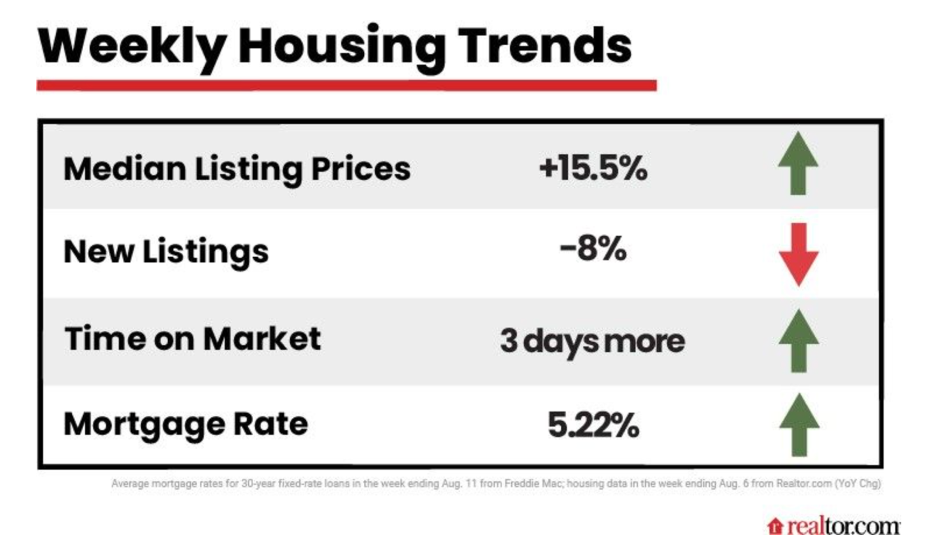
    “The housing market is resetting in a buyer-friendly direction,” notes Realtor Chief Economist Danielle Hale in her evaluation. We’d be remised if we didn’t note a “buyer-friendly direction” is certainly not the same as a true buyer’s market. While the same analysis notes the obvious, historic seller’s market that’s raged since COVID-19 began, it points out that the window for sellers is closing, rapidly. Below are the previously mentioned Realtor weekly housing trends, for week-end August 6th, 2022.

    -Realtor.com – Weekly Housing Trends, August 6th, 2022

    What jumps out to me are the top two statistics. A 15.5% median listing price increase, coupled with 8% fewer listing than the week before (Realtor.com). Hale has a unique and thought-provoking perspective on this phenomenon.

    Is There Surprisingly Good News in a 15.5% Increase in Median Listing Price?

    According to Hale, yes, this number is good news for prospective buyers. The last data from July 2022 shows a median nationwide listing price of $449,000. For the week ending August 6th, a 15.5% listing price increase means the new median was $518.595. While this marks the 34th straight week of double-digit price growth, Hale points out it’s also the “second consecutive week of deceleration” (Dutton, Realtor). The previous two weeks – at the end of July 2022 – median listing prices rose by 16.6% and 15.6%, respectively. This third ‘relatively temperate’ hike offers buyers hope home price growth will finally continue steadily dwindling.

    “The improvement has been substantial”, confirms Hale. She’s just as quick to add, “buyers in today’s market may still face meaningful affordability challenges as the typical home listing price remains near a record high”. But there’s little long-term evidence to suggest sticker price is a major deterrent for buyers (Dutton, Realtor). Hale reaffirms, “Persistent [homebuyers] may still continue to find success”. She goes on to add, “Second quarter data showed that homeownership rates increased from a year ago, both overall and for nearly every age and racial and ethnic group”.

    Given that homeownership rates have surged — amid rampant inflation, rising mortgage rates, and other deterrents — strongly signals that buyers who are willing to have some flexibility will ultimately win. Participants who are been willing to purchase somewhere they may not have considered pre-pandemic have largely become homebuyers. It’s a true testament to the lengths that homebuyers are willing to go today, provided sellers meet them halfway.

    Are Sellers Undermining the ‘Buyer Friendly’ Market?

    Anything positive for homebuyers is a negative for home sellers and of course, vice versa. Many sellers with properties on the market are panicking they ‘missed the mark’ by not closing a sale on their property during the COVID-19 real estate boom. For week-end July 30th, 2022, the number of new listings dropped by 8%, year-over-year (Dutton, Realtor).

    “New listings fell from a year ago for a fourth week. This is looking more and more like sellers may be wary of current market conditions, which have shifted substantially, even though they remain quite favorable to sellers who have owned for just about any length of time.”

    – Danielle Hale, Chief Economist, Realtor

    Hale appears to be hesitant to commit to buyer-friendly market conditions. However, she does definitively comment that conditions are becoming less and less favorable for sellers. The same message seems to be resonating across the board: if you’re a seller, the longer your property stays on the market, the worse-off your position will be.

    “While overall inventory [of new and old listings] grew by 28% over this same week last year, the active listings count still trails its 2020 and 2019 levels by more than 15% and 45%, respectively. More improvement in active inventory is likely needed to bring balance, but the recent trend may be at risk if homeowner attitudes toward selling now continue to deteriorate.”

    – Danielle Hale, Chief Economist, Realtor

    Once again, Hale seems to reemphasize the same underlying position. ‘We’re not in a pro-buyer’s market, we’re in a market that’s rapidly growing less favorable to sellers.’

    Are Rising Mortgage Rates to Blame for Homebuyers not Rushing to Close a Deal?

    The last question Realtor’s frequented market assessment addresses is why buyer’s aren’t rushing to close the deal. We are in a market that’s getting less and less favorable towards sellers, after all. What happens when we hit that market floor and conditions start to change against homebuyers. That has been the case – at a staggering rate – for well over two years now (Dutton, Realtor).

    In July 2022, listings lingered on the market a mere 34 days before getting snapped up. That’s nearly half the time it took two years earlier (Dutton, Realtor). Conversely, after having entered August 2022, it seems homebuyers are pumping the breaks and not feeling in such a rush. Hale’s prediction? Expect more of the same. She stated, “We expect more slowing ahead as the housing market reset”. The question remains, why?

    According to data provided by Freddie Mac, rising mortgage rates are a good place to start. For week-end August 11th, 2022, the average 30-year fixed mortgage rate increased to 5.22%. That’s considered a significantly steep spike from the previous week’s 4.99% (Mortgage Rates, Freddie Mac). Realtor predicts the future will hinge on how large corporations will view the potentially looming recession.

    “The big question for consumers is whether companies will over-react to the recession concerns and start trimming payrolls. A sharp pullback in hiring could have a direct impact on people’s ability to keep spending, especially with today’s high inflation.”

    – George Ratiu, Senior Economist, Realtor

    Realtor ultimately winds up agreeing. Prospective homebuyers should take full advantage of this buyer-friendly market while it lasts (Dutton, Realtor).

  • Is the US Real Estate Market Finally Starting to Cool Off?

    According to recent trends witnessed primarily in California, but largely nationwide, the supply in the housing market appears to be growing, while the demand is shrinking. This is what experts are counting on leading to a “cool off” period in real estate prices. “Today, week after week, we see more and more inventory come on the market and demand is down,” said broker Justin Itzen. He added, “Buyers have more to choose from, they can be more selective” (Moscufo, ABC News). Taylor Marr, chief economist of Redfin, echoed a very similar narrative. Marr made a distinguishment between expensive coastal markets and cheaper, rural housing markets. As Itzen’s remarks indicated, Marr concurs coastal cities located in California, New York, etc. will witness most of the impact.

    But that still leaves the larger question unanswered; are we looking at a nationwide real estate cooling period? According to an investors report Redfin released at the very start of August 2022, the share of home listings that have been on the market for more than 30 days has increased more than 12% from 2021. Due to inflationary effects, interest rates for average mortgages were between 5-6% in July 2022, compared to 2-3% July 2021. Inflation and rising prices (or rates) go hand-in-hand, but this increase is steep enough to leave tangible impressions. With more listings, dropping prices, and definite near future housing market uncertainty, we’re hopefully finally entering a buyer’s market.

    Importantly, Iesha McTier-Whyte, a broker selling middle to high-end homes in Newark, NJ advised she’s seen the same pattern. However, she doesn’t view it as a bad thing. “It’s nice to see [the market] cool down and kind of go back to the basics,” McTier-Whyte said. “What we experienced last year was like no other”. Itzen’s partner, Gio Helou, remarked “buyers are [now] able to actually go through the natural home buying process”. Assumingely, Helou meant that buyer’s now have the luxury of options. They no longer have to make the same kind of extraordinary sacrifices to simply purchase a family home.

    At one point, “homes were going within days for way over the asking price,” said Tim Sherman, a prospective homebuyer. When he and his wife found a home in Huntington Beach, CA, they began considering liquidating investments to purchase it. Not only “15% over the asking price,” commented Sherman, “but it was now over the market estimates of what the property was worth” (Moscufo, ABC News).

    The end to Sherman’s story really ties into the underlying assertion of this article. That first house fell through, but he and his wife did wind up purchasing a home. As soon as they saw the photos their broker sent them, they put in an immediate offer. Their former home in Dallas then sold in just one day (Moscufo, ABC News). If that’s any indication of the market dynamics moving forward, expect lower prices, more supply, and increased quality listings. A true win-win, both for individual homeowners and for real estate investors. As for the critics who continue to say there’s somewhat of a 2008-like “housing bubble” getting ready to pop, there’s little quantitative evidence to support the theory. Yet even the critics concede:

    “There is now a huge supply of new houses for sale, in all stages of construction, over 9 months’ supply in total, according to the Census Bureau. In terms of the number of houses, by June [2022], there were 463,000 new single-family houses at all stages of construction for sale, the highest since May 2008, and up by over 30%, from a year ago.”

    -Wolf Richter, The Wolf Street Report

    Their perspective is investors need to remain patient, as market conditions are continuing to return to their equilibrium. After what we’ve witnessed with the COVID-19 global pandemic, anything is possible, but conceptually, our economy isn’t close to the same state it was in heading into the 2008 financial collapse. We have far more restrictions on speculative investments, strict leverage ratios, mandatory reporting requirements, etc. The lessons of 2008 essentially taught us how to avoid widespread economic fragility when a significant market starts looking vulnerable. Additionally, the credit worthiness, financial disclosures, and ability to repay have all tightened considerably for buyers. Time will only tell whether we are in the midst of a “cooling off” period, or if we’re about to witness about bubble bursting. From our research and observations, we see it as more of a buyer’s market than a ‘fragile’ housing market.  

  • New York City’s Housing Market Finishes Strong in 2021; Slowdown Expected in 2022?

    New York City’s residential real estate market closed 2021 with many arguing it had the strongest performance in three decades. By mid-October, Manhattan contract signings already surpassed the previous record, which was 12,520 in 2013 (UrbanDigs). With a little under two weeks left in 2021, closings reached 14,774 (Cavanaugh, TheRealDeal). Already, that’s more than double the 2020 total. Despite a rise in listings, that level of closings undoubtably depleted inventory. Are we heading towards a residential real estate market slowdown in NYC in 2022?

    UrbanDigs found that through December 5th, 2021, listings had exceeded the 2008-2018 average by 18%. Net new inventory – the number of monthly new listings, minus contracts signed and listings taken off-market – surprised many market experts. Astonishingly, buyers bought out the increased supply at an even faster pace. Net new inventory dropped below zero in 9 of 11 months during 2021, to negative 861 units (Cavanaugh, TheRealDeal).

    For buyers, prices have steadily risen in tandem. For the first time since 2015, listing discounts fell consistently throughout the year, even as buy-side competition increased. The luxury market, considered properties with a selling price of $4M and up, had the best year since 2014 (UrbanDigs). Buyers spent over $14B so far and with less than a couple weeks left in 2021, this represents a 19% increase over the previous record of the last three decades (UrbanDigs).

    Even with the residential housing market’s red hot 2021 performance, UrbanDigs co-founder John Walkup does not have nearly the same forecast for 2022.

    “Deal volume may slow through the holiday season, especially with fewer units coming to market”

    -John Walkup, Co-Founder of UrbanDigs

    He continued with stating he feels the next quarter could be noticeably slower than Q4 of 2021.

    “A slowdown in buy-side activity may cause inventory levels to rise, pressuring prices”

    -John Walkup, Co-Founder of UrbanDigs

    Furthermore, he predicted a “multi-quarter lull in 2022” for the luxury market.

    Walkup’s predictions for 2022 aren’t exactly universally accepted by known residential real estate experts. Jonathan Miller, President and CEO of Miller Samuel, had a different sentiment in his latest report for Douglas Elliman. Miller sees deals in Manhattan and Brooklyn continuing to outpace listings heading into 2022, as they have closing 2021. His report cautions real estate market participants not to be surprised if there isn’t as noticeable a slowdown in 2022.

     “Inventory is continuing to collapse, and that’s why we anticipate continued price growth into the new year”

    -Jonathan Miller, President & CEO of Miller Samuel

    According to the Wall Street Journal (WSJ), the Federal Reserve may hike interest rates as early as March 2022. Walkup believes this could “put an upper bound on condo prices, with luxury and new development prices falling first”. Simultaneously, Walkup assured the luxury lull will be “nothing too drastic”, estimating discounts maxing out at 5%.

    In a peculiar comparison, the WSJ noted that condos, as an asset class, lag behind the exceptional performance of the S&P 500 Index (Joe Wallace, Wall Street Journal). The S&P hit a 67th record high in the third to last week of 2021 (Alexander Osipovich, Wall Street Journal). Since the 2008 US financial collapse was largely related to assets and various securities in the housing market, it’s not surprising during that time, both the stock market and the value of real estate took a hit as a result (Cavanaugh, TheRealDeal). UrbanDigs found that since January 2008, the S&P increased 230%, while the price per square foot of a new Manhattan condo rose 68%.

    “The frothy activity observed in the NYC real estate market since the reopening has yet to translate into anything approaching the gains seen on the broader equity index”

    -John Walkup, Co-Founder of UrbanDigs

    While that may be true, you cannot live in an index, or any stock portfolio.

    Interest rates could also be a major influencing factor for foreign investment. Should the Fed raise rates, this would further strengthen the USD, which already surged to a 16-month high in November 2021 according to Barron’s. As a result, this places buyers with wealth in other countries in a disadvantageous position. So much so, Walkup pontificates, that this will dissuade foreigners from buying US real estate. Instead, Walkup believes they are likely to liquidate their current holdings. He goes on to state, “2022 could be the year of the foreign sellers”.

    In anticipation of the opposite, NYC brokers geared up for an influx of foreign buyers, ahead of travel bans being lifted from 33 countries in November 2021. The increasing prevalence of the Omicron variant is heavily pushing a slowdown on that effort. Nonetheless, a rebound of residential real estate in overseas markets suggests foreign investor fears may be receding.

    “On the whole, I think travel bans take a back seat to [profit and loss] statements. So whereas a lifted travel ban could certainly stimulate some activity, if NYC investment returns are viewed as less than optimal due to currency fluctuations or price volatility, foreign buyers will look elsewhere.”

    -John Walkup, Co-Founder of UrbanDigs

    On a more granular level, Walkup expects continued strong townhouse demand and a renewed interest in “fixer-uppers”. Compared to the 2008 – 2018 average, in 2021 average monthly sales volume of Manhattan townhouses rose by nearly 50 percent. Walkup feels the market will likely remain hot, as buyers continue pursuing space and privacy, inspired by the COVID-19 pandemic. He sees sales and prices continuing to rise, as more homes are snapped up, thereby depleting inventory.

    The demand for renovated units, however, could be ebbing (UrbanDigs). In October 2021, UrbanDigs released a report outlining a roughly 30 percent divide between prices of renovated units and “fixer-uppers”. The prevailing theory seems to be supply chain problems, with labor shortages and rising material costs being the main catalysts. This helps explain why a very substantial block of buyers opted to avoid properties requiring extensive renovation.

    Walkup said in 2022, the spread between renovated and unrenovated units has potential to narrow. Increasingly tightening supply compels buyers to opt for units in need of some TLC. All-in-all, especially considering NYC has remained a historically hot buyer’s market when it comes to residential real estate throughout all of 2021, it’s too early to truly predict what 2022 will bring. The Omicron variant’s spread throughout the US, as well as the world, will surely have an impact. Other external economic factors will continue to impact NYC’s housing market as well, as all eyes are on the Fed. If and when the Fed chooses to hike up rates, investors should expect the entire landscape of residential real estate in NYC, as well as the entire United States, to change.  

  • New York City’s Housing Market Finishes Strong in 2021; Slowdown Expected in 2022?

    New York City’s residential real estate market closed 2021 with many arguing it had the strongest performance in three decades. By mid-October, Manhattan contract signings already surpassed the previous record, which was 12,520 in 2013 (UrbanDigs). With a little under two weeks left in 2021, closings reached 14,774 (Cavanaugh, TheRealDeal). Already, that’s more than double the 2020 total. Despite a rise in listings, that level of closings undoubtably depleted inventory. Are we heading towards a residential real estate market slowdown in NYC in 2022?

    UrbanDigs found that through December 5th, 2021, listings had exceeded the 2008-2018 average by 18%. Net new inventory – the number of monthly new listings, minus contracts signed and listings taken off-market – surprised many market experts. Astonishingly, buyers bought out the increased supply at an even faster pace. Net new inventory dropped below zero in 9 of 11 months during 2021, to negative 861 units (Cavanaugh, TheRealDeal).

    For buyers, prices have steadily risen in tandem. For the first time since 2015, listing discounts fell consistently throughout the year, even as buy-side competition increased. The luxury market, considered properties with a selling price of $4M and up, had the best year since 2014 (UrbanDigs). Buyers spent over $14B so far and with less than a couple weeks left in 2021, this represents a 19% increase over the previous record of the last three decades (UrbanDigs).

    Even with the residential housing market’s red hot 2021 performance, UrbanDigs co-founder John Walkup does not have nearly the same forecast for 2022.

    “Deal volume may slow through the holiday season, especially with fewer units coming to market”

    -John Walkup, Co-Founder of UrbanDigs

    He continued with stating he feels the next quarter could be noticeably slower than Q4 of 2021.

    “A slowdown in buy-side activity may cause inventory levels to rise, pressuring prices”

    -John Walkup, Co-Founder of UrbanDigs

    Furthermore, he predicted a “multi-quarter lull in 2022” for the luxury market.

    Walkup’s predictions for 2022 aren’t exactly universally accepted by known residential real estate experts. Jonathan Miller, President and CEO of Miller Samuel, had a different sentiment in his latest report for Douglas Elliman. Miller sees deals in Manhattan and Brooklyn continuing to outpace listings heading into 2022, as they have closing 2021. His report cautions real estate market participants not to be surprised if there isn’t as noticeable a slowdown in 2022.

     “Inventory is continuing to collapse, and that’s why we anticipate continued price growth into the new year”

    -Jonathan Miller, President & CEO of Miller Samuel

    According to the Wall Street Journal (WSJ), the Federal Reserve may hike interest rates as early as March 2022. Walkup believes this could “put an upper bound on condo prices, with luxury and new development prices falling first”. Simultaneously, Walkup assured the luxury lull will be “nothing too drastic”, estimating discounts maxing out at 5%.

    In a peculiar comparison, the WSJ noted that condos, as an asset class, lag behind the exceptional performance of the S&P 500 Index (Joe Wallace, Wall Street Journal). The S&P hit a 67th record high in the third to last week of 2021 (Alexander Osipovich, Wall Street Journal). Since the 2008 US financial collapse was largely related to assets and various securities in the housing market, it’s not surprising during that time, both the stock market and the value of real estate took a hit as a result (Cavanaugh, TheRealDeal). UrbanDigs found that since January 2008, the S&P increased 230%, while the price per square foot of a new Manhattan condo rose 68%.

    “The frothy activity observed in the NYC real estate market since the reopening has yet to translate into anything approaching the gains seen on the broader equity index”

    -John Walkup, Co-Founder of UrbanDigs

    While that may be true, you cannot live in an index, or any stock portfolio.

    Interest rates could also be a major influencing factor for foreign investment. Should the Fed raise rates, this would further strengthen the USD, which already surged to a 16-month high in November 2021 according to Barron’s. As a result, this places buyers with wealth in other countries in a disadvantageous position. So much so, Walkup pontificates, that this will dissuade foreigners from buying US real estate. Instead, Walkup believes they are likely to liquidate their current holdings. He goes on to state, “2022 could be the year of the foreign sellers”.

    In anticipation of the opposite, NYC brokers geared up for an influx of foreign buyers, ahead of travel bans being lifted from 33 countries in November 2021. The increasing prevalence of the Omicron variant is heavily pushing a slowdown on that effort. Nonetheless, a rebound of residential real estate in overseas markets suggests foreign investor fears may be receding.

    “On the whole, I think travel bans take a back seat to [profit and loss] statements. So whereas a lifted travel ban could certainly stimulate some activity, if NYC investment returns are viewed as less than optimal due to currency fluctuations or price volatility, foreign buyers will look elsewhere.”

    -John Walkup, Co-Founder of UrbanDigs

    On a more granular level, Walkup expects continued strong townhouse demand and a renewed interest in “fixer-uppers”. Compared to the 2008 – 2018 average, in 2021 average monthly sales volume of Manhattan townhouses rose by nearly 50 percent. Walkup feels the market will likely remain hot, as buyers continue pursuing space and privacy, inspired by the COVID-19 pandemic. He sees sales and prices continuing to rise, as more homes are snapped up, thereby depleting inventory.

    The demand for renovated units, however, could be ebbing (UrbanDigs). In October 2021, UrbanDigs released a report outlining a roughly 30 percent divide between prices of renovated units and “fixer-uppers”. The prevailing theory seems to be supply chain problems, with labor shortages and rising material costs being the main catalysts. This helps explain why a very substantial block of buyers opted to avoid properties requiring extensive renovation.

    Walkup said in 2022, the spread between renovated and unrenovated units has potential to narrow. Increasingly tightening supply compels buyers to opt for units in need of some TLC. All-in-all, especially considering NYC has remained a historically hot buyer’s market when it comes to residential real estate throughout all of 2021, it’s too early to truly predict what 2022 will bring. The Omicron variant’s spread throughout the US, as well as the world, will surely have an impact. Other external economic factors will continue to impact NYC’s housing market as well, as all eyes are on the Fed. If and when the Fed chooses to hike up rates, investors should expect the entire landscape of residential real estate in NYC, as well as the entire United States, to change.  

  • Inflation is Rising, What About Housing Prices?

    Prices are rising, nearly universally. Inflation appears to be increasing at an increasing rate.

    Just about all credible economists are continuing to signal the inflation warning bells, with consumers continuing to pay more for everyday necessities, such as food and gasoline (Fox, CNBC). While we’re yet to see substantive, broad housing price increases, many believe we’re going to. 

    “With inflation rising so aggressively and the fact that people’s salaries and weekly income are not rising at the same rate, we end up with less discretionary money to spend each month”.

    -George Ratiu, Manager of Economic Research at Realtor.com

    Rising Home Prices

    To be clear, home prices have began to rise as well. The CPI (Consumer Price Index), which measures the cost of goods and services, shows that shelter [housing] rose 0.5% in October (Olick, CNBC). The CPI takes into account both rent prices and approximate prices homeowners would receive in hypothetical rent payments.

    Separately, it’s critical to note one month almost never gives any sort of definitive indication. However in August 2021, home prices were up 19.8%, a staggering increase (S&P CoreLogic Case-Shiller Indices). Nothing is definite yet, but renters would be wise to begin lowering their other budgetary expenditures. First and foremost, you will have less disposable income every month since you’re paying higher prices. However secondarily, according to Realtor.com, we’re also seeing mortgage rates climbing. Compared to a year ago, buyers are now spending on average $160 more a month on mortgage payments. Many experts believe those rates will continue to climb.

    “Generally as we see inflation go higher, we are going to see mortgage rates go higher”.

    -George Ratiu, Manager of Economic Research at Realtor.com

    Hedging Against Inflation

    Historically, real estate has largely been viewed as a hedge against inflation. With a mortgage, you lock in a fixed monthly payment for the term of the loan, which is definitely long-term. In turn, this shields you from sharp volatility in prices. Additionally, home values have traditionally at least kept up with inflation (Cox, CNBC).

    “Homes are expensive now … but for most people the comparison that is most important is how that cost of home ownership is going to compare to the cost of renting”.

    -Jeff Tucker, Senior Economist for Zillow

    Of course, rent is more unpredictable than locking in a fixed mortgage monthly payment. Over the course of your mortgage repayment, rent prices are almost certain to go up.

    “If wages are rising or if the cost of building materials and appliances and light bulbs and paint is rising, all of these to some extent will flow into the cost of maintaining and building rental homes”.

    -Jeff Tucker, Senior Economist for Zillow

    Furthermore, as seasoned investors are aware of, supply and demand often dictates housing market prices. According to CoreLogic, demand rose 10.2% nationally in September 2021 compared to where it was in 2020. On the flip side, a Realtor survey of 1,300 homeowners from fall 2021 found 26% plan to sell their home within the next 12 months. This figure is more than double the percentage of their same March 2021 survey. Overall, the consensus appears to be buying over renting, so long as you can afford it.

    “Historically, you are likely to get some of the best bargains of the year. I think 2022 has the promise of providing less competition, a lot more homes to choose from and, as a result, a lot more approachable prices”.

    -George Ratiu, Manager of Economic Research at Realtor.com

    At the same time, you may want to reconsider talking yourself into buying a home based on price alone.

    “The house is the place where your family is going to live every day”.

    -Jeff Tucker, Senior Economist for Zillow
  • As Fall 2021 Approaches, Will the Housing Market Cool Off?

    Today’s hot housing market is one of the peculiar outliers to the pandemic (Campisi, Forbes). Housing supply was already low before COVID-19, however it was even further hampered, as lockdowns took place, enticing people to begin looking for new homes. Experts have attributed this to a desire to leave populated cities for better home offices during the pandemic.

    The Federal Reserve’s steps in 2020 to keep financial markets liquid and ensure mortgage rates stayed low have continued. The Federal Reserve really deserves tremendous credit for keeping the housing market solidly afloat, virtually throughout the entire pandemic.

    Housing prices nationwide, including distressed sales, grew by 17.2% in June 2021 compared with June 2020 (CoreLogic). According to the latest CoreLogic housing market report, that’s a record high. While there have undoubtedly been “hot seller’s markets” in the past, experts argue they don’t quite compare to the current market, where more than 50% of homes for sale have fetched over the asking price (Campisi, Forbes).

    “We’ve been tracking housing prices for over 20 years, and we’ve never seen anything like this.”


    – Frank Nothaft, Chief Economist at CoreLogic

    Historically, the fall ushers in less competition and thereby better deals, as children return to school and the holidays overtake schedules. But the pandemic altered that trend last year, and many cities are going through double-digit percentage increases in housing prices (Campisi, Forbes).

    Are Housing Prices Starting to Slow Down?

    While a full-fledged celebration might be too easy, prospective homebuyers can breathe a little easier. Based on predictions from real estate experts, prices are beginning to decelerate in some areas. As more inventory of single-family homes becomes available, investors can expect consumer prices to decrease further. According to the National Association of Realtors (NAR), unsold homes rose 3.3% to 1.25 million from May to June this year (National Association of Realtors). Marginally increased inventory isn’t enough to handle demand; it might give buyers hope and potentially buying leverage with more options.

    “Mortgage applications have dropped to an 18-month low, and we are seeing some real buyer fatigue in the market. Sellers are responding to lower buyer enthusiasm with price reductions.”


    – Tamar Asken, Real Estate Agent at Avenue 8, Los Angeles

    In Northern Virginia, housing prices increased 10.9% year-over-year (YOY) in June 2021, compared to the same time last year. The more affordable areas of Northern Virginia, like Fairfax City, saw a sharper rise in YOY median housing price gains like 15.1%, compared to their more expensive nearby areas like Falls Church, which experienced a significantly smaller rise of just 3.2% (Andrews, Virginia Business).

    “The market in Northern Virginia has slowed significantly during the past month, with fewer offers and longer days on market. While this would be a normal pattern in a typical year, given the intensity of the spring market, it is surprising. It could well be due to an uptick in travel as pandemic restrictions eased.”


    –Ryan McLaughlin, CEO at the Northern Virginia Association of Realtors (NVAR)

    Buyer Behavior is Becoming More Predictable and Rationale

    Succinctly, consumers flocked out to the real estate market last year (Lake, Forbes). As demand for houses picked up, interested buyers have pulled out all the stops to outbid the competition.

    This caused all sorts of strange and certainly even reckless behavior, including buyers forgoing contingencies in the sales contract meant to protect themselves and their earnest money, which can amount to thousands of dollars (Treece, Forbes). Some buyers were using retirement savings, while others were getting loans, so they could appear to be all-cash buyers.

    The good news is that experts seem to agree this “go-for-broke” approach could be declining. Whether it’s because inventory is beginning to ramp up or home prices are flattening, some buyers realize that they might be putting too much on the line. Even Asken says she is noticing that more buyers are now proceeding with caution. Keep in mind she works at a real estate company based in Los Angeles, a notoriously expensive and competitive market.

    “I do not see the same level of desperation and urgency we saw a few months ago. After large price increases, many properties just don’t feel like such a good deal anymore.”


    – Tamar Asken, Real Estate Agent at Avenue 8, Los Angeles

    Mortgage Rates and Housing Price Forecasts for Fall 2021

    While history generally indicates that during a fall is when you can get a better deal on real estate, last year contested all trends with enormous housing market sales growth recorded in the fall season. So, are we likely to see a repeat later this year? Some experts claim demand will go back to its usual cooling-off period in the fall, noting the recent expansion of inventory and retreating home prices (Ralph B. McLaughlin, Chief Economist & SVP of Analytics, Haus, Inc.).

    “I think it’s absolutely likely that price growth will slow throughout the end of the year, as they’re already slowing from their peak in June. We expect price growth to moderate to the mid-high single digits by December.”


    – Ralph B. McLaughlin, Chief Economist & SVP of Analytics, Haus, Inc.

    Nevertheless, McLaughlin added that he doesn’t expect inventory to recover fully until next spring. This is instructive specifically for current, prospective buyers. The best course of action for patiently waiting buyers is to start getting their finances in order now. Waiting to do that until a deal comes along often means you’ll be too late. This is a good time to work on your credit score. A higher score means lower interest rates, which extends to a lower monthly payment. Keep in mind that as home prices rise, so does your down payment requirement. While we’re yet to see a true “cool off” in the housing market, there is plenty of reason to suspect it will continue to slow down substantially.

  • Five Key Tips to Investing in Rental Properties

    Five Key Tips to Investing in Rental Properties

    1. Stay on Top of Your Personal Debt

    Savvy investors tend to make sure they are not highly levered, especially prior to investing in any real estate property they intend to rent out. While all would agree that it’s not necessary to have 100% cash up front in many situations to make the property a great investment, it’s wise to try to pay down any personal debt you may have prior to, or after acquiring a rental property. Otherwise you may find that your expenses – especially something like a huge, unexpected medical bill – could cause you to pay a lot more in interest, thus losing profit, than you were originally seeking to.

    2. Make Sure You Can Really Afford Your Downpayment

    Whether you want to purchase a rental property for supplemental income, to diversify your investment portfolio, or as part of a longer-term investing strategy, it’s essential that when you decide to pull the trigger, you’re confident your budget can sustain the downpayment. This ties back to staying on top of your personal debt and other investments in your portfolio, but at the same time it’s a common mistake. You won’t be putting down 3-10% like you may on your personal home. With the minimum being 20% and if financing, you generally see it coming in the form of a personal loan, you can once again get into a rut with interest and possible refinancing if you can’t really afford the initial downpayment.

    3. Stay Away from Financing with High Interest Rates

    Comparatively in 2020, the cost of borrowing money has been very cheap due to economic factors from the COVID-19 pandemic, however in general loans with higher interest rates are best to avoid when looking to buy a rental property. Remember, you’re not going to get the benefit of a traditional mortgage interest rate, so be sure to stay away from personal loans (or other means of obtaining financing) that carry high interest rates.

    4. Location, Location, Location

    Investors already in the rental market are just starting to see prices stabilize, but only in certain “prime” locations. For example, if you look at various subdivisions of geographic areas within the Manhattan real estate market, you’ll find studios in the Upper East Side (for example) are now all above a ‘floor price’. However, if you look at similar studios in East Harlem, you won’t see the same uniformity. In fact, it’s very much to the contrary; there’s still high volatility in rental prices in ‘non-prime’ locations. To ensure your investment property is as immune as possible to market fluctuations resulting from uncertainty, the location of your rental property is essential to a successful return on investment.

    5. Invest in Landlord Insurance; Assume Unexpected Costs

    The two don’t necessarily go hand-in-hand (you should always assume unexpected costs), we wanted to recommend landlord insurance specifically on top of homeowners insurance. Landlord insurance generally covers property damage, lost rental income, and liability protection, in case a tenant or a visitor suffers injury as a result of property maintenance issues (for example). Depending on various factors of your rental property, the cost may be higher than you anticipate and you may be one of the people who thinks “this will never happen to me, so I don’t need it”, but in these cases it’s definitely better to be safe than sorry. Investing in a rental property is a big commitment and the landlord insurance certainly isn’t somewhere it’ll be worth it to cut costs in the long-term.

  • Home Prices Continue to Soar, Are We Headed for Another Housing Market Bubble?

    Nearly all experts predict we are not. Here’s Frank Martell, President, and CEO of CoreLogic.

    With prospective buyers continuing to be motivated by historically low mortgage rates, we anticipate sustained demand in the summer and early fall…

    Additionally, housing market investors don’t perceive there to be many similarities to the 2008 housing market crash. The bottom line is no one has any real concerns about a sudden drop in prices as home price statistics, provided by Forbes, show consistent month-to-month increases in prices.

    Greg McBride, the chief financial analyst at Bankrate.com, told Forbes that although home prices are climbing, any perceived similarities to the housing bubble and crash of 2006-2008 are yet premature:

    The [current] rise in prices is a byproduct of a severe imbalance between supply and demand, not the ‘loosey, goosey,’ anything-goes lending that so was so prevalent in the [2006-2008] housing bubble

    McBride also points out that, unlike the 2006-2008 period, lending standards have greatly tightened. Banks are now only lending to the most creditworthy mortgage customers, suggesting a price crash is probably not in the cards. But McBride warns that if lending standards loosen again and “we see the [excessive lending] practices we saw from 2004-2006, then all bets are off.”

    Frank Nothaft, the chief economist for CoreLogic, told Forbes that subprime borrowers are now “largely absent” from the mortgage market. The subprime borrowers were partly to blame for the prior housing meltdown. The list of experts with similar beliefs that the housing crash is not imminent is extremely long. They don’t believe there is anything close to a repeat of 2008 in the near future. Only time will tell.