Tag: NYC real estate market

  • NYC’s Real Estate Market Outlook as the CDC’s Moratorium on Eviction Expires

    When the CDC (Center for Disease Control and Prevention) last extended the eviction moratorium a third time, due to the COVID-19 pandemic, from the end of June 2021 to the end of July 2021, they were clear that would be the final extension. Republicans opposing another extension of the eviction moratorium cited the recent 5-4 decision by the Supreme Court, which suggested legislative approval would be required. Leading Democrats responded with brief arguments that the eviction ban needs to be extended, as Congress has only distributed $3B out of the $46.5B in approved rental relief. According to a study by the Aspen Institute, more than 15 million people in 6.5 million US households are currently behind on rental payments. The same study estimates the collective cost to landlords to this point has been over $20B. Landlord groups previously came together in an unsuccessful attempt to end the moratorium earlier, arguing the CDC overstepped their legal authority, but they were rejected by the Supreme Court’s ruling then. Determined not to give up, the National Apartment Association (NAA), with 82,600 members that collectively manage more than 9.7 million rental units, sued the U.S. government on Tuesday July 27th, seeking billions of dollars in unpaid rent due to the moratorium (Shepardson, Reuters).

    While opportunities for a federal extension essentially ended when the House of Representatives adjourned Friday July 30th, effectively giving up, there are states that have already extended the eviction ban. New York and California top the list, with the two states passing bans on evictions until August 31st and September 30th, respectively (Shepardson, Reuters). Keep in mind, the justification for the CDC initially issuing this policy was due to the federal government’s direction to self-quarantine during the worst of the COVID-19 pandemic. It was not primarily over economic concerns, as that would be outside the CDC’s purview. Regardless, assuming nothing changes from this point, New Yorker’s in financial crisis will only have one additional month of safe haven before they too will have to deal with the reality of federal protections stemming from the COVID-19 pandemic ending.

    What does the looming end of the eviction moratorium mean for NYC’s real estate market? Firstly, as predicted by several well-known real estate attorneys, there will be a huge backlog of cases in Housing Court. Prior to the pandemic, during routine economic and geopolitical times, evictions could take anywhere from three to six months – considered typical – or sometimes drag out for years on end (Hogan, NY Post). The backlog will in turn lead to some landlords, who have certainly been financially struggling throughout this ordeal, being forced into foreclosure or given no choice but to sell cheap to cash buyers. Landlords need revenue in order to run a building. They have expenses, such as providing heat, paying personnel and staff, building supers and contractors, as well as real estate taxes to boot.

    If you’re one of the savvy, fortunate investors who came out of the pandemic with a solid amount of disposable income set aside for your portfolio’s growth, a direct real estate investing approach could prove to be extremely rewarding. REIGs (Real Estate Investment Groups) can also become a powerful force in NYC’s residential real estate market in particular, once the moratorium ends. This vehicle gives real estate investors the ability to join together and pool both their money and knowledge to invest in multiple residential real estate properties. Similarly, members of the REIG would share the costs associated with property management. They could also benefit from diversification and economies of scale, which are additional benefits to joining a REIG. The bottom line for NYC is once the eviction moratorium does end, you’ll see solid opportunities for a long-term residential real estate investment. As is usually the case with financial markets during times of uncertainty, there’s definitely opportunity, but with that opportunity comes inherent market risk.
  • NYC Real Estate Market Mid-2021: Are You Better Off Buying or Renting?

    Since New York City’s (NYC) real estate market is still experiencing a fresh post-COVID effect, you are better off buying if you have the money (and credit score). However, as is often the case, it greatly depends on your financial situation. Living in arguably the most desirable and expensive part of the world presents a financial burden to many younger adults, who are still working lower paying, entry level jobs.

    The majority of real estate property owners in New York City are of older age and in the highest income brackets (NYU Furman Center). Additionally, they are more likely to have permanent ownership of property in other locations (Goldstein, Property Nest).

    Many people view renting as ‘wasteful’ because you don’t have the benefit of acquiring equity in your property. However, the reality is for most young or middle-aged professionals, the economic opportunities – combined with the cost of living in New York City – don’t allow them to acquire enough requisite disposable income to put a down payment on a desirable apartment unit. This brings up a primary obstacle many residents of New York City see with buying a permanent unit: most people don’t view New York City as their ‘final destination’, long-term residence. In other words, when most people think about taking out a mortgage and buying a home, they’re thinking about a serious long-term commitment (emphasis on long-term). Raising kids, settling down in a permanent work situation, and finally retiring. The suburbs or a quiet town; not the most densely populated, most popular tourist destination in the world.

    While there are plenty of mechanisms available to individuals looking to get out of a 20 or 30-year mortgage after only a few years, logically, it would make sense for most to still prefer not to take on that kind of serious financial responsibility without the intent of staying in that location for a while.  

    With that being said, from the perspective of someone simply asking: “hey, would I be better off buying or renting in New York City?”, I would advise them to not be hesitant and buy if they have the money saved.

    The reason is two-fold. If you are going to live in the unit, at least initially, you’ll acquire equity simultaneously. If you find that NYC is not for you in a few years – as many inevitably do – current market prices and historic trends, combined with current rates and incentives, suggest one would be able to see a positive cash flow from subleasing or subletting their own property. Meaning, renters are consistently earning more monthly rent than their monthly mortgage payments. Alternatively, if you have no desire of becoming a landlord, contrary to ordinary homeowner’s beliefs, there is the ability to sell your mortgaged property and earn a profit. It’s extremely difficult to look at the recent data without considering the COVID-19 situation, but over a 10-year period prior to that, real estate prices were significantly increasing year-over-year.

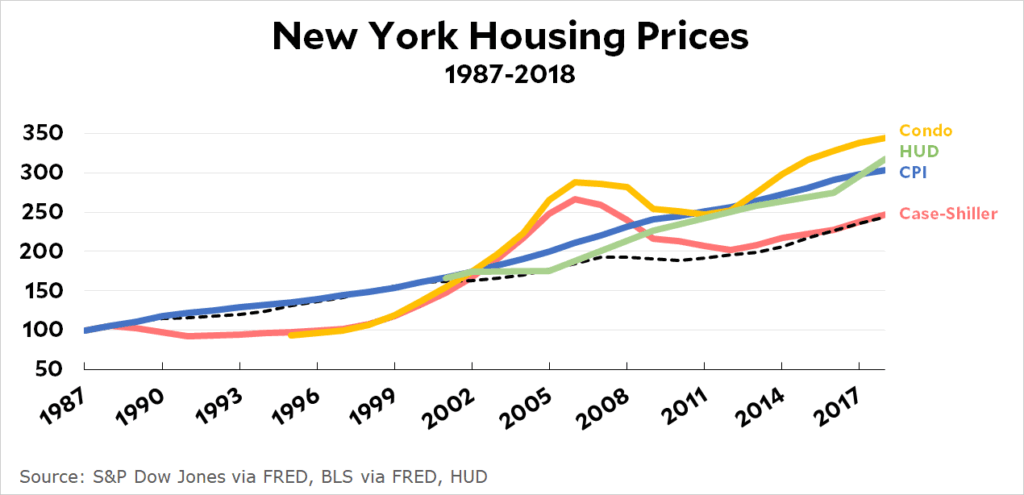
    That’s largely why real estate became viewed as a very popular investment vehicle for financial investors. The figure below illustrates an average of New York housing prices over a 30-year period, between 1987 and 2018, from different housing market segments.

    Figure 1 – New York (NYC) Housing Market Prices (1987-2018) Overview

    As one can see, prices went up across the board mostly every year, with the exception of a rocky period in the midst of the Great Recession of 2008. Therefore, having more ownership/equity in a property that’s also going to increase in value over time is a no brainer, even if you choose to move out of that property prior to paying off your mortgage.

  • NYC Real Estate Market Mid-2021: Are You Better Off Buying or Renting?

    Since New York City’s (NYC) real estate market is still experiencing a fresh post-COVID effect, you are better off buying if you have the money (and credit score). However, as is often the case, it greatly depends on your financial situation. Living in arguably the most desirable and expensive part of the world presents a financial burden to many younger adults, who are still working lower paying, entry level jobs.

    The majority of real estate property owners in New York City are of older age and in the highest income brackets (NYU Furman Center). Additionally, they are more likely to have permanent ownership of property in other locations (Goldstein, Property Nest).

    Many people view renting as ‘wasteful’ because you don’t have the benefit of acquiring equity in your property. However, the reality is for most young or middle-aged professionals, the economic opportunities – combined with the cost of living in New York City – don’t allow them to acquire enough requisite disposable income to put a down payment on a desirable apartment unit. This brings up a primary obstacle many residents of New York City see with buying a permanent unit: most people don’t view New York City as their ‘final destination’, long-term residence. In other words, when most people think about taking out a mortgage and buying a home, they’re thinking about a serious long-term commitment (emphasis on long-term). Raising kids, settling down in a permanent work situation, and finally retiring. The suburbs or a quiet town; not the most densely populated, most popular tourist destination in the world.

    While there are plenty of mechanisms available to individuals looking to get out of a 20 or 30-year mortgage after only a few years, logically, it would make sense for most to still prefer not to take on that kind of serious financial responsibility without the intent of staying in that location for a while.  

    With that being said, from the perspective of someone simply asking: “hey, would I be better off buying or renting in New York City?”, I would advise them to not be hesitant and buy if they have the money saved.

    The reason is two-fold. If you are going to live in the unit, at least initially, you’ll acquire equity simultaneously. If you find that NYC is not for you in a few years – as many inevitably do – current market prices and historic trends, combined with current rates and incentives, suggest one would be able to see a positive cash flow from subleasing or subletting their own property. Meaning, renters are consistently earning more monthly rent than their monthly mortgage payments. Alternatively, if you have no desire of becoming a landlord, contrary to ordinary homeowner’s beliefs, there is the ability to sell your mortgaged property and earn a profit. It’s extremely difficult to look at the recent data without considering the COVID-19 situation, but over a 10-year period prior to that, real estate prices were significantly increasing year-over-year.

    That’s largely why real estate became viewed as a very popular investment vehicle for financial investors. The figure below illustrates an average of New York housing prices over a 30-year period, between 1987 and 2018, from different housing market segments.

    Figure 1 – New York (NYC) Housing Market Prices (1987-2018) Overview

    As one can see, prices went up across the board mostly every year, with the exception of a rocky period in the midst of the Great Recession of 2008. Therefore, having more ownership/equity in a property that’s also going to increase in value over time is a no brainer, even if you choose to move out of that property prior to paying off your mortgage.