
The CBRE report gives a good lay of the land of the top 30 tech cities. We advise investors to do their own due diligence as we live in a different world in 2020 and growth data from 2018 and 2019 cannot be used as reliable indicators. But, this will give some investment ideas for investors interested in the office space and also where the coveted tech jobs are going. A lot of other property types (for e..g multifamily) also look at cities with a great tech story. For the full report, please visit CBRE 2020 Tech 30.
Tag: private equity
-
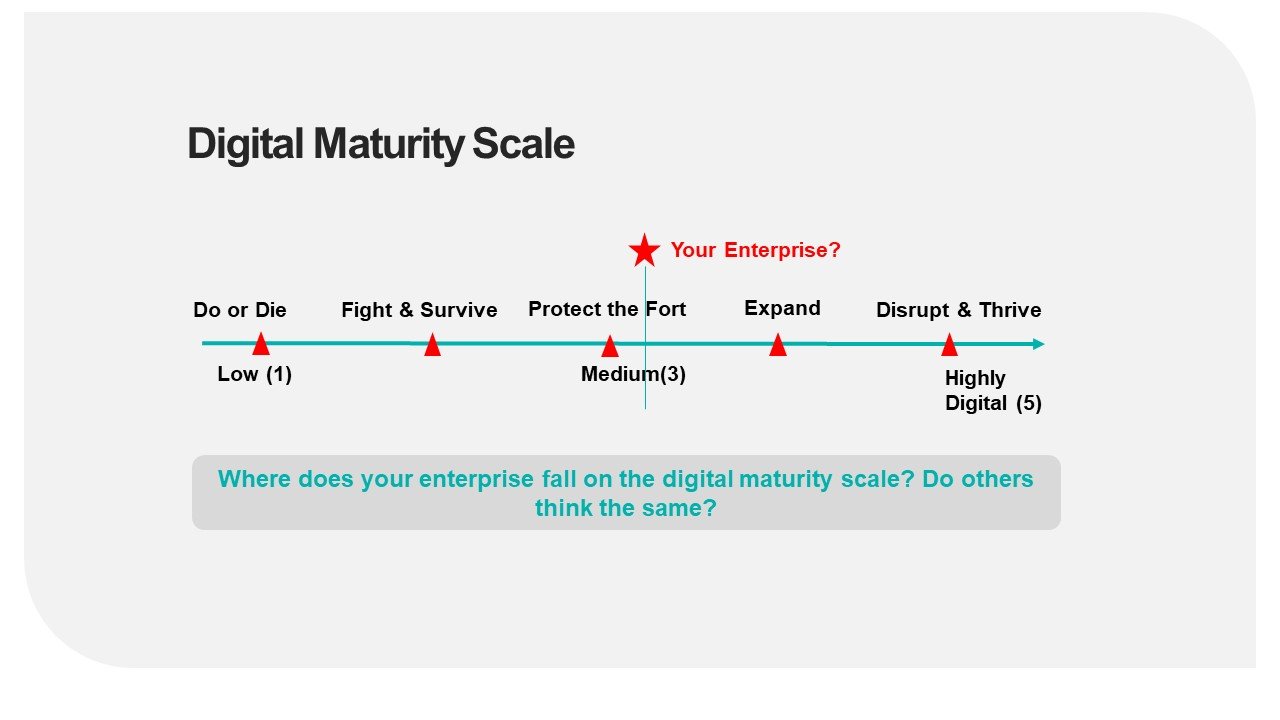
Digital Maturity of your enterprise
Even before your organization starts to invest in digital, it needs to assess where it falls in the digital spectrum. This is an important step in digital strategy. As a starting point for your organization’s digital journey, see where you place on the digital maturity scale:
1. Do or Die – Competition or disruption has already squashed the industry, organization, or product. This is a “do or die” situation for the company to reinvent its business model.
2. Fight and survive – The business is not in imminent danger, but it is very clear that the business needs to be transformed and there is pressure from various constituents (board, shareholders) for change.
3. Protect the Fort – Business has some competitive advantage that will take years to disrupt, but the possibility of digital disruption remains. Organizations have a sense of security and may even be complacent.
4. Land/Expand – These are visionary companies that see opportunities in their industry to build or acquire and add value to customers and increase their market share.
5. Disrupt/Build and Thrive – These are businesses that go after major problems in industries and disrupt the market. Typically, these are digital natives (i.e. built with digital vision).Honestly evaluating your enterprise’s current digital maturity will serve as the starting point for your digital strategy. The next step will be to define where you want to be on the digital maturity scale in the future and how you can get there.
-

How can an investor conquer analysis paralysis?
Have you ever been in a situation where there is no progress because things keep getting stuck in the analysis? If any of the following examples sound familiar to you, then you have witnessed analysis paralysis:
- As an investor, you have been observing a geographical market and trying to invest there for years. But, you are still in the analysis mode without taking any action.
- Maybe you are a sponsor who has to develop a digital presence and finalize a vendor in 3 months. It is month 6 and you’re still considering the pros and cons.
- Your team in a large enterprise had to gather investment and related data, clean it, and load it into a new system. But, the data rules and their merits are still being “validated”.
- You are doing investment research and you should produce a final recommendation in a month. Alas, you’re still collecting and analyzing data after a couple of months.
Why does analysis paralysis happen?
Most investors realize that analysis paralysis can cause major delays and even make them lose deals. But then, why does it continue to happen and why do we let that happen? It usually happens due to one or more of the following:
- Sometimes we try to gain consensus from ALL (say, business partners or family) involved. A variant of this is the pursuit of elusive perfection.
- Unfortunately, in some cases, we are (a) afraid to make decisions or (b) don’t know how to make decisions or (c) are waiting for someone else to make the decisions.
- There are instances when we are unable to influence, nudge, or negotiate to the outcome desired, especially with various personality types involved.
- We “kick the can” as much as possible as there are no consequences or incentives to make timely decisions.
How to conquer analysis paralysis?
How do we conquer analysis paralysis then? A good part of the solution comes from changing individual or team behaviors. You can conquer analysis paralysis by following these guidelines:
Action
The best antidote to analysis paralysis is taking action. Be careful to work within the permissible confines of your beliefs or principles.
Make decision making part of the process
Adopt a work approach that has decision making embedded. For e.g. follow this common approach – define the problem statement, propose 3-4 options, evaluate the pros, and cons, and come up with a recommendation.
Don’t aim for perfection
Realize that there is NO perfect product or technology. Perfect quality is a myth and definitely not attainable in a given timeline. Don’t get caught up in continuous improvement to get to perfection.
Use resources, time, or money pressure in your favor
When we are up against time, resources, and money, it forces us to make decisions or act. We should reiterate to ourselves how lack of decisions negatively impacts the outcome. For e.g. loss of a deal.
Takeaways
If you are facing “analysis paralysis” in any of your endeavors, you have to first acknowledge it. It saps energy, wastes time, reduces morale, and usually benefits no one – not even the procrastinators. Only when you acknowledge it can you address it. By understanding the reasons and taking steps to resolve the analysis paralysis using some techniques outlined in this article. Time to put this into action!
-

Six design principles for digital and technology projects
Many of us are aware of the benefits of following design principles in technology and digital projects. Design principles:
1) Provide guidelines to design solutions
2) Help with consensus building
3) Speed decision makingFor e.g. when different people have differing views, running against the design principles helps the team narrow the design options and choose the recommended solution.
Here are the six design principles for technology projects based on our experience. Most principles can be applied to any digital, technology and construction project and across many industries in addition to real estate.
1) Requirements or design should clearly demonstrate value i.e. usefulness to users
2) Follow industry best practices – Many have walked through this path before, there is no need to “reinvent the wheel” unless it is a competitive differentiator
3) Differentiate between business “need” and “want” and prioritize
4) Keep it simple – Solution should be simple for users to adopt and these are usually the best solutions
5) Leverage platform capabilities “out of the box” – Avoid customization unless it is to implement best practices; this helps to keep the solution simple and standard
6) Don’t aim for perfection – Don’t let perfection be the enemy of good as it isn’t attainable -
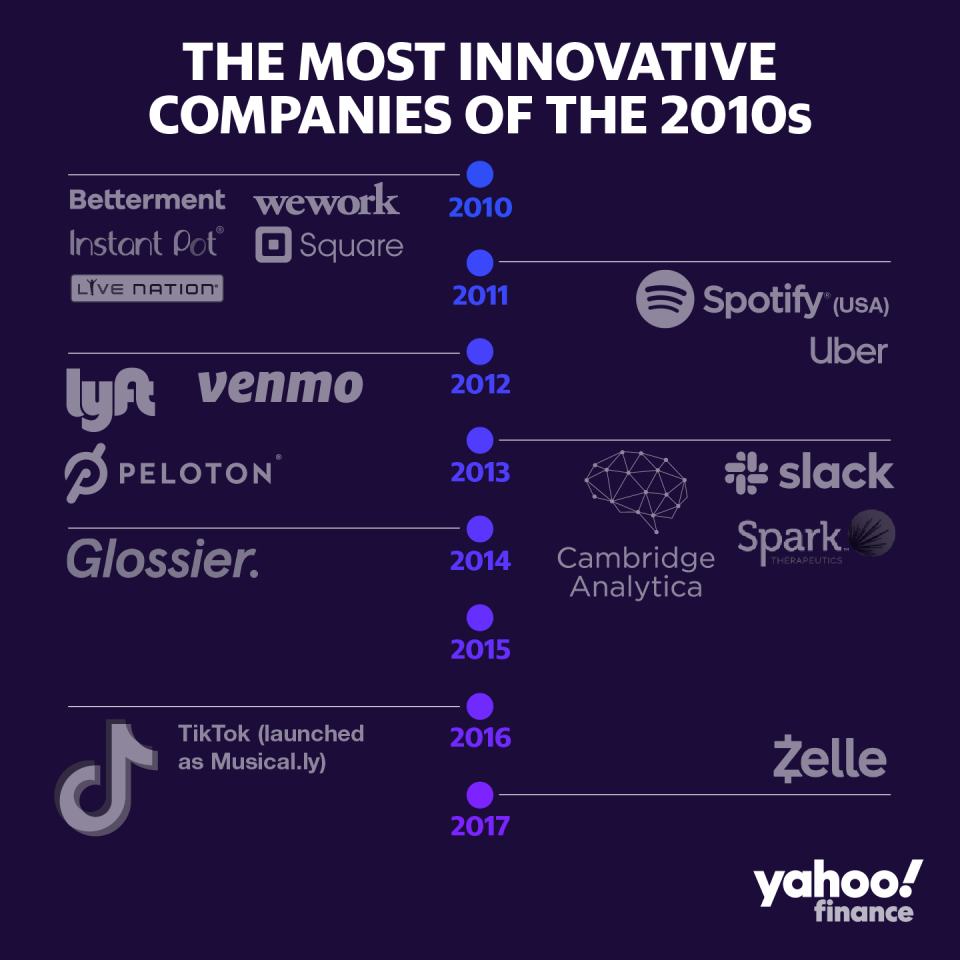
Most innovative companies of the 2010s
Yahoo Finance has come up with the list of most innovative companies of the 2010s. Worth a look for sure.
-
10 Rules, Quotes, or Laws of Meetings!
We have read many books, articles and blogs on meeting facilitation and management, but this still remains an area where all of us can improve. We still through those meetings where nothing gets accomplished and we feel that we’ve wasted most of our day in meetings. This is especially true if we work with teams or large organizations.
We have concocted 10 quotes/rules/laws on meetings drawing “inspiration” from various sources – science, literature, and even divinity. Please enjoy it with your favorite beverage.
- It is good to have a meeting with a good facilitator. It is better to have a meeting with prepared participants. It is best not to have the meeting in the first place!
- Ignore participants who shout or speak a long time in meetings and you won’t miss much.
- Why bother attending a meeting, when someone didn’t bother with an agenda?
- I came across a fork, I declined the meeting and that made all the difference.
- A meeting that starts on time is likely to end on time. A meeting that doesn’t start on time is not likely to end on time. It is that simple, folks!
- Meeting’s success can be measured by its actual duration – the shorter the better.
- I went around looking for the bad in other’s meetings, only to realize mine was the worst.
- More the mass in the meeting room, the less the velocity of the meeting.
- What is the purpose of attending a meeting, if the meeting doesn’t have a purpose?
- The only time meetings are fun, it is called Sports.
-

COVID-19 and Digital Priorities for Enterprises
Over the course of two weeks in March 2020, we’ve had the opportunity to discuss with 20+ technology leaders the state of Digital and Technology, especially the impact of the global pandemic on Digital and Technology priorities. Organizations all over the world will be revisiting their priorities and we felt it will be good for us to evaluate the impact and prepare ourselves for the road ahead. In order to do that, every organization in real estate and other industries has to answer the following question: What areas of digital and technology to focus on in the coming two years?
The answer to the above question is the objective of this article. We will dive deeper into what we believe are the top 10 digital and technology focus areas for enterprises and rank priorities. Some feel that digital and tech has been a big help – for business continuity as well as connecting people – during these trying times and some feel that some enterprises will weather through these trying times and emerge stronger.
Before we go further, we’d like to call out a few things. If not anything, this article is a place to collect our thoughts and synthesize the various viewpoints; We do hope some can benefit from the collective experience and viewpoint provided. To remain agnostic, we’ve avoided naming organizations or products.
Impact Scorecard
Top 10 Digital & Technology focus areas for organizations have been identified and listed. It is a tough exercise to keep the list of focus areas to 10 and we had to drop a few areas like regulations and API economy to keep the list to the top 10. The following chart summarizes those focus areas and a gauge of the likely 2020 and 2021 priority – investment and interest – in those areas. The priorities are categorized into low, medium, and high. The priorities are relative to each other in the list. Our take on 2019 priorities is also provided to serve as a baseline.
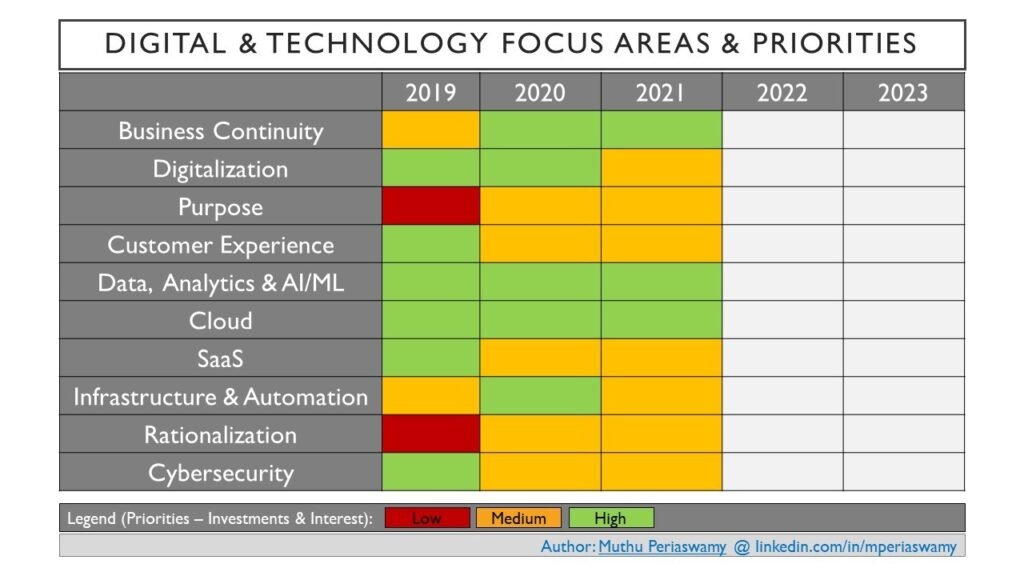
Top 10 Focus Areas
Let us dig into all of the focus areas as they need an explanation. Some focus areas may be controversial and hence additional commentary for those:
- Business Continuity – #1 High priority in 2020. The first and foremost thing on every executive’s mind will be to ensure that their organization does business (if they can) without any disruption. The organization’s business continuity plans will be thoroughly tested and many weaknesses will arise that organizations will fix as soon as they possibly can.
- Digitalization – High priority in 2020. Digitalization will be a tale of two worlds, with digitalization actually increasing for use cases that support business continuity and mobility vs. digitalization decreasing for use cases with poor business cases and large budgets. Overall, new or existing initiatives to address #1 above will keep digitalization a high priority this year.
- Purpose – Medium priority in 2020. There will be an awakening of sorts and people (and hence organizations) will clamor to incorporate ESG – Environmental, Social, and Governance – in their business. Technology will enable businesses to be more purpose-driven, particularly the social impact part (the S in ESG). It remains to be seen what shape or form it will take, but the debates and discussions will happen.
- Customer Experience (CX) – Medium priority in 2020. Organizations can be expected to continue the customer focus, but with two changes. First, there will be less tolerance for big spending on customer acquisition, retention, and CX delivery. Pragmatism will creep in and key tenets of CX – Reliability, Trust, etc. – will be prioritized. Second, expect some significant rethinking on how CX will coexist with social impact i.e #4 above.
- Data, Analytics, and Machine Learning – High priority in 2020. The importance of data will only grow, but the appetite for big data initiatives with big budgets will reduce. Cheap analytics (mostly cloud-based) will lead the way and will get the job done. Expect AI and ML to be bundled along with Analytics or other products/services.
- Cloud – High priority in 2020. Public cloud adoption and the automation of infrastructure and deployment will only accelerate as organizations focus on bottom-line and efficiency. Cloud-native architecture and deployment will see a big uptick. Another factor is that cloud providers have better reliability and security than many organizations and can enable business continuity. Cloud will be a high priority.
- SaaS – Medium priority in 2020. Cross-industry horizontal SaaS (for e.g. human capital management, CRM) are well entrenched in many organizations and that is not going to change. But, expect competitive pricing from nimbler but reliable SaaS providers and a lot of consolidation. Industry-specific SaaS adoption (for e.g. wealth management) will accelerate and consolidate around the leaders.
- Infrastructure & Automation – High priority in 2020. Workloads are increasingly moving to cloud and SaaS, but a significant amount of on-premise infrastructure needs to run smoothly to enable business continuity. Some Automation areas will see an increase (for e.g. CI/CD), whereas some areas may plateau (for e.g. Robotic Process Automation) as it will be difficult to show return on investment.
- Rationalization – Medium priority in 2020. The need for cost-savings and efficiency will result in many organizations streamlining their tech stack and sunsetting software and infrastructure that have been kept around. This effort may go by a new catchy name, but we should expect organizations to undertake this during tough times.
- Cybersecurity – Medium priority in 2020. The importance of cybersecurity will remain, but we should expect more scrutiny of investments and results. Cybersecurity was probably the #1 issue for many organizations in 2019, but survival (i.e. keep business running) will be #1 issue in 2020.
Takeaways
In this article, we looked at the top 10 digital and technology focus areas of organizations across industries. In summary, organizations will prioritize business continuity, cloud, data, and rethink social impact (ESG) in 2020!