Tag: real estate investing

  • What is a REIG? The Pros and Cons

    A REIG (Real Estate Investment Group) is a group of private investors who invest almost exclusively in real estate by pooling money, knowledge, and/or time to acquire properties that generate income (Brummer, Millionacres). Investment strategies for REIGs will differ based on each group’s specific strengths. A REIG is not a real estate investment trust (REIT) or crowdfunding real estate venture, although superficially, they may appear similar. They both invest the majority of pooled funds in real estate or real estate debt, earn income primarily from real estate, and distribute most of the income back to the parties involved.

    Pros of a REIG

    A REIG is a way for you to have your investment funds backed by physical real estate while allowing you to leverage the collective buying power and experience of the group. Additionally, investing in real estate as a group can give you a less “hands on” approach to real estate investing, or more, depending on your desires and the strengths of your group. Furthermore, a REIG is a form of “diversification” in the sense that your thoughts about the financial incentives of an acquisition may be different than your partners in the group. Of course, this can be a negative if you are unable to persuade others investors in the group and the property turns out to be a successful investment. However if you surround yourself with like-minded investors, which is generally the case for most REIGs, this is unlikely to occur often. Going back to buying power, groups of investors can pool a very substantial amount of money together. This would in turn allow them to invest greater sums of cash and diversify their investments over a greater number of real estate properties. Conversely, an individual investor may only have enough capital to put into one – or a few – properties that may wind up taking an unexpected downturn. Finally, there’s a benefit to having fellow investors with the same stakes you do because you have the opportunity to learn from them. You would be able to potentially use some of those successful strategies in your own personal real estate investments.

    Cons of a REIG

    Many cons to a REIG can also be viewed as strengths, depending on the amount of weight you pull in it. For example, a more “hands-off” approach to investing through a REIG can turn detrimental if the individual(s) responsible for the “hands-on” tasks do a poor job. Additionally, since REIGs pool your investment money with others, you lose out on some profit prospective with it being shared throughout the group. To the contrast, this could be viewed as a way to mitigate your conceivable losses – as mentioned in the strengths – but skilled real estate investors rarely have a pessimistic view of investments they are willing to enter into. While some view this as insignificant, the tax structure and fees associated with REIGs similarly lower your bottom line profit. Along the same lines, due to regulations and commonplace agreements signed between the parties, pulling your money out of the REIG can be burdensome and costly. Finally, many investors are prone to different management styles, have different investment goals, and differ in many other germane ways. Conflicts arising from disagreements between members in a REIG can lead to not only unfavorable financial outcomes, but it can go as far as breaking up the REIG.

    Concisely, REIGs are a good fit for novice or expect real estate investors, as well as everything in between. From our perspective, the concept seems like it would be a better fit for those looking to enter the real estate market, rapidly expand their presence in that market, or if you have unique knowledge, but do not have the cash saved to personally invest in real estate yet. Reviewing the pros and cons alone, unfortunately, does not provide enough guidance as to whether or not this is the right investment vehicle for you. As with most financial investments, REIGs can be beneficial or detrimental for you, completely dependent on your financial situation, knowledge of the real estate market, and more. We do believe that an invaluable positive to REIGs is the knowledge potential from other investors in your group. Some of the most successful investors from different parts of the globe have said that intellectual capital can prove to be exponentially more valuable than simply having excess cash in a savings account, with no unique or constructive ideas on how to put that capital to use in order to maximize a positive return. 

  • Passive Real Estate Investing

    When reading about real estate investing, often times investors think of active real estate investors, who are essentially landlords. There are also both direct and indirect passive real estate investors. Passive real estate investing is investing in real estate without substantial hands-on effort or active participation from the investor. They invest through syndications, online crowdfunding, individual real estate funds, and real estate investment trusts. In fact, many would argue passive real estate investing requires the least experience and hassle while offering more diversification and liquidity.

    Direct Passive Real Estate Investing

    With direct real estate investing, an investor will purchase a property or portion of a property that is subsequently rented out. Often, real estate investors that purchase entire properties will hire what is known as a property manager, or property management company, to take care of the day to day maintenance and tasks such as collecting rent. Post-purchase of the property, hiring a property management company allows an investor to essentially be hands-off in the management of the property. Hence the term passive real estate investing in this context.

    Indirect Passive Real Estate Investing

    To the contrary, indirect real estate investing is a process where individuals invest in a REIT (Real Estate Investment Trust) or a real estate related mutual fund. This type of real estate investing is considered passive because there is no day-to-day management needed and it’s also considered indirect because it doesn’t involve a specific piece of real estate. Investors then collect passive income as returns or dividends from funds.

    Regardless of which method you prefer, there is a great potential for positive cash flow and overall wealth generation in real estate investment markets. In upcoming posts, we’ll dive into more specifics about REITs, as well as other types of real estate funds investors are often more drawn to.

  • Why Real Estate Investors Refer to Real Estate as an I.D.E.A.L. Investment

    Many real estate investors are familiar with the acronym ‘I.D.E.A.L. Investment’ in the context of real estate investing (Chad Carson, Coach Carson). This acronym is a great, succinct explanation for why real estate is preferred by many investors to other vehicles like dividend stocks, bonds, small businesses, index funds, bank certificate of deposits, annuities, and more.

    Income

    Real estate properties provide excellent cash flow on a regular (typically a monthly) basis and the income size can be quite substantial, depending on your properties’ interest rate, unpaid principal, and property value. This is the primary objective of any investor, which makes real estate a top choice for many. If you aren’t seeing much or any cash flow from an investment, especially after a lengthy period of time, typically it’s not a very successful one.

    Depreciation

    Another big advantage to real estate investing was actually made widely known by Donald Trump in the 2016 presidential campaign; depreciation. Depreciation occurs because for residential buildings, the U.S. government requires real estate investors to spread out most of the cost of real estate purchases over 27.5 years. This creates an annual depreciation expense, which can provide incredible tax benefits. This ‘expense’ doesn’t come out of your bank account, like purchasing materials to sell products, or insurance/maintenance costs. Instead it’s absorbed ‘on paper’ and you see real financial benefits in the form of tax relief.

    Equity

    Generally for real estate investors, as time goes on the more equity they’ll acquire in their own properties by repaying loans, which is directly linked to greater overall wealth. The shorter it takes you to pay off your own financial obligations on a property, the larger your ROI will be. Additionally, you’ll be able to optimize the length of time you’ll see financial benefits from that investment. While it may depend on your financial situation and the real estate market climate, real estate investing is a great way to acquire equity and see positive cash flow simultaneously.

    Appreciation

    Appreciations refers to the idea that your property value is supposed to increase each year. As we’ve seen in recent years, this may not necessarily be the case (primarily due to unpredictable circumstances). However, long-term investors (who comprise a very large segment of real estate investors) are satisfied with the long-term average of property values visibly pointing towards an upward trajectory.

    Leverage

    Leverage can refer to two distinct advantages of real estate investing. Firstly, some indicate this means the initial incurrence of debt leading to equity growth over time (this appears to be covered by ‘Appreciation’). Secondly, leverage can more commonly refer to the idea of using other people’s money (OPM) to earn a positive cash flow. This gives investors the opportunity to use relatively small amounts of cash upfront to gain control over multiple investment properties and earn returns on cash invested. This method isn’t typically used by passive investors, who would be concerned with over-leveraging and what could happen if there was a steep decline in the housing market.  

  • Five Key Tips to Investing in Rental Properties

    Five Key Tips to Investing in Rental Properties

    1. Stay on Top of Your Personal Debt

    Savvy investors tend to make sure they are not highly levered, especially prior to investing in any real estate property they intend to rent out. While all would agree that it’s not necessary to have 100% cash up front in many situations to make the property a great investment, it’s wise to try to pay down any personal debt you may have prior to, or after acquiring a rental property. Otherwise you may find that your expenses – especially something like a huge, unexpected medical bill – could cause you to pay a lot more in interest, thus losing profit, than you were originally seeking to.

    2. Make Sure You Can Really Afford Your Downpayment

    Whether you want to purchase a rental property for supplemental income, to diversify your investment portfolio, or as part of a longer-term investing strategy, it’s essential that when you decide to pull the trigger, you’re confident your budget can sustain the downpayment. This ties back to staying on top of your personal debt and other investments in your portfolio, but at the same time it’s a common mistake. You won’t be putting down 3-10% like you may on your personal home. With the minimum being 20% and if financing, you generally see it coming in the form of a personal loan, you can once again get into a rut with interest and possible refinancing if you can’t really afford the initial downpayment.

    3. Stay Away from Financing with High Interest Rates

    Comparatively in 2020, the cost of borrowing money has been very cheap due to economic factors from the COVID-19 pandemic, however in general loans with higher interest rates are best to avoid when looking to buy a rental property. Remember, you’re not going to get the benefit of a traditional mortgage interest rate, so be sure to stay away from personal loans (or other means of obtaining financing) that carry high interest rates.

    4. Location, Location, Location

    Investors already in the rental market are just starting to see prices stabilize, but only in certain “prime” locations. For example, if you look at various subdivisions of geographic areas within the Manhattan real estate market, you’ll find studios in the Upper East Side (for example) are now all above a ‘floor price’. However, if you look at similar studios in East Harlem, you won’t see the same uniformity. In fact, it’s very much to the contrary; there’s still high volatility in rental prices in ‘non-prime’ locations. To ensure your investment property is as immune as possible to market fluctuations resulting from uncertainty, the location of your rental property is essential to a successful return on investment.

    5. Invest in Landlord Insurance; Assume Unexpected Costs

    The two don’t necessarily go hand-in-hand (you should always assume unexpected costs), we wanted to recommend landlord insurance specifically on top of homeowners insurance. Landlord insurance generally covers property damage, lost rental income, and liability protection, in case a tenant or a visitor suffers injury as a result of property maintenance issues (for example). Depending on various factors of your rental property, the cost may be higher than you anticipate and you may be one of the people who thinks “this will never happen to me, so I don’t need it”, but in these cases it’s definitely better to be safe than sorry. Investing in a rental property is a big commitment and the landlord insurance certainly isn’t somewhere it’ll be worth it to cut costs in the long-term.

  • Home Prices Continue to Soar, Are We Headed for Another Housing Market Bubble?

    Nearly all experts predict we are not. Here’s Frank Martell, President, and CEO of CoreLogic.

    With prospective buyers continuing to be motivated by historically low mortgage rates, we anticipate sustained demand in the summer and early fall…

    Additionally, housing market investors don’t perceive there to be many similarities to the 2008 housing market crash. The bottom line is no one has any real concerns about a sudden drop in prices as home price statistics, provided by Forbes, show consistent month-to-month increases in prices.

    Greg McBride, the chief financial analyst at Bankrate.com, told Forbes that although home prices are climbing, any perceived similarities to the housing bubble and crash of 2006-2008 are yet premature:

    The [current] rise in prices is a byproduct of a severe imbalance between supply and demand, not the ‘loosey, goosey,’ anything-goes lending that so was so prevalent in the [2006-2008] housing bubble

    McBride also points out that, unlike the 2006-2008 period, lending standards have greatly tightened. Banks are now only lending to the most creditworthy mortgage customers, suggesting a price crash is probably not in the cards. But McBride warns that if lending standards loosen again and “we see the [excessive lending] practices we saw from 2004-2006, then all bets are off.”

    Frank Nothaft, the chief economist for CoreLogic, told Forbes that subprime borrowers are now “largely absent” from the mortgage market. The subprime borrowers were partly to blame for the prior housing meltdown. The list of experts with similar beliefs that the housing crash is not imminent is extremely long. They don’t believe there is anything close to a repeat of 2008 in the near future. Only time will tell.

  • How big is the real estate sector in S&P 500?

    Commercial Real Estate (CRE) Investor Question #91: How big is the real estate sector in S&P 500?

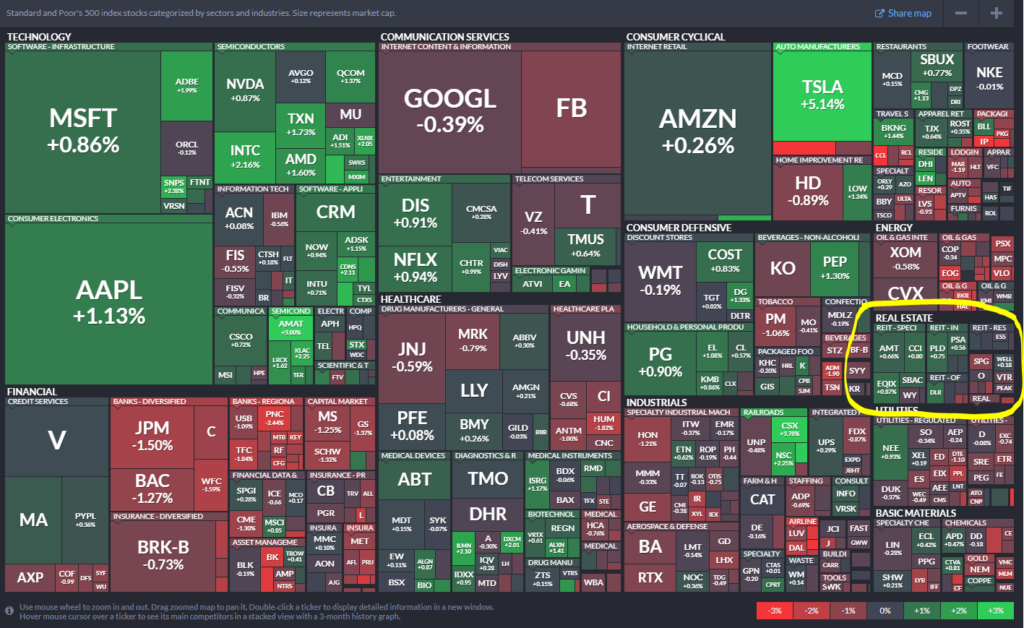
    The following illustration gives an idea of the size of the real estate sector (circled in yellow) within the S&P 500. Going by market size, it is one of the smallest sectors in S&P 500 as of March 2021. Technology is the biggest sector. The real estate sector consists of REITs across multiple property types like Industrial, Multifamily, Office, etc.

    Source: Finviz S&P 500 composition and the Real Estate sector
  • Can you leverage migration patterns for investing?

    Demographics and in particular net migration plays an outsized role in Real Estate. In this article, we’ll look at the key factors affecting real estate and why net migration is a good indicator to follow for real estate investors.

    We’ll delve into why net migration is actually a great indicator for the top states, counties, and towns to invest in. We’ll look at some migration reports from 2020 and see if they can form the basis of some investment ideas in 2021 and beyond.

    Key Pillars of Real Estate Investing

    Real Estate business and investing is impacted by multiple factors, but we can group them into three major categories:

    • Demographics
      • Population Growth, Urbanization/Sub-urbanization, and Migration
      • Employment Growth
      • Income/Cost of living
    • Economic
      • Supply & Demand
      • Infrastructure – Technology / Transportation
      • Fiscal and monetary policies (for e.g. interest rates)
    • Incentives
      • Affordable housing policies
      • Tax and Federal housing incentives
      • State and local incentives and policies

    For an individual investor, keeping track of the above can be overwhelming though some of the policies and economics may remain the same over years or even decades. Still, it is a stretch for individual investors. In this article, we’ll focus on demographics and see if net migration can be a proxy (or close to a proxy) to find states or cities to invest in.

    Demographics and demographic trends

    Our focus will be on demographics and in particular net migration in this article. Why is demographics a key pillar and why should we focus on that? Because demographics is all about the consumers i.e. tenants. One can have the best economic climate and the greatest policies, but at the end of the day a customer has to rent real estate and that is driven by demographics makeup. First, let us see the definition of demographics.

    Demographics are the data that describes the composition of a population, such as age, race, gender, income, migration patterns, and population growth. These statistics are an often overlooked but significant factor that affects how real estate is priced and what types of properties are in demand

    Source: https://www.investopedia.com/articles/mortages-real-estate/11/factors-affecting-real-estate-market.asp

    A customer (i.e. tenant) has to rent real estate in a given location and demographics is all about the customers. Investors should look at demographics at a given point of time as well as over a period of time (i.e. trends). It is also good to remember that many demographical trends were already underway and they only got accelerated due to the global pandemic in 2020.

    Net Migration and Migration Trends

    Investors realize that certain states or cities are growing because they see or hear about many moving to those places. For e.g. many people in New York realize that a lot of jobs are moving to the south, particularly Florida, and people follow those jobs. Net migration in certain regions, states, and cities surpass those of poorly faring places.

    Savills, the International real estate firm has done studies on the reasons for migration throughout the world. Here is the summary of the impact of migration on real estate.

    In-migration has a major impact on real estate as demand for both residential and commercial space increases. If supply is unable to match the demand, this often results in pressure on prices. We have analyzed data from Oxford Economics to understand which cities are expected to attract the largest net migration over the next five years as a percentage of their population.

    Source: https://www.savills.com/impacts/social-change/the-impact-of-migration-on-real-estate.html

    Savills has the following take on the reasons major cities are seeing a lot of net migration:

    • Europe: Swiss Cities in demand
    • Asia: Attracting talent
    • North America: Quality of life

    We’ll look at net migration data and statistics on the following factors in US and see if we see some patterns that will give some ideas on locations to invest.

    • Flight to suburbs and smaller cities
    • Flight to quality of life
    • Flight to “business” friendly and no-tax states

    Net migration to secondary cities and suburbs

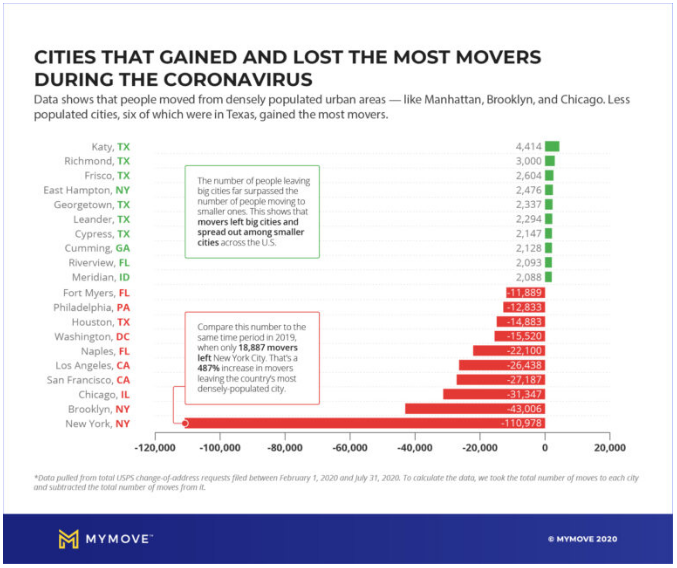
    Mymove has studied migration patterns in 2020 with the COVID pandemic and over 15.9 million have moved during the pandemic based on USPS data. Urban density has been a big reason for people to move to smaller cities and suburbs. As you can see from the chart below, big cities have had a large outflow in the first half of 2020. This has resulted in rent reduction in dense and pricey cities, but the opposite in smaller cities and suburban places.

    CITIES THAT GAINED AND LOST THE MOST MOVERS 
DURING THE CORONAVIRUS 
Data shows that people moved from sely populated urban areas — like Manhattan, Brooklyn. and Chicago. Less 
cities, six of which were in Texas, gained the most movers. 
Katy, TX 
Richmond, TX 
East Hampton. NY 
Leander, TX 
cypress. TX 
Cumming, GA 
Meridian. ID 
Myers. 
Philadelphia. PA 
Houston. 
TX 
Washington, DC 
Naples, 
FL 
LOS CA 
San Vrancisco. 
CA 
NY 
New York. 
-120n 
lett big cit•s 
cit*sacrcssmeUS 
20'9. 
18.887 —S 
lett ( 
2,476 
2,29a 
2,093 • 
20s* • 
20.000 
7070 
M MYMOVE-

    Net migration to “business” friendly or no-tax states

    In the 20th century, people migrated to cities like New York or Los Angeles for better opporunities, but in the past couple of decades states like Texas have been able to lure many people with their “business” friendly or no-tax policies. Florida and Arizona are also considered “business” and tax friendly states and hence the net migration needs to be reviewed further.

    STATES THAT GAINED AND LOST THE MOST MOVERS 
DURING THE CORONAVIRUS 
Florida , New York, and California — states with big cities that experienced a surge in infection rates during the onset 
of the pandemic — lost the largest number of movers. Michigan, North Carolina, and Texas the most movers. 
NJ 
HIGHEST NET GAIN 
-199,000 to 
S9,ocoto -go,ooo 
-79,000 to 40,000 
-39.000 to O 
M MYMOVE• 
to 10,ooo 
10,001 to 
20,001 to 30,000 
30,001 to 40,000 
40,001 to 50,000 
PR 
HIGHEST NET Loss 
-235.765 
-15.638 
MN 
TX 
NC 
30.603

    Net Migration for quality of life

    Quality of life is primarily defined by cost of living and access to amenities that people are looking for. Savills Research shows the top 10 cities for net migration in the US. The results should not be surprising for many. We see cities in Texas, Flordia and Georgia that have attracted sizable new population. This should give investors some ideas about places to invest.

    Source: Savills Research using Oxford Economics  Note: Only cities with GDP greater than $50bn considered

    Investor Takeaways

    In summary, we’ve seen how demographics is a key pillar of real estate investing. We’ve seen how net migration is a great indicator or proxy of demographics and even attractiveness of investment locations. We’ve also looked at migration patterns in US to help investors find states and cities that may be attractive investing targets.

    Though net migration data should not be looked at on its own, looking at migration along with other key data will net investors some good investment locations and ideas. The action items for investors are to answer the questions: Do the locations you want to invest in have these positive migration characteristics? Can you update your investment thesis based on these locations?

  • Can you leverage migration patterns for investing?

    Demographics and in particular net migration plays an outsized role in Real Estate. In this article, we’ll look at the key factors affecting real estate and why net migration is a good indicator to follow for real estate investors.

    We’ll delve into why net migration is actually a great indicator for the top states, counties, and towns to invest in. We’ll look at some migration reports from 2020 and see if they can form the basis of some investment ideas in 2021 and beyond.

    Key Pillars of Real Estate Investing

    Real Estate business and investing is impacted by multiple factors, but we can group them into three major categories:

    • Demographics
      • Population Growth, Urbanization/Sub-urbanization, and Migration
      • Employment Growth
      • Income/Cost of living
    • Economic
      • Supply & Demand
      • Infrastructure – Technology / Transportation
      • Fiscal and monetary policies (for e.g. interest rates)
    • Incentives
      • Affordable housing policies
      • Tax and Federal housing incentives
      • State and local incentives and policies

    For an individual investor, keeping track of the above can be overwhelming though some of the policies and economics may remain the same over years or even decades. Still, it is a stretch for individual investors. In this article, we’ll focus on demographics and see if net migration can be a proxy (or close to a proxy) to find states or cities to invest in.

    Demographics and demographic trends

    Our focus will be on demographics and in particular net migration in this article. Why is demographics a key pillar and why should we focus on that? Because demographics is all about the consumers i.e. tenants. One can have the best economic climate and the greatest policies, but at the end of the day a customer has to rent real estate and that is driven by demographics makeup. First, let us see the definition of demographics.

    Demographics are the data that describes the composition of a population, such as age, race, gender, income, migration patterns, and population growth. These statistics are an often overlooked but significant factor that affects how real estate is priced and what types of properties are in demand

    Source: https://www.investopedia.com/articles/mortages-real-estate/11/factors-affecting-real-estate-market.asp

    A customer (i.e. tenant) has to rent real estate in a given location and demographics is all about the customers. Investors should look at demographics at a given point of time as well as over a period of time (i.e. trends). It is also good to remember that many demographical trends were already underway and they only got accelerated due to the global pandemic in 2020.

    Net Migration and Migration Trends

    Investors realize that certain states or cities are growing because they see or hear about many moving to those places. For e.g. many people in New York realize that a lot of jobs are moving to the south, particularly Florida, and people follow those jobs. Net migration in certain regions, states, and cities surpass those of poorly faring places.

    Savills, the International real estate firm has done studies on the reasons for migration throughout the world. Here is the summary of the impact of migration on real estate.

    In-migration has a major impact on real estate as demand for both residential and commercial space increases. If supply is unable to match the demand, this often results in pressure on prices. We have analyzed data from Oxford Economics to understand which cities are expected to attract the largest net migration over the next five years as a percentage of their population.

    Source: https://www.savills.com/impacts/social-change/the-impact-of-migration-on-real-estate.html

    Savills has the following take on the reasons major cities are seeing a lot of net migration:

    • Europe: Swiss Cities in demand
    • Asia: Attracting talent
    • North America: Quality of life

    We’ll look at net migration data and statistics on the following factors in US and see if we see some patterns that will give some ideas on locations to invest.

    • Flight to suburbs and smaller cities
    • Flight to quality of life
    • Flight to “business” friendly and no-tax states

    Net migration to secondary cities and suburbs

    Mymove has studied migration patterns in 2020 with the COVID pandemic and over 15.9 million have moved during the pandemic based on USPS data. Urban density has been a big reason for people to move to smaller cities and suburbs. As you can see from the chart below, big cities have had a large outflow in the first half of 2020. This has resulted in rent reduction in dense and pricey cities, but the opposite in smaller cities and suburban places.

    CITIES THAT GAINED AND LOST THE MOST MOVERS 
DURING THE CORONAVIRUS 
Data shows that people moved from sely populated urban areas — like Manhattan, Brooklyn. and Chicago. Less 
cities, six of which were in Texas, gained the most movers. 
Katy, TX 
Richmond, TX 
East Hampton. NY 
Leander, TX 
cypress. TX 
Cumming, GA 
Meridian. ID 
Myers. 
Philadelphia. PA 
Houston. 
TX 
Washington, DC 
Naples, 
FL 
LOS CA 
San Vrancisco. 
CA 
NY 
New York. 
-120n 
lett big cit•s 
cit*sacrcssmeUS 
20'9. 
18.887 —S 
lett ( 
2,476 
2,29a 
2,093 • 
20s* • 
20.000 
7070 
M MYMOVE-

    Net migration to “business” friendly or no-tax states

    In the 20th century, people migrated to cities like New York or Los Angeles for better opporunities, but in the past couple of decades states like Texas have been able to lure many people with their “business” friendly or no-tax policies. Florida and Arizona are also considered “business” and tax friendly states and hence the net migration needs to be reviewed further.

    STATES THAT GAINED AND LOST THE MOST MOVERS 
DURING THE CORONAVIRUS 
Florida , New York, and California — states with big cities that experienced a surge in infection rates during the onset 
of the pandemic — lost the largest number of movers. Michigan, North Carolina, and Texas the most movers. 
NJ 
HIGHEST NET GAIN 
-199,000 to 
S9,ocoto -go,ooo 
-79,000 to 40,000 
-39.000 to O 
M MYMOVE• 
to 10,ooo 
10,001 to 
20,001 to 30,000 
30,001 to 40,000 
40,001 to 50,000 
PR 
HIGHEST NET Loss 
-235.765 
-15.638 
MN 
TX 
NC 
30.603

    Net Migration for quality of life

    Quality of life is primarily defined by cost of living and access to amenities that people are looking for. Savills Research shows the top 10 cities for net migration in the US. The results should not be surprising for many. We see cities in Texas, Flordia and Georgia that have attracted sizable new population. This should give investors some ideas about places to invest.

    Source: Savills Research using Oxford Economics  Note: Only cities with GDP greater than $50bn considered

    Investor Takeaways

    In summary, we’ve seen how demographics is a key pillar of real estate investing. We’ve seen how net migration is a great indicator or proxy of demographics and even attractiveness of investment locations. We’ve also looked at migration patterns in US to help investors find states and cities that may be attractive investing targets.

    Though net migration data should not be looked at on its own, looking at migration along with other key data will net investors some good investment locations and ideas. The action items for investors are to answer the questions: Do the locations you want to invest in have these positive migration characteristics? Can you update your investment thesis based on these locations?

  • Rental Yield vs. Cap Rate?

    Commercial Real Estate (CRE) Investor Question #90: What is the difference between rental yield and cap rate?

    Rental yield is the net amount of money a landlord receives in rent over one year (after deducting operating expenses), shown as a percentage of the amount of money invested in the property.

    So, Rental Yield = (Net Annual Rental Income / Cost) X 100

    Note that rental yield is calculated on Net Operating Income without considering interest payment, tax and depreciation.

    Cap rate (or capitalization rate) is the ratio between the net operating income produced by a real estate asset and its cost (or current market value).

    So, Cap Rate = Net Operating Income / Value (or cost)

    If you notice, both rental yield and cap rate appears to be same!

    Rental yield is used to calculate the yield (return) of an asset whereas the cap rate is used to find the value (capitalized value) of an income generating real estate asset.

    Source: https://www.feasibility.pro/real-estate-analyst-interview-questions-answers/
  • Rental Yield vs. Cap Rate?

    Commercial Real Estate (CRE) Investor Question #90: What is the difference between rental yield and cap rate?

    Rental yield is the net amount of money a landlord receives in rent over one year (after deducting operating expenses), shown as a percentage of the amount of money invested in the property.

    So, Rental Yield = (Net Annual Rental Income / Cost) X 100

    Note that rental yield is calculated on Net Operating Income without considering interest payment, tax and depreciation.

    Cap rate (or capitalization rate) is the ratio between the net operating income produced by a real estate asset and its cost (or current market value).

    So, Cap Rate = Net Operating Income / Value (or cost)

    If you notice, both rental yield and cap rate appears to be same!

    Rental yield is used to calculate the yield (return) of an asset whereas the cap rate is used to find the value (capitalized value) of an income generating real estate asset.

    Source: https://www.feasibility.pro/real-estate-analyst-interview-questions-answers/