Tag: real estate investment

  • Financial Markets Are Suffering, But What About Real Estate?

    As recent signals that the Fed’s “soft landing” recession isn’t going to come to fruition, financial markets responded accordingly. In addition to covering financial markets impact, we’re going to look into real estate. The DOW Jones and S&P 500 both dropped steadily Friday 10/7. The S&P has been on such a steady decline, the last 12 months of gains have officially completely canceled out. While some have speculated that we’re at a “bottoming out” in the equities market, which is supported by historic S&P 500 trends, market participants don’t seem to fully buy in. In fact, quantitatively the Top 5 stocks by market cap in the S&P 500 (Apple, Microsoft, Amazon, Tesla, and Alphabet Inc/Google, i.e., “Big Tech”) have been overpriced for years, compared to S&P 500 P/E [Price-to-Earnings] averages.

    Either way, turmoil is very likely to continue for capital markets and equities investors. Even if the net result is positive, there will be a lot of sleepless nights in the process. Let’s shift gears and take a look at a completely different, but critical (remember 2008) market: real estate.

    The Real Estate Market was Effectively COVID-proof; is it Recession-proof?

    This is the ultimate question for investors will look at real estate – both passive and active investments – in the longer-term. Foreign investors are already starting to see massive benefits to American real estate investments. That’s certainly one of the primary catalysts for steadily high real estate prices, while other assets are devalued. While we’re going to address the current and future state of the real estate market, the heading was rhetorical. Never forget 2008. That’s going to be a critical lesson investors takeaway from this coming recession, as well. 

    Real estate and related assets are certainly not recession, or even depression proof. It’s always good to be reminded of this fact: real estate is the world’s largest asset class. That means the most money (in all forms of currency, worldwide) is being spent in this market, as compared to any other segment in global finance. With real estate-related securities, we now know we must pay extra close attention to the value of the underlying assets. That goes back to a key differentiator when you’re discussing real estate in the context of an investment strategy. People and families will always need shelter. The landscape may have been altered due to COVID-19, but corporations still need office buildings.

    Physical Real Estate Will Always Have Some Value

    The critical point is real estate will continue to have some value, regardless of what happens in financial markets. Moving away from the combination of greed – both on the part of homeowners and lenders – that led up to the 2008 financial crisis, real estate is still something society will always need. Remember how truly heartbreaking some of the stories of families losing their homes during that 2008 recession was? When tangible assets that we get daily utility from as in the equation, it’s an entirely different scenario from an illiquid financial asset. The types of investors are different, their goals are different, their interests vary, etc. This is all to say that while there’s no doubt there’s a level of positive correlation between financial markets and real estate prices, by no means is it absolute. The dynamics are far too dissimilar.

    However, not being recession-proof is actually one of the common denominators that always holds true for the pair. 

    The Pandemic Housing Boom

    As we’ve recently shared, experts started questioning how long this “seller’s market” we’ve seen explode since COVID-19 will last. Since then, there have been major developments. First and foremost, from the Fed. In late September 2022, the Fed announced they are going to “reset” the real estate market through a ‘difficult’ correction. In June 2022, Fed Chair Jerome Powell said he sees spiking mortgages rates fizzling out the Pandemic Housing Boom as a “good thing”. During what’s referred to as the Pandemic Housing Boom, housing prices soared in growth by 42%. We’ll now certainly see some of those gains erased.

    With increased rates, we should expect to see a diminished potential buyer pool. In April 2022, prices peaked at 21% – according to Zillow’s home value index – however by this fall they fell to just 14%. According to Zillow senior economist Jeff Tucker, “it’s too soon to tell” how big of an impact the reset will have on home prices. In July 2022, the S&P Case-Shiller index, which measures house prices in 20 US cities, recorded its first monthly decline in a decade, dropping by 0.44%. Mortgage rates (30-year, fixed rate) are currently sitting at roughly 6.7%, according to guarantor Freddie Mae. Just a year ago however, the same 30-year, fixed rate mortgage was 2.99%.

    The Impact of the Current Correction in Housing Market Prices

    “The market is shifting, but a correction was needed”, said real estate agent Junior Torres. “It was not a sane market, what we were having in the pandemic”. This is causing sellers, who were driving the early 2020s pandemic market, to face a new reality. Fewer properties are receiving fewer offers. Sellers are going to continue getting more and more ‘desperate’ the longer the correction lasts. In other words, until we’ve reached a point where supply and demand is back at an equilibrium price, median selling prices will continue to decrease.

    Additionally, a correction in the housing market typically incentivizes homeowners to ‘stay put’. Investors and home flippers might feel pressure to sell quickly, however homeowners will simply keep their house. If we do reach that point sometime in 2023 – but more likely 2024 – they will then reassess their situation. However, when the Fed is verbally communicating that rates aren’t down – the opposite – homeowners have frankly no incentive to sell. According to the latest numbers from Zillow, the median stay in a US home is 12 years.

    Concisely, housing market prices are going to continue decreasing while rates remain at this level. From Fed statements, this is expected to continue through 2023. This should result in housing market prices continuing on the same trajectory. Committed sellers and investors will feel pressure to act quicker. Those not ‘forced’ to sell for unexpected reasons (new job, for example) will very likely remain in their homes. This will obviously decrease supply, but again primarily due to the current and expected mortgage rates in the short-term, we should expect to see below average demand.
  • Financial Markets Are Suffering, But What About Real Estate?

    As recent signals that the Fed’s “soft landing” recession isn’t going to come to fruition, financial markets responded accordingly. In addition to covering financial markets impact, we’re going to look into real estate. The DOW Jones and S&P 500 both dropped steadily Friday 10/7. The S&P has been on such a steady decline, the last 12 months of gains have officially completely canceled out. While some have speculated that we’re at a “bottoming out” in the equities market, which is supported by historic S&P 500 trends, market participants don’t seem to fully buy in. In fact, quantitatively the Top 5 stocks by market cap in the S&P 500 (Apple, Microsoft, Amazon, Tesla, and Alphabet Inc/Google, i.e., “Big Tech”) have been overpriced for years, compared to S&P 500 P/E [Price-to-Earnings] averages.

    Either way, turmoil is very likely to continue for capital markets and equities investors. Even if the net result is positive, there will be a lot of sleepless nights in the process. Let’s shift gears and take a look at a completely different, but critical (remember 2008) market: real estate.

    The Real Estate Market was Effectively COVID-proof; is it Recession-proof?

    This is the ultimate question for investors will look at real estate – both passive and active investments – in the longer-term. Foreign investors are already starting to see massive benefits to American real estate investments. That’s certainly one of the primary catalysts for steadily high real estate prices, while other assets are devalued. While we’re going to address the current and future state of the real estate market, the heading was rhetorical. Never forget 2008. That’s going to be a critical lesson investors takeaway from this coming recession, as well. 

    Real estate and related assets are certainly not recession, or even depression proof. It’s always good to be reminded of this fact: real estate is the world’s largest asset class. That means the most money (in all forms of currency, worldwide) is being spent in this market, as compared to any other segment in global finance. With real estate-related securities, we now know we must pay extra close attention to the value of the underlying assets. That goes back to a key differentiator when you’re discussing real estate in the context of an investment strategy. People and families will always need shelter. The landscape may have been altered due to COVID-19, but corporations still need office buildings.

    Physical Real Estate Will Always Have Some Value

    The critical point is real estate will continue to have some value, regardless of what happens in financial markets. Moving away from the combination of greed – both on the part of homeowners and lenders – that led up to the 2008 financial crisis, real estate is still something society will always need. Remember how truly heartbreaking some of the stories of families losing their homes during that 2008 recession was? When tangible assets that we get daily utility from as in the equation, it’s an entirely different scenario from an illiquid financial asset. The types of investors are different, their goals are different, their interests vary, etc. This is all to say that while there’s no doubt there’s a level of positive correlation between financial markets and real estate prices, by no means is it absolute. The dynamics are far too dissimilar.

    However, not being recession-proof is actually one of the common denominators that always holds true for the pair. 

    The Pandemic Housing Boom

    As we’ve recently shared, experts started questioning how long this “seller’s market” we’ve seen explode since COVID-19 will last. Since then, there have been major developments. First and foremost, from the Fed. In late September 2022, the Fed announced they are going to “reset” the real estate market through a ‘difficult’ correction. In June 2022, Fed Chair Jerome Powell said he sees spiking mortgages rates fizzling out the Pandemic Housing Boom as a “good thing”. During what’s referred to as the Pandemic Housing Boom, housing prices soared in growth by 42%. We’ll now certainly see some of those gains erased.

    With increased rates, we should expect to see a diminished potential buyer pool. In April 2022, prices peaked at 21% – according to Zillow’s home value index – however by this fall they fell to just 14%. According to Zillow senior economist Jeff Tucker, “it’s too soon to tell” how big of an impact the reset will have on home prices. In July 2022, the S&P Case-Shiller index, which measures house prices in 20 US cities, recorded its first monthly decline in a decade, dropping by 0.44%. Mortgage rates (30-year, fixed rate) are currently sitting at roughly 6.7%, according to guarantor Freddie Mae. Just a year ago however, the same 30-year, fixed rate mortgage was 2.99%.

    The Impact of the Current Correction in Housing Market Prices

    “The market is shifting, but a correction was needed”, said real estate agent Junior Torres. “It was not a sane market, what we were having in the pandemic”. This is causing sellers, who were driving the early 2020s pandemic market, to face a new reality. Fewer properties are receiving fewer offers. Sellers are going to continue getting more and more ‘desperate’ the longer the correction lasts. In other words, until we’ve reached a point where supply and demand is back at an equilibrium price, median selling prices will continue to decrease.

    Additionally, a correction in the housing market typically incentivizes homeowners to ‘stay put’. Investors and home flippers might feel pressure to sell quickly, however homeowners will simply keep their house. If we do reach that point sometime in 2023 – but more likely 2024 – they will then reassess their situation. However, when the Fed is verbally communicating that rates aren’t down – the opposite – homeowners have frankly no incentive to sell. According to the latest numbers from Zillow, the median stay in a US home is 12 years.

    Concisely, housing market prices are going to continue decreasing while rates remain at this level. From Fed statements, this is expected to continue through 2023. This should result in housing market prices continuing on the same trajectory. Committed sellers and investors will feel pressure to act quicker. Those not ‘forced’ to sell for unexpected reasons (new job, for example) will very likely remain in their homes. This will obviously decrease supply, but again primarily due to the current and expected mortgage rates in the short-term, we should expect to see below average demand.

  • Is there a Difference Between a ‘Buyer’s Market’ and a ‘Market that’s Rapidly Getting Less Advantageous Towards Seller’s’?

    The vast majority of latest prognostications point to a shift in the housing market, in favor of buyers over sellers. It’s about time. America’s housing market has been brutal on homebuyer’s, renters, and those looking to lease in prime locations for years now. There is a lot of qualitative and quantitative analysis to suggest that despite rising rates, buyers currently have the advantage.

    Realtor’s Weekly Housing Market: “The Four Big Bellwethers”

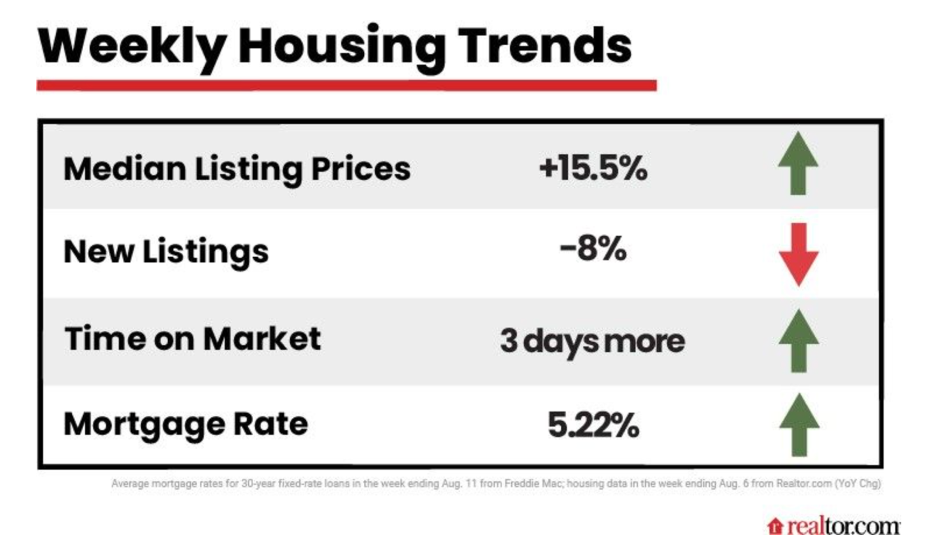
    Realtor has a weekly column called “How’s the Housing Market This Week?”. Realtor’s real estate economists are some of the most trusted in the industry. Weekly, Realtor delivers the most up-to-date statistics on what they coined “the four big bellwethers of the housing market”. These include home prices, # of new listings, total days on market, and of course, mortgage rates (Dutton, Realtor).

    “The housing market is resetting in a buyer-friendly direction,” notes Realtor Chief Economist Danielle Hale in her evaluation. We’d be remised if we didn’t note a “buyer-friendly direction” is certainly not the same as a true buyer’s market. While the same analysis notes the obvious, historic seller’s market that’s raged since COVID-19 began, it points out that the window for sellers is closing, rapidly. Below are the previously mentioned Realtor weekly housing trends, for week-end August 6th, 2022.

    -Realtor.com – Weekly Housing Trends, August 6th, 2022

    What jumps out to me are the top two statistics. A 15.5% median listing price increase, coupled with 8% fewer listing than the week before (Realtor.com). Hale has a unique and thought-provoking perspective on this phenomenon.

    Is There Surprisingly Good News in a 15.5% Increase in Median Listing Price?

    According to Hale, yes, this number is good news for prospective buyers. The last data from July 2022 shows a median nationwide listing price of $449,000. For the week ending August 6th, a 15.5% listing price increase means the new median was $518.595. While this marks the 34th straight week of double-digit price growth, Hale points out it’s also the “second consecutive week of deceleration” (Dutton, Realtor). The previous two weeks – at the end of July 2022 – median listing prices rose by 16.6% and 15.6%, respectively. This third ‘relatively temperate’ hike offers buyers hope home price growth will finally continue steadily dwindling.

    “The improvement has been substantial”, confirms Hale. She’s just as quick to add, “buyers in today’s market may still face meaningful affordability challenges as the typical home listing price remains near a record high”. But there’s little long-term evidence to suggest sticker price is a major deterrent for buyers (Dutton, Realtor). Hale reaffirms, “Persistent [homebuyers] may still continue to find success”. She goes on to add, “Second quarter data showed that homeownership rates increased from a year ago, both overall and for nearly every age and racial and ethnic group”.

    Given that homeownership rates have surged — amid rampant inflation, rising mortgage rates, and other deterrents — strongly signals that buyers who are willing to have some flexibility will ultimately win. Participants who are been willing to purchase somewhere they may not have considered pre-pandemic have largely become homebuyers. It’s a true testament to the lengths that homebuyers are willing to go today, provided sellers meet them halfway.

    Are Sellers Undermining the ‘Buyer Friendly’ Market?

    Anything positive for homebuyers is a negative for home sellers and of course, vice versa. Many sellers with properties on the market are panicking they ‘missed the mark’ by not closing a sale on their property during the COVID-19 real estate boom. For week-end July 30th, 2022, the number of new listings dropped by 8%, year-over-year (Dutton, Realtor).

    “New listings fell from a year ago for a fourth week. This is looking more and more like sellers may be wary of current market conditions, which have shifted substantially, even though they remain quite favorable to sellers who have owned for just about any length of time.”

    – Danielle Hale, Chief Economist, Realtor

    Hale appears to be hesitant to commit to buyer-friendly market conditions. However, she does definitively comment that conditions are becoming less and less favorable for sellers. The same message seems to be resonating across the board: if you’re a seller, the longer your property stays on the market, the worse-off your position will be.

    “While overall inventory [of new and old listings] grew by 28% over this same week last year, the active listings count still trails its 2020 and 2019 levels by more than 15% and 45%, respectively. More improvement in active inventory is likely needed to bring balance, but the recent trend may be at risk if homeowner attitudes toward selling now continue to deteriorate.”

    – Danielle Hale, Chief Economist, Realtor

    Once again, Hale seems to reemphasize the same underlying position. ‘We’re not in a pro-buyer’s market, we’re in a market that’s rapidly growing less favorable to sellers.’

    Are Rising Mortgage Rates to Blame for Homebuyers not Rushing to Close a Deal?

    The last question Realtor’s frequented market assessment addresses is why buyer’s aren’t rushing to close the deal. We are in a market that’s getting less and less favorable towards sellers, after all. What happens when we hit that market floor and conditions start to change against homebuyers. That has been the case – at a staggering rate – for well over two years now (Dutton, Realtor).

    In July 2022, listings lingered on the market a mere 34 days before getting snapped up. That’s nearly half the time it took two years earlier (Dutton, Realtor). Conversely, after having entered August 2022, it seems homebuyers are pumping the breaks and not feeling in such a rush. Hale’s prediction? Expect more of the same. She stated, “We expect more slowing ahead as the housing market reset”. The question remains, why?

    According to data provided by Freddie Mac, rising mortgage rates are a good place to start. For week-end August 11th, 2022, the average 30-year fixed mortgage rate increased to 5.22%. That’s considered a significantly steep spike from the previous week’s 4.99% (Mortgage Rates, Freddie Mac). Realtor predicts the future will hinge on how large corporations will view the potentially looming recession.

    “The big question for consumers is whether companies will over-react to the recession concerns and start trimming payrolls. A sharp pullback in hiring could have a direct impact on people’s ability to keep spending, especially with today’s high inflation.”

    – George Ratiu, Senior Economist, Realtor

    Realtor ultimately winds up agreeing. Prospective homebuyers should take full advantage of this buyer-friendly market while it lasts (Dutton, Realtor).

  • Is the US Real Estate Market Finally Starting to Cool Off?

    According to recent trends witnessed primarily in California, but largely nationwide, the supply in the housing market appears to be growing, while the demand is shrinking. This is what experts are counting on leading to a “cool off” period in real estate prices. “Today, week after week, we see more and more inventory come on the market and demand is down,” said broker Justin Itzen. He added, “Buyers have more to choose from, they can be more selective” (Moscufo, ABC News). Taylor Marr, chief economist of Redfin, echoed a very similar narrative. Marr made a distinguishment between expensive coastal markets and cheaper, rural housing markets. As Itzen’s remarks indicated, Marr concurs coastal cities located in California, New York, etc. will witness most of the impact.

    But that still leaves the larger question unanswered; are we looking at a nationwide real estate cooling period? According to an investors report Redfin released at the very start of August 2022, the share of home listings that have been on the market for more than 30 days has increased more than 12% from 2021. Due to inflationary effects, interest rates for average mortgages were between 5-6% in July 2022, compared to 2-3% July 2021. Inflation and rising prices (or rates) go hand-in-hand, but this increase is steep enough to leave tangible impressions. With more listings, dropping prices, and definite near future housing market uncertainty, we’re hopefully finally entering a buyer’s market.

    Importantly, Iesha McTier-Whyte, a broker selling middle to high-end homes in Newark, NJ advised she’s seen the same pattern. However, she doesn’t view it as a bad thing. “It’s nice to see [the market] cool down and kind of go back to the basics,” McTier-Whyte said. “What we experienced last year was like no other”. Itzen’s partner, Gio Helou, remarked “buyers are [now] able to actually go through the natural home buying process”. Assumingely, Helou meant that buyer’s now have the luxury of options. They no longer have to make the same kind of extraordinary sacrifices to simply purchase a family home.

    At one point, “homes were going within days for way over the asking price,” said Tim Sherman, a prospective homebuyer. When he and his wife found a home in Huntington Beach, CA, they began considering liquidating investments to purchase it. Not only “15% over the asking price,” commented Sherman, “but it was now over the market estimates of what the property was worth” (Moscufo, ABC News).

    The end to Sherman’s story really ties into the underlying assertion of this article. That first house fell through, but he and his wife did wind up purchasing a home. As soon as they saw the photos their broker sent them, they put in an immediate offer. Their former home in Dallas then sold in just one day (Moscufo, ABC News). If that’s any indication of the market dynamics moving forward, expect lower prices, more supply, and increased quality listings. A true win-win, both for individual homeowners and for real estate investors. As for the critics who continue to say there’s somewhat of a 2008-like “housing bubble” getting ready to pop, there’s little quantitative evidence to support the theory. Yet even the critics concede:

    “There is now a huge supply of new houses for sale, in all stages of construction, over 9 months’ supply in total, according to the Census Bureau. In terms of the number of houses, by June [2022], there were 463,000 new single-family houses at all stages of construction for sale, the highest since May 2008, and up by over 30%, from a year ago.”

    -Wolf Richter, The Wolf Street Report

    Their perspective is investors need to remain patient, as market conditions are continuing to return to their equilibrium. After what we’ve witnessed with the COVID-19 global pandemic, anything is possible, but conceptually, our economy isn’t close to the same state it was in heading into the 2008 financial collapse. We have far more restrictions on speculative investments, strict leverage ratios, mandatory reporting requirements, etc. The lessons of 2008 essentially taught us how to avoid widespread economic fragility when a significant market starts looking vulnerable. Additionally, the credit worthiness, financial disclosures, and ability to repay have all tightened considerably for buyers. Time will only tell whether we are in the midst of a “cooling off” period, or if we’re about to witness about bubble bursting. From our research and observations, we see it as more of a buyer’s market than a ‘fragile’ housing market.  

  • Are CRE Investors Impacting Environmental Social Governance (ESG)?

    Many experts are confirming the number of commercial real estate (CRE) investors who are considering environmental, social, and governance (ESG) standards when looking at potential investment opportunities is significantly increasing. A staggering 60 percent of respondents to brokerage CBRE’s 2021 Global Investor Intentions Survey stated that they had already adopted ESG criteria as part of their investment strategies. In other words, 3 out of every 5 CRE investors have factored ESG into their investment portfolio’s strategy. That’s an extremely significant number.

    What’s The Impact?

    This will force real estate investment firms to start catering to ESG conscious investors if they want to remain competitive. According to the same 2021 CBRE report, some CRE firms have committed to net-zero carbon emissions: Heitman by 2030, Nuveen by 2040, and Brookfield Properties by 2050. Overall, that seems like a win-win in the end. Commercial real estate properties will be built to be more eco-friendly and investors will continue to profit. What’s not to like?

    Industry executives, primarily, in the CRE property construction industry have been frustrated by increased scrutiny. This seems to be common in amongst senior executives, for the most part, and especially in an industry like construction. Anytime there’s increased regulation, that always leads to greater frustration. More tensions regarding profit margins, income statements, investor reports. Increased regulation almost always results in greater costs for corporations. What does that result in, in turn? Layoffs, a decrease in quality, a decrease in work/life balance, etc. Another way to look at it is when executives become worse off, employees under them are sure to suffer too. The same is true in the CRE market, both for companies on the demand and supply side.

    What Will Happen to the “Other” 40%?

    What about the other 40%; the investors who haven’t considered ESG as part of their investment strategy. Perhaps they don’t care about climate change, or they don’t believe factoring in ESG is a winning investment position. Either way, 40% of a group is still an extremely significant number. It’s not like those 40% can be forgotten or neglected. It’s basically the same situation as the other side of the coin: real estate investment firms will have to carry products that cater to ESG negligent investors too. This could include (amongst other things) REITs that hedge against heavily ESG driven CRE investment properties.

    What’s The Ultimate Outcome?

    Investors and investment firms that nail down the perfect balance of ESG conscious investments will prosper. Ultimately, with names in the CRE space like Heitman, Nuveen, and Brookfield Properties all committing to net-zero carbon emissions, you can expect “greener” CRE properties to be built in the future. That’s surely a win-win for everyone, political agenda, or affiliation notwithstanding. For investors, it means being more mindful of the ESG impact of a given CRE construction project. For example, if you’re in a REIG, or even more importantly as an individual investor, much like the 60% of current CRE investors who factored ESG into their CRE investment portfolio, you must do the same. With a REIG, you benefit from economies of scale where investors can collaboratively think of the best long-term approach. When you’re on your own, you must be certain you’re cognizant of all variables that may cause you to potentially get into the red on an investment. The research from this article shows that for CRE specifically, ESG will be included in prospective long-term plans.

    Be sure to take note!

  • What America’s Past in Real Estate Tells Us About the Future

    Some experts have argued that we’re at a torrid time in the future of the US real estate market. Others have argued NYC’s housing market has been roaring, with no sign of slowing down. With inflation continuing to cripple the value of the USD, prospective home buyers face pressure to invest in tangible assets. Many Americans are realizing a home is the most sensible shelter for their savings (Nguyen, Forbes).

    However, home supplies in coveted markets are scarce. Prices are ever-climbing and competition for homes is currently relentless. That’s generally where America’s market currently stands. The main question on the minds of homeowners and prospective buyers continues to be: “Where will markets go from here?”

    Of course, no one can say with certainty. Nevertheless, select lessons from America’s history provide a blueprint for home buying at this unique historical juncture.

    Lesson from the Great Depression

    Principally, you cannot separate the national economy from the nation’s housing markets. The American economy and the American housing market are akin to dominos aligned in the same row. On some occasions, the economy is the domino at the front of the row. Whereas there were other times – the subprime mortgage crisis (Great Recession, 2008) – the housing market is first in line.

    Arguably no time in American history better exhibits the inextricable link between national economic performance and the American people’s ability to both purchase, as well as hold onto, long-term houses. As the stock market crashed in 1929, bank runs quickly ensued, and mass unemployment followed closely behind. A staggering 273,000 Americans lost their homes in 1932, plus even more suffered foreclosure in the following year. Americans simply did not have the wherewithal to keep up with mortgage payments when crushing stagflation hit.

    Some things have not changed since the onset of the Great Depression. Americans today have become far more cognizant of a future possibility of widespread economic downturn. An economy in contraction means jobs lost, wages uncollected, and mortgage payments undelivered. Ultimately, this means foreclosures.

    Current Home-Buying Spree Continues

    Yet, even facing economic hardship triggered by the pandemic, America finds itself in the midst of a record home-buying spree. This may suggest any of the following three (Nguyen, Forbes):

    • A new segment of Americans (including former apartment-dwelling city residents) are injecting unprecedented capital into newfound housing markets.
    • Home buyers see houses as a sound investment, even as many expect the economy to take a turn for the worse.
    • The demand for homes in America is far greater than supply, increasing competition for each home.

    On one hand, the Great Depression is a necessary reminder for prospective home owners to not purchase beyond their means. However, many who lost their homes during the Great Depression certainly weren’t living lavishly. This is a critical takeaway – though one we must extract – from the hardships of the late 1920s and 1930s.

    Moreover, there are notable differences between 1930’s America and 2021, which bode favorably for today’s housing market. Incentive-laden tax policies, enacted since the Depression, made it more affordable to purchase homes and make the requisite mortgage payments. Today, Americans have a variety of investment options to mitigate risk. Additionally, federal policy has prevented bank failures from the magnitude witnessed during the Great Depression.

    Lesson from the GI Bill (1944)

    Concisely, cheap credit can set you up for life (Nguyen, Forbes). If you’ve been relishing your prevailing 3% interest rates, prepare for disappointment (by comparison).

    Not long after the Allied invasion of Normandy Beach, US President Franklin Roosevelt signed the GI Bill (1944). The was portrayed as a token of appreciation to a generation of young Americans, who risked their lives at war. Upon returning home, those GIs received government-backed loans that all but guaranteed homeownership, amongst other benefits. Banks the US government deemed a guarantor were overwhelmingly likely to approve a mortgage application.

    With access to such favorable loan conditions, veterans went on to purchase 20% of all homes built after the war. GIs took full, absolute advantage of the easy credit they undeniably earned.

    Fast forward to the present. While a government-guaranteed loan might sound ideal, you truly cannot complain about today’s prevailing 3% interest rates (Campisi, Forbes). To compare, interest rates topped 17% in 1982, then hovered around 10% for significant periods in the 1990s. That means two decades ago, you’d have to pay 8% for a home loan. Quite staggering compared to today’s housing market climate, to say the least.

    To reemphasize, the prime takeaway from the GI Bill, is that favorable credit should be pounced on, while it’s available. Historically, the sub-3% rate, which we’ve seen for the vast majority of 2021, is a statistical anomaly. Based on the frenzy of home buying we’ve witnessed, it seems that many Americans and foreign investors know their history. Perhaps much more than some casual real estate investors may think.

    Conclusion

    Seemingly, the two monumental American national economic events discussed provide opposing lessons for today’s prospective home buyer. The sudden, near-total crash of the Depression-era housing market reminds us the importance of consumer’s buying within their means. The GI Bill reinforces the importance of closing on a home, especially while lending terms are favorable. Upon extensive examination, these lessons can be very much complimentary in the future.

    As we’ve noted, today, Americans find themselves at a confounding point. Interest rates are very favorable; however, the economy is riddled with inflationary concerns and general uncertainty. It’s a time both reminiscent of GI Bill-era opportunity and Depression-era anxiety (Nguyen, Forbes).

    Of any lesson investors should takeaway, it’s this: you can embrace the benefits of comparatively cheap credit while remaining within your spending means. Be sure you don’t miss out on a prime real estate investment, while interest rates are so favorable. Stray away from overextending yourself to the point where you cannot keep up with future payments, should times get tough.

    For strategically sound real estate investing, you must look to the past to help predict the future. If nothing else, for guidance. That includes the better parts, but perhaps even more importantly for investors, the worse.  

  • What America’s Past in Real Estate Tells Us About the Future

    Some experts have argued that we’re at a torrid time in the future of the US real estate market. Others have argued NYC’s housing market has been roaring, with no sign of slowing down. With inflation continuing to cripple the value of the USD, prospective home buyers face pressure to invest in tangible assets. Many Americans are realizing a home is the most sensible shelter for their savings (Nguyen, Forbes).

    However, home supplies in coveted markets are scarce. Prices are ever-climbing and competition for homes is currently relentless. That’s generally where America’s market currently stands. The main question on the minds of homeowners and prospective buyers continues to be: “Where will markets go from here?”

    Of course, no one can say with certainty. Nevertheless, select lessons from America’s history provide a blueprint for home buying at this unique historical juncture.

    Lesson from the Great Depression

    Principally, you cannot separate the national economy from the nation’s housing markets. The American economy and the American housing market are akin to dominos aligned in the same row. On some occasions, the economy is the domino at the front of the row. Whereas there were other times – the subprime mortgage crisis (Great Recession, 2008) – the housing market is first in line.

    Arguably no time in American history better exhibits the inextricable link between national economic performance and the American people’s ability to both purchase, as well as hold onto, long-term houses. As the stock market crashed in 1929, bank runs quickly ensued, and mass unemployment followed closely behind. A staggering 273,000 Americans lost their homes in 1932, plus even more suffered foreclosure in the following year. Americans simply did not have the wherewithal to keep up with mortgage payments when crushing stagflation hit.

    Some things have not changed since the onset of the Great Depression. Americans today have become far more cognizant of a future possibility of widespread economic downturn. An economy in contraction means jobs lost, wages uncollected, and mortgage payments undelivered. Ultimately, this means foreclosures.

    Current Home-Buying Spree Continues

    Yet, even facing economic hardship triggered by the pandemic, America finds itself in the midst of a record home-buying spree. This may suggest any of the following three (Nguyen, Forbes):

    • A new segment of Americans (including former apartment-dwelling city residents) are injecting unprecedented capital into newfound housing markets.
    • Home buyers see houses as a sound investment, even as many expect the economy to take a turn for the worse.
    • The demand for homes in America is far greater than supply, increasing competition for each home.

    On one hand, the Great Depression is a necessary reminder for prospective home owners to not purchase beyond their means. However, many who lost their homes during the Great Depression certainly weren’t living lavishly. This is a critical takeaway – though one we must extract – from the hardships of the late 1920s and 1930s.

    Moreover, there are notable differences between 1930’s America and 2021, which bode favorably for today’s housing market. Incentive-laden tax policies, enacted since the Depression, made it more affordable to purchase homes and make the requisite mortgage payments. Today, Americans have a variety of investment options to mitigate risk. Additionally, federal policy has prevented bank failures from the magnitude witnessed during the Great Depression.

    Lesson from the GI Bill (1944)

    Concisely, cheap credit can set you up for life (Nguyen, Forbes). If you’ve been relishing your prevailing 3% interest rates, prepare for disappointment (by comparison).

    Not long after the Allied invasion of Normandy Beach, US President Franklin Roosevelt signed the GI Bill (1944). The was portrayed as a token of appreciation to a generation of young Americans, who risked their lives at war. Upon returning home, those GIs received government-backed loans that all but guaranteed homeownership, amongst other benefits. Banks the US government deemed a guarantor were overwhelmingly likely to approve a mortgage application.

    With access to such favorable loan conditions, veterans went on to purchase 20% of all homes built after the war. GIs took full, absolute advantage of the easy credit they undeniably earned.

    Fast forward to the present. While a government-guaranteed loan might sound ideal, you truly cannot complain about today’s prevailing 3% interest rates (Campisi, Forbes). To compare, interest rates topped 17% in 1982, then hovered around 10% for significant periods in the 1990s. That means two decades ago, you’d have to pay 8% for a home loan. Quite staggering compared to today’s housing market climate, to say the least.

    To reemphasize, the prime takeaway from the GI Bill, is that favorable credit should be pounced on, while it’s available. Historically, the sub-3% rate, which we’ve seen for the vast majority of 2021, is a statistical anomaly. Based on the frenzy of home buying we’ve witnessed, it seems that many Americans and foreign investors know their history. Perhaps much more than some casual real estate investors may think.

    Conclusion

    Seemingly, the two monumental American national economic events discussed provide opposing lessons for today’s prospective home buyer. The sudden, near-total crash of the Depression-era housing market reminds us the importance of consumer’s buying within their means. The GI Bill reinforces the importance of closing on a home, especially while lending terms are favorable. Upon extensive examination, these lessons can be very much complimentary in the future.

    As we’ve noted, today, Americans find themselves at a confounding point. Interest rates are very favorable; however, the economy is riddled with inflationary concerns and general uncertainty. It’s a time both reminiscent of GI Bill-era opportunity and Depression-era anxiety (Nguyen, Forbes).

    Of any lesson investors should takeaway, it’s this: you can embrace the benefits of comparatively cheap credit while remaining within your spending means. Be sure you don’t miss out on a prime real estate investment, while interest rates are so favorable. Stray away from overextending yourself to the point where you cannot keep up with future payments, should times get tough.

    For strategically sound real estate investing, you must look to the past to help predict the future. If nothing else, for guidance. That includes the better parts, but perhaps even more importantly for investors, the worse.  

  • PropTech: What is it and Who Are the Primary Investors?

    Property Technology, commonly known as PropTech, refers to the use of Information Technology (IT) to assist both individuals and companies buy, sell, research, and manage real estate. While still a relatively new field, the convergence of technologies, cloud, and digital transformation are key forces driving PropTech forward. The goals of PropTech include: minimizing the cost and resources associated with real estate transactions, maximizing efficiency, saving time, and personalizing property management. This concept is similar to FinTech, where the focus is on the use of technology in finance. PropTech utilizes digital innovation and other technologies to address real estate market participants’ needs in the property industry.

    Efficient PropTech is specifically devised to streamline processes and connect market participants in all aspects of real estate. Therefore, PropTech directly impacts buyers, sellers, brokers, lenders, landlords, as well as others. One of the most popular current PropTech technology is virtual reality software, which allows prospective buyers to virtually walk through properties, construction sites, and more. Additional well-known PropTech technologies include software for reporting repairs, splitting rent payments, and crowdfunding new real estate projects.

    At this time, PropTech consists of three major market segments: (1) smart home, (2) sharing real estate, and (3) real estate FinTech.

    Smart Home

    A smart home is equipped with digital platforms that monitor, manage, or operate specific property assets. Amazon Echo’s Alexa is an example of something in a smart home. Generally, they are comprised of digital platforms that monitor, manage or operate specific property assets. Other examples could be something a security surveillance system that warns property owners of a threat, a smart thermostat that regulates the temperature of uninhabited units, or smart light bulbs that can be turned on by a smartphone app or digital assistant.

    Sharing Real Estate

    This refers to technology that facilitates the processes involved with sharing or renting real estate assets, such as land, offices, storage, apartments, parking lots, and more. For example, there could be a software that facilitates automatic online payments for retail spaces occupied in a building owned by a property management company.

    Real Estate FinTech

    This segment of PropTech includes applications that involve buying and selling real estate assets. A platform that reduces the amount of physical paperwork and documentation involved in a home purchase can be thought of as an example. Stay tuned for a deeper conversation regarding the relationship between PropTech and FinTech.

    With PropTech still being a relatively new field, the investors are largely comprised of wealthy, seasoned real estate investing experts (or at least those with a real estate investing background). In addition to being backed by some of the world’s largest real estate giants, it would be fair to say most of the individuals behind the world’s biggest tech companies, agree that future technology is pushing towards digital transformation (Donati, Forbes). Therefore, you’ll find investors that are interested in a sort of ‘futuristic’ technology category when it comes to financial investments. For example, PropTech investors would be very likely to also be interested in FinTech and Cryptocurrency. While the latter two seem to be more popular at the moment, PropTech is definitely something well worth looking into, especially if you have a specific interest in real estate investing.

  • PropTech: What is it and Who Are the Primary Investors?

    Property Technology, commonly known as PropTech, refers to the use of Information Technology (IT) to assist both individuals and companies buy, sell, research, and manage real estate. While still a relatively new field, the convergence of technologies, cloud, and digital transformation are key forces driving PropTech forward. The goals of PropTech include: minimizing the cost and resources associated with real estate transactions, maximizing efficiency, saving time, and personalizing property management. This concept is similar to FinTech, where the focus is on the use of technology in finance. PropTech utilizes digital innovation and other technologies to address real estate market participants’ needs in the property industry.

    Efficient PropTech is specifically devised to streamline processes and connect market participants in all aspects of real estate. Therefore, PropTech directly impacts buyers, sellers, brokers, lenders, landlords, as well as others. One of the most popular current PropTech technology is virtual reality software, which allows prospective buyers to virtually walk through properties, construction sites, and more. Additional well-known PropTech technologies include software for reporting repairs, splitting rent payments, and crowdfunding new real estate projects.

    At this time, PropTech consists of three major market segments: (1) smart home, (2) sharing real estate, and (3) real estate FinTech.

    Smart Home

    A smart home is equipped with digital platforms that monitor, manage, or operate specific property assets. Amazon Echo’s Alexa is an example of something in a smart home. Generally, they are comprised of digital platforms that monitor, manage or operate specific property assets. Other examples could be something a security surveillance system that warns property owners of a threat, a smart thermostat that regulates the temperature of uninhabited units, or smart light bulbs that can be turned on by a smartphone app or digital assistant.

    Sharing Real Estate

    This refers to technology that facilitates the processes involved with sharing or renting real estate assets, such as land, offices, storage, apartments, parking lots, and more. For example, there could be a software that facilitates automatic online payments for retail spaces occupied in a building owned by a property management company.

    Real Estate FinTech

    This segment of PropTech includes applications that involve buying and selling real estate assets. A platform that reduces the amount of physical paperwork and documentation involved in a home purchase can be thought of as an example. Stay tuned for a deeper conversation regarding the relationship between PropTech and FinTech.

    With PropTech still being a relatively new field, the investors are largely comprised of wealthy, seasoned real estate investing experts (or at least those with a real estate investing background). In addition to being backed by some of the world’s largest real estate giants, it would be fair to say most of the individuals behind the world’s biggest tech companies, agree that future technology is pushing towards digital transformation (Donati, Forbes). Therefore, you’ll find investors that are interested in a sort of ‘futuristic’ technology category when it comes to financial investments. For example, PropTech investors would be very likely to also be interested in FinTech and Cryptocurrency. While the latter two seem to be more popular at the moment, PropTech is definitely something well worth looking into, especially if you have a specific interest in real estate investing.

  • Why Real Estate Investors Refer to Real Estate as an I.D.E.A.L. Investment

    Many real estate investors are familiar with the acronym ‘I.D.E.A.L. Investment’ in the context of real estate investing (Chad Carson, Coach Carson). This acronym is a great, succinct explanation for why real estate is preferred by many investors to other vehicles like dividend stocks, bonds, small businesses, index funds, bank certificate of deposits, annuities, and more.

    Income

    Real estate properties provide excellent cash flow on a regular (typically a monthly) basis and the income size can be quite substantial, depending on your properties’ interest rate, unpaid principal, and property value. This is the primary objective of any investor, which makes real estate a top choice for many. If you aren’t seeing much or any cash flow from an investment, especially after a lengthy period of time, typically it’s not a very successful one.

    Depreciation

    Another big advantage to real estate investing was actually made widely known by Donald Trump in the 2016 presidential campaign; depreciation. Depreciation occurs because for residential buildings, the U.S. government requires real estate investors to spread out most of the cost of real estate purchases over 27.5 years. This creates an annual depreciation expense, which can provide incredible tax benefits. This ‘expense’ doesn’t come out of your bank account, like purchasing materials to sell products, or insurance/maintenance costs. Instead it’s absorbed ‘on paper’ and you see real financial benefits in the form of tax relief.

    Equity

    Generally for real estate investors, as time goes on the more equity they’ll acquire in their own properties by repaying loans, which is directly linked to greater overall wealth. The shorter it takes you to pay off your own financial obligations on a property, the larger your ROI will be. Additionally, you’ll be able to optimize the length of time you’ll see financial benefits from that investment. While it may depend on your financial situation and the real estate market climate, real estate investing is a great way to acquire equity and see positive cash flow simultaneously.

    Appreciation

    Appreciations refers to the idea that your property value is supposed to increase each year. As we’ve seen in recent years, this may not necessarily be the case (primarily due to unpredictable circumstances). However, long-term investors (who comprise a very large segment of real estate investors) are satisfied with the long-term average of property values visibly pointing towards an upward trajectory.

    Leverage

    Leverage can refer to two distinct advantages of real estate investing. Firstly, some indicate this means the initial incurrence of debt leading to equity growth over time (this appears to be covered by ‘Appreciation’). Secondly, leverage can more commonly refer to the idea of using other people’s money (OPM) to earn a positive cash flow. This gives investors the opportunity to use relatively small amounts of cash upfront to gain control over multiple investment properties and earn returns on cash invested. This method isn’t typically used by passive investors, who would be concerned with over-leveraging and what could happen if there was a steep decline in the housing market.