Tag: real estate market tips

  • Is there a Difference Between a ‘Buyer’s Market’ and a ‘Market that’s Rapidly Getting Less Advantageous Towards Seller’s’?

    The vast majority of latest prognostications point to a shift in the housing market, in favor of buyers over sellers. It’s about time. America’s housing market has been brutal on homebuyer’s, renters, and those looking to lease in prime locations for years now. There is a lot of qualitative and quantitative analysis to suggest that despite rising rates, buyers currently have the advantage.

    Realtor’s Weekly Housing Market: “The Four Big Bellwethers”

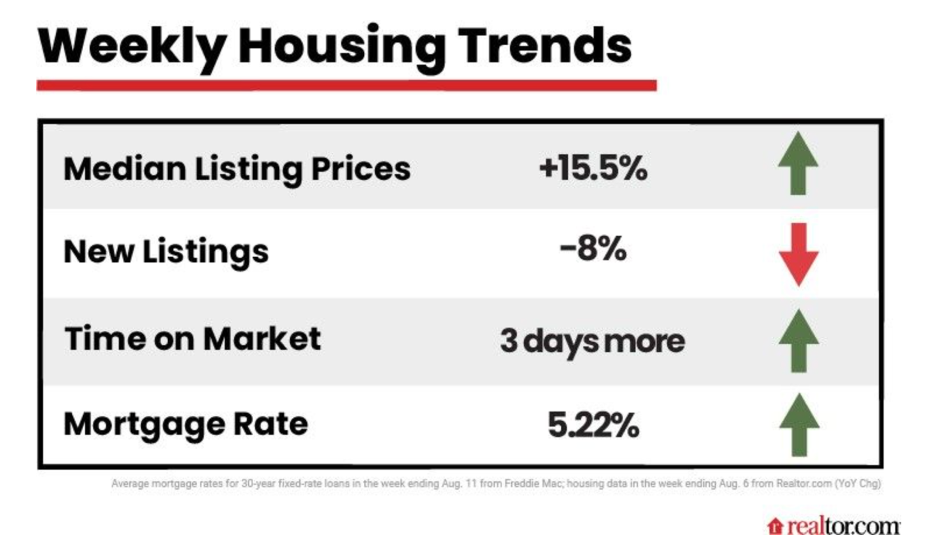
    Realtor has a weekly column called “How’s the Housing Market This Week?”. Realtor’s real estate economists are some of the most trusted in the industry. Weekly, Realtor delivers the most up-to-date statistics on what they coined “the four big bellwethers of the housing market”. These include home prices, # of new listings, total days on market, and of course, mortgage rates (Dutton, Realtor).

    “The housing market is resetting in a buyer-friendly direction,” notes Realtor Chief Economist Danielle Hale in her evaluation. We’d be remised if we didn’t note a “buyer-friendly direction” is certainly not the same as a true buyer’s market. While the same analysis notes the obvious, historic seller’s market that’s raged since COVID-19 began, it points out that the window for sellers is closing, rapidly. Below are the previously mentioned Realtor weekly housing trends, for week-end August 6th, 2022.
    -Realtor.com – Weekly Housing Trends, August 6th, 2022

    What jumps out to me are the top two statistics. A 15.5% median listing price increase, coupled with 8% fewer listing than the week before (Realtor.com). Hale has a unique and thought-provoking perspective on this phenomenon.

    Is There Surprisingly Good News in a 15.5% Increase in Median Listing Price?

    According to Hale, yes, this number is good news for prospective buyers. The last data from July 2022 shows a median nationwide listing price of $449,000. For the week ending August 6th, a 15.5% listing price increase means the new median was $518.595. While this marks the 34th straight week of double-digit price growth, Hale points out it’s also the “second consecutive week of deceleration” (Dutton, Realtor). The previous two weeks – at the end of July 2022 – median listing prices rose by 16.6% and 15.6%, respectively. This third ‘relatively temperate’ hike offers buyers hope home price growth will finally continue steadily dwindling.

    “The improvement has been substantial”, confirms Hale. She’s just as quick to add, “buyers in today’s market may still face meaningful affordability challenges as the typical home listing price remains near a record high”. But there’s little long-term evidence to suggest sticker price is a major deterrent for buyers (Dutton, Realtor). Hale reaffirms, “Persistent [homebuyers] may still continue to find success”. She goes on to add, “Second quarter data showed that homeownership rates increased from a year ago, both overall and for nearly every age and racial and ethnic group”.

    Given that homeownership rates have surged — amid rampant inflation, rising mortgage rates, and other deterrents — strongly signals that buyers who are willing to have some flexibility will ultimately win. Participants who are been willing to purchase somewhere they may not have considered pre-pandemic have largely become homebuyers. It’s a true testament to the lengths that homebuyers are willing to go today, provided sellers meet them halfway.

    Are Sellers Undermining the ‘Buyer Friendly’ Market?

    Anything positive for homebuyers is a negative for home sellers and of course, vice versa. Many sellers with properties on the market are panicking they ‘missed the mark’ by not closing a sale on their property during the COVID-19 real estate boom. For week-end July 30th, 2022, the number of new listings dropped by 8%, year-over-year (Dutton, Realtor).

    “New listings fell from a year ago for a fourth week. This is looking more and more like sellers may be wary of current market conditions, which have shifted substantially, even though they remain quite favorable to sellers who have owned for just about any length of time.”

    – Danielle Hale, Chief Economist, Realtor

    Hale appears to be hesitant to commit to buyer-friendly market conditions. However, she does definitively comment that conditions are becoming less and less favorable for sellers. The same message seems to be resonating across the board: if you’re a seller, the longer your property stays on the market, the worse-off your position will be.

    “While overall inventory [of new and old listings] grew by 28% over this same week last year, the active listings count still trails its 2020 and 2019 levels by more than 15% and 45%, respectively. More improvement in active inventory is likely needed to bring balance, but the recent trend may be at risk if homeowner attitudes toward selling now continue to deteriorate.”

    – Danielle Hale, Chief Economist, Realtor

    Once again, Hale seems to reemphasize the same underlying position. ‘We’re not in a pro-buyer’s market, we’re in a market that’s rapidly growing less favorable to sellers.’

    Are Rising Mortgage Rates to Blame for Homebuyers not Rushing to Close a Deal?

    The last question Realtor’s frequented market assessment addresses is why buyer’s aren’t rushing to close the deal. We are in a market that’s getting less and less favorable towards sellers, after all. What happens when we hit that market floor and conditions start to change against homebuyers. That has been the case – at a staggering rate – for well over two years now (Dutton, Realtor).

    In July 2022, listings lingered on the market a mere 34 days before getting snapped up. That’s nearly half the time it took two years earlier (Dutton, Realtor). Conversely, after having entered August 2022, it seems homebuyers are pumping the breaks and not feeling in such a rush. Hale’s prediction? Expect more of the same. She stated, “We expect more slowing ahead as the housing market reset”. The question remains, why?

    According to data provided by Freddie Mac, rising mortgage rates are a good place to start. For week-end August 11th, 2022, the average 30-year fixed mortgage rate increased to 5.22%. That’s considered a significantly steep spike from the previous week’s 4.99% (Mortgage Rates, Freddie Mac). Realtor predicts the future will hinge on how large corporations will view the potentially looming recession.

    “The big question for consumers is whether companies will over-react to the recession concerns and start trimming payrolls. A sharp pullback in hiring could have a direct impact on people’s ability to keep spending, especially with today’s high inflation.”

    – George Ratiu, Senior Economist, Realtor

    Realtor ultimately winds up agreeing. Prospective homebuyers should take full advantage of this buyer-friendly market while it lasts (Dutton, Realtor).
  • NYC Real Estate Market Mid-2021: Are You Better Off Buying or Renting?

    Since New York City’s (NYC) real estate market is still experiencing a fresh post-COVID effect, you are better off buying if you have the money (and credit score). However, as is often the case, it greatly depends on your financial situation. Living in arguably the most desirable and expensive part of the world presents a financial burden to many younger adults, who are still working lower paying, entry level jobs.

    The majority of real estate property owners in New York City are of older age and in the highest income brackets (NYU Furman Center). Additionally, they are more likely to have permanent ownership of property in other locations (Goldstein, Property Nest).

    Many people view renting as ‘wasteful’ because you don’t have the benefit of acquiring equity in your property. However, the reality is for most young or middle-aged professionals, the economic opportunities – combined with the cost of living in New York City – don’t allow them to acquire enough requisite disposable income to put a down payment on a desirable apartment unit. This brings up a primary obstacle many residents of New York City see with buying a permanent unit: most people don’t view New York City as their ‘final destination’, long-term residence. In other words, when most people think about taking out a mortgage and buying a home, they’re thinking about a serious long-term commitment (emphasis on long-term). Raising kids, settling down in a permanent work situation, and finally retiring. The suburbs or a quiet town; not the most densely populated, most popular tourist destination in the world.

    While there are plenty of mechanisms available to individuals looking to get out of a 20 or 30-year mortgage after only a few years, logically, it would make sense for most to still prefer not to take on that kind of serious financial responsibility without the intent of staying in that location for a while.  

    With that being said, from the perspective of someone simply asking: “hey, would I be better off buying or renting in New York City?”, I would advise them to not be hesitant and buy if they have the money saved.

    The reason is two-fold. If you are going to live in the unit, at least initially, you’ll acquire equity simultaneously. If you find that NYC is not for you in a few years – as many inevitably do – current market prices and historic trends, combined with current rates and incentives, suggest one would be able to see a positive cash flow from subleasing or subletting their own property. Meaning, renters are consistently earning more monthly rent than their monthly mortgage payments. Alternatively, if you have no desire of becoming a landlord, contrary to ordinary homeowner’s beliefs, there is the ability to sell your mortgaged property and earn a profit. It’s extremely difficult to look at the recent data without considering the COVID-19 situation, but over a 10-year period prior to that, real estate prices were significantly increasing year-over-year.

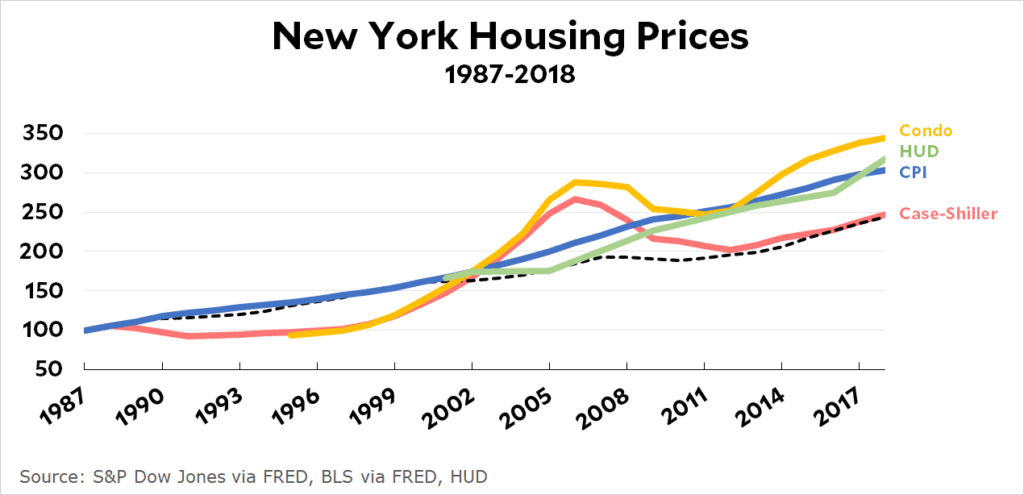
    That’s largely why real estate became viewed as a very popular investment vehicle for financial investors. The figure below illustrates an average of New York housing prices over a 30-year period, between 1987 and 2018, from different housing market segments.

    Figure 1 – New York (NYC) Housing Market Prices (1987-2018) Overview

    As one can see, prices went up across the board mostly every year, with the exception of a rocky period in the midst of the Great Recession of 2008. Therefore, having more ownership/equity in a property that’s also going to increase in value over time is a no brainer, even if you choose to move out of that property prior to paying off your mortgage.

  • NYC Real Estate Market Mid-2021: Are You Better Off Buying or Renting?

    Since New York City’s (NYC) real estate market is still experiencing a fresh post-COVID effect, you are better off buying if you have the money (and credit score). However, as is often the case, it greatly depends on your financial situation. Living in arguably the most desirable and expensive part of the world presents a financial burden to many younger adults, who are still working lower paying, entry level jobs.

    The majority of real estate property owners in New York City are of older age and in the highest income brackets (NYU Furman Center). Additionally, they are more likely to have permanent ownership of property in other locations (Goldstein, Property Nest).

    Many people view renting as ‘wasteful’ because you don’t have the benefit of acquiring equity in your property. However, the reality is for most young or middle-aged professionals, the economic opportunities – combined with the cost of living in New York City – don’t allow them to acquire enough requisite disposable income to put a down payment on a desirable apartment unit. This brings up a primary obstacle many residents of New York City see with buying a permanent unit: most people don’t view New York City as their ‘final destination’, long-term residence. In other words, when most people think about taking out a mortgage and buying a home, they’re thinking about a serious long-term commitment (emphasis on long-term). Raising kids, settling down in a permanent work situation, and finally retiring. The suburbs or a quiet town; not the most densely populated, most popular tourist destination in the world.

    While there are plenty of mechanisms available to individuals looking to get out of a 20 or 30-year mortgage after only a few years, logically, it would make sense for most to still prefer not to take on that kind of serious financial responsibility without the intent of staying in that location for a while.  

    With that being said, from the perspective of someone simply asking: “hey, would I be better off buying or renting in New York City?”, I would advise them to not be hesitant and buy if they have the money saved.

    The reason is two-fold. If you are going to live in the unit, at least initially, you’ll acquire equity simultaneously. If you find that NYC is not for you in a few years – as many inevitably do – current market prices and historic trends, combined with current rates and incentives, suggest one would be able to see a positive cash flow from subleasing or subletting their own property. Meaning, renters are consistently earning more monthly rent than their monthly mortgage payments. Alternatively, if you have no desire of becoming a landlord, contrary to ordinary homeowner’s beliefs, there is the ability to sell your mortgaged property and earn a profit. It’s extremely difficult to look at the recent data without considering the COVID-19 situation, but over a 10-year period prior to that, real estate prices were significantly increasing year-over-year.

    That’s largely why real estate became viewed as a very popular investment vehicle for financial investors. The figure below illustrates an average of New York housing prices over a 30-year period, between 1987 and 2018, from different housing market segments.

    Figure 1 – New York (NYC) Housing Market Prices (1987-2018) Overview

    As one can see, prices went up across the board mostly every year, with the exception of a rocky period in the midst of the Great Recession of 2008. Therefore, having more ownership/equity in a property that’s also going to increase in value over time is a no brainer, even if you choose to move out of that property prior to paying off your mortgage.