According to recent trends witnessed primarily in California, but largely nationwide, the supply in the housing market appears to be growing, while the demand is shrinking. This is what experts are counting on leading to a “cool off” period in real estate prices. “Today, week after week, we see more and more inventory come on the market and demand is down,” said broker Justin Itzen. He added, “Buyers have more to choose from, they can be more selective” (Moscufo, ABC News). Taylor Marr, chief economist of Redfin, echoed a very similar narrative. Marr made a distinguishment between expensive coastal markets and cheaper, rural housing markets. As Itzen’s remarks indicated, Marr concurs coastal cities located in California, New York, etc. will witness most of the impact.
But that still leaves the larger question unanswered; are we looking at a nationwide real estate cooling period? According to an investors report Redfin released at the very start of August 2022, the share of home listings that have been on the market for more than 30 days has increased more than 12% from 2021. Due to inflationary effects, interest rates for average mortgages were between 5-6% in July 2022, compared to 2-3% July 2021. Inflation and rising prices (or rates) go hand-in-hand, but this increase is steep enough to leave tangible impressions. With more listings, dropping prices, and definite near future housing market uncertainty, we’re hopefully finally entering a buyer’s market.
Importantly, Iesha McTier-Whyte, a broker selling middle to high-end homes in Newark, NJ advised she’s seen the same pattern. However, she doesn’t view it as a bad thing. “It’s nice to see [the market] cool down and kind of go back to the basics,” McTier-Whyte said. “What we experienced last year was like no other”. Itzen’s partner, Gio Helou, remarked “buyers are [now] able to actually go through the natural home buying process”. Assumingely, Helou meant that buyer’s now have the luxury of options. They no longer have to make the same kind of extraordinary sacrifices to simply purchase a family home.
At one point, “homes were going within days for way over the asking price,” said Tim Sherman, a prospective homebuyer. When he and his wife found a home in Huntington Beach, CA, they began considering liquidating investments to purchase it. Not only “15% over the asking price,” commented Sherman, “but it was now over the market estimates of what the property was worth” (Moscufo, ABC News).
The end to Sherman’s story really ties into the underlying assertion of this article. That first house fell through, but he and his wife did wind up purchasing a home. As soon as they saw the photos their broker sent them, they put in an immediate offer. Their former home in Dallas then sold in just one day (Moscufo, ABC News). If that’s any indication of the market dynamics moving forward, expect lower prices, more supply, and increased quality listings. A true win-win, both for individual homeowners and for real estate investors. As for the critics who continue to say there’s somewhat of a 2008-like “housing bubble” getting ready to pop, there’s little quantitative evidence to support the theory. Yet even the critics concede:
“There is now a huge supply of new houses for sale, in all stages of construction, over 9 months’ supply in total, according to the Census Bureau. In terms of the number of houses, by June [2022], there were 463,000 new single-family houses at all stages of construction for sale, the highest since May 2008, and up by over 30%, from a year ago.”
-Wolf Richter, The Wolf Street Report
Their perspective is investors need to remain patient, as market conditions are continuing to return to their equilibrium. After what we’ve witnessed with the COVID-19 global pandemic, anything is possible, but conceptually, our economy isn’t close to the same state it was in heading into the 2008 financial collapse. We have far more restrictions on speculative investments, strict leverage ratios, mandatory reporting requirements, etc. The lessons of 2008 essentially taught us how to avoid widespread economic fragility when a significant market starts looking vulnerable. Additionally, the credit worthiness, financial disclosures, and ability to repay have all tightened considerably for buyers. Time will only tell whether we are in the midst of a “cooling off” period, or if we’re about to witness about bubble bursting. From our research and observations, we see it as more of a buyer’s market than a ‘fragile’ housing market.
From the perspective of investors, coming up with an accurate property valuation is the most significant factor in making investment decisions. Commercial real estate (CRE) investment has become increasingly popular in the past few decades. That’s because it’s viewed as an excellent vehicle for corporate and public wealth investors to achieve stable returns.
In this post, we’ll look at four primary valuation methods investors use when looking at CRE proposals. It should be no surprise that technology deeply impacts a potential CRE investment valuation. It’s truly astounding how powerful software solutions can support the consistency, transparency, and standardization across the valuation industry.
Cost Approach
The cost approach involves estimating a rough total budget for how much the structure would cost to build from scratch. The cost approach accounts for the original value of the land, plus the cost to build the structure from the ground up. Investors typically look at this approach to see if it’s financially more profitable to develop a new property, versus buying an existing one. The cost approach is comprised of two major methods:
Reproduction Method – Costs of rebuilding an exact replica of the existing structure, using the same materials, construction methods, etc.
Replacement Method – Costs of rebuilding a new structure with brand new materials, construction methods, designs, etc.
This logic is generally sound. However, it’s critical to note this method does not account for additional effort of development and construction involved in building a property from the ground up. Similarly, it does not account for the long-term cash flow of a given CRE project.
Sales Comparison Approach
Comparisons between key market factors are one of the most important inputs to any valuation method. Furthermore, sales comparisons are usually the source of information, such as cost of reproduction, current market capitalization rate, loan-to-value ratios, and others (Atlus Group). Prospective buyers use this approach to compare current CRE listings to recently sold projects. Though this list isn’t exhaustive, it includes major components of the sales comparison approach:
The closer in similarity a prospective CRE property is to a comparable sale – especially a recent one – referencing the above components, the more effective this approach tends to be. Finally, once the quantitative characteristics of the perspective CRE property are compared, there is a qualitative analysis to ensure any more or less favorable attributes are accounted for. These adjustments are an essential precaution, if using this valuation method for CRE purchases.
One notable downside to this method is a lack of analysis of any long-term cash flows or property valuation.
The “cap rate” approach is one of the most popular methods of property valuation. It’s very frequently used by analysts in both the lending world and intended acquisitions (Atlus Group). When you hear real estate professionals mention what a property “traded at”, they’re almost always citing either the cap rate, or the price per square foot, a property sold for.
The formula for calculating cap rate is simple. It’s equal to the net operating income (NOI) of the property, divided by the capitalization rate. The outcome represents the ownership’s approximate value of the property, based on the first year’s expected cash flow.
Like the Sales Comparison Approach, this tool is most valuable to estimate the current value of CRE properties. Furthermore, it’s even more useful if the property has relatively stable and easily predictable cash flow. New, complex projects that have essentially zero NOI are not good candidates for this valuation approach. In such circumstances, investors are much more likely to turn to the Discounted Cash Flow Approach.
Discounted Cash Flow Approach
While the three previously detailed CRE valuation methods are undoubtably useful under certain conditions, they share a major drawback. Each of first three valuation methods estimate the value of a CRE property at a specific point in time. This is in fact a major drawback for real estate investors, who are rarely investing primarily for short-term gains.
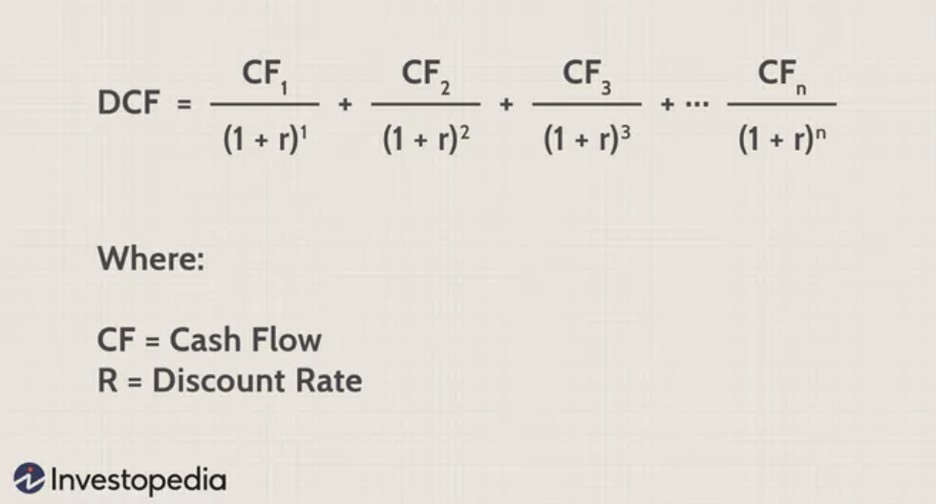
Suppose an example of a long-term, direct real estate investor, looking to maximize their return of a 10-year period. The below formula, taken from Investopedia shows the common formula for the Discounted Cash Flow (DCF) approach.
Source: Sabrina Jiang, Investopedia (2021)
Investors utilize this method to factor in both the delta of the initial buying price and the value of the property after ten years, in addition to the net present value (NPV) of any cash flows that come in from owning that property over 10 years. This gives real estate investors a great formula to input prognostications, then make transactions based on those forecasts.
Reverting to the drawbacks of point-in-time valuations, firstly, it’s critical to understand fundamental psychology real estate investors utilize. Typically, real estate investors have a longer-term vision, especially compared to investors who purchase various securities. This makes a point-in-time valuation much less relevant, since in the long-run real estate investors are not just looking at an easily predictably present value. As we saw in 2008 most famously and during the COVID-19 pandemic most recently, real estate prices can tank from unrelated market activities, political changes, or even a completely unexpected global health pandemic (Altus Group).
Conclusion
Long-term volatility concerns necessitate real estate investors to rely on more than increases in value over time. This is a primary explanation why investors generally rely on the cash flow, plus a final value increase. If an investor holds a property for ten years from purchase to sale, as an example, the overall return will be a combination of cash flow from all ten years of ownership, plus any difference between the initial purchase price and the ultimate sale price.
The cost, sales comparison, and capitalization rate approaches all fail to account for both potential changes in the cash flow, or value of the property, over the investment hold period. Hypothetically, if an investor knows that in year three of the hold period, a major tenant is going to vacate the property and cause a significant decrease in the property’s cash flow for the period, this clearly negatively impacts the overall return the investor attains. The only valuation method that takes into consideration time value of money and captures the future performance of the property is the DCF method.
The DCF method predicts future cash flows over an estimated property hold period. This includes both annual cash flow and profit at the time of sale. Many practitioners found that attempting to accurately predict revenue, expenses, and the future value of the property at the time of sale, is actually quitedifficult. It essentially forces them forces them to think deeply and more critically. Long-term risk factors, management, quality of tenants, and trends in the real estate market suddenly appear on their immediate radar.
While not perfect (valuation models are not a crystal ball), the DCF method is generally preferred by real estate investors. Bluntly, the DCF approach best matches the reality of the investment, compared to the others discussed above.
The Closing Argument to Real Estate Investors (Primarily CRE Investors)
Selecting the best-fit valuation method is akin to choosing the right tool for a homeowner’s repair project. Most of the decision is decided on a case-by-case basis, based on the best information available. With the varying subjective methods and information, asset appraisal in the world of commercial is part formula, part art form.
In practicality, most appraisers don’t limit themselves to one method, instead taking an average of two or more methods. It’s hardly surprising appraisers have toned down their aggressive approach, especially compared to nearly 15 years ago. After the catastrophic downward spiral of 2008, the more analysis real estate investment projects undergo, the better. To build on the methods discussed, a well-known method rapidly gaining increasing popularity is called the stress test. Perhaps this test is more commonly referenced in the investment banking sector, namely to monitor volatility ratios of aggressive investment banks who also hold client checking and other deposit accounts, to ensure we don’t need to worry about anymore “bank runs”, but nonetheless the same logic applies to the real estate sector and it’s played an indispensable component to accurate real estate valuations.
If you take nothing else away from this article, use the DCF Method whenever possible. Especially in today’s ever-changing real estate market, periodic cash flows are a must to have a successful, long-term real estate holding. As with any other investment, do your due diligence, ensure you have the right team around you, and take calculated, well-thought risks. Good luck to all continuing to navigate the post COVID-19 real estate landmine!
From the perspective of investors, coming up with an accurate property valuation is the most significant factor in making investment decisions. Commercial real estate (CRE) investment has become increasingly popular in the past few decades. That’s because it’s viewed as an excellent vehicle for corporate and public wealth investors to achieve stable returns.
In this post, we’ll look at four primary valuation methods investors use when looking at CRE proposals. It should be no surprise that technology deeply impacts a potential CRE investment valuation. It’s truly astounding how powerful software solutions can support the consistency, transparency, and standardization across the valuation industry.
Cost Approach
The cost approach involves estimating a rough total budget for how much the structure would cost to build from scratch. The cost approach accounts for the original value of the land, plus the cost to build the structure from the ground up. Investors typically look at this approach to see if it’s financially more profitable to develop a new property, versus buying an existing one. The cost approach is comprised of two major methods:
Reproduction Method – Costs of rebuilding an exact replica of the existing structure, using the same materials, construction methods, etc.
Replacement Method – Costs of rebuilding a new structure with brand new materials, construction methods, designs, etc.
This logic is generally sound. However, it’s critical to note this method does not account for additional effort of development and construction involved in building a property from the ground up. Similarly, it does not account for the long-term cash flow of a given CRE project.
Sales Comparison Approach
Comparisons between key market factors are one of the most important inputs to any valuation method. Furthermore, sales comparisons are usually the source of information, such as cost of reproduction, current market capitalization rate, loan-to-value ratios, and others (Atlus Group). Prospective buyers use this approach to compare current CRE listings to recently sold projects. Though this list isn’t exhaustive, it includes major components of the sales comparison approach:
The closer in similarity a prospective CRE property is to a comparable sale – especially a recent one – referencing the above components, the more effective this approach tends to be. Finally, once the quantitative characteristics of the perspective CRE property are compared, there is a qualitative analysis to ensure any more or less favorable attributes are accounted for. These adjustments are an essential precaution, if using this valuation method for CRE purchases.
One notable downside to this method is a lack of analysis of any long-term cash flows or property valuation.
The “cap rate” approach is one of the most popular methods of property valuation. It’s very frequently used by analysts in both the lending world and intended acquisitions (Atlus Group). When you hear real estate professionals mention what a property “traded at”, they’re almost always citing either the cap rate, or the price per square foot, a property sold for.
The formula for calculating cap rate is simple. It’s equal to the net operating income (NOI) of the property, divided by the capitalization rate. The outcome represents the ownership’s approximate value of the property, based on the first year’s expected cash flow.
Like the Sales Comparison Approach, this tool is most valuable to estimate the current value of CRE properties. Furthermore, it’s even more useful if the property has relatively stable and easily predictable cash flow. New, complex projects that have essentially zero NOI are not good candidates for this valuation approach. In such circumstances, investors are much more likely to turn to the Discounted Cash Flow Approach.
Discounted Cash Flow Approach
While the three previously detailed CRE valuation methods are undoubtably useful under certain conditions, they share a major drawback. Each of first three valuation methods estimate the value of a CRE property at a specific point in time. This is in fact a major drawback for real estate investors, who are rarely investing primarily for short-term gains.
Suppose an example of a long-term, direct real estate investor, looking to maximize their return of a 10-year period. The below formula, taken from Investopedia shows the common formula for the Discounted Cash Flow (DCF) approach.
Source: Sabrina Jiang, Investopedia (2021)
Investors utilize this method to factor in both the delta of the initial buying price and the value of the property after ten years, in addition to the net present value (NPV) of any cash flows that come in from owning that property over 10 years. This gives real estate investors a great formula to input prognostications, then make transactions based on those forecasts.
Reverting to the drawbacks of point-in-time valuations, firstly, it’s critical to understand fundamental psychology real estate investors utilize. Typically, real estate investors have a longer-term vision, especially compared to investors who purchase various securities. This makes a point-in-time valuation much less relevant, since in the long-run real estate investors are not just looking at an easily predictably present value. As we saw in 2008 most famously and during the COVID-19 pandemic most recently, real estate prices can tank from unrelated market activities, political changes, or even a completely unexpected global health pandemic (Altus Group).
Conclusion
Long-term volatility concerns necessitate real estate investors to rely on more than increases in value over time. This is a primary explanation why investors generally rely on the cash flow, plus a final value increase. If an investor holds a property for ten years from purchase to sale, as an example, the overall return will be a combination of cash flow from all ten years of ownership, plus any difference between the initial purchase price and the ultimate sale price.
The cost, sales comparison, and capitalization rate approaches all fail to account for both potential changes in the cash flow, or value of the property, over the investment hold period. Hypothetically, if an investor knows that in year three of the hold period, a major tenant is going to vacate the property and cause a significant decrease in the property’s cash flow for the period, this clearly negatively impacts the overall return the investor attains. The only valuation method that takes into consideration time value of money and captures the future performance of the property is the DCF method.
The DCF method predicts future cash flows over an estimated property hold period. This includes both annual cash flow and profit at the time of sale. Many practitioners found that attempting to accurately predict revenue, expenses, and the future value of the property at the time of sale, is actually quitedifficult. It essentially forces them forces them to think deeply and more critically. Long-term risk factors, management, quality of tenants, and trends in the real estate market suddenly appear on their immediate radar.
While not perfect (valuation models are not a crystal ball), the DCF method is generally preferred by real estate investors. Bluntly, the DCF approach best matches the reality of the investment, compared to the others discussed above.
The Closing Argument to Real Estate Investors (Primarily CRE Investors)
Selecting the best-fit valuation method is akin to choosing the right tool for a homeowner’s repair project. Most of the decision is decided on a case-by-case basis, based on the best information available. With the varying subjective methods and information, asset appraisal in the world of commercial is part formula, part art form.
In practicality, most appraisers don’t limit themselves to one method, instead taking an average of two or more methods. It’s hardly surprising appraisers have toned down their aggressive approach, especially compared to nearly 15 years ago. After the catastrophic downward spiral of 2008, the more analysis real estate investment projects undergo, the better. To build on the methods discussed, a well-known method rapidly gaining increasing popularity is called the stress test. Perhaps this test is more commonly referenced in the investment banking sector, namely to monitor volatility ratios of aggressive investment banks who also hold client checking and other deposit accounts, to ensure we don’t need to worry about anymore “bank runs”, but nonetheless the same logic applies to the real estate sector and it’s played an indispensable component to accurate real estate valuations.
If you take nothing else away from this article, use the DCF Method whenever possible. Especially in today’s ever-changing real estate market, periodic cash flows are a must to have a successful, long-term real estate holding. As with any other investment, do your due diligence, ensure you have the right team around you, and take calculated, well-thought risks. Good luck to all continuing to navigate the post COVID-19 real estate landmine!
COVID-19 will forever change the landscape of CRE (Commercial Real Estate), especially for firms who are used to operating almost exclusively in a brick and mortar, office environment. The aftermath of COVID-19 will almost undoubtedly include more “smart” CRE. To put it another way, as software like Zoom has become a household name – whereas prior to COVID-19 it was largely known to the white-collar working class – you can expect firms to invest less in physical property. Consequently, the data shows that in every sector, at least in the short-term, PropTech investment has slowed down (Abuelsamid, Forbes).
Intuitively, successful long-term investors tend to be heavily data driven, which has been a big reason for the slowdown in PropTech. Investors within the real estate sector are exercising caution with regards to their portfolios, as well as towards new deals for CRE projects. A great deal of this is attributed to the initial concept of this piece (which Forbes agrees with): corporations and startup firms alike are showing an increased interest in technology, which allowed them to work “smart” (i.e. Zoom) despite the pandemic (Abuelsamid, Forbes). With decreased overhead being a large incentive for startups and pressure from shareholders to cut costs being a large incentive for big corporations, many are realizing that the way they were forced to do business is perhaps a more efficient way than they were prior to the COVID-19 pandemic.
With that being said, as we mentioned in a previous piece, PropTech is still a relatively new field to most investors. The CRE investing subsector of PropTech is even smaller, so there’s definitely still plenty of opportunity for successful PropTech investment vehicles. Even with the current data showing there’s slowed growth in the PropTech CRE subsector, that’s not to say you shouldn’t keep an eye out for solid investment opportunities, as they are still out there and can definitely be lucrative. This is the main reason you’ll typically find seasoned, experienced investors in the CRE PropTech space. There is opportunity for large returns, but it is definitely slim.
In the longer-term, there’s no reason right now to believe firms will switch back to investment in more physical property, especially when that money can be spent on human capital. Therefore, if you’re interested in PropTech investment strategies, you should not expect to see consistent positive performance from PropTech CRE investments. On the other hand – while this subject deserves a complete discussion on its own – residential PropTech is definitely on the rise (Aramati, Forbes). With a major push coming from cloud technologies and digital transformation, there’s a lot more investment in “smart” residential real estate as opposed to commercial real estate. Generally speaking, investments in “smart” technology have gained a tremendous amount of traction and thereby very large returns for earlier stage investors. Again, as we discussed in a previous article regarding PropTech, technological advancement is the future and investors who are looking for the next Amazon or Google in the real estate market ought to look into residential PropTech options with a more favorable outlook than commercial PropTech.
COVID-19 will forever change the landscape of CRE (Commercial Real Estate), especially for firms who are used to operating almost exclusively in a brick and mortar, office environment. The aftermath of COVID-19 will almost undoubtedly include more “smart” CRE. To put it another way, as software like Zoom has become a household name – whereas prior to COVID-19 it was largely known to the white-collar working class – you can expect firms to invest less in physical property. Consequently, the data shows that in every sector, at least in the short-term, PropTech investment has slowed down (Abuelsamid, Forbes).
Intuitively, successful long-term investors tend to be heavily data driven, which has been a big reason for the slowdown in PropTech. Investors within the real estate sector are exercising caution with regards to their portfolios, as well as towards new deals for CRE projects. A great deal of this is attributed to the initial concept of this piece (which Forbes agrees with): corporations and startup firms alike are showing an increased interest in technology, which allowed them to work “smart” (i.e. Zoom) despite the pandemic (Abuelsamid, Forbes). With decreased overhead being a large incentive for startups and pressure from shareholders to cut costs being a large incentive for big corporations, many are realizing that the way they were forced to do business is perhaps a more efficient way than they were prior to the COVID-19 pandemic.
With that being said, as we mentioned in a previous piece, PropTech is still a relatively new field to most investors. The CRE investing subsector of PropTech is even smaller, so there’s definitely still plenty of opportunity for successful PropTech investment vehicles. Even with the current data showing there’s slowed growth in the PropTech CRE subsector, that’s not to say you shouldn’t keep an eye out for solid investment opportunities, as they are still out there and can definitely be lucrative. This is the main reason you’ll typically find seasoned, experienced investors in the CRE PropTech space. There is opportunity for large returns, but it is definitely slim.
In the longer-term, there’s no reason right now to believe firms will switch back to investment in more physical property, especially when that money can be spent on human capital. Therefore, if you’re interested in PropTech investment strategies, you should not expect to see consistent positive performance from PropTech CRE investments. On the other hand – while this subject deserves a complete discussion on its own – residential PropTech is definitely on the rise (Aramati, Forbes). With a major push coming from cloud technologies and digital transformation, there’s a lot more investment in “smart” residential real estate as opposed to commercial real estate. Generally speaking, investments in “smart” technology have gained a tremendous amount of traction and thereby very large returns for earlier stage investors. Again, as we discussed in a previous article regarding PropTech, technological advancement is the future and investors who are looking for the next Amazon or Google in the real estate market ought to look into residential PropTech options with a more favorable outlook than commercial PropTech.