Tag: residential real estate investor tips

  • New York City’s Housing Market Finishes Strong in 2021; Slowdown Expected in 2022?

    New York City’s residential real estate market closed 2021 with many arguing it had the strongest performance in three decades. By mid-October, Manhattan contract signings already surpassed the previous record, which was 12,520 in 2013 (UrbanDigs). With a little under two weeks left in 2021, closings reached 14,774 (Cavanaugh, TheRealDeal). Already, that’s more than double the 2020 total. Despite a rise in listings, that level of closings undoubtably depleted inventory. Are we heading towards a residential real estate market slowdown in NYC in 2022?

    UrbanDigs found that through December 5th, 2021, listings had exceeded the 2008-2018 average by 18%. Net new inventory – the number of monthly new listings, minus contracts signed and listings taken off-market – surprised many market experts. Astonishingly, buyers bought out the increased supply at an even faster pace. Net new inventory dropped below zero in 9 of 11 months during 2021, to negative 861 units (Cavanaugh, TheRealDeal).

    For buyers, prices have steadily risen in tandem. For the first time since 2015, listing discounts fell consistently throughout the year, even as buy-side competition increased. The luxury market, considered properties with a selling price of $4M and up, had the best year since 2014 (UrbanDigs). Buyers spent over $14B so far and with less than a couple weeks left in 2021, this represents a 19% increase over the previous record of the last three decades (UrbanDigs).

    Even with the residential housing market’s red hot 2021 performance, UrbanDigs co-founder John Walkup does not have nearly the same forecast for 2022.

    “Deal volume may slow through the holiday season, especially with fewer units coming to market”

    -John Walkup, Co-Founder of UrbanDigs

    He continued with stating he feels the next quarter could be noticeably slower than Q4 of 2021.

    “A slowdown in buy-side activity may cause inventory levels to rise, pressuring prices”

    -John Walkup, Co-Founder of UrbanDigs

    Furthermore, he predicted a “multi-quarter lull in 2022” for the luxury market.

    Walkup’s predictions for 2022 aren’t exactly universally accepted by known residential real estate experts. Jonathan Miller, President and CEO of Miller Samuel, had a different sentiment in his latest report for Douglas Elliman. Miller sees deals in Manhattan and Brooklyn continuing to outpace listings heading into 2022, as they have closing 2021. His report cautions real estate market participants not to be surprised if there isn’t as noticeable a slowdown in 2022.

     “Inventory is continuing to collapse, and that’s why we anticipate continued price growth into the new year”

    -Jonathan Miller, President & CEO of Miller Samuel

    According to the Wall Street Journal (WSJ), the Federal Reserve may hike interest rates as early as March 2022. Walkup believes this could “put an upper bound on condo prices, with luxury and new development prices falling first”. Simultaneously, Walkup assured the luxury lull will be “nothing too drastic”, estimating discounts maxing out at 5%.

    In a peculiar comparison, the WSJ noted that condos, as an asset class, lag behind the exceptional performance of the S&P 500 Index (Joe Wallace, Wall Street Journal). The S&P hit a 67th record high in the third to last week of 2021 (Alexander Osipovich, Wall Street Journal). Since the 2008 US financial collapse was largely related to assets and various securities in the housing market, it’s not surprising during that time, both the stock market and the value of real estate took a hit as a result (Cavanaugh, TheRealDeal). UrbanDigs found that since January 2008, the S&P increased 230%, while the price per square foot of a new Manhattan condo rose 68%.

    “The frothy activity observed in the NYC real estate market since the reopening has yet to translate into anything approaching the gains seen on the broader equity index”

    -John Walkup, Co-Founder of UrbanDigs

    While that may be true, you cannot live in an index, or any stock portfolio.

    Interest rates could also be a major influencing factor for foreign investment. Should the Fed raise rates, this would further strengthen the USD, which already surged to a 16-month high in November 2021 according to Barron’s. As a result, this places buyers with wealth in other countries in a disadvantageous position. So much so, Walkup pontificates, that this will dissuade foreigners from buying US real estate. Instead, Walkup believes they are likely to liquidate their current holdings. He goes on to state, “2022 could be the year of the foreign sellers”.

    In anticipation of the opposite, NYC brokers geared up for an influx of foreign buyers, ahead of travel bans being lifted from 33 countries in November 2021. The increasing prevalence of the Omicron variant is heavily pushing a slowdown on that effort. Nonetheless, a rebound of residential real estate in overseas markets suggests foreign investor fears may be receding.

    “On the whole, I think travel bans take a back seat to [profit and loss] statements. So whereas a lifted travel ban could certainly stimulate some activity, if NYC investment returns are viewed as less than optimal due to currency fluctuations or price volatility, foreign buyers will look elsewhere.”

    -John Walkup, Co-Founder of UrbanDigs

    On a more granular level, Walkup expects continued strong townhouse demand and a renewed interest in “fixer-uppers”. Compared to the 2008 – 2018 average, in 2021 average monthly sales volume of Manhattan townhouses rose by nearly 50 percent. Walkup feels the market will likely remain hot, as buyers continue pursuing space and privacy, inspired by the COVID-19 pandemic. He sees sales and prices continuing to rise, as more homes are snapped up, thereby depleting inventory.

    The demand for renovated units, however, could be ebbing (UrbanDigs). In October 2021, UrbanDigs released a report outlining a roughly 30 percent divide between prices of renovated units and “fixer-uppers”. The prevailing theory seems to be supply chain problems, with labor shortages and rising material costs being the main catalysts. This helps explain why a very substantial block of buyers opted to avoid properties requiring extensive renovation.

    Walkup said in 2022, the spread between renovated and unrenovated units has potential to narrow. Increasingly tightening supply compels buyers to opt for units in need of some TLC. All-in-all, especially considering NYC has remained a historically hot buyer’s market when it comes to residential real estate throughout all of 2021, it’s too early to truly predict what 2022 will bring. The Omicron variant’s spread throughout the US, as well as the world, will surely have an impact. Other external economic factors will continue to impact NYC’s housing market as well, as all eyes are on the Fed. If and when the Fed chooses to hike up rates, investors should expect the entire landscape of residential real estate in NYC, as well as the entire United States, to change.  
  • New York City’s Housing Market Finishes Strong in 2021; Slowdown Expected in 2022?

    New York City’s residential real estate market closed 2021 with many arguing it had the strongest performance in three decades. By mid-October, Manhattan contract signings already surpassed the previous record, which was 12,520 in 2013 (UrbanDigs). With a little under two weeks left in 2021, closings reached 14,774 (Cavanaugh, TheRealDeal). Already, that’s more than double the 2020 total. Despite a rise in listings, that level of closings undoubtably depleted inventory. Are we heading towards a residential real estate market slowdown in NYC in 2022?

    UrbanDigs found that through December 5th, 2021, listings had exceeded the 2008-2018 average by 18%. Net new inventory – the number of monthly new listings, minus contracts signed and listings taken off-market – surprised many market experts. Astonishingly, buyers bought out the increased supply at an even faster pace. Net new inventory dropped below zero in 9 of 11 months during 2021, to negative 861 units (Cavanaugh, TheRealDeal).

    For buyers, prices have steadily risen in tandem. For the first time since 2015, listing discounts fell consistently throughout the year, even as buy-side competition increased. The luxury market, considered properties with a selling price of $4M and up, had the best year since 2014 (UrbanDigs). Buyers spent over $14B so far and with less than a couple weeks left in 2021, this represents a 19% increase over the previous record of the last three decades (UrbanDigs).

    Even with the residential housing market’s red hot 2021 performance, UrbanDigs co-founder John Walkup does not have nearly the same forecast for 2022.

    “Deal volume may slow through the holiday season, especially with fewer units coming to market”

    -John Walkup, Co-Founder of UrbanDigs

    He continued with stating he feels the next quarter could be noticeably slower than Q4 of 2021.

    “A slowdown in buy-side activity may cause inventory levels to rise, pressuring prices”

    -John Walkup, Co-Founder of UrbanDigs

    Furthermore, he predicted a “multi-quarter lull in 2022” for the luxury market.

    Walkup’s predictions for 2022 aren’t exactly universally accepted by known residential real estate experts. Jonathan Miller, President and CEO of Miller Samuel, had a different sentiment in his latest report for Douglas Elliman. Miller sees deals in Manhattan and Brooklyn continuing to outpace listings heading into 2022, as they have closing 2021. His report cautions real estate market participants not to be surprised if there isn’t as noticeable a slowdown in 2022.

     “Inventory is continuing to collapse, and that’s why we anticipate continued price growth into the new year”

    -Jonathan Miller, President & CEO of Miller Samuel

    According to the Wall Street Journal (WSJ), the Federal Reserve may hike interest rates as early as March 2022. Walkup believes this could “put an upper bound on condo prices, with luxury and new development prices falling first”. Simultaneously, Walkup assured the luxury lull will be “nothing too drastic”, estimating discounts maxing out at 5%.

    In a peculiar comparison, the WSJ noted that condos, as an asset class, lag behind the exceptional performance of the S&P 500 Index (Joe Wallace, Wall Street Journal). The S&P hit a 67th record high in the third to last week of 2021 (Alexander Osipovich, Wall Street Journal). Since the 2008 US financial collapse was largely related to assets and various securities in the housing market, it’s not surprising during that time, both the stock market and the value of real estate took a hit as a result (Cavanaugh, TheRealDeal). UrbanDigs found that since January 2008, the S&P increased 230%, while the price per square foot of a new Manhattan condo rose 68%.

    “The frothy activity observed in the NYC real estate market since the reopening has yet to translate into anything approaching the gains seen on the broader equity index”

    -John Walkup, Co-Founder of UrbanDigs

    While that may be true, you cannot live in an index, or any stock portfolio.

    Interest rates could also be a major influencing factor for foreign investment. Should the Fed raise rates, this would further strengthen the USD, which already surged to a 16-month high in November 2021 according to Barron’s. As a result, this places buyers with wealth in other countries in a disadvantageous position. So much so, Walkup pontificates, that this will dissuade foreigners from buying US real estate. Instead, Walkup believes they are likely to liquidate their current holdings. He goes on to state, “2022 could be the year of the foreign sellers”.

    In anticipation of the opposite, NYC brokers geared up for an influx of foreign buyers, ahead of travel bans being lifted from 33 countries in November 2021. The increasing prevalence of the Omicron variant is heavily pushing a slowdown on that effort. Nonetheless, a rebound of residential real estate in overseas markets suggests foreign investor fears may be receding.

    “On the whole, I think travel bans take a back seat to [profit and loss] statements. So whereas a lifted travel ban could certainly stimulate some activity, if NYC investment returns are viewed as less than optimal due to currency fluctuations or price volatility, foreign buyers will look elsewhere.”

    -John Walkup, Co-Founder of UrbanDigs

    On a more granular level, Walkup expects continued strong townhouse demand and a renewed interest in “fixer-uppers”. Compared to the 2008 – 2018 average, in 2021 average monthly sales volume of Manhattan townhouses rose by nearly 50 percent. Walkup feels the market will likely remain hot, as buyers continue pursuing space and privacy, inspired by the COVID-19 pandemic. He sees sales and prices continuing to rise, as more homes are snapped up, thereby depleting inventory.

    The demand for renovated units, however, could be ebbing (UrbanDigs). In October 2021, UrbanDigs released a report outlining a roughly 30 percent divide between prices of renovated units and “fixer-uppers”. The prevailing theory seems to be supply chain problems, with labor shortages and rising material costs being the main catalysts. This helps explain why a very substantial block of buyers opted to avoid properties requiring extensive renovation.

    Walkup said in 2022, the spread between renovated and unrenovated units has potential to narrow. Increasingly tightening supply compels buyers to opt for units in need of some TLC. All-in-all, especially considering NYC has remained a historically hot buyer’s market when it comes to residential real estate throughout all of 2021, it’s too early to truly predict what 2022 will bring. The Omicron variant’s spread throughout the US, as well as the world, will surely have an impact. Other external economic factors will continue to impact NYC’s housing market as well, as all eyes are on the Fed. If and when the Fed chooses to hike up rates, investors should expect the entire landscape of residential real estate in NYC, as well as the entire United States, to change.  

  • NYC’s Real Estate Market Outlook as the CDC’s Moratorium on Eviction Expires

    When the CDC (Center for Disease Control and Prevention) last extended the eviction moratorium a third time, due to the COVID-19 pandemic, from the end of June 2021 to the end of July 2021, they were clear that would be the final extension. Republicans opposing another extension of the eviction moratorium cited the recent 5-4 decision by the Supreme Court, which suggested legislative approval would be required. Leading Democrats responded with brief arguments that the eviction ban needs to be extended, as Congress has only distributed $3B out of the $46.5B in approved rental relief. According to a study by the Aspen Institute, more than 15 million people in 6.5 million US households are currently behind on rental payments. The same study estimates the collective cost to landlords to this point has been over $20B. Landlord groups previously came together in an unsuccessful attempt to end the moratorium earlier, arguing the CDC overstepped their legal authority, but they were rejected by the Supreme Court’s ruling then. Determined not to give up, the National Apartment Association (NAA), with 82,600 members that collectively manage more than 9.7 million rental units, sued the U.S. government on Tuesday July 27th, seeking billions of dollars in unpaid rent due to the moratorium (Shepardson, Reuters).

    While opportunities for a federal extension essentially ended when the House of Representatives adjourned Friday July 30th, effectively giving up, there are states that have already extended the eviction ban. New York and California top the list, with the two states passing bans on evictions until August 31st and September 30th, respectively (Shepardson, Reuters). Keep in mind, the justification for the CDC initially issuing this policy was due to the federal government’s direction to self-quarantine during the worst of the COVID-19 pandemic. It was not primarily over economic concerns, as that would be outside the CDC’s purview. Regardless, assuming nothing changes from this point, New Yorker’s in financial crisis will only have one additional month of safe haven before they too will have to deal with the reality of federal protections stemming from the COVID-19 pandemic ending.

    What does the looming end of the eviction moratorium mean for NYC’s real estate market? Firstly, as predicted by several well-known real estate attorneys, there will be a huge backlog of cases in Housing Court. Prior to the pandemic, during routine economic and geopolitical times, evictions could take anywhere from three to six months – considered typical – or sometimes drag out for years on end (Hogan, NY Post). The backlog will in turn lead to some landlords, who have certainly been financially struggling throughout this ordeal, being forced into foreclosure or given no choice but to sell cheap to cash buyers. Landlords need revenue in order to run a building. They have expenses, such as providing heat, paying personnel and staff, building supers and contractors, as well as real estate taxes to boot.

    If you’re one of the savvy, fortunate investors who came out of the pandemic with a solid amount of disposable income set aside for your portfolio’s growth, a direct real estate investing approach could prove to be extremely rewarding. REIGs (Real Estate Investment Groups) can also become a powerful force in NYC’s residential real estate market in particular, once the moratorium ends. This vehicle gives real estate investors the ability to join together and pool both their money and knowledge to invest in multiple residential real estate properties. Similarly, members of the REIG would share the costs associated with property management. They could also benefit from diversification and economies of scale, which are additional benefits to joining a REIG. The bottom line for NYC is once the eviction moratorium does end, you’ll see solid opportunities for a long-term residential real estate investment. As is usually the case with financial markets during times of uncertainty, there’s definitely opportunity, but with that opportunity comes inherent market risk.

  • How the Green New Deal Would Impact Real Estate Investors

    Depending on your views on climate change, the Green New Deal framework will either conjure up enthusiasm, anxiety, or perhaps a combination of the two. The proposed bill, which has since been explained as a framework towards what we ought to work towards, calls for “maximum energy efficiency”. Based on scientific research, which concludes climate change is imminent and potentially disastrous, the proposal aims for net-zero emissions in the United States by 2050. As part of the plan to get there, this means every building in the country would need to be upgraded for maximal energy efficiency, water efficiency, safety, affordability, comfort, and durability.

    As of the start of 2020, approximately 40% of the United States’ carbon monoxide emissions come from either commercial or residential real estate buildings (Neiditch, Forbes). Many of the political proponents of the Green New Deal were pushing it behind the idea that up to $1 trillion of infrastructure and coastal real estate could be damaged by global warming by 2050. According to the Energy Information Administration (EIA), currently, there are approximately 5.6 million commercial real estate buildings in the United States. Specifically in New York City, as part of an ongoing effort to combat climate change, legislation was passed to force buildings that are larger than 25,000 square feet to make energy efficient alterations. The legislation mandates cutting down greenhouse gas emissions 40% by 2030 and 80% by 2050. While the parameters for smaller, residential buildings aren’t as explicit, it’s estimated 95 million homes will be impacted and the cost to owners will be in excess of $400 billion (Neiditch, Forbes).

    While the Green New Deal did not come close to passing as it was originally written and there is unlikely to be sweeping legislation on a national level to overhaul climate change, many cities and states are finding a balance between clean air and economic productivity. Unfortunately, a lot of this conversation tends to be intertwined with politics, but the reality is a rural area in Kentucky (as an example) is not going to have the same availability of economic or human capital resources as a metropolis, like New York or Los Angeles. The lack of availability of these resources puts constraints on the ability of certain regions to advance their technological capabilities, thereby making the real estate investment opportunities unattractive to potential investors.

    Though preparations to meet the 2030 and 2050 targets have begun, there are some more immediate upgrades property owners can make that aren’t as long-term oriented, including switching out lightbulbs for “smart” lighting, upgrading HVAC systems, installing remote-controlled window shades, painting roofs with light-reflecting paint, planting trees, and installing photovoltaics. Additionally, preparation for weatherization is key to having a more energy efficient property. Windows, doors, and insulation can all be switched out and there is legislation to include different types of incentives for property owners to make these changes. Upgrading electric and plumbing systems, as well as installing solar panels can make homes more marketable, considering these changes are becoming more prevalent to the point of necessity. Finally, the Green New Deal framework focuses heavily on “green spaces” – or lawns – that cover more than 40 million acres of land in the United States. Lawns limit biodiversity and encourage pesticide usage and emissions from lawnmowers. The Green New Deal supporters encourage the conversion of these spaces to victory gardens and the expansion of green landscape architecture practices. An example of this is xeriscaping, or sustainable, easy-to-maintain landscaping first used in arid regions, which uses native plants and limits turf areas. This can reduce outdoor water use by as much as 50%, saving water as well as the environment (Neiditch, Forbes).

    So, what does the ambitious Green New Deal framework and the implications it will have on commercial and residential real estate mean for investors? Firstly, investors should focus on high-tech, climate-resilient opportunities in the real estate market. Secondly, residential real estate owners who are not under pressure from legislators to make climate change friendly adjustments to their properties should do so anyway, otherwise they will be far less attractive to prospective investors. Finally, commercial real estate investors, who are under pressure to begin implementing climate change measures mandated by signed legislation, are going to face major hurdles with regards to cost cutting. This legislation poses further challenges to commercial real estate investors, who are already in a difficult position coming out of the pandemic, in addition to facing the necessity to transform their assets to handle the push towards digital transformation. One thing is for sure: the conversation will continue. Being prepared for change is the best way to not only save the environment, but your long-term financial stability as well.

  • How the Green New Deal Would Impact Real Estate Investors

    Depending on your views on climate change, the Green New Deal framework will either conjure up enthusiasm, anxiety, or perhaps a combination of the two. The proposed bill, which has since been explained as a framework towards what we ought to work towards, calls for “maximum energy efficiency”. Based on scientific research, which concludes climate change is imminent and potentially disastrous, the proposal aims for net-zero emissions in the United States by 2050. As part of the plan to get there, this means every building in the country would need to be upgraded for maximal energy efficiency, water efficiency, safety, affordability, comfort, and durability.

    As of the start of 2020, approximately 40% of the United States’ carbon monoxide emissions come from either commercial or residential real estate buildings (Neiditch, Forbes). Many of the political proponents of the Green New Deal were pushing it behind the idea that up to $1 trillion of infrastructure and coastal real estate could be damaged by global warming by 2050. According to the Energy Information Administration (EIA), currently, there are approximately 5.6 million commercial real estate buildings in the United States. Specifically in New York City, as part of an ongoing effort to combat climate change, legislation was passed to force buildings that are larger than 25,000 square feet to make energy efficient alterations. The legislation mandates cutting down greenhouse gas emissions 40% by 2030 and 80% by 2050. While the parameters for smaller, residential buildings aren’t as explicit, it’s estimated 95 million homes will be impacted and the cost to owners will be in excess of $400 billion (Neiditch, Forbes).

    While the Green New Deal did not come close to passing as it was originally written and there is unlikely to be sweeping legislation on a national level to overhaul climate change, many cities and states are finding a balance between clean air and economic productivity. Unfortunately, a lot of this conversation tends to be intertwined with politics, but the reality is a rural area in Kentucky (as an example) is not going to have the same availability of economic or human capital resources as a metropolis, like New York or Los Angeles. The lack of availability of these resources puts constraints on the ability of certain regions to advance their technological capabilities, thereby making the real estate investment opportunities unattractive to potential investors.

    Though preparations to meet the 2030 and 2050 targets have begun, there are some more immediate upgrades property owners can make that aren’t as long-term oriented, including switching out lightbulbs for “smart” lighting, upgrading HVAC systems, installing remote-controlled window shades, painting roofs with light-reflecting paint, planting trees, and installing photovoltaics. Additionally, preparation for weatherization is key to having a more energy efficient property. Windows, doors, and insulation can all be switched out and there is legislation to include different types of incentives for property owners to make these changes. Upgrading electric and plumbing systems, as well as installing solar panels can make homes more marketable, considering these changes are becoming more prevalent to the point of necessity. Finally, the Green New Deal framework focuses heavily on “green spaces” – or lawns – that cover more than 40 million acres of land in the United States. Lawns limit biodiversity and encourage pesticide usage and emissions from lawnmowers. The Green New Deal supporters encourage the conversion of these spaces to victory gardens and the expansion of green landscape architecture practices. An example of this is xeriscaping, or sustainable, easy-to-maintain landscaping first used in arid regions, which uses native plants and limits turf areas. This can reduce outdoor water use by as much as 50%, saving water as well as the environment (Neiditch, Forbes).

    So, what does the ambitious Green New Deal framework and the implications it will have on commercial and residential real estate mean for investors? Firstly, investors should focus on high-tech, climate-resilient opportunities in the real estate market. Secondly, residential real estate owners who are not under pressure from legislators to make climate change friendly adjustments to their properties should do so anyway, otherwise they will be far less attractive to prospective investors. Finally, commercial real estate investors, who are under pressure to begin implementing climate change measures mandated by signed legislation, are going to face major hurdles with regards to cost cutting. This legislation poses further challenges to commercial real estate investors, who are already in a difficult position coming out of the pandemic, in addition to facing the necessity to transform their assets to handle the push towards digital transformation. One thing is for sure: the conversation will continue. Being prepared for change is the best way to not only save the environment, but your long-term financial stability as well.

  • NYC Real Estate Market Mid-2021: Are You Better Off Buying or Renting?

    Since New York City’s (NYC) real estate market is still experiencing a fresh post-COVID effect, you are better off buying if you have the money (and credit score). However, as is often the case, it greatly depends on your financial situation. Living in arguably the most desirable and expensive part of the world presents a financial burden to many younger adults, who are still working lower paying, entry level jobs.

    The majority of real estate property owners in New York City are of older age and in the highest income brackets (NYU Furman Center). Additionally, they are more likely to have permanent ownership of property in other locations (Goldstein, Property Nest).

    Many people view renting as ‘wasteful’ because you don’t have the benefit of acquiring equity in your property. However, the reality is for most young or middle-aged professionals, the economic opportunities – combined with the cost of living in New York City – don’t allow them to acquire enough requisite disposable income to put a down payment on a desirable apartment unit. This brings up a primary obstacle many residents of New York City see with buying a permanent unit: most people don’t view New York City as their ‘final destination’, long-term residence. In other words, when most people think about taking out a mortgage and buying a home, they’re thinking about a serious long-term commitment (emphasis on long-term). Raising kids, settling down in a permanent work situation, and finally retiring. The suburbs or a quiet town; not the most densely populated, most popular tourist destination in the world.

    While there are plenty of mechanisms available to individuals looking to get out of a 20 or 30-year mortgage after only a few years, logically, it would make sense for most to still prefer not to take on that kind of serious financial responsibility without the intent of staying in that location for a while.  

    With that being said, from the perspective of someone simply asking: “hey, would I be better off buying or renting in New York City?”, I would advise them to not be hesitant and buy if they have the money saved.

    The reason is two-fold. If you are going to live in the unit, at least initially, you’ll acquire equity simultaneously. If you find that NYC is not for you in a few years – as many inevitably do – current market prices and historic trends, combined with current rates and incentives, suggest one would be able to see a positive cash flow from subleasing or subletting their own property. Meaning, renters are consistently earning more monthly rent than their monthly mortgage payments. Alternatively, if you have no desire of becoming a landlord, contrary to ordinary homeowner’s beliefs, there is the ability to sell your mortgaged property and earn a profit. It’s extremely difficult to look at the recent data without considering the COVID-19 situation, but over a 10-year period prior to that, real estate prices were significantly increasing year-over-year.

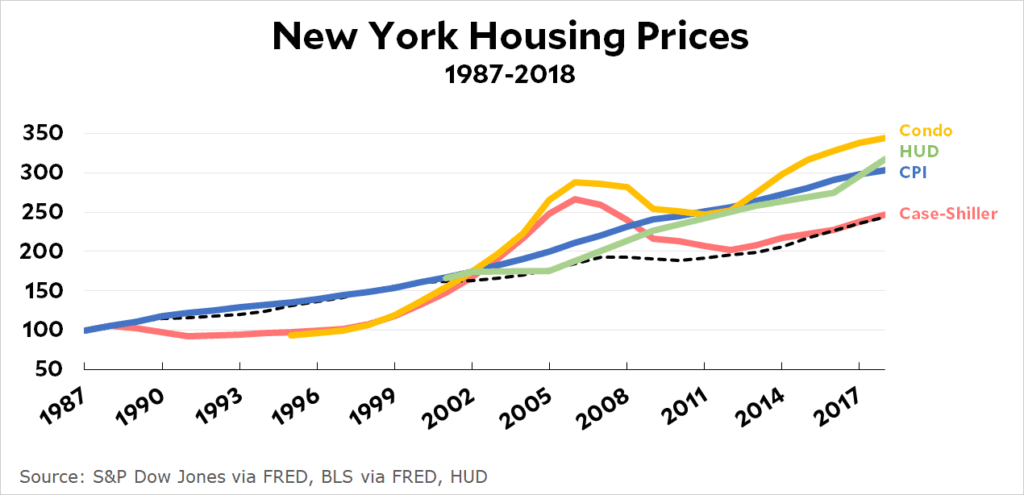
    That’s largely why real estate became viewed as a very popular investment vehicle for financial investors. The figure below illustrates an average of New York housing prices over a 30-year period, between 1987 and 2018, from different housing market segments.

    Figure 1 – New York (NYC) Housing Market Prices (1987-2018) Overview

    As one can see, prices went up across the board mostly every year, with the exception of a rocky period in the midst of the Great Recession of 2008. Therefore, having more ownership/equity in a property that’s also going to increase in value over time is a no brainer, even if you choose to move out of that property prior to paying off your mortgage.

  • NYC Real Estate Market Mid-2021: Are You Better Off Buying or Renting?

    Since New York City’s (NYC) real estate market is still experiencing a fresh post-COVID effect, you are better off buying if you have the money (and credit score). However, as is often the case, it greatly depends on your financial situation. Living in arguably the most desirable and expensive part of the world presents a financial burden to many younger adults, who are still working lower paying, entry level jobs.

    The majority of real estate property owners in New York City are of older age and in the highest income brackets (NYU Furman Center). Additionally, they are more likely to have permanent ownership of property in other locations (Goldstein, Property Nest).

    Many people view renting as ‘wasteful’ because you don’t have the benefit of acquiring equity in your property. However, the reality is for most young or middle-aged professionals, the economic opportunities – combined with the cost of living in New York City – don’t allow them to acquire enough requisite disposable income to put a down payment on a desirable apartment unit. This brings up a primary obstacle many residents of New York City see with buying a permanent unit: most people don’t view New York City as their ‘final destination’, long-term residence. In other words, when most people think about taking out a mortgage and buying a home, they’re thinking about a serious long-term commitment (emphasis on long-term). Raising kids, settling down in a permanent work situation, and finally retiring. The suburbs or a quiet town; not the most densely populated, most popular tourist destination in the world.

    While there are plenty of mechanisms available to individuals looking to get out of a 20 or 30-year mortgage after only a few years, logically, it would make sense for most to still prefer not to take on that kind of serious financial responsibility without the intent of staying in that location for a while.  

    With that being said, from the perspective of someone simply asking: “hey, would I be better off buying or renting in New York City?”, I would advise them to not be hesitant and buy if they have the money saved.

    The reason is two-fold. If you are going to live in the unit, at least initially, you’ll acquire equity simultaneously. If you find that NYC is not for you in a few years – as many inevitably do – current market prices and historic trends, combined with current rates and incentives, suggest one would be able to see a positive cash flow from subleasing or subletting their own property. Meaning, renters are consistently earning more monthly rent than their monthly mortgage payments. Alternatively, if you have no desire of becoming a landlord, contrary to ordinary homeowner’s beliefs, there is the ability to sell your mortgaged property and earn a profit. It’s extremely difficult to look at the recent data without considering the COVID-19 situation, but over a 10-year period prior to that, real estate prices were significantly increasing year-over-year.

    That’s largely why real estate became viewed as a very popular investment vehicle for financial investors. The figure below illustrates an average of New York housing prices over a 30-year period, between 1987 and 2018, from different housing market segments.

    Figure 1 – New York (NYC) Housing Market Prices (1987-2018) Overview

    As one can see, prices went up across the board mostly every year, with the exception of a rocky period in the midst of the Great Recession of 2008. Therefore, having more ownership/equity in a property that’s also going to increase in value over time is a no brainer, even if you choose to move out of that property prior to paying off your mortgage.