Tag: residential real estate

  • Investigating a Critic of Real Estate Investing

    While real estate continues to be the biggest asset class in the world, there are still asset managers who are skeptical about recommending it to their clients as an investment vehicle. As Andy Rachleff puts it:

    One of the most common pieces of financial advice our clients hear from their friends and family is to invest their excess cash in rental properties. Unfortunately, this is terrible advice for all but a lucky few.


    Andy Rachelff

    The piece goes on to give four distinct reasons for critics’ deviation from traditional logic. Let’s break it down one by one.

    Income Isn’t Guaranteed

    While this is true, this is true when it comes to any financial investment vehicle. According to the National Council of Real Estate Investment Fiduciaries (NCREIF), as of Q1 2021 the average 25-year return for private commercial real estate properties held for investment purposes slightly outperformed the S&P 500 Index, with average annualized returns of 10.3% and 9.6%, respectively. Residential and diversified real estate investments also averaged returns of 10.3% (NCREIF). Keep in mind, this data takes into account both the 2008 financial crisis and the COVID-19 pandemic. Each calamity gravely deflated assets in the real estate market. So while it’s certainly true that income isn’t guaranteed, over a 25-year period both commercial and residential real estate holdings outperformed the S&P 500 Index. While income is almost never guaranteed, this should make you feel more at ease about investing your money in the real estate sector.

    It’s Hard To Generate A Compelling Return

    Another generic statement that can be said about almost any investment vehicle. If generating a compelling return was easy, everyone would follow the same system. When you invest in real estate, whether it be through direct property management or a REIT, you still maintain some level of ownership over a physical asset. Conversely, with stocks, as an example, you own a piece of a publicly traded company that has a board of directors, executives, and senior management controlling the day-to-day operations. In other words, your money is in the hand’s of others. With the majority of real estate investment vehicles, you are in control. Therefore, you are the one who has the ability to make decisions that generate a more compelling return, versus leaving those decisions in other people’s hands. It’s easier to generate a compelling return when you have control because at the end of the day, no one will care as much about your money as yourself. Additionally, the under 8% net over eight years earned by Weatherfront’s portfolio is not only a logical fallacy as it is only one data point, but their complaint is largely surrounding the tax structure of rental properties investors will have to pay. It is anecdotal data tailored to disprove a very generic argument to begin with.

    It’s Better To Diversify Your Portfolio

    In this section, the writer essentially makes a compelling argument to investing in a REIT versus direct real estate investing. While we’ve covered both strategies in depth, it’s true that in the long-term a REIT, REIG, or some form of pooled investment will mitigate your portfolio’s risk. This is especially true for individual properties that “fall out of favor”, sometimes due to external factors (i.e. COVID-19 pandemic). The writer correctly points out the substantial risk in a situation where you have enough capital to invest in only one property and advises you against it, but then makes a perfect argument for how to actually diversify your capital within the real estate market. After all, diversification is cited by a vast majority a major benefit to the real estate investment sector. Irrespective of how much money you have to invest upfront, you have control over how much risk you want to take on. Therefore you can choose to diversify your real estate portfolio, or you can put all your eggs in one basket. We are in agreement with Weatherfront that the latter generally isn’t advisable.

    Liquidity Matters

    Depending on what approach you take to real estate investing, the writer has a point. If you take a direct approach to real estate investing, you can easily get stuck with an undesirable property. Alternatively, investing in a real estate index fund, gives you the same liquidity as investing in any other index or stock. Nowadays, it’s very rare to see an investor take all their excess investment capital and tie it down in one property. If they do, they’re doing so at their own peril. With so much data available that shows national long-term economic growth is cyclical, one would have to have a very high appetite for risk to directly invest in a single property. Diversification has been proven to be an essential component to any successful investment portfolio.

    Concisely, do we agree with the critic’s assertion to avoid investing in real estate holdings? No, we don’t. While the writer points out some opportunities to improve your real estate investment strategy, they don’t provide a compelling argument to avoid investing in the entire segment. While some data is anecdotal and some is actual, they make a good case to be wary of rental properties. At the same time, they make a great case for diversification through REITs and other real estate index funds. The fact is there will always be critics and skeptics of any investment choices. There are analysts who are paid to do just that. However real estate has been the world’s largest asset class for awhile and it isn’t going anywhere. For investors, it would be wise to embrace that and research the abundant amount of strategies available within the real estate segment. Diversification will always be critical. Especially if you’re not currently invested in the real estate market, it would be prudent to look into various strategies because you’re all but sure to find some that suit either your short or long-term goals.

  • Investigating a Critic of Real Estate Investing

    While real estate continues to be the biggest asset class in the world, there are still asset managers who are skeptical about recommending it to their clients as an investment vehicle. As Andy Rachleff puts it:

    One of the most common pieces of financial advice our clients hear from their friends and family is to invest their excess cash in rental properties. Unfortunately, this is terrible advice for all but a lucky few.


    Andy Rachelff

    The piece goes on to give four distinct reasons for critics’ deviation from traditional logic. Let’s break it down one by one.

    Income Isn’t Guaranteed

    While this is true, this is true when it comes to any financial investment vehicle. According to the National Council of Real Estate Investment Fiduciaries (NCREIF), as of Q1 2021 the average 25-year return for private commercial real estate properties held for investment purposes slightly outperformed the S&P 500 Index, with average annualized returns of 10.3% and 9.6%, respectively. Residential and diversified real estate investments also averaged returns of 10.3% (NCREIF). Keep in mind, this data takes into account both the 2008 financial crisis and the COVID-19 pandemic. Each calamity gravely deflated assets in the real estate market. So while it’s certainly true that income isn’t guaranteed, over a 25-year period both commercial and residential real estate holdings outperformed the S&P 500 Index. While income is almost never guaranteed, this should make you feel more at ease about investing your money in the real estate sector.

    It’s Hard To Generate A Compelling Return

    Another generic statement that can be said about almost any investment vehicle. If generating a compelling return was easy, everyone would follow the same system. When you invest in real estate, whether it be through direct property management or a REIT, you still maintain some level of ownership over a physical asset. Conversely, with stocks, as an example, you own a piece of a publicly traded company that has a board of directors, executives, and senior management controlling the day-to-day operations. In other words, your money is in the hand’s of others. With the majority of real estate investment vehicles, you are in control. Therefore, you are the one who has the ability to make decisions that generate a more compelling return, versus leaving those decisions in other people’s hands. It’s easier to generate a compelling return when you have control because at the end of the day, no one will care as much about your money as yourself. Additionally, the under 8% net over eight years earned by Weatherfront’s portfolio is not only a logical fallacy as it is only one data point, but their complaint is largely surrounding the tax structure of rental properties investors will have to pay. It is anecdotal data tailored to disprove a very generic argument to begin with.

    It’s Better To Diversify Your Portfolio

    In this section, the writer essentially makes a compelling argument to investing in a REIT versus direct real estate investing. While we’ve covered both strategies in depth, it’s true that in the long-term a REIT, REIG, or some form of pooled investment will mitigate your portfolio’s risk. This is especially true for individual properties that “fall out of favor”, sometimes due to external factors (i.e. COVID-19 pandemic). The writer correctly points out the substantial risk in a situation where you have enough capital to invest in only one property and advises you against it, but then makes a perfect argument for how to actually diversify your capital within the real estate market. After all, diversification is cited by a vast majority a major benefit to the real estate investment sector. Irrespective of how much money you have to invest upfront, you have control over how much risk you want to take on. Therefore you can choose to diversify your real estate portfolio, or you can put all your eggs in one basket. We are in agreement with Weatherfront that the latter generally isn’t advisable.

    Liquidity Matters

    Depending on what approach you take to real estate investing, the writer has a point. If you take a direct approach to real estate investing, you can easily get stuck with an undesirable property. Alternatively, investing in a real estate index fund, gives you the same liquidity as investing in any other index or stock. Nowadays, it’s very rare to see an investor take all their excess investment capital and tie it down in one property. If they do, they’re doing so at their own peril. With so much data available that shows national long-term economic growth is cyclical, one would have to have a very high appetite for risk to directly invest in a single property. Diversification has been proven to be an essential component to any successful investment portfolio.

    Concisely, do we agree with the critic’s assertion to avoid investing in real estate holdings? No, we don’t. While the writer points out some opportunities to improve your real estate investment strategy, they don’t provide a compelling argument to avoid investing in the entire segment. While some data is anecdotal and some is actual, they make a good case to be wary of rental properties. At the same time, they make a great case for diversification through REITs and other real estate index funds. The fact is there will always be critics and skeptics of any investment choices. There are analysts who are paid to do just that. However real estate has been the world’s largest asset class for awhile and it isn’t going anywhere. For investors, it would be wise to embrace that and research the abundant amount of strategies available within the real estate segment. Diversification will always be critical. Especially if you’re not currently invested in the real estate market, it would be prudent to look into various strategies because you’re all but sure to find some that suit either your short or long-term goals.

  • NYC’s Real Estate Market Outlook as the CDC’s Moratorium on Eviction Expires

    When the CDC (Center for Disease Control and Prevention) last extended the eviction moratorium a third time, due to the COVID-19 pandemic, from the end of June 2021 to the end of July 2021, they were clear that would be the final extension. Republicans opposing another extension of the eviction moratorium cited the recent 5-4 decision by the Supreme Court, which suggested legislative approval would be required. Leading Democrats responded with brief arguments that the eviction ban needs to be extended, as Congress has only distributed $3B out of the $46.5B in approved rental relief. According to a study by the Aspen Institute, more than 15 million people in 6.5 million US households are currently behind on rental payments. The same study estimates the collective cost to landlords to this point has been over $20B. Landlord groups previously came together in an unsuccessful attempt to end the moratorium earlier, arguing the CDC overstepped their legal authority, but they were rejected by the Supreme Court’s ruling then. Determined not to give up, the National Apartment Association (NAA), with 82,600 members that collectively manage more than 9.7 million rental units, sued the U.S. government on Tuesday July 27th, seeking billions of dollars in unpaid rent due to the moratorium (Shepardson, Reuters).

    While opportunities for a federal extension essentially ended when the House of Representatives adjourned Friday July 30th, effectively giving up, there are states that have already extended the eviction ban. New York and California top the list, with the two states passing bans on evictions until August 31st and September 30th, respectively (Shepardson, Reuters). Keep in mind, the justification for the CDC initially issuing this policy was due to the federal government’s direction to self-quarantine during the worst of the COVID-19 pandemic. It was not primarily over economic concerns, as that would be outside the CDC’s purview. Regardless, assuming nothing changes from this point, New Yorker’s in financial crisis will only have one additional month of safe haven before they too will have to deal with the reality of federal protections stemming from the COVID-19 pandemic ending.

    What does the looming end of the eviction moratorium mean for NYC’s real estate market? Firstly, as predicted by several well-known real estate attorneys, there will be a huge backlog of cases in Housing Court. Prior to the pandemic, during routine economic and geopolitical times, evictions could take anywhere from three to six months – considered typical – or sometimes drag out for years on end (Hogan, NY Post). The backlog will in turn lead to some landlords, who have certainly been financially struggling throughout this ordeal, being forced into foreclosure or given no choice but to sell cheap to cash buyers. Landlords need revenue in order to run a building. They have expenses, such as providing heat, paying personnel and staff, building supers and contractors, as well as real estate taxes to boot.

    If you’re one of the savvy, fortunate investors who came out of the pandemic with a solid amount of disposable income set aside for your portfolio’s growth, a direct real estate investing approach could prove to be extremely rewarding. REIGs (Real Estate Investment Groups) can also become a powerful force in NYC’s residential real estate market in particular, once the moratorium ends. This vehicle gives real estate investors the ability to join together and pool both their money and knowledge to invest in multiple residential real estate properties. Similarly, members of the REIG would share the costs associated with property management. They could also benefit from diversification and economies of scale, which are additional benefits to joining a REIG. The bottom line for NYC is once the eviction moratorium does end, you’ll see solid opportunities for a long-term residential real estate investment. As is usually the case with financial markets during times of uncertainty, there’s definitely opportunity, but with that opportunity comes inherent market risk.

  • Homebuyers: Five Tips for Financing and Budgeting

    When it comes to home buying, there’s a well-known critical rule: Avoid purchasing more house than you can afford. However, what represents “affordable” will differ between homebuyers. Therefore, one of the most important things for a first-time home buyer to do is plan and budget in advance. Diving into a potential multi-decade financial commitment is one of the most daunting experiences for an individual (or a couple, for that matter) in their lives. It is also highly probable that it will be your most expensive purchase. Before doing so, strategically allocating your money is essential. Otherwise the costs are steep. Before you know it, you may quickly find yourself getting buried in financial hardship, or the ultimate worst nightmare: foreclosure. To avoid this, we recommend the following five tips for first-time homebuyers.

    1. Strongly consider getting started with the “28 Percent Rule”

    The “28 Percent Rule” dictates that your mortgage shouldn’t be more than 28% of your gross income each month. While the Federal Housing Administration (FHA) recommends a slightly more generous allowance of 31%, first-time homebuyers in particular ought to air on the side of caution, considering they are likely repaying some other forms of debt. Additionally, there are the normal monthly expenses (food, transportation, healthcare, etc.) that any working-class individuals would have to account for.

    2. Your down payment should dictate your home’s budget

    Generally, lenders will look for homebuyers to put at least 20% of the property’s purchase price in cash. Though you can utilize other resources to obtain an approval, such as private mortgage insurance (PMI), this will inflate your monthly mortgage payment by roughly 1% (Fuscaldo, Investopedia). It’s important to note that the PMI depends significantly on the size of the property, your credit score, and the potential for the value of the home to increase over time. It’s equally important to note that it is in your long-term best interest to avoid these kinds of instruments, as they’ll tie up more and more of your monthly disposable income in interest repayment. On top of everything else, it’s critical to remember closing costs, as they’ll cost you anywhere from 2-5% of the home’s purchasing price, depending on what state you live in (Fuscaldo, Investopedia). Avoid over-leveraging yourself. Put as much money down as you can afford to, but certainly aim for higher than the bare minimum 10%.

    3. Precisely track your debt-to-income ratio

    It’s a very well-known fact that mortgage lenders will look at a prospective homeowner’s debt-to-income ratio when determining if they will extend a loan to the borrower. Therefore, keeping track of this ratio on a monthly basis is a good benchmark for prospective homeowners to calculate themselves, in order to ultimately decide if a home they’re interested in is affordable. Suppose your gross monthly income is $5,000. Then, if your mortgage payment is $1,500 and the total of your other monthly financial obligations is $1,000, this puts your debt-to-income ratio at 50%. Qualified mortgage lenders very rarely will approve a borrower with a debt-to-income ratio above 43%. Thus, in the above example the hopeful homeowner would unlikely to get approved and even if they did, it’s probable they would be setting themselves up for failure.

    4. Don’t forget all homeowner expenses, not just the monthly mortgage

    There’s no question getting approved for a home loan is an essential step in the process, yet this is only one obligation (though it’s by far the largest). The tough reality is your monthly mortgage payment will not be your only reoccurring expense as a homeowner. Consider additional monthly homeowners’ insurance, utilities, repairs, and maintenance costs. Depending on the season, the snow will need to be shoveled, or the lawn will need to be mowed, or the shrubs will need to be trimmed. Many find that over time, the list just keeps growing. When you calculate the affordability of a home, you may find that an affordable $1,500 monthly mortgage payment is no longer palatable when you factor in an additional $1,000 in monthly expenses. This is a large reason behind the idea of putting a considerable downpayment on the home; it frees up money for those other monthly costs, rather than irresponsibly squandering it on interest.

    5. Settle on a property you can handle managing

    Not only are the additional monthly homeowner expenses important to factor in, but you also need to be mindful of the condition and size of the property. In a situation when you’re concerned about a large utility bill from heating or cooling, less is more. A 4,000-square-foot property that needs serious repair may be a tempting proposition, until it breaks the budget. You may find you’re better off financially with more of a picturesque small home on a quaint hill, in a quiet neighborhood instead. For your own benefit, have a construction or homeowner expert look into the homes specifications to ensure you haven’t missed anything vitally wrong.

    The bottom line is that to many, home ownership is still considered to be the American Dream. In reality, it can quickly turn into a financial nightmare when you miscalculate your monthly expenditures. First-time buyers in particular often want more than they can take on at that moment. Without taking the time to properly prepare for the single biggest purchase of one’s life, they can find themselves house-rich and cash-poor, leading to ultimate financial misery. We urge any future homebuyers to take the necessary preparation steps. Do not sign up for a dream you are not exceptionally confident you can afford.

  • Homebuyers: Five Tips for Financing and Budgeting

    When it comes to home buying, there’s a well-known critical rule: Avoid purchasing more house than you can afford. However, what represents “affordable” will differ between homebuyers. Therefore, one of the most important things for a first-time home buyer to do is plan and budget in advance. Diving into a potential multi-decade financial commitment is one of the most daunting experiences for an individual (or a couple, for that matter) in their lives. It is also highly probable that it will be your most expensive purchase. Before doing so, strategically allocating your money is essential. Otherwise the costs are steep. Before you know it, you may quickly find yourself getting buried in financial hardship, or the ultimate worst nightmare: foreclosure. To avoid this, we recommend the following five tips for first-time homebuyers.

    1. Strongly consider getting started with the “28 Percent Rule”

    The “28 Percent Rule” dictates that your mortgage shouldn’t be more than 28% of your gross income each month. While the Federal Housing Administration (FHA) recommends a slightly more generous allowance of 31%, first-time homebuyers in particular ought to air on the side of caution, considering they are likely repaying some other forms of debt. Additionally, there are the normal monthly expenses (food, transportation, healthcare, etc.) that any working-class individuals would have to account for.

    2. Your down payment should dictate your home’s budget

    Generally, lenders will look for homebuyers to put at least 20% of the property’s purchase price in cash. Though you can utilize other resources to obtain an approval, such as private mortgage insurance (PMI), this will inflate your monthly mortgage payment by roughly 1% (Fuscaldo, Investopedia). It’s important to note that the PMI depends significantly on the size of the property, your credit score, and the potential for the value of the home to increase over time. It’s equally important to note that it is in your long-term best interest to avoid these kinds of instruments, as they’ll tie up more and more of your monthly disposable income in interest repayment. On top of everything else, it’s critical to remember closing costs, as they’ll cost you anywhere from 2-5% of the home’s purchasing price, depending on what state you live in (Fuscaldo, Investopedia). Avoid over-leveraging yourself. Put as much money down as you can afford to, but certainly aim for higher than the bare minimum 10%.

    3. Precisely track your debt-to-income ratio

    It’s a very well-known fact that mortgage lenders will look at a prospective homeowner’s debt-to-income ratio when determining if they will extend a loan to the borrower. Therefore, keeping track of this ratio on a monthly basis is a good benchmark for prospective homeowners to calculate themselves, in order to ultimately decide if a home they’re interested in is affordable. Suppose your gross monthly income is $5,000. Then, if your mortgage payment is $1,500 and the total of your other monthly financial obligations is $1,000, this puts your debt-to-income ratio at 50%. Qualified mortgage lenders very rarely will approve a borrower with a debt-to-income ratio above 43%. Thus, in the above example the hopeful homeowner would unlikely to get approved and even if they did, it’s probable they would be setting themselves up for failure.

    4. Don’t forget all homeowner expenses, not just the monthly mortgage

    There’s no question getting approved for a home loan is an essential step in the process, yet this is only one obligation (though it’s by far the largest). The tough reality is your monthly mortgage payment will not be your only reoccurring expense as a homeowner. Consider additional monthly homeowners’ insurance, utilities, repairs, and maintenance costs. Depending on the season, the snow will need to be shoveled, or the lawn will need to be mowed, or the shrubs will need to be trimmed. Many find that over time, the list just keeps growing. When you calculate the affordability of a home, you may find that an affordable $1,500 monthly mortgage payment is no longer palatable when you factor in an additional $1,000 in monthly expenses. This is a large reason behind the idea of putting a considerable downpayment on the home; it frees up money for those other monthly costs, rather than irresponsibly squandering it on interest.

    5. Settle on a property you can handle managing

    Not only are the additional monthly homeowner expenses important to factor in, but you also need to be mindful of the condition and size of the property. In a situation when you’re concerned about a large utility bill from heating or cooling, less is more. A 4,000-square-foot property that needs serious repair may be a tempting proposition, until it breaks the budget. You may find you’re better off financially with more of a picturesque small home on a quaint hill, in a quiet neighborhood instead. For your own benefit, have a construction or homeowner expert look into the homes specifications to ensure you haven’t missed anything vitally wrong.

    The bottom line is that to many, home ownership is still considered to be the American Dream. In reality, it can quickly turn into a financial nightmare when you miscalculate your monthly expenditures. First-time buyers in particular often want more than they can take on at that moment. Without taking the time to properly prepare for the single biggest purchase of one’s life, they can find themselves house-rich and cash-poor, leading to ultimate financial misery. We urge any future homebuyers to take the necessary preparation steps. Do not sign up for a dream you are not exceptionally confident you can afford.

  • NYC Real Estate Market Mid-2021: Are You Better Off Buying or Renting?

    Since New York City’s (NYC) real estate market is still experiencing a fresh post-COVID effect, you are better off buying if you have the money (and credit score). However, as is often the case, it greatly depends on your financial situation. Living in arguably the most desirable and expensive part of the world presents a financial burden to many younger adults, who are still working lower paying, entry level jobs.

    The majority of real estate property owners in New York City are of older age and in the highest income brackets (NYU Furman Center). Additionally, they are more likely to have permanent ownership of property in other locations (Goldstein, Property Nest).

    Many people view renting as ‘wasteful’ because you don’t have the benefit of acquiring equity in your property. However, the reality is for most young or middle-aged professionals, the economic opportunities – combined with the cost of living in New York City – don’t allow them to acquire enough requisite disposable income to put a down payment on a desirable apartment unit. This brings up a primary obstacle many residents of New York City see with buying a permanent unit: most people don’t view New York City as their ‘final destination’, long-term residence. In other words, when most people think about taking out a mortgage and buying a home, they’re thinking about a serious long-term commitment (emphasis on long-term). Raising kids, settling down in a permanent work situation, and finally retiring. The suburbs or a quiet town; not the most densely populated, most popular tourist destination in the world.

    While there are plenty of mechanisms available to individuals looking to get out of a 20 or 30-year mortgage after only a few years, logically, it would make sense for most to still prefer not to take on that kind of serious financial responsibility without the intent of staying in that location for a while.  

    With that being said, from the perspective of someone simply asking: “hey, would I be better off buying or renting in New York City?”, I would advise them to not be hesitant and buy if they have the money saved.

    The reason is two-fold. If you are going to live in the unit, at least initially, you’ll acquire equity simultaneously. If you find that NYC is not for you in a few years – as many inevitably do – current market prices and historic trends, combined with current rates and incentives, suggest one would be able to see a positive cash flow from subleasing or subletting their own property. Meaning, renters are consistently earning more monthly rent than their monthly mortgage payments. Alternatively, if you have no desire of becoming a landlord, contrary to ordinary homeowner’s beliefs, there is the ability to sell your mortgaged property and earn a profit. It’s extremely difficult to look at the recent data without considering the COVID-19 situation, but over a 10-year period prior to that, real estate prices were significantly increasing year-over-year.

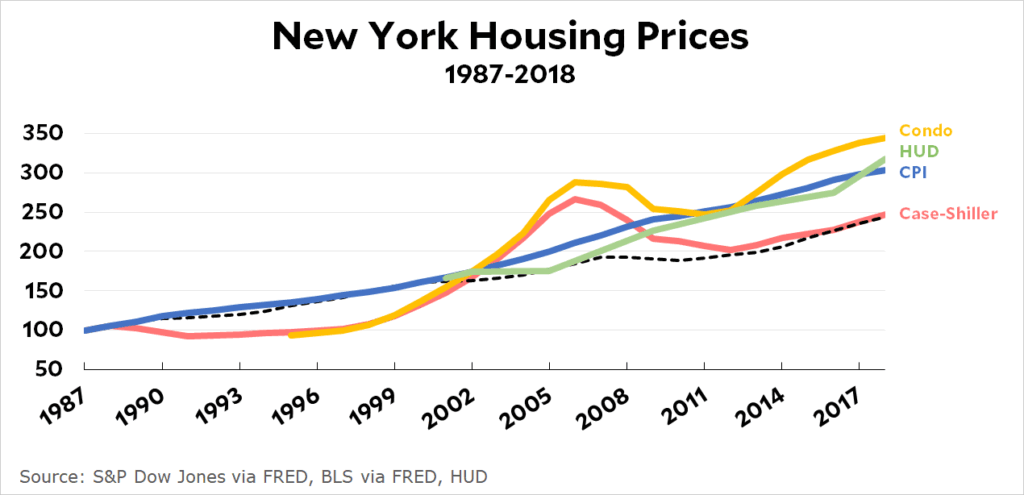
    That’s largely why real estate became viewed as a very popular investment vehicle for financial investors. The figure below illustrates an average of New York housing prices over a 30-year period, between 1987 and 2018, from different housing market segments.

    Figure 1 – New York (NYC) Housing Market Prices (1987-2018) Overview

    As one can see, prices went up across the board mostly every year, with the exception of a rocky period in the midst of the Great Recession of 2008. Therefore, having more ownership/equity in a property that’s also going to increase in value over time is a no brainer, even if you choose to move out of that property prior to paying off your mortgage.

  • NYC Real Estate Market Mid-2021: Are You Better Off Buying or Renting?

    Since New York City’s (NYC) real estate market is still experiencing a fresh post-COVID effect, you are better off buying if you have the money (and credit score). However, as is often the case, it greatly depends on your financial situation. Living in arguably the most desirable and expensive part of the world presents a financial burden to many younger adults, who are still working lower paying, entry level jobs.

    The majority of real estate property owners in New York City are of older age and in the highest income brackets (NYU Furman Center). Additionally, they are more likely to have permanent ownership of property in other locations (Goldstein, Property Nest).

    Many people view renting as ‘wasteful’ because you don’t have the benefit of acquiring equity in your property. However, the reality is for most young or middle-aged professionals, the economic opportunities – combined with the cost of living in New York City – don’t allow them to acquire enough requisite disposable income to put a down payment on a desirable apartment unit. This brings up a primary obstacle many residents of New York City see with buying a permanent unit: most people don’t view New York City as their ‘final destination’, long-term residence. In other words, when most people think about taking out a mortgage and buying a home, they’re thinking about a serious long-term commitment (emphasis on long-term). Raising kids, settling down in a permanent work situation, and finally retiring. The suburbs or a quiet town; not the most densely populated, most popular tourist destination in the world.

    While there are plenty of mechanisms available to individuals looking to get out of a 20 or 30-year mortgage after only a few years, logically, it would make sense for most to still prefer not to take on that kind of serious financial responsibility without the intent of staying in that location for a while.  

    With that being said, from the perspective of someone simply asking: “hey, would I be better off buying or renting in New York City?”, I would advise them to not be hesitant and buy if they have the money saved.

    The reason is two-fold. If you are going to live in the unit, at least initially, you’ll acquire equity simultaneously. If you find that NYC is not for you in a few years – as many inevitably do – current market prices and historic trends, combined with current rates and incentives, suggest one would be able to see a positive cash flow from subleasing or subletting their own property. Meaning, renters are consistently earning more monthly rent than their monthly mortgage payments. Alternatively, if you have no desire of becoming a landlord, contrary to ordinary homeowner’s beliefs, there is the ability to sell your mortgaged property and earn a profit. It’s extremely difficult to look at the recent data without considering the COVID-19 situation, but over a 10-year period prior to that, real estate prices were significantly increasing year-over-year.

    That’s largely why real estate became viewed as a very popular investment vehicle for financial investors. The figure below illustrates an average of New York housing prices over a 30-year period, between 1987 and 2018, from different housing market segments.

    Figure 1 – New York (NYC) Housing Market Prices (1987-2018) Overview

    As one can see, prices went up across the board mostly every year, with the exception of a rocky period in the midst of the Great Recession of 2008. Therefore, having more ownership/equity in a property that’s also going to increase in value over time is a no brainer, even if you choose to move out of that property prior to paying off your mortgage.

  • What Exactly is a Subprime Mortgage?

    What Exactly is a Subprime Mortgage?

    A subprime mortgage is a type of housing loan granted to individual with a poor credit score – 640 or less (and even below 600) – who, as a result of their poor credit rating would not qualify for more conventional mortgages. The term subprime itself is referring specifically to the borrower’s credit score – thus their ability to pay back their financial obligation – rather than the financial agreement embedded in the loan itself. Subprime borrowers are implicitly more likely to default than others with a higher credit score.

    Types of Subprime Mortgages

    In essence, subprime mortgages are mortgages given to subprime borrowers. The main types of subprime mortgages include fixed-rate mortgages with 40- to 50-year terms, interest-only mortgages, and adjustable rate mortgages (ARMs).

    Fixed-Interest Mortgages

    One type of subprime mortgage is a fixed-rate mortgage, given for a 40- or 50-year term, in contrast to the standard 30-year period. This lengthy loan period lowers the borrower’s monthly payments, but it is more likely to be accompanied by a higher interest rate. The interest rates available for fixed-interest mortgages can vary substantially from lender to lender. Higher interest rates over a lengthy period of time means the borrower will be under constant pressure to meet their monthly obligations over a prolonged period of time; additionally, it means that the lender will gain a lot of interest of their principal if the loan is paid off.

    Adjustable-Rate Mortgages

    An adjustable-rate mortgage starts out with a fixed interest rate and later, during the life of the loan, switches to a floating rate. One common example is the 2/28 ARM. The 2/28 ARM is a 30-year mortgage with a fixed interest rate for two years before being adjusted. Another typical version of the ARM loan, the 3/27 ARM, has a fixed interest rate for three years before it becomes variable.

    In these types of loans, the floating rate is determined based on an index plus a margin. A commonly used index is ICE LIBOR. With ARMs, the borrower’s monthly payments are usually lower during the initial term. However, when their mortgages reset to the higher, variable rate, mortgage payments usually increase significantly. Of course, the interest rate could decrease over time, depending on the index and economic conditions, which, in turn, would shrink the payment amount.

    According to CNN Money’s Les Christie, “ARMs played a huge role in the crisis”. When home prices started to drop, many homeowners understood that their homes weren’t worth the amount the purchase price. This, coupled with the rise in interest rates led to a massive amount of default. This led to a drastic increase in the number of subprime mortgage foreclosures in August of 2006 and the bursting of the housing bubble that ensued the following year.

    Interest-Only Mortgages

    The third type of subprime mortgage is an interest-only mortgage. For the initial term of the loan, which is typically five, seven, or 10 years, principal payments are postponed so the borrower only pays interest. He can choose to make payments toward the principal, but these payments are not required.

    When this term ends, the borrower begins paying off the principal, or he can choose to refinance the mortgage. This can be a smart option for a borrower if his income tends to fluctuate from year to year, or if he would like to buy a home and is expecting his income to rise within a few years.

    Dignity Mortgages

    The dignity mortgage is a ‘new type of subprime loan’, in which the borrower makes a down payment of about 10% and agrees to pay a higher rate interest for a set period, usually for five years. If he makes the monthly payments on time, after five years, the amount that has been paid toward interest goes toward reducing the balance on the mortgage, and the interest rate is lowered to the prime rate.