Tag: securities

  • What is a Prime Brokerage and Who Uses Their Services?

    A prime brokerage is a bundled group of services offered by investment banks and other financial institutions. Investment banks may offer these services to hedge funds and other large investment clients that have a need to be able to borrow securities (or cash), in order to engage in “netting” to achieve “absolute returns”.

    What is Netting?

    Netting refers to offsetting the value of multiple positions, or payments, due to be exchanged between two or more parties. Typically, it’s used to determine which party is owed compensation in a multiparty contract.  Additionally, utilized as a method of reducing risks in financial contracts by combining or aggregating multiple financial obligations to arrive at a net obligation amount. Netting reduces settlement, credit, and other financial risks between two or more parties.

    What is an Absolute Return?

    An absolute return indicates the return an asset receives over a specific period. This measure looks at the appreciation/depreciation that an asset – such as a stock or mutual fund – has achieved over time. Absolute returns differ from relative returns in that there’s no benchmark comparison. The absolute return is concerned with the return of that specific asset over a period of time. An easier way to think of an absolute return is by its other reference, total return. Therefore, the gain or loss of an asset or portfolio is measured independent of any other standard. Absolute returns may be positive or negative and they may also bear no correlation to other market activities.

    Who Typically Utilizes Prime Brokerage Services and Who Provides Them?

    Hedge funds would amongst the first category of prime brokerage clients. Legally, clients may not access prime brokerage services for less than $500,000 in equity, even though it’s typical for clients to have over $50M in equity. High net worth private investors are another popular category of prime brokerage clients.

    On the other hand, prime brokerage services are generally offered by large investment banks. These institutions benefit from economies of scale to bundle multiple financial service offerings with more efficiency, at a cheaper cost. Some of the most notable firms who offer prime brokerage services include Goldman Sachs, BAML, JPMC, Citigroup, and BNY Mellon. Services bundled include largely “back office” tasks like asset custody, financial reporting, cash/securities lending, investor introductions, and risk consulting.

    Historically, Goldman Sachs has been known as the most reputable prime brokerage. However, their prime brokerage agreements are such that smaller hedge funds would have difficulty meeting their expected capital requirements. More recently, Pershing – an elite BNY Mellon subsidiary – has become the backbone of the prime brokerage street business. Combining the custodial services BNY Mellon is renowned for, with Pershing’s uniquely skilled investments and alternatives specialists, gives the duo a unique marketing position within the prime brokerage business. Pershing’s “prime services” are highlighted by risk management consulting. Additional offerings include securities lending, financing solutions, trade execution, technology, liquid alternative investments, and more. Within the alternative investment niche, which is extremely frequently accessed by hedge funds, Pershing has built an impeccable reputation.

  • What is a Prime Brokerage and Who Uses Their Services?

    A prime brokerage is a bundled group of services offered by investment banks and other financial institutions. Investment banks may offer these services to hedge funds and other large investment clients that have a need to be able to borrow securities (or cash), in order to engage in “netting” to achieve “absolute returns”.

    What is Netting?

    Netting refers to offsetting the value of multiple positions, or payments, due to be exchanged between two or more parties. Typically, it’s used to determine which party is owed compensation in a multiparty contract.  Additionally, utilized as a method of reducing risks in financial contracts by combining or aggregating multiple financial obligations to arrive at a net obligation amount. Netting reduces settlement, credit, and other financial risks between two or more parties.

    What is an Absolute Return?

    An absolute return indicates the return an asset receives over a specific period. This measure looks at the appreciation/depreciation that an asset – such as a stock or mutual fund – has achieved over time. Absolute returns differ from relative returns in that there’s no benchmark comparison. The absolute return is concerned with the return of that specific asset over a period of time. An easier way to think of an absolute return is by its other reference, total return. Therefore, the gain or loss of an asset or portfolio is measured independent of any other standard. Absolute returns may be positive or negative and they may also bear no correlation to other market activities.

    Who Typically Utilizes Prime Brokerage Services and Who Provides Them?

    Hedge funds would amongst the first category of prime brokerage clients. Legally, clients may not access prime brokerage services for less than $500,000 in equity, even though it’s typical for clients to have over $50M in equity. High net worth private investors are another popular category of prime brokerage clients.

    On the other hand, prime brokerage services are generally offered by large investment banks. These institutions benefit from economies of scale to bundle multiple financial service offerings with more efficiency, at a cheaper cost. Some of the most notable firms who offer prime brokerage services include Goldman Sachs, BAML, JPMC, Citigroup, and BNY Mellon. Services bundled include largely “back office” tasks like asset custody, financial reporting, cash/securities lending, investor introductions, and risk consulting.

    Historically, Goldman Sachs has been known as the most reputable prime brokerage. However, their prime brokerage agreements are such that smaller hedge funds would have difficulty meeting their expected capital requirements. More recently, Pershing – an elite BNY Mellon subsidiary – has become the backbone of the prime brokerage street business. Combining the custodial services BNY Mellon is renowned for, with Pershing’s uniquely skilled investments and alternatives specialists, gives the duo a unique marketing position within the prime brokerage business. Pershing’s “prime services” are highlighted by risk management consulting. Additional offerings include securities lending, financing solutions, trade execution, technology, liquid alternative investments, and more. Within the alternative investment niche, which is extremely frequently accessed by hedge funds, Pershing has built an impeccable reputation.

  • What is a Tri-Party Repo (TREPS)and How Did the Market Operate?

    What is a Tri-Party Repo (TREPS)and How Did the Market Operate?

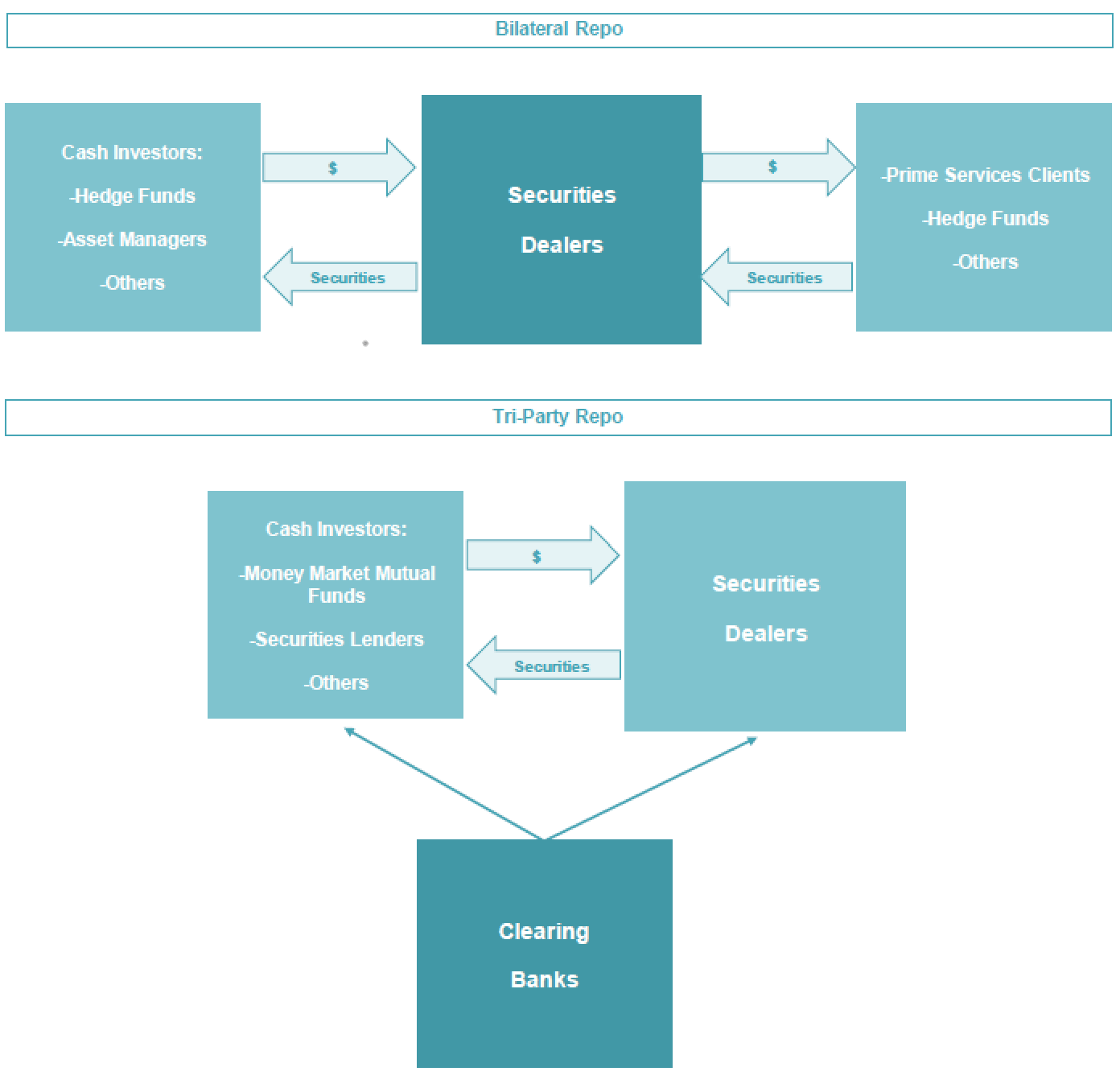
    The simplest way to understand a tri-party repo (TREPS) is to think of it as a simple repurchase agreement between two parties, where a third-party – historically a very large and reputable bank (only JPM Chase or BNY Mellon, during the time these transactions were widely common) – processes administrative work and even guarantees the cash provided by Company A to Company B and the collateral Company B secures the cash from Company A with. These third parties, commonly referred to as clearing banks, also performed valuation services to ensure the collateral put up by Company B was within the approximate fair market value of the cash lent by Company A.

    Tri-Party Repos in the Derivative Era

    These transactions actually became popular at the “boom” of the derivative trading era – even though they had a comparatively low-yield percentage for both companies – mainly because of mechanics of how these transactions occurred. They were typically cleared and settled overnight, so the investment banker would have the cash available in the morning when the trading day began. The “unwinding” process of this repo would also happen after the trading day was complete; the dealer (Company B) would finance the broker (Company A) with cash and the third-party clearing bank would take care of the rest for a small fee.

    To be clear, the responsibilities of the clearing banks weren’t minuscule, they were tasked with: taking custody of the securities involved in the repo, valuing the securities and making sure that the specified margin is applied, settling the transaction on their books, and offer services to help dealers optimize the use of their collateral. However as mentioned, to give dealers access to their securities during the day, the clearing banks settle all repos very early each day, returning cash to cash investors and collateral to dealers. This would lead to a delay in real-time settlement, therefore in reality the clearing banks wind up extending hundreds of billions of intraday credit to the dealers until new repos are settled in the evening.

    Role in 2008 Financial Crisis

    It’s argued by many to have played an underscored role in the 2008 US Financial Crisis, primarily because between 2007-2009 these repurchase agreements became a common daily routine for almost all of the largest brokers and dealers in the world. This was for several logical reasons. Firstly, it made sense for securities brokers to engage in because they have access to cash immediately, the second the daily trading day begins.

    It equally makes sense for dealers. They are receiving a profit from lending cash and they have the comfort of knowing their cash is backed by collateral that was signed off on by either JPMC or BNYM. Finally, it makes sense for the clearing bank to use their economies of scale and human resources to make a couple percentage points. At the time this was thought to be routine administrative clearing bank procedure. However, it turned out to be a much bigger nightmare than ever imagined.

    The nightmare catch is best described by the following scenario. Contemplate what happens if you have a very large and highly levered broker, like Bear Sterns as the famous example. You then encounter a situation where financial markets they have heavy exposure in drop sharply. The collateral a broker like Bear Sterns would put up would be in the form of a portfolio of securities. They wouldn’t contribute any physical assets, or guaranteed/risk-less investments (like T-Notes).

    Where Systemic Financial Fragility and Potential Crisis Begins

    Now you have a situation where the dealer (Company B) may not feel as comfortable providing liquid cash financing to Bear Sterns anymore. Then you essentially have the clearing bank – JPM Chase or BNY Mellon – incurring the loss because the process was done so hastily. They almost certainly never took the time to deeply look into whether the collateral put up by Bear Sterns was equal in liquid valuation to the cash provided by their various dealers (who by the way would usually be institutions like secondary education private schools, or institutions in a medical (or other) field with a surplus of cash), so the settlement process only occurred on paper for them.

    When things went south, even though the clearing banks do not match dealers with cash investors. Nor do they play the role of broker in that market. They had to settle disproportionately valued securities with the most liquid form of financial currency: cash. Looking at Bear Sterns, they would’ve used dozens of cash lenders to diversify. Even more so the clearing banks would be incentivized to not look too closely at their spotted collateral. Picture what happens if you have Lehman Brothers, Goldman Sachs, and Morgan Stanley incurring the same scenarios. The same day, as well. Of course Goldman Sachs and Morgan Stanley are two of the most prestigious investment banks in the world. Likely not enough of their total portfolio was invested in the tri-party repo market to cause them to fail.

    Conclusion

    However when that market did ultimately fail, things went that route for Lehman and Bear Sterns. Concisely, while on the surface a tri-party repo is a simple repurchase agreement where a third party provides administrative surfaces at a small fee for the two companies engaged in the repo, understanding the mechanics of it are invaluable to appreciating how some financial markets collapsed so rapidly in late 2008.

  • What is a Tri-Party Repo (TREPS)and How Did the Market Operate?

    What is a Tri-Party Repo (TREPS)and How Did the Market Operate?

    The simplest way to understand a tri-party repo (TREPS) is to think of it as a simple repurchase agreement between two parties, where a third-party – historically a very large and reputable bank (only JPM Chase or BNY Mellon, during the time these transactions were widely common) – processes administrative work and even guarantees the cash provided by Company A to Company B and the collateral Company B secures the cash from Company A with. These third parties, commonly referred to as clearing banks, also performed valuation services to ensure the collateral put up by Company B was within the approximate fair market value of the cash lent by Company A.

    Tri-Party Repos in the Derivative Era

    These transactions actually became popular at the “boom” of the derivative trading era – even though they had a comparatively low-yield percentage for both companies – mainly because of mechanics of how these transactions occurred. They were typically cleared and settled overnight, so the investment banker would have the cash available in the morning when the trading day began. The “unwinding” process of this repo would also happen after the trading day was complete; the dealer (Company B) would finance the broker (Company A) with cash and the third-party clearing bank would take care of the rest for a small fee.

    To be clear, the responsibilities of the clearing banks weren’t minuscule, they were tasked with: taking custody of the securities involved in the repo, valuing the securities and making sure that the specified margin is applied, settling the transaction on their books, and offer services to help dealers optimize the use of their collateral. However as mentioned, to give dealers access to their securities during the day, the clearing banks settle all repos very early each day, returning cash to cash investors and collateral to dealers. This would lead to a delay in real-time settlement, therefore in reality the clearing banks wind up extending hundreds of billions of intraday credit to the dealers until new repos are settled in the evening.

    Role in 2008 Financial Crisis

    It’s argued by many to have played an underscored role in the 2008 US Financial Crisis, primarily because between 2007-2009 these repurchase agreements became a common daily routine for almost all of the largest brokers and dealers in the world. This was for several logical reasons. Firstly, it made sense for securities brokers to engage in because they have access to cash immediately, the second the daily trading day begins.

    It equally makes sense for dealers. They are receiving a profit from lending cash and they have the comfort of knowing their cash is backed by collateral that was signed off on by either JPMC or BNYM. Finally, it makes sense for the clearing bank to use their economies of scale and human resources to make a couple percentage points. At the time this was thought to be routine administrative clearing bank procedure. However, it turned out to be a much bigger nightmare than ever imagined.

    The nightmare catch is best described by the following scenario. Contemplate what happens if you have a very large and highly levered broker, like Bear Sterns as the famous example. You then encounter a situation where financial markets they have heavy exposure in drop sharply. The collateral a broker like Bear Sterns would put up would be in the form of a portfolio of securities. They wouldn’t contribute any physical assets, or guaranteed/risk-less investments (like T-Notes).

    Where Systemic Financial Fragility and Potential Crisis Begins

    Now you have a situation where the dealer (Company B) may not feel as comfortable providing liquid cash financing to Bear Sterns anymore. Then you essentially have the clearing bank – JPM Chase or BNY Mellon – incurring the loss because the process was done so hastily. They almost certainly never took the time to deeply look into whether the collateral put up by Bear Sterns was equal in liquid valuation to the cash provided by their various dealers (who by the way would usually be institutions like secondary education private schools, or institutions in a medical (or other) field with a surplus of cash), so the settlement process only occurred on paper for them.

    When things went south, even though the clearing banks do not match dealers with cash investors. Nor do they play the role of broker in that market. They had to settle disproportionately valued securities with the most liquid form of financial currency: cash. Looking at Bear Sterns, they would’ve used dozens of cash lenders to diversify. Even more so the clearing banks would be incentivized to not look too closely at their spotted collateral. Picture what happens if you have Lehman Brothers, Goldman Sachs, and Morgan Stanley incurring the same scenarios. The same day, as well. Of course Goldman Sachs and Morgan Stanley are two of the most prestigious investment banks in the world. Likely not enough of their total portfolio was invested in the tri-party repo market to cause them to fail.

    Conclusion

    However when that market did ultimately fail, things went that route for Lehman and Bear Sterns. Concisely, while on the surface a tri-party repo is a simple repurchase agreement where a third party provides administrative surfaces at a small fee for the two companies engaged in the repo, understanding the mechanics of it are invaluable to appreciating how some financial markets collapsed so rapidly in late 2008.