Tag: technological innovation

  • Grayscale Investments, LLC Presents: Grayscale Bitcoin Trust (GBTC), Bitcoin’s First Spot ETF?

    Amongst the latest “hot topics” in the Financial Technology (FinTech) space is a cryptocurrency product aimed at changing the receptiveness of the international investment community to cryptocurrencies. Grayscale Investments, LLC has created the GBTC (Grayscale Bitcoin Trust), in an attempt to make a cryptocurrency product more marketable to institutional investors, pension funds, and other more traditional investment vehicles. Whether this approach will work in the long-term seems to be very hotly contested at the moment, for a number of reasons.

    The Grayscale Bitcoin Trust (GBTC)

    Surprisingly – though maybe not to many in the crypto community – Grayscale largely markets the GBTC for its “robust security and storage”. You would think that as an asset manager, even a crypto asset manager, Grayscale would be more excited about presenting numbers that investors are typically hungry for. However, they lead by offering the following:

    “Grayscale Bitcoin Trust’s assets are stored in offline or “cold” storage with Coinbase Custody Trust Company, LLC, as Custodian. The Custodian is a fiduciary under § 100 of the New York Banking Law and a qualified custodian for purposes of Rule 206(4)-2(d)(6) under the Investment Advisers Act of 1940, as amended.”

    Grayscale Investments, LLC (2022)

    Additional benefits, advertised by Grayscale, to purchase the GBTC include tax-advantaged account eligibility, “titled, auditable ownership [of a crypto asset] through a traditional investment vehicle”, publicly quoted price (OTCQX®: GBTC), and support from a network of trusted providers (this is where they let you know they have hired global financial services legal tycoon Davis Polk & Wardwell LLP). Why is that relevant?

    The SEC’s Ruling on Grayscale’s Bitcoin Spot ETF

    At the top of Grayscale’s website, you’ll see a banner with a hyperlink stating, “We’ve received a decision in our application to convert GBTC to an ETF”. That’s the real storyline here. It’s not the GBTC, it’s the fact that the SEC has disallowed Grayscale to convert the GBTC into a Bitcoin spot ETF. The concise version of the SEC’s 86-page decision can be captured in the following paragraph:

    “This order disapproves the proposed rule change, as modified by Amendment No. 1. The Commission concludes that NYSE Arca has not met its burden under the Exchange Act and the Commission’s Rules of Practice to demonstrate that its proposal is consistent with the requirements of Exchange Act Section 6(b)(5), which requires, in relevant part, that the rules of a national securities exchange be ‘designed to prevent fraudulent and manipulative acts and practices’ and ‘to protect investors and the public interest.’’’

    SEC, Release No. 34-95180; File No. SR-NYSEArca-2021-90 (July 22, 2022)

    Grayscale immediately responded by hiring former U.S. Solicitor General, Donald B. Verrilli, Jr. – best known for arguing President Obama’s ACA (Affordable Care Act) successfully before the US Supreme Court – who filed an appeal of the SEC’s ruling. Grayscale says they had no choice but to escalate the matter, given the “SEC’s arbitrary and capricious actions and discriminatory treatment of issuers”. The appeal seems to be almost exclusively relying on the argument that the SEC has allowed multiple Bitcoin futures ETFs into the marketplace. Furthermore, since their treatment of futures and spots of derivatives is generally similar, they are unjustly denying investors access to a new marketplace: Bitcoin spot ETFs. GBTC has the potential to become the first Bitcoin spot ETF to be approved by the SEC.

    A High-Level Look at GBTC’s Financials

    Below you can see some basic financials on GBTC from Grayscale’s website. They include the CUSIP (389637109), where we’ll use Bloomberg to investigate GBTC’s high-level financials.
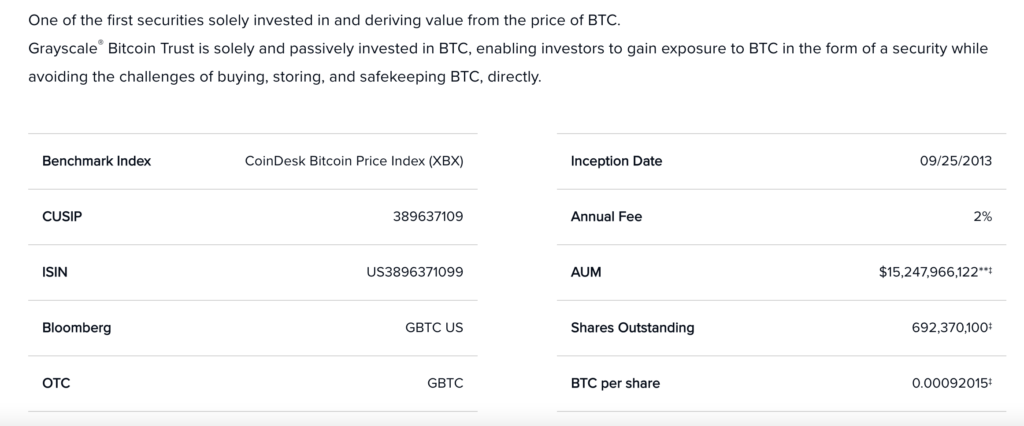
    Source: Grayscale Investments, LLC (August 2022)

    The “Key Statistics” from Bloomberg for CUSIP 389637109 as of Tuesday August 9th, 2022 (GBTC US) are below.
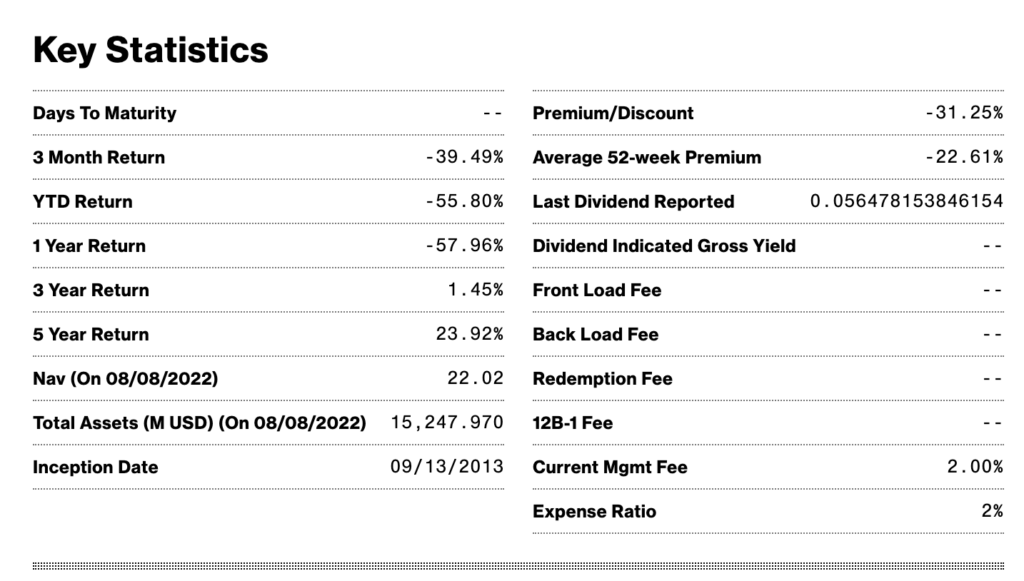
    Source: Bloomberg L.P. (August 2022)

    Looking at the YTD, 1-year, 3-year, and 5-year average returns, in the context of converting this Bitcoin asset to a spot ETF, is the SEC wrong when they say Grayscale is breaking an SEC rule that “requires, in relevant part, that the rules of a national securities exchange be ‘designed to prevent fraudulent and manipulative acts and practices’ and ‘to protect investors and the public interest’”? In other words, is introducing a Bitcoin spot ETF into the marketplace more dangerous than a Bitcoin futures ETF?

    Bitcoin Futures ETFs vs. Bitcoin Spot ETFs

    While we’re not opining on a question that’s currently an open legal issue, perhaps understanding the difference would help. A spot Bitcoin ETF brings many (almost all) of the benefits of a futures ETF. Some include investing in Bitcoin without using an exchange, paying less in fees than on a crypto exchange, and streamlining the overall process (Moeller, Cointelegraph). However, a spot ETF invests in Bitcoin on the spot.

    With a Bitcoin spot ETF, you invest in Bitcoin at its spot price, meaning buyers will be holding Bitcoin within their portfolio. In practice, it’d be very much like buying a stock. Crypto enthusiasts view a spot ETF as a more legitimate method of investment, therefore Bitcoin would become more legitimized with a SEC-approved Bitcoin spot ETF product.

    Futures are defined as “derivative financial contracts that obligate parties to buy or sell an asset at a predetermined future date and price” (Investopedia, 2022). So, what’s the key difference? With a Bitcoin spot ETF, you have immediate ownership of Bitcoin. When you purchase a Bitcoin futures ETF, you’re effectively just betting on the market, depending on if you choose to take a long or short position. But purchasing a Bitcoin futures ETF by no means entails immediate ownership of Bitcoin as an asset. If you’re going to purchase a SEC-approved Bitcoin spot ETF in the future, as one does not exist today, it’s critical to understand you’ll immediately add Bitcoin to your asset portfolio.

    GBTC’s Primary Differentiator: Security

    That seems to circle back to Grayscale’s initial pitch of the GBTC having “robust security and storage”. The SEC appears to be making less of a comment on the GBTC than they are about Bitcoin in general. A Bitcoin spot ETF can only be rejected for the reasons given by the SEC if they felt that Bitcoin was too susceptible to “fraudulent and manipulative acts”. Through strategic marketing, Grayscale is looking to differentiate their potential Bitcoin spot ETF product as completely secure. Furthermore, they’ve had the longest and most hopeful petition to the SEC for a Bitcoin spot ETF, with initial efforts dating back to 2016 (Moeller, Cointelegraph). Over six years later, Grayscale remains just as committed to convert the GBTC to Bitcoin’s first SEC-approved spot ETF. Whether or not they’ll be successful is still very much an open question. It’s worth noting that Grayscale’s Bitcoin Trust (GBTC) is the world’s only SEC-approved, publicly traded “Bitcoin Trust”. A “Bitcoin Trust” can be very closely compared to a private-placement trust. It trades just like a stock over the counter. That existing confidence, along with potential first-mover market advantage, would certainly give Grayscale a huge reason to seek to overturn the SEC’s latest official ruling.

    For reference, if you want to investigate a few of the best-known Bitcoin futures ETFs, they include ProShares BITO Bitcoin futures ETF, Valkyrie Bitcoin Strategy ETF, and VanEck Bitcoin Strategy ETF. The ProShares BITO Bitcoin futures ETF currently holds around $1B in investments (Moeller, Cointelegraph). For a look closer at information and BITO’s financials, they’re listed on the New York Stock Exchange (NYSE: Arca). For additional information on Grayscale Investments or the GBTC, their website can be found here.
  • Grayscale Investments, LLC Presents: Grayscale Bitcoin Trust (GBTC), Bitcoin’s First Spot ETF?

    Amongst the latest “hot topics” in the Financial Technology (FinTech) space is a cryptocurrency product aimed at changing the receptiveness of the international investment community to cryptocurrencies. Grayscale Investments, LLC has created the GBTC (Grayscale Bitcoin Trust), in an attempt to make a cryptocurrency product more marketable to institutional investors, pension funds, and other more traditional investment vehicles. Whether this approach will work in the long-term seems to be very hotly contested at the moment, for a number of reasons.

    The Grayscale Bitcoin Trust (GBTC)

    Surprisingly – though maybe not to many in the crypto community – Grayscale largely markets the GBTC for its “robust security and storage”. You would think that as an asset manager, even a crypto asset manager, Grayscale would be more excited about presenting numbers that investors are typically hungry for. However, they lead by offering the following:

    “Grayscale Bitcoin Trust’s assets are stored in offline or “cold” storage with Coinbase Custody Trust Company, LLC, as Custodian. The Custodian is a fiduciary under § 100 of the New York Banking Law and a qualified custodian for purposes of Rule 206(4)-2(d)(6) under the Investment Advisers Act of 1940, as amended.”

    Grayscale Investments, LLC (2022)

    Additional benefits, advertised by Grayscale, to purchase the GBTC include tax-advantaged account eligibility, “titled, auditable ownership [of a crypto asset] through a traditional investment vehicle”, publicly quoted price (OTCQX®: GBTC), and support from a network of trusted providers (this is where they let you know they have hired global financial services legal tycoon Davis Polk & Wardwell LLP). Why is that relevant?

    The SEC’s Ruling on Grayscale’s Bitcoin Spot ETF

    At the top of Grayscale’s website, you’ll see a banner with a hyperlink stating, “We’ve received a decision in our application to convert GBTC to an ETF”. That’s the real storyline here. It’s not the GBTC, it’s the fact that the SEC has disallowed Grayscale to convert the GBTC into a Bitcoin spot ETF. The concise version of the SEC’s 86-page decision can be captured in the following paragraph:

    “This order disapproves the proposed rule change, as modified by Amendment No. 1. The Commission concludes that NYSE Arca has not met its burden under the Exchange Act and the Commission’s Rules of Practice to demonstrate that its proposal is consistent with the requirements of Exchange Act Section 6(b)(5), which requires, in relevant part, that the rules of a national securities exchange be ‘designed to prevent fraudulent and manipulative acts and practices’ and ‘to protect investors and the public interest.’’’

    SEC, Release No. 34-95180; File No. SR-NYSEArca-2021-90 (July 22, 2022)

    Grayscale immediately responded by hiring former U.S. Solicitor General, Donald B. Verrilli, Jr. – best known for arguing President Obama’s ACA (Affordable Care Act) successfully before the US Supreme Court – who filed an appeal of the SEC’s ruling. Grayscale says they had no choice but to escalate the matter, given the “SEC’s arbitrary and capricious actions and discriminatory treatment of issuers”. The appeal seems to be almost exclusively relying on the argument that the SEC has allowed multiple Bitcoin futures ETFs into the marketplace. Furthermore, since their treatment of futures and spots of derivatives is generally similar, they are unjustly denying investors access to a new marketplace: Bitcoin spot ETFs. GBTC has the potential to become the first Bitcoin spot ETF to be approved by the SEC.

    A High-Level Look at GBTC’s Financials

    Below you can see some basic financials on GBTC from Grayscale’s website. They include the CUSIP (389637109), where we’ll use Bloomberg to investigate GBTC’s high-level financials.

    Source: Grayscale Investments, LLC (August 2022)

    The “Key Statistics” from Bloomberg for CUSIP 389637109 as of Tuesday August 9th, 2022 (GBTC US) are below.

    Source: Bloomberg L.P. (August 2022)

    Looking at the YTD, 1-year, 3-year, and 5-year average returns, in the context of converting this Bitcoin asset to a spot ETF, is the SEC wrong when they say Grayscale is breaking an SEC rule that “requires, in relevant part, that the rules of a national securities exchange be ‘designed to prevent fraudulent and manipulative acts and practices’ and ‘to protect investors and the public interest’”? In other words, is introducing a Bitcoin spot ETF into the marketplace more dangerous than a Bitcoin futures ETF?

    Bitcoin Futures ETFs vs. Bitcoin Spot ETFs

    While we’re not opining on a question that’s currently an open legal issue, perhaps understanding the difference would help. A spot Bitcoin ETF brings many (almost all) of the benefits of a futures ETF. Some include investing in Bitcoin without using an exchange, paying less in fees than on a crypto exchange, and streamlining the overall process (Moeller, Cointelegraph). However, a spot ETF invests in Bitcoin on the spot.

    With a Bitcoin spot ETF, you invest in Bitcoin at its spot price, meaning buyers will be holding Bitcoin within their portfolio. In practice, it’d be very much like buying a stock. Crypto enthusiasts view a spot ETF as a more legitimate method of investment, therefore Bitcoin would become more legitimized with a SEC-approved Bitcoin spot ETF product.

    Futures are defined as “derivative financial contracts that obligate parties to buy or sell an asset at a predetermined future date and price” (Investopedia, 2022). So, what’s the key difference? With a Bitcoin spot ETF, you have immediate ownership of Bitcoin. When you purchase a Bitcoin futures ETF, you’re effectively just betting on the market, depending on if you choose to take a long or short position. But purchasing a Bitcoin futures ETF by no means entails immediate ownership of Bitcoin as an asset. If you’re going to purchase a SEC-approved Bitcoin spot ETF in the future, as one does not exist today, it’s critical to understand you’ll immediately add Bitcoin to your asset portfolio.

    GBTC’s Primary Differentiator: Security

    That seems to circle back to Grayscale’s initial pitch of the GBTC having “robust security and storage”. The SEC appears to be making less of a comment on the GBTC than they are about Bitcoin in general. A Bitcoin spot ETF can only be rejected for the reasons given by the SEC if they felt that Bitcoin was too susceptible to “fraudulent and manipulative acts”. Through strategic marketing, Grayscale is looking to differentiate their potential Bitcoin spot ETF product as completely secure. Furthermore, they’ve had the longest and most hopeful petition to the SEC for a Bitcoin spot ETF, with initial efforts dating back to 2016 (Moeller, Cointelegraph). Over six years later, Grayscale remains just as committed to convert the GBTC to Bitcoin’s first SEC-approved spot ETF. Whether or not they’ll be successful is still very much an open question. It’s worth noting that Grayscale’s Bitcoin Trust (GBTC) is the world’s only SEC-approved, publicly traded “Bitcoin Trust”. A “Bitcoin Trust” can be very closely compared to a private-placement trust. It trades just like a stock over the counter. That existing confidence, along with potential first-mover market advantage, would certainly give Grayscale a huge reason to seek to overturn the SEC’s latest official ruling.

    For reference, if you want to investigate a few of the best-known Bitcoin futures ETFs, they include ProShares BITO Bitcoin futures ETF, Valkyrie Bitcoin Strategy ETF, and VanEck Bitcoin Strategy ETF. The ProShares BITO Bitcoin futures ETF currently holds around $1B in investments (Moeller, Cointelegraph). For a look closer at information and BITO’s financials, they’re listed on the New York Stock Exchange (NYSE: Arca). For additional information on Grayscale Investments or the GBTC, their website can be found here.

  • Technological & Digital Disruption

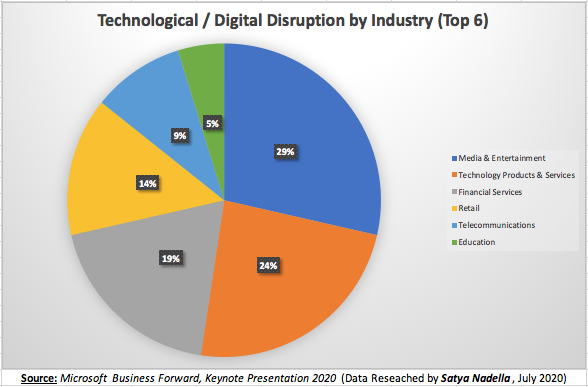
    While it’s commonly known that tech disruption is rapidly occurring, are you aware of which sectors of the US economy are being transformed the most? Initially presented in a Microsoft Business Forward forum, this research is key to assessing the sectors that need to gear up and prepare to deal with the newest technologies. The chart below substantiates just how much technological innovation and digital transformation are disrupting critical, traditional sectors within the nation’s economy.

    Top 6 Industries Impacted by Technological & Digital Disruption

    Microsoft: Top 6 Sectors Affected by Tech / Digital Disruption (Satya Nadella, 2020)

    PropTech addresses technological innovation specifically in the real estate segment. Moreover, you’ll notice that the Top 6 industries affected are most likely ones you come across in your everyday life. What does this mean for management, consumers, and the working class (specifically in these industries)? The article that complements Satya’s research shares a grim prognostication:

    “Digital disruption is well upon us. While a survey conducted by the Global Center for Digital Business Transformation for the large and mid-sized private sector companies agreed, to varying degrees, that digital disruption comes with its own set of benefits, it is also true that Digital Disruption is threatening the survival of many businesses and industries.

    Futuristic businesses and start-ups are exploring new avenues of re-inventing their business activities and industries all together to compete with and dislodge incumbents. The last decade alone has witnessed some exponential progress in technological disruption – think Airbnb, Paytm, Netflix and Uber.

    And this disruption is gradually influencing every industry, including banking, healthcare, hospitality, construction, manufacturing, packaging, logistics, and insurance amongst others (discussed in detail by Satya in Microsoft’s 2020 Keynote Forum).”

    Embee Staff

    Conclusion: What Does This Mean for Real Estate Investors?

    Succinctly, to have longevity in a given industry, the necessity for technological innovation has proven to be non-negotiable. Avoiding this reality will get you nowhere – or worse, out of business – quickly. As the abundance of digital and cloud transformation technologies are increasing, many are finding themselves playing catch-up. The information Microsoft presented suggests nearly all industries will be behind if they refuse to acknowledge technological progress. Not only acknowledge it, but make drastic changes, as necessary, to adapt alongside it.

    We’ve summarized the role technological innovation will play at length in the real estate market moving forward, specifically. Finally, ponder this. Imagine the impact to real estate markets, even globally, if critical industries and large corporations were to fall ‘behind-the-curve‘. What would this mean for CRE investors, who have continued to struggle as of late? The data study produced by Microsoft illustrates just how cataclysmic failures to adapt to new technologies – no matter the reason – can cause widespread fragility beyond the individual companies, or even those particular industry segments. It’s imperative to always look at the bigger picture. In this case, failure to adapt to new technologies will almost certainly cause broad, undesired consequences for investors.

  • The Future of Capital Markets Technology

    Capital Markets are where savings and investments are channeled between suppliers, people, or institutions with capital to lend or invest — as well as those in need (Hayes, Investopedia). Suppliers typically include banks and investors while those who seek capital are businesses, governments, and individuals. Capital markets are composed of primary and secondary markets.

    The most common capital markets are the stock market and the bond market. However other, more complex, markets include the CRE (Commercial Real Estate) Market, Equity Capital Market (ECM), as well as many others that are typically geared towards a specific investor. Therefore there is not as much trading volume or frequency, since the broader excitement is not the same. Even though real estate is the world’s largest asset class, we’ve seen a recent decline in CRE investment. Medium recently posted an article detailing the advantages of a platform called Beacon Platform, Inc, which was a critical, major acquisition for Centena.

    Medium: Modernizing the Capital Markets Technology Stack: Centana’s Investment in Beacon Platform, Inc.

    Why do customers choose Beacon?

    Time-to-Value and ROI. Today, companies continue to deal with cumbersome internal applications that have been stitched together, often with legacy code and/or 3rd party vendors in the Trading and Risk Management space, which are “black box” and difficult, if not impossible, to alter.

    Beacon’s entire code base is flexible and transparent (i.e. the code is made available to customers) and seamlessly integrates with existing software and other 3rd party solutions (like Murex and Calypso), or in-house proprietary solutions, which helps drive quick time-to-value and high utility.

    In a fraction of the time and cost of alternative solutions, Beacon has helped customers achieve objectives such as migrating workloads to the cloud, expanding into new markets, upgrading legacy code by placing it within a modern developer wrapper and extending analytics and applications to customers’ end-users.

    -Matt Alfieri
    Key Takeaways

    When it comes to capital markets technology, the evolving nature of the tech space all but ensures we will see new technologies introduced into capital markets operations. Additionally, while this may sound like an advertisement for Beacon (though FinYork has absolutely no affiliation to it), the critical feature to note is this is an exemplary illustration of where capital markets technology appears to be heading.

    Vertical SaaS or cloud industry solutions, instead of legacy or proprietary in-house solutions, are showing us that they’re easier to replace than many executives originally thought. You should expect to see a similar effect here as with PropTech, as it becomes more widely available and accepted by savvy executives and high net worth real estate investors. You definitely do not want to be the firm who is continuing to use antiquated capital markets technologies. This puts you at an immediate, huge disadvantage. It makes it that much harder to catch up with your competitors, who have a leg-up as they’ve already implemented innovative technologies.

    All this goes to say that SaaS, digital transformation, cloud technologies, PropTech, and even niche technologies that aim to improve efficiency in capital markets are going to play an integral part of the future. The success of firms who will adapt them largely depends on the success those firms will have in the implementation process. To be sure, capital markets technology is only going to continue getting more efficient, robust, and easier to adapt.

  • The Future of Capital Markets Technology

    Capital Markets are where savings and investments are channeled between suppliers, people, or institutions with capital to lend or invest — as well as those in need (Hayes, Investopedia). Suppliers typically include banks and investors while those who seek capital are businesses, governments, and individuals. Capital markets are composed of primary and secondary markets.

    The most common capital markets are the stock market and the bond market. However other, more complex, markets include the CRE (Commercial Real Estate) Market, Equity Capital Market (ECM), as well as many others that are typically geared towards a specific investor. Therefore there is not as much trading volume or frequency, since the broader excitement is not the same. Even though real estate is the world’s largest asset class, we’ve seen a recent decline in CRE investment. Medium recently posted an article detailing the advantages of a platform called Beacon Platform, Inc, which was a critical, major acquisition for Centena.

    Medium: Modernizing the Capital Markets Technology Stack: Centana’s Investment in Beacon Platform, Inc.

    Why do customers choose Beacon?

    Time-to-Value and ROI. Today, companies continue to deal with cumbersome internal applications that have been stitched together, often with legacy code and/or 3rd party vendors in the Trading and Risk Management space, which are “black box” and difficult, if not impossible, to alter.

    Beacon’s entire code base is flexible and transparent (i.e. the code is made available to customers) and seamlessly integrates with existing software and other 3rd party solutions (like Murex and Calypso), or in-house proprietary solutions, which helps drive quick time-to-value and high utility.

    In a fraction of the time and cost of alternative solutions, Beacon has helped customers achieve objectives such as migrating workloads to the cloud, expanding into new markets, upgrading legacy code by placing it within a modern developer wrapper and extending analytics and applications to customers’ end-users.

    -Matt Alfieri
    Key Takeaways

    When it comes to capital markets technology, the evolving nature of the tech space all but ensures we will see new technologies introduced into capital markets operations. Additionally, while this may sound like an advertisement for Beacon (though FinYork has absolutely no affiliation to it), the critical feature to note is this is an exemplary illustration of where capital markets technology appears to be heading.

    Vertical SaaS or cloud industry solutions, instead of legacy or proprietary in-house solutions, are showing us that they’re easier to replace than many executives originally thought. You should expect to see a similar effect here as with PropTech, as it becomes more widely available and accepted by savvy executives and high net worth real estate investors. You definitely do not want to be the firm who is continuing to use antiquated capital markets technologies. This puts you at an immediate, huge disadvantage. It makes it that much harder to catch up with your competitors, who have a leg-up as they’ve already implemented innovative technologies.

    All this goes to say that SaaS, digital transformation, cloud technologies, PropTech, and even niche technologies that aim to improve efficiency in capital markets are going to play an integral part of the future. The success of firms who will adapt them largely depends on the success those firms will have in the implementation process. To be sure, capital markets technology is only going to continue getting more efficient, robust, and easier to adapt.

  • What’s Holding Back PropTech?

    While PropTech has seen some growth in recent years, more so before the COVID-19 pandemic, we still haven’t seen the manifestation of the scale of technological revolution in the property industry we were once promised. The vast majority of buildings we come across in our daily lives are still operating in traditional ways, using outdated but proven equipment. Let’s dive into why we are yet to see the kind of transformative innovation we were expecting on a broader scale.

    Real estate is widely recognized as the world’s largest financial asset class. However, in today’s world, we often see companies rise to prominence before crashing and burning in a matter of a few short years. Most of the biggest corporations in the world today didn’t have a trace of existence 30 years ago. The real estate asset class could not be categorized more differently. It’s not only the largest asset class (by far), it’s also the oldest asset class (Hagerty, Propmodo). Historically, the property industry is a very slow, cautious sector. Unlike an App, such as Uber for example, buildings and other construction projects take many years from the design process to the completion of the physical structure. This is attributed partially to the reality that protecting buildings and the occupants inside them is paramount. In both the residential and commercial real estate sub-sectors, moving too fast and making a mistake that may lead to a potential building collapse is simply out of the question. Due to real estate’s conservative business model, even the most sophisticated PropTech products are having a difficult time gaining broad, large-scale traction (Hagerty, Propmodo).

    Ernst & Young’s Comprehensive PropTech Study

    An Ernst & Young (E&Y) survey recently found that 43% of those who provide PropTech products are majorly struggling with widespread adoption across a given client’s business. Additionally, the same research discovered that 35% of PropTech providers are seeing a very sizable lack of scaling, as a direct result of their application being adopted. Perhaps the biggest shock from this study is 39% of respondents are yet to adopt even a single PropTech tool.

    In addition to safety concerns, the attitude of business managers has been noted as a key opponent to PropTech’s success. Value in real estate is most frequently determined by three factors: 1) location, 2) size, and 3) finishes [amenities]. Reducing costs and increasing efficiency plays a major role in the construction industry, but we don’t typically see those same levels of concern in asset management. PropTech is actually attempting to change that. With the right technology, savings from efficiency, integration, and automation can start to pile up (Hagerty, Propmodo). Having the ability to tap into data generated by buildings is providing actionable insights that are too big of a potential game-changer to ignore. For individuals or companies that already have a real estate strategy in place, implementing innovative PropTech is only putting them further ahead of the pack. Executives, board members, and direct real estate investors alike clearly understand the need for PropTech. The biggest challenge remains in implementation.

    Conclusions Drawn From Ernst & Young’s Study

    We can conclude from the E&Y study that the remedy starts with ensuring the right people are in place. E&Y found 53 percent of real estate owners don’t feel they have the in-house talent to successfully adopt new technology. It’s worth taking a moment to let that sink in. More than half of executives, or very senior personnel in a position to make these decisions, are not confident in their own teams’ implementation ability. Without technology-minded talent and leadership, it’s hard to see the light at the end of the tunnel. Traditional real estate leadership has often been hesitant – or perhaps more precisely, even negligent – in scrapping outdated systems and processes they’ve relied on for decades. Again, PropTech aims to alter that mindset entirely. Leveraging technology is about focusing on future potential, rather than cost. There are undoubtedly sizable upfront costs associated with widespread PropTech adoption across a portfolio. What makes executives and board members in particular hesitant with implementing PropTech is the mindset about their obligation to stakeholders being centered around cost cutting. Why bother spending money “fixing something” that isn’t broken? Buildings are operating just fine without the need for any sweeping, technological overhaul. That’s the position traditional real estate leadership has taken; they are extremely hesitant to tolerate large capital expenditures on risky, bold technologies that don’t have a clear trajectory of return on investment. Succinctly, from the E&Y analysis we can clearly deduce that executives and board members need to ensure there are enough personnel focused on technology to help senior management understand there in fact is a return on investment from implementing various PropTech products. It’s not as clear-cut, but the long-term financial benefits are there.

    Again, referring back to the same E&Y data, almost 60% of real estate companies surveyed responded that they find new systems difficult to integrate with existing platforms. This is viewed as a further hinderance for executives because this translates to times and resources in order to get things set up, further disincentivizing them by piling on additional costs and additionally clouding the potential return on investment. The rapid pace of development and deployment is leading to piecemeal technology strategies instead of full end-to-end solutions, which is easier for leadership to recognize. As the PropTech industry matures, consolidations, acquisitions, and a wider array of products to service every aspect of portfolios could help solve some of those problems (Hagerty, Propmodo).

    “As investors begin to see the benefit of companies adopting technology, we believe they will help drive the industry forward more rapidly in the same way that investor pressure has encouraged companies to do more and report more on ESG related issues”.

    Mark Grinis, Ernst & Young Global Real Estate, Hospitality, & Construction Leader

    Perhaps an unpopular opinion, but some have compelling arguments that growing pains in PropTech industry is actually a good thing. The real estate industry was stagnating for decades, perhaps centuries. In a few short years, technology has worked its way into practically every executive conversation or board member meeting. With that being said, retrofitting existing buildings will not be a viable solution for every – or most – property owners.  Building technology into the bedrock of the property industry is a ground-up exercise, literally, which makes taking stock of progress that’s been made that much more important. That’s where PropTech comes in. There’s plenty of obstacles in the industry slowing down PropTech at the moment, but there’s no stopping it, especially it in the long-term as we’ve seen companies rapidly expand cloud and digital transformation technologies.