Category: FY Minute

Daily posts

  • NYC Real Estate Market Mid-2021: Are You Better Off Buying or Renting?

    Since New York City’s (NYC) real estate market is still experiencing a fresh post-COVID effect, you are better off buying if you have the money (and credit score). However, as is often the case, it greatly depends on your financial situation. Living in arguably the most desirable and expensive part of the world presents a financial burden to many younger adults, who are still working lower paying, entry level jobs.

    The majority of real estate property owners in New York City are of older age and in the highest income brackets (NYU Furman Center). Additionally, they are more likely to have permanent ownership of property in other locations (Goldstein, Property Nest).

    Many people view renting as ‘wasteful’ because you don’t have the benefit of acquiring equity in your property. However, the reality is for most young or middle-aged professionals, the economic opportunities – combined with the cost of living in New York City – don’t allow them to acquire enough requisite disposable income to put a down payment on a desirable apartment unit. This brings up a primary obstacle many residents of New York City see with buying a permanent unit: most people don’t view New York City as their ‘final destination’, long-term residence. In other words, when most people think about taking out a mortgage and buying a home, they’re thinking about a serious long-term commitment (emphasis on long-term). Raising kids, settling down in a permanent work situation, and finally retiring. The suburbs or a quiet town; not the most densely populated, most popular tourist destination in the world.

    While there are plenty of mechanisms available to individuals looking to get out of a 20 or 30-year mortgage after only a few years, logically, it would make sense for most to still prefer not to take on that kind of serious financial responsibility without the intent of staying in that location for a while.  

    With that being said, from the perspective of someone simply asking: “hey, would I be better off buying or renting in New York City?”, I would advise them to not be hesitant and buy if they have the money saved.

    The reason is two-fold. If you are going to live in the unit, at least initially, you’ll acquire equity simultaneously. If you find that NYC is not for you in a few years – as many inevitably do – current market prices and historic trends, combined with current rates and incentives, suggest one would be able to see a positive cash flow from subleasing or subletting their own property. Meaning, renters are consistently earning more monthly rent than their monthly mortgage payments. Alternatively, if you have no desire of becoming a landlord, contrary to ordinary homeowner’s beliefs, there is the ability to sell your mortgaged property and earn a profit. It’s extremely difficult to look at the recent data without considering the COVID-19 situation, but over a 10-year period prior to that, real estate prices were significantly increasing year-over-year.

    That’s largely why real estate became viewed as a very popular investment vehicle for financial investors. The figure below illustrates an average of New York housing prices over a 30-year period, between 1987 and 2018, from different housing market segments.

    Figure 1 – New York (NYC) Housing Market Prices (1987-2018) Overview
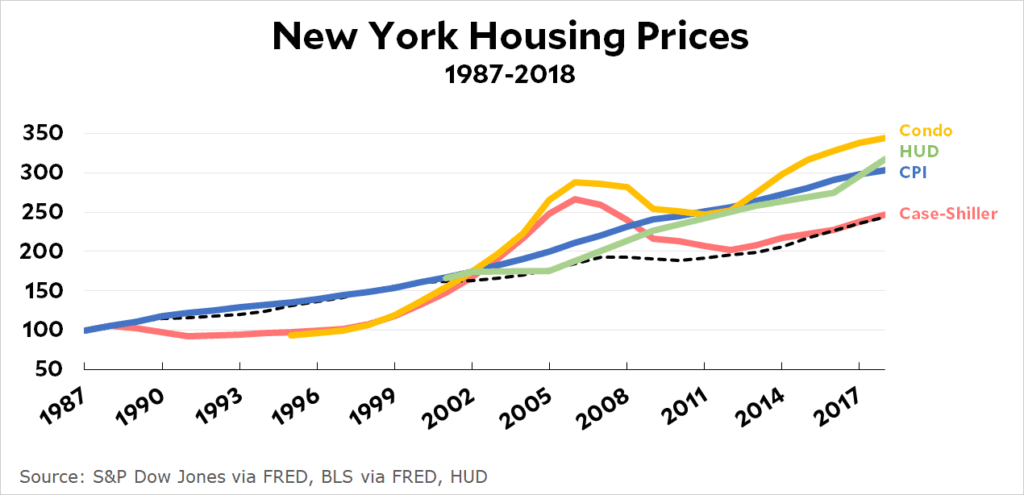
    As one can see, prices went up across the board mostly every year, with the exception of a rocky period in the midst of the Great Recession of 2008. Therefore, having more ownership/equity in a property that’s also going to increase in value over time is a no brainer, even if you choose to move out of that property prior to paying off your mortgage.


  • NYC Real Estate Market Mid-2021: Are You Better Off Buying or Renting?

    Since New York City’s (NYC) real estate market is still experiencing a fresh post-COVID effect, you are better off buying if you have the money (and credit score). However, as is often the case, it greatly depends on your financial situation. Living in arguably the most desirable and expensive part of the world presents a financial burden to many younger adults, who are still working lower paying, entry level jobs.

    The majority of real estate property owners in New York City are of older age and in the highest income brackets (NYU Furman Center). Additionally, they are more likely to have permanent ownership of property in other locations (Goldstein, Property Nest).

    Many people view renting as ‘wasteful’ because you don’t have the benefit of acquiring equity in your property. However, the reality is for most young or middle-aged professionals, the economic opportunities – combined with the cost of living in New York City – don’t allow them to acquire enough requisite disposable income to put a down payment on a desirable apartment unit. This brings up a primary obstacle many residents of New York City see with buying a permanent unit: most people don’t view New York City as their ‘final destination’, long-term residence. In other words, when most people think about taking out a mortgage and buying a home, they’re thinking about a serious long-term commitment (emphasis on long-term). Raising kids, settling down in a permanent work situation, and finally retiring. The suburbs or a quiet town; not the most densely populated, most popular tourist destination in the world.

    While there are plenty of mechanisms available to individuals looking to get out of a 20 or 30-year mortgage after only a few years, logically, it would make sense for most to still prefer not to take on that kind of serious financial responsibility without the intent of staying in that location for a while.  

    With that being said, from the perspective of someone simply asking: “hey, would I be better off buying or renting in New York City?”, I would advise them to not be hesitant and buy if they have the money saved.

    The reason is two-fold. If you are going to live in the unit, at least initially, you’ll acquire equity simultaneously. If you find that NYC is not for you in a few years – as many inevitably do – current market prices and historic trends, combined with current rates and incentives, suggest one would be able to see a positive cash flow from subleasing or subletting their own property. Meaning, renters are consistently earning more monthly rent than their monthly mortgage payments. Alternatively, if you have no desire of becoming a landlord, contrary to ordinary homeowner’s beliefs, there is the ability to sell your mortgaged property and earn a profit. It’s extremely difficult to look at the recent data without considering the COVID-19 situation, but over a 10-year period prior to that, real estate prices were significantly increasing year-over-year.

    That’s largely why real estate became viewed as a very popular investment vehicle for financial investors. The figure below illustrates an average of New York housing prices over a 30-year period, between 1987 and 2018, from different housing market segments.

    Figure 1 – New York (NYC) Housing Market Prices (1987-2018) Overview

    As one can see, prices went up across the board mostly every year, with the exception of a rocky period in the midst of the Great Recession of 2008. Therefore, having more ownership/equity in a property that’s also going to increase in value over time is a no brainer, even if you choose to move out of that property prior to paying off your mortgage.

  • CRE Investing Through CrowdStreet

    CrowdStreet™ is an up-and-coming type of crowdfunding website that’s tailored specifically to CRE (Commercial Real Estate) investors. Founded in 2013, the site pairs thousands of investors on their marketplace and pools their money to invest in different CRE properties. The benefits that CrowdStreet claims to provide are: low cost, institutional quality real estate investments that have lower fees than REITs and only include pre-vetted projects.

    As of June 19th, 2021, CrowdStreet has completed 488 deals, raised $1.9B in capital, and returned $197M of investor distributions (www.CrowdStreet.com). With new deals launching every week, the CrowdStreet marketplace is also unique because it gives prospective investors the following three (3) projections on each CRE investment: (1) Targeted Investor IRR, (2) Targeted Equity Multiple, and (3) Targeted Investment Period. Keeping in mind these are all pre-vetted projects, this allows prospective investors to pick from multiple properties based on the attributes that are geared towards their goals.

    Since there are many different types of real estate crowdfunding websites, CrowdStreet in particular distinguishes itself because they target CRE properties specifically. They then break-down individual prospective gains, equity multiples, and the period the investor will have their capital tied up. This allows investors to see a clearer overview of their investment return potential and the amount of time their capital will be utilized for the CRE investment, so they can make more informed decisions, as well as better manage the risk of their overall portfolio. But there’s a catch. While CrowdStreet is continuing to grow along with their user base, an investor account minimum must be $25,000 and the platform is only available to accredited investors. For seasoned CRE investors, that may not be as big of a problem. However, for the average qualifying CRE investor, CrowdStreet’s business model is viewed as highly illiquid.

    Overall, while CrowdStreet offers distinct advantages to CRE investors, its limitations prevent it from reaching a wider audience. Clearly that’s their intention, but perhaps some of the requirements limit the potential success of their offerings. For example, if a non-accredited investor has a higher risk tolerance and is willing to invest the minimum amount, the CRE project may not get financing because that investor wouldn’t be accepted on CrowdStreet. Similarly, if an accredited investor is more risk averse, or is not in a position to immediately invest $25,000 in a given project over a period of years, there is no middle-ground and again, the CRE project may not receive financing. Concisely, within the limited scope of their business model, there is more CrowdStreet can do to broaden their user base and thereby pave the way for more CRE projects to receive financing.

  • Why Real Estate Investors Refer to Real Estate as an I.D.E.A.L. Investment

    Many real estate investors are familiar with the acronym ‘I.D.E.A.L. Investment’ in the context of real estate investing (Chad Carson, Coach Carson). This acronym is a great, succinct explanation for why real estate is preferred by many investors to other vehicles like dividend stocks, bonds, small businesses, index funds, bank certificate of deposits, annuities, and more.

    Income

    Real estate properties provide excellent cash flow on a regular (typically a monthly) basis and the income size can be quite substantial, depending on your properties’ interest rate, unpaid principal, and property value. This is the primary objective of any investor, which makes real estate a top choice for many. If you aren’t seeing much or any cash flow from an investment, especially after a lengthy period of time, typically it’s not a very successful one.

    Depreciation

    Another big advantage to real estate investing was actually made widely known by Donald Trump in the 2016 presidential campaign; depreciation. Depreciation occurs because for residential buildings, the U.S. government requires real estate investors to spread out most of the cost of real estate purchases over 27.5 years. This creates an annual depreciation expense, which can provide incredible tax benefits. This ‘expense’ doesn’t come out of your bank account, like purchasing materials to sell products, or insurance/maintenance costs. Instead it’s absorbed ‘on paper’ and you see real financial benefits in the form of tax relief.

    Equity

    Generally for real estate investors, as time goes on the more equity they’ll acquire in their own properties by repaying loans, which is directly linked to greater overall wealth. The shorter it takes you to pay off your own financial obligations on a property, the larger your ROI will be. Additionally, you’ll be able to optimize the length of time you’ll see financial benefits from that investment. While it may depend on your financial situation and the real estate market climate, real estate investing is a great way to acquire equity and see positive cash flow simultaneously.

    Appreciation

    Appreciations refers to the idea that your property value is supposed to increase each year. As we’ve seen in recent years, this may not necessarily be the case (primarily due to unpredictable circumstances). However, long-term investors (who comprise a very large segment of real estate investors) are satisfied with the long-term average of property values visibly pointing towards an upward trajectory.

    Leverage

    Leverage can refer to two distinct advantages of real estate investing. Firstly, some indicate this means the initial incurrence of debt leading to equity growth over time (this appears to be covered by ‘Appreciation’). Secondly, leverage can more commonly refer to the idea of using other people’s money (OPM) to earn a positive cash flow. This gives investors the opportunity to use relatively small amounts of cash upfront to gain control over multiple investment properties and earn returns on cash invested. This method isn’t typically used by passive investors, who would be concerned with over-leveraging and what could happen if there was a steep decline in the housing market.  

  • What the COVID-19 Vaccine Means for NYC’s Real Estate Market (May 2021)

    What the COVID-19 Vaccine Means for NYC’s Real Estate Market (May 2021)

    As of the beginning of May 2021, in New York City 48.9% of New Yorkers have received one dose of the COVID-19 vaccine, while 37% have been fully vaccinated. This coverts to 7.19 million people fully vaccinated, compared to approximately 106 million nationwide, or 32.3% of America’s total population. Though the vaccinations have slowed down from their initial surge in NYC, their apparent effects on the real estate market were what sellers and renters were hoping for.

    The relatively mass availability of vaccinations seemed to provide a sense of stability to the real estate market in NYC; renters and sellers appear to now be able to gauge price and demand more easily. Additionally, according to Realtors, both average prices for rentals and sales in NYC have continued to rise these first five months of 2021, as the COVID-19 vaccinations became more and more available. In almost all prestigious NYC locations, studio apartments are now consistently renting for over $2500 per month and 1-bedroom apartments are averaging close to $3500 per month. These are more like the numbers we witnessed prior to the COVID-19 pandemics and prior to the moratoriums issued by the State of New York and City of Manhattan, which undoubtedly temporarily created downward pricing in the NYC real estate rental market.

    Other housing statistics from Realtors offer the same conclusion: the stability of real estate prices in NYC have certainly increased by an upward trajectory. Steven James, President and CEO of Douglas Elliman, said there will be an immediate increase in activity once the vaccine is approved. He hinted that the best “opportunity is now” for prospective real estate investors because prices will only continue to increase proportionate to the amount of New Yorkers and Americans who get fully vaccinated. George Ratiu, a senior economist at Realtors, echoed Steven’s point by predicting “a gradual shift over the next six to eight months” in rising real estate prices in NYC.

  • What the COVID-19 Vaccine Means for NYC’s Real Estate Market (May 2021)

    What the COVID-19 Vaccine Means for NYC’s Real Estate Market (May 2021)

    As of the beginning of May 2021, in New York City 48.9% of New Yorkers have received one dose of the COVID-19 vaccine, while 37% have been fully vaccinated. This coverts to 7.19 million people fully vaccinated, compared to approximately 106 million nationwide, or 32.3% of America’s total population. Though the vaccinations have slowed down from their initial surge in NYC, their apparent effects on the real estate market were what sellers and renters were hoping for.

    The relatively mass availability of vaccinations seemed to provide a sense of stability to the real estate market in NYC; renters and sellers appear to now be able to gauge price and demand more easily. Additionally, according to Realtors, both average prices for rentals and sales in NYC have continued to rise these first five months of 2021, as the COVID-19 vaccinations became more and more available. In almost all prestigious NYC locations, studio apartments are now consistently renting for over $2500 per month and 1-bedroom apartments are averaging close to $3500 per month. These are more like the numbers we witnessed prior to the COVID-19 pandemics and prior to the moratoriums issued by the State of New York and City of Manhattan, which undoubtedly temporarily created downward pricing in the NYC real estate rental market.

    Other housing statistics from Realtors offer the same conclusion: the stability of real estate prices in NYC have certainly increased by an upward trajectory. Steven James, President and CEO of Douglas Elliman, said there will be an immediate increase in activity once the vaccine is approved. He hinted that the best “opportunity is now” for prospective real estate investors because prices will only continue to increase proportionate to the amount of New Yorkers and Americans who get fully vaccinated. George Ratiu, a senior economist at Realtors, echoed Steven’s point by predicting “a gradual shift over the next six to eight months” in rising real estate prices in NYC.

  • Bitcoin and Other Cryptocurrencies Tumble as China Issues Crackdown Statement

    Bitcoin and Other Cryptocurrencies Tumble as China Issues Crackdown Statement

    This past Friday May 21st, 2021, Bitcoin and other cryptocurrencies crashed as a result of China’s statement that same day, cracking down on Bitcoin mining and trading of cryptocurrencies. Chinese Vice Premier Liu He and the State Council issued a statement citing concerns over the cryptocurrencies mining and trading risks to China’s national economy. The statement, which was released late Friday in China, said it is necessary to “crack down on Bitcoin mining and trading behavior, and resolutely prevent the transmission of individual risks to the social field.” Bitcoin’s price on Coin Metrics slid more than 8.5% as news of the statement circulated, part of a broader plunge that has seen the digital currency tumble more than 40% from its peak.

    Additionally, China’s rhetoric on Bitcoin comes just a day after U.S. officials pledged to get tough on those using bitcoin to conduct “illegal activity broadly including tax evasion.” Following that announcement, the Treasury Department said it will require reporting on crypto transfers of more than $10,000, just as with cash (Jeff Cox, CNBC).

    But the concerns specifically in China stemmed from a number of issues, surprisingly the number one likely being related to energy. Much of bitcoin mining is done there by computer that use massive amounts of energy to solve complex math problems to unlock the cryptocurrency. Additionally, those same Chinese financial authorities raised similar concerns to the Treasury Department, regarding the use of the cryptocurrency as a mechanism to make money in illicit ways. Their statement went on to say, “It is necessary to maintain the smooth operation of the stock, debt, and foreign exchange markets, severely crack down on illegal securities activities, and severely punish illegal financial activities”. However, it’s important to note, as part of an effort to enter the booming digital currency space, China’s central bank has been one of the first in the world to develop its own digital currency backed by the yuan.

  • Bitcoin and Other Cryptocurrencies Tumble as China Issues Crackdown Statement

    Bitcoin and Other Cryptocurrencies Tumble as China Issues Crackdown Statement

    This past Friday May 21st, 2021, Bitcoin and other cryptocurrencies crashed as a result of China’s statement that same day, cracking down on Bitcoin mining and trading of cryptocurrencies. Chinese Vice Premier Liu He and the State Council issued a statement citing concerns over the cryptocurrencies mining and trading risks to China’s national economy. The statement, which was released late Friday in China, said it is necessary to “crack down on Bitcoin mining and trading behavior, and resolutely prevent the transmission of individual risks to the social field.” Bitcoin’s price on Coin Metrics slid more than 8.5% as news of the statement circulated, part of a broader plunge that has seen the digital currency tumble more than 40% from its peak.

    Additionally, China’s rhetoric on Bitcoin comes just a day after U.S. officials pledged to get tough on those using bitcoin to conduct “illegal activity broadly including tax evasion.” Following that announcement, the Treasury Department said it will require reporting on crypto transfers of more than $10,000, just as with cash (Jeff Cox, CNBC).

    But the concerns specifically in China stemmed from a number of issues, surprisingly the number one likely being related to energy. Much of bitcoin mining is done there by computer that use massive amounts of energy to solve complex math problems to unlock the cryptocurrency. Additionally, those same Chinese financial authorities raised similar concerns to the Treasury Department, regarding the use of the cryptocurrency as a mechanism to make money in illicit ways. Their statement went on to say, “It is necessary to maintain the smooth operation of the stock, debt, and foreign exchange markets, severely crack down on illegal securities activities, and severely punish illegal financial activities”. However, it’s important to note, as part of an effort to enter the booming digital currency space, China’s central bank has been one of the first in the world to develop its own digital currency backed by the yuan.

  • Home Prices Continue to Soar, Are We Headed for Another Housing Market Bubble?

    Nearly all experts predict we are not. Here’s Frank Martell, President, and CEO of CoreLogic.

    With prospective buyers continuing to be motivated by historically low mortgage rates, we anticipate sustained demand in the summer and early fall…

    Additionally, housing market investors don’t perceive there to be many similarities to the 2008 housing market crash. The bottom line is no one has any real concerns about a sudden drop in prices as home price statistics, provided by Forbes, show consistent month-to-month increases in prices.

    Greg McBride, the chief financial analyst at Bankrate.com, told Forbes that although home prices are climbing, any perceived similarities to the housing bubble and crash of 2006-2008 are yet premature:

    The [current] rise in prices is a byproduct of a severe imbalance between supply and demand, not the ‘loosey, goosey,’ anything-goes lending that so was so prevalent in the [2006-2008] housing bubble

    McBride also points out that, unlike the 2006-2008 period, lending standards have greatly tightened. Banks are now only lending to the most creditworthy mortgage customers, suggesting a price crash is probably not in the cards. But McBride warns that if lending standards loosen again and “we see the [excessive lending] practices we saw from 2004-2006, then all bets are off.”

    Frank Nothaft, the chief economist for CoreLogic, told Forbes that subprime borrowers are now “largely absent” from the mortgage market. The subprime borrowers were partly to blame for the prior housing meltdown. The list of experts with similar beliefs that the housing crash is not imminent is extremely long. They don’t believe there is anything close to a repeat of 2008 in the near future. Only time will tell.

  • How big is the real estate sector in S&P 500?

    Commercial Real Estate (CRE) Investor Question #91: How big is the real estate sector in S&P 500?

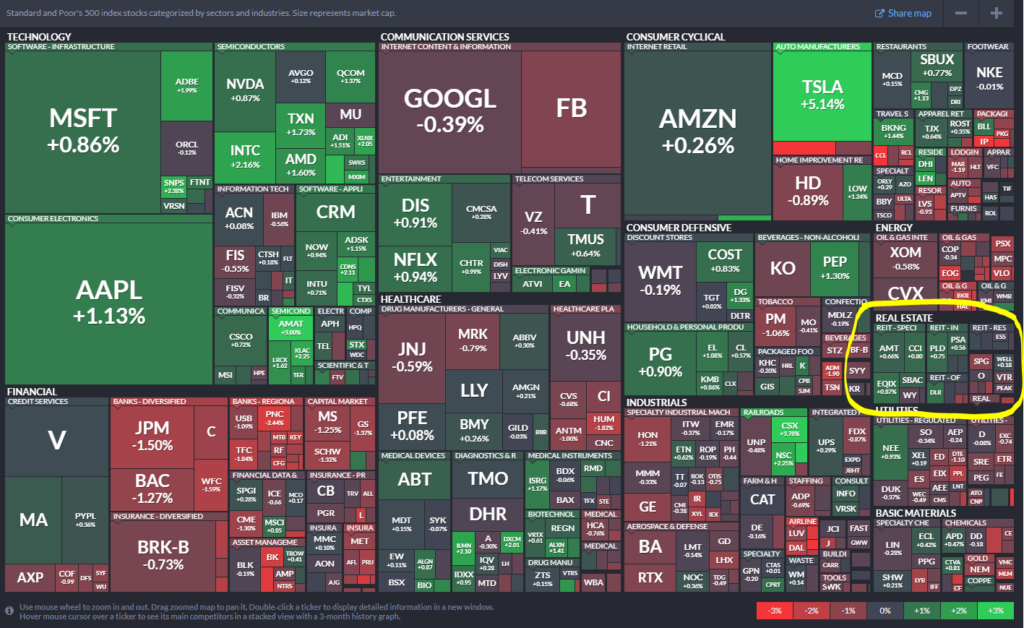
    The following illustration gives an idea of the size of the real estate sector (circled in yellow) within the S&P 500. Going by market size, it is one of the smallest sectors in S&P 500 as of March 2021. Technology is the biggest sector. The real estate sector consists of REITs across multiple property types like Industrial, Multifamily, Office, etc.

    Source: Finviz S&P 500 composition and the Real Estate sector