Category: FY Minute

Daily posts

  • Rental Yield vs. Cap Rate?

    Commercial Real Estate (CRE) Investor Question #90: What is the difference between rental yield and cap rate?

    Rental yield is the net amount of money a landlord receives in rent over one year (after deducting operating expenses), shown as a percentage of the amount of money invested in the property.

    So, Rental Yield = (Net Annual Rental Income / Cost) X 100

    Note that rental yield is calculated on Net Operating Income without considering interest payment, tax and depreciation.

    Cap rate (or capitalization rate) is the ratio between the net operating income produced by a real estate asset and its cost (or current market value).

    So, Cap Rate = Net Operating Income / Value (or cost)

    If you notice, both rental yield and cap rate appears to be same!

    Rental yield is used to calculate the yield (return) of an asset whereas the cap rate is used to find the value (capitalized value) of an income generating real estate asset.

    Source: https://www.feasibility.pro/real-estate-analyst-interview-questions-answers/
  • Rental Yield vs. Cap Rate?

    Commercial Real Estate (CRE) Investor Question #90: What is the difference between rental yield and cap rate?

    Rental yield is the net amount of money a landlord receives in rent over one year (after deducting operating expenses), shown as a percentage of the amount of money invested in the property.

    So, Rental Yield = (Net Annual Rental Income / Cost) X 100

    Note that rental yield is calculated on Net Operating Income without considering interest payment, tax and depreciation.

    Cap rate (or capitalization rate) is the ratio between the net operating income produced by a real estate asset and its cost (or current market value).

    So, Cap Rate = Net Operating Income / Value (or cost)

    If you notice, both rental yield and cap rate appears to be same!

    Rental yield is used to calculate the yield (return) of an asset whereas the cap rate is used to find the value (capitalized value) of an income generating real estate asset.

    Source: https://www.feasibility.pro/real-estate-analyst-interview-questions-answers/
  • Is real estate a good hedge against inflation?

    Commercial Real Estate (CRE) Investor Question #89: Is real estate / housing a good hedge against inflation?

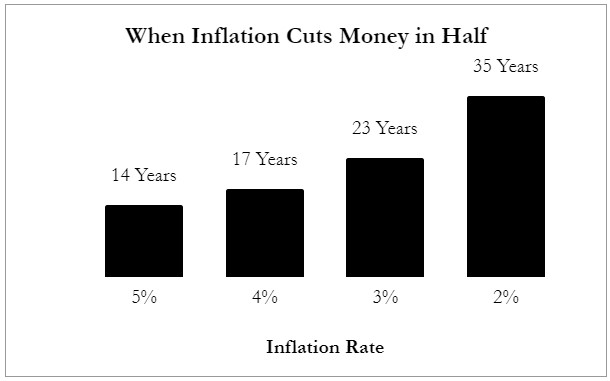
    Yes, real estate or housing is a good hedge against inflation. Ben Carlson, a popular portfolio manager has an in-depth article on this question. Here’s a picture from his book on how inflation “destroys” wealth. On the flip side, having a mortgage can help counteract those interest payments over time.

    Source: https://awealthofcommonsense.com/2021/03/why-housing-is-a-good-hedge-against-inflation/
  • Property Valuation and Methods?

    Commercial Real Estate (CRE) Investor Question #88: What are the key elements of property value? What are the top valuation methods?

    Real Estate Property Value consists of the following key elements:

    Demand: the desire or need for ownership supported by the financial means to satisfy the desire.

    Utility: the ability to satisfy future owners’ desires and needs.

    Scarcity: the finite supply of competing properties.

    Transferability: the ease with which property ownership rights are transferred.

    Source: Reonomy

    The key methods of property valuation, some of which we’ve seen earlier, are:

    • Income Approach – Based on income generated by the property
    • Sales Comparision Method – Based on comparable (comps) property sales
    • Cost Method – Based on the cost of building

    A detailed article on the above methods is available at Reonomy!

  • How to invest in REITs?

    Commercial Real Estate (CRE) Investor Question #87: I would like to get exposure to real estate asset class through REITs. Where do I start?

    We’ve seen that REITs or REIT funds are a popular way to invest in real estate as they behave like stocks and can be bought through various brokerages. Many of the brokerages (for e.g. Fidelity, Merrill, Charles Schwab et.) also provide material and research on REITs as they do for stocks of companies.

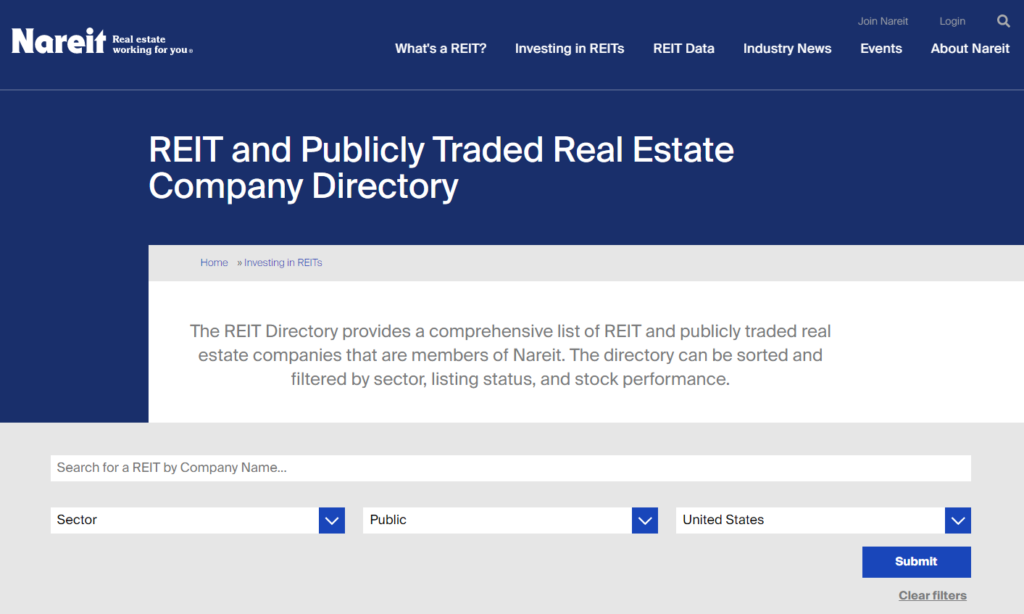
    You can research and trade with your brokerage. Another great resource to understand the world of REITs is Nareit. It provides a listing or directory of REITs and you can search and research based on various criteria as shown below.

    Source: Nareit

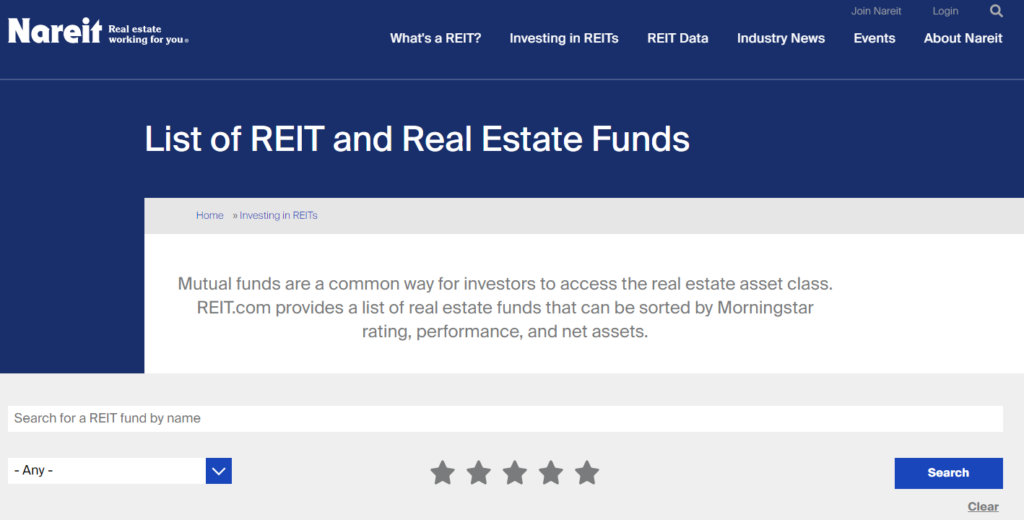
    Nareit also provides a list of REIT funds in addition to various other resources to get started with your research.

    Source: https://www.reit.com/investing/reit-funds
  • What is Preferred Equity?

    Commercial Real Estate (CRE) Investor Question #86: What is preferred equity and should I invest in preferred equity?

    We’ve seen the CRE capital stack in a previous post and how preferred equity is a part of it. We’ve seen that preferred equity is a debt/equity hybrid that resides in the third position of the capital stack.  It is more senior than common equity but less senior than all forms of debt (Senior and Mezzanine).

    It is important to understand the risk and characteristics of preferred equity compared to the rest of the stack. PropertyMetrics explains preferred equity in detail and compares it to the rest of the capital stack.

    Risk level, repayment prioritization, and return expectations:

    Risk Level:Medium – High
    Repayment Prioritization:3rd
    Return Expectations:8% – 10% + “Kicker”
    Source: https://propertymetrics.com/blog/capital-stack/

    Characteristics of Preferred Equity

    Further explanation of preferred equity can be found in the same article. We highly recommend going through the entire article and getting familiar with the capital stack and preferred equity in particular.

    Preferred equity serves a similar function to mezzanine debt in that it is meant to fill the gap between senior debt and common equity

    In return for the risk associated with making a preferred equity investment, the investor is compensated with a steady return in the form of annual payments (like debt) as well as an opportunity to participate in the upside of the project should it meet certain performance goals (like equity).  

    The performance goals are clearly outlined in the investment contract and typically establish a threshold, above which an equity “kicker” allows the preferred equity holder to participate in additional profits.

    Source: https://propertymetrics.com/blog/capital-stack/


  • What is Preferred Equity?

    Commercial Real Estate (CRE) Investor Question #86: What is preferred equity and should I invest in preferred equity?

    We’ve seen the CRE capital stack in a previous post and how preferred equity is a part of it. We’ve seen that preferred equity is a debt/equity hybrid that resides in the third position of the capital stack.  It is more senior than common equity but less senior than all forms of debt (Senior and Mezzanine).

    It is important to understand the risk and characteristics of preferred equity compared to the rest of the stack. PropertyMetrics explains preferred equity in detail and compares it to the rest of the capital stack.

    Risk level, repayment prioritization, and return expectations:

    Risk Level:Medium – High
    Repayment Prioritization:3rd
    Return Expectations:8% – 10% + “Kicker”
    Source: https://propertymetrics.com/blog/capital-stack/

    Characteristics of Preferred Equity

    Further explanation of preferred equity can be found in the same article. We highly recommend going through the entire article and getting familiar with the capital stack and preferred equity in particular.

    Preferred equity serves a similar function to mezzanine debt in that it is meant to fill the gap between senior debt and common equity

    In return for the risk associated with making a preferred equity investment, the investor is compensated with a steady return in the form of annual payments (like debt) as well as an opportunity to participate in the upside of the project should it meet certain performance goals (like equity).  

    The performance goals are clearly outlined in the investment contract and typically establish a threshold, above which an equity “kicker” allows the preferred equity holder to participate in additional profits.

    Source: https://propertymetrics.com/blog/capital-stack/


  • Risks faced by a CRE Investor?

    Commercial Real Estate (CRE) Investor Question #85: What are the various risks faced by a CRE investor?

    Investing is all about risk vs reward and managing the risk to protect capital and returns. It is true for Commercial Real Estate (CRE) investing as well. Here are the major risks faced by a CRE investor:

    • Market Risk
    • Property Risk
    • Credit and Debt Risk
    • Liquidity Risk

    A detailed description of the above is available at Embroker’s real estate risk managment blog.

  • Does Preferred Return matter?

    Commercial Real Estate (CRE) Investor Question #83: What is Preferred Return and does it matter?

    Preferred return is part of a distribution waterfall in real estate private equity. We’ve seen earlier that a Distribution Waterfall refers to the way in which profits are allocated between the participants – sponsors and Limited Partners – in an investment.

    Preferred return is a key component of the distribution waterfall and its main purpose is to align incentives between the sponsor and limited partners(LPs). Let us take an example from EquityMultiple, a popular funding website:

    In this arrangement, the investor will receive a preferred return before any capital is returned to the sponsor; the investor will receive profits up to a predefined percentage rate of return. Let’s look at our Bushwick Mixed-Use Redevelopment Project. The order of profit distribution is as follows:

    1) 100% pro rata to investors (including the Sponsor and LPs) until they have received a cumulative 10% preferred return

    2) Return of investor capital contributions, pro rata

    3) 30% to the sponsor and 70% to investors (including the Sponsor, such that the Sponsor receives a share of the 70% in addition to their 30%)

    Source: https://www.equitymultiple.com/blog/commercial-real-estate-practice/preferred-return

    Preferred return aligns the sponsor to the LPs i.e. the sponsors won’t get any extra profit until a certain threshold is met. In the above example, both sponsors and LPs will equally share the profits until 10%. After that sponsors, will take an extra percentage of the profits (also called promote) which can be an incentive for them to perform better. For LPs, preferred return is always better than no preferred return for a given a deal, all other parameters being the same.

  • Holding Period Returns by Property Type?

    Commercial Real Estate (CRE) Investor Question #82: Can you compare Holding Period Returns by Property Type?

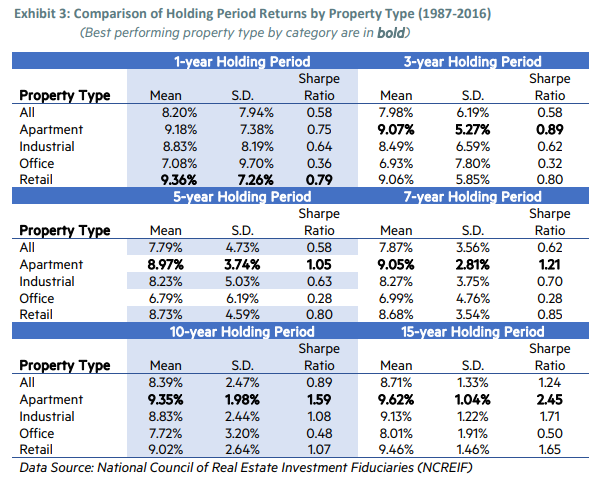
    National Multifamily Housing Council (NMHC) has done a comprehensive study on the holding period returns of key property types. The primary data source for this research is the MSA-level NPI data which includes quarterly property income and appreciation returns for the period 1978-2Q 2017. The NPI is a total return index of privately held commercial real estate properties owned by tax-exempt institutional investors. NPI returns are reported on an unlevered basis.

    Summary is as follows, again the returns are based on an unlevered basis: