Category: Ideas

Round up of investing ideas and insights that we can actually put to use to invest.

  • What is a Prime Brokerage and Who Uses Their Services?

    A prime brokerage is a bundled group of services offered by investment banks and other financial institutions. Investment banks may offer these services to hedge funds and other large investment clients that have a need to be able to borrow securities (or cash), in order to engage in “netting” to achieve “absolute returns”.

    What is Netting?

    Netting refers to offsetting the value of multiple positions, or payments, due to be exchanged between two or more parties. Typically, it’s used to determine which party is owed compensation in a multiparty contract.  Additionally, utilized as a method of reducing risks in financial contracts by combining or aggregating multiple financial obligations to arrive at a net obligation amount. Netting reduces settlement, credit, and other financial risks between two or more parties.

    What is an Absolute Return?

    An absolute return indicates the return an asset receives over a specific period. This measure looks at the appreciation/depreciation that an asset – such as a stock or mutual fund – has achieved over time. Absolute returns differ from relative returns in that there’s no benchmark comparison. The absolute return is concerned with the return of that specific asset over a period of time. An easier way to think of an absolute return is by its other reference, total return. Therefore, the gain or loss of an asset or portfolio is measured independent of any other standard. Absolute returns may be positive or negative and they may also bear no correlation to other market activities.

    Who Typically Utilizes Prime Brokerage Services and Who Provides Them?

    Hedge funds would amongst the first category of prime brokerage clients. Legally, clients may not access prime brokerage services for less than $500,000 in equity, even though it’s typical for clients to have over $50M in equity. High net worth private investors are another popular category of prime brokerage clients.

    On the other hand, prime brokerage services are generally offered by large investment banks. These institutions benefit from economies of scale to bundle multiple financial service offerings with more efficiency, at a cheaper cost. Some of the most notable firms who offer prime brokerage services include Goldman Sachs, BAML, JPMC, Citigroup, and BNY Mellon. Services bundled include largely “back office” tasks like asset custody, financial reporting, cash/securities lending, investor introductions, and risk consulting.

    Historically, Goldman Sachs has been known as the most reputable prime brokerage. However, their prime brokerage agreements are such that smaller hedge funds would have difficulty meeting their expected capital requirements. More recently, Pershing – an elite BNY Mellon subsidiary – has become the backbone of the prime brokerage street business. Combining the custodial services BNY Mellon is renowned for, with Pershing’s uniquely skilled investments and alternatives specialists, gives the duo a unique marketing position within the prime brokerage business. Pershing’s “prime services” are highlighted by risk management consulting. Additional offerings include securities lending, financing solutions, trade execution, technology, liquid alternative investments, and more. Within the alternative investment niche, which is extremely frequently accessed by hedge funds, Pershing has built an impeccable reputation.

  • What is a Prime Brokerage and Who Uses Their Services?

    A prime brokerage is a bundled group of services offered by investment banks and other financial institutions. Investment banks may offer these services to hedge funds and other large investment clients that have a need to be able to borrow securities (or cash), in order to engage in “netting” to achieve “absolute returns”.

    What is Netting?

    Netting refers to offsetting the value of multiple positions, or payments, due to be exchanged between two or more parties. Typically, it’s used to determine which party is owed compensation in a multiparty contract.  Additionally, utilized as a method of reducing risks in financial contracts by combining or aggregating multiple financial obligations to arrive at a net obligation amount. Netting reduces settlement, credit, and other financial risks between two or more parties.

    What is an Absolute Return?

    An absolute return indicates the return an asset receives over a specific period. This measure looks at the appreciation/depreciation that an asset – such as a stock or mutual fund – has achieved over time. Absolute returns differ from relative returns in that there’s no benchmark comparison. The absolute return is concerned with the return of that specific asset over a period of time. An easier way to think of an absolute return is by its other reference, total return. Therefore, the gain or loss of an asset or portfolio is measured independent of any other standard. Absolute returns may be positive or negative and they may also bear no correlation to other market activities.

    Who Typically Utilizes Prime Brokerage Services and Who Provides Them?

    Hedge funds would amongst the first category of prime brokerage clients. Legally, clients may not access prime brokerage services for less than $500,000 in equity, even though it’s typical for clients to have over $50M in equity. High net worth private investors are another popular category of prime brokerage clients.

    On the other hand, prime brokerage services are generally offered by large investment banks. These institutions benefit from economies of scale to bundle multiple financial service offerings with more efficiency, at a cheaper cost. Some of the most notable firms who offer prime brokerage services include Goldman Sachs, BAML, JPMC, Citigroup, and BNY Mellon. Services bundled include largely “back office” tasks like asset custody, financial reporting, cash/securities lending, investor introductions, and risk consulting.

    Historically, Goldman Sachs has been known as the most reputable prime brokerage. However, their prime brokerage agreements are such that smaller hedge funds would have difficulty meeting their expected capital requirements. More recently, Pershing – an elite BNY Mellon subsidiary – has become the backbone of the prime brokerage street business. Combining the custodial services BNY Mellon is renowned for, with Pershing’s uniquely skilled investments and alternatives specialists, gives the duo a unique marketing position within the prime brokerage business. Pershing’s “prime services” are highlighted by risk management consulting. Additional offerings include securities lending, financing solutions, trade execution, technology, liquid alternative investments, and more. Within the alternative investment niche, which is extremely frequently accessed by hedge funds, Pershing has built an impeccable reputation.

  • Corporate Actions – Dividend Arbitrage – Cumex “Cum-Ex” Transaction Litigation

    Corporate Actions are well defined by Investopedia. A corporate action is any activity that brings material change to an organization and impacts its stakeholders, including shareholders, both common and preferred, as well as bondholders. When a publicly traded company issues a corporate action, they are initiating a process that directly affects the securities issued by that company. Therefore, the board of directors is generally always involved, with shareholder involvement sometimes even required. In the event of a major takeover possibility, for example, shareholders may be required to submit a response giving their input. After researching, it seems the most common corporate actions can be condensed into dividends, stock splits, mergers, acquisitions, and spinoffs.

    According to Institutional investor, BNY Mellon has been the largest custodian in the world for the last 8 years. Given that fact, corporate actions can be of particular interest to them. Again, due to their custodianship business, one can imagine how a poorly executed or thought-out take-over, for example, could affect not only the entire company, but furthermore spread to other very large investment institutions, brokerages, hedge funds, etc. that would otherwise be solvent.

    What is Dividend Arbitrage?

    Options traders in the tri-party repo market would also be familiar with dividend arbitrage. Dividend arbitrage is an arbitrage strategy that may seem complex, but once you break it down it’s relatively straightforward. To understand this strategy, you first need to understand an ex-dividend date. Secondly, I would point out this strategy is typically exercised by options traders. The arbitrage occurs whereby, the options trader buys both the stock and the equivalent number of put options before ex-dividend, then waits to collect the dividend before exercising his put. Let’s look at a hypothetical example to understand that better.

    FinYork stock is trading at $90 per share and is paying a $2 dividend tomorrow. A put with a striking price of $100 is selling for $11. Here, an options trader can enter a risk-less dividend arbitrage by purchasing both the stock for $9000, as well as the put for $1100, for a grand total of $10,100.

    A second, seemingly more complicated way to engage in a dividend arbitrage occurs using “covered writes”. On the day before ex-dividend date, you can do a covered write by buying the dividend paying stock, then simultaneously writing an equivalent number of “deep in-the-money” call options on it. The call strike, price plus the premiums received, should be equal or greater than the current stock price. On ex-dividend date, assuming no “assignment” takes place, you will have qualified for the dividend. While the underlying stock price will have drop by the dividend amount, the written call options will also register the same drop, since “deep-in-the-money” options have a delta of nearly 1. Then, one can sell the underlying stock, buy back the short calls at no-loss and wait to collect the dividends.

    The risk in using this strategy is that of an “early assignment” taking place before the ex-dividend date. If assigned, one would not be able to qualify for the dividends.

    Litigation Against “Cum-Ex Transactions”; A Form of Dividend Arbitrage

    There have been a number of these lawsuits now, especially civil cases, largely in Europe from my research. However, I believe the litigation has now also spilled over into US courts. From my findings, litigation against “cum-ex transactions” originated in Germany. More specifically, in 2019, in Germany it was reported over 100 banks were being investigated for “cum-ex” or “Cumex” transactions involving ‘huge volumes’ leading up to 2012. A cum-ex transaction is a complex form of dividend arbitrage or dividend stripping.

    “For the purpose of dividend arbitrage, traders in alternative tax jurisdictions trade shares around dividend dates. Cum-ex trades specifically serve as a mechanism allowing both the buyer and seller of shares to recover capital gains tax (CGT) paid only once on dividend income. The transactions involve acquiring shares ‘cum dividend’ (including dividend right) just before a dividend is due, and then selling ‘ex dividend’ (without dividend right) after the dividend record date. The various steps are processed very quickly, making it difficult to identify the true owner of the shares, thus enabling multiple parties to claim tax credits or tax compensation payments for CGT paid only once. This process often involves the original owner of the shares, the bank or broker that sells them short, and the buyer who purchases them on dividend day. It has been common for the parties to split the proceeds of the tax refunds.”
    -Yorick M Ruland, International Bar Association

    As Yorick spells out, this form of dividend arbitrage requires the involvement of corrupt shareholders and brokers alike. Considering the processes complexity and the capabilities to catch perpetrators of these financial schemes alike, many go unaccounted for. That hasn’t stopped the ones who do get caught from facing both criminal and civil penalties.

  • What’s Next for Cryptocurrencies and Digital Assets, Post-2020s Recession

    The macroeconomic outlook for the cryptocurrency/digital asset market is definitely not looking good, at this time. There are a multitude of reasons. I think this is largely because Cryptocurrencies are considered “trendy” in financial services, however I’ve recently been asked for my take on specific Crypto’s (Bitcoin primarily) and what I’ve come to refer to as “Complex Crypto’s” (ETFs, other Exchange Traded Crypto Securities, Crypto IRA’s, etc.). Of course, at the center of this conversation is Cryptocurrency mining and trading. As most who follow this market even casually know, the two are intimately related.

    Standpoint on Cryptocurrency and Digital Assets Throughout the Recession

    Disclaimer: Pro-crypto enthusiasts will not be happy. This is how I’d put it, favorably. I see the cryptocurrency market, coming out of the recession – assuming it does – with entirely new technologies, marketing strategies, market dynamics, etc. To elaborate, let’s take what we can all agree to be true about the cryptocurrency fan base today, largely speaking. They’re a) not long-term strategists, b) very weak (or completely incoherent) when it comes to basic knowledge of financial markets and even more complex financial instruments, and c) the composition of cryptocurrency investors is not one you’d generally – or ever – consider “cash rich” compared to other investors (both individual and institutional).

    We’re looking at a market with the majority of participants being short-term, stubborn and perhaps unqualified thinkers, with little to no savings to boot. Market dynamics aside, Bitcoin has been religiously dropping for quite a while now. If conceptually it doesn’t make sense and the numbers aren’t there, investors are in deep trouble.

    Fast forward a few months. The Fed continues their ongoing strategy of “deflating the inflation” with historically “aggressive” rate hikes. The participants in the market described above would generally be considered high in terms of price elasticity. Meaning, their sensitivity to pricing changes is above average. In prices rise, they are more likely to sell quicker than someone who is more price inelastic, perhaps because they have a larger savings (as an example). On average, the same cryptocurrency enthusiasts who decided to invest in a Crypto ITF are the ones who will be forced to sell off their digital asset portfolio the quickest.

    When the average cryptocurrency enthusiast starts to get more and more burdened by everyday essentials, their digital wallet’s intrinsic value will diminish rapidly. Are you willing to struggle to pay rent to hold onto Bitcoin at the price you bought it? If you’re already a short-term thinker, the answer is more or less common sense. No. Nor are you willing to sell your house to maintain a bullish position on Bitcoin (if you’ll be in one of the unfortunate groups that lose their job in the recession).

    The Cryptocurrency Enthusiasts with Never-ending Dedication

    Cryptocurrency enthusiasts will undoubtably disagree with the short-term thinking narrative, but it’s respectfully backwards. There’s no other asset in financial markets you’ve analyzed as a better bet for the long-term. Really? Not the S&P 500 Index? US Treasuries that have never defaulted? If you’re looking for enhanced potential for extravagant short-term returns, cryptocurrency is an area for you. But that’s a complete contradiction to the long-term value proposition. There is none.

    Their last standing argument: Blockchain Technology. This is debated in part, but the general consensus among the Crypto community appears to be along the lines of, “Blockchain technology is considered a commodity and regulated by the CFTC that we simply cannot live without as a society. Therefore, Bitcoin will survive and prosper through any recession, since we have propriety technology that will revolutionize the world” [I’m paraphrasing]. This technology is by no means universally accepted in traditional financial markets. Bill Murray’s Ethereum wallet was recently infamously hacked. This will no doubt bolster the SEC’s position against institutionalizing digital assets.

    It’s relied on even less so by traditional financial investors. Let’s not forget, the SEC is still unwilling to budge on a Bitcoin spot ETF with the number one concern being lack of technological innovation to eliminate jacking and market manipulation. If the SEC says it’s too dangerous, where do you think institutional investors will fall with the current macroeconomic trajectory? Why is Bill Murray’s Ethereum wallet suddenly the focus of all the daily financial newsletters?

    Near and Long-Term Cryptocurrency and Digital Assets Outlook

    In the near term (3-4 months), look for prices to continue dropping steadily. This goes across the board for all digital assets. In the long term (1.5-2+ years), that becomes a very complicated question when you dig into potential hypotheticals. Digital assets and cryptocurrencies are almost completely unregulated. There are no remotely serious regulatory requirements or disclosures of any information about holdings reports, portfolio allocation, investor reports, or any other typically standard financial accounting. That was part of the initial pitch: anonymity.

    Now, when purely digital asset portfolio managers like Grayscale want to get through to institutional investors, they start to create SEC approved Bitcoin Trusts, strategically push for Bitcoin spot ETFs, make it publicly known they own roughly 4% of all of Bitcoin, etc. That goes back to an original point. Bitcoin and cryptocurrencies may not get completely cratered like the dinosaurs did, but will we have thousands – or tens of thousands – of different cryptocurrencies, trading on infinite different platforms, with an unlimited amount of different marketed benefits? I don’t see it.

    Are Cryptocurrencies and Digital Assets Going to Crash from the Recession?

    To the more interesting question, can digital assets become the modern-day dinosaurs? It’s vaguely possible, but unlikely. This is where global politics, luck, and irrational/unconventional investor behavior tend to make the largest impacts. Let’s say Bitcoin drops below $5,000 and Grayscale, owning roughly 4%, assesses a further drop to $3,000 by next month. What does Grayscale do? Every financial product they sell is a digital asset and they’ve marketed Bitcoin as the obvious face. They get absolutely no protections from bankruptcy and neither do their investors. Yet, with the amount of Bitcoin they own, could they theoretically have backdoor discussions that would lead to the price of Bitcoin artificially being propped up? It’s a definite theoretical possibility.

    Again, we don’t know who Grayscale would be in the room and how much bargaining power they’d have. To the cryptocurrency enthusiasts who think it’s “cool” to invest in cryptocurrencies specifically because executives at traditional investment institutions are known for appeasing shareholders (in other words, doing their jobs) and “throwing investors under the bus”, well what do you think will happen to you? Will the CEO responsible for making those decisions that has the potential to change investors lives do the “ethical” thing because they don’t have shareholders to protect? I think the fair and impartial response is that remains to be seen. That’s the truth.

    Let’s face it: cryptocurrencies and digital assets are in for the fight for their existence. This is newfound territory for this comparatively new market. It will absolutely shed so much more light than we have today about investors true perspectives and feelings on digital assets. At the end of the day, in a world where quantitative data leads investment decisions, rather than personal belief and alleged loyalty, we’ll have to see what executives and cryptocurrency holders alike do on a broad scale.

    The Bottom Line and What to Do

    The “correct” decision – meaning the decision statistically likely to have the most favorable outcome – would be to reinvest your holdings elsewhere. The risk is way too big, while the reward is way too small or nonexistent. Of the at-risk assets on the chopping block, digital assets are first in line. There is no remotely likely scenario where cryptocurrency supporters get to say “I told you so” anytime soon.

    In reality, what you do is listen to the experts, at least in this case. No one’s saying you need to get your IRA, or any other investment vehicle out for that matter, but you can’t think of a more prudent investment given the economic climate you’re being explained? What about real estate? You have the benefit of a physical asset, upside to earn capital gains if market prices increase, and at the simplest level, housing is essential. Individuals will never not need housing. If the recession impact results in a catastrophic scenario, you have an asset with no real danger of going to zero.

    If you’re going to hunker down and stay invested in digital assets until the end, you can still diversify and reduce your exposure. There are Bitcoin futures ETFs, like the VanEck Bitcoin Strategy ETF we discussed last time. There is the SEC-backed Bitcoin Trust; Grayscale’s GBTC. You can invest in hard currencies that would offset your exposure to digital currencies.

    There’s a plethora of options of the astute investor, but the question in my mind continues to be, why? Why go through an agonizing recession, where you’ll make difficult financial choices just to maintain your current cryptocurrency holdings? Again, if you’re so over-the-top for Blockchain technology, it will be available for purchase at a lower price in the future. But the near future? No chances from the present. Bitcoin will continue to systematically drop daily until there is major turnaround. There’s no telling what that will look like yet.

    The Warren Buffett Philosophy

    Consider this quote from Warren Buffett and how it applies to this debate. Buffett is universally known as the most intelligent and disciplined value-based investor of our generation.

    “People should only [make investments] in companies that exhibit solid fundamentals, strong earnings power, and the potential for continued growth.”

    -Warren Buffett, Unpublished

    Does the cryptocurrency market currently a) exhibit solid fundamentals, b) has strong earnings power, or c) has a solid potential for future growth? The answer to all three is no. That’s likely why Buffet has always remained a staunch opponent to digital assets. Buffet’s average holdings are somewhere from 10-34 years. It’s more than fair to say he views investing as a marathon, not a race.

    Concisely, as all other major financial news agree, the cryptocurrency market is at a crucial testing point, at bare minimum. We know crypto products aren’t going to gain market value during a recession, for sure. However, the extent of the damages digital assets will take compared to other “at-risk” assets remains to be seen. Time, Forbes, CNBC, and Reuters all predicted major cryptocurrency market tumbles during the recession just this week. Again, a lot of it will depend on luck and how things play out, but there are actions you can take as an investor to mitigate your exposure to the bullish side of the crypto/digital asset market during a recession.

    I’ll end with one final argument against cryptocurrencies and digital assets. Ironically, this goes against Warren Buffett’s main investing principle (at least in part). I believe he’s said that during a recession, his investment philosophy changes, but I was unable to find that quote.

    “Over the long term, the stock market news will be good. In the 20th century, the United States endured two world wars and other traumatic and expensive military conflicts; the Depression; a dozen or so recessions and financial panics; oil shocks; a fly epidemic; and the resignation of a disgraced president. Yet the Dow rose from 66 to 11,497.”

    -Warren Buffett, Unpublished

    The Secret Behind Buffett’s Legacy: Some Deals are Simply too Risky

    Whether you agree with the risks to digital assets now or not, Buffett is spot on as usual. He has more famous quotes regarding investing in the stock market for the long-term, which is what he starts with. Buffett has held AXP (American Express) since 1964, KO (Coca-Cola) since 1988, and Wells Fargo (WFC) since 1989. Buffett’s outlook on the stock market is almost exclusively dependent on his analysis of that specific business. He’ll look at the financials in extensive detail, but he’ll also study the business model. How the company generates profits, what kinds of costs they incur. He’s the third richest person in the world off investments alone. Warren Buffett – rather than major investment banks or cash lenders – is known to have plenty of available cash during a recession or financial panic.

    Why? He hedges anywhere he’s far too overexposed and to boot, he has a knack for taking good bets on massively successful companies. In the context of cryptocurrency and digital assets, are they going to withstand all those arduous times? WWI & WWII, Vietnam, the Great Depression, over a dozen recessions and financial panics, oil shocks, a fly epidemic, and a political catastrophe? That wasn’t just an ego-trip; Buffett lived through those eras and more so, he prospered through them. Very few, if any, can say the same. Buffett stays away from a certain level of risk, period. No matter what the potential or hypothetical reward is, Buffett doesn’t execute the deal unless it’s met his standards.

    In Conclusion…

    With the way Blockchain was initially pitched, then repurposed, and gained little traction since is worrisome to me. The bottom line is cryptocurrency and digital assets have nowhere to go but down during an impactful recession. What you should do, in full sincerity, depends almost exclusively on your investing goals and available capital. In common, everyday situations – for example purchasing an overpriced digital currency – you should still mitigate your losses.

    You don’t want to be taking a bigger loss because you were too stubborn to take a much smaller one initially. I believe we’ll wind up seeing a lot of cryptocurrency investors in that boat. At what point will they be willing to toss it in and accept this investment just didn’t work out? Will they get to that point? Time will tell. What’s certain is the magnitude the recession’s impact will have on the cryptocurrencies and digital assets markets.
  • What’s Next for Cryptocurrencies and Digital Assets, Post-2020s Recession

    The macroeconomic outlook for the cryptocurrency/digital asset market is definitely not looking good, at this time. There are a multitude of reasons. I think this is largely because Cryptocurrencies are considered “trendy” in financial services, however I’ve recently been asked for my take on specific Crypto’s (Bitcoin primarily) and what I’ve come to refer to as “Complex Crypto’s” (ETFs, other Exchange Traded Crypto Securities, Crypto IRA’s, etc.). Of course, at the center of this conversation is Cryptocurrency mining and trading. As most who follow this market even casually know, the two are intimately related.

    Standpoint on Cryptocurrency and Digital Assets Throughout the Recession

    Disclaimer: Pro-crypto enthusiasts will not be happy. This is how I’d put it, favorably. I see the cryptocurrency market, coming out of the recession – assuming it does – with entirely new technologies, marketing strategies, market dynamics, etc. To elaborate, let’s take what we can all agree to be true about the cryptocurrency fan base today, largely speaking. They’re a) not long-term strategists, b) very weak (or completely incoherent) when it comes to basic knowledge of financial markets and even more complex financial instruments, and c) the composition of cryptocurrency investors is not one you’d generally – or ever – consider “cash rich” compared to other investors (both individual and institutional).

    We’re looking at a market with the majority of participants being short-term, stubborn and perhaps unqualified thinkers, with little to no savings to boot. Market dynamics aside, Bitcoin has been religiously dropping for quite a while now. If conceptually it doesn’t make sense and the numbers aren’t there, investors are in deep trouble.

    Fast forward a few months. The Fed continues their ongoing strategy of “deflating the inflation” with historically “aggressive” rate hikes. The participants in the market described above would generally be considered high in terms of price elasticity. Meaning, their sensitivity to pricing changes is above average. In prices rise, they are more likely to sell quicker than someone who is more price inelastic, perhaps because they have a larger savings (as an example). On average, the same cryptocurrency enthusiasts who decided to invest in a Crypto ITF are the ones who will be forced to sell off their digital asset portfolio the quickest.

    When the average cryptocurrency enthusiast starts to get more and more burdened by everyday essentials, their digital wallet’s intrinsic value will diminish rapidly. Are you willing to struggle to pay rent to hold onto Bitcoin at the price you bought it? If you’re already a short-term thinker, the answer is more or less common sense. No. Nor are you willing to sell your house to maintain a bullish position on Bitcoin (if you’ll be in one of the unfortunate groups that lose their job in the recession).

    The Cryptocurrency Enthusiasts with Never-ending Dedication

    Cryptocurrency enthusiasts will undoubtably disagree with the short-term thinking narrative, but it’s respectfully backwards. There’s no other asset in financial markets you’ve analyzed as a better bet for the long-term. Really? Not the S&P 500 Index? US Treasuries that have never defaulted? If you’re looking for enhanced potential for extravagant short-term returns, cryptocurrency is an area for you. But that’s a complete contradiction to the long-term value proposition. There is none.

    Their last standing argument: Blockchain Technology. This is debated in part, but the general consensus among the Crypto community appears to be along the lines of, “Blockchain technology is considered a commodity and regulated by the CFTC that we simply cannot live without as a society. Therefore, Bitcoin will survive and prosper through any recession, since we have propriety technology that will revolutionize the world” [I’m paraphrasing]. This technology is by no means universally accepted in traditional financial markets. Bill Murray’s Ethereum wallet was recently infamously hacked. This will no doubt bolster the SEC’s position against institutionalizing digital assets.

    It’s relied on even less so by traditional financial investors. Let’s not forget, the SEC is still unwilling to budge on a Bitcoin spot ETF with the number one concern being lack of technological innovation to eliminate jacking and market manipulation. If the SEC says it’s too dangerous, where do you think institutional investors will fall with the current macroeconomic trajectory? Why is Bill Murray’s Ethereum wallet suddenly the focus of all the daily financial newsletters?

    Near and Long-Term Cryptocurrency and Digital Assets Outlook

    In the near term (3-4 months), look for prices to continue dropping steadily. This goes across the board for all digital assets. In the long term (1.5-2+ years), that becomes a very complicated question when you dig into potential hypotheticals. Digital assets and cryptocurrencies are almost completely unregulated. There are no remotely serious regulatory requirements or disclosures of any information about holdings reports, portfolio allocation, investor reports, or any other typically standard financial accounting. That was part of the initial pitch: anonymity.

    Now, when purely digital asset portfolio managers like Grayscale want to get through to institutional investors, they start to create SEC approved Bitcoin Trusts, strategically push for Bitcoin spot ETFs, make it publicly known they own roughly 4% of all of Bitcoin, etc. That goes back to an original point. Bitcoin and cryptocurrencies may not get completely cratered like the dinosaurs did, but will we have thousands – or tens of thousands – of different cryptocurrencies, trading on infinite different platforms, with an unlimited amount of different marketed benefits? I don’t see it.

    Are Cryptocurrencies and Digital Assets Going to Crash from the Recession?

    To the more interesting question, can digital assets become the modern-day dinosaurs? It’s vaguely possible, but unlikely. This is where global politics, luck, and irrational/unconventional investor behavior tend to make the largest impacts. Let’s say Bitcoin drops below $5,000 and Grayscale, owning roughly 4%, assesses a further drop to $3,000 by next month. What does Grayscale do? Every financial product they sell is a digital asset and they’ve marketed Bitcoin as the obvious face. They get absolutely no protections from bankruptcy and neither do their investors. Yet, with the amount of Bitcoin they own, could they theoretically have backdoor discussions that would lead to the price of Bitcoin artificially being propped up? It’s a definite theoretical possibility.

    Again, we don’t know who Grayscale would be in the room and how much bargaining power they’d have. To the cryptocurrency enthusiasts who think it’s “cool” to invest in cryptocurrencies specifically because executives at traditional investment institutions are known for appeasing shareholders (in other words, doing their jobs) and “throwing investors under the bus”, well what do you think will happen to you? Will the CEO responsible for making those decisions that has the potential to change investors lives do the “ethical” thing because they don’t have shareholders to protect? I think the fair and impartial response is that remains to be seen. That’s the truth.

    Let’s face it: cryptocurrencies and digital assets are in for the fight for their existence. This is newfound territory for this comparatively new market. It will absolutely shed so much more light than we have today about investors true perspectives and feelings on digital assets. At the end of the day, in a world where quantitative data leads investment decisions, rather than personal belief and alleged loyalty, we’ll have to see what executives and cryptocurrency holders alike do on a broad scale.

    The Bottom Line and What to Do

    The “correct” decision – meaning the decision statistically likely to have the most favorable outcome – would be to reinvest your holdings elsewhere. The risk is way too big, while the reward is way too small or nonexistent. Of the at-risk assets on the chopping block, digital assets are first in line. There is no remotely likely scenario where cryptocurrency supporters get to say “I told you so” anytime soon.

    In reality, what you do is listen to the experts, at least in this case. No one’s saying you need to get your IRA, or any other investment vehicle out for that matter, but you can’t think of a more prudent investment given the economic climate you’re being explained? What about real estate? You have the benefit of a physical asset, upside to earn capital gains if market prices increase, and at the simplest level, housing is essential. Individuals will never not need housing. If the recession impact results in a catastrophic scenario, you have an asset with no real danger of going to zero.

    If you’re going to hunker down and stay invested in digital assets until the end, you can still diversify and reduce your exposure. There are Bitcoin futures ETFs, like the VanEck Bitcoin Strategy ETF we discussed last time. There is the SEC-backed Bitcoin Trust; Grayscale’s GBTC. You can invest in hard currencies that would offset your exposure to digital currencies.

    There’s a plethora of options of the astute investor, but the question in my mind continues to be, why? Why go through an agonizing recession, where you’ll make difficult financial choices just to maintain your current cryptocurrency holdings? Again, if you’re so over-the-top for Blockchain technology, it will be available for purchase at a lower price in the future. But the near future? No chances from the present. Bitcoin will continue to systematically drop daily until there is major turnaround. There’s no telling what that will look like yet.

    The Warren Buffett Philosophy

    Consider this quote from Warren Buffett and how it applies to this debate. Buffett is universally known as the most intelligent and disciplined value-based investor of our generation.

    “People should only [make investments] in companies that exhibit solid fundamentals, strong earnings power, and the potential for continued growth.”

    -Warren Buffett, Unpublished

    Does the cryptocurrency market currently a) exhibit solid fundamentals, b) has strong earnings power, or c) has a solid potential for future growth? The answer to all three is no. That’s likely why Buffet has always remained a staunch opponent to digital assets. Buffet’s average holdings are somewhere from 10-34 years. It’s more than fair to say he views investing as a marathon, not a race.

    Concisely, as all other major financial news agree, the cryptocurrency market is at a crucial testing point, at bare minimum. We know crypto products aren’t going to gain market value during a recession, for sure. However, the extent of the damages digital assets will take compared to other “at-risk” assets remains to be seen. Time, Forbes, CNBC, and Reuters all predicted major cryptocurrency market tumbles during the recession just this week. Again, a lot of it will depend on luck and how things play out, but there are actions you can take as an investor to mitigate your exposure to the bullish side of the crypto/digital asset market during a recession.

    I’ll end with one final argument against cryptocurrencies and digital assets. Ironically, this goes against Warren Buffett’s main investing principle (at least in part). I believe he’s said that during a recession, his investment philosophy changes, but I was unable to find that quote.

    “Over the long term, the stock market news will be good. In the 20th century, the United States endured two world wars and other traumatic and expensive military conflicts; the Depression; a dozen or so recessions and financial panics; oil shocks; a fly epidemic; and the resignation of a disgraced president. Yet the Dow rose from 66 to 11,497.”

    -Warren Buffett, Unpublished

    The Secret Behind Buffett’s Legacy: Some Deals are Simply too Risky

    Whether you agree with the risks to digital assets now or not, Buffett is spot on as usual. He has more famous quotes regarding investing in the stock market for the long-term, which is what he starts with. Buffett has held AXP (American Express) since 1964, KO (Coca-Cola) since 1988, and Wells Fargo (WFC) since 1989. Buffett’s outlook on the stock market is almost exclusively dependent on his analysis of that specific business. He’ll look at the financials in extensive detail, but he’ll also study the business model. How the company generates profits, what kinds of costs they incur. He’s the third richest person in the world off investments alone. Warren Buffett – rather than major investment banks or cash lenders – is known to have plenty of available cash during a recession or financial panic.

    Why? He hedges anywhere he’s far too overexposed and to boot, he has a knack for taking good bets on massively successful companies. In the context of cryptocurrency and digital assets, are they going to withstand all those arduous times? WWI & WWII, Vietnam, the Great Depression, over a dozen recessions and financial panics, oil shocks, a fly epidemic, and a political catastrophe? That wasn’t just an ego-trip; Buffett lived through those eras and more so, he prospered through them. Very few, if any, can say the same. Buffett stays away from a certain level of risk, period. No matter what the potential or hypothetical reward is, Buffett doesn’t execute the deal unless it’s met his standards.

    In Conclusion…

    With the way Blockchain was initially pitched, then repurposed, and gained little traction since is worrisome to me. The bottom line is cryptocurrency and digital assets have nowhere to go but down during an impactful recession. What you should do, in full sincerity, depends almost exclusively on your investing goals and available capital. In common, everyday situations – for example purchasing an overpriced digital currency – you should still mitigate your losses.

    You don’t want to be taking a bigger loss because you were too stubborn to take a much smaller one initially. I believe we’ll wind up seeing a lot of cryptocurrency investors in that boat. At what point will they be willing to toss it in and accept this investment just didn’t work out? Will they get to that point? Time will tell. What’s certain is the magnitude the recession’s impact will have on the cryptocurrencies and digital assets markets.

  • How CRE Investors Can Still Create Value Amidst Rising Rates

    As we’ve covered in the last couple weeks, the current trend seems to be moving towards the buyer’s direction. Rising rates and other consequences from inflation are certainly a motivating factor. However, that does not mean there is no room for the average investor to make money. This is particularly true for CRE (Commercial Real Estate) investors. There’s always money to be made in the real estate market, that is, if you’re a seasoned and skilled buyer.

    “You can’t add value to bonds — and unless you own a VC firm or you’re Warren Buffett or Elon Musk, you really can’t create value by owning stocks. Other than owning a company or a franchise, only real estate allows investors to roll up their sleeves, either physically or metaphorically, and create value in an investment.”
    -John Chang, Marcus & Millichap
    Tweet

    Not only that, but in the CRE marketplace specifically, investors have so many options. From REITs, REIGs, non-traded REIT sponsors, mini-tender offers, all the way to even direct CRE property management. The latter is what Chang illuded to in his quote above. Having a “do it yourself” attitude in real estate can allow to you avoid hiring FTE’s. Thus, you’re much more likely to have room for a positive return. What will every intelligent macroeconomist suggest to businesses when monetary policy is geared towards inflationary times, or a potential recession? Minimize business costs (Wan, CloserIQ). That applies directly to CRE investors too. If you can minimize your business cost, by acting as your own property manager for example, you are undoubtably more likely to succeed irrespective of turbulent financial times.

    With an official from the Fed quoted as saying he sees the Fed raising rates through the end of 2023, investors should prepare for a tightening economy (Saphir & Dunsmuir, Reuters). Rising prices with relatively unchanged labor market conditions. If you invest in FX, that likely means the dollar will be disadvantaged. But in CRE, as in the whole real estate asset class, positive returns are always on the table. To reiterate, investors who are willing to cut costs will make out well in a recessionary economic period.

  • Are CRE Investors Impacting Environmental Social Governance (ESG)?

    Many experts are confirming the number of commercial real estate (CRE) investors who are considering environmental, social, and governance (ESG) standards when looking at potential investment opportunities is significantly increasing. A staggering 60 percent of respondents to brokerage CBRE’s 2021 Global Investor Intentions Survey stated that they had already adopted ESG criteria as part of their investment strategies. In other words, 3 out of every 5 CRE investors have factored ESG into their investment portfolio’s strategy. That’s an extremely significant number.

    What’s The Impact?

    This will force real estate investment firms to start catering to ESG conscious investors if they want to remain competitive. According to the same 2021 CBRE report, some CRE firms have committed to net-zero carbon emissions: Heitman by 2030, Nuveen by 2040, and Brookfield Properties by 2050. Overall, that seems like a win-win in the end. Commercial real estate properties will be built to be more eco-friendly and investors will continue to profit. What’s not to like?

    Industry executives, primarily, in the CRE property construction industry have been frustrated by increased scrutiny. This seems to be common in amongst senior executives, for the most part, and especially in an industry like construction. Anytime there’s increased regulation, that always leads to greater frustration. More tensions regarding profit margins, income statements, investor reports. Increased regulation almost always results in greater costs for corporations. What does that result in, in turn? Layoffs, a decrease in quality, a decrease in work/life balance, etc. Another way to look at it is when executives become worse off, employees under them are sure to suffer too. The same is true in the CRE market, both for companies on the demand and supply side.

    What Will Happen to the “Other” 40%?

    What about the other 40%; the investors who haven’t considered ESG as part of their investment strategy. Perhaps they don’t care about climate change, or they don’t believe factoring in ESG is a winning investment position. Either way, 40% of a group is still an extremely significant number. It’s not like those 40% can be forgotten or neglected. It’s basically the same situation as the other side of the coin: real estate investment firms will have to carry products that cater to ESG negligent investors too. This could include (amongst other things) REITs that hedge against heavily ESG driven CRE investment properties.

    What’s The Ultimate Outcome?

    Investors and investment firms that nail down the perfect balance of ESG conscious investments will prosper. Ultimately, with names in the CRE space like Heitman, Nuveen, and Brookfield Properties all committing to net-zero carbon emissions, you can expect “greener” CRE properties to be built in the future. That’s surely a win-win for everyone, political agenda, or affiliation notwithstanding. For investors, it means being more mindful of the ESG impact of a given CRE construction project. For example, if you’re in a REIG, or even more importantly as an individual investor, much like the 60% of current CRE investors who factored ESG into their CRE investment portfolio, you must do the same. With a REIG, you benefit from economies of scale where investors can collaboratively think of the best long-term approach. When you’re on your own, you must be certain you’re cognizant of all variables that may cause you to potentially get into the red on an investment. The research from this article shows that for CRE specifically, ESG will be included in prospective long-term plans.

    Be sure to take note!

  • The Three Different Property Categories in Real Estate Investing

    One of the more common myths about real estate investing is that for the average investor, it’s largely lopsided in the way potential investors view their options in the real estate market. While real estate is the world’s largest asset class, most novice investors, who make up the majority of the real estate investing class, largely favor investing in the residential real estate segment. In other words, they do not fully appreciate multiple real estate investment categories.

    “One of the questions that generally first arises is: Exactly what sorts of property can be invested in? Is real estate investment just about flipping houses?”

    – Topouzis & Associates, P.C., 2022

    No, it’s not. Real estate investment is about a lot more than merely “flipping houses”. Real estate investment, in today’s day and age, is about portfolio diversification, hedging risk, purchasing REITs, leasing several adjoined units and becoming the Airbnb property manager, etc. There are plenty of ways real estate investors can earn a positive ROI outside of “buying low, selling high”. Historically and still commonly today, real estate investing has been segregated into three primary categories.

    1. Residential Real Estate

    Flipping houses is undoubtedly considered to be under the residential real estate umbrella. However, there is far more to it than that. Other types of property included in this category are condos, townhouses, and free-standing homes (Topouzis & Associates, P.C., 2022). Fundamentally, this is where people want to live, rather than work. Here’s an undoubtably interesting fact for real estate investors. If you have a rental property extend beyond four units in size – which causes it to be considered apartments – at which point the property becomes classified as Commercial Real Estate (CRE).

    2. Commercial Real Estate (CRE)

    In essence, this is the type of property where businesses are located. These locations are generally in large metropolitan areas, or places where potential customers can frequent. Commercial Real Estate (CRE), up until COVID at bare minimum, has seen a rapid acceleration of investment. Furthermore, multifamily residential units that have 4 plus units are considered in the CRE sub-sector of real estate investing. When you factor in alternative, more complex ways investors get into the CRE market (PropTech, REIGs, REITs, etc.), you’ll notice there is a tremendous amount of room to make a profit.

    3. Industrial Real Estate

    This class of real estate can be described as the kind of property where industrial “behind the scenes” elements of business get done. These locations are usually not “open” to customers in the conventional sense. Though generally there’s no prohibition against the occasional customer visitation. This third and final category of real estate investment includes areas such as warehouses, plants, factories, and shipment facilities.

    It’s critical to understand that each category will have a different investing approach. As an example, at times the residential real estate market was doing well, the CRE market plummeted. Novice real estate investors are best starting off here, at the first point of understanding the three different categories. Which category do you want to invest in? Why? Have you thought about the alternatives? Make sure you not only understand what real estate class is for you, but make sure you review the broad array of financial instruments available in each of those categories.

  • Four Major Valuation Methods Explained: Commercial Real Estate (CRE)

    From the perspective of investors, coming up with an accurate property valuation is the most significant factor in making investment decisions. Commercial real estate (CRE) investment has become increasingly popular in the past few decades. That’s because it’s viewed as an excellent vehicle for corporate and public wealth investors to achieve stable returns.

    In this post, we’ll look at four primary valuation methods investors use when looking at CRE proposals. It should be no surprise that technology deeply impacts a potential CRE investment valuation. It’s truly astounding how powerful software solutions can support the consistency, transparency, and standardization across the valuation industry.

    Cost Approach

    The cost approach involves estimating a rough total budget for how much the structure would cost to build from scratch. The cost approach accounts for the original value of the land, plus the cost to build the structure from the ground up. Investors typically look at this approach to see if it’s financially more profitable to develop a new property, versus buying an existing one. The cost approach is comprised of two major methods:

    • Reproduction Method – Costs of rebuilding an exact replica of the existing structure, using the same materials, construction methods, etc.
    • Replacement Method – Costs of rebuilding a new structure with brand new materials, construction methods, designs, etc.

    This logic is generally sound. However, it’s critical to note this method does not account for additional effort of development and construction involved in building a property from the ground up. Similarly, it does not account for the long-term cash flow of a given CRE project.

    Sales Comparison Approach

    Comparisons between key market factors are one of the most important inputs to any valuation method. Furthermore, sales comparisons are usually the source of information, such as cost of reproduction, current market capitalization rate, loan-to-value ratios, and others (Atlus Group). Prospective buyers use this approach to compare current CRE listings to recently sold projects. Though this list isn’t exhaustive, it includes major components of the sales comparison approach:

    • Price per square foot
    • Capitalization rate
    • Price per unit (multifamily CRE)
    • Price per key (hospitality CRE)
    • Physical condition
    • Location
    • Tenant profiles (income, credit quality, cash flow stability, etc.)
    • Income (financial statements)

    The closer in similarity a prospective CRE property is to a comparable sale – especially a recent one – referencing the above components, the more effective this approach tends to be. Finally, once the quantitative characteristics of the perspective CRE property are compared, there is a qualitative analysis to ensure any more or less favorable attributes are accounted for. These adjustments are an essential precaution, if using this valuation method for CRE purchases.

    One notable downside to this method is a lack of analysis of any long-term cash flows or property valuation.

    Capitalization Rate Approach (Income Capitalization)

    The “cap rate” approach is one of the most popular methods of property valuation. It’s very frequently used by analysts in both the lending world and intended acquisitions (Atlus Group). When you hear real estate professionals mention what a property “traded at”, they’re almost always citing either the cap rate, or the price per square foot, a property sold for.

    The formula for calculating cap rate is simple. It’s equal to the net operating income (NOI) of the property, divided by the capitalization rate. The outcome represents the ownership’s approximate value of the property, based on the first year’s expected cash flow.

    Like the Sales Comparison Approach, this tool is most valuable to estimate the current value of CRE properties. Furthermore, it’s even more useful if the property has relatively stable and easily predictable cash flow. New, complex projects that have essentially zero NOI are not good candidates for this valuation approach. In such circumstances, investors are much more likely to turn to the Discounted Cash Flow Approach.

    Discounted Cash Flow Approach

    While the three previously detailed CRE valuation methods are undoubtably useful under certain conditions, they share a major drawback. Each of first three valuation methods estimate the value of a CRE property at a specific point in time. This is in fact a major drawback for real estate investors, who are rarely investing primarily for short-term gains.

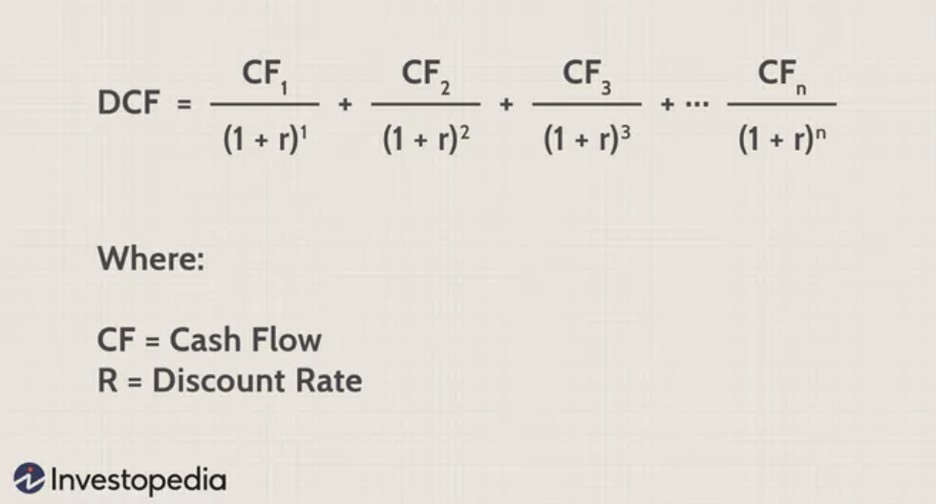
    Suppose an example of a long-term, direct real estate investor, looking to maximize their return of a 10-year period. The below formula, taken from Investopedia shows the common formula for the Discounted Cash Flow (DCF) approach.

    Source: Sabrina Jiang, Investopedia (2021)

    Investors utilize this method to factor in both the delta of the initial buying price and the value of the property after ten years, in addition to the net present value (NPV) of any cash flows that come in from owning that property over 10 years. This gives real estate investors a great formula to input prognostications, then make transactions based on those forecasts.

    Reverting to the drawbacks of point-in-time valuations, firstly, it’s critical to understand fundamental psychology real estate investors utilize. Typically, real estate investors have a longer-term vision, especially compared to investors who purchase various securities. This makes a point-in-time valuation much less relevant, since in the long-run real estate investors are not just looking at an easily predictably present value. As we saw in 2008 most famously and during the COVID-19 pandemic most recently, real estate prices can tank from unrelated market activities, political changes, or even a completely unexpected global health pandemic (Altus Group).

    Conclusion

    Long-term volatility concerns necessitate real estate investors to rely on more than increases in value over time. This is a primary explanation why investors generally rely on the cash flow, plus a final value increase. If an investor holds a property for ten years from purchase to sale, as an example, the overall return will be a combination of cash flow from all ten years of ownership, plus any difference between the initial purchase price and the ultimate sale price.

    The cost, sales comparison, and capitalization rate approaches all fail to account for both potential changes in the cash flow, or value of the property, over the investment hold period. Hypothetically, if an investor knows that in year three of the hold period, a major tenant is going to vacate the property and cause a significant decrease in the property’s cash flow for the period, this clearly negatively impacts the overall return the investor attains. The only valuation method that takes into consideration time value of money and captures the future performance of the property is the DCF method.

    The DCF method predicts future cash flows over an estimated property hold period. This includes both annual cash flow and profit at the time of sale. Many practitioners found that attempting to accurately predict revenue, expenses, and the future value of the property at the time of sale, is actually quite difficult. It essentially forces them forces them to think deeply and more critically. Long-term risk factors, management, quality of tenants, and trends in the real estate market suddenly appear on their immediate radar.

    While not perfect (valuation models are not a crystal ball), the DCF method is generally preferred by real estate investors. Bluntly, the DCF approach best matches the reality of the investment, compared to the others discussed above.

    The Closing Argument to Real Estate Investors (Primarily CRE Investors)

    Selecting the best-fit valuation method is akin to choosing the right tool for a homeowner’s repair project. Most of the decision is decided on a case-by-case basis, based on the best information available. With the varying subjective methods and information, asset appraisal in the world of commercial is part formula, part art form.

    In practicality, most appraisers don’t limit themselves to one method, instead taking an average of two or more methods. It’s hardly surprising appraisers have toned down their aggressive approach, especially compared to nearly 15 years ago. After the catastrophic downward spiral of 2008, the more analysis real estate investment projects undergo, the better. To build on the methods discussed, a well-known method rapidly gaining increasing popularity is called the stress test. Perhaps this test is more commonly referenced in the investment banking sector, namely to monitor volatility ratios of aggressive investment banks who also hold client checking and other deposit accounts, to ensure we don’t need to worry about anymore “bank runs”, but nonetheless the same logic applies to the real estate sector and it’s played an indispensable component to accurate real estate valuations. 

    If you take nothing else away from this article, use the DCF Method whenever possible. Especially in today’s ever-changing real estate market, periodic cash flows are a must to have a successful, long-term real estate holding. As with any other investment, do your due diligence, ensure you have the right team around you, and take calculated, well-thought risks. Good luck to all continuing to navigate the post COVID-19 real estate landmine!

  • Four Major Valuation Methods Explained: Commercial Real Estate (CRE)

    From the perspective of investors, coming up with an accurate property valuation is the most significant factor in making investment decisions. Commercial real estate (CRE) investment has become increasingly popular in the past few decades. That’s because it’s viewed as an excellent vehicle for corporate and public wealth investors to achieve stable returns.

    In this post, we’ll look at four primary valuation methods investors use when looking at CRE proposals. It should be no surprise that technology deeply impacts a potential CRE investment valuation. It’s truly astounding how powerful software solutions can support the consistency, transparency, and standardization across the valuation industry.

    Cost Approach

    The cost approach involves estimating a rough total budget for how much the structure would cost to build from scratch. The cost approach accounts for the original value of the land, plus the cost to build the structure from the ground up. Investors typically look at this approach to see if it’s financially more profitable to develop a new property, versus buying an existing one. The cost approach is comprised of two major methods:

    • Reproduction Method – Costs of rebuilding an exact replica of the existing structure, using the same materials, construction methods, etc.
    • Replacement Method – Costs of rebuilding a new structure with brand new materials, construction methods, designs, etc.

    This logic is generally sound. However, it’s critical to note this method does not account for additional effort of development and construction involved in building a property from the ground up. Similarly, it does not account for the long-term cash flow of a given CRE project.

    Sales Comparison Approach

    Comparisons between key market factors are one of the most important inputs to any valuation method. Furthermore, sales comparisons are usually the source of information, such as cost of reproduction, current market capitalization rate, loan-to-value ratios, and others (Atlus Group). Prospective buyers use this approach to compare current CRE listings to recently sold projects. Though this list isn’t exhaustive, it includes major components of the sales comparison approach:

    • Price per square foot
    • Capitalization rate
    • Price per unit (multifamily CRE)
    • Price per key (hospitality CRE)
    • Physical condition
    • Location
    • Tenant profiles (income, credit quality, cash flow stability, etc.)
    • Income (financial statements)

    The closer in similarity a prospective CRE property is to a comparable sale – especially a recent one – referencing the above components, the more effective this approach tends to be. Finally, once the quantitative characteristics of the perspective CRE property are compared, there is a qualitative analysis to ensure any more or less favorable attributes are accounted for. These adjustments are an essential precaution, if using this valuation method for CRE purchases.

    One notable downside to this method is a lack of analysis of any long-term cash flows or property valuation.

    Capitalization Rate Approach (Income Capitalization)

    The “cap rate” approach is one of the most popular methods of property valuation. It’s very frequently used by analysts in both the lending world and intended acquisitions (Atlus Group). When you hear real estate professionals mention what a property “traded at”, they’re almost always citing either the cap rate, or the price per square foot, a property sold for.

    The formula for calculating cap rate is simple. It’s equal to the net operating income (NOI) of the property, divided by the capitalization rate. The outcome represents the ownership’s approximate value of the property, based on the first year’s expected cash flow.

    Like the Sales Comparison Approach, this tool is most valuable to estimate the current value of CRE properties. Furthermore, it’s even more useful if the property has relatively stable and easily predictable cash flow. New, complex projects that have essentially zero NOI are not good candidates for this valuation approach. In such circumstances, investors are much more likely to turn to the Discounted Cash Flow Approach.

    Discounted Cash Flow Approach

    While the three previously detailed CRE valuation methods are undoubtably useful under certain conditions, they share a major drawback. Each of first three valuation methods estimate the value of a CRE property at a specific point in time. This is in fact a major drawback for real estate investors, who are rarely investing primarily for short-term gains.

    Suppose an example of a long-term, direct real estate investor, looking to maximize their return of a 10-year period. The below formula, taken from Investopedia shows the common formula for the Discounted Cash Flow (DCF) approach.

    Source: Sabrina Jiang, Investopedia (2021)

    Investors utilize this method to factor in both the delta of the initial buying price and the value of the property after ten years, in addition to the net present value (NPV) of any cash flows that come in from owning that property over 10 years. This gives real estate investors a great formula to input prognostications, then make transactions based on those forecasts.

    Reverting to the drawbacks of point-in-time valuations, firstly, it’s critical to understand fundamental psychology real estate investors utilize. Typically, real estate investors have a longer-term vision, especially compared to investors who purchase various securities. This makes a point-in-time valuation much less relevant, since in the long-run real estate investors are not just looking at an easily predictably present value. As we saw in 2008 most famously and during the COVID-19 pandemic most recently, real estate prices can tank from unrelated market activities, political changes, or even a completely unexpected global health pandemic (Altus Group).

    Conclusion

    Long-term volatility concerns necessitate real estate investors to rely on more than increases in value over time. This is a primary explanation why investors generally rely on the cash flow, plus a final value increase. If an investor holds a property for ten years from purchase to sale, as an example, the overall return will be a combination of cash flow from all ten years of ownership, plus any difference between the initial purchase price and the ultimate sale price.

    The cost, sales comparison, and capitalization rate approaches all fail to account for both potential changes in the cash flow, or value of the property, over the investment hold period. Hypothetically, if an investor knows that in year three of the hold period, a major tenant is going to vacate the property and cause a significant decrease in the property’s cash flow for the period, this clearly negatively impacts the overall return the investor attains. The only valuation method that takes into consideration time value of money and captures the future performance of the property is the DCF method.

    The DCF method predicts future cash flows over an estimated property hold period. This includes both annual cash flow and profit at the time of sale. Many practitioners found that attempting to accurately predict revenue, expenses, and the future value of the property at the time of sale, is actually quite difficult. It essentially forces them forces them to think deeply and more critically. Long-term risk factors, management, quality of tenants, and trends in the real estate market suddenly appear on their immediate radar.

    While not perfect (valuation models are not a crystal ball), the DCF method is generally preferred by real estate investors. Bluntly, the DCF approach best matches the reality of the investment, compared to the others discussed above.

    The Closing Argument to Real Estate Investors (Primarily CRE Investors)

    Selecting the best-fit valuation method is akin to choosing the right tool for a homeowner’s repair project. Most of the decision is decided on a case-by-case basis, based on the best information available. With the varying subjective methods and information, asset appraisal in the world of commercial is part formula, part art form.

    In practicality, most appraisers don’t limit themselves to one method, instead taking an average of two or more methods. It’s hardly surprising appraisers have toned down their aggressive approach, especially compared to nearly 15 years ago. After the catastrophic downward spiral of 2008, the more analysis real estate investment projects undergo, the better. To build on the methods discussed, a well-known method rapidly gaining increasing popularity is called the stress test. Perhaps this test is more commonly referenced in the investment banking sector, namely to monitor volatility ratios of aggressive investment banks who also hold client checking and other deposit accounts, to ensure we don’t need to worry about anymore “bank runs”, but nonetheless the same logic applies to the real estate sector and it’s played an indispensable component to accurate real estate valuations. 

    If you take nothing else away from this article, use the DCF Method whenever possible. Especially in today’s ever-changing real estate market, periodic cash flows are a must to have a successful, long-term real estate holding. As with any other investment, do your due diligence, ensure you have the right team around you, and take calculated, well-thought risks. Good luck to all continuing to navigate the post COVID-19 real estate landmine!