Tag: investment strategy

  • What is a Prime Brokerage and Who Uses Their Services?

    A prime brokerage is a bundled group of services offered by investment banks and other financial institutions. Investment banks may offer these services to hedge funds and other large investment clients that have a need to be able to borrow securities (or cash), in order to engage in “netting” to achieve “absolute returns”.

    What is Netting?

    Netting refers to offsetting the value of multiple positions, or payments, due to be exchanged between two or more parties. Typically, it’s used to determine which party is owed compensation in a multiparty contract.  Additionally, utilized as a method of reducing risks in financial contracts by combining or aggregating multiple financial obligations to arrive at a net obligation amount. Netting reduces settlement, credit, and other financial risks between two or more parties.

    What is an Absolute Return?

    An absolute return indicates the return an asset receives over a specific period. This measure looks at the appreciation/depreciation that an asset – such as a stock or mutual fund – has achieved over time. Absolute returns differ from relative returns in that there’s no benchmark comparison. The absolute return is concerned with the return of that specific asset over a period of time. An easier way to think of an absolute return is by its other reference, total return. Therefore, the gain or loss of an asset or portfolio is measured independent of any other standard. Absolute returns may be positive or negative and they may also bear no correlation to other market activities.

    Who Typically Utilizes Prime Brokerage Services and Who Provides Them?

    Hedge funds would amongst the first category of prime brokerage clients. Legally, clients may not access prime brokerage services for less than $500,000 in equity, even though it’s typical for clients to have over $50M in equity. High net worth private investors are another popular category of prime brokerage clients.

    On the other hand, prime brokerage services are generally offered by large investment banks. These institutions benefit from economies of scale to bundle multiple financial service offerings with more efficiency, at a cheaper cost. Some of the most notable firms who offer prime brokerage services include Goldman Sachs, BAML, JPMC, Citigroup, and BNY Mellon. Services bundled include largely “back office” tasks like asset custody, financial reporting, cash/securities lending, investor introductions, and risk consulting.

    Historically, Goldman Sachs has been known as the most reputable prime brokerage. However, their prime brokerage agreements are such that smaller hedge funds would have difficulty meeting their expected capital requirements. More recently, Pershing – an elite BNY Mellon subsidiary – has become the backbone of the prime brokerage street business. Combining the custodial services BNY Mellon is renowned for, with Pershing’s uniquely skilled investments and alternatives specialists, gives the duo a unique marketing position within the prime brokerage business. Pershing’s “prime services” are highlighted by risk management consulting. Additional offerings include securities lending, financing solutions, trade execution, technology, liquid alternative investments, and more. Within the alternative investment niche, which is extremely frequently accessed by hedge funds, Pershing has built an impeccable reputation.

  • What is a Prime Brokerage and Who Uses Their Services?

    A prime brokerage is a bundled group of services offered by investment banks and other financial institutions. Investment banks may offer these services to hedge funds and other large investment clients that have a need to be able to borrow securities (or cash), in order to engage in “netting” to achieve “absolute returns”.

    What is Netting?

    Netting refers to offsetting the value of multiple positions, or payments, due to be exchanged between two or more parties. Typically, it’s used to determine which party is owed compensation in a multiparty contract.  Additionally, utilized as a method of reducing risks in financial contracts by combining or aggregating multiple financial obligations to arrive at a net obligation amount. Netting reduces settlement, credit, and other financial risks between two or more parties.

    What is an Absolute Return?

    An absolute return indicates the return an asset receives over a specific period. This measure looks at the appreciation/depreciation that an asset – such as a stock or mutual fund – has achieved over time. Absolute returns differ from relative returns in that there’s no benchmark comparison. The absolute return is concerned with the return of that specific asset over a period of time. An easier way to think of an absolute return is by its other reference, total return. Therefore, the gain or loss of an asset or portfolio is measured independent of any other standard. Absolute returns may be positive or negative and they may also bear no correlation to other market activities.

    Who Typically Utilizes Prime Brokerage Services and Who Provides Them?

    Hedge funds would amongst the first category of prime brokerage clients. Legally, clients may not access prime brokerage services for less than $500,000 in equity, even though it’s typical for clients to have over $50M in equity. High net worth private investors are another popular category of prime brokerage clients.

    On the other hand, prime brokerage services are generally offered by large investment banks. These institutions benefit from economies of scale to bundle multiple financial service offerings with more efficiency, at a cheaper cost. Some of the most notable firms who offer prime brokerage services include Goldman Sachs, BAML, JPMC, Citigroup, and BNY Mellon. Services bundled include largely “back office” tasks like asset custody, financial reporting, cash/securities lending, investor introductions, and risk consulting.

    Historically, Goldman Sachs has been known as the most reputable prime brokerage. However, their prime brokerage agreements are such that smaller hedge funds would have difficulty meeting their expected capital requirements. More recently, Pershing – an elite BNY Mellon subsidiary – has become the backbone of the prime brokerage street business. Combining the custodial services BNY Mellon is renowned for, with Pershing’s uniquely skilled investments and alternatives specialists, gives the duo a unique marketing position within the prime brokerage business. Pershing’s “prime services” are highlighted by risk management consulting. Additional offerings include securities lending, financing solutions, trade execution, technology, liquid alternative investments, and more. Within the alternative investment niche, which is extremely frequently accessed by hedge funds, Pershing has built an impeccable reputation.

  • The World’s Oldest and Largest Custodian Bank – BNY Mellon – Builds Platform to Revolutionize Digital Asset Custody Services

    BNY Mellon, founded by Alexander Hamilton in 1784 – the first US Treasury Secretary – has announced they are continuing to build out a highly advanced, robust, and secure digital assets custody business.

    “Touching more than 20% of the world’s investable assets, BNY Mellon has the scale to help our clients reimagine financial markets through blockchain technology and digital assets. We are still in the early days of this evolution, but the possibilities are exciting. Today’s announcement marks a step in what we see as an ongoing innovation journey for our firm, our clients and the rest of the financial industry.”

    -Robin Vince, CEO of BNY Mellon

    BNY’s custodianship business is based on some of the very principles Hamilton wrote about in the late 1700s. They are both the largest and the oldest custodian bank in the world, with approximately $45T (Trillion) in Assets Under Custody (AUC). With their experience, brand recognition, and unique ability to utilize economies of scale – coupled with what appears to be a recent renewed peaking interest in digital assets – this move is an example of exceptional business strategy.

    The Timing of BNY Mellon’s Announcement

    The timing of the announcement is interesting for a number of reasons. Firstly (likely the primary reason), the Sibos Update conference, which initially lasted from 10/10-10/13. BNY had a very large presence and rolled this news out in parallel. Secondly, we’re at an absolutely critical point in macroeconomic policy. Will the Fed’s decision to hike up rates to deflate the inflation work? Did they start too late? What’s the impact on US and global financial markets? Presently, those questions are central to investors every single day.

    Generally, during recessionary cyclical economic times, at-risk assets don’t do well (to say the least). Cryptocurrencies and digital assets are in the heart of today’s at-risk assets category – though that may be slowly changing. Regardless, during such a time of economic uncertainty, rolling out a high-tech, revolutionary custodianship service for digital assets is interesting. That leads me to the next timing overlap.

    The SEC’s Ongoing Persistence of Rejecting Bitcoin Spot ETF Proposals

    The SEC has been on a roll with rejecting Bitcoin spot ETFs. Coverage of this began intensifying when they rejected Grayscale GBTC’s conversion request from a SEC-approved Bitcoin Trust to an SEC-approved Bitcoin spot ETF. Grayscale immediately retained Donald Verrilli Jr., who subsequently filed a quick appeal. Verrilli is best known for making a successful oral argument to the US Supreme Court in favor of the ACA (Obamacare). Afterwards, any new Bitcoin ETF – especially spot ETFs – were widely covered by the media and enthused investors. This announcement came on October 11th, 2022, the same day WisdomTree’s Bitcoin spot ETF application was rejected by the SEC, which is also coincidentally the same date the SEC had a deadline to respond to VanEck’s appeal of their previously rejected Bitcoin spot ETF. To note, the SEC has now missed their 45-day deadline to respond.

    Bear in mind, VanEck is not heavily exposed in digital assets at all. They are a highly reputable institutional investment firm, with one SEC-approved Bitcoin Strategy ETF on the market. As all other currently SEC-approved Bitcoin ETFs, VanEck’s Strategy ETF is a Bitcoin futures ETF. Nonetheless, BNY Mellon – very likely coincidentally, admittedly – announced this launch on the same day as two highly anticipated SEC rulings on digital asset products.

    Expected Impact for the Digital Asset Market

    The impact, especially in the longer-term, is potentially massive. Let’s remember the primary, above-and-beyond, number one reason the SEC is rejecting Bitcoin spot ETFs: security. Grayscale’s SEC-approved GBTC Bitcoin Trust advertises and details the product’s custodianship. The custodian is Coinbase Custody Trust Company, LLC. In other words, at least from the branding, the custodian of the cryptocurrency product is a cryptocurrency-specific custodian. Continuing with the Grayscale example, this makes their rebuttal to the SEC more difficult. Is there any remotely tangible security added if a cryptocurrency product is in the custody of another cryptocurrency-specific firm? I don’t doubt Grayscale’s ability to make a compelling and technically robust argument, but I seriously doubt the SEC’s acceptance.

    What if the scenario remains the same, with the only change being the custodian. With very few exceptions, in my opinion nothing really changes. That is, unless the custodian is BNY Mellon. Some, including myself, might argue that turns the dynamic in the other direction. If GBTC is held in the custody of BNY Mellon, would the SEC still cite security concerns? Unimaginable. BNY Mellon’s brand is iconic when it comes to custodianship services in global banking. Through this core offering, BNY Mellon alone winds up touching over 20% – or more than 1 out of every 5 USD (or global currency equivalent) – throughout the entire world. That’s astounding. Keeping in mind they are the oldest bank and the oldest publicly traded company, BNY must be doing something right in custodianship services.

    Security Has Always Been Paramount in Custodian Banking

    With custodianship banking generally, security is definitely mission critical. BNY has provided this service, highly successfully, arguably longer than any other service offered by any institution. They’ve been evolving the custody banking sector since the late 1700s. Back to the SEC, if I’m looking at GBTC in the custody of BNY Mellon, I don’t see any compelling argument for security concerns. If anything, I’d see that as more of comical reasoning. The SEC could always pivot to another, more plausible concern if (when) that were to happen, but it’s still a huge win for the digital asset market – as well as BNY Mellon.

    As a final note here, the SEC is rejecting Bitcoin spot ETFs at an increasing rate, meaning applications are growing. More and more firms are attempting to get SEC-approved Bitcoin products into the marketplace. Clearly, they’re prognosticating an increase in investor demand for digital asset products and are attempting to respond accordingly. Let’s also be clear – investors and investment firms aren’t required to get SEC clearance to sell Bitcoin derivatives.

    That said, of course it’s highly preferred. In an asset class still largely plagued by uncertainty, SEC approval is an immediate, gigantic game-changer. BNY Mellon holding custody of digital assets on an in-house, BNY Mellon digital assets custody platform changes cryptocurrency market dynamics. It also likely puts cryptocurrency-specific custodians out of business, amongst other market effects. One would think it’d have to alter the SEC’s position substantially and broadly on digital assets. In turn, that should similarly substantially and broadly alter investor perception of digital assets.

    Could Anything Go Wrong?

    Always. On a more serious note, even Alexander Hamilton was famously quoted saying, “I never expect a perfect work from an imperfect man”. From my perspective, BNY Mellon is not only the biggest risk-taker here; they are the biggest by a landslide. This is a company that was founded by the first US Treasury Secretary and has only improved their initial, core offering over time. The SEC also isn’t raising concerns over security as a completely illegitimate excuse. We’ve seen Ethereum wallets hacked, viruses created to successfully steal Bitcoin, cyber-attacks against crypto exchanges, and more. BNY Mellon will have the sole responsibility to ensure none of that occurs on their watch, so to speak. What if they fail? That’s exactly the point at which this could all go terribly wrong.

    BNY Mellon built a brand with the core focus on custodian banking spanning the course of over 225 years. They are widely considered to be the most prestigious and critical institutional investment services firm in the world. Now they’ve made a major move into the digital asset space, an admittedly enticing and potentially extremely lucrative strategy. However, in banking, all it takes to bring down a reputation built over 225 years is one mistake in seconds.

    To be sure, there’s added nuance here. Digital assets are naturally going to be more susceptible to evolving technologies as digital assets themselves are an evolving technology. Cybersecurity preventability measures and the sophistication of cybersecurity attacks have both increased. In the age of digital transformation, I believe this is a correctly calculated risk for BNY Mellon.

    Extent a Momentary Error Could Hurt BNY Mellon’s Core Business

    While there can be little to no doubt a security issue coming from BNY’s digital asset custody platform would be detrimental to the company – potentially in a very large way – the same can be said for the likelihood of that instance actually bringing down what BNY’s built in over 225 years. Even if the world’s most secure custodian has a security malfunction, I don’t believe it would even impact their current business model. It may take them out of digital asset custody services – I think even that is reaching – but again, I don’t see it majorly tarnishing the brand.

    All-in-all, this is a win-win scenario, statistically speaking. Yes, something could go wrong. When this platform is ready for go-live and it’s used broadly, we’ll get a better sense of the impact. But BNY especially would not dramatically – out of character – launch a futuristic digital assets custody platform that didn’t meet the mark from a technology perspective.

    There shouldn’t be doubt BNY made budgetary concerns a main priority, or even an obstacle, of this project. The team they’ve assembled is comprised of the brightest, most experienced, innovative SME’s in their respective areas. This continuing work-in-progress originated in 2019 and is just now starting to be publicly rolled out in a significant way. BNY likely took 3 years to ensure they had capacity to build a product worthy of publicly announcing is work-in-progress. They notably take perfection seriously; I doubt many disbelieve they’re going to rollout an incredible product. Whether perfection in digital assets custody is attainable is a separate discussion, but if anyone could, it’s BNY Mellon.
  • The World’s Oldest and Largest Custodian Bank – BNY Mellon – Builds Platform to Revolutionize Digital Asset Custody Services

    BNY Mellon, founded by Alexander Hamilton in 1784 – the first US Treasury Secretary – has announced they are continuing to build out a highly advanced, robust, and secure digital assets custody business.

    “Touching more than 20% of the world’s investable assets, BNY Mellon has the scale to help our clients reimagine financial markets through blockchain technology and digital assets. We are still in the early days of this evolution, but the possibilities are exciting. Today’s announcement marks a step in what we see as an ongoing innovation journey for our firm, our clients and the rest of the financial industry.”

    -Robin Vince, CEO of BNY Mellon

    BNY’s custodianship business is based on some of the very principles Hamilton wrote about in the late 1700s. They are both the largest and the oldest custodian bank in the world, with approximately $45T (Trillion) in Assets Under Custody (AUC). With their experience, brand recognition, and unique ability to utilize economies of scale – coupled with what appears to be a recent renewed peaking interest in digital assets – this move is an example of exceptional business strategy.

    The Timing of BNY Mellon’s Announcement

    The timing of the announcement is interesting for a number of reasons. Firstly (likely the primary reason), the Sibos Update conference, which initially lasted from 10/10-10/13. BNY had a very large presence and rolled this news out in parallel. Secondly, we’re at an absolutely critical point in macroeconomic policy. Will the Fed’s decision to hike up rates to deflate the inflation work? Did they start too late? What’s the impact on US and global financial markets? Presently, those questions are central to investors every single day.

    Generally, during recessionary cyclical economic times, at-risk assets don’t do well (to say the least). Cryptocurrencies and digital assets are in the heart of today’s at-risk assets category – though that may be slowly changing. Regardless, during such a time of economic uncertainty, rolling out a high-tech, revolutionary custodianship service for digital assets is interesting. That leads me to the next timing overlap.

    The SEC’s Ongoing Persistence of Rejecting Bitcoin Spot ETF Proposals

    The SEC has been on a roll with rejecting Bitcoin spot ETFs. Coverage of this began intensifying when they rejected Grayscale GBTC’s conversion request from a SEC-approved Bitcoin Trust to an SEC-approved Bitcoin spot ETF. Grayscale immediately retained Donald Verrilli Jr., who subsequently filed a quick appeal. Verrilli is best known for making a successful oral argument to the US Supreme Court in favor of the ACA (Obamacare). Afterwards, any new Bitcoin ETF – especially spot ETFs – were widely covered by the media and enthused investors. This announcement came on October 11th, 2022, the same day WisdomTree’s Bitcoin spot ETF application was rejected by the SEC, which is also coincidentally the same date the SEC had a deadline to respond to VanEck’s appeal of their previously rejected Bitcoin spot ETF. To note, the SEC has now missed their 45-day deadline to respond.

    Bear in mind, VanEck is not heavily exposed in digital assets at all. They are a highly reputable institutional investment firm, with one SEC-approved Bitcoin Strategy ETF on the market. As all other currently SEC-approved Bitcoin ETFs, VanEck’s Strategy ETF is a Bitcoin futures ETF. Nonetheless, BNY Mellon – very likely coincidentally, admittedly – announced this launch on the same day as two highly anticipated SEC rulings on digital asset products.

    Expected Impact for the Digital Asset Market

    The impact, especially in the longer-term, is potentially massive. Let’s remember the primary, above-and-beyond, number one reason the SEC is rejecting Bitcoin spot ETFs: security. Grayscale’s SEC-approved GBTC Bitcoin Trust advertises and details the product’s custodianship. The custodian is Coinbase Custody Trust Company, LLC. In other words, at least from the branding, the custodian of the cryptocurrency product is a cryptocurrency-specific custodian. Continuing with the Grayscale example, this makes their rebuttal to the SEC more difficult. Is there any remotely tangible security added if a cryptocurrency product is in the custody of another cryptocurrency-specific firm? I don’t doubt Grayscale’s ability to make a compelling and technically robust argument, but I seriously doubt the SEC’s acceptance.

    What if the scenario remains the same, with the only change being the custodian. With very few exceptions, in my opinion nothing really changes. That is, unless the custodian is BNY Mellon. Some, including myself, might argue that turns the dynamic in the other direction. If GBTC is held in the custody of BNY Mellon, would the SEC still cite security concerns? Unimaginable. BNY Mellon’s brand is iconic when it comes to custodianship services in global banking. Through this core offering, BNY Mellon alone winds up touching over 20% – or more than 1 out of every 5 USD (or global currency equivalent) – throughout the entire world. That’s astounding. Keeping in mind they are the oldest bank and the oldest publicly traded company, BNY must be doing something right in custodianship services.

    Security Has Always Been Paramount in Custodian Banking

    With custodianship banking generally, security is definitely mission critical. BNY has provided this service, highly successfully, arguably longer than any other service offered by any institution. They’ve been evolving the custody banking sector since the late 1700s. Back to the SEC, if I’m looking at GBTC in the custody of BNY Mellon, I don’t see any compelling argument for security concerns. If anything, I’d see that as more of comical reasoning. The SEC could always pivot to another, more plausible concern if (when) that were to happen, but it’s still a huge win for the digital asset market – as well as BNY Mellon.

    As a final note here, the SEC is rejecting Bitcoin spot ETFs at an increasing rate, meaning applications are growing. More and more firms are attempting to get SEC-approved Bitcoin products into the marketplace. Clearly, they’re prognosticating an increase in investor demand for digital asset products and are attempting to respond accordingly. Let’s also be clear – investors and investment firms aren’t required to get SEC clearance to sell Bitcoin derivatives.

    That said, of course it’s highly preferred. In an asset class still largely plagued by uncertainty, SEC approval is an immediate, gigantic game-changer. BNY Mellon holding custody of digital assets on an in-house, BNY Mellon digital assets custody platform changes cryptocurrency market dynamics. It also likely puts cryptocurrency-specific custodians out of business, amongst other market effects. One would think it’d have to alter the SEC’s position substantially and broadly on digital assets. In turn, that should similarly substantially and broadly alter investor perception of digital assets.

    Could Anything Go Wrong?

    Always. On a more serious note, even Alexander Hamilton was famously quoted saying, “I never expect a perfect work from an imperfect man”. From my perspective, BNY Mellon is not only the biggest risk-taker here; they are the biggest by a landslide. This is a company that was founded by the first US Treasury Secretary and has only improved their initial, core offering over time. The SEC also isn’t raising concerns over security as a completely illegitimate excuse. We’ve seen Ethereum wallets hacked, viruses created to successfully steal Bitcoin, cyber-attacks against crypto exchanges, and more. BNY Mellon will have the sole responsibility to ensure none of that occurs on their watch, so to speak. What if they fail? That’s exactly the point at which this could all go terribly wrong.

    BNY Mellon built a brand with the core focus on custodian banking spanning the course of over 225 years. They are widely considered to be the most prestigious and critical institutional investment services firm in the world. Now they’ve made a major move into the digital asset space, an admittedly enticing and potentially extremely lucrative strategy. However, in banking, all it takes to bring down a reputation built over 225 years is one mistake in seconds.

    To be sure, there’s added nuance here. Digital assets are naturally going to be more susceptible to evolving technologies as digital assets themselves are an evolving technology. Cybersecurity preventability measures and the sophistication of cybersecurity attacks have both increased. In the age of digital transformation, I believe this is a correctly calculated risk for BNY Mellon.

    Extent a Momentary Error Could Hurt BNY Mellon’s Core Business

    While there can be little to no doubt a security issue coming from BNY’s digital asset custody platform would be detrimental to the company – potentially in a very large way – the same can be said for the likelihood of that instance actually bringing down what BNY’s built in over 225 years. Even if the world’s most secure custodian has a security malfunction, I don’t believe it would even impact their current business model. It may take them out of digital asset custody services – I think even that is reaching – but again, I don’t see it majorly tarnishing the brand.

    All-in-all, this is a win-win scenario, statistically speaking. Yes, something could go wrong. When this platform is ready for go-live and it’s used broadly, we’ll get a better sense of the impact. But BNY especially would not dramatically – out of character – launch a futuristic digital assets custody platform that didn’t meet the mark from a technology perspective.

    There shouldn’t be doubt BNY made budgetary concerns a main priority, or even an obstacle, of this project. The team they’ve assembled is comprised of the brightest, most experienced, innovative SME’s in their respective areas. This continuing work-in-progress originated in 2019 and is just now starting to be publicly rolled out in a significant way. BNY likely took 3 years to ensure they had capacity to build a product worthy of publicly announcing is work-in-progress. They notably take perfection seriously; I doubt many disbelieve they’re going to rollout an incredible product. Whether perfection in digital assets custody is attainable is a separate discussion, but if anyone could, it’s BNY Mellon.

  • Financial Markets Outlook Q4 2022 – Thoughts on Late September/Early October Bear Market Rally

    As the sell-off of stocks intensified into late September 2022, the S&P 500 lost all gains from the previous calendar year in September 2021. Coupled with an annual slump of 24% – the lowest since November 2020 – many were quick to point out the likelihood of a short-term bear market rally. This wasn’t (and isn’t) unjustified at all. During inflationary periods, as we entered this year by definition after two consecutive quarters of negative GDP growth, current stock market trends seemed to point to a classic “bottoming out”. An asset that has “bottomed out” reached its low point and could be in the early stages of trending upward. That’s the real question most investors are asking. Given all the global financial market dynamics that have been putting downward pressure on prices, are they ready to rebound? Will it be a short-term bear market? Will there be any noticeable rebound at all? What are the chances of a long-term bear market cycle? These are all questions investors are keen on getting more insight into daily.

    How Are Financial Markets Looking for the Remainder of Q4 2022?

    Shaky and unpredictable, at best. Specifically looking back at the S&P 500 trends, October, like September, tends to be a comparatively volatile month. This is coming off a year where more than half the trading days saw movements above or below 1%, indicating high general volatility.

    Before we get to the Fed policy, let’s quickly mention something many people are overlooking; current problems plaguing the UK. When we’re talking about the general trend of global financial markets, the US and UK generally follow similar patterns. In 2008, when the US recession hit, did the UK not feel the impact too? Ominously, the UK has already been in recession for a full year. Furthermore, S&P Global is predicting a “tough winter” for EU markets. Add that to the ongoing currency crises the GBP and EUR are currently experiencing and one would not be out of line at all to believe that the UK, as well as struggling countries in the EU, will fall into an even deeper recession. Surely – if that were to happen – it would obviously not bode well for US financial markets.

    But more realistically, actions taken by the Fed regarding inflationary concerns are what investors are eyeing more closely. Let’s take a deeper look at the Fed’s policy to combat inflation and how that’s impacting financial markets.

    The Fed’s Continuously Shifting Narrative on Inflation

    It’s important to first point out the Fed’s inflation narrative and, accordingly, their policy has shifted dramatically the past year. In fact, just last year Fed officials said inflation “wouldn’t be a problem”. Shortly later, the Fed promised us it would be “transitory” inflation. Now, they’re shifting to a “soft landing” inflation for the economy, amidst hiked up rates and economic downturn. As evidence of the deflationary attempts being rejected mounts, the Fed will undoubtably continue to move the bar.

    Why is that concerning for financial markets and moreover, market participants? Generally – intuitively, this should be especially true during times of economic uncertainty – investors often look to the Fed for guidance. Meaning, the majority of market participants will react to news from the Fed in real time. Even more specifically, they’ll take a bearish or bullish position based on what the Fed is saying at that time. David Schassler, Head of Quantitative Investment Solutions for VanEck, noted the same.

    “Market participants have been slow to catch up with the party line — and that’s reflected in the wild volatility. The market has failed to recognize the threat of inflation. Unfortunately, we think the idea of a soft landing is a bit of a fairy tale, and investors can expect a lot more volatility”.
    -David Schassler, VanEck Investments
    Tweet

    But what’s more concerning is that even the Fed knows, for deflation to be successful, there also has to be a drop in demand. It doesn’t appear, nor is anyone really reporting, that there is any drop in demand. That’s starting to have – quite significant at that – ramifications on the global supply chain. Regardless of the reason – it could be the “COVID-10 lockdowns” J.P. Morgan hypothesized – at this point we know we are heading towards a global supply chain “crisis”. On top of a potentially botched deflation, we could see increased – rather than decreased – demand meet supply shortages, which would equal very rapid, upward prices until demand swings back down. Factoring back in how shaky the global economy looks at present, I think it’s extremely difficult to confidently say we’re definitely not going to have a financial crisis-like recession sometime in 2023. As many have said, time will tell.

    Conclusion for Q4 2022

    Concisely, we’re likely entering even darker waters than we’ve been in. That goes for capital markets, equities, indices, and related securities. Savvy investors will start looking at alternative investment products, while at-risk assets continue to have a negative long-term outlook. During times of financial uncertainty, investments in real estate (physical assets, more broadly) are usually a better value risk. High-value commodities, like gold, are known to do well in recessions (no, not Blockchain technology). High-value commodities such as gold in general are a quintessential hedge against a deflating dollar (USD) value.

    While we want to make it abundantly clear if there is a bear market, we expect it to be a short-term bounce back. To reiterate, the long-term macroeconomic outlook right now looks bleak. However, we also don’t want to give the incorrect impression that we are predicting a 2008-like financial collapse. Many have speculated that today’s CDOs are the mid-late 2000’s MBS products that led to the widespread 2008 financial collapse, however the comparison is a false equivalency.

    The safeguards we’ve put in place since 2008 prevent the kind of collapse we witnessed during that time. We have new volatility ratios that dual-acting (depository/investment) banks must strictly maintain. We have new regulatory reporting and compliance procedures banks have entire departments of staff dedicated to. The biggest investment banks in the world have literally thousands of dedicated employees specifically for regulatory reporting and compliance projects. My genuine belief is most active market observers understand we’re smart enough to learn from 2008 and avoid a repeat.

    However – needless to say – we’re still imperfect. With the way the global financial system now operates, there can only be winners if there are also losers. That dynamic is becoming more apparent at an upward trajectory. The biggest winners are becoming bigger (wealthier) and the biggest losers are becoming poorer. Interestingly, according to Fox, the last few recessions have statistically benefitted the “rich of the rich”.

  • Corporate Actions – Dividend Arbitrage – Cumex “Cum-Ex” Transaction Litigation

    Corporate Actions are well defined by Investopedia. A corporate action is any activity that brings material change to an organization and impacts its stakeholders, including shareholders, both common and preferred, as well as bondholders. When a publicly traded company issues a corporate action, they are initiating a process that directly affects the securities issued by that company. Therefore, the board of directors is generally always involved, with shareholder involvement sometimes even required. In the event of a major takeover possibility, for example, shareholders may be required to submit a response giving their input. After researching, it seems the most common corporate actions can be condensed into dividends, stock splits, mergers, acquisitions, and spinoffs.

    According to Institutional investor, BNY Mellon has been the largest custodian in the world for the last 8 years. Given that fact, corporate actions can be of particular interest to them. Again, due to their custodianship business, one can imagine how a poorly executed or thought-out take-over, for example, could affect not only the entire company, but furthermore spread to other very large investment institutions, brokerages, hedge funds, etc. that would otherwise be solvent.

    What is Dividend Arbitrage?

    Options traders in the tri-party repo market would also be familiar with dividend arbitrage. Dividend arbitrage is an arbitrage strategy that may seem complex, but once you break it down it’s relatively straightforward. To understand this strategy, you first need to understand an ex-dividend date. Secondly, I would point out this strategy is typically exercised by options traders. The arbitrage occurs whereby, the options trader buys both the stock and the equivalent number of put options before ex-dividend, then waits to collect the dividend before exercising his put. Let’s look at a hypothetical example to understand that better.

    FinYork stock is trading at $90 per share and is paying a $2 dividend tomorrow. A put with a striking price of $100 is selling for $11. Here, an options trader can enter a risk-less dividend arbitrage by purchasing both the stock for $9000, as well as the put for $1100, for a grand total of $10,100.

    A second, seemingly more complicated way to engage in a dividend arbitrage occurs using “covered writes”. On the day before ex-dividend date, you can do a covered write by buying the dividend paying stock, then simultaneously writing an equivalent number of “deep in-the-money” call options on it. The call strike, price plus the premiums received, should be equal or greater than the current stock price. On ex-dividend date, assuming no “assignment” takes place, you will have qualified for the dividend. While the underlying stock price will have drop by the dividend amount, the written call options will also register the same drop, since “deep-in-the-money” options have a delta of nearly 1. Then, one can sell the underlying stock, buy back the short calls at no-loss and wait to collect the dividends.

    The risk in using this strategy is that of an “early assignment” taking place before the ex-dividend date. If assigned, one would not be able to qualify for the dividends.

    Litigation Against “Cum-Ex Transactions”; A Form of Dividend Arbitrage

    There have been a number of these lawsuits now, especially civil cases, largely in Europe from my research. However, I believe the litigation has now also spilled over into US courts. From my findings, litigation against “cum-ex transactions” originated in Germany. More specifically, in 2019, in Germany it was reported over 100 banks were being investigated for “cum-ex” or “Cumex” transactions involving ‘huge volumes’ leading up to 2012. A cum-ex transaction is a complex form of dividend arbitrage or dividend stripping.

    “For the purpose of dividend arbitrage, traders in alternative tax jurisdictions trade shares around dividend dates. Cum-ex trades specifically serve as a mechanism allowing both the buyer and seller of shares to recover capital gains tax (CGT) paid only once on dividend income. The transactions involve acquiring shares ‘cum dividend’ (including dividend right) just before a dividend is due, and then selling ‘ex dividend’ (without dividend right) after the dividend record date. The various steps are processed very quickly, making it difficult to identify the true owner of the shares, thus enabling multiple parties to claim tax credits or tax compensation payments for CGT paid only once. This process often involves the original owner of the shares, the bank or broker that sells them short, and the buyer who purchases them on dividend day. It has been common for the parties to split the proceeds of the tax refunds.”
    -Yorick M Ruland, International Bar Association

    As Yorick spells out, this form of dividend arbitrage requires the involvement of corrupt shareholders and brokers alike. Considering the processes complexity and the capabilities to catch perpetrators of these financial schemes alike, many go unaccounted for. That hasn’t stopped the ones who do get caught from facing both criminal and civil penalties.

  • Is India’s UPI (Unified Payments Interface) Technology Worth Selling Overseas and to Western Countries?

    The Unified Payments Interface (UPI) was created by the National Payments Corporation of India (NPCI) for purposes of “enabling digital payments and settlement systems in India, is an initiative of RBI and IBA”. As announced in Bloomberg in June 2022, the NPCI is looking to take UPI to overseas markets. This implies that a) the technology has been tested thoroughly and successfully in Indian markets and b) there is currently no real competitor to UPI in overseas markets. At one point, NPCI CEO Ritesh Shukla compared it to a “home-grown alternative to SWIFT”. For those who aren’t familiar, SWIFT is a Belgium-based cross-border payments system operator.

    Has the Product [UPI] been Thoroughly Tested in Indian Markets?

    Based on our research, yes UPI has been tested both rigorously and successfully in Indian markets.

    “We have displaced cash in India to a large extent and are now looking to repeat the success in cross-border corridors. Overseas Indians can use our rails to remit money inwards straightway into their bank accounts, and for the markets where Indians travel frequently, we will build acceptance for our instruments.”
    – NPCI CEO, Ritesh Shukla
    Tweet

    Not only has the technology behind UPI been proven and tested, but the methodology has also succeeded. At least that’s the quantitative claim Shukla’s making. The World Bank data seems to support the analysis too. Indians overseas remitted $87 billion in 2021; the biggest inflow for any country that was tracked by the World Bank.

    Under the RBI’s “Liberalized Remittance Scheme”, all resident individuals (including minors) are allowed to freely remit up to USD $250,000 per year. This is from April-March, for any permissible current or capital account transaction, or a combination of both. Further, resident individuals can avail of the foreign exchange facility, for specific purposes within the limit of USD $250,000 only. The RBI’s “Scheme” was introduced on February 4, 2004, with a limit of USD $25,000 (BusinessDesk, Bloomberg). Since then, the LRS limit has been revised in stages consistent with prevailing macro and micro economic conditions. Notably, the “Scheme” is not available to corporates, partnership firms, HUF, Trusts etc.

    Are there Any Notable Comparisons to India’s UPI Abroad (not factoring in SWIFT)?

    Of the $87 million in remittances India received in 2021, the US was the biggest source (World Bank). According to the World Bank, US remittances to India accounted for over 20% of the $87 million in 2021.

    “Flows to India (the world’s largest recipient of remittances) are expected to reach $87 billion, a gain of 4.6 per cent with the severity of COVID-19 caseloads and deaths during the second quarter (well above the global average) playing a prominent role in drawing altruistic flows (including for the purchase of oxygen tanks) to the country”.
    – World Bank Spokesperson, World Bank Migration and Development Brief, 2022
    Tweet

    In terms of total global remittances, India is followed by China, Mexico, the Philippines, and Egypt (World Bank). In India, remittances are projected to grow 3% in 2022 to $89.6 billion. This is reflective of a drop in overall migrant stock, as a large proportion of returnees from Middle Eastern countries are still awaiting return (World Bank).

    Remittances in low-and-middle-income countries are projected to have grown a strong 7.3% to reach $589 billion in 2021 (World Bank). This “return to growth” is far more robust than earlier estimates. Following the same resilience of flows in 2020, when remittances declined by only 1.7% despite a severe global recession due to COVID-19, according to estimates from the World Bank’s Migration and Development Brief. Lastly, the brief in its entirety can be found here, from the World Bank’s website.

    Outside of evaluating the micro-differences to SWIFT, there are no current notable competitors to India’s UPI we could find. Without any doubt, no possible comparisons would come close in terms of size or scale.

  • Is India’s UPI (Unified Payments Interface) Technology Worth Selling Overseas and to Western Countries?

    The Unified Payments Interface (UPI) was created by the National Payments Corporation of India (NPCI) for purposes of “enabling digital payments and settlement systems in India, is an initiative of RBI and IBA”. As announced in Bloomberg in June 2022, the NPCI is looking to take UPI to overseas markets. This implies that a) the technology has been tested thoroughly and successfully in Indian markets and b) there is currently no real competitor to UPI in overseas markets. At one point, NPCI CEO Ritesh Shukla compared it to a “home-grown alternative to SWIFT”. For those who aren’t familiar, SWIFT is a Belgium-based cross-border payments system operator.

    Has the Product [UPI] been Thoroughly Tested in Indian Markets?

    Based on our research, yes UPI has been tested both rigorously and successfully in Indian markets.

    “We have displaced cash in India to a large extent and are now looking to repeat the success in cross-border corridors. Overseas Indians can use our rails to remit money inwards straightway into their bank accounts, and for the markets where Indians travel frequently, we will build acceptance for our instruments.”
    – NPCI CEO, Ritesh Shukla
    Tweet

    Not only has the technology behind UPI been proven and tested, but the methodology has also succeeded. At least that’s the quantitative claim Shukla’s making. The World Bank data seems to support the analysis too. Indians overseas remitted $87 billion in 2021; the biggest inflow for any country that was tracked by the World Bank.

    Under the RBI’s “Liberalized Remittance Scheme”, all resident individuals (including minors) are allowed to freely remit up to USD $250,000 per year. This is from April-March, for any permissible current or capital account transaction, or a combination of both. Further, resident individuals can avail of the foreign exchange facility, for specific purposes within the limit of USD $250,000 only. The RBI’s “Scheme” was introduced on February 4, 2004, with a limit of USD $25,000 (BusinessDesk, Bloomberg). Since then, the LRS limit has been revised in stages consistent with prevailing macro and micro economic conditions. Notably, the “Scheme” is not available to corporates, partnership firms, HUF, Trusts etc.

    Are there Any Notable Comparisons to India’s UPI Abroad (not factoring in SWIFT)?

    Of the $87 million in remittances India received in 2021, the US was the biggest source (World Bank). According to the World Bank, US remittances to India accounted for over 20% of the $87 million in 2021.

    “Flows to India (the world’s largest recipient of remittances) are expected to reach $87 billion, a gain of 4.6 per cent with the severity of COVID-19 caseloads and deaths during the second quarter (well above the global average) playing a prominent role in drawing altruistic flows (including for the purchase of oxygen tanks) to the country”.
    – World Bank Spokesperson, World Bank Migration and Development Brief, 2022
    Tweet

    In terms of total global remittances, India is followed by China, Mexico, the Philippines, and Egypt (World Bank). In India, remittances are projected to grow 3% in 2022 to $89.6 billion. This is reflective of a drop in overall migrant stock, as a large proportion of returnees from Middle Eastern countries are still awaiting return (World Bank).

    Remittances in low-and-middle-income countries are projected to have grown a strong 7.3% to reach $589 billion in 2021 (World Bank). This “return to growth” is far more robust than earlier estimates. Following the same resilience of flows in 2020, when remittances declined by only 1.7% despite a severe global recession due to COVID-19, according to estimates from the World Bank’s Migration and Development Brief. Lastly, the brief in its entirety can be found here, from the World Bank’s website.

    Outside of evaluating the micro-differences to SWIFT, there are no current notable competitors to India’s UPI we could find. Without any doubt, no possible comparisons would come close in terms of size or scale.

  • Is there a Difference Between a ‘Buyer’s Market’ and a ‘Market that’s Rapidly Getting Less Advantageous Towards Seller’s’?

    The vast majority of latest prognostications point to a shift in the housing market, in favor of buyers over sellers. It’s about time. America’s housing market has been brutal on homebuyer’s, renters, and those looking to lease in prime locations for years now. There is a lot of qualitative and quantitative analysis to suggest that despite rising rates, buyers currently have the advantage.

    Realtor’s Weekly Housing Market: “The Four Big Bellwethers”

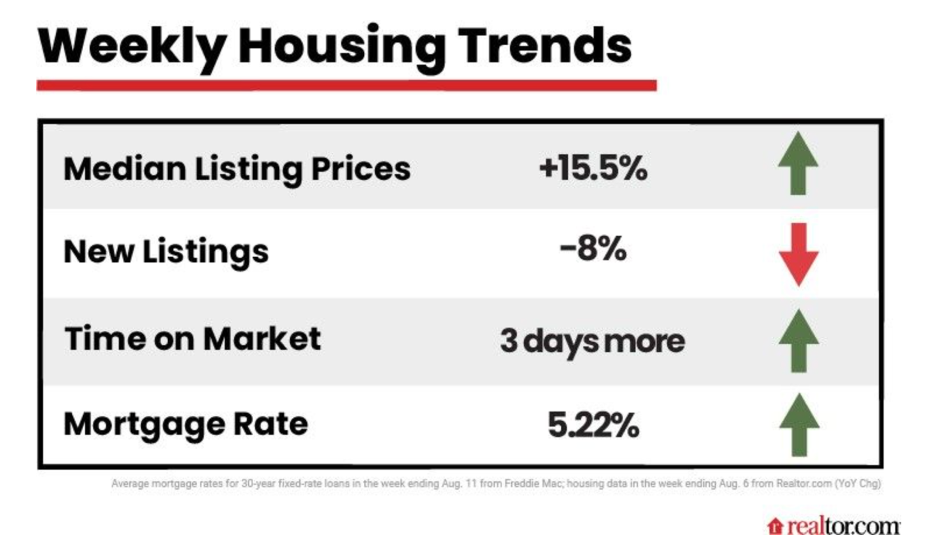
    Realtor has a weekly column called “How’s the Housing Market This Week?”. Realtor’s real estate economists are some of the most trusted in the industry. Weekly, Realtor delivers the most up-to-date statistics on what they coined “the four big bellwethers of the housing market”. These include home prices, # of new listings, total days on market, and of course, mortgage rates (Dutton, Realtor).

    “The housing market is resetting in a buyer-friendly direction,” notes Realtor Chief Economist Danielle Hale in her evaluation. We’d be remised if we didn’t note a “buyer-friendly direction” is certainly not the same as a true buyer’s market. While the same analysis notes the obvious, historic seller’s market that’s raged since COVID-19 began, it points out that the window for sellers is closing, rapidly. Below are the previously mentioned Realtor weekly housing trends, for week-end August 6th, 2022.

    -Realtor.com – Weekly Housing Trends, August 6th, 2022

    What jumps out to me are the top two statistics. A 15.5% median listing price increase, coupled with 8% fewer listing than the week before (Realtor.com). Hale has a unique and thought-provoking perspective on this phenomenon.

    Is There Surprisingly Good News in a 15.5% Increase in Median Listing Price?

    According to Hale, yes, this number is good news for prospective buyers. The last data from July 2022 shows a median nationwide listing price of $449,000. For the week ending August 6th, a 15.5% listing price increase means the new median was $518.595. While this marks the 34th straight week of double-digit price growth, Hale points out it’s also the “second consecutive week of deceleration” (Dutton, Realtor). The previous two weeks – at the end of July 2022 – median listing prices rose by 16.6% and 15.6%, respectively. This third ‘relatively temperate’ hike offers buyers hope home price growth will finally continue steadily dwindling.

    “The improvement has been substantial”, confirms Hale. She’s just as quick to add, “buyers in today’s market may still face meaningful affordability challenges as the typical home listing price remains near a record high”. But there’s little long-term evidence to suggest sticker price is a major deterrent for buyers (Dutton, Realtor). Hale reaffirms, “Persistent [homebuyers] may still continue to find success”. She goes on to add, “Second quarter data showed that homeownership rates increased from a year ago, both overall and for nearly every age and racial and ethnic group”.

    Given that homeownership rates have surged — amid rampant inflation, rising mortgage rates, and other deterrents — strongly signals that buyers who are willing to have some flexibility will ultimately win. Participants who are been willing to purchase somewhere they may not have considered pre-pandemic have largely become homebuyers. It’s a true testament to the lengths that homebuyers are willing to go today, provided sellers meet them halfway.

    Are Sellers Undermining the ‘Buyer Friendly’ Market?

    Anything positive for homebuyers is a negative for home sellers and of course, vice versa. Many sellers with properties on the market are panicking they ‘missed the mark’ by not closing a sale on their property during the COVID-19 real estate boom. For week-end July 30th, 2022, the number of new listings dropped by 8%, year-over-year (Dutton, Realtor).

    “New listings fell from a year ago for a fourth week. This is looking more and more like sellers may be wary of current market conditions, which have shifted substantially, even though they remain quite favorable to sellers who have owned for just about any length of time.”

    – Danielle Hale, Chief Economist, Realtor

    Hale appears to be hesitant to commit to buyer-friendly market conditions. However, she does definitively comment that conditions are becoming less and less favorable for sellers. The same message seems to be resonating across the board: if you’re a seller, the longer your property stays on the market, the worse-off your position will be.

    “While overall inventory [of new and old listings] grew by 28% over this same week last year, the active listings count still trails its 2020 and 2019 levels by more than 15% and 45%, respectively. More improvement in active inventory is likely needed to bring balance, but the recent trend may be at risk if homeowner attitudes toward selling now continue to deteriorate.”

    – Danielle Hale, Chief Economist, Realtor

    Once again, Hale seems to reemphasize the same underlying position. ‘We’re not in a pro-buyer’s market, we’re in a market that’s rapidly growing less favorable to sellers.’

    Are Rising Mortgage Rates to Blame for Homebuyers not Rushing to Close a Deal?

    The last question Realtor’s frequented market assessment addresses is why buyer’s aren’t rushing to close the deal. We are in a market that’s getting less and less favorable towards sellers, after all. What happens when we hit that market floor and conditions start to change against homebuyers. That has been the case – at a staggering rate – for well over two years now (Dutton, Realtor).

    In July 2022, listings lingered on the market a mere 34 days before getting snapped up. That’s nearly half the time it took two years earlier (Dutton, Realtor). Conversely, after having entered August 2022, it seems homebuyers are pumping the breaks and not feeling in such a rush. Hale’s prediction? Expect more of the same. She stated, “We expect more slowing ahead as the housing market reset”. The question remains, why?

    According to data provided by Freddie Mac, rising mortgage rates are a good place to start. For week-end August 11th, 2022, the average 30-year fixed mortgage rate increased to 5.22%. That’s considered a significantly steep spike from the previous week’s 4.99% (Mortgage Rates, Freddie Mac). Realtor predicts the future will hinge on how large corporations will view the potentially looming recession.

    “The big question for consumers is whether companies will over-react to the recession concerns and start trimming payrolls. A sharp pullback in hiring could have a direct impact on people’s ability to keep spending, especially with today’s high inflation.”

    – George Ratiu, Senior Economist, Realtor

    Realtor ultimately winds up agreeing. Prospective homebuyers should take full advantage of this buyer-friendly market while it lasts (Dutton, Realtor).

  • Why Real Estate Investors Refer to Real Estate as an I.D.E.A.L. Investment

    Many real estate investors are familiar with the acronym ‘I.D.E.A.L. Investment’ in the context of real estate investing (Chad Carson, Coach Carson). This acronym is a great, succinct explanation for why real estate is preferred by many investors to other vehicles like dividend stocks, bonds, small businesses, index funds, bank certificate of deposits, annuities, and more.

    Income

    Real estate properties provide excellent cash flow on a regular (typically a monthly) basis and the income size can be quite substantial, depending on your properties’ interest rate, unpaid principal, and property value. This is the primary objective of any investor, which makes real estate a top choice for many. If you aren’t seeing much or any cash flow from an investment, especially after a lengthy period of time, typically it’s not a very successful one.

    Depreciation

    Another big advantage to real estate investing was actually made widely known by Donald Trump in the 2016 presidential campaign; depreciation. Depreciation occurs because for residential buildings, the U.S. government requires real estate investors to spread out most of the cost of real estate purchases over 27.5 years. This creates an annual depreciation expense, which can provide incredible tax benefits. This ‘expense’ doesn’t come out of your bank account, like purchasing materials to sell products, or insurance/maintenance costs. Instead it’s absorbed ‘on paper’ and you see real financial benefits in the form of tax relief.

    Equity

    Generally for real estate investors, as time goes on the more equity they’ll acquire in their own properties by repaying loans, which is directly linked to greater overall wealth. The shorter it takes you to pay off your own financial obligations on a property, the larger your ROI will be. Additionally, you’ll be able to optimize the length of time you’ll see financial benefits from that investment. While it may depend on your financial situation and the real estate market climate, real estate investing is a great way to acquire equity and see positive cash flow simultaneously.

    Appreciation

    Appreciations refers to the idea that your property value is supposed to increase each year. As we’ve seen in recent years, this may not necessarily be the case (primarily due to unpredictable circumstances). However, long-term investors (who comprise a very large segment of real estate investors) are satisfied with the long-term average of property values visibly pointing towards an upward trajectory.

    Leverage

    Leverage can refer to two distinct advantages of real estate investing. Firstly, some indicate this means the initial incurrence of debt leading to equity growth over time (this appears to be covered by ‘Appreciation’). Secondly, leverage can more commonly refer to the idea of using other people’s money (OPM) to earn a positive cash flow. This gives investors the opportunity to use relatively small amounts of cash upfront to gain control over multiple investment properties and earn returns on cash invested. This method isn’t typically used by passive investors, who would be concerned with over-leveraging and what could happen if there was a steep decline in the housing market.