Tag: real estate investing

  • First step in Investing – Your risk tolerance and goals

    There are beginner investors who can’t wait to invest or do a deal. They want to put capital to work right away and see the returns. On the other end of the spectrum, there are investors who hesitate to invest as they fear losing the money. And then there is a wide range of investors in between.

    So, with this wide range of investors, where does one start? We’ll argue in this article that the first step to start investing is to understand risk, our tolerance to risk, and our goals. Understanding ourselves, our motives, and behavior is probably the hardest and most time consuming for many beginner and intermediate investors. In this post, we’ll share key steps with some resources for investors to assess their personal risk tolerance and create investing goals.

    Where does an investor start?

    Remember the first time you built a hobby? It probably happened over months or years. You tried a few things, liked that particular activity, and started doing more and more of it. Consciously, you may not have even taken the time to observe our actions. But, but you enjoyed it and continued it. Though many won’t consider investing as a hobby, the journey is similar. There is a lot of learning involved – technical and behavioral – and it is a very long journey to get better at investing. What is the first step in this journey? It comes down to understanding risk and our tolerance for risk. In the first place, what is risk?

    In simple terms, risk is the possibility of something bad happening……

    Risk involves uncertainty about the effects/implications of an activity with respect to something that humans value…such as health, well-being, wealth, property, or the environment…. often focusing on negative, undesirable consequences.

    Source: https://en.wikipedia.org/wiki/Risk

    It is easy to get carried away in this day and age as most of us are exposed, sometimes overexposed, to finance and investing from general and financial media? We maybe seduced to get stock tips from our favorite financial media or guru and act on it. We need to be careful. Investing is not speculation and is for the long-term, and patience and learning are key. A good investor learns the basics and continues to learn every day!

    Understanding and having an appreciation for risk is at the heart of finance and investing. Reward or returns is a by-product of risk. Many of us focus on rewards without appreciating the underlying risk. We’re always enticed by the higher return. But, we need to start with understanding our risk tolerance as explained below.

    Evaluating our personal risk tolerance

    We take risks on a daily basis though we may not see it as such. We make decisions based on risk all the time. Every time we cross a road we assess and take the risk of safely crossing the road. We select a college and course after weighing the risks and rewards. Will this college help me secure a job? We may not see it as such but some of the major life decisions are also risk-based decisions:

    Given the importance of risk in finance and our daily lives, understanding our individual risk tolerance is of paramount importance. This will save months and years of worry and regrets.

    Let us take an example. Say, you’ve $1000 to invest and are looking for ways to invest. You have done your research and narrowed it down to 3 options. The first option will give $10 after a year, but $1000 most likely not get affected. The second option will give you $100, but you could also lose $100 and end up with $900. i.e. Option 2 is riskier than Option 1. Some may prefer Option 1 and some may prefer Option 2. There is no universal single correct answer. It depends on the individual. It is important to understand which option you prefer i.e. what is your risk tolerance.

    FinYork recommends taking an Investment Risk Tolerance Assessment, as the first step in assessing investment risk tolerance. The one below from the University of Missouri is popular. It is worth every minute of your time as this will set the stage for your investment planning.

    Source: https://pfp.missouri.edu/research/investment-risk-tolerance-assessment/

    Once you finish answering all the questions, you’ll be given an assessment of your risk tolerance. You can use this as the basis of your investments or discuss it with your financial advisor. You may have seen your brokerage’s investor profile questionnaire which is another tool for individual risk tolerance assessment. The whole purpose of this exercise is to evaluate your individual risk tolerance and even confront your fears upfront.

    The survey gives a risk tolerance score at the end as shown below. The score will indicate whether you have a HIGH, MEDIUM or LOW risk tolerance. Your investment strategy has to follow your risk tolerance level. For e.g. someone with a LOW risk tolerance should go with a conservative investing strategy and invest in less risky asset classes. We’ll cover this in detail in upcoming articles.

    Source: https://pfp.missouri.edu/research/investment-risk-tolerance-assessment/

    Investing Goals

    We have so far looked at evaluating our risk profile and risk tolerance. Once we have an idea of our personal risk tolerance, what do we do next? The next step is to set up investing goals which will form the basis of our personal investing approach. If you already have investing goals and approach to meet those goals, that is great. If you don’t, please take the time to write them down. You need to make sure that you don’t stop at personal finance and budgeting but also think about your net worth and investing goals with a long-term view. You’ll find it beneficial to evaluate where you’re today in terms of personal finance (income/expenses) and net worth.

    Investment Goals will differ by age and personal situation

    Investment goals for people in their 20s are quite likely different from people in their 40s or 60s. Similarly, goals for people with families are going to be different for singles or couples. More importantly, they are going to be different based on your risk tolerance and personal financial situation. Please take note of your work situation, financial cash flows when coming up with goals. It is best for goals to follow the SMART method of setting goals. For further reading, please visit Corporate Finance Institute’s site on setting up SMART goals.

    Write down Investing Goals

    Before we get into the how of investing, particularly real estate investing, it is very important to assess your risk tolerance and have clear investing goals. Please take the time to write down the investing goals even if it takes a few hours a day. Above all, investing is a habit. You need to be committed and keep practicing it consistently to get better at it. Your investing goals may consist of the following or more:

    • Your goals and why you want to achieve those goals? For e.g. “My goal is to retire by 55 with X income and Y assets so that I can be financially free”
    • What are your guiding principles? For e.g. “I will invest in companies that also do some social good”
    • Your fears and how to overcome them? For e.g. “My fear is that I have little confidence in myself when it comes to money matters. I plan to overcome my fear by learning about investing by spending an hour every day.”

    Investor Takeaways

    In this article, we understand the basics of risk and risk tolerance and why understanding our risk tolerance is so important. Risk and our tolerance of risk is in itself not a good or bad thing. We just need to understand our risk tolerance as this will define our investing strategy. Having a true appreciation of our risk-taking will define our investing strategy. It will lead to the kind of investments – stocks, real estate, etc. we chose. We hope we’ve convinced you as an investor to evaluate your risk tolerance before making your first investment as it will save a lot of headaches.

    Complete the above-referenced questionnaire, evaluate your risk tolerance, and keep it for your reference. In addition, take the time to think through and write your Investment Goals. We suggest doing this exercise on a regular basis (say, year-end every year) as that will inform us of our risk tolerance and come up with an appropriate investment strategy to manage risk. This will be the topic of upcoming articles.

  • How Airbnb has disrupted Commercial Real Estate (CRE)

    Airbnb has been a disruptor in the hotel industry though many may view it as just another technology marketplace or platform company like Uber. We’ll argue in this article why Airbnb is a disruptor not just in the hotel industry, but the overall commercial real estate (CRE) industry. Airbnb’s business model has ramifications that can echo past hotels and disrupt other property types in CRE in the years to come. As investors, we need to watch out for the Airbnb effect and how the industry responds.

    Airbnb and its business model

    Airbnb probably needs no introduction to many, but let us level set and review Airbnb’s summary from Wikipedia. The key points we will review are highlighted in orange.

    Airbnb… is an American vacation rental online marketplace company… Airbnb maintains and hosts a marketplace, accessible to consumers on its website or via an app. Through the service, users can arrange lodging, primarily homestays, and tourism experiences or list their properties for rental. Airbnb does not own any of the listed properties; instead, it profits by receiving commission from each booking. 

    Source: Wikipedia

    Let us also look at the numbers to get an idea of the reach of Airbnb. As of 2020, Airbnb had grown to 4 million hosts and 800 million guests in 100,000 cities in almost every country and region across the globe. The reach of Airbnb blows away the reach of traditional hotel companies like Marriott. After all, Airbnb can operate anywhere there is a house with a room to spare.

    Airbnb as yet another tech marketplace or platform

    We can use two lenses to look at Airbnb as a company and its place in the markets. The first lens is that of a technology company and the second lens is that of a real estate company. Airbnb can be viewed as a high flying technology company that went public in 2020. In and of itself, there are probably tens of other technology companies in the platform or marketplace category. Notably, Airbnb can be seen as the Uber for guest stays. In essence, just viewed as a technology company Airbnb may not come across as a significant disrupter. Here is an opinion from 2013 during the early years of Airbnb.

    Please hear me loud and clear when I say the following: disruptive innovation does not exist or apply as far as the real estate business is concerned, and it will not in the future, either. Not even in the case of Airbnb (explained below). Real estate product and its consumption are fundamentally different from non-real estate product and its consumption, and at this point in history, real estate markets are no longer likely to be disrupted.

    Source: https://www.getrefm.com/disruptive-innovation-in-real-estate-there-is-no-such-thing/

    The significance of the disruption and further potential comes into play when one looks at Airbnb from a hotel or real estate lens. How big is the disruption? Let us look at the chart below from Professor Galloway at NYU Stern School of Business. As of October 2020, around the time Airbnb went public, the projected market cap exceeded those of FIVE major hotel chains and THREE major airlines combined. The battered hotel and airlines have recovered since October 2020, but you get the idea – Airbnb is worth many major hotel chains combined.

    Source: Professor Galloway

    Airbnb’s disruption of the Hotel industry

    In the previous section, we looked at valuations and reach and saw how Airbnb easily surpasses the valuation and reach of the largest hotel chains. In this section, we will look at exactly how Airbnb has disrupted the hotel industry business model and turned it on its head.

    Asset light and Risk light

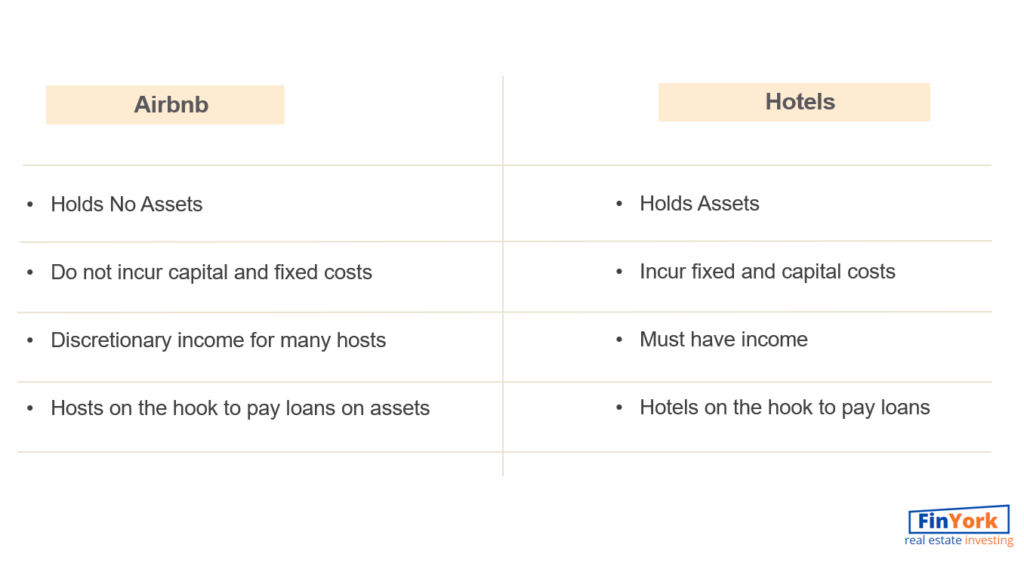
    Airbnb is a marketplace platform and does not hold real estate assets. Hotels on the other hand hold the hotel’s real assets. What this means is that hotels (or their franchisees or partners) are responsible for buying, building, and running the hotel property. In Airbnb’s case, the hosts are responsible for buying and running the assets. This leads to Airbnb being asset-light which is a huge advantage. How come? The hotels hold the real estate risk whereas the hosts (not Airbnb) hold the real estate risks. In an ironic way, Airbnb is disrupting CRE without holding ANY real estate assets. This is similar to Uber which disrupted the car ride industry without holding any cars.

    The above-mentioned asset and risk light nature of Airbnb vs Hotels have major implications for investors. The investor who invests in Airbnb stock takes limited or no real estate risk whereas an equity investor in a hotel asset takes the real estate risk. As it happened during COVID-19, the hotels faced a deep loss of revenue when stays come to a screeching halt. The hotels still had real estate expenses and loan obligations to run minimum operations. Airbnb stays also came to a screeching halt, but it didn’t have any real estate expenses or loan obligations. Its hosts had.

    Agile, Lean and easily scalable

    As we saw previously, Airbnb has no real estate obligations to build or maintain the asset, raise capital or get a loan. But, Airbnb has a powerful technology platform and spends most of its money on R&D and improving the platform. This makes Airbnb agile and lean. Airbnb can also scale up or down its business in little time as it has no real assets.

    When the COVID-19 pandemic started, both Airbnb and hotels took a big hit. But, Airbnb was able to recover way faster. More so, Airbnb was even able to go to the public markets with an IPO. Airbnb has disrupted the hotel business model to such an extent that hotels are now providing Airbnb-like platforms i.e. the hotels just act as intermediaries but provide some basic branding and consistent service. The table below summarizes salient features of Airbnb and Hotels business models we reviewed.

    More CRE disruption to come?

    Disrupting hotels which is a major CRE property type is one thing, but disrupting the whole CRE is at a different level altogether. In our opinion, Airbnb has the potential to disrupt the rest of CRE as well. COVID-19 and Airbnb’s potential should be a cause for concern for many players in CRE. The CRE industry, particularly office and retail, is facing a big crisis with the pandemic. Will it provide an opening for disruptors like Airbnb or other players? It will be a mistake for the CRE industry to treat Airbnb as just a hotel company for the reasons mentioned below.

    From hotel to other property types

    We’ve argued so far how Airbnb has already disrupted the hotel industry. Why can’t it do the same for offices or retail or for that matter any property type? COVID-19 has actually accelerated the importance of homes. Which real estate player is better positioned to leverage the home as an asset than Airbnb? Let us take a few scenarios which may seem a stretch but quite possible:

    • WIth WFH, people start using a part of their homes as a gathering place to work
    • People start using their spare basement, yard, or other spaces for group exercises
    • How about having dinner gatherings at someone’s home than restaurants?

    Who can create and capitalize on these trends? Startups or established players like Airbnb that have a platform. The above will reduce the need for a traditional office or retail property type and increase the need for a technology platform that can facilitate the above. Let us take a couple of different scenarios:

    • Can small office landlords share their existing space using an Airbnb like platform (similar to WeWork)?
    • Can small retail shops share their existing space using an Airbnb like platform?

    There is nothing stopping Airbnb from providing the conventional marketplace for office, retail, and other property types? In essence, it can become the Shopify equivalent for the CRE Amazons of the world.

    Shorter Leases

    Another key differentiator for Airbnb is that it provides a way for shorter leases or stays to guests across millions of assets. At the surface, this may not appear to be a big deal. So what? Most of Commercial Real Estate is built around leases that run into years. For e.g. you may have signed an annual lease for your apartment. Retail, industrial and office leases run into many many years. The penalty for breaking the leases are so high that many tenants hesitate to break the leases.

    With this background, Airbnb provides pretty much provides short leases to tenants. Yes, hotels also provide short stays but their model has not been transferred to other property types because the business model cannot work. Airbnb can make that business model work for other property types like an office. For e.g. similar to WeWork Airbnb has the platform to provide shorter office leases to office goers. Airbnb has thus built a transferable platform to further disrupt CRE.

    Investor Takeaways

    In this article, we’ve looked at Airbnb as a marketplace platform and how it has disrupted the hotel industry by being asset-light and easily scalable. We also looked at how Airbnb has the platform and potential to disrupt the rest of the CRE industry property types as well. As a real estate investor, one has to closely watch Airbnb’s entry into other property types as well as newer behavior and trends that are arising, accelerated by the pandemic. It may not be enough for an investor to just look at the numbers and evaluate deals. They also need to answer the question – Can Airbnb or a similar player disrupt this space to affect my bottomline?

  • Should I consider Real Estate Rentals?

    One of the most common questions we get from beginner individual investors: should they invest in real estate rentals? Some want to take their first step in investing beyond stocks and bonds. Some see rentals as a source of passive income, in addition to their primary source of income. Some rent out their existing house when they buy a new house. Some are very much interested in real estate and want to take their first step. Reasons are varied and many.

    Even though there is a lot of interest, real estate investing comes across as daunting for many. The reasons are again varied and many – high capital needs, time commitment, etc. The purpose of this article is to lay out three major ways to invest in real estate, including rentals. We will look into the characteristics of the different investment options and provide an approach to answer the question. The investor can then evaluate the pros and cons and decide whether rentals make sense.

    Investing options

    Real estate investors these days have a variety of options to start investing in real estate. Many of these were not easily available to a lot of individual investors even a few years back. The major options include investing in REITs, private placements, and directly investing in rentals. The good news is that there are so many ways to invest in real estate and get started that you don’t need to have a large amount of capital which used to be a big roadblock.

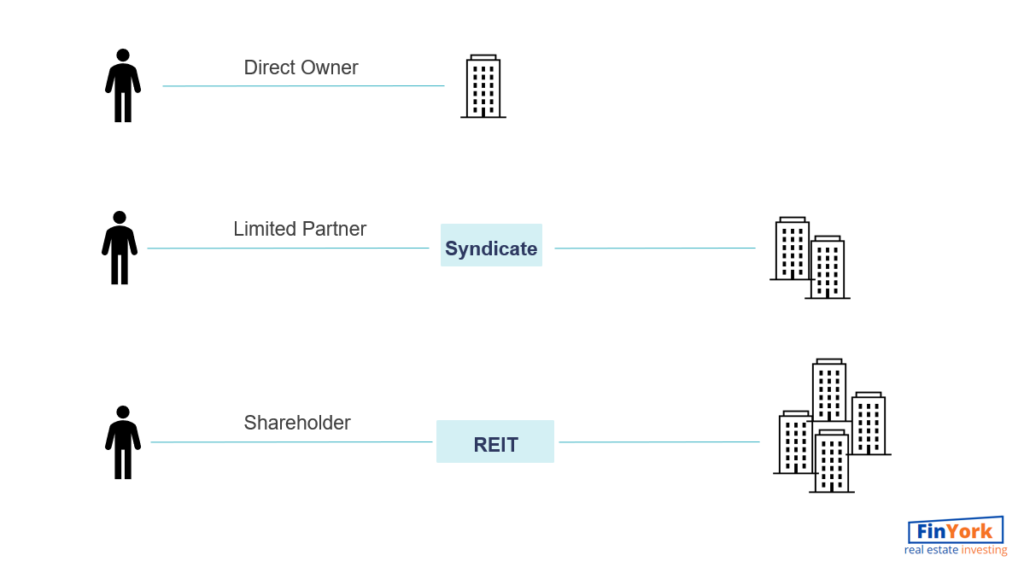
    We’ll look at all three investment options through the lens of an investor, not necessarily as someone who wants to build a career in real estate. There are many ways for investors to get started with investing in real estate. Basically, it comes down to investing in the following three major ways illustrated and explained below.

    Real Estate Investing Options

    Direct Ownership of Rentals

    Direct ownership of rentals needs no introduction. Buying a rental property has been an “old school” way to invest in real estate for decades and even centuries. Almost everyone can identify with buying a rental property and having full control over the property. People buy a rental home and are responsible for everything – buying the home and managing it themselves.

    Syndication or Crowdfunding Platforms

    Investing through syndication or crowdfunding platforms has become very popular over the past few years. Someone you know may have done it through crowdfunding platforms like Fundrise, RealCrowd or CrowdStreet. The terms maybe confusing to beginners, but think of syndicates as capital pooled from tens or hundreds of investors. The property is bought, managed and sold by the sponsor. In essence, sponsor is the active landlord and you’ll be the passive investor as a limited partner.

    REITs and Stocks

    Real Estate Investment Trusts (REITs) are real estate securities that trade like stocks. REITs are run by large institutions and they typically manage a property type (e.g. office or multifamily) across a large geographic region. Some of the popular REITs are Equity Residential for Multifamily or Prologis for Industrial property types. In addition to REITs, investors can also invest in housing stocks or real estate mutual funds.

    Comparison of Various Options

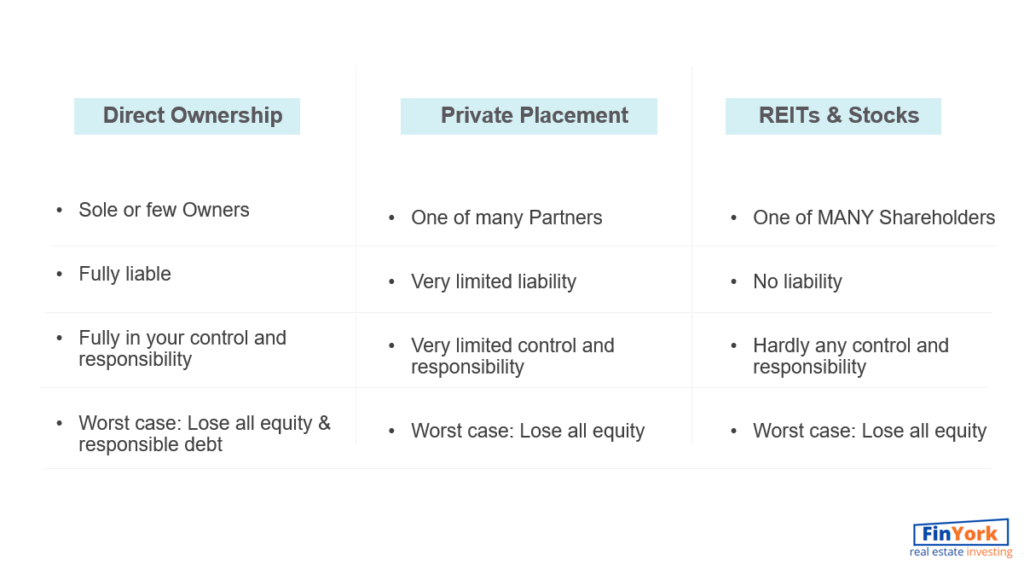
    Now that we have an understanding of the major options to invest in real estate, let us look at the characteristics of each of them. We’ll look into the four key characteristics of the real estate investing options available – Ownership, Liability, Control, and Finances. The key characteristics are summarized in the illustration below:

    Comparison of the Investing Options

    Ownership, Control and Responsibility

    When an investor invests in a rental property she will be the sole owner or one of the few owners. The investor is in full control. This is the storied mom and pop landlord that many of us are familiar with. The investor will be the sole responsible party as the landlord and she is responsible for all aspects of buying the property, getting a loan on the property, managing the property, and eventually selling it.

    For private placements, the investor will most likely be a limited partner – one amongst tens or hundreds – in a given property. The investor will share the ownership with tens and possibly hundreds of other investors depending on the capital contributed. The investor will have limited or no responsibility, but she will have access to the sponsor and will get periodic distributions (usually quarterly or monthly) and reports.

    From an ownership perspective, the investor will be one of the thousands of shareholders in REITs, funds, and housing stocks. The investor will hardly have any control over the property or management. The investor’s experience is the same as buying the shares of a public company in any other sector.

    Liability and Financial Worst Case Scenario

    When someone buys a rental property directly, they are fully liable as their name is on the title and all the documents. If a tenant sues the landlord because she hurt herself, the landlord will be fully liable and responsible. The investor also needs to get the debt (i.e. loan) and guarantee it. If things go south, the investor will lose her equity in the property and in addition, will need to pay off the debt as well. This is very important to understand.

    For private placements, the investors will usually be a limited partner i.e. someone with very limited or no liability. The sponsor will be the general partner and will be responsible for all liability. The investor doesn’t even have to worry about debt financing, as the sponsor will be responsible for the loan. So, if things go terribly wrong, the worst thing that could happen is the investor will lose all their investment, but not more.

    For REITs, the company management will be liable and the investor has NO liability at all. In the worst-case scenario, if the REIT does a poor job the investor loses all her money invested, but she won’t be responsible for the debt.

    Investor Objective and Takeaways

    We have looked into the major ways to invest in real estate and their characteristics. Now, let us come to the key question – Should you consider investing in rentals? Investors have different personal objectives, motivations, and situations. There is no one answer that fits all. We’ve seen the characteristics of the major investment options. Which one do you find appealing? The following questions will help you personalize the decision to your objectives and situation:

    • What are your (a) personal and (b) real estate investment objectives?
    • How much control/ownership do you want to keep or give to others?
    • How much liability and responsibility (including time commitment) are you willing to take?
    • Are the returns worth the risk?

    Once you have understood the characteristics of the major investment options discussed earlier and answered the above questions, the choice will start crystallizing. Are you looking for passive income with minimal time commitment and headaches? Then, the options are REITs or private placements. Do you enjoy real estate or want to be more active in real estate? Then direct ownership in rentals may make more sense. After all, you know yourself the best.

  • Should I consider Real Estate Rentals?

    One of the most common questions we get from beginner individual investors: should they invest in real estate rentals? Some want to take their first step in investing beyond stocks and bonds. Some see rentals as a source of passive income, in addition to their primary source of income. Some rent out their existing house when they buy a new house. Some are very much interested in real estate and want to take their first step. Reasons are varied and many.

    Even though there is a lot of interest, real estate investing comes across as daunting for many. The reasons are again varied and many – high capital needs, time commitment, etc. The purpose of this article is to lay out three major ways to invest in real estate, including rentals. We will look into the characteristics of the different investment options and provide an approach to answer the question. The investor can then evaluate the pros and cons and decide whether rentals make sense.

    Investing options

    Real estate investors these days have a variety of options to start investing in real estate. Many of these were not easily available to a lot of individual investors even a few years back. The major options include investing in REITs, private placements, and directly investing in rentals. The good news is that there are so many ways to invest in real estate and get started that you don’t need to have a large amount of capital which used to be a big roadblock.

    We’ll look at all three investment options through the lens of an investor, not necessarily as someone who wants to build a career in real estate. There are many ways for investors to get started with investing in real estate. Basically, it comes down to investing in the following three major ways illustrated and explained below.

    Real Estate Investing Options

    Direct Ownership of Rentals

    Direct ownership of rentals needs no introduction. Buying a rental property has been an “old school” way to invest in real estate for decades and even centuries. Almost everyone can identify with buying a rental property and having full control over the property. People buy a rental home and are responsible for everything – buying the home and managing it themselves.

    Syndication or Crowdfunding Platforms

    Investing through syndication or crowdfunding platforms has become very popular over the past few years. Someone you know may have done it through crowdfunding platforms like Fundrise, RealCrowd or CrowdStreet. The terms maybe confusing to beginners, but think of syndicates as capital pooled from tens or hundreds of investors. The property is bought, managed and sold by the sponsor. In essence, sponsor is the active landlord and you’ll be the passive investor as a limited partner.

    REITs and Stocks

    Real Estate Investment Trusts (REITs) are real estate securities that trade like stocks. REITs are run by large institutions and they typically manage a property type (e.g. office or multifamily) across a large geographic region. Some of the popular REITs are Equity Residential for Multifamily or Prologis for Industrial property types. In addition to REITs, investors can also invest in housing stocks or real estate mutual funds.

    Comparison of Various Options

    Now that we have an understanding of the major options to invest in real estate, let us look at the characteristics of each of them. We’ll look into the four key characteristics of the real estate investing options available – Ownership, Liability, Control, and Finances. The key characteristics are summarized in the illustration below:

    Comparison of the Investing Options

    Ownership, Control and Responsibility

    When an investor invests in a rental property she will be the sole owner or one of the few owners. The investor is in full control. This is the storied mom and pop landlord that many of us are familiar with. The investor will be the sole responsible party as the landlord and she is responsible for all aspects of buying the property, getting a loan on the property, managing the property, and eventually selling it.

    For private placements, the investor will most likely be a limited partner – one amongst tens or hundreds – in a given property. The investor will share the ownership with tens and possibly hundreds of other investors depending on the capital contributed. The investor will have limited or no responsibility, but she will have access to the sponsor and will get periodic distributions (usually quarterly or monthly) and reports.

    From an ownership perspective, the investor will be one of the thousands of shareholders in REITs, funds, and housing stocks. The investor will hardly have any control over the property or management. The investor’s experience is the same as buying the shares of a public company in any other sector.

    Liability and Financial Worst Case Scenario

    When someone buys a rental property directly, they are fully liable as their name is on the title and all the documents. If a tenant sues the landlord because she hurt herself, the landlord will be fully liable and responsible. The investor also needs to get the debt (i.e. loan) and guarantee it. If things go south, the investor will lose her equity in the property and in addition, will need to pay off the debt as well. This is very important to understand.

    For private placements, the investors will usually be a limited partner i.e. someone with very limited or no liability. The sponsor will be the general partner and will be responsible for all liability. The investor doesn’t even have to worry about debt financing, as the sponsor will be responsible for the loan. So, if things go terribly wrong, the worst thing that could happen is the investor will lose all their investment, but not more.

    For REITs, the company management will be liable and the investor has NO liability at all. In the worst-case scenario, if the REIT does a poor job the investor loses all her money invested, but she won’t be responsible for the debt.

    Investor Objective and Takeaways

    We have looked into the major ways to invest in real estate and their characteristics. Now, let us come to the key question – Should you consider investing in rentals? Investors have different personal objectives, motivations, and situations. There is no one answer that fits all. We’ve seen the characteristics of the major investment options. Which one do you find appealing? The following questions will help you personalize the decision to your objectives and situation:

    • What are your (a) personal and (b) real estate investment objectives?
    • How much control/ownership do you want to keep or give to others?
    • How much liability and responsibility (including time commitment) are you willing to take?
    • Are the returns worth the risk?

    Once you have understood the characteristics of the major investment options discussed earlier and answered the above questions, the choice will start crystallizing. Are you looking for passive income with minimal time commitment and headaches? Then, the options are REITs or private placements. Do you enjoy real estate or want to be more active in real estate? Then direct ownership in rentals may make more sense. After all, you know yourself the best.

  • Investing based on the Real Estate Market Cycle?

    Investing based on the Real Estate Market Cycle?

    Effective Commercial Real Estate (CRE) investing has two key requirements – capital and opportunities to invest the capital. Both are equally important and one without the other doesn’t work. And hence an investor has to constantly look for opportunities to invest if they have the capital. Where does one find real estate investing ideas or opportunities? How does an investor validate their real estate investment ideas and thesis? The purpose of this article is to answer these questions.

    A Real Estate (RE) investor has to look at the right places to get RE investment ideas in today’s information overload age. Some good sources are market studies, reports, and research done by academia, government agencies, and consulting companies. We’ll look at one great source – Real Estate Market Cycle reports – to answer our questions around RE investment ideas. We will see if we can validate investment ideas at the property or portfolio level according to the investor type and their risk tolerance. We’ll summarize investor takeaways based on the three major investor types – conservative, moderate, and aggressive.

    Real Estate Market Cycle Introduction

    You may have heard about economic/business cycles or credit cycles. The Real Estate Market Cycle can be viewed as the business cycle for the real estate industry. It is based on the fundamental belief that real estate goes through sequential cycles. A given cycle also goes through multiple phases. Real Estate Market Cycles are long, like credit cycles, and can last 10-20 years and so the investor needs to think and plan long-term.

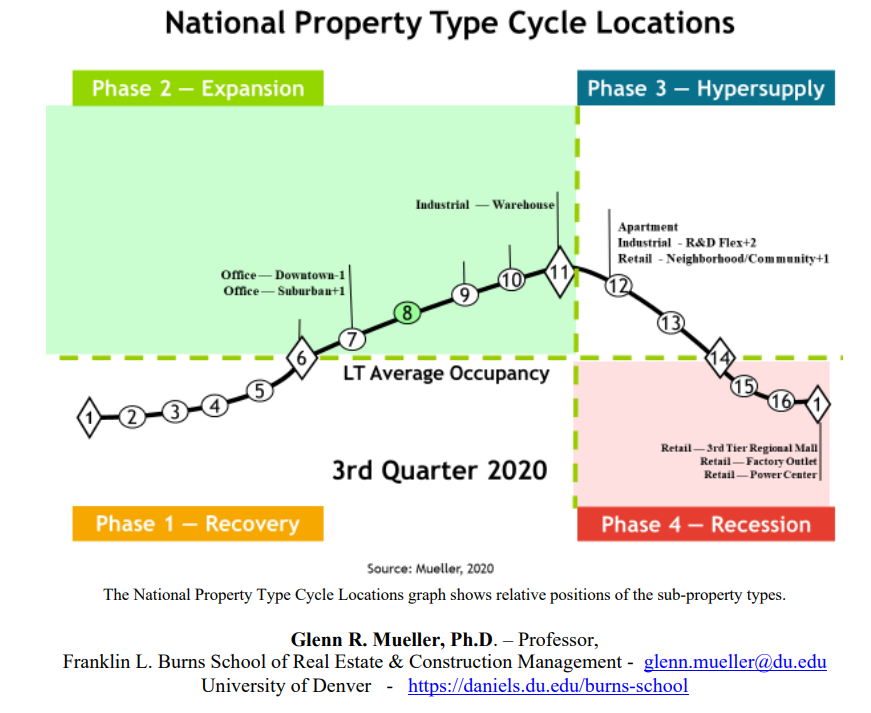
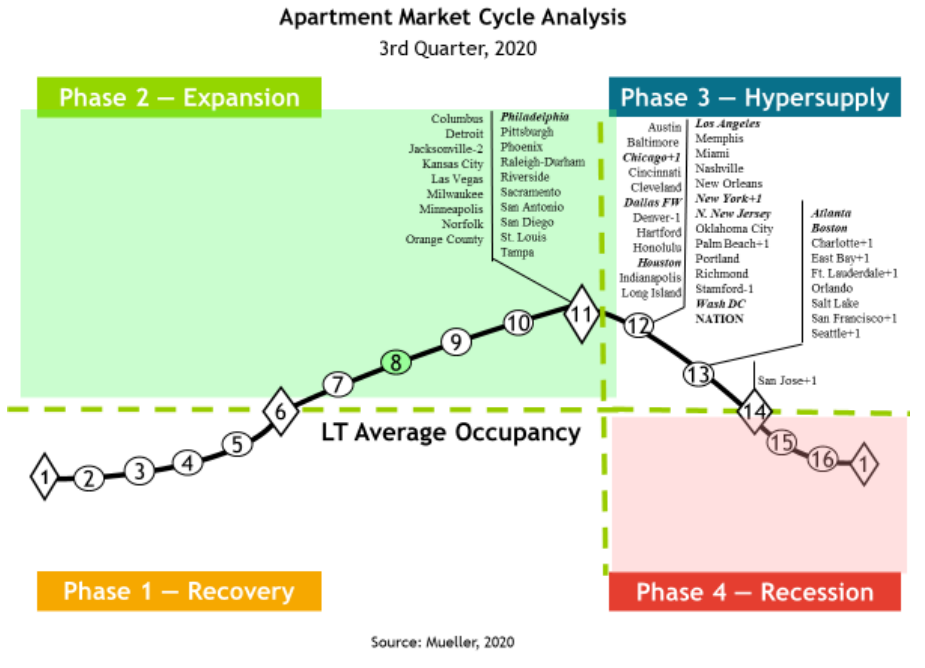
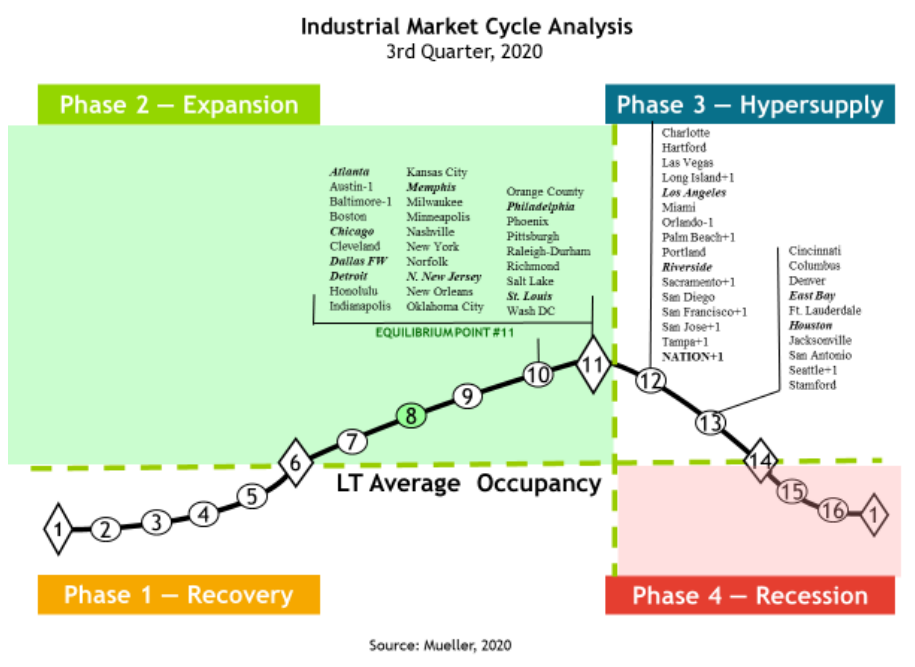
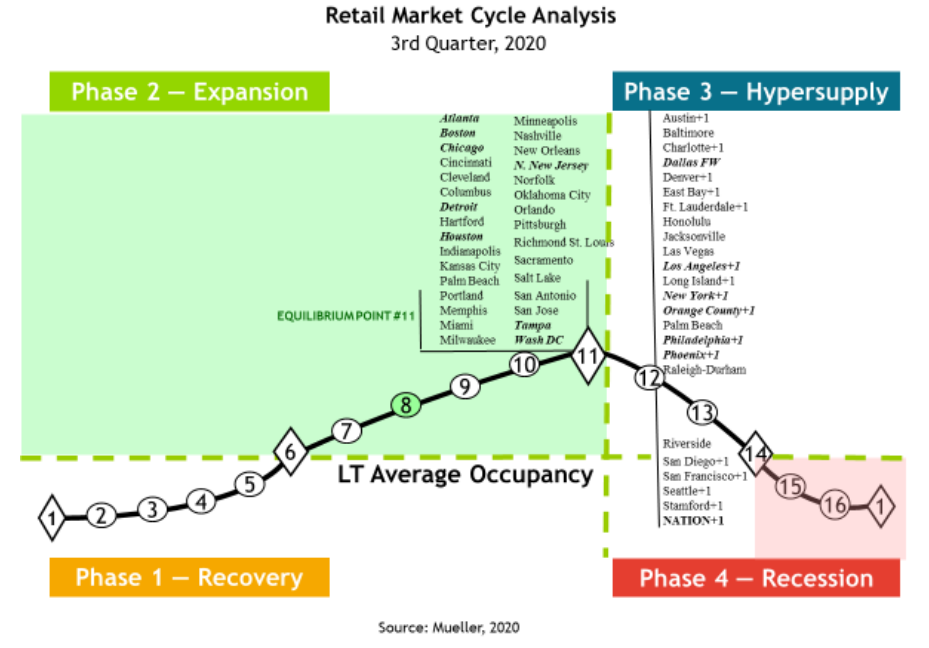
    One of the popular US real estate cycle report comes from Professor Mueller at the University of Denver. Professor Mueller publishes a quarterly Physical Market Cycle Analysis of four Property Types in 54 Metropolitan Statistical Areas (MSAs). The Real Estate Market Cycles are based on the long-term occupancy average as it is a key factor for rental growth rates, income, and thus property values. The market cycle phases or quadrants within the real estate cycle are illustrated in the graph below:

    CRE property types have different risk/reward profiles. Accordingly, Real Estate Market Cycles covers the following property types and sub-types:

    • Office – Suburban, Downtown
    • Industrial – Warehouse, R&D, Flex
    • Apartment
    • Retail – Neighborhood/Community, 3rd Tier Regional Mall, Factory Outlet, PowerCenter

    The chart below shows the National Property Type Cycle Locations in Q3 2020. In summary, Office and Industrial warehouses are in the expansion phase. Apartments, Industrial R&D and Neighborhood Retail are in the Hypersupply phase. Retail, except for neighborhood stores – is in the recession phase.

    How to leverage the Market Cycle and invest?

    How does an investor leverage the market cycle for her investment decisions – Buy, Hold, or Sell? Before we analyze this further, it is important to remind ourselves that COVID-19 has caused major dislocation in the CRE industry. CRE industry is in a state of flux and it will cloud the picture for investors in 2021-2023. The Real Estate market cycle can be one data point for investors, but not the sole data point or factor. Keeping this in mind, an investor has a couple of ways to leverage the real estate market cycle:

    Portfolio Strategy

    Portfolio strategy is the overall asset allocation amongst the major asset classes – stocks, bonds, and real estate. The Real Estate Market Cycle gives an investor the opportunity to validate or make updates to her long-term portfolio strategy. Should an investor increase or reduce her exposure to real estate? Compared to stocks and bonds what should the real estate allocation be in the years going forward? Real estate investing, in particular, takes a lot of portfolio planning and long-term thinking as the execution can run into quarters.

    New and Existing Investments

    When it comes to investing in new real estate deals, an investor can look at the Real Estate Market Cycle for the given property type and location to determine the potential risk and upside. For e.g. if the investor buys during the hyper supply phase, the returns are going to be lower than when buying during the expansion phase. On the flip side, the investor can expect more upside when she buys during recovery/expansion and sells during the hyper supply phase. The investor can follow a similar approach to see if an asset should be sold or held.

    Our opinion for all investor types

    As we saw in the last section, an investor can prepare herself and plan for her portfolio based on the Real Estate Market Cycle. It is important to keep in mind that the progression along the market curve is not always smooth and sequential. It is possible for a property type and location to fall back on the curve.

    An investor can look at the property type and location combination and see where they are in the market cycle. In the following sections, we review the Real Estate Market Cycle by property type and give our opinion for various investor types.

    Multifamily

    Multifamily property type for various locations is either in the hyper supply phase or close to it, as in the Multifamily Real Estate Market Cycle shown below. Multifamily has been resilient in 2020 with expectations for it to continue the next few years. Deal activity came to a halt for most of 2020 and it is expected to pick up in 2021. An investor will have opportunities to buy, hold, or sell but the asset prices will remain elevated in the hyper supply phase.

    Those looking to buy will be faced with high asset prices and thus low returns and cap rates. The key macro-trend to watch is the outward migration from urban and coastal areas to the sunbelt and the limited supply of housing stock.

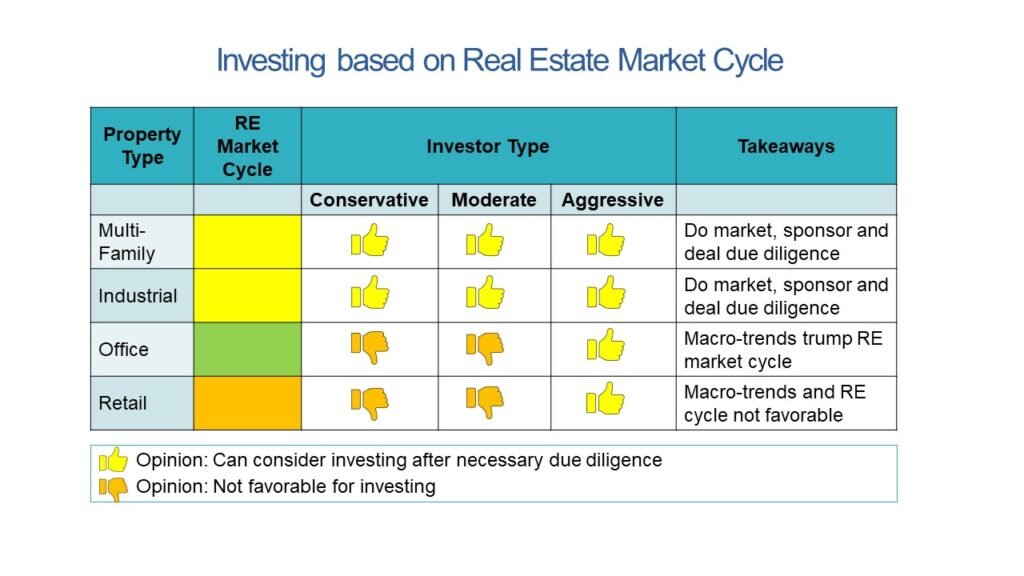
    Our opinion: Multifamily will provide opportunities for all investor types – conservative, moderate, and aggressive. But, investors need to do due diligence at the market, company/operator, and deal level.

    Industrial

    The industrial real estate market cycle looks very similar to the multifamily market cycle. Similar to multifamily, industrial properties have been resilient in 2020 and the eCommerce acceleration has only increased industrial demand. The trends in play are not going to slow down anytime and actually can be expected to increase in the coming years.

    Our opinion: Industrial will continue to provide opportunities for all investor types – conservative, moderate, and aggressive. But, investors need to do due diligence at the market, company/operator, and deal level.

    Office

    The office property type is usually the domain for institutions, but there are some individual investors who invest in smaller suburban offices. Per the Office Market Cycle Analysis, most of the markets are in the expansion phase. This may come across as a surprise to many as offices were hardly occupied in urban areas. Most of the office leases are long-term and hence there hasn’t been a drastic impact on economic occupancy as tenants have continued to pay the rent.

    The upcoming quarters need to be carefully watched as many of the urban offices may move into hyper supply or recession. Though the Office Market Cycle looks favorable, we believe it is clouded due to the long term leases. In addition, there are major macro-trends at play like work from home and employer migration to sunbelt states, that makes it risky for conservative and moderate individual investor types.

    Our opinion: We do not recommend investing in office for conservative and moderate individual investor types. Aggressive individual investors may leverage distress, adaptive reuse, or contrarian opportunities.

    This image has an empty alt attribute; its file name is 11-25-20-table4.jpg

    Retail

    Retail Maret Cycle has been clouded with the underlying macro-trend of the retail “apocalypse” over the past few years as well as COVID-19. Simply put, investing in Retail is for professional and aggressive investors only. It is for the institutional players who can make use of the adaptive reuse opportunities (i.e. convert retail into warehouses or apartments etc.). Quality institutional investors have the scale, capital, and wherewithal to execute adaptive reuse. We can expect some breakthrough innovation and associated rewards in retail, but it is not for the faint of the heart. Retail is not for conservative or moderate investors.

    Our opinion: We do not recommend investing in retail for conservative and moderate individual investor types. Aggressive individual investors may leverage distress, adaptive reuse, or contrarian opportunities.

    Investor Takeaways

    We introduced Real Estate Market Cycle as a great resource to generate or validate CRE portfolio and investment strategy. We looked into the Market Cycle for each property type and our opinion for different types of investors. The following table captures the key takeaways based on the type of investor. Conservative and moderate investors can consider multi-family and industrial property types but stay away from office and retail. Nevertheless, all investors need to do the market, sponsor, and opportunity due diligence.

    Source: Prof Mueller’s Q3 2020 Real Estate Market Cycle Analysis; FinYork’s analysis and opinion on secular trends

  • Investing based on the Real Estate Market Cycle?

    Investing based on the Real Estate Market Cycle?

    Effective Commercial Real Estate (CRE) investing has two key requirements – capital and opportunities to invest the capital. Both are equally important and one without the other doesn’t work. And hence an investor has to constantly look for opportunities to invest if they have the capital. Where does one find real estate investing ideas or opportunities? How does an investor validate their real estate investment ideas and thesis? The purpose of this article is to answer these questions.

    A Real Estate (RE) investor has to look at the right places to get RE investment ideas in today’s information overload age. Some good sources are market studies, reports, and research done by academia, government agencies, and consulting companies. We’ll look at one great source – Real Estate Market Cycle reports – to answer our questions around RE investment ideas. We will see if we can validate investment ideas at the property or portfolio level according to the investor type and their risk tolerance. We’ll summarize investor takeaways based on the three major investor types – conservative, moderate, and aggressive.

    Real Estate Market Cycle Introduction

    You may have heard about economic/business cycles or credit cycles. The Real Estate Market Cycle can be viewed as the business cycle for the real estate industry. It is based on the fundamental belief that real estate goes through sequential cycles. A given cycle also goes through multiple phases. Real Estate Market Cycles are long, like credit cycles, and can last 10-20 years and so the investor needs to think and plan long-term.

    One of the popular US real estate cycle report comes from Professor Mueller at the University of Denver. Professor Mueller publishes a quarterly Physical Market Cycle Analysis of four Property Types in 54 Metropolitan Statistical Areas (MSAs). The Real Estate Market Cycles are based on the long-term occupancy average as it is a key factor for rental growth rates, income, and thus property values. The market cycle phases or quadrants within the real estate cycle are illustrated in the graph below:

    CRE property types have different risk/reward profiles. Accordingly, Real Estate Market Cycles covers the following property types and sub-types:

    • Office – Suburban, Downtown
    • Industrial – Warehouse, R&D, Flex
    • Apartment
    • Retail – Neighborhood/Community, 3rd Tier Regional Mall, Factory Outlet, PowerCenter

    The chart below shows the National Property Type Cycle Locations in Q3 2020. In summary, Office and Industrial warehouses are in the expansion phase. Apartments, Industrial R&D and Neighborhood Retail are in the Hypersupply phase. Retail, except for neighborhood stores – is in the recession phase.

    How to leverage the Market Cycle and invest?

    How does an investor leverage the market cycle for her investment decisions – Buy, Hold, or Sell? Before we analyze this further, it is important to remind ourselves that COVID-19 has caused major dislocation in the CRE industry. CRE industry is in a state of flux and it will cloud the picture for investors in 2021-2023. The Real Estate market cycle can be one data point for investors, but not the sole data point or factor. Keeping this in mind, an investor has a couple of ways to leverage the real estate market cycle:

    Portfolio Strategy

    Portfolio strategy is the overall asset allocation amongst the major asset classes – stocks, bonds, and real estate. The Real Estate Market Cycle gives an investor the opportunity to validate or make updates to her long-term portfolio strategy. Should an investor increase or reduce her exposure to real estate? Compared to stocks and bonds what should the real estate allocation be in the years going forward? Real estate investing, in particular, takes a lot of portfolio planning and long-term thinking as the execution can run into quarters.

    New and Existing Investments

    When it comes to investing in new real estate deals, an investor can look at the Real Estate Market Cycle for the given property type and location to determine the potential risk and upside. For e.g. if the investor buys during the hyper supply phase, the returns are going to be lower than when buying during the expansion phase. On the flip side, the investor can expect more upside when she buys during recovery/expansion and sells during the hyper supply phase. The investor can follow a similar approach to see if an asset should be sold or held.

    Our opinion for all investor types

    As we saw in the last section, an investor can prepare herself and plan for her portfolio based on the Real Estate Market Cycle. It is important to keep in mind that the progression along the market curve is not always smooth and sequential. It is possible for a property type and location to fall back on the curve.

    An investor can look at the property type and location combination and see where they are in the market cycle. In the following sections, we review the Real Estate Market Cycle by property type and give our opinion for various investor types.

    Multifamily

    Multifamily property type for various locations is either in the hyper supply phase or close to it, as in the Multifamily Real Estate Market Cycle shown below. Multifamily has been resilient in 2020 with expectations for it to continue the next few years. Deal activity came to a halt for most of 2020 and it is expected to pick up in 2021. An investor will have opportunities to buy, hold, or sell but the asset prices will remain elevated in the hyper supply phase.

    Those looking to buy will be faced with high asset prices and thus low returns and cap rates. The key macro-trend to watch is the outward migration from urban and coastal areas to the sunbelt and the limited supply of housing stock.

    Our opinion: Multifamily will provide opportunities for all investor types – conservative, moderate, and aggressive. But, investors need to do due diligence at the market, company/operator, and deal level.

    Industrial

    The industrial real estate market cycle looks very similar to the multifamily market cycle. Similar to multifamily, industrial properties have been resilient in 2020 and the eCommerce acceleration has only increased industrial demand. The trends in play are not going to slow down anytime and actually can be expected to increase in the coming years.

    Our opinion: Industrial will continue to provide opportunities for all investor types – conservative, moderate, and aggressive. But, investors need to do due diligence at the market, company/operator, and deal level.

    Office

    The office property type is usually the domain for institutions, but there are some individual investors who invest in smaller suburban offices. Per the Office Market Cycle Analysis, most of the markets are in the expansion phase. This may come across as a surprise to many as offices were hardly occupied in urban areas. Most of the office leases are long-term and hence there hasn’t been a drastic impact on economic occupancy as tenants have continued to pay the rent.

    The upcoming quarters need to be carefully watched as many of the urban offices may move into hyper supply or recession. Though the Office Market Cycle looks favorable, we believe it is clouded due to the long term leases. In addition, there are major macro-trends at play like work from home and employer migration to sunbelt states, that makes it risky for conservative and moderate individual investor types.

    Our opinion: We do not recommend investing in office for conservative and moderate individual investor types. Aggressive individual investors may leverage distress, adaptive reuse, or contrarian opportunities.

    This image has an empty alt attribute; its file name is 11-25-20-table4.jpg

    Retail

    Retail Maret Cycle has been clouded with the underlying macro-trend of the retail “apocalypse” over the past few years as well as COVID-19. Simply put, investing in Retail is for professional and aggressive investors only. It is for the institutional players who can make use of the adaptive reuse opportunities (i.e. convert retail into warehouses or apartments etc.). Quality institutional investors have the scale, capital, and wherewithal to execute adaptive reuse. We can expect some breakthrough innovation and associated rewards in retail, but it is not for the faint of the heart. Retail is not for conservative or moderate investors.

    Our opinion: We do not recommend investing in retail for conservative and moderate individual investor types. Aggressive individual investors may leverage distress, adaptive reuse, or contrarian opportunities.

    Investor Takeaways

    We introduced Real Estate Market Cycle as a great resource to generate or validate CRE portfolio and investment strategy. We looked into the Market Cycle for each property type and our opinion for different types of investors. The following table captures the key takeaways based on the type of investor. Conservative and moderate investors can consider multi-family and industrial property types but stay away from office and retail. Nevertheless, all investors need to do the market, sponsor, and opportunity due diligence.

    Source: Prof Mueller’s Q3 2020 Real Estate Market Cycle Analysis; FinYork’s analysis and opinion on secular trends

  • 30 leading tech markets in the US and Canada

    30 leading tech markets in the US and Canada

    The CBRE report gives a good lay of the land of the top 30 tech cities. We advise investors to do their own due diligence as we live in a different world in 2020 and growth data from 2018 and 2019 cannot be used as reliable indicators. But, this will give some investment ideas for investors interested in the office space and also where the coveted tech jobs are going. A lot of other property types (for e..g multifamily) also look at cities with a great tech story. For the full report, please visit CBRE 2020 Tech 30.

  • Digital Maturity of your enterprise

    Digital Maturity of your enterprise

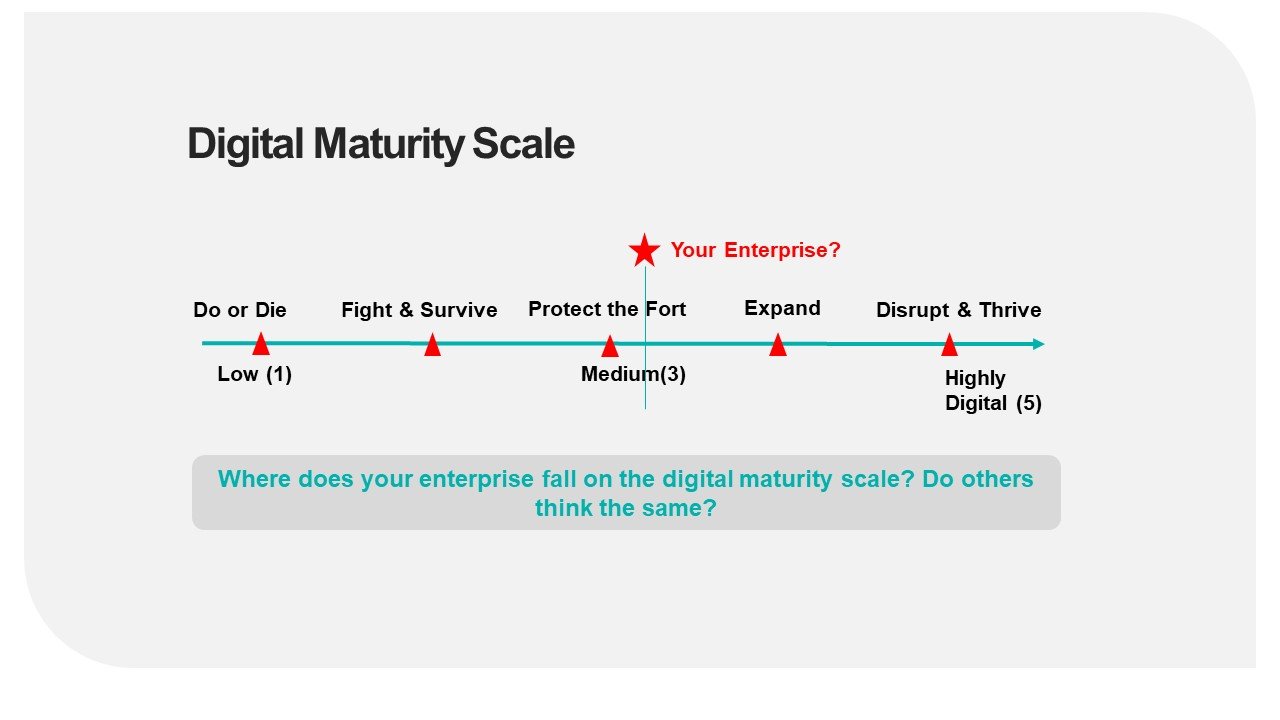
    Even before your organization starts to invest in digital, it needs to assess where it falls in the digital spectrum. This is an important step in digital strategy. As a starting point for your organization’s digital journey, see where you place on the digital maturity scale:

    1. Do or Die – Competition or disruption has already squashed the industry, organization, or product. This is a “do or die” situation for the company to reinvent its business model.
    2. Fight and survive – The business is not in imminent danger, but it is very clear that the business needs to be transformed and there is pressure from various constituents (board, shareholders) for change.
    3. Protect the Fort – Business has some competitive advantage that will take years to disrupt, but the possibility of digital disruption remains. Organizations have a sense of security and may even be complacent.
    4. Land/Expand – These are visionary companies that see opportunities in their industry to build or acquire and add value to customers and increase their market share.
    5. Disrupt/Build and Thrive – These are businesses that go after major problems in industries and disrupt the market. Typically, these are digital natives (i.e. built with digital vision).

    Honestly evaluating your enterprise’s current digital maturity will serve as the starting point for your digital strategy. The next step will be to define where you want to be on the digital maturity scale in the future and how you can get there.

  • How can an investor conquer analysis paralysis?

    How can an investor conquer analysis paralysis?

    Have you ever been in a situation where there is no progress because things keep getting stuck in the analysis? If any of the following examples sound familiar to you, then you have witnessed analysis paralysis:

    • As an investor, you have been observing a geographical market and trying to invest there for years. But, you are still in the analysis mode without taking any action.
    • Maybe you are a sponsor who has to develop a digital presence and finalize a vendor in 3 months. It is month 6 and you’re still considering the pros and cons.
    • Your team in a large enterprise had to gather investment and related data, clean it, and load it into a new system. But, the data rules and their merits are still being “validated”.
    • You are doing investment research and you should produce a final recommendation in a month. Alas, you’re still collecting and analyzing data after a couple of months.

    Why does analysis paralysis happen?

    Most investors realize that analysis paralysis can cause major delays and even make them lose deals. But then, why does it continue to happen and why do we let that happen? It usually happens due to one or more of the following:

    • Sometimes we try to gain consensus from ALL (say, business partners or family) involved. A variant of this is the pursuit of elusive perfection.
    • Unfortunately, in some cases, we are (a) afraid to make decisions or (b) don’t know how to make decisions or (c) are waiting for someone else to make the decisions.
    • There are instances when we are unable to influence, nudge, or negotiate to the outcome desired, especially with various personality types involved.
    • We “kick the can” as much as possible as there are no consequences or incentives to make timely decisions.

    How to conquer analysis paralysis?

    How do we conquer analysis paralysis then? A good part of the solution comes from changing individual or team behaviors. You can conquer analysis paralysis by following these guidelines:

    Action

    The best antidote to analysis paralysis is taking action. Be careful to work within the permissible confines of your beliefs or principles.

    Make decision making part of the process

    Adopt a work approach that has decision making embedded. For e.g. follow this common approach – define the problem statement, propose 3-4 options, evaluate the pros, and cons, and come up with a recommendation.

    Don’t aim for perfection

    Realize that there is NO perfect product or technology. Perfect quality is a myth and definitely not attainable in a given timeline. Don’t get caught up in continuous improvement to get to perfection.

    Use resources, time, or money pressure in your favor

    When we are up against time, resources, and money, it forces us to make decisions or act. We should reiterate to ourselves how lack of decisions negatively impacts the outcome. For e.g. loss of a deal.

    Takeaways

    If you are facing “analysis paralysis” in any of your endeavors, you have to first acknowledge it. It saps energy, wastes time, reduces morale, and usually benefits no one – not even the procrastinators. Only when you acknowledge it can you address it. By understanding the reasons and taking steps to resolve the analysis paralysis using some techniques outlined in this article. Time to put this into action!

  • Six design principles for digital and technology projects

    Six design principles for digital and technology projects

    Many of us are aware of the benefits of following design principles in technology and digital projects. Design principles:
    1) Provide guidelines to design solutions
    2) Help with consensus building
    3) Speed decision making

    For e.g. when different people have differing views, running against the design principles helps the team narrow the design options and choose the recommended solution.

    Here are the six design principles for technology projects based on our experience. Most principles can be applied to any digital, technology and construction project and across many industries in addition to real estate.

    1) Requirements or design should clearly demonstrate value i.e. usefulness to users
    2) Follow industry best practices – Many have walked through this path before, there is no need to “reinvent the wheel” unless it is a competitive differentiator
    3) Differentiate between business “need” and “want” and prioritize
    4) Keep it simple – Solution should be simple for users to adopt and these are usually the best solutions
    5) Leverage platform capabilities “out of the box” – Avoid customization unless it is to implement best practices; this helps to keep the solution simple and standard
    6) Don’t aim for perfection – Don’t let perfection be the enemy of good as it isn’t attainable