Tag: real estate investment tips

  • Are CRE Investors Impacting Environmental Social Governance (ESG)?

    Many experts are confirming the number of commercial real estate (CRE) investors who are considering environmental, social, and governance (ESG) standards when looking at potential investment opportunities is significantly increasing. A staggering 60 percent of respondents to brokerage CBRE’s 2021 Global Investor Intentions Survey stated that they had already adopted ESG criteria as part of their investment strategies. In other words, 3 out of every 5 CRE investors have factored ESG into their investment portfolio’s strategy. That’s an extremely significant number.

    What’s The Impact?

    This will force real estate investment firms to start catering to ESG conscious investors if they want to remain competitive. According to the same 2021 CBRE report, some CRE firms have committed to net-zero carbon emissions: Heitman by 2030, Nuveen by 2040, and Brookfield Properties by 2050. Overall, that seems like a win-win in the end. Commercial real estate properties will be built to be more eco-friendly and investors will continue to profit. What’s not to like?

    Industry executives, primarily, in the CRE property construction industry have been frustrated by increased scrutiny. This seems to be common in amongst senior executives, for the most part, and especially in an industry like construction. Anytime there’s increased regulation, that always leads to greater frustration. More tensions regarding profit margins, income statements, investor reports. Increased regulation almost always results in greater costs for corporations. What does that result in, in turn? Layoffs, a decrease in quality, a decrease in work/life balance, etc. Another way to look at it is when executives become worse off, employees under them are sure to suffer too. The same is true in the CRE market, both for companies on the demand and supply side.

    What Will Happen to the “Other” 40%?

    What about the other 40%; the investors who haven’t considered ESG as part of their investment strategy. Perhaps they don’t care about climate change, or they don’t believe factoring in ESG is a winning investment position. Either way, 40% of a group is still an extremely significant number. It’s not like those 40% can be forgotten or neglected. It’s basically the same situation as the other side of the coin: real estate investment firms will have to carry products that cater to ESG negligent investors too. This could include (amongst other things) REITs that hedge against heavily ESG driven CRE investment properties.

    What’s The Ultimate Outcome?

    Investors and investment firms that nail down the perfect balance of ESG conscious investments will prosper. Ultimately, with names in the CRE space like Heitman, Nuveen, and Brookfield Properties all committing to net-zero carbon emissions, you can expect “greener” CRE properties to be built in the future. That’s surely a win-win for everyone, political agenda, or affiliation notwithstanding. For investors, it means being more mindful of the ESG impact of a given CRE construction project. For example, if you’re in a REIG, or even more importantly as an individual investor, much like the 60% of current CRE investors who factored ESG into their CRE investment portfolio, you must do the same. With a REIG, you benefit from economies of scale where investors can collaboratively think of the best long-term approach. When you’re on your own, you must be certain you’re cognizant of all variables that may cause you to potentially get into the red on an investment. The research from this article shows that for CRE specifically, ESG will be included in prospective long-term plans.

    Be sure to take note!
  • How to Best Invest in Real Estate in the Midwest

    The most surprising feature about housing markets in the Midwest is that home prices – in most of them – are still below the level where local incomes dictate they should be (Winzer, Forbes). If you’re a real estate investor, this means two things. Firstly, there are bargains still available in these markets. Secondly, demand for housing not been very strong, at least not yet.

    Midwest Housing Market Overview

    The lack of rebound in the Midwest housing market following 2008 is largely due to the specific types of local economic growth that prevailed before that (Winzer, Forbes). The housing recession came coupled with a lengthy, slow decline in manufacturing. The availability of an educated but low-cost labor force had encouraged the growth of big financial operations in Des Moines, Minneapolis, Omaha, Sioux Falls and Green Bay. However, manufacturing still has a large role in Fayetteville, Davenport, Peoria, Rockford, Gary, Fort Wayne, South Bend, Wichita, Milwaukee and Green Bay (Millsap, Forbes).

    This makes these markets a bit riskier to invest in. The markets with a large finance sector are also risky because automation is responsible for an increasing amount of work. Despite structural problems, growth is now returning to many Midwest markets, as it did prior to COVID-19. Especially in areas that function as regional centers – Fayetteville and Peoria, for example – the expansion of jobs is due to an increase in healthcare and business services. Similarly, to the country, these services are becoming concentrated in large urban centers, creating opportunities for investors in rental housing.

    An uncharacteristic feature housing investors contend with is many Midwest markets have agricultural roots, with manufacturing later added on top. Since land was readily and easily available during their growth, they tend to be spread out. This combination produces low home prices, but increased difficulty for investors to select a locality. After all, the saying “real estate is about location, location, location”, rings true in most cases.

    Now that we’ve established some fundamental generalities, let’s get to the specifics and numbers.

    Established Demand

    Fort Wayne, Kansas City, Indianapolis, Green Bay, Springfield, Fayetteville, Gary and South Bend.

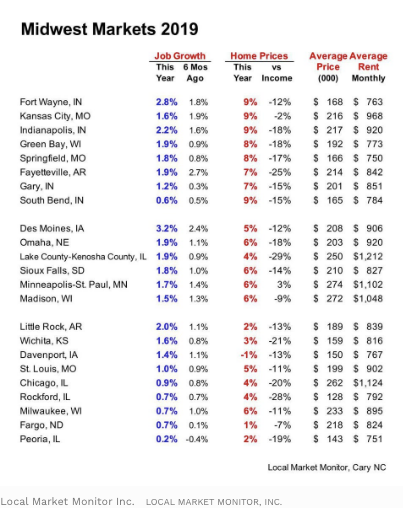
    In these markets, it appears home prices increased relatively broadly in the past year, indicating good demand not just for single-family homes, but rentals as well. With prices still well below income levels and above average job growth, demand is likely to keep raising prices higher. Though the trend depicted below shows the housing market pre-COVID, that trend is pretty much identical today. The housing market didn’t really suffer the same volume of consequences as other markets, but the small parts that did are steadily recovering (Winzer, Forbes).

    Source: Local Market Monitor, Inc.

    South Bend and Gary are at the bottom of this list because their job growth had been less reliable. Before bargains evaporate, investors should move quickly into these markets. Straight, single-family rentals – with minor improvements – are the best bet (Winzer, Forbes).

    Growing Demand

    Des Moines, Omaha, Lake County-Kenosha County, Sioux Falls, Minneapolis, Madison.

    These markets are showing solid job growth, but only moderate increases in demand thus far. Apartments appear to be a good investment in Lake County-Kenosha County and Minneapolis, due to higher density and prices. Since their dependence on the financial sector is comparably very high, most of these markets are also slightly riskier, so investors should be very careful to find properties towards the middle of the renter pool and definitely avoid the higher end.

    Uncertain Demand

    Little Rock, Wichita, Davenport, St. Louis, Chicago, Rockford, Milwaukee, Fargo, Peoria.

    In these markets either demand or job growth are weak, or even more likely, both. Low home prices are also far more commonly found in these markets. This may tempt investors to purchase a low-cost property and rent it out for cheap, without spending another dime. However, renting at the low-end is a specialty that most investors should avoid. In uncertain real estate markets, it makes sense to first look for the safest geographic areas in that market. Then you can perhaps expand and renovate a really inexpensive property, turning it into a profitable rental. That definitely involves more work, but it has potential to give you a bigger return for less risk.

    The Bottom Line

    Concisely, there’s clearly room for excellent returns on housing market investments in the Midwest. While some areas have more opportunity, depending on what strategy you choose, there’s solid return on investment potential all-around. The more time that passes from the start of the COVID-19 pandemic, the less attractive prospects will exist. Active real estate investors would be wise to look strongly into the Midwest and move quickly on specifically the kinds of properties with the features described above. Considering the housing rental market is excellent and still growing, there are definite, safe strategies to fall back on.

  • How to Best Invest in Real Estate in the Midwest

    The most surprising feature about housing markets in the Midwest is that home prices – in most of them – are still below the level where local incomes dictate they should be (Winzer, Forbes). If you’re a real estate investor, this means two things. Firstly, there are bargains still available in these markets. Secondly, demand for housing not been very strong, at least not yet.

    Midwest Housing Market Overview

    The lack of rebound in the Midwest housing market following 2008 is largely due to the specific types of local economic growth that prevailed before that (Winzer, Forbes). The housing recession came coupled with a lengthy, slow decline in manufacturing. The availability of an educated but low-cost labor force had encouraged the growth of big financial operations in Des Moines, Minneapolis, Omaha, Sioux Falls and Green Bay. However, manufacturing still has a large role in Fayetteville, Davenport, Peoria, Rockford, Gary, Fort Wayne, South Bend, Wichita, Milwaukee and Green Bay (Millsap, Forbes).

    This makes these markets a bit riskier to invest in. The markets with a large finance sector are also risky because automation is responsible for an increasing amount of work. Despite structural problems, growth is now returning to many Midwest markets, as it did prior to COVID-19. Especially in areas that function as regional centers – Fayetteville and Peoria, for example – the expansion of jobs is due to an increase in healthcare and business services. Similarly, to the country, these services are becoming concentrated in large urban centers, creating opportunities for investors in rental housing.

    An uncharacteristic feature housing investors contend with is many Midwest markets have agricultural roots, with manufacturing later added on top. Since land was readily and easily available during their growth, they tend to be spread out. This combination produces low home prices, but increased difficulty for investors to select a locality. After all, the saying “real estate is about location, location, location”, rings true in most cases.

    Now that we’ve established some fundamental generalities, let’s get to the specifics and numbers.

    Established Demand

    Fort Wayne, Kansas City, Indianapolis, Green Bay, Springfield, Fayetteville, Gary and South Bend.

    In these markets, it appears home prices increased relatively broadly in the past year, indicating good demand not just for single-family homes, but rentals as well. With prices still well below income levels and above average job growth, demand is likely to keep raising prices higher. Though the trend depicted below shows the housing market pre-COVID, that trend is pretty much identical today. The housing market didn’t really suffer the same volume of consequences as other markets, but the small parts that did are steadily recovering (Winzer, Forbes).

    Source: Local Market Monitor, Inc.

    South Bend and Gary are at the bottom of this list because their job growth had been less reliable. Before bargains evaporate, investors should move quickly into these markets. Straight, single-family rentals – with minor improvements – are the best bet (Winzer, Forbes).

    Growing Demand

    Des Moines, Omaha, Lake County-Kenosha County, Sioux Falls, Minneapolis, Madison.

    These markets are showing solid job growth, but only moderate increases in demand thus far. Apartments appear to be a good investment in Lake County-Kenosha County and Minneapolis, due to higher density and prices. Since their dependence on the financial sector is comparably very high, most of these markets are also slightly riskier, so investors should be very careful to find properties towards the middle of the renter pool and definitely avoid the higher end.

    Uncertain Demand

    Little Rock, Wichita, Davenport, St. Louis, Chicago, Rockford, Milwaukee, Fargo, Peoria.

    In these markets either demand or job growth are weak, or even more likely, both. Low home prices are also far more commonly found in these markets. This may tempt investors to purchase a low-cost property and rent it out for cheap, without spending another dime. However, renting at the low-end is a specialty that most investors should avoid. In uncertain real estate markets, it makes sense to first look for the safest geographic areas in that market. Then you can perhaps expand and renovate a really inexpensive property, turning it into a profitable rental. That definitely involves more work, but it has potential to give you a bigger return for less risk.

    The Bottom Line

    Concisely, there’s clearly room for excellent returns on housing market investments in the Midwest. While some areas have more opportunity, depending on what strategy you choose, there’s solid return on investment potential all-around. The more time that passes from the start of the COVID-19 pandemic, the less attractive prospects will exist. Active real estate investors would be wise to look strongly into the Midwest and move quickly on specifically the kinds of properties with the features described above. Considering the housing rental market is excellent and still growing, there are definite, safe strategies to fall back on.

  • Liquidity for India’s REIT Market to Improve Based on Revised SEBI Norms

    As we’ve highlighted before, real estate is by far the biggest asset class in the world. A short time back, there was a relaxation in investment norms and real estate investment trusts by the Securities and Exchange Board of India (SEBI). Real estate investment companies directly impacted praised SEBI’s initiative (Nandy, MINT). Specifically, they were grateful SEBI took a proactive approach to address a growing, local real estate market problem (Nandy, MINT). Typically, when looking at financial markets regulated by a government’s central compliance department, it’s very rare to see them proactively intervene with the intent of improving liquidity conditions for market participants. Aside from major global economic catastrophes, which always require a unique centralized response, regulators are thought of as “watchdogs”. Here, a regulator intervened to create opportunities for investors to get simpler, quicker access to larger sums of cash. 

    Indian REITS are expecting to bring in more retail investors and encourage more public listings in the future. SEBI recently revised the minimum subscription and trading lot for publicly issued REITS and infrastructure investment trusts (InvITs). with the minimum application value to be brought down from ₹50,000 now to a range of Rs.10,000-15,000 and the revised trading lot shall be of one unit.

    Support for SEBI Initiative from Major Indian REIT Investment Manager and CEO

    “We welcome SEBI’s regulation to reduce the minimum application value from ₹50,000 to Rs. 10,000-15,000, and trading lot to one unit. The earlier ₹50,000 cap restricted participation to only a certain set of investors. We believe that this amendment makes investment in REITs at par with other equity options in India. Reduction in minimum application amount will further bring in more investors thus improving the liquidity in REITs”.

    – Vinod Rohira, CEO, Mindspace Business Parks REIT

    In late 2020, it was first reported that SEBI was considering opening up REITs and InvITs to small investors by lowering the minimum trading lot size of REIT units from ₹50,000 to the value of just a single unit, much like how stocks are traded.

    Presently, there are just three publicly listed office REITs in the country – Embassy REIT, Mindspace Business Parks REIT, and the most recently listed Brookfield India REIT (Yadav, MINT).

    “We commend this proactive initiative by the regulator to reduce the trading lots of both REITs and InVITs. Embassy REIT’s listing in 2020, coupled with our strong and resilient performance since then, has paved the way for Indian REITs to evolve a mainstream asset class. With approximately $2 billion of primary REIT equity having listed in India in the last two years, leading global and domestic asset managers and growing numbers of retail holders now form the foundation of REIT unit holder registers. The reduction in lot size will increase liquidity for the entire REIT market, enable REITs to be included into benchmark domestic indices and allow greater participation from newer pools of institutional and retail investors.”

    – Michael Holland, CEO, Embassy REIT

    Impact to CRE Investing in India

    With India being on every investor’s radar as a country with potential lucrative returns, this should be welcome news. It’s also clear both Vinod and Michael, CEOs of two-thirds of India’s publicly listed REITs, echo each other’s statements. Revisions and relaxation to SEBI norms will improve liquidity conditions for REITs. This should encourage foreign investment and furthermore, the kind of investment India wants to see an increase in (Yadav, MINT).

    India has steadily been growing in CRE investment, something they telegraphed they would try to do. In India, CRE has grown at a 16 percent compound annual growth rate (CAGR) over the last five years. India was one of the few countries who avoided significant CRE investment decline resulting from COVID-19 (Sinha, Financial Express). All-in-all, while India’s real estate investment market (commercial or residential) obviously can’t be compared to the United States, the numbers paint a clear picture. The most influential Indian industry executives double down on what the numbers show. The aforementioned actions recently taken by SEBI will only continue that trajectory. How quickly India’s CRE market specifically will grow is definitely debatable, but for now there’s no doubt, investment is increasing. Again, SEBI altering norms to improve liquidity conditions for Indian REITs will continue to attract increasing investment to India.

  • Liquidity for India’s REIT Market to Improve Based on Revised SEBI Norms

    As we’ve highlighted before, real estate is by far the biggest asset class in the world. A short time back, there was a relaxation in investment norms and real estate investment trusts by the Securities and Exchange Board of India (SEBI). Real estate investment companies directly impacted praised SEBI’s initiative (Nandy, MINT). Specifically, they were grateful SEBI took a proactive approach to address a growing, local real estate market problem (Nandy, MINT). Typically, when looking at financial markets regulated by a government’s central compliance department, it’s very rare to see them proactively intervene with the intent of improving liquidity conditions for market participants. Aside from major global economic catastrophes, which always require a unique centralized response, regulators are thought of as “watchdogs”. Here, a regulator intervened to create opportunities for investors to get simpler, quicker access to larger sums of cash. 

    Indian REITS are expecting to bring in more retail investors and encourage more public listings in the future. SEBI recently revised the minimum subscription and trading lot for publicly issued REITS and infrastructure investment trusts (InvITs). with the minimum application value to be brought down from ₹50,000 now to a range of Rs.10,000-15,000 and the revised trading lot shall be of one unit.

    Support for SEBI Initiative from Major Indian REIT Investment Manager and CEO

    “We welcome SEBI’s regulation to reduce the minimum application value from ₹50,000 to Rs. 10,000-15,000, and trading lot to one unit. The earlier ₹50,000 cap restricted participation to only a certain set of investors. We believe that this amendment makes investment in REITs at par with other equity options in India. Reduction in minimum application amount will further bring in more investors thus improving the liquidity in REITs”.

    – Vinod Rohira, CEO, Mindspace Business Parks REIT

    In late 2020, it was first reported that SEBI was considering opening up REITs and InvITs to small investors by lowering the minimum trading lot size of REIT units from ₹50,000 to the value of just a single unit, much like how stocks are traded.

    Presently, there are just three publicly listed office REITs in the country – Embassy REIT, Mindspace Business Parks REIT, and the most recently listed Brookfield India REIT (Yadav, MINT).

    “We commend this proactive initiative by the regulator to reduce the trading lots of both REITs and InVITs. Embassy REIT’s listing in 2020, coupled with our strong and resilient performance since then, has paved the way for Indian REITs to evolve a mainstream asset class. With approximately $2 billion of primary REIT equity having listed in India in the last two years, leading global and domestic asset managers and growing numbers of retail holders now form the foundation of REIT unit holder registers. The reduction in lot size will increase liquidity for the entire REIT market, enable REITs to be included into benchmark domestic indices and allow greater participation from newer pools of institutional and retail investors.”

    – Michael Holland, CEO, Embassy REIT

    Impact to CRE Investing in India

    With India being on every investor’s radar as a country with potential lucrative returns, this should be welcome news. It’s also clear both Vinod and Michael, CEOs of two-thirds of India’s publicly listed REITs, echo each other’s statements. Revisions and relaxation to SEBI norms will improve liquidity conditions for REITs. This should encourage foreign investment and furthermore, the kind of investment India wants to see an increase in (Yadav, MINT).

    India has steadily been growing in CRE investment, something they telegraphed they would try to do. In India, CRE has grown at a 16 percent compound annual growth rate (CAGR) over the last five years. India was one of the few countries who avoided significant CRE investment decline resulting from COVID-19 (Sinha, Financial Express). All-in-all, while India’s real estate investment market (commercial or residential) obviously can’t be compared to the United States, the numbers paint a clear picture. The most influential Indian industry executives double down on what the numbers show. The aforementioned actions recently taken by SEBI will only continue that trajectory. How quickly India’s CRE market specifically will grow is definitely debatable, but for now there’s no doubt, investment is increasing. Again, SEBI altering norms to improve liquidity conditions for Indian REITs will continue to attract increasing investment to India.

  • Study Finds Long, Working Hours Kill Nearly a Million Individuals a Year

    According to the WHO (World Health Organization), long-working hours are directly attributed to the death’s of thousands, upon thousands, upon thousands in global cities (check out this past year, alone). We’re talking about nearly a million people in 2016 alone. The study – again conducted by the incredibly prestigious WHO and cited in BBC News – has some truly alarming statistics. This global survey contains data that is some of the first of its kind and begins gathering data to reach the hypothesis that was likely reached as early as 2016 (BBC News Service).

    As this research was being conducted all the way dating back to 2016, it’s vital to note this takes into account labor market conditions mostly prior to the global, COVID-19 pandemic. Following the aftermath of the pandemic, we’ve seen companies adapt more of a hybrid office schedule for employees. We’ve even seen some companies abandon office schedules altogether (at least for the time being). Perhaps once these working conditions began, it was somewhat refreshing to those who commuted to the office everyday. However, as other studies have shown, while many really didn’t mind working from home, some individuals who were previously content with their weekly schedules became increasingly uncomfortable. Nonetheless, as labor market conditions are returning closer to pre-pandemic times, we can likely expect to see a bit more hybrid working schedules, but largely the same pre-pandemic conditions as in 2016 (BBC News Service).

    Some Alarming Conclusions

    Referring back to that 2016 study done by the WHO and initially reported on by BBC News, of the various alarming statistics, the very first one jumps out: 745,000 people died in 2016 as a result of stroke and heart disease due to long working hours. The article goes on to cite several egregious examples of worker abuse. Lora Jones, a 22 year-old described her initial role at a digital marketing firm as “cult-like”, regarding their adherence to a 72-hour minimum work week (Jones, BBC News).

    While this may not surprise many, Goldman Sachs was thrown under the rug for overworking entry-level analysts. One report details entry-level analysts joining together to have a discussion with their managers at Goldman. They asked for an 80-hour work week cap, calling their current working conditions “abusive” and even “inhumane”. Nonetheless, in a subsequent BBC Report, Goldman CEO David Solomon had no problem with – now – a 95-hour work week. While applauding the courage of the entry-level personnel, Solomon noted “going an extra mile can go a long way”. Everyone reading this should understand the meaning of that pretty clearly.

    Furthermore, the research compared those working a 55-hour work week with those working 35-40 hours. It found that those working a 55-hour work week had a 35% higher risk of stroke and a 17% higher risk of dying from heart disease, compared to those working 35-40 hours.

    A final study, conducted by the International Labour Organization (ILO), concluded men were clearly at a higher risk. Specifically, they reported nearly three quarters of those that died due to working long hours were middle-aged or older men.

    What Will The Future Impact Be?

    BBC News continued with additional regurgitations of the same message; there’s a renewed interest in debating US working class conditions. Reports not cited by BBC show CEOs and executives taking great interest in the happiness of their everyday staff. With that, it’s important to note we’re not suggesting these BCC reports are fair portrayals of the average executive attitude, or average company culture. As we noted in the beginning, a key impact will be many companies adapting a hybrid work routine. This should appease both employees who don’t mind working from home and those who want to be in the office.

    While hybrid work schedules aren’t necessarily great news for CRE investors, they are already a reality. This isn’t something companies are considering doing in the long-run; this is something several big companies have pledged to. The list is likely to only keep growing. These positive changes, combined with a renewed interest in publicly debating this topic, bodes well for the working class. For bullish CRE investors, perhaps not so much.

  • Technological & Digital Disruption

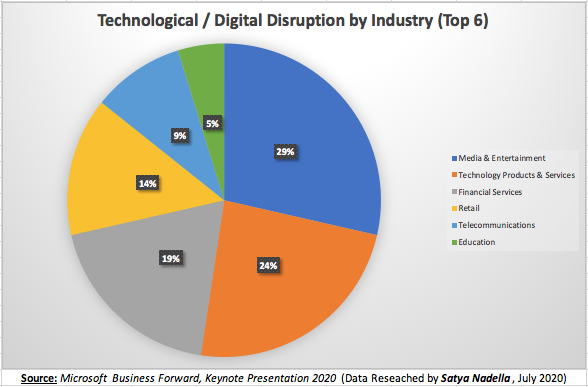
    While it’s commonly known that tech disruption is rapidly occurring, are you aware of which sectors of the US economy are being transformed the most? Initially presented in a Microsoft Business Forward forum, this research is key to assessing the sectors that need to gear up and prepare to deal with the newest technologies. The chart below substantiates just how much technological innovation and digital transformation are disrupting critical, traditional sectors within the nation’s economy.

    Top 6 Industries Impacted by Technological & Digital Disruption

    Microsoft: Top 6 Sectors Affected by Tech / Digital Disruption (Satya Nadella, 2020)

    PropTech addresses technological innovation specifically in the real estate segment. Moreover, you’ll notice that the Top 6 industries affected are most likely ones you come across in your everyday life. What does this mean for management, consumers, and the working class (specifically in these industries)? The article that complements Satya’s research shares a grim prognostication:

    “Digital disruption is well upon us. While a survey conducted by the Global Center for Digital Business Transformation for the large and mid-sized private sector companies agreed, to varying degrees, that digital disruption comes with its own set of benefits, it is also true that Digital Disruption is threatening the survival of many businesses and industries.

    Futuristic businesses and start-ups are exploring new avenues of re-inventing their business activities and industries all together to compete with and dislodge incumbents. The last decade alone has witnessed some exponential progress in technological disruption – think Airbnb, Paytm, Netflix and Uber.

    And this disruption is gradually influencing every industry, including banking, healthcare, hospitality, construction, manufacturing, packaging, logistics, and insurance amongst others (discussed in detail by Satya in Microsoft’s 2020 Keynote Forum).”

    Embee Staff

    Conclusion: What Does This Mean for Real Estate Investors?

    Succinctly, to have longevity in a given industry, the necessity for technological innovation has proven to be non-negotiable. Avoiding this reality will get you nowhere – or worse, out of business – quickly. As the abundance of digital and cloud transformation technologies are increasing, many are finding themselves playing catch-up. The information Microsoft presented suggests nearly all industries will be behind if they refuse to acknowledge technological progress. Not only acknowledge it, but make drastic changes, as necessary, to adapt alongside it.

    We’ve summarized the role technological innovation will play at length in the real estate market moving forward, specifically. Finally, ponder this. Imagine the impact to real estate markets, even globally, if critical industries and large corporations were to fall ‘behind-the-curve‘. What would this mean for CRE investors, who have continued to struggle as of late? The data study produced by Microsoft illustrates just how cataclysmic failures to adapt to new technologies – no matter the reason – can cause widespread fragility beyond the individual companies, or even those particular industry segments. It’s imperative to always look at the bigger picture. In this case, failure to adapt to new technologies will almost certainly cause broad, undesired consequences for investors.

  • Key Players in the CRE Market

    Many property types within the Commercial Real Estate (CRE) market are generally agreed to have had a poor performance the past few years, largely due to the COVID-19 pandemic restrictions. Particularly, office and retail property types. The real question investors are asking themselves is whether or not it has the potential for an emphatic return, or if a commercial real estate focus is not likely to be a great long-term investing strategy. The opportunities for successful CRE investments are still there. There are still plenty of marketplaces exclusively geared towards CRE investment, which have uniquely positioned themselves in the broader real estate investing market.

    Before committing your resources to a given investment strategy, new investors should understand who the market players are for a CRE deal. Below is a thoroughly compiled list of the key players (roles) in the commercial real estate market, which then goes onto provide an additional link to a description of each role.

    Key Players in CRE :
    • Buyer & Seller
    • Brokers: Buy-side and Sell-side
    • Legal Counsel: Buy-side, Sell-side, and Lender Counsel
    • Mortgage Broker
    • Lender/Loan Officer
    • Title Company
    • Capital Partners/Investors
    • Property Management
    • Insurance Provider
    • Appraiser & Surveyor
    • Environmental Consultant
    • Accountant: Buy-side and Sell-side

    The following article shares a useful and detailed look at the key players in CRE. Refer to the link below. It provides key details about the key players in CRE’s marketplace.

    What Are The Key Players And What Are Their Roles In A Commercial Real Estate Transaction

    As a commercial real estate investor, either as a buyer or as a seller, you work with multiple parties to move a deal from discovery through to closing. To manage a deal process efficiently, it is of utmost importance to understand all of the key players in a commercial real estate transaction.

    GerCNergy.com (Administrator)
    https://getcnergy.com/knowledge-base/key-players-in-a-commercial-real-estate-transaction/
    Summary

    The above players all comprise parts of the CRE deal. It is important for a sophisticated investor to be familiar with the various players as they can understand the dynamics of a deal and align with the sponsors who will work with most of the players mentioned.

  • Key Players in the CRE Market

    Many property types within the Commercial Real Estate (CRE) market are generally agreed to have had a poor performance the past few years, largely due to the COVID-19 pandemic restrictions. Particularly, office and retail property types. The real question investors are asking themselves is whether or not it has the potential for an emphatic return, or if a commercial real estate focus is not likely to be a great long-term investing strategy. The opportunities for successful CRE investments are still there. There are still plenty of marketplaces exclusively geared towards CRE investment, which have uniquely positioned themselves in the broader real estate investing market.

    Before committing your resources to a given investment strategy, new investors should understand who the market players are for a CRE deal. Below is a thoroughly compiled list of the key players (roles) in the commercial real estate market, which then goes onto provide an additional link to a description of each role.

    Key Players in CRE :
    • Buyer & Seller
    • Brokers: Buy-side and Sell-side
    • Legal Counsel: Buy-side, Sell-side, and Lender Counsel
    • Mortgage Broker
    • Lender/Loan Officer
    • Title Company
    • Capital Partners/Investors
    • Property Management
    • Insurance Provider
    • Appraiser & Surveyor
    • Environmental Consultant
    • Accountant: Buy-side and Sell-side

    The following article shares a useful and detailed look at the key players in CRE. Refer to the link below. It provides key details about the key players in CRE’s marketplace.

    What Are The Key Players And What Are Their Roles In A Commercial Real Estate Transaction

    As a commercial real estate investor, either as a buyer or as a seller, you work with multiple parties to move a deal from discovery through to closing. To manage a deal process efficiently, it is of utmost importance to understand all of the key players in a commercial real estate transaction.

    GerCNergy.com (Administrator)
    https://getcnergy.com/knowledge-base/key-players-in-a-commercial-real-estate-transaction/
    Summary

    The above players all comprise parts of the CRE deal. It is important for a sophisticated investor to be familiar with the various players as they can understand the dynamics of a deal and align with the sponsors who will work with most of the players mentioned.

  • NYC’s Real Estate Market Outlook as the CDC’s Moratorium on Eviction Expires

    When the CDC (Center for Disease Control and Prevention) last extended the eviction moratorium a third time, due to the COVID-19 pandemic, from the end of June 2021 to the end of July 2021, they were clear that would be the final extension. Republicans opposing another extension of the eviction moratorium cited the recent 5-4 decision by the Supreme Court, which suggested legislative approval would be required. Leading Democrats responded with brief arguments that the eviction ban needs to be extended, as Congress has only distributed $3B out of the $46.5B in approved rental relief. According to a study by the Aspen Institute, more than 15 million people in 6.5 million US households are currently behind on rental payments. The same study estimates the collective cost to landlords to this point has been over $20B. Landlord groups previously came together in an unsuccessful attempt to end the moratorium earlier, arguing the CDC overstepped their legal authority, but they were rejected by the Supreme Court’s ruling then. Determined not to give up, the National Apartment Association (NAA), with 82,600 members that collectively manage more than 9.7 million rental units, sued the U.S. government on Tuesday July 27th, seeking billions of dollars in unpaid rent due to the moratorium (Shepardson, Reuters).

    While opportunities for a federal extension essentially ended when the House of Representatives adjourned Friday July 30th, effectively giving up, there are states that have already extended the eviction ban. New York and California top the list, with the two states passing bans on evictions until August 31st and September 30th, respectively (Shepardson, Reuters). Keep in mind, the justification for the CDC initially issuing this policy was due to the federal government’s direction to self-quarantine during the worst of the COVID-19 pandemic. It was not primarily over economic concerns, as that would be outside the CDC’s purview. Regardless, assuming nothing changes from this point, New Yorker’s in financial crisis will only have one additional month of safe haven before they too will have to deal with the reality of federal protections stemming from the COVID-19 pandemic ending.

    What does the looming end of the eviction moratorium mean for NYC’s real estate market? Firstly, as predicted by several well-known real estate attorneys, there will be a huge backlog of cases in Housing Court. Prior to the pandemic, during routine economic and geopolitical times, evictions could take anywhere from three to six months – considered typical – or sometimes drag out for years on end (Hogan, NY Post). The backlog will in turn lead to some landlords, who have certainly been financially struggling throughout this ordeal, being forced into foreclosure or given no choice but to sell cheap to cash buyers. Landlords need revenue in order to run a building. They have expenses, such as providing heat, paying personnel and staff, building supers and contractors, as well as real estate taxes to boot.

    If you’re one of the savvy, fortunate investors who came out of the pandemic with a solid amount of disposable income set aside for your portfolio’s growth, a direct real estate investing approach could prove to be extremely rewarding. REIGs (Real Estate Investment Groups) can also become a powerful force in NYC’s residential real estate market in particular, once the moratorium ends. This vehicle gives real estate investors the ability to join together and pool both their money and knowledge to invest in multiple residential real estate properties. Similarly, members of the REIG would share the costs associated with property management. They could also benefit from diversification and economies of scale, which are additional benefits to joining a REIG. The bottom line for NYC is once the eviction moratorium does end, you’ll see solid opportunities for a long-term residential real estate investment. As is usually the case with financial markets during times of uncertainty, there’s definitely opportunity, but with that opportunity comes inherent market risk.