Many property types within the Commercial Real Estate (CRE) market are generally agreed to have had a poor performance the past few years, largely due to the COVID-19 pandemic restrictions. Particularly, office and retail property types. The real question investors are asking themselves is whether or not it has the potential for an emphatic return, or if a commercial real estate focus is not likely to be a great long-term investing strategy. The opportunities for successful CRE investments are still there. There are still plenty of marketplaces exclusively geared towards CRE investment, which have uniquely positioned themselves in the broader real estate investing market.
Before committing your resources to a given investment strategy, new investors should understand who the market players are for a CRE deal. Below is a thoroughly compiled list of the key players (roles) in the commercial real estate market, which then goes onto provide an additional link to a description of each role.
Key Players in CRE :
Buyer & Seller
Brokers: Buy-side and Sell-side
Legal Counsel: Buy-side, Sell-side, and Lender Counsel
Mortgage Broker
Lender/Loan Officer
Title Company
Capital Partners/Investors
Property Management
Insurance Provider
Appraiser & Surveyor
Environmental Consultant
Accountant: Buy-side and Sell-side
The following article shares a useful and detailed look at the key players in CRE. Refer to the link below. It provides key details about the key players in CRE’s marketplace.
As a commercial real estate investor, either as a buyer or as a seller, you work with multiple parties to move a deal from discovery through to closing. To manage a deal process efficiently, it is of utmost importance to understand all of the key players in a commercial real estate transaction.
The above players all comprise parts of the CRE deal. It is important for a sophisticated investor to be familiar with the various players as they can understand the dynamics of a deal and align with the sponsors who will work with most of the players mentioned.
While PropTech has seen some growth in recent years, more so before the COVID-19 pandemic, we still haven’t seen the manifestation of the scale of technological revolution in the property industry we were once promised. The vast majority of buildings we come across in our daily lives are still operating in traditional ways, using outdated but proven equipment. Let’s dive into why we are yet to see the kind of transformative innovation we were expecting on a broader scale.
Real estate is widely recognized as the world’s largest financial asset class. However, in today’s world, we often see companies rise to prominence before crashing and burning in a matter of a few short years. Most of the biggest corporations in the world today didn’t have a trace of existence 30 years ago. The real estate asset class could not be categorized more differently. It’s not only the largest asset class (by far), it’s also the oldest asset class (Hagerty, Propmodo). Historically, the property industry is a very slow, cautious sector. Unlike an App, such as Uber for example, buildings and other construction projects take many years from the design process to the completion of the physical structure. This is attributed partially to the reality that protecting buildings and the occupants inside them is paramount. In both the residential and commercial real estate sub-sectors, moving too fast and making a mistake that may lead to a potential building collapse is simply out of the question. Due to real estate’s conservative business model, even the most sophisticated PropTech products are having a difficult time gaining broad, large-scale traction (Hagerty, Propmodo).
Ernst & Young’s Comprehensive PropTech Study
An Ernst & Young (E&Y) survey recently found that 43% of those who provide PropTech products are majorly struggling with widespread adoption across a given client’s business. Additionally, the same research discovered that 35% of PropTech providers are seeing a very sizable lack of scaling, as a direct result of their application being adopted. Perhaps the biggest shock from this study is 39% of respondents are yet to adopt even a single PropTech tool.
In addition to safety concerns, the attitude of business managers has been noted as a key opponent to PropTech’s success. Value in real estate is most frequently determined by three factors: 1) location, 2) size, and 3) finishes [amenities]. Reducing costs and increasing efficiency plays a major role in the construction industry, but we don’t typically see those same levels of concern in asset management. PropTech is actually attempting to change that. With the right technology, savings from efficiency, integration, and automation can start to pile up (Hagerty, Propmodo). Having the ability to tap into data generated by buildings is providing actionable insights that are too big of a potential game-changer to ignore. For individuals or companies that already have a real estate strategy in place, implementing innovative PropTech is only putting them further ahead of the pack. Executives, board members, and direct real estate investors alike clearly understand the need for PropTech. The biggest challenge remains in implementation.
Conclusions Drawn From Ernst & Young’s Study
We can conclude from the E&Y study that the remedy starts with ensuring the right people are in place. E&Y found 53 percent of real estate owners don’t feel they have the in-house talent to successfully adopt new technology. It’s worth taking a moment to let that sink in. More than half of executives, or very senior personnel in a position to make these decisions, are not confident in their own teams’ implementation ability. Without technology-minded talent and leadership, it’s hard to see the light at the end of the tunnel. Traditional real estate leadership has often been hesitant – or perhaps more precisely, even negligent – in scrapping outdated systems and processes they’ve relied on for decades. Again, PropTech aims to alter that mindset entirely. Leveraging technology is about focusing on future potential, rather than cost. There are undoubtedly sizable upfront costs associated with widespread PropTech adoption across a portfolio. What makes executives and board members in particular hesitant with implementing PropTech is the mindset about their obligation to stakeholders being centered around cost cutting. Why bother spending money “fixing something” that isn’t broken? Buildings are operating just fine without the need for any sweeping, technological overhaul. That’s the position traditional real estate leadership has taken; they are extremely hesitant to tolerate large capital expenditures on risky, bold technologies that don’t have a clear trajectory of return on investment. Succinctly, from the E&Y analysis we can clearly deduce that executives and board members need to ensure there are enough personnel focused on technology to help senior management understand there in fact is a return on investment from implementing various PropTech products. It’s not as clear-cut, but the long-term financial benefits are there.
Again, referring back to the same E&Y data, almost 60% of real estate companies surveyed responded that they find new systems difficult to integrate with existing platforms. This is viewed as a further hinderance for executives because this translates to times and resources in order to get things set up, further disincentivizing them by piling on additional costs and additionally clouding the potential return on investment. The rapid pace of development and deployment is leading to piecemeal technology strategies instead of full end-to-end solutions, which is easier for leadership to recognize. As the PropTech industry matures, consolidations, acquisitions, and a wider array of products to service every aspect of portfolios could help solve some of those problems (Hagerty, Propmodo).
“As investors begin to see the benefit of companies adopting technology, we believe they will help drive the industry forward more rapidly in the same way that investor pressure has encouraged companies to do more and report more on ESG related issues”.
Mark Grinis, Ernst & Young Global Real Estate, Hospitality, & Construction Leader
Perhaps an unpopular opinion, but some have compelling arguments that growing pains in PropTech industry is actually a good thing. The real estate industry was stagnating for decades, perhaps centuries. In a few short years, technology has worked its way into practically every executive conversation or board member meeting. With that being said, retrofitting existing buildings will not be a viable solution for every – or most – property owners. Building technology into the bedrock of the property industry is a ground-up exercise, literally, which makes taking stock of progress that’s been made that much more important. That’s where PropTech comes in. There’s plenty of obstacles in the industry slowing down PropTech at the moment, but there’s no stopping it, especially it in the long-term as we’ve seen companies rapidly expand cloud and digital transformation technologies.
A REIG (Real Estate Investment Group) is a group of private investors who invest almost exclusively in real estate by pooling money, knowledge, and/or time to acquire properties that generate income (Brummer, Millionacres). Investment strategies for REIGs will differ based on each group’s specific strengths. A REIG is not a real estate investment trust (REIT) or crowdfunding real estate venture, although superficially, they may appear similar. They both invest the majority of pooled funds in real estate or real estate debt, earn income primarily from real estate, and distribute most of the income back to the parties involved.
Pros of a REIG
A REIG is a way for you to have your investment funds backed by physical real estate while allowing you to leverage the collective buying power and experience of the group. Additionally, investing in real estate as a group can give you a less “hands on” approach to real estate investing, or more, depending on your desires and the strengths of your group. Furthermore, a REIG is a form of “diversification” in the sense that your thoughts about the financial incentives of an acquisition may be different than your partners in the group. Of course, this can be a negative if you are unable to persuade others investors in the group and the property turns out to be a successful investment. However if you surround yourself with like-minded investors, which is generally the case for most REIGs, this is unlikely to occur often. Going back to buying power, groups of investors can pool a very substantial amount of money together. This would in turn allow them to invest greater sums of cash and diversify their investments over a greater number of real estate properties. Conversely, an individual investor may only have enough capital to put into one – or a few – properties that may wind up taking an unexpected downturn. Finally, there’s a benefit to having fellow investors with the same stakes you do because you have the opportunity to learn from them. You would be able to potentially use some of those successful strategies in your own personal real estate investments.
Cons of a REIG
Many cons to a REIG can also be viewed as strengths, depending on the amount of weight you pull in it. For example, a more “hands-off” approach to investing through a REIG can turn detrimental if the individual(s) responsible for the “hands-on” tasks do a poor job. Additionally, since REIGs pool your investment money with others, you lose out on some profit prospective with it being shared throughout the group. To the contrast, this could be viewed as a way to mitigate your conceivable losses – as mentioned in the strengths – but skilled real estate investors rarely have a pessimistic view of investments they are willing to enter into. While some view this as insignificant, the tax structure and fees associated with REIGs similarly lower your bottom line profit. Along the same lines, due to regulations and commonplace agreements signed between the parties, pulling your money out of the REIG can be burdensome and costly. Finally, many investors are prone to different management styles, have different investment goals, and differ in many other germane ways. Conflicts arising from disagreements between members in a REIG can lead to not only unfavorable financial outcomes, but it can go as far as breaking up the REIG.
Concisely, REIGs are a good fit for novice or expect real estate investors, as well as everything in between. From our perspective, the concept seems like it would be a better fit for those looking to enter the real estate market, rapidly expand their presence in that market, or if you have unique knowledge, but do not have the cash saved to personally invest in real estate yet. Reviewing the pros and cons alone, unfortunately, does not provide enough guidance as to whether or not this is the right investment vehicle for you. As with most financial investments, REIGs can be beneficial or detrimental for you, completely dependent on your financial situation, knowledge of the real estate market, and more. We do believe that an invaluable positive to REIGs is the knowledge potential from other investors in your group. Some of the most successful investors from different parts of the globe have said that intellectual capital can prove to be exponentially more valuable than simply having excess cash in a savings account, with no unique or constructive ideas on how to put that capital to use in order to maximize a positive return.
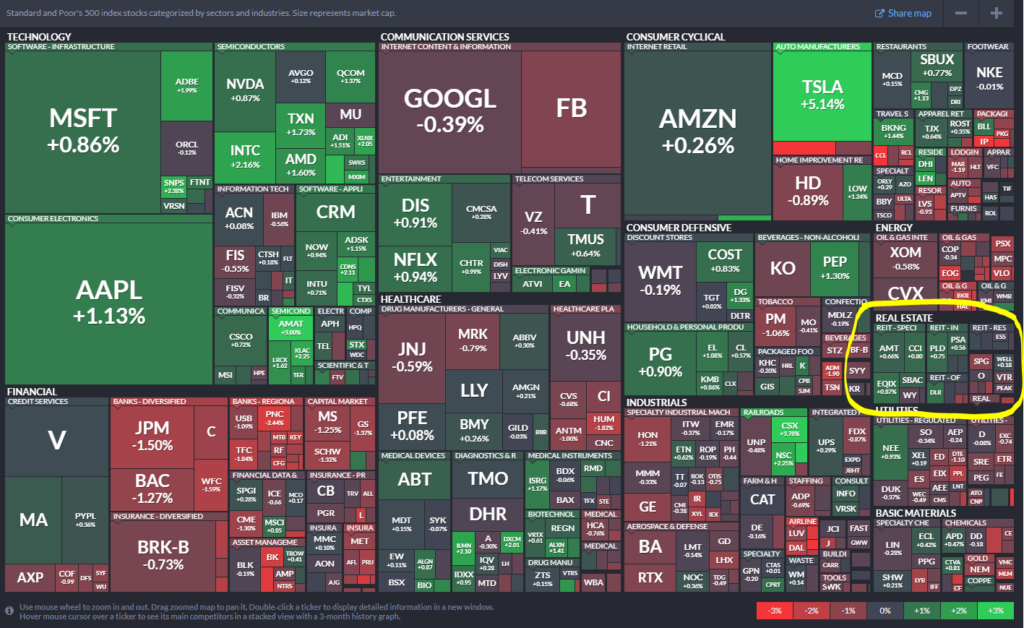
Commercial Real Estate (CRE) Investor Question #91: How big is the real estate sector in S&P 500?
The following illustration gives an idea of the size of the real estate sector (circled in yellow) within the S&P 500. Going by market size, it is one of the smallest sectors in S&P 500 as of March 2021. Technology is the biggest sector. The real estate sector consists of REITs across multiple property types like Industrial, Multifamily, Office, etc.
Source: Finviz S&P 500 composition and the Real Estate sector
Demographics and in particular net migration plays an outsized role in Real Estate. In this article, we’ll look at the key factors affecting real estate and why net migration is a good indicator to follow for real estate investors.
We’ll delve into why net migration is actually a great indicator for the top states, counties, and towns to invest in. We’ll look at some migration reports from 2020 and see if they can form the basis of some investment ideas in 2021 and beyond.
Key Pillars of Real Estate Investing
Real Estate business and investing is impacted by multiple factors, but we can group them into three major categories:
Demographics
Population Growth, Urbanization/Sub-urbanization, and Migration
Employment Growth
Income/Cost of living
Economic
Supply & Demand
Infrastructure – Technology / Transportation
Fiscal and monetary policies (for e.g. interest rates)
Incentives
Affordable housing policies
Tax and Federal housing incentives
State and local incentives and policies
For an individual investor, keeping track of the above can be overwhelming though some of the policies and economics may remain the same over years or even decades. Still, it is a stretch for individual investors. In this article, we’ll focus on demographics and see if net migration can be a proxy (or close to a proxy) to find states or cities to invest in.
Demographics and demographic trends
Our focus will be on demographics and in particular net migration in this article. Why is demographics a key pillar and why should we focus on that? Because demographics is all about the consumers i.e. tenants. One can have the best economic climate and the greatest policies, but at the end of the day a customer has to rent real estate and that is driven by demographics makeup. First, let us see the definition of demographics.
Demographics are the data that describes the composition of a population, such as age, race, gender, income, migration patterns, and population growth. These statistics are an often overlooked but significant factor that affects how real estate is priced and what types of properties are in demand
A customer (i.e. tenant) has to rent real estate in a given location and demographics is all about the customers. Investors should look at demographics at a given point of time as well as over a period of time (i.e. trends). It is also good to remember that many demographical trends were already underway and they only got accelerated due to the global pandemic in 2020.
Net Migration and Migration Trends
Investors realize that certain states or cities are growing because they see or hear about many moving to those places. For e.g. many people in New York realize that a lot of jobs are moving to the south, particularly Florida, and people follow those jobs. Net migration in certain regions, states, and cities surpass those of poorly faring places.
Savills, the International real estate firm has done studies on the reasons for migration throughout the world. Here is the summary of the impact of migration on real estate.
In-migration has a major impact on real estate as demand for both residential and commercial space increases. If supply is unable to match the demand, this often results in pressure on prices. We have analyzed data from Oxford Economics to understand which cities are expected to attract the largest net migration over the next five years as a percentage of their population.
Savills has the following take on the reasons major cities are seeing a lot of net migration:
Europe: Swiss Cities in demand
Asia: Attracting talent
North America: Quality of life
We’ll look at net migration data and statistics on the following factors in US and see if we see some patterns that will give some ideas on locations to invest.
Flight to suburbs and smaller cities
Flight to quality of life
Flight to “business” friendly and no-tax states
Net migration to secondary cities and suburbs
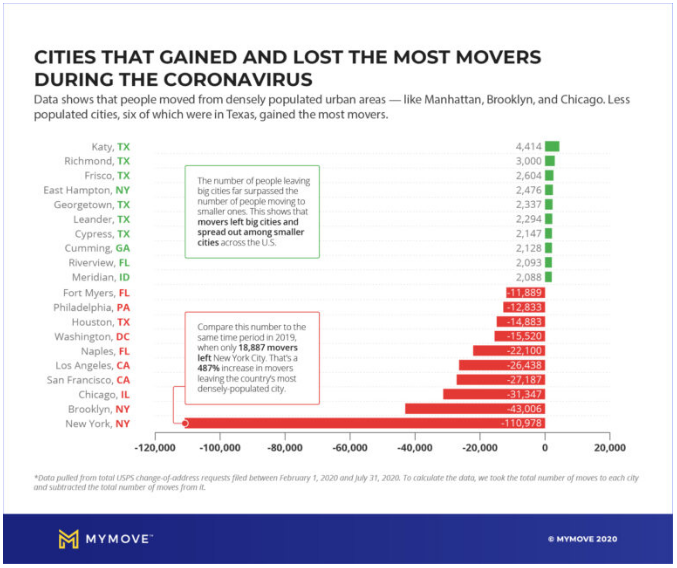
Mymove has studied migration patterns in 2020 with the COVID pandemic and over 15.9 million have moved during the pandemic based on USPS data. Urban density has been a big reason for people to move to smaller cities and suburbs. As you can see from the chart below, big cities have had a large outflow in the first half of 2020. This has resulted in rent reduction in dense and pricey cities, but the opposite in smaller cities and suburban places.
Net migration to “business” friendly or no-tax states
In the 20th century, people migrated to cities like New York or Los Angeles for better opporunities, but in the past couple of decades states like Texas have been able to lure many people with their “business” friendly or no-tax policies. Florida and Arizona are also considered “business” and tax friendly states and hence the net migration needs to be reviewed further.
Net Migration for quality of life
Quality of life is primarily defined by cost of living and access to amenities that people are looking for. Savills Research shows the top 10 cities for net migration in the US. The results should not be surprising for many. We see cities in Texas, Flordia and Georgia that have attracted sizable new population. This should give investors some ideas about places to invest.
Source: Savills Research using Oxford Economics Note: Only cities with GDP greater than $50bn considered
Investor Takeaways
In summary, we’ve seen how demographics is a key pillar of real estate investing. We’ve seen how net migration is a great indicator or proxy of demographics and even attractiveness of investment locations. We’ve also looked at migration patterns in US to help investors find states and cities that may be attractive investing targets.
Though net migration data should not be looked at on its own, looking at migration along with other key data will net investors some good investment locations and ideas. The action items for investors are to answer the questions: Do the locations you want to invest in have these positive migration characteristics? Can you update your investment thesis based on these locations?
Demographics and in particular net migration plays an outsized role in Real Estate. In this article, we’ll look at the key factors affecting real estate and why net migration is a good indicator to follow for real estate investors.
We’ll delve into why net migration is actually a great indicator for the top states, counties, and towns to invest in. We’ll look at some migration reports from 2020 and see if they can form the basis of some investment ideas in 2021 and beyond.
Key Pillars of Real Estate Investing
Real Estate business and investing is impacted by multiple factors, but we can group them into three major categories:
Demographics
Population Growth, Urbanization/Sub-urbanization, and Migration
Employment Growth
Income/Cost of living
Economic
Supply & Demand
Infrastructure – Technology / Transportation
Fiscal and monetary policies (for e.g. interest rates)
Incentives
Affordable housing policies
Tax and Federal housing incentives
State and local incentives and policies
For an individual investor, keeping track of the above can be overwhelming though some of the policies and economics may remain the same over years or even decades. Still, it is a stretch for individual investors. In this article, we’ll focus on demographics and see if net migration can be a proxy (or close to a proxy) to find states or cities to invest in.
Demographics and demographic trends
Our focus will be on demographics and in particular net migration in this article. Why is demographics a key pillar and why should we focus on that? Because demographics is all about the consumers i.e. tenants. One can have the best economic climate and the greatest policies, but at the end of the day a customer has to rent real estate and that is driven by demographics makeup. First, let us see the definition of demographics.
Demographics are the data that describes the composition of a population, such as age, race, gender, income, migration patterns, and population growth. These statistics are an often overlooked but significant factor that affects how real estate is priced and what types of properties are in demand
A customer (i.e. tenant) has to rent real estate in a given location and demographics is all about the customers. Investors should look at demographics at a given point of time as well as over a period of time (i.e. trends). It is also good to remember that many demographical trends were already underway and they only got accelerated due to the global pandemic in 2020.
Net Migration and Migration Trends
Investors realize that certain states or cities are growing because they see or hear about many moving to those places. For e.g. many people in New York realize that a lot of jobs are moving to the south, particularly Florida, and people follow those jobs. Net migration in certain regions, states, and cities surpass those of poorly faring places.
Savills, the International real estate firm has done studies on the reasons for migration throughout the world. Here is the summary of the impact of migration on real estate.
In-migration has a major impact on real estate as demand for both residential and commercial space increases. If supply is unable to match the demand, this often results in pressure on prices. We have analyzed data from Oxford Economics to understand which cities are expected to attract the largest net migration over the next five years as a percentage of their population.
Savills has the following take on the reasons major cities are seeing a lot of net migration:
Europe: Swiss Cities in demand
Asia: Attracting talent
North America: Quality of life
We’ll look at net migration data and statistics on the following factors in US and see if we see some patterns that will give some ideas on locations to invest.
Flight to suburbs and smaller cities
Flight to quality of life
Flight to “business” friendly and no-tax states
Net migration to secondary cities and suburbs
Mymove has studied migration patterns in 2020 with the COVID pandemic and over 15.9 million have moved during the pandemic based on USPS data. Urban density has been a big reason for people to move to smaller cities and suburbs. As you can see from the chart below, big cities have had a large outflow in the first half of 2020. This has resulted in rent reduction in dense and pricey cities, but the opposite in smaller cities and suburban places.
Net migration to “business” friendly or no-tax states
In the 20th century, people migrated to cities like New York or Los Angeles for better opporunities, but in the past couple of decades states like Texas have been able to lure many people with their “business” friendly or no-tax policies. Florida and Arizona are also considered “business” and tax friendly states and hence the net migration needs to be reviewed further.
Net Migration for quality of life
Quality of life is primarily defined by cost of living and access to amenities that people are looking for. Savills Research shows the top 10 cities for net migration in the US. The results should not be surprising for many. We see cities in Texas, Flordia and Georgia that have attracted sizable new population. This should give investors some ideas about places to invest.
Source: Savills Research using Oxford Economics Note: Only cities with GDP greater than $50bn considered
Investor Takeaways
In summary, we’ve seen how demographics is a key pillar of real estate investing. We’ve seen how net migration is a great indicator or proxy of demographics and even attractiveness of investment locations. We’ve also looked at migration patterns in US to help investors find states and cities that may be attractive investing targets.
Though net migration data should not be looked at on its own, looking at migration along with other key data will net investors some good investment locations and ideas. The action items for investors are to answer the questions: Do the locations you want to invest in have these positive migration characteristics? Can you update your investment thesis based on these locations?
Commercial Real Estate (CRE) Investor Question #90: What is the difference between rental yield and cap rate?
Rental yield is the net amount of money a landlord receives in rent over one year (after deducting operating expenses), shown as a percentage of the amount of money invested in the property.
So, Rental Yield = (Net Annual Rental Income / Cost) X 100
Note that rental yield is calculated on Net Operating Income without considering interest payment, tax and depreciation.
Cap rate (or capitalization rate) is the ratio between the net operating income produced by a real estate asset and its cost (or current market value).
So, Cap Rate = Net Operating Income / Value (or cost)
If you notice, both rental yield and cap rate appears to be same!
Rental yield is used to calculate the yield (return) of an asset whereas the cap rate is used to find the value (capitalized value) of an income generating real estate asset.
Commercial Real Estate (CRE) Investor Question #90: What is the difference between rental yield and cap rate?
Rental yield is the net amount of money a landlord receives in rent over one year (after deducting operating expenses), shown as a percentage of the amount of money invested in the property.
So, Rental Yield = (Net Annual Rental Income / Cost) X 100
Note that rental yield is calculated on Net Operating Income without considering interest payment, tax and depreciation.
Cap rate (or capitalization rate) is the ratio between the net operating income produced by a real estate asset and its cost (or current market value).
So, Cap Rate = Net Operating Income / Value (or cost)
If you notice, both rental yield and cap rate appears to be same!
Rental yield is used to calculate the yield (return) of an asset whereas the cap rate is used to find the value (capitalized value) of an income generating real estate asset.
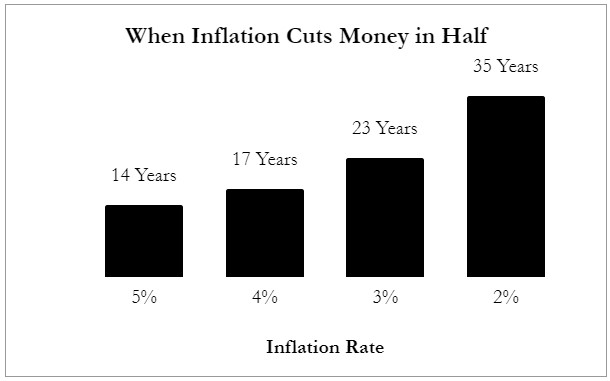
Commercial Real Estate (CRE) Investor Question #89: Is real estate / housing a good hedge against inflation?
Yes, real estate or housing is a good hedge against inflation. Ben Carlson, a popular portfolio manager has an in-depth article on this question. Here’s a picture from his book on how inflation “destroys” wealth. On the flip side, having a mortgage can help counteract those interest payments over time.