Tag: real estate investments

  • Why bother to invest in Commercial Real Estate?

    Investing in stocks or bonds has become so easy and widespread with advances in technology, with the likes of Robinhood. It also makes us wonder why invest in other asset classes like Commercial Real Estate (CRE) in the first place? In this article, we will attempt to answer this question. Along the way, we will also try to appreciate the risk profile and pros and cons of the three major asset classes – stocks, bonds, and real estate.

    As we look into the three major asset classes – stocks, bonds, and real estate – we will review the basis for portfolio diversification to manage risk. We will also look into the performance of the major asset classes in the past 15 years to see how they have performed relatively. Finally, we’ll see the relative tax and other advantages of the various asset classes as that will affect the bottom line to the investors.

    Portfolio diversification among asset classes

    You must have heard the oft-repeated phrase “don’t put all your eggs in one basket”. Though cliched, it is the idea behind portfolio diversification. In financial terms, the intent of portfolio diversification is to reduce overall volatility and enhance risk-adjusted returns. As we have seen in previous FinYork articles, investing is all about having an investment strategy in accordance with one’s risk tolerance and executing on that strategy. Hence, portfolio diversification is a key tenet of investment strategy.

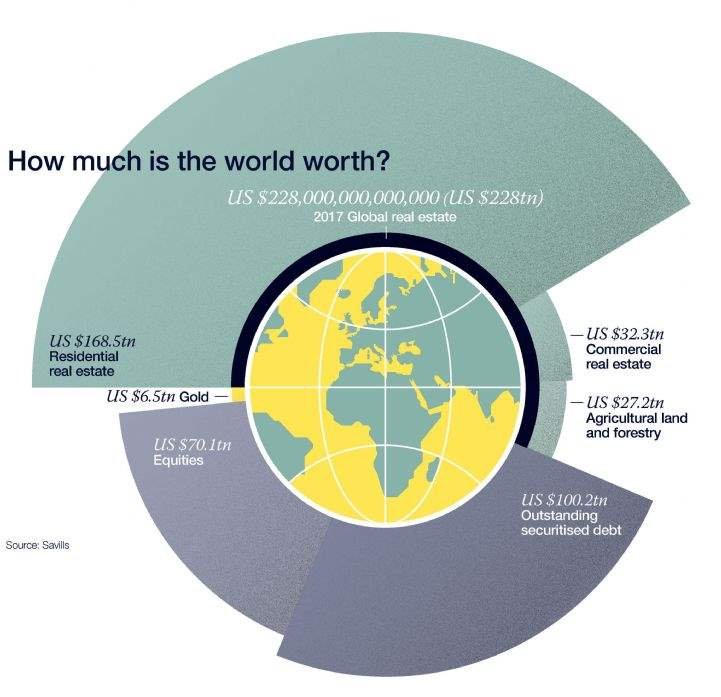
    Here’s a chart from Savills on how much the world is worth divided into various asset classes. Real estate refers to residential real estate and CRE market size is $32 Trillion. It comes after Debt (Bonds) and Equities (Stocks) and only growing. Essentially, CRE is a major asset class globally.
    How much is the world worth
    Source: Savills

    When added to a stock and bond portfolio, real estate can provide diversification benefits as real estate has historically shown a low correlation to stocks or bonds. There have been a couple of instances when all asset classes move together as in the Great Financial Crisis (GFC). Still, it is fair to say that the addition of real estate to a mixed-asset portfolio may lower overall volatility and enhance risk-adjusted returns.

    Real estate is likely the first asset class that we got exposed to whether it is to live, study, play, or work. Even if everything falls apart, humans need people need built space to sleep, live, and work. Simply put, humans cannot live without real estate. This provides a powerful argument for the longevity of the asset class and why a portfolio must have exposure to an asset class that meets the basic needs of humans.

    Long-term investment returns

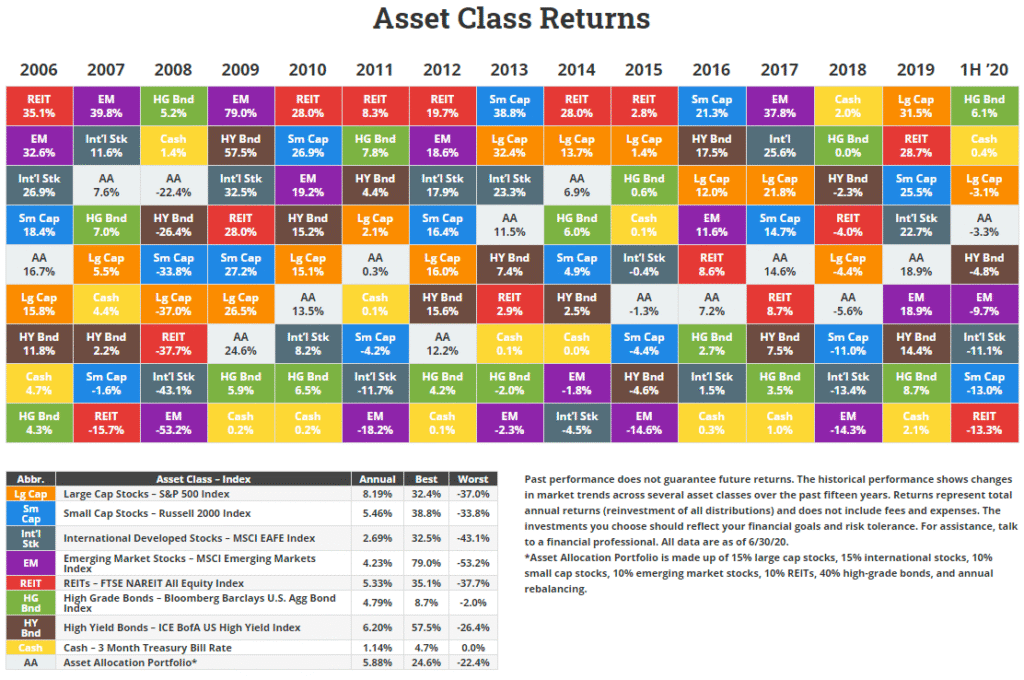
    As of Feb 2021, stock markets are at all-time highs even though it has not been a good year for certain real estate property types like retail or hotels. Let us rewind a bit and look at asset class returns over a longer period. We found the following chart from Novel Investor that compares asset class performance since 2006. As it turns out, REITs (real estate securities) came out on top the most in 6 of the 15 years tracked. Including the 2007-2008 great financial crisis (GFC), which was triggered by real estate, REITs have performed well.
    Asset Class Returns 
2006 
35.1% 
Int'l Stk 
Sm Cap 
16.7% 
Lg Cap 
HY end 
11.8% 
HG end 
4.3% 
Abbr. 
Int'l 
end 
2007 
Int'l Stk 
11.6% 
7.6% 
HG end 
Lg Cap 
Cash 
HY end 
Sm Cap 
-15.7% 
2008 
HG end 
1.4% 
-22.4% 
HY end 
Sm Cap 
Lg Cap 
Intl Stk 
-411% 
2009 
HY end 
57.5% 
Intl Stk 
Sm Cap 
Lg Cap 
HG end 
2010 
Sm Cap 
HY end 
Cap 
15.1% 
13.5% 
Int'l Stk 
8.2% 
HG end 
0.2% 
2011 
8.3% 
HG end 
HY end 
Cap 
2.1% 
0.3% 
Cash 
Sm Cap 
Intl Stk 
-11.7% 
-18.2% 
Annual 
8.19% 
5.46% 
2.69% 
4.23% 
5.33% 
4.79% 
6.20% 
1.14% 
5.88% 
2012 
19.7% 
Intl Stk 
17.9% 
Sm Cap 
Lg Cap 
HY end 
12.2% 
HG end 
0.1% 
2013 
Sm Cap 
Lg Cap 
Int'l Stk 
11.5% 
HY end 
7.4% 
HG end 
2014 
Lg Cap 
13.7% 
HG end 
Sm Cap 
HY end 
Intl Stk 
2015 
2.8% 
Lg Cap 
1.4% 
HG end 
Int'l Stk 
-0.4% 
Sm Cap 
HY end 
-14.6% 
2016 
Sm Cap 
21.3% 
HY end 
17.5% 
Lg Cap 
11.6% 
REIT 
7.2% 
HG end 
Stk 
1.5% 
2017 
Int'l 
25.6% 
Lg Cap 
21.8% 
Sm Cap 
14.6% 
REIT 
HY end 
3.5% 
2018 
Cash 
HG end 
HY end 
REIT 
Lg Cap 
Sm Cap 
-11.0% 
Int'l Stk 
-13.4% 
-143% 
2019 
Lg Cap 
31.5% 
REIT 
28.7% 
Sm Cap 
Int'l Stk 
22.7% 
18.9% 
18.9% 
HY end 
2.1% 
IH '20 
HG end 
6.1% 
Lg Cap 
-3.1% 
HY end 
Stk 
-11.1% 
Sm Cap 
-13.0% 
REIT 
-13.3% 
Asset Class - Index 
Large Cap Stocks - S&P 500 Index 
Small Cap Stocks - Russell 2000 Index 
International Developed Stocks - MSCI EAFE Index 
Emerging Market Stocks - MSCI Emerging Markets 
Index 
REITs - FTSE NAREIT All Equity Index 
Hi h Grade Bonds - Bloomberg Barclays U.S. Agg Bond 
In ex 
High Yield Bonds - ICE BofA US High Yield Index 
Cash -3 Month Treasury Bill Rate 
Asset Allocation Portfolio* 
Best 
32.4% 
38.8% 
32.5% 
79.0% 
35.1% 
8.7% 
57.5% 
4.7% 
24.6% 
Worst 
-37.0% 
-33.8% 
-43.1% 
-53.2% 
-37.7% 
-2.0% 
-26.4% 
0.0% 
-22.4% 
Past performance does not guarantee future returns. The historical performance shows changes 
in market trends across several asset classes over the past fifteen years. Returns represent total 
annual returns (reinvestment of all distributions) and does not include fees and expenses. The 
investments you choose should reflect your financial goals and risk tolerance. For assistance, talk 
to a financial professional. All data are as of 6/30/20. 
*Asset Allocation Portfolio is made up of 15% large cap stocks, 15% international stocks, 10% 
small cap stocks, 10% emerging market stocks, 10% REITs, 40% high-grade bonds, and annual 
rebalancing.
    Source: Novel investor Asset Class Returns

    Income Potential

    Real estate is in many ways different than a popular high-tech stock that may have doubled over a couple of years. For e.g. real estate offers investors relatively steady and recurring quarterly or monthly income that comes from operations. Many property types in real estate historically involved multi-year lease agreements (e.g. office leases) and hence the cash flow also tends to be relatively predictable and long-term in nature.

    On the other end, an investor may be getting zero returns in her savings accounts. Relatively speaking, real estate offers higher yields for such investors. When the cash and equivalents produce close to zero interests. A lot of people (e.g. retirees) need steady and stable cash flows.

    Inflation hedge and tax advantages

    The fourth benefit real estate provides – inflation hedge and tax advantages. This is very powerful because it can make a big difference to how much money you can actually pocket. Compared to other asset classes, CRE provides a level of inflation protection. How does it provide protection? Real estate leases for the most part incorporate rent increases based on inflation. You may be familiar with your annual house or office rent increase based on inflation. In addition, property values also appreciate based on input costs. If the cost of input like construction material or amenities increase due to inflation, so does the property price and value. The above also doesn’t take into account inflation i.e. it assumes the dollar value is the same in 2006 as it is in 2020. We know that a dollar can buy less of gas or milk than before.

    Investing directly in hard assets provides tax advantages in most countries. Tax policies favor real estate investing in many countries including the USA. For stocks and bonds, you’d have to pay taxes on interests, dividends, and capital gain. Depreciation and other treatment can lead to a paper loss when filing corporate or individual taxes. Hence, your tax burden may actually be very less. This deserves in-depth treatment and we will cover it in the future, but let us remember that many countries have historically provided very favorable treatment to the real estate sector.

    Investor takeaways

    We looked at the major asset classes and the role real estate can play in a portfolio to provide diversification. Real estate can help some investors meet their diversification strategy according to their risk tolerance. Looking at the long-term investment returns of various asset classes securities, Real Estate performance has actually been good in the long run. Scars of the Global Financial Crisis remain and COVID-19 will continue to be a challenge for many real estate property types.

    We also compared the asset classes using inflation and a tax lens. Of all the asset classes, real estate provides the most inflation hedge and tax advantages due to real estate advantageous tax policies in many countries.

    In summary, it may be worth investing in Real Estate as an asset class. We at FinYork believe all asset classes have a role to play in a portfolio, though we’ll be the first to admit we’re biased towards the real estate asset class. We also believe the real estate asset class is going to become more available and accessible to investors in the years to come. We want all investors to learn and benefit from this asset class. We plan to have a corresponding article on why NOT to invest in real estate. We encourage you to read both the articles and come to your own conclusions.
  • Sources and Uses of Funds

    Sources and Uses of Funds

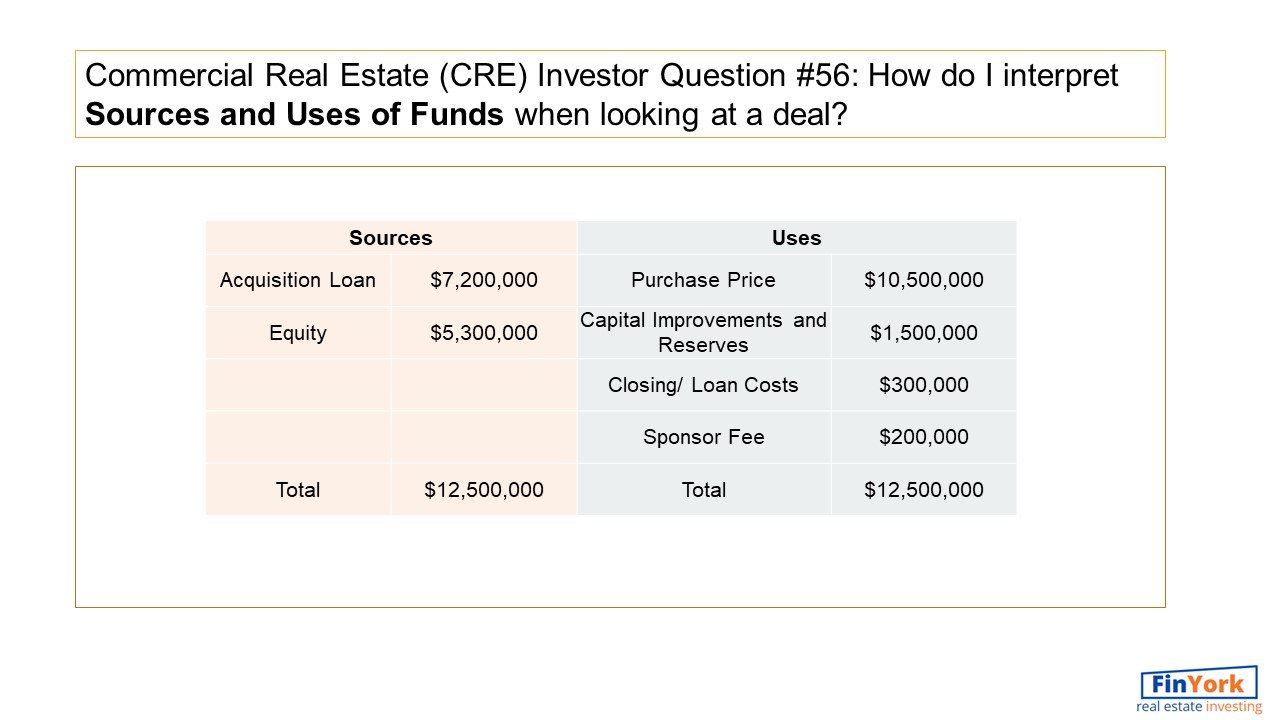
    Commercial Real Estate (CRE) Investor Question #56: I am looking at a CRE deal. Can you explain the sources and uses of funds?

    Sources and uses of funds is a summary view of capital needs of the deal (uses) and how the capital will be raised (sources). This should be a key part of any pitch of the sponsor and should give a high level idea of the capital stack (debt vs. equity) and the overall costs including fees to close the deal. An example snapshot is provided in the featured image.

  • General Partner & Limited Partner

    Commercial Real Estate (CRE) Investor Question #55: I am looking at a real estate syndicated / private placement / private equity deal. Who is a General Partner(GP) and who is a Limited Partner(LP)?

    General Partner is typically the sponsor or operator responsible for finding the deal, setting up the deal, handling the transaction, securing the financing, managing the investment, and eventually selling it.

    Limited Partners are passive investors and they contribute capital to the syndicate to earn a return on their investment. LPs benefit from having limited liability in the investment.

    For a more detailed treatment, check out the article.

    #finyork #100crequestions #cre #commercialrealestate #investing #creinvesting #alternativeinvestments

  • General Partner & Limited Partner

    Commercial Real Estate (CRE) Investor Question #55: I am looking at a real estate syndicated / private placement / private equity deal. Who is a General Partner(GP) and who is a Limited Partner(LP)?

    General Partner is typically the sponsor or operator responsible for finding the deal, setting up the deal, handling the transaction, securing the financing, managing the investment, and eventually selling it.

    Limited Partners are passive investors and they contribute capital to the syndicate to earn a return on their investment. LPs benefit from having limited liability in the investment.

    For a more detailed treatment, check out the article.

    #finyork #100crequestions #cre #commercialrealestate #investing #creinvesting #alternativeinvestments

  • Where to put your assets to work?

    We looked at how understanding our risk tolerance and setting goals is the first stage of investing in a previous post. What do we do once we understand our risk tolerance and the goals are set? The next step is to have a basic idea of the investing universe and determine the areas to put investment dollars to work.

    Many individual investors have a typical journey when it comes to investing. We would have started with savings accounts or CDs and then moved to dabbling in stocks and bonds. It is also very likely that many were forced to manage our retirement portfolios when we started working and got introduced to mutual funds and index funds. Along the way, some may have got exposed to real estate, commodities, or derivatives.

    In essence, many individual investors do not have the opportunity to look at their portfolio holistically. After all, most of our time is consumed with our daily job and family commitments. The purpose of this article is to provide a holistic picture of investing. We will go through the various investment options available for investors to put their assets to work. We’ll get some ideas from top institutional investors who have performed well in the long run.

    Myriad of Investing options

    An investor has a myriad of investments to choose from these days. We may have heard about many of these investments, but we may have just invested in one or two of them. It can sometimes be confusing and sometimes daunting.

    Unfortunately, investing is not taught for many in school or college and hence we don’t have any structured approach or framework for investing to follow. Let us first understand the myriad of investment options available. In the financial world, the various investment options are also called asset classes.

    An asset class is a grouping of investments that exhibit similar characteristics and are subject to the same laws and regulations.

    https://www.investopedia.com/terms/a/assetclasses.asp

    The major asset classes are depicted below. Historically, the  popular asset classes have been stocks, bonds, cash-equivalent, commodities and real estate as depicted below. This misses some of the relatively newer investing options like private equity, hedge fund, derivatives and cryptocurrencies.

    https://www.franklintempletonindia.com/investor/investor-education/video/understanding-asset-classes-io04og31

    If you’re interested further in evaluating the various asset classes, nerdwallet has a detailed review of major asset classes.

    How do you allocate the assets?

    Understanding asset classes provide a lay of the land or big picture that will help you chose the asset classes that you can invest in. Understanding various characteristics of the asset classes helps you diversify your assets (the often used “don’t put all your eggs in one basket”).

    The key is to understand the characteristics of an asset class, whether you invest in it or not. For e.g. when one thinks of transportation, one intuitively understands the difference between various modes of transportation – cars, trucks, trains, buses, planes, etc, and their characteristics. Assets classes are similar when it comes to characteristics between the various asset classes.

    There are various traditional asset allocation calculators available to help allocate the assets. Many of them only consider traditional assets – stocks, bonds, and cash – only. We’ll see in the upcoming section, why investors should also consider diversifying beyond these traditional assets.

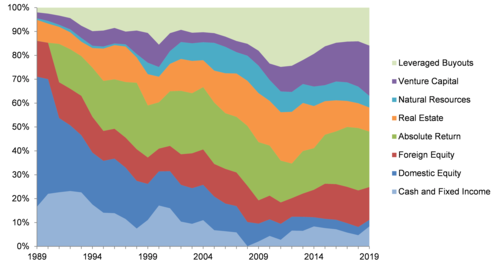
    Yale University’s Asset Allocation

    Let us look at industry leaders when it comes to investment performance. We can look at enterprises with a good record of investment returns. Yale University is one of them. Yale University is known for its portfolio performance as it has performed better than many peers and many college endowments compare themselves to Yale’s endowment performance. Let us take a look at Yale’s portfolio below.

    AA FY19.png
    Source: Yale Investments Office

    As we can see, Yale has allocated amongst many asset classes, some available to individual investors and some that aren’t (except for those with high net worth). Yale does invest in cash and fixed income, equities, and real estate that are available to individual investors. It also invests in private equity, venture capital, etc. that may not be available to individual investors.

    California Pension Fund’s Asset Allocation

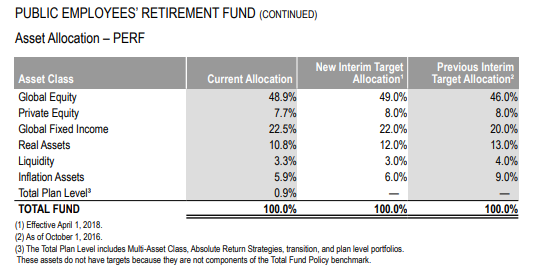
    Let us look at another institution that manages many people’s money – Calpers. Calpers is California’s pension fund and manages the pension funds of its 1.9 million members. They are a leading institution when it comes to investment portfolio management. Let us take a look at Calpers portfolio below.

    PUBLIC EMPLOYEES' RETIREMENT FUND (CONTINUED) 
Asset Allocation - PERF 
Asset Class 
Global Equity 
Private Equity 
Global Fixed Income 
Real Assets 
Liquidity 
Total Plan Level' 
TOTAL FUND 
1.2018 
Current Allocation 
489% 
225% 
108% 
100.0% 
New Interim Target 
Allocation' 
12.0% 
100.0% 
Previous Interim 
Target Allocation• 
46 
80% 
20 
130% 
9.0% 
100.0% 
(3) Tots 
Tt— wts do ttE TctS
    Source: Calper’s Investment Report

    Essentially, Calpers has major allocation to cash equivalents (liquidity, inflation assets), fixed income, real estate and equities.

    Personal Asset Allocation

    Looking at Yale and Calpers has given us an idea of how a couple of leading institutions are allocating between assets. We can draw some lessons for our personal portfolio from them though some asset classes may be out of reach for many individual investors.

    Thinking through risk tolerance and portfolio asset allocation is a key pillar of investing. For a majority of us, the investment universe may just consist of cash and fixed income, equities, and real estate. The exact percentage allocation for your portfolio would be based on your risk tolerance and your goals. The traditional calculators and thinking behind asset allocation is undergoing a big change.

    • Traditional Assets
      • Cash
      • Bonds
      • Stocks – Domestic and Foreign
    • Alternative Assets
      • Real Estate – REITs, crowdfunding, direct ownership, or private placements
      • Private Equity
      • Venture Capital
      • Commodities
    • Your Business

    If you need more ideas on the % allocation, check out articles that address the various asset classes described above. We highly recommend you do this exercise on a regular basis. Here’s some advice from US SEC for investors.

    If you understand your time horizon and risk tolerance – and have some investing experience – you may feel comfortable creating your own asset allocation model. “How to” books on investing often discuss general “rules of thumb,” and various online resources can help you with your decision.

    For example, although the SEC cannot endorse any particular formula or methodology, the Iowa Public Employees Retirement System (www.ipers.org) offers an online asset allocation calculator. In the end, you’ll be making a very personal choice. There is no single asset allocation model that is right for every financial goal. You’ll need to use the one that is right for you.

    Some financial experts believe that determining your asset allocation is the most important decision that you’ll make with respect to your investments – that it’s even more important than the individual investments you buy….

    Source: US SEC’s Investor Beginner’s Guide

    Investor Takeaways

    Coming up with a personal asset allocation model is the biggest decision an investor can make. An investor should devote significant time and attention to this effort and get trusted financial advice as needed. After taking a risk tolerance assessment and understanding your risk profile, the next step is to understand the major asset classes and allocate them amongst your portfolio.

    We’ve seen some examples of leading institutional investors and how they invest in both traditional and alternative asset classes. Leverage calculators and modern thinking around asset allocation. Write down your asset allocation model and visit it on a periodic basis. This exercise is in itself worth your time in Gold.

  • Where to put your assets to work?

    We looked at how understanding our risk tolerance and setting goals is the first stage of investing in a previous post. What do we do once we understand our risk tolerance and the goals are set? The next step is to have a basic idea of the investing universe and determine the areas to put investment dollars to work.

    Many individual investors have a typical journey when it comes to investing. We would have started with savings accounts or CDs and then moved to dabbling in stocks and bonds. It is also very likely that many were forced to manage our retirement portfolios when we started working and got introduced to mutual funds and index funds. Along the way, some may have got exposed to real estate, commodities, or derivatives.

    In essence, many individual investors do not have the opportunity to look at their portfolio holistically. After all, most of our time is consumed with our daily job and family commitments. The purpose of this article is to provide a holistic picture of investing. We will go through the various investment options available for investors to put their assets to work. We’ll get some ideas from top institutional investors who have performed well in the long run.

    Myriad of Investing options

    An investor has a myriad of investments to choose from these days. We may have heard about many of these investments, but we may have just invested in one or two of them. It can sometimes be confusing and sometimes daunting.

    Unfortunately, investing is not taught for many in school or college and hence we don’t have any structured approach or framework for investing to follow. Let us first understand the myriad of investment options available. In the financial world, the various investment options are also called asset classes.

    An asset class is a grouping of investments that exhibit similar characteristics and are subject to the same laws and regulations.

    https://www.investopedia.com/terms/a/assetclasses.asp

    The major asset classes are depicted below. Historically, the  popular asset classes have been stocks, bonds, cash-equivalent, commodities and real estate as depicted below. This misses some of the relatively newer investing options like private equity, hedge fund, derivatives and cryptocurrencies.

    https://www.franklintempletonindia.com/investor/investor-education/video/understanding-asset-classes-io04og31

    If you’re interested further in evaluating the various asset classes, nerdwallet has a detailed review of major asset classes.

    How do you allocate the assets?

    Understanding asset classes provide a lay of the land or big picture that will help you chose the asset classes that you can invest in. Understanding various characteristics of the asset classes helps you diversify your assets (the often used “don’t put all your eggs in one basket”).

    The key is to understand the characteristics of an asset class, whether you invest in it or not. For e.g. when one thinks of transportation, one intuitively understands the difference between various modes of transportation – cars, trucks, trains, buses, planes, etc, and their characteristics. Assets classes are similar when it comes to characteristics between the various asset classes.

    There are various traditional asset allocation calculators available to help allocate the assets. Many of them only consider traditional assets – stocks, bonds, and cash – only. We’ll see in the upcoming section, why investors should also consider diversifying beyond these traditional assets.

    Yale University’s Asset Allocation

    Let us look at industry leaders when it comes to investment performance. We can look at enterprises with a good record of investment returns. Yale University is one of them. Yale University is known for its portfolio performance as it has performed better than many peers and many college endowments compare themselves to Yale’s endowment performance. Let us take a look at Yale’s portfolio below.

    AA FY19.png
    Source: Yale Investments Office

    As we can see, Yale has allocated amongst many asset classes, some available to individual investors and some that aren’t (except for those with high net worth). Yale does invest in cash and fixed income, equities, and real estate that are available to individual investors. It also invests in private equity, venture capital, etc. that may not be available to individual investors.

    California Pension Fund’s Asset Allocation

    Let us look at another institution that manages many people’s money – Calpers. Calpers is California’s pension fund and manages the pension funds of its 1.9 million members. They are a leading institution when it comes to investment portfolio management. Let us take a look at Calpers portfolio below.

    PUBLIC EMPLOYEES' RETIREMENT FUND (CONTINUED) 
Asset Allocation - PERF 
Asset Class 
Global Equity 
Private Equity 
Global Fixed Income 
Real Assets 
Liquidity 
Total Plan Level' 
TOTAL FUND 
1.2018 
Current Allocation 
489% 
225% 
108% 
100.0% 
New Interim Target 
Allocation' 
12.0% 
100.0% 
Previous Interim 
Target Allocation• 
46 
80% 
20 
130% 
9.0% 
100.0% 
(3) Tots 
Tt— wts do ttE TctS
    Source: Calper’s Investment Report

    Essentially, Calpers has major allocation to cash equivalents (liquidity, inflation assets), fixed income, real estate and equities.

    Personal Asset Allocation

    Looking at Yale and Calpers has given us an idea of how a couple of leading institutions are allocating between assets. We can draw some lessons for our personal portfolio from them though some asset classes may be out of reach for many individual investors.

    Thinking through risk tolerance and portfolio asset allocation is a key pillar of investing. For a majority of us, the investment universe may just consist of cash and fixed income, equities, and real estate. The exact percentage allocation for your portfolio would be based on your risk tolerance and your goals. The traditional calculators and thinking behind asset allocation is undergoing a big change.

    • Traditional Assets
      • Cash
      • Bonds
      • Stocks – Domestic and Foreign
    • Alternative Assets
      • Real Estate – REITs, crowdfunding, direct ownership, or private placements
      • Private Equity
      • Venture Capital
      • Commodities
    • Your Business

    If you need more ideas on the % allocation, check out articles that address the various asset classes described above. We highly recommend you do this exercise on a regular basis. Here’s some advice from US SEC for investors.

    If you understand your time horizon and risk tolerance – and have some investing experience – you may feel comfortable creating your own asset allocation model. “How to” books on investing often discuss general “rules of thumb,” and various online resources can help you with your decision.

    For example, although the SEC cannot endorse any particular formula or methodology, the Iowa Public Employees Retirement System (www.ipers.org) offers an online asset allocation calculator. In the end, you’ll be making a very personal choice. There is no single asset allocation model that is right for every financial goal. You’ll need to use the one that is right for you.

    Some financial experts believe that determining your asset allocation is the most important decision that you’ll make with respect to your investments – that it’s even more important than the individual investments you buy….

    Source: US SEC’s Investor Beginner’s Guide

    Investor Takeaways

    Coming up with a personal asset allocation model is the biggest decision an investor can make. An investor should devote significant time and attention to this effort and get trusted financial advice as needed. After taking a risk tolerance assessment and understanding your risk profile, the next step is to understand the major asset classes and allocate them amongst your portfolio.

    We’ve seen some examples of leading institutional investors and how they invest in both traditional and alternative asset classes. Leverage calculators and modern thinking around asset allocation. Write down your asset allocation model and visit it on a periodic basis. This exercise is in itself worth your time in Gold.

  • First step in Investing – Your risk tolerance and goals

    There are beginner investors who can’t wait to invest or do a deal. They want to put capital to work right away and see the returns. On the other end of the spectrum, there are investors who hesitate to invest as they fear losing the money. And then there is a wide range of investors in between.

    So, with this wide range of investors, where does one start? We’ll argue in this article that the first step to start investing is to understand risk, our tolerance to risk, and our goals. Understanding ourselves, our motives, and behavior is probably the hardest and most time consuming for many beginner and intermediate investors. In this post, we’ll share key steps with some resources for investors to assess their personal risk tolerance and create investing goals.

    Where does an investor start?

    Remember the first time you built a hobby? It probably happened over months or years. You tried a few things, liked that particular activity, and started doing more and more of it. Consciously, you may not have even taken the time to observe our actions. But, but you enjoyed it and continued it. Though many won’t consider investing as a hobby, the journey is similar. There is a lot of learning involved – technical and behavioral – and it is a very long journey to get better at investing. What is the first step in this journey? It comes down to understanding risk and our tolerance for risk. In the first place, what is risk?

    In simple terms, risk is the possibility of something bad happening……

    Risk involves uncertainty about the effects/implications of an activity with respect to something that humans value…such as health, well-being, wealth, property, or the environment…. often focusing on negative, undesirable consequences.

    Source: https://en.wikipedia.org/wiki/Risk

    It is easy to get carried away in this day and age as most of us are exposed, sometimes overexposed, to finance and investing from general and financial media? We maybe seduced to get stock tips from our favorite financial media or guru and act on it. We need to be careful. Investing is not speculation and is for the long-term, and patience and learning are key. A good investor learns the basics and continues to learn every day!

    Understanding and having an appreciation for risk is at the heart of finance and investing. Reward or returns is a by-product of risk. Many of us focus on rewards without appreciating the underlying risk. We’re always enticed by the higher return. But, we need to start with understanding our risk tolerance as explained below.

    Evaluating our personal risk tolerance

    We take risks on a daily basis though we may not see it as such. We make decisions based on risk all the time. Every time we cross a road we assess and take the risk of safely crossing the road. We select a college and course after weighing the risks and rewards. Will this college help me secure a job? We may not see it as such but some of the major life decisions are also risk-based decisions:

    Given the importance of risk in finance and our daily lives, understanding our individual risk tolerance is of paramount importance. This will save months and years of worry and regrets.

    Let us take an example. Say, you’ve $1000 to invest and are looking for ways to invest. You have done your research and narrowed it down to 3 options. The first option will give $10 after a year, but $1000 most likely not get affected. The second option will give you $100, but you could also lose $100 and end up with $900. i.e. Option 2 is riskier than Option 1. Some may prefer Option 1 and some may prefer Option 2. There is no universal single correct answer. It depends on the individual. It is important to understand which option you prefer i.e. what is your risk tolerance.

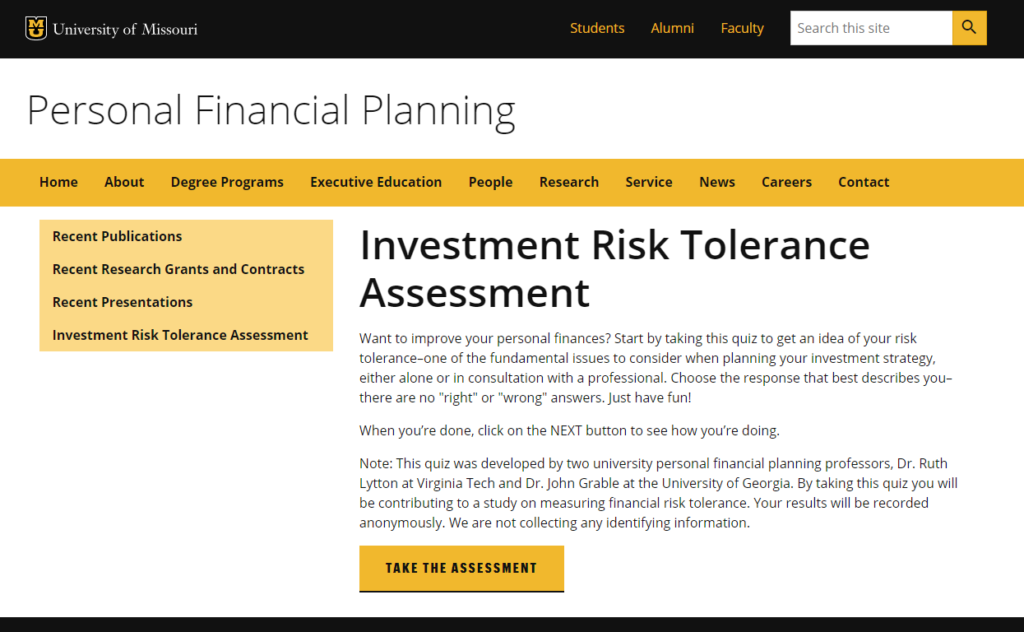
    FinYork recommends taking an Investment Risk Tolerance Assessment, as the first step in assessing investment risk tolerance. The one below from the University of Missouri is popular. It is worth every minute of your time as this will set the stage for your investment planning.

    Source: https://pfp.missouri.edu/research/investment-risk-tolerance-assessment/

    Once you finish answering all the questions, you’ll be given an assessment of your risk tolerance. You can use this as the basis of your investments or discuss it with your financial advisor. You may have seen your brokerage’s investor profile questionnaire which is another tool for individual risk tolerance assessment. The whole purpose of this exercise is to evaluate your individual risk tolerance and even confront your fears upfront.

    The survey gives a risk tolerance score at the end as shown below. The score will indicate whether you have a HIGH, MEDIUM or LOW risk tolerance. Your investment strategy has to follow your risk tolerance level. For e.g. someone with a LOW risk tolerance should go with a conservative investing strategy and invest in less risky asset classes. We’ll cover this in detail in upcoming articles.

    Source: https://pfp.missouri.edu/research/investment-risk-tolerance-assessment/

    Investing Goals

    We have so far looked at evaluating our risk profile and risk tolerance. Once we have an idea of our personal risk tolerance, what do we do next? The next step is to set up investing goals which will form the basis of our personal investing approach. If you already have investing goals and approach to meet those goals, that is great. If you don’t, please take the time to write them down. You need to make sure that you don’t stop at personal finance and budgeting but also think about your net worth and investing goals with a long-term view. You’ll find it beneficial to evaluate where you’re today in terms of personal finance (income/expenses) and net worth.

    Investment Goals will differ by age and personal situation

    Investment goals for people in their 20s are quite likely different from people in their 40s or 60s. Similarly, goals for people with families are going to be different for singles or couples. More importantly, they are going to be different based on your risk tolerance and personal financial situation. Please take note of your work situation, financial cash flows when coming up with goals. It is best for goals to follow the SMART method of setting goals. For further reading, please visit Corporate Finance Institute’s site on setting up SMART goals.

    Write down Investing Goals

    Before we get into the how of investing, particularly real estate investing, it is very important to assess your risk tolerance and have clear investing goals. Please take the time to write down the investing goals even if it takes a few hours a day. Above all, investing is a habit. You need to be committed and keep practicing it consistently to get better at it. Your investing goals may consist of the following or more:

    • Your goals and why you want to achieve those goals? For e.g. “My goal is to retire by 55 with X income and Y assets so that I can be financially free”
    • What are your guiding principles? For e.g. “I will invest in companies that also do some social good”
    • Your fears and how to overcome them? For e.g. “My fear is that I have little confidence in myself when it comes to money matters. I plan to overcome my fear by learning about investing by spending an hour every day.”

    Investor Takeaways

    In this article, we understand the basics of risk and risk tolerance and why understanding our risk tolerance is so important. Risk and our tolerance of risk is in itself not a good or bad thing. We just need to understand our risk tolerance as this will define our investing strategy. Having a true appreciation of our risk-taking will define our investing strategy. It will lead to the kind of investments – stocks, real estate, etc. we chose. We hope we’ve convinced you as an investor to evaluate your risk tolerance before making your first investment as it will save a lot of headaches.

    Complete the above-referenced questionnaire, evaluate your risk tolerance, and keep it for your reference. In addition, take the time to think through and write your Investment Goals. We suggest doing this exercise on a regular basis (say, year-end every year) as that will inform us of our risk tolerance and come up with an appropriate investment strategy to manage risk. This will be the topic of upcoming articles.

  • How Airbnb has disrupted Commercial Real Estate (CRE)

    Airbnb has been a disruptor in the hotel industry though many may view it as just another technology marketplace or platform company like Uber. We’ll argue in this article why Airbnb is a disruptor not just in the hotel industry, but the overall commercial real estate (CRE) industry. Airbnb’s business model has ramifications that can echo past hotels and disrupt other property types in CRE in the years to come. As investors, we need to watch out for the Airbnb effect and how the industry responds.

    Airbnb and its business model

    Airbnb probably needs no introduction to many, but let us level set and review Airbnb’s summary from Wikipedia. The key points we will review are highlighted in orange.

    Airbnb… is an American vacation rental online marketplace company… Airbnb maintains and hosts a marketplace, accessible to consumers on its website or via an app. Through the service, users can arrange lodging, primarily homestays, and tourism experiences or list their properties for rental. Airbnb does not own any of the listed properties; instead, it profits by receiving commission from each booking. 

    Source: Wikipedia

    Let us also look at the numbers to get an idea of the reach of Airbnb. As of 2020, Airbnb had grown to 4 million hosts and 800 million guests in 100,000 cities in almost every country and region across the globe. The reach of Airbnb blows away the reach of traditional hotel companies like Marriott. After all, Airbnb can operate anywhere there is a house with a room to spare.

    Airbnb as yet another tech marketplace or platform

    We can use two lenses to look at Airbnb as a company and its place in the markets. The first lens is that of a technology company and the second lens is that of a real estate company. Airbnb can be viewed as a high flying technology company that went public in 2020. In and of itself, there are probably tens of other technology companies in the platform or marketplace category. Notably, Airbnb can be seen as the Uber for guest stays. In essence, just viewed as a technology company Airbnb may not come across as a significant disrupter. Here is an opinion from 2013 during the early years of Airbnb.

    Please hear me loud and clear when I say the following: disruptive innovation does not exist or apply as far as the real estate business is concerned, and it will not in the future, either. Not even in the case of Airbnb (explained below). Real estate product and its consumption are fundamentally different from non-real estate product and its consumption, and at this point in history, real estate markets are no longer likely to be disrupted.

    Source: https://www.getrefm.com/disruptive-innovation-in-real-estate-there-is-no-such-thing/

    The significance of the disruption and further potential comes into play when one looks at Airbnb from a hotel or real estate lens. How big is the disruption? Let us look at the chart below from Professor Galloway at NYU Stern School of Business. As of October 2020, around the time Airbnb went public, the projected market cap exceeded those of FIVE major hotel chains and THREE major airlines combined. The battered hotel and airlines have recovered since October 2020, but you get the idea – Airbnb is worth many major hotel chains combined.

    Source: Professor Galloway

    Airbnb’s disruption of the Hotel industry

    In the previous section, we looked at valuations and reach and saw how Airbnb easily surpasses the valuation and reach of the largest hotel chains. In this section, we will look at exactly how Airbnb has disrupted the hotel industry business model and turned it on its head.

    Asset light and Risk light

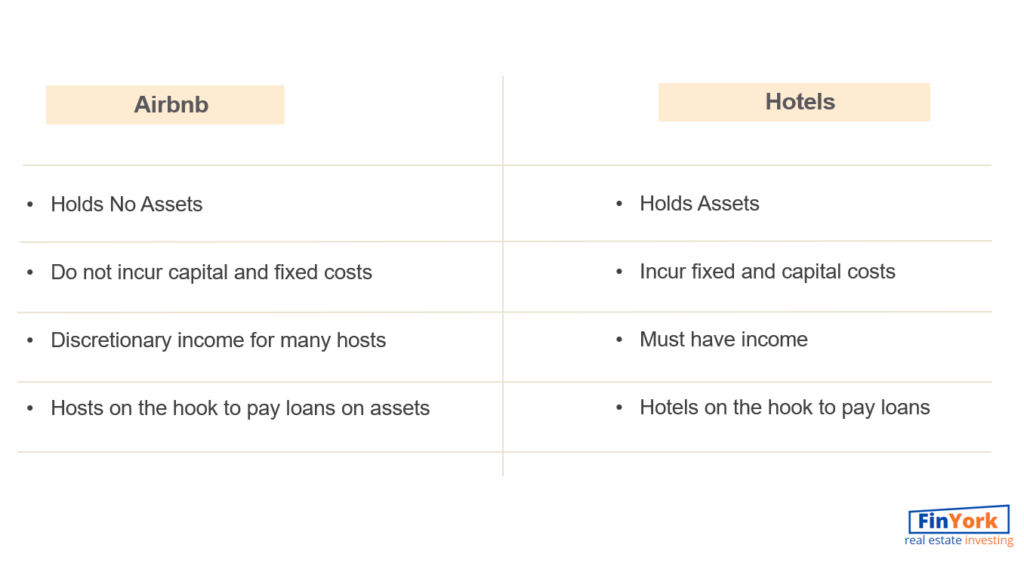
    Airbnb is a marketplace platform and does not hold real estate assets. Hotels on the other hand hold the hotel’s real assets. What this means is that hotels (or their franchisees or partners) are responsible for buying, building, and running the hotel property. In Airbnb’s case, the hosts are responsible for buying and running the assets. This leads to Airbnb being asset-light which is a huge advantage. How come? The hotels hold the real estate risk whereas the hosts (not Airbnb) hold the real estate risks. In an ironic way, Airbnb is disrupting CRE without holding ANY real estate assets. This is similar to Uber which disrupted the car ride industry without holding any cars.

    The above-mentioned asset and risk light nature of Airbnb vs Hotels have major implications for investors. The investor who invests in Airbnb stock takes limited or no real estate risk whereas an equity investor in a hotel asset takes the real estate risk. As it happened during COVID-19, the hotels faced a deep loss of revenue when stays come to a screeching halt. The hotels still had real estate expenses and loan obligations to run minimum operations. Airbnb stays also came to a screeching halt, but it didn’t have any real estate expenses or loan obligations. Its hosts had.

    Agile, Lean and easily scalable

    As we saw previously, Airbnb has no real estate obligations to build or maintain the asset, raise capital or get a loan. But, Airbnb has a powerful technology platform and spends most of its money on R&D and improving the platform. This makes Airbnb agile and lean. Airbnb can also scale up or down its business in little time as it has no real assets.

    When the COVID-19 pandemic started, both Airbnb and hotels took a big hit. But, Airbnb was able to recover way faster. More so, Airbnb was even able to go to the public markets with an IPO. Airbnb has disrupted the hotel business model to such an extent that hotels are now providing Airbnb-like platforms i.e. the hotels just act as intermediaries but provide some basic branding and consistent service. The table below summarizes salient features of Airbnb and Hotels business models we reviewed.

    More CRE disruption to come?

    Disrupting hotels which is a major CRE property type is one thing, but disrupting the whole CRE is at a different level altogether. In our opinion, Airbnb has the potential to disrupt the rest of CRE as well. COVID-19 and Airbnb’s potential should be a cause for concern for many players in CRE. The CRE industry, particularly office and retail, is facing a big crisis with the pandemic. Will it provide an opening for disruptors like Airbnb or other players? It will be a mistake for the CRE industry to treat Airbnb as just a hotel company for the reasons mentioned below.

    From hotel to other property types

    We’ve argued so far how Airbnb has already disrupted the hotel industry. Why can’t it do the same for offices or retail or for that matter any property type? COVID-19 has actually accelerated the importance of homes. Which real estate player is better positioned to leverage the home as an asset than Airbnb? Let us take a few scenarios which may seem a stretch but quite possible:

    • WIth WFH, people start using a part of their homes as a gathering place to work
    • People start using their spare basement, yard, or other spaces for group exercises
    • How about having dinner gatherings at someone’s home than restaurants?

    Who can create and capitalize on these trends? Startups or established players like Airbnb that have a platform. The above will reduce the need for a traditional office or retail property type and increase the need for a technology platform that can facilitate the above. Let us take a couple of different scenarios:

    • Can small office landlords share their existing space using an Airbnb like platform (similar to WeWork)?
    • Can small retail shops share their existing space using an Airbnb like platform?

    There is nothing stopping Airbnb from providing the conventional marketplace for office, retail, and other property types? In essence, it can become the Shopify equivalent for the CRE Amazons of the world.

    Shorter Leases

    Another key differentiator for Airbnb is that it provides a way for shorter leases or stays to guests across millions of assets. At the surface, this may not appear to be a big deal. So what? Most of Commercial Real Estate is built around leases that run into years. For e.g. you may have signed an annual lease for your apartment. Retail, industrial and office leases run into many many years. The penalty for breaking the leases are so high that many tenants hesitate to break the leases.

    With this background, Airbnb provides pretty much provides short leases to tenants. Yes, hotels also provide short stays but their model has not been transferred to other property types because the business model cannot work. Airbnb can make that business model work for other property types like an office. For e.g. similar to WeWork Airbnb has the platform to provide shorter office leases to office goers. Airbnb has thus built a transferable platform to further disrupt CRE.

    Investor Takeaways

    In this article, we’ve looked at Airbnb as a marketplace platform and how it has disrupted the hotel industry by being asset-light and easily scalable. We also looked at how Airbnb has the platform and potential to disrupt the rest of the CRE industry property types as well. As a real estate investor, one has to closely watch Airbnb’s entry into other property types as well as newer behavior and trends that are arising, accelerated by the pandemic. It may not be enough for an investor to just look at the numbers and evaluate deals. They also need to answer the question – Can Airbnb or a similar player disrupt this space to affect my bottomline?