Tag: real estate

  • Study Finds Long, Working Hours Kill Nearly a Million Individuals a Year

    According to the WHO (World Health Organization), long-working hours are directly attributed to the death’s of thousands, upon thousands, upon thousands in global cities (check out this past year, alone). We’re talking about nearly a million people in 2016 alone. The study – again conducted by the incredibly prestigious WHO and cited in BBC News – has some truly alarming statistics. This global survey contains data that is some of the first of its kind and begins gathering data to reach the hypothesis that was likely reached as early as 2016 (BBC News Service).

    As this research was being conducted all the way dating back to 2016, it’s vital to note this takes into account labor market conditions mostly prior to the global, COVID-19 pandemic. Following the aftermath of the pandemic, we’ve seen companies adapt more of a hybrid office schedule for employees. We’ve even seen some companies abandon office schedules altogether (at least for the time being). Perhaps once these working conditions began, it was somewhat refreshing to those who commuted to the office everyday. However, as other studies have shown, while many really didn’t mind working from home, some individuals who were previously content with their weekly schedules became increasingly uncomfortable. Nonetheless, as labor market conditions are returning closer to pre-pandemic times, we can likely expect to see a bit more hybrid working schedules, but largely the same pre-pandemic conditions as in 2016 (BBC News Service).

    Some Alarming Conclusions

    Referring back to that 2016 study done by the WHO and initially reported on by BBC News, of the various alarming statistics, the very first one jumps out: 745,000 people died in 2016 as a result of stroke and heart disease due to long working hours. The article goes on to cite several egregious examples of worker abuse. Lora Jones, a 22 year-old described her initial role at a digital marketing firm as “cult-like”, regarding their adherence to a 72-hour minimum work week (Jones, BBC News).

    While this may not surprise many, Goldman Sachs was thrown under the rug for overworking entry-level analysts. One report details entry-level analysts joining together to have a discussion with their managers at Goldman. They asked for an 80-hour work week cap, calling their current working conditions “abusive” and even “inhumane”. Nonetheless, in a subsequent BBC Report, Goldman CEO David Solomon had no problem with – now – a 95-hour work week. While applauding the courage of the entry-level personnel, Solomon noted “going an extra mile can go a long way”. Everyone reading this should understand the meaning of that pretty clearly.

    Furthermore, the research compared those working a 55-hour work week with those working 35-40 hours. It found that those working a 55-hour work week had a 35% higher risk of stroke and a 17% higher risk of dying from heart disease, compared to those working 35-40 hours.

    A final study, conducted by the International Labour Organization (ILO), concluded men were clearly at a higher risk. Specifically, they reported nearly three quarters of those that died due to working long hours were middle-aged or older men.

    What Will The Future Impact Be?

    BBC News continued with additional regurgitations of the same message; there’s a renewed interest in debating US working class conditions. Reports not cited by BBC show CEOs and executives taking great interest in the happiness of their everyday staff. With that, it’s important to note we’re not suggesting these BCC reports are fair portrayals of the average executive attitude, or average company culture. As we noted in the beginning, a key impact will be many companies adapting a hybrid work routine. This should appease both employees who don’t mind working from home and those who want to be in the office.

    While hybrid work schedules aren’t necessarily great news for CRE investors, they are already a reality. This isn’t something companies are considering doing in the long-run; this is something several big companies have pledged to. The list is likely to only keep growing. These positive changes, combined with a renewed interest in publicly debating this topic, bodes well for the working class. For bullish CRE investors, perhaps not so much.
  • Technological & Digital Disruption

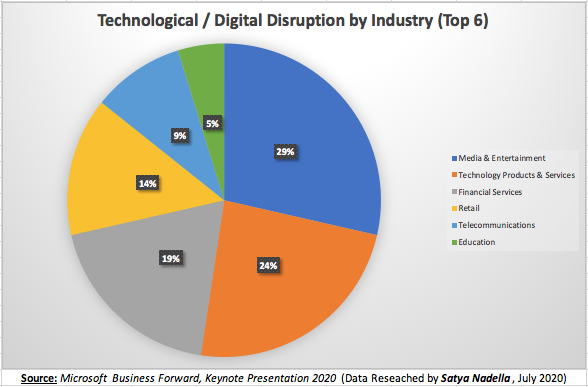
    While it’s commonly known that tech disruption is rapidly occurring, are you aware of which sectors of the US economy are being transformed the most? Initially presented in a Microsoft Business Forward forum, this research is key to assessing the sectors that need to gear up and prepare to deal with the newest technologies. The chart below substantiates just how much technological innovation and digital transformation are disrupting critical, traditional sectors within the nation’s economy.

    Top 6 Industries Impacted by Technological & Digital Disruption

    Microsoft: Top 6 Sectors Affected by Tech / Digital Disruption (Satya Nadella, 2020)

    PropTech addresses technological innovation specifically in the real estate segment. Moreover, you’ll notice that the Top 6 industries affected are most likely ones you come across in your everyday life. What does this mean for management, consumers, and the working class (specifically in these industries)? The article that complements Satya’s research shares a grim prognostication:

    “Digital disruption is well upon us. While a survey conducted by the Global Center for Digital Business Transformation for the large and mid-sized private sector companies agreed, to varying degrees, that digital disruption comes with its own set of benefits, it is also true that Digital Disruption is threatening the survival of many businesses and industries.

    Futuristic businesses and start-ups are exploring new avenues of re-inventing their business activities and industries all together to compete with and dislodge incumbents. The last decade alone has witnessed some exponential progress in technological disruption – think Airbnb, Paytm, Netflix and Uber.

    And this disruption is gradually influencing every industry, including banking, healthcare, hospitality, construction, manufacturing, packaging, logistics, and insurance amongst others (discussed in detail by Satya in Microsoft’s 2020 Keynote Forum).”

    Embee Staff

    Conclusion: What Does This Mean for Real Estate Investors?

    Succinctly, to have longevity in a given industry, the necessity for technological innovation has proven to be non-negotiable. Avoiding this reality will get you nowhere – or worse, out of business – quickly. As the abundance of digital and cloud transformation technologies are increasing, many are finding themselves playing catch-up. The information Microsoft presented suggests nearly all industries will be behind if they refuse to acknowledge technological progress. Not only acknowledge it, but make drastic changes, as necessary, to adapt alongside it.

    We’ve summarized the role technological innovation will play at length in the real estate market moving forward, specifically. Finally, ponder this. Imagine the impact to real estate markets, even globally, if critical industries and large corporations were to fall ‘behind-the-curve‘. What would this mean for CRE investors, who have continued to struggle as of late? The data study produced by Microsoft illustrates just how cataclysmic failures to adapt to new technologies – no matter the reason – can cause widespread fragility beyond the individual companies, or even those particular industry segments. It’s imperative to always look at the bigger picture. In this case, failure to adapt to new technologies will almost certainly cause broad, undesired consequences for investors.

  • Investigating a Critic of Real Estate Investing

    While real estate continues to be the biggest asset class in the world, there are still asset managers who are skeptical about recommending it to their clients as an investment vehicle. As Andy Rachleff puts it:

    One of the most common pieces of financial advice our clients hear from their friends and family is to invest their excess cash in rental properties. Unfortunately, this is terrible advice for all but a lucky few.


    Andy Rachelff

    The piece goes on to give four distinct reasons for critics’ deviation from traditional logic. Let’s break it down one by one.

    Income Isn’t Guaranteed

    While this is true, this is true when it comes to any financial investment vehicle. According to the National Council of Real Estate Investment Fiduciaries (NCREIF), as of Q1 2021 the average 25-year return for private commercial real estate properties held for investment purposes slightly outperformed the S&P 500 Index, with average annualized returns of 10.3% and 9.6%, respectively. Residential and diversified real estate investments also averaged returns of 10.3% (NCREIF). Keep in mind, this data takes into account both the 2008 financial crisis and the COVID-19 pandemic. Each calamity gravely deflated assets in the real estate market. So while it’s certainly true that income isn’t guaranteed, over a 25-year period both commercial and residential real estate holdings outperformed the S&P 500 Index. While income is almost never guaranteed, this should make you feel more at ease about investing your money in the real estate sector.

    It’s Hard To Generate A Compelling Return

    Another generic statement that can be said about almost any investment vehicle. If generating a compelling return was easy, everyone would follow the same system. When you invest in real estate, whether it be through direct property management or a REIT, you still maintain some level of ownership over a physical asset. Conversely, with stocks, as an example, you own a piece of a publicly traded company that has a board of directors, executives, and senior management controlling the day-to-day operations. In other words, your money is in the hand’s of others. With the majority of real estate investment vehicles, you are in control. Therefore, you are the one who has the ability to make decisions that generate a more compelling return, versus leaving those decisions in other people’s hands. It’s easier to generate a compelling return when you have control because at the end of the day, no one will care as much about your money as yourself. Additionally, the under 8% net over eight years earned by Weatherfront’s portfolio is not only a logical fallacy as it is only one data point, but their complaint is largely surrounding the tax structure of rental properties investors will have to pay. It is anecdotal data tailored to disprove a very generic argument to begin with.

    It’s Better To Diversify Your Portfolio

    In this section, the writer essentially makes a compelling argument to investing in a REIT versus direct real estate investing. While we’ve covered both strategies in depth, it’s true that in the long-term a REIT, REIG, or some form of pooled investment will mitigate your portfolio’s risk. This is especially true for individual properties that “fall out of favor”, sometimes due to external factors (i.e. COVID-19 pandemic). The writer correctly points out the substantial risk in a situation where you have enough capital to invest in only one property and advises you against it, but then makes a perfect argument for how to actually diversify your capital within the real estate market. After all, diversification is cited by a vast majority a major benefit to the real estate investment sector. Irrespective of how much money you have to invest upfront, you have control over how much risk you want to take on. Therefore you can choose to diversify your real estate portfolio, or you can put all your eggs in one basket. We are in agreement with Weatherfront that the latter generally isn’t advisable.

    Liquidity Matters

    Depending on what approach you take to real estate investing, the writer has a point. If you take a direct approach to real estate investing, you can easily get stuck with an undesirable property. Alternatively, investing in a real estate index fund, gives you the same liquidity as investing in any other index or stock. Nowadays, it’s very rare to see an investor take all their excess investment capital and tie it down in one property. If they do, they’re doing so at their own peril. With so much data available that shows national long-term economic growth is cyclical, one would have to have a very high appetite for risk to directly invest in a single property. Diversification has been proven to be an essential component to any successful investment portfolio.

    Concisely, do we agree with the critic’s assertion to avoid investing in real estate holdings? No, we don’t. While the writer points out some opportunities to improve your real estate investment strategy, they don’t provide a compelling argument to avoid investing in the entire segment. While some data is anecdotal and some is actual, they make a good case to be wary of rental properties. At the same time, they make a great case for diversification through REITs and other real estate index funds. The fact is there will always be critics and skeptics of any investment choices. There are analysts who are paid to do just that. However real estate has been the world’s largest asset class for awhile and it isn’t going anywhere. For investors, it would be wise to embrace that and research the abundant amount of strategies available within the real estate segment. Diversification will always be critical. Especially if you’re not currently invested in the real estate market, it would be prudent to look into various strategies because you’re all but sure to find some that suit either your short or long-term goals.

  • Investigating a Critic of Real Estate Investing

    While real estate continues to be the biggest asset class in the world, there are still asset managers who are skeptical about recommending it to their clients as an investment vehicle. As Andy Rachleff puts it:

    One of the most common pieces of financial advice our clients hear from their friends and family is to invest their excess cash in rental properties. Unfortunately, this is terrible advice for all but a lucky few.


    Andy Rachelff

    The piece goes on to give four distinct reasons for critics’ deviation from traditional logic. Let’s break it down one by one.

    Income Isn’t Guaranteed

    While this is true, this is true when it comes to any financial investment vehicle. According to the National Council of Real Estate Investment Fiduciaries (NCREIF), as of Q1 2021 the average 25-year return for private commercial real estate properties held for investment purposes slightly outperformed the S&P 500 Index, with average annualized returns of 10.3% and 9.6%, respectively. Residential and diversified real estate investments also averaged returns of 10.3% (NCREIF). Keep in mind, this data takes into account both the 2008 financial crisis and the COVID-19 pandemic. Each calamity gravely deflated assets in the real estate market. So while it’s certainly true that income isn’t guaranteed, over a 25-year period both commercial and residential real estate holdings outperformed the S&P 500 Index. While income is almost never guaranteed, this should make you feel more at ease about investing your money in the real estate sector.

    It’s Hard To Generate A Compelling Return

    Another generic statement that can be said about almost any investment vehicle. If generating a compelling return was easy, everyone would follow the same system. When you invest in real estate, whether it be through direct property management or a REIT, you still maintain some level of ownership over a physical asset. Conversely, with stocks, as an example, you own a piece of a publicly traded company that has a board of directors, executives, and senior management controlling the day-to-day operations. In other words, your money is in the hand’s of others. With the majority of real estate investment vehicles, you are in control. Therefore, you are the one who has the ability to make decisions that generate a more compelling return, versus leaving those decisions in other people’s hands. It’s easier to generate a compelling return when you have control because at the end of the day, no one will care as much about your money as yourself. Additionally, the under 8% net over eight years earned by Weatherfront’s portfolio is not only a logical fallacy as it is only one data point, but their complaint is largely surrounding the tax structure of rental properties investors will have to pay. It is anecdotal data tailored to disprove a very generic argument to begin with.

    It’s Better To Diversify Your Portfolio

    In this section, the writer essentially makes a compelling argument to investing in a REIT versus direct real estate investing. While we’ve covered both strategies in depth, it’s true that in the long-term a REIT, REIG, or some form of pooled investment will mitigate your portfolio’s risk. This is especially true for individual properties that “fall out of favor”, sometimes due to external factors (i.e. COVID-19 pandemic). The writer correctly points out the substantial risk in a situation where you have enough capital to invest in only one property and advises you against it, but then makes a perfect argument for how to actually diversify your capital within the real estate market. After all, diversification is cited by a vast majority a major benefit to the real estate investment sector. Irrespective of how much money you have to invest upfront, you have control over how much risk you want to take on. Therefore you can choose to diversify your real estate portfolio, or you can put all your eggs in one basket. We are in agreement with Weatherfront that the latter generally isn’t advisable.

    Liquidity Matters

    Depending on what approach you take to real estate investing, the writer has a point. If you take a direct approach to real estate investing, you can easily get stuck with an undesirable property. Alternatively, investing in a real estate index fund, gives you the same liquidity as investing in any other index or stock. Nowadays, it’s very rare to see an investor take all their excess investment capital and tie it down in one property. If they do, they’re doing so at their own peril. With so much data available that shows national long-term economic growth is cyclical, one would have to have a very high appetite for risk to directly invest in a single property. Diversification has been proven to be an essential component to any successful investment portfolio.

    Concisely, do we agree with the critic’s assertion to avoid investing in real estate holdings? No, we don’t. While the writer points out some opportunities to improve your real estate investment strategy, they don’t provide a compelling argument to avoid investing in the entire segment. While some data is anecdotal and some is actual, they make a good case to be wary of rental properties. At the same time, they make a great case for diversification through REITs and other real estate index funds. The fact is there will always be critics and skeptics of any investment choices. There are analysts who are paid to do just that. However real estate has been the world’s largest asset class for awhile and it isn’t going anywhere. For investors, it would be wise to embrace that and research the abundant amount of strategies available within the real estate segment. Diversification will always be critical. Especially if you’re not currently invested in the real estate market, it would be prudent to look into various strategies because you’re all but sure to find some that suit either your short or long-term goals.

  • The Future of Capital Markets Technology

    Capital Markets are where savings and investments are channeled between suppliers, people, or institutions with capital to lend or invest — as well as those in need (Hayes, Investopedia). Suppliers typically include banks and investors while those who seek capital are businesses, governments, and individuals. Capital markets are composed of primary and secondary markets.

    The most common capital markets are the stock market and the bond market. However other, more complex, markets include the CRE (Commercial Real Estate) Market, Equity Capital Market (ECM), as well as many others that are typically geared towards a specific investor. Therefore there is not as much trading volume or frequency, since the broader excitement is not the same. Even though real estate is the world’s largest asset class, we’ve seen a recent decline in CRE investment. Medium recently posted an article detailing the advantages of a platform called Beacon Platform, Inc, which was a critical, major acquisition for Centena.

    Medium: Modernizing the Capital Markets Technology Stack: Centana’s Investment in Beacon Platform, Inc.

    Why do customers choose Beacon?

    Time-to-Value and ROI. Today, companies continue to deal with cumbersome internal applications that have been stitched together, often with legacy code and/or 3rd party vendors in the Trading and Risk Management space, which are “black box” and difficult, if not impossible, to alter.

    Beacon’s entire code base is flexible and transparent (i.e. the code is made available to customers) and seamlessly integrates with existing software and other 3rd party solutions (like Murex and Calypso), or in-house proprietary solutions, which helps drive quick time-to-value and high utility.

    In a fraction of the time and cost of alternative solutions, Beacon has helped customers achieve objectives such as migrating workloads to the cloud, expanding into new markets, upgrading legacy code by placing it within a modern developer wrapper and extending analytics and applications to customers’ end-users.

    -Matt Alfieri
    Key Takeaways

    When it comes to capital markets technology, the evolving nature of the tech space all but ensures we will see new technologies introduced into capital markets operations. Additionally, while this may sound like an advertisement for Beacon (though FinYork has absolutely no affiliation to it), the critical feature to note is this is an exemplary illustration of where capital markets technology appears to be heading.

    Vertical SaaS or cloud industry solutions, instead of legacy or proprietary in-house solutions, are showing us that they’re easier to replace than many executives originally thought. You should expect to see a similar effect here as with PropTech, as it becomes more widely available and accepted by savvy executives and high net worth real estate investors. You definitely do not want to be the firm who is continuing to use antiquated capital markets technologies. This puts you at an immediate, huge disadvantage. It makes it that much harder to catch up with your competitors, who have a leg-up as they’ve already implemented innovative technologies.

    All this goes to say that SaaS, digital transformation, cloud technologies, PropTech, and even niche technologies that aim to improve efficiency in capital markets are going to play an integral part of the future. The success of firms who will adapt them largely depends on the success those firms will have in the implementation process. To be sure, capital markets technology is only going to continue getting more efficient, robust, and easier to adapt.

  • The Future of Capital Markets Technology

    Capital Markets are where savings and investments are channeled between suppliers, people, or institutions with capital to lend or invest — as well as those in need (Hayes, Investopedia). Suppliers typically include banks and investors while those who seek capital are businesses, governments, and individuals. Capital markets are composed of primary and secondary markets.

    The most common capital markets are the stock market and the bond market. However other, more complex, markets include the CRE (Commercial Real Estate) Market, Equity Capital Market (ECM), as well as many others that are typically geared towards a specific investor. Therefore there is not as much trading volume or frequency, since the broader excitement is not the same. Even though real estate is the world’s largest asset class, we’ve seen a recent decline in CRE investment. Medium recently posted an article detailing the advantages of a platform called Beacon Platform, Inc, which was a critical, major acquisition for Centena.

    Medium: Modernizing the Capital Markets Technology Stack: Centana’s Investment in Beacon Platform, Inc.

    Why do customers choose Beacon?

    Time-to-Value and ROI. Today, companies continue to deal with cumbersome internal applications that have been stitched together, often with legacy code and/or 3rd party vendors in the Trading and Risk Management space, which are “black box” and difficult, if not impossible, to alter.

    Beacon’s entire code base is flexible and transparent (i.e. the code is made available to customers) and seamlessly integrates with existing software and other 3rd party solutions (like Murex and Calypso), or in-house proprietary solutions, which helps drive quick time-to-value and high utility.

    In a fraction of the time and cost of alternative solutions, Beacon has helped customers achieve objectives such as migrating workloads to the cloud, expanding into new markets, upgrading legacy code by placing it within a modern developer wrapper and extending analytics and applications to customers’ end-users.

    -Matt Alfieri
    Key Takeaways

    When it comes to capital markets technology, the evolving nature of the tech space all but ensures we will see new technologies introduced into capital markets operations. Additionally, while this may sound like an advertisement for Beacon (though FinYork has absolutely no affiliation to it), the critical feature to note is this is an exemplary illustration of where capital markets technology appears to be heading.

    Vertical SaaS or cloud industry solutions, instead of legacy or proprietary in-house solutions, are showing us that they’re easier to replace than many executives originally thought. You should expect to see a similar effect here as with PropTech, as it becomes more widely available and accepted by savvy executives and high net worth real estate investors. You definitely do not want to be the firm who is continuing to use antiquated capital markets technologies. This puts you at an immediate, huge disadvantage. It makes it that much harder to catch up with your competitors, who have a leg-up as they’ve already implemented innovative technologies.

    All this goes to say that SaaS, digital transformation, cloud technologies, PropTech, and even niche technologies that aim to improve efficiency in capital markets are going to play an integral part of the future. The success of firms who will adapt them largely depends on the success those firms will have in the implementation process. To be sure, capital markets technology is only going to continue getting more efficient, robust, and easier to adapt.

  • Key Players in the CRE Market

    Many property types within the Commercial Real Estate (CRE) market are generally agreed to have had a poor performance the past few years, largely due to the COVID-19 pandemic restrictions. Particularly, office and retail property types. The real question investors are asking themselves is whether or not it has the potential for an emphatic return, or if a commercial real estate focus is not likely to be a great long-term investing strategy. The opportunities for successful CRE investments are still there. There are still plenty of marketplaces exclusively geared towards CRE investment, which have uniquely positioned themselves in the broader real estate investing market.

    Before committing your resources to a given investment strategy, new investors should understand who the market players are for a CRE deal. Below is a thoroughly compiled list of the key players (roles) in the commercial real estate market, which then goes onto provide an additional link to a description of each role.

    Key Players in CRE :
    • Buyer & Seller
    • Brokers: Buy-side and Sell-side
    • Legal Counsel: Buy-side, Sell-side, and Lender Counsel
    • Mortgage Broker
    • Lender/Loan Officer
    • Title Company
    • Capital Partners/Investors
    • Property Management
    • Insurance Provider
    • Appraiser & Surveyor
    • Environmental Consultant
    • Accountant: Buy-side and Sell-side

    The following article shares a useful and detailed look at the key players in CRE. Refer to the link below. It provides key details about the key players in CRE’s marketplace.

    What Are The Key Players And What Are Their Roles In A Commercial Real Estate Transaction

    As a commercial real estate investor, either as a buyer or as a seller, you work with multiple parties to move a deal from discovery through to closing. To manage a deal process efficiently, it is of utmost importance to understand all of the key players in a commercial real estate transaction.

    GerCNergy.com (Administrator)
    https://getcnergy.com/knowledge-base/key-players-in-a-commercial-real-estate-transaction/
    Summary

    The above players all comprise parts of the CRE deal. It is important for a sophisticated investor to be familiar with the various players as they can understand the dynamics of a deal and align with the sponsors who will work with most of the players mentioned.

  • Key Players in the CRE Market

    Many property types within the Commercial Real Estate (CRE) market are generally agreed to have had a poor performance the past few years, largely due to the COVID-19 pandemic restrictions. Particularly, office and retail property types. The real question investors are asking themselves is whether or not it has the potential for an emphatic return, or if a commercial real estate focus is not likely to be a great long-term investing strategy. The opportunities for successful CRE investments are still there. There are still plenty of marketplaces exclusively geared towards CRE investment, which have uniquely positioned themselves in the broader real estate investing market.

    Before committing your resources to a given investment strategy, new investors should understand who the market players are for a CRE deal. Below is a thoroughly compiled list of the key players (roles) in the commercial real estate market, which then goes onto provide an additional link to a description of each role.

    Key Players in CRE :
    • Buyer & Seller
    • Brokers: Buy-side and Sell-side
    • Legal Counsel: Buy-side, Sell-side, and Lender Counsel
    • Mortgage Broker
    • Lender/Loan Officer
    • Title Company
    • Capital Partners/Investors
    • Property Management
    • Insurance Provider
    • Appraiser & Surveyor
    • Environmental Consultant
    • Accountant: Buy-side and Sell-side

    The following article shares a useful and detailed look at the key players in CRE. Refer to the link below. It provides key details about the key players in CRE’s marketplace.

    What Are The Key Players And What Are Their Roles In A Commercial Real Estate Transaction

    As a commercial real estate investor, either as a buyer or as a seller, you work with multiple parties to move a deal from discovery through to closing. To manage a deal process efficiently, it is of utmost importance to understand all of the key players in a commercial real estate transaction.

    GerCNergy.com (Administrator)
    https://getcnergy.com/knowledge-base/key-players-in-a-commercial-real-estate-transaction/
    Summary

    The above players all comprise parts of the CRE deal. It is important for a sophisticated investor to be familiar with the various players as they can understand the dynamics of a deal and align with the sponsors who will work with most of the players mentioned.

  • NYC’s Real Estate Market Outlook as the CDC’s Moratorium on Eviction Expires

    When the CDC (Center for Disease Control and Prevention) last extended the eviction moratorium a third time, due to the COVID-19 pandemic, from the end of June 2021 to the end of July 2021, they were clear that would be the final extension. Republicans opposing another extension of the eviction moratorium cited the recent 5-4 decision by the Supreme Court, which suggested legislative approval would be required. Leading Democrats responded with brief arguments that the eviction ban needs to be extended, as Congress has only distributed $3B out of the $46.5B in approved rental relief. According to a study by the Aspen Institute, more than 15 million people in 6.5 million US households are currently behind on rental payments. The same study estimates the collective cost to landlords to this point has been over $20B. Landlord groups previously came together in an unsuccessful attempt to end the moratorium earlier, arguing the CDC overstepped their legal authority, but they were rejected by the Supreme Court’s ruling then. Determined not to give up, the National Apartment Association (NAA), with 82,600 members that collectively manage more than 9.7 million rental units, sued the U.S. government on Tuesday July 27th, seeking billions of dollars in unpaid rent due to the moratorium (Shepardson, Reuters).

    While opportunities for a federal extension essentially ended when the House of Representatives adjourned Friday July 30th, effectively giving up, there are states that have already extended the eviction ban. New York and California top the list, with the two states passing bans on evictions until August 31st and September 30th, respectively (Shepardson, Reuters). Keep in mind, the justification for the CDC initially issuing this policy was due to the federal government’s direction to self-quarantine during the worst of the COVID-19 pandemic. It was not primarily over economic concerns, as that would be outside the CDC’s purview. Regardless, assuming nothing changes from this point, New Yorker’s in financial crisis will only have one additional month of safe haven before they too will have to deal with the reality of federal protections stemming from the COVID-19 pandemic ending.

    What does the looming end of the eviction moratorium mean for NYC’s real estate market? Firstly, as predicted by several well-known real estate attorneys, there will be a huge backlog of cases in Housing Court. Prior to the pandemic, during routine economic and geopolitical times, evictions could take anywhere from three to six months – considered typical – or sometimes drag out for years on end (Hogan, NY Post). The backlog will in turn lead to some landlords, who have certainly been financially struggling throughout this ordeal, being forced into foreclosure or given no choice but to sell cheap to cash buyers. Landlords need revenue in order to run a building. They have expenses, such as providing heat, paying personnel and staff, building supers and contractors, as well as real estate taxes to boot.

    If you’re one of the savvy, fortunate investors who came out of the pandemic with a solid amount of disposable income set aside for your portfolio’s growth, a direct real estate investing approach could prove to be extremely rewarding. REIGs (Real Estate Investment Groups) can also become a powerful force in NYC’s residential real estate market in particular, once the moratorium ends. This vehicle gives real estate investors the ability to join together and pool both their money and knowledge to invest in multiple residential real estate properties. Similarly, members of the REIG would share the costs associated with property management. They could also benefit from diversification and economies of scale, which are additional benefits to joining a REIG. The bottom line for NYC is once the eviction moratorium does end, you’ll see solid opportunities for a long-term residential real estate investment. As is usually the case with financial markets during times of uncertainty, there’s definitely opportunity, but with that opportunity comes inherent market risk.

  • CRE PropTech: How Will it be Affected by the Aftermath of COVID-19

    COVID-19 will forever change the landscape of CRE (Commercial Real Estate), especially for firms who are used to operating almost exclusively in a brick and mortar, office environment. The aftermath of COVID-19 will almost undoubtedly include more “smart” CRE. To put it another way, as software like Zoom has become a household name – whereas prior to COVID-19 it was largely known to the white-collar working class – you can expect firms to invest less in physical property. Consequently, the data shows that in every sector, at least in the short-term, PropTech investment has slowed down (Abuelsamid, Forbes).

    Intuitively, successful long-term investors tend to be heavily data driven, which has been a big reason for the slowdown in PropTech. Investors within the real estate sector are exercising caution with regards to their portfolios, as well as towards new deals for CRE projects. A great deal of this is attributed to the initial concept of this piece (which Forbes agrees with): corporations and startup firms alike are showing an increased interest in technology, which allowed them to work “smart” (i.e. Zoom) despite the pandemic (Abuelsamid, Forbes). With decreased overhead being a large incentive for startups and pressure from shareholders to cut costs being a large incentive for big corporations, many are realizing that the way they were forced to do business is perhaps a more efficient way than they were prior to the COVID-19 pandemic.

    With that being said, as we mentioned in a previous piece, PropTech is still a relatively new field to most investors. The CRE investing subsector of PropTech is even smaller, so there’s definitely still plenty of opportunity for successful PropTech investment vehicles. Even with the current data showing there’s slowed growth in the PropTech CRE subsector, that’s not to say you shouldn’t keep an eye out for solid investment opportunities, as they are still out there and can definitely be lucrative. This is the main reason you’ll typically find seasoned, experienced investors in the CRE PropTech space. There is opportunity for large returns, but it is definitely slim.

    In the longer-term, there’s no reason right now to believe firms will switch back to investment in more physical property, especially when that money can be spent on human capital. Therefore, if you’re interested in PropTech investment strategies, you should not expect to see consistent positive performance from PropTech CRE investments. On the other hand – while this subject deserves a complete discussion on its own – residential PropTech is definitely on the rise (Aramati, Forbes). With a major push coming from cloud technologies and digital transformation, there’s a lot more investment in “smart” residential real estate as opposed to commercial real estate. Generally speaking, investments in “smart” technology have gained a tremendous amount of traction and thereby very large returns for earlier stage investors. Again, as we discussed in a previous article regarding PropTech, technological advancement is the future and investors who are looking for the next Amazon or Google in the real estate market ought to look into residential PropTech options with a more favorable outlook than commercial PropTech.