Tag: rental housing market

  • NYC’s Real Estate Market: Roaring Housing Prices Show No Signs of Slowdown

    “The story that I’m seeing across the board: All segments are transacting. New York [real estate] is back, and people want to be here.”

    – Christopher Kromer, Brown Harris Stevens

    Statistically, that’s an excellent summation of New York City’s real estate market. While real estate was least of all financial asset classes hit by the COVID-19 pandemic, it’s not really “recovering”. Quite amazingly, it’s heating up. It has been for months now, but experts predict that was just a warm up (Singh, CNBC).

    “We’re coming off a record number of signed contracts in the second quarter, and what’s driving that is buyers are seeing value. They’re sensing opportunity, and there’s a real sense of hope for an economic boom in September when it opens up.”

    – Christopher Kromer, Brown Harris Stevens

    In other words, even reasonable rental prices are getting nearly impossible to find almost anywhere in New York City. The buyer’s market is a different story. As Kromer put it, “For the most part, if you’re buying today, it’s probably less expensive than it would have been three or four years ago”. For these purposes, suppose we break New York City’s real estate market into two distinct elements. The profit opportunity for cash buyers has been there and will continue to be there for a prolonged time. Conversely, the residential real estate market for renters, who are mostly living paycheck-to-paycheck, is a nightmare (Nasdaq).

    A Contradictory Study

    Although, a recent Douglas Elliman and Miller Samuel report appeared to somewhat contradict this philosophy. The report showed median resale prices for Manhattan apartments reached an all-time high in Q2 2021 (Douglas Elliman). Average sale prices rose 12% in the quarter (Douglas Elliman). They topped $1.9 million and there was also a 150% gain in sales during that same time period, compared to 2020. In Q2 of 2020, Manhattan apartment sales had their largest percentage decline in 30 years. Residents fled Manhattan during the COVID-19 pandemic, so brokers largely weren’t even able to show apartments to prospective buyers.

    Kromer had a response to the data presented by the Douglas Elliman and Miller Samuel report.

    “I think it’s probably tilted with a lot of high-end closings. The luxury market has been booming lately with a lot of discounts.”

    – Christopher Kromer, Brown Harris Stevens

    The recent activity in Manhattan’s luxury housing market still hasn’t wiped away the excess inventory created by COVID-19. In the luxury market, sellers are coming down on asking prices to meet buyers on their side. This in turn gives buyer’s even more buying power because they have options.

    “What’s driving this are more realistic sellers and softer prices. We still are at near-record levels of inventory. So, the sellers are going down to meet the buyers at their prices. The buyers have options.”

    – Christopher Kromer, Brown Harris Stevens

    Moving Beyond Manhattan

    Astoundingly, markets in the outer boroughs of New York, such as Brooklyn, showed far more resilience through the pandemic. This is again compared to the luxury, upscale housing market in Manhattan; a very significant geographic market difference.

    “People were looking for value, for space and less dense areas, and you did not see the discounts that you saw in Manhattan in the outer boroughs”.

    – Christopher Kromer, Brown Harris Stevens

    A few of Kromer’s own listings in Queens and Brooklyn recently sold above asking price, after receiving multiple offers. One two-bedroom co-op in Brooklyn even sold at roughly 8-9% above the price it sold at three years ago.

    “A single-family home in Queens was overwhelmed with interest. We had about 50 showings within the first week, with it selling for about 10% above the asking price”.

    – Christopher Kromer, Brown Harris Stevens

    In Conclusion

    Despite the study from Douglas Elliman and Miller Samuel, data shows NYC’s housing market is prospering. Housing rental prices on luxurious Manhattan properties are barely affordable. Rental prices outside the heart of New York are still steep and the availability of affordable housing is shrinking. This is nearly all attributed to the “buyer’s market” NYC real estate is clearly in the midst of. Prospective renters need to act fast to avoid losing out on any decent affordable housing in the five boroughs. Prices will only continue to increase, while availability will only continue to decrease.
  • How to Best Invest in Real Estate in the Midwest

    The most surprising feature about housing markets in the Midwest is that home prices – in most of them – are still below the level where local incomes dictate they should be (Winzer, Forbes). If you’re a real estate investor, this means two things. Firstly, there are bargains still available in these markets. Secondly, demand for housing not been very strong, at least not yet.

    Midwest Housing Market Overview

    The lack of rebound in the Midwest housing market following 2008 is largely due to the specific types of local economic growth that prevailed before that (Winzer, Forbes). The housing recession came coupled with a lengthy, slow decline in manufacturing. The availability of an educated but low-cost labor force had encouraged the growth of big financial operations in Des Moines, Minneapolis, Omaha, Sioux Falls and Green Bay. However, manufacturing still has a large role in Fayetteville, Davenport, Peoria, Rockford, Gary, Fort Wayne, South Bend, Wichita, Milwaukee and Green Bay (Millsap, Forbes).

    This makes these markets a bit riskier to invest in. The markets with a large finance sector are also risky because automation is responsible for an increasing amount of work. Despite structural problems, growth is now returning to many Midwest markets, as it did prior to COVID-19. Especially in areas that function as regional centers – Fayetteville and Peoria, for example – the expansion of jobs is due to an increase in healthcare and business services. Similarly, to the country, these services are becoming concentrated in large urban centers, creating opportunities for investors in rental housing.

    An uncharacteristic feature housing investors contend with is many Midwest markets have agricultural roots, with manufacturing later added on top. Since land was readily and easily available during their growth, they tend to be spread out. This combination produces low home prices, but increased difficulty for investors to select a locality. After all, the saying “real estate is about location, location, location”, rings true in most cases.

    Now that we’ve established some fundamental generalities, let’s get to the specifics and numbers.

    Established Demand

    Fort Wayne, Kansas City, Indianapolis, Green Bay, Springfield, Fayetteville, Gary and South Bend.

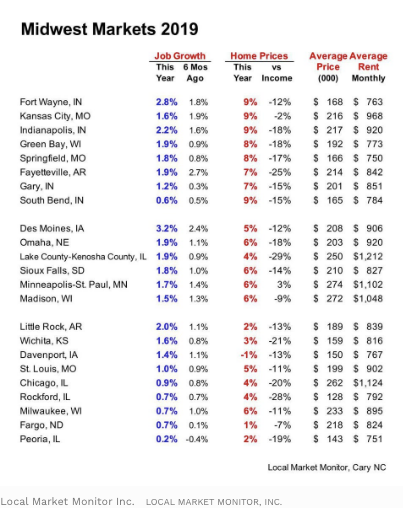
    In these markets, it appears home prices increased relatively broadly in the past year, indicating good demand not just for single-family homes, but rentals as well. With prices still well below income levels and above average job growth, demand is likely to keep raising prices higher. Though the trend depicted below shows the housing market pre-COVID, that trend is pretty much identical today. The housing market didn’t really suffer the same volume of consequences as other markets, but the small parts that did are steadily recovering (Winzer, Forbes).

    Source: Local Market Monitor, Inc.

    South Bend and Gary are at the bottom of this list because their job growth had been less reliable. Before bargains evaporate, investors should move quickly into these markets. Straight, single-family rentals – with minor improvements – are the best bet (Winzer, Forbes).

    Growing Demand

    Des Moines, Omaha, Lake County-Kenosha County, Sioux Falls, Minneapolis, Madison.

    These markets are showing solid job growth, but only moderate increases in demand thus far. Apartments appear to be a good investment in Lake County-Kenosha County and Minneapolis, due to higher density and prices. Since their dependence on the financial sector is comparably very high, most of these markets are also slightly riskier, so investors should be very careful to find properties towards the middle of the renter pool and definitely avoid the higher end.

    Uncertain Demand

    Little Rock, Wichita, Davenport, St. Louis, Chicago, Rockford, Milwaukee, Fargo, Peoria.

    In these markets either demand or job growth are weak, or even more likely, both. Low home prices are also far more commonly found in these markets. This may tempt investors to purchase a low-cost property and rent it out for cheap, without spending another dime. However, renting at the low-end is a specialty that most investors should avoid. In uncertain real estate markets, it makes sense to first look for the safest geographic areas in that market. Then you can perhaps expand and renovate a really inexpensive property, turning it into a profitable rental. That definitely involves more work, but it has potential to give you a bigger return for less risk.

    The Bottom Line

    Concisely, there’s clearly room for excellent returns on housing market investments in the Midwest. While some areas have more opportunity, depending on what strategy you choose, there’s solid return on investment potential all-around. The more time that passes from the start of the COVID-19 pandemic, the less attractive prospects will exist. Active real estate investors would be wise to look strongly into the Midwest and move quickly on specifically the kinds of properties with the features described above. Considering the housing rental market is excellent and still growing, there are definite, safe strategies to fall back on.

  • How to Best Invest in Real Estate in the Midwest

    The most surprising feature about housing markets in the Midwest is that home prices – in most of them – are still below the level where local incomes dictate they should be (Winzer, Forbes). If you’re a real estate investor, this means two things. Firstly, there are bargains still available in these markets. Secondly, demand for housing not been very strong, at least not yet.

    Midwest Housing Market Overview

    The lack of rebound in the Midwest housing market following 2008 is largely due to the specific types of local economic growth that prevailed before that (Winzer, Forbes). The housing recession came coupled with a lengthy, slow decline in manufacturing. The availability of an educated but low-cost labor force had encouraged the growth of big financial operations in Des Moines, Minneapolis, Omaha, Sioux Falls and Green Bay. However, manufacturing still has a large role in Fayetteville, Davenport, Peoria, Rockford, Gary, Fort Wayne, South Bend, Wichita, Milwaukee and Green Bay (Millsap, Forbes).

    This makes these markets a bit riskier to invest in. The markets with a large finance sector are also risky because automation is responsible for an increasing amount of work. Despite structural problems, growth is now returning to many Midwest markets, as it did prior to COVID-19. Especially in areas that function as regional centers – Fayetteville and Peoria, for example – the expansion of jobs is due to an increase in healthcare and business services. Similarly, to the country, these services are becoming concentrated in large urban centers, creating opportunities for investors in rental housing.

    An uncharacteristic feature housing investors contend with is many Midwest markets have agricultural roots, with manufacturing later added on top. Since land was readily and easily available during their growth, they tend to be spread out. This combination produces low home prices, but increased difficulty for investors to select a locality. After all, the saying “real estate is about location, location, location”, rings true in most cases.

    Now that we’ve established some fundamental generalities, let’s get to the specifics and numbers.

    Established Demand

    Fort Wayne, Kansas City, Indianapolis, Green Bay, Springfield, Fayetteville, Gary and South Bend.

    In these markets, it appears home prices increased relatively broadly in the past year, indicating good demand not just for single-family homes, but rentals as well. With prices still well below income levels and above average job growth, demand is likely to keep raising prices higher. Though the trend depicted below shows the housing market pre-COVID, that trend is pretty much identical today. The housing market didn’t really suffer the same volume of consequences as other markets, but the small parts that did are steadily recovering (Winzer, Forbes).

    Source: Local Market Monitor, Inc.

    South Bend and Gary are at the bottom of this list because their job growth had been less reliable. Before bargains evaporate, investors should move quickly into these markets. Straight, single-family rentals – with minor improvements – are the best bet (Winzer, Forbes).

    Growing Demand

    Des Moines, Omaha, Lake County-Kenosha County, Sioux Falls, Minneapolis, Madison.

    These markets are showing solid job growth, but only moderate increases in demand thus far. Apartments appear to be a good investment in Lake County-Kenosha County and Minneapolis, due to higher density and prices. Since their dependence on the financial sector is comparably very high, most of these markets are also slightly riskier, so investors should be very careful to find properties towards the middle of the renter pool and definitely avoid the higher end.

    Uncertain Demand

    Little Rock, Wichita, Davenport, St. Louis, Chicago, Rockford, Milwaukee, Fargo, Peoria.

    In these markets either demand or job growth are weak, or even more likely, both. Low home prices are also far more commonly found in these markets. This may tempt investors to purchase a low-cost property and rent it out for cheap, without spending another dime. However, renting at the low-end is a specialty that most investors should avoid. In uncertain real estate markets, it makes sense to first look for the safest geographic areas in that market. Then you can perhaps expand and renovate a really inexpensive property, turning it into a profitable rental. That definitely involves more work, but it has potential to give you a bigger return for less risk.

    The Bottom Line

    Concisely, there’s clearly room for excellent returns on housing market investments in the Midwest. While some areas have more opportunity, depending on what strategy you choose, there’s solid return on investment potential all-around. The more time that passes from the start of the COVID-19 pandemic, the less attractive prospects will exist. Active real estate investors would be wise to look strongly into the Midwest and move quickly on specifically the kinds of properties with the features described above. Considering the housing rental market is excellent and still growing, there are definite, safe strategies to fall back on.