Tag: rental prices

  • How to Best Invest in Real Estate in the Midwest

    The most surprising feature about housing markets in the Midwest is that home prices – in most of them – are still below the level where local incomes dictate they should be (Winzer, Forbes). If you’re a real estate investor, this means two things. Firstly, there are bargains still available in these markets. Secondly, demand for housing not been very strong, at least not yet.

    Midwest Housing Market Overview

    The lack of rebound in the Midwest housing market following 2008 is largely due to the specific types of local economic growth that prevailed before that (Winzer, Forbes). The housing recession came coupled with a lengthy, slow decline in manufacturing. The availability of an educated but low-cost labor force had encouraged the growth of big financial operations in Des Moines, Minneapolis, Omaha, Sioux Falls and Green Bay. However, manufacturing still has a large role in Fayetteville, Davenport, Peoria, Rockford, Gary, Fort Wayne, South Bend, Wichita, Milwaukee and Green Bay (Millsap, Forbes).

    This makes these markets a bit riskier to invest in. The markets with a large finance sector are also risky because automation is responsible for an increasing amount of work. Despite structural problems, growth is now returning to many Midwest markets, as it did prior to COVID-19. Especially in areas that function as regional centers – Fayetteville and Peoria, for example – the expansion of jobs is due to an increase in healthcare and business services. Similarly, to the country, these services are becoming concentrated in large urban centers, creating opportunities for investors in rental housing.

    An uncharacteristic feature housing investors contend with is many Midwest markets have agricultural roots, with manufacturing later added on top. Since land was readily and easily available during their growth, they tend to be spread out. This combination produces low home prices, but increased difficulty for investors to select a locality. After all, the saying “real estate is about location, location, location”, rings true in most cases.

    Now that we’ve established some fundamental generalities, let’s get to the specifics and numbers.

    Established Demand

    Fort Wayne, Kansas City, Indianapolis, Green Bay, Springfield, Fayetteville, Gary and South Bend.

    In these markets, it appears home prices increased relatively broadly in the past year, indicating good demand not just for single-family homes, but rentals as well. With prices still well below income levels and above average job growth, demand is likely to keep raising prices higher. Though the trend depicted below shows the housing market pre-COVID, that trend is pretty much identical today. The housing market didn’t really suffer the same volume of consequences as other markets, but the small parts that did are steadily recovering (Winzer, Forbes).
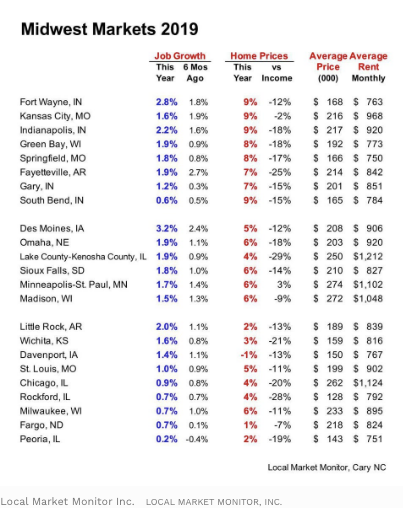
    Source: Local Market Monitor, Inc.

    South Bend and Gary are at the bottom of this list because their job growth had been less reliable. Before bargains evaporate, investors should move quickly into these markets. Straight, single-family rentals – with minor improvements – are the best bet (Winzer, Forbes).

    Growing Demand

    Des Moines, Omaha, Lake County-Kenosha County, Sioux Falls, Minneapolis, Madison.

    These markets are showing solid job growth, but only moderate increases in demand thus far. Apartments appear to be a good investment in Lake County-Kenosha County and Minneapolis, due to higher density and prices. Since their dependence on the financial sector is comparably very high, most of these markets are also slightly riskier, so investors should be very careful to find properties towards the middle of the renter pool and definitely avoid the higher end.

    Uncertain Demand

    Little Rock, Wichita, Davenport, St. Louis, Chicago, Rockford, Milwaukee, Fargo, Peoria.

    In these markets either demand or job growth are weak, or even more likely, both. Low home prices are also far more commonly found in these markets. This may tempt investors to purchase a low-cost property and rent it out for cheap, without spending another dime. However, renting at the low-end is a specialty that most investors should avoid. In uncertain real estate markets, it makes sense to first look for the safest geographic areas in that market. Then you can perhaps expand and renovate a really inexpensive property, turning it into a profitable rental. That definitely involves more work, but it has potential to give you a bigger return for less risk.

    The Bottom Line

    Concisely, there’s clearly room for excellent returns on housing market investments in the Midwest. While some areas have more opportunity, depending on what strategy you choose, there’s solid return on investment potential all-around. The more time that passes from the start of the COVID-19 pandemic, the less attractive prospects will exist. Active real estate investors would be wise to look strongly into the Midwest and move quickly on specifically the kinds of properties with the features described above. Considering the housing rental market is excellent and still growing, there are definite, safe strategies to fall back on.


  • How to Best Invest in Real Estate in the Midwest

    The most surprising feature about housing markets in the Midwest is that home prices – in most of them – are still below the level where local incomes dictate they should be (Winzer, Forbes). If you’re a real estate investor, this means two things. Firstly, there are bargains still available in these markets. Secondly, demand for housing not been very strong, at least not yet.

    Midwest Housing Market Overview

    The lack of rebound in the Midwest housing market following 2008 is largely due to the specific types of local economic growth that prevailed before that (Winzer, Forbes). The housing recession came coupled with a lengthy, slow decline in manufacturing. The availability of an educated but low-cost labor force had encouraged the growth of big financial operations in Des Moines, Minneapolis, Omaha, Sioux Falls and Green Bay. However, manufacturing still has a large role in Fayetteville, Davenport, Peoria, Rockford, Gary, Fort Wayne, South Bend, Wichita, Milwaukee and Green Bay (Millsap, Forbes).

    This makes these markets a bit riskier to invest in. The markets with a large finance sector are also risky because automation is responsible for an increasing amount of work. Despite structural problems, growth is now returning to many Midwest markets, as it did prior to COVID-19. Especially in areas that function as regional centers – Fayetteville and Peoria, for example – the expansion of jobs is due to an increase in healthcare and business services. Similarly, to the country, these services are becoming concentrated in large urban centers, creating opportunities for investors in rental housing.

    An uncharacteristic feature housing investors contend with is many Midwest markets have agricultural roots, with manufacturing later added on top. Since land was readily and easily available during their growth, they tend to be spread out. This combination produces low home prices, but increased difficulty for investors to select a locality. After all, the saying “real estate is about location, location, location”, rings true in most cases.

    Now that we’ve established some fundamental generalities, let’s get to the specifics and numbers.

    Established Demand

    Fort Wayne, Kansas City, Indianapolis, Green Bay, Springfield, Fayetteville, Gary and South Bend.

    In these markets, it appears home prices increased relatively broadly in the past year, indicating good demand not just for single-family homes, but rentals as well. With prices still well below income levels and above average job growth, demand is likely to keep raising prices higher. Though the trend depicted below shows the housing market pre-COVID, that trend is pretty much identical today. The housing market didn’t really suffer the same volume of consequences as other markets, but the small parts that did are steadily recovering (Winzer, Forbes).

    Source: Local Market Monitor, Inc.

    South Bend and Gary are at the bottom of this list because their job growth had been less reliable. Before bargains evaporate, investors should move quickly into these markets. Straight, single-family rentals – with minor improvements – are the best bet (Winzer, Forbes).

    Growing Demand

    Des Moines, Omaha, Lake County-Kenosha County, Sioux Falls, Minneapolis, Madison.

    These markets are showing solid job growth, but only moderate increases in demand thus far. Apartments appear to be a good investment in Lake County-Kenosha County and Minneapolis, due to higher density and prices. Since their dependence on the financial sector is comparably very high, most of these markets are also slightly riskier, so investors should be very careful to find properties towards the middle of the renter pool and definitely avoid the higher end.

    Uncertain Demand

    Little Rock, Wichita, Davenport, St. Louis, Chicago, Rockford, Milwaukee, Fargo, Peoria.

    In these markets either demand or job growth are weak, or even more likely, both. Low home prices are also far more commonly found in these markets. This may tempt investors to purchase a low-cost property and rent it out for cheap, without spending another dime. However, renting at the low-end is a specialty that most investors should avoid. In uncertain real estate markets, it makes sense to first look for the safest geographic areas in that market. Then you can perhaps expand and renovate a really inexpensive property, turning it into a profitable rental. That definitely involves more work, but it has potential to give you a bigger return for less risk.

    The Bottom Line

    Concisely, there’s clearly room for excellent returns on housing market investments in the Midwest. While some areas have more opportunity, depending on what strategy you choose, there’s solid return on investment potential all-around. The more time that passes from the start of the COVID-19 pandemic, the less attractive prospects will exist. Active real estate investors would be wise to look strongly into the Midwest and move quickly on specifically the kinds of properties with the features described above. Considering the housing rental market is excellent and still growing, there are definite, safe strategies to fall back on.

  • What the COVID-19 Vaccine Means for NYC’s Real Estate Market (May 2021)

    What the COVID-19 Vaccine Means for NYC’s Real Estate Market (May 2021)

    As of the beginning of May 2021, in New York City 48.9% of New Yorkers have received one dose of the COVID-19 vaccine, while 37% have been fully vaccinated. This coverts to 7.19 million people fully vaccinated, compared to approximately 106 million nationwide, or 32.3% of America’s total population. Though the vaccinations have slowed down from their initial surge in NYC, their apparent effects on the real estate market were what sellers and renters were hoping for.

    The relatively mass availability of vaccinations seemed to provide a sense of stability to the real estate market in NYC; renters and sellers appear to now be able to gauge price and demand more easily. Additionally, according to Realtors, both average prices for rentals and sales in NYC have continued to rise these first five months of 2021, as the COVID-19 vaccinations became more and more available. In almost all prestigious NYC locations, studio apartments are now consistently renting for over $2500 per month and 1-bedroom apartments are averaging close to $3500 per month. These are more like the numbers we witnessed prior to the COVID-19 pandemics and prior to the moratoriums issued by the State of New York and City of Manhattan, which undoubtedly temporarily created downward pricing in the NYC real estate rental market.

    Other housing statistics from Realtors offer the same conclusion: the stability of real estate prices in NYC have certainly increased by an upward trajectory. Steven James, President and CEO of Douglas Elliman, said there will be an immediate increase in activity once the vaccine is approved. He hinted that the best “opportunity is now” for prospective real estate investors because prices will only continue to increase proportionate to the amount of New Yorkers and Americans who get fully vaccinated. George Ratiu, a senior economist at Realtors, echoed Steven’s point by predicting “a gradual shift over the next six to eight months” in rising real estate prices in NYC.

  • What the COVID-19 Vaccine Means for NYC’s Real Estate Market (May 2021)

    What the COVID-19 Vaccine Means for NYC’s Real Estate Market (May 2021)

    As of the beginning of May 2021, in New York City 48.9% of New Yorkers have received one dose of the COVID-19 vaccine, while 37% have been fully vaccinated. This coverts to 7.19 million people fully vaccinated, compared to approximately 106 million nationwide, or 32.3% of America’s total population. Though the vaccinations have slowed down from their initial surge in NYC, their apparent effects on the real estate market were what sellers and renters were hoping for.

    The relatively mass availability of vaccinations seemed to provide a sense of stability to the real estate market in NYC; renters and sellers appear to now be able to gauge price and demand more easily. Additionally, according to Realtors, both average prices for rentals and sales in NYC have continued to rise these first five months of 2021, as the COVID-19 vaccinations became more and more available. In almost all prestigious NYC locations, studio apartments are now consistently renting for over $2500 per month and 1-bedroom apartments are averaging close to $3500 per month. These are more like the numbers we witnessed prior to the COVID-19 pandemics and prior to the moratoriums issued by the State of New York and City of Manhattan, which undoubtedly temporarily created downward pricing in the NYC real estate rental market.

    Other housing statistics from Realtors offer the same conclusion: the stability of real estate prices in NYC have certainly increased by an upward trajectory. Steven James, President and CEO of Douglas Elliman, said there will be an immediate increase in activity once the vaccine is approved. He hinted that the best “opportunity is now” for prospective real estate investors because prices will only continue to increase proportionate to the amount of New Yorkers and Americans who get fully vaccinated. George Ratiu, a senior economist at Realtors, echoed Steven’s point by predicting “a gradual shift over the next six to eight months” in rising real estate prices in NYC.

  • Five Key Tips to Investing in Rental Properties

    Five Key Tips to Investing in Rental Properties

    1. Stay on Top of Your Personal Debt

    Savvy investors tend to make sure they are not highly levered, especially prior to investing in any real estate property they intend to rent out. While all would agree that it’s not necessary to have 100% cash up front in many situations to make the property a great investment, it’s wise to try to pay down any personal debt you may have prior to, or after acquiring a rental property. Otherwise you may find that your expenses – especially something like a huge, unexpected medical bill – could cause you to pay a lot more in interest, thus losing profit, than you were originally seeking to.

    2. Make Sure You Can Really Afford Your Downpayment

    Whether you want to purchase a rental property for supplemental income, to diversify your investment portfolio, or as part of a longer-term investing strategy, it’s essential that when you decide to pull the trigger, you’re confident your budget can sustain the downpayment. This ties back to staying on top of your personal debt and other investments in your portfolio, but at the same time it’s a common mistake. You won’t be putting down 3-10% like you may on your personal home. With the minimum being 20% and if financing, you generally see it coming in the form of a personal loan, you can once again get into a rut with interest and possible refinancing if you can’t really afford the initial downpayment.

    3. Stay Away from Financing with High Interest Rates

    Comparatively in 2020, the cost of borrowing money has been very cheap due to economic factors from the COVID-19 pandemic, however in general loans with higher interest rates are best to avoid when looking to buy a rental property. Remember, you’re not going to get the benefit of a traditional mortgage interest rate, so be sure to stay away from personal loans (or other means of obtaining financing) that carry high interest rates.

    4. Location, Location, Location

    Investors already in the rental market are just starting to see prices stabilize, but only in certain “prime” locations. For example, if you look at various subdivisions of geographic areas within the Manhattan real estate market, you’ll find studios in the Upper East Side (for example) are now all above a ‘floor price’. However, if you look at similar studios in East Harlem, you won’t see the same uniformity. In fact, it’s very much to the contrary; there’s still high volatility in rental prices in ‘non-prime’ locations. To ensure your investment property is as immune as possible to market fluctuations resulting from uncertainty, the location of your rental property is essential to a successful return on investment.

    5. Invest in Landlord Insurance; Assume Unexpected Costs

    The two don’t necessarily go hand-in-hand (you should always assume unexpected costs), we wanted to recommend landlord insurance specifically on top of homeowners insurance. Landlord insurance generally covers property damage, lost rental income, and liability protection, in case a tenant or a visitor suffers injury as a result of property maintenance issues (for example). Depending on various factors of your rental property, the cost may be higher than you anticipate and you may be one of the people who thinks “this will never happen to me, so I don’t need it”, but in these cases it’s definitely better to be safe than sorry. Investing in a rental property is a big commitment and the landlord insurance certainly isn’t somewhere it’ll be worth it to cut costs in the long-term.