Tag: rental properties

  • How to Best Invest in Real Estate in the Midwest

    The most surprising feature about housing markets in the Midwest is that home prices – in most of them – are still below the level where local incomes dictate they should be (Winzer, Forbes). If you’re a real estate investor, this means two things. Firstly, there are bargains still available in these markets. Secondly, demand for housing not been very strong, at least not yet.

    Midwest Housing Market Overview

    The lack of rebound in the Midwest housing market following 2008 is largely due to the specific types of local economic growth that prevailed before that (Winzer, Forbes). The housing recession came coupled with a lengthy, slow decline in manufacturing. The availability of an educated but low-cost labor force had encouraged the growth of big financial operations in Des Moines, Minneapolis, Omaha, Sioux Falls and Green Bay. However, manufacturing still has a large role in Fayetteville, Davenport, Peoria, Rockford, Gary, Fort Wayne, South Bend, Wichita, Milwaukee and Green Bay (Millsap, Forbes).

    This makes these markets a bit riskier to invest in. The markets with a large finance sector are also risky because automation is responsible for an increasing amount of work. Despite structural problems, growth is now returning to many Midwest markets, as it did prior to COVID-19. Especially in areas that function as regional centers – Fayetteville and Peoria, for example – the expansion of jobs is due to an increase in healthcare and business services. Similarly, to the country, these services are becoming concentrated in large urban centers, creating opportunities for investors in rental housing.

    An uncharacteristic feature housing investors contend with is many Midwest markets have agricultural roots, with manufacturing later added on top. Since land was readily and easily available during their growth, they tend to be spread out. This combination produces low home prices, but increased difficulty for investors to select a locality. After all, the saying “real estate is about location, location, location”, rings true in most cases.

    Now that we’ve established some fundamental generalities, let’s get to the specifics and numbers.

    Established Demand

    Fort Wayne, Kansas City, Indianapolis, Green Bay, Springfield, Fayetteville, Gary and South Bend.

    In these markets, it appears home prices increased relatively broadly in the past year, indicating good demand not just for single-family homes, but rentals as well. With prices still well below income levels and above average job growth, demand is likely to keep raising prices higher. Though the trend depicted below shows the housing market pre-COVID, that trend is pretty much identical today. The housing market didn’t really suffer the same volume of consequences as other markets, but the small parts that did are steadily recovering (Winzer, Forbes).
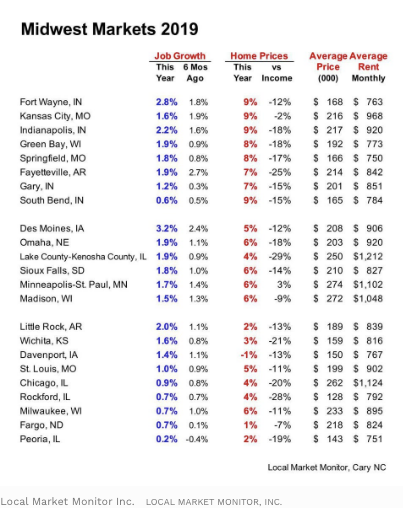
    Source: Local Market Monitor, Inc.

    South Bend and Gary are at the bottom of this list because their job growth had been less reliable. Before bargains evaporate, investors should move quickly into these markets. Straight, single-family rentals – with minor improvements – are the best bet (Winzer, Forbes).

    Growing Demand

    Des Moines, Omaha, Lake County-Kenosha County, Sioux Falls, Minneapolis, Madison.

    These markets are showing solid job growth, but only moderate increases in demand thus far. Apartments appear to be a good investment in Lake County-Kenosha County and Minneapolis, due to higher density and prices. Since their dependence on the financial sector is comparably very high, most of these markets are also slightly riskier, so investors should be very careful to find properties towards the middle of the renter pool and definitely avoid the higher end.

    Uncertain Demand

    Little Rock, Wichita, Davenport, St. Louis, Chicago, Rockford, Milwaukee, Fargo, Peoria.

    In these markets either demand or job growth are weak, or even more likely, both. Low home prices are also far more commonly found in these markets. This may tempt investors to purchase a low-cost property and rent it out for cheap, without spending another dime. However, renting at the low-end is a specialty that most investors should avoid. In uncertain real estate markets, it makes sense to first look for the safest geographic areas in that market. Then you can perhaps expand and renovate a really inexpensive property, turning it into a profitable rental. That definitely involves more work, but it has potential to give you a bigger return for less risk.

    The Bottom Line

    Concisely, there’s clearly room for excellent returns on housing market investments in the Midwest. While some areas have more opportunity, depending on what strategy you choose, there’s solid return on investment potential all-around. The more time that passes from the start of the COVID-19 pandemic, the less attractive prospects will exist. Active real estate investors would be wise to look strongly into the Midwest and move quickly on specifically the kinds of properties with the features described above. Considering the housing rental market is excellent and still growing, there are definite, safe strategies to fall back on.

  • How to Best Invest in Real Estate in the Midwest

    The most surprising feature about housing markets in the Midwest is that home prices – in most of them – are still below the level where local incomes dictate they should be (Winzer, Forbes). If you’re a real estate investor, this means two things. Firstly, there are bargains still available in these markets. Secondly, demand for housing not been very strong, at least not yet.

    Midwest Housing Market Overview

    The lack of rebound in the Midwest housing market following 2008 is largely due to the specific types of local economic growth that prevailed before that (Winzer, Forbes). The housing recession came coupled with a lengthy, slow decline in manufacturing. The availability of an educated but low-cost labor force had encouraged the growth of big financial operations in Des Moines, Minneapolis, Omaha, Sioux Falls and Green Bay. However, manufacturing still has a large role in Fayetteville, Davenport, Peoria, Rockford, Gary, Fort Wayne, South Bend, Wichita, Milwaukee and Green Bay (Millsap, Forbes).

    This makes these markets a bit riskier to invest in. The markets with a large finance sector are also risky because automation is responsible for an increasing amount of work. Despite structural problems, growth is now returning to many Midwest markets, as it did prior to COVID-19. Especially in areas that function as regional centers – Fayetteville and Peoria, for example – the expansion of jobs is due to an increase in healthcare and business services. Similarly, to the country, these services are becoming concentrated in large urban centers, creating opportunities for investors in rental housing.

    An uncharacteristic feature housing investors contend with is many Midwest markets have agricultural roots, with manufacturing later added on top. Since land was readily and easily available during their growth, they tend to be spread out. This combination produces low home prices, but increased difficulty for investors to select a locality. After all, the saying “real estate is about location, location, location”, rings true in most cases.

    Now that we’ve established some fundamental generalities, let’s get to the specifics and numbers.

    Established Demand

    Fort Wayne, Kansas City, Indianapolis, Green Bay, Springfield, Fayetteville, Gary and South Bend.

    In these markets, it appears home prices increased relatively broadly in the past year, indicating good demand not just for single-family homes, but rentals as well. With prices still well below income levels and above average job growth, demand is likely to keep raising prices higher. Though the trend depicted below shows the housing market pre-COVID, that trend is pretty much identical today. The housing market didn’t really suffer the same volume of consequences as other markets, but the small parts that did are steadily recovering (Winzer, Forbes).

    Source: Local Market Monitor, Inc.

    South Bend and Gary are at the bottom of this list because their job growth had been less reliable. Before bargains evaporate, investors should move quickly into these markets. Straight, single-family rentals – with minor improvements – are the best bet (Winzer, Forbes).

    Growing Demand

    Des Moines, Omaha, Lake County-Kenosha County, Sioux Falls, Minneapolis, Madison.

    These markets are showing solid job growth, but only moderate increases in demand thus far. Apartments appear to be a good investment in Lake County-Kenosha County and Minneapolis, due to higher density and prices. Since their dependence on the financial sector is comparably very high, most of these markets are also slightly riskier, so investors should be very careful to find properties towards the middle of the renter pool and definitely avoid the higher end.

    Uncertain Demand

    Little Rock, Wichita, Davenport, St. Louis, Chicago, Rockford, Milwaukee, Fargo, Peoria.

    In these markets either demand or job growth are weak, or even more likely, both. Low home prices are also far more commonly found in these markets. This may tempt investors to purchase a low-cost property and rent it out for cheap, without spending another dime. However, renting at the low-end is a specialty that most investors should avoid. In uncertain real estate markets, it makes sense to first look for the safest geographic areas in that market. Then you can perhaps expand and renovate a really inexpensive property, turning it into a profitable rental. That definitely involves more work, but it has potential to give you a bigger return for less risk.

    The Bottom Line

    Concisely, there’s clearly room for excellent returns on housing market investments in the Midwest. While some areas have more opportunity, depending on what strategy you choose, there’s solid return on investment potential all-around. The more time that passes from the start of the COVID-19 pandemic, the less attractive prospects will exist. Active real estate investors would be wise to look strongly into the Midwest and move quickly on specifically the kinds of properties with the features described above. Considering the housing rental market is excellent and still growing, there are definite, safe strategies to fall back on.

  • Investigating a Critic of Real Estate Investing

    While real estate continues to be the biggest asset class in the world, there are still asset managers who are skeptical about recommending it to their clients as an investment vehicle. As Andy Rachleff puts it:

    One of the most common pieces of financial advice our clients hear from their friends and family is to invest their excess cash in rental properties. Unfortunately, this is terrible advice for all but a lucky few.


    Andy Rachelff

    The piece goes on to give four distinct reasons for critics’ deviation from traditional logic. Let’s break it down one by one.

    Income Isn’t Guaranteed

    While this is true, this is true when it comes to any financial investment vehicle. According to the National Council of Real Estate Investment Fiduciaries (NCREIF), as of Q1 2021 the average 25-year return for private commercial real estate properties held for investment purposes slightly outperformed the S&P 500 Index, with average annualized returns of 10.3% and 9.6%, respectively. Residential and diversified real estate investments also averaged returns of 10.3% (NCREIF). Keep in mind, this data takes into account both the 2008 financial crisis and the COVID-19 pandemic. Each calamity gravely deflated assets in the real estate market. So while it’s certainly true that income isn’t guaranteed, over a 25-year period both commercial and residential real estate holdings outperformed the S&P 500 Index. While income is almost never guaranteed, this should make you feel more at ease about investing your money in the real estate sector.

    It’s Hard To Generate A Compelling Return

    Another generic statement that can be said about almost any investment vehicle. If generating a compelling return was easy, everyone would follow the same system. When you invest in real estate, whether it be through direct property management or a REIT, you still maintain some level of ownership over a physical asset. Conversely, with stocks, as an example, you own a piece of a publicly traded company that has a board of directors, executives, and senior management controlling the day-to-day operations. In other words, your money is in the hand’s of others. With the majority of real estate investment vehicles, you are in control. Therefore, you are the one who has the ability to make decisions that generate a more compelling return, versus leaving those decisions in other people’s hands. It’s easier to generate a compelling return when you have control because at the end of the day, no one will care as much about your money as yourself. Additionally, the under 8% net over eight years earned by Weatherfront’s portfolio is not only a logical fallacy as it is only one data point, but their complaint is largely surrounding the tax structure of rental properties investors will have to pay. It is anecdotal data tailored to disprove a very generic argument to begin with.

    It’s Better To Diversify Your Portfolio

    In this section, the writer essentially makes a compelling argument to investing in a REIT versus direct real estate investing. While we’ve covered both strategies in depth, it’s true that in the long-term a REIT, REIG, or some form of pooled investment will mitigate your portfolio’s risk. This is especially true for individual properties that “fall out of favor”, sometimes due to external factors (i.e. COVID-19 pandemic). The writer correctly points out the substantial risk in a situation where you have enough capital to invest in only one property and advises you against it, but then makes a perfect argument for how to actually diversify your capital within the real estate market. After all, diversification is cited by a vast majority a major benefit to the real estate investment sector. Irrespective of how much money you have to invest upfront, you have control over how much risk you want to take on. Therefore you can choose to diversify your real estate portfolio, or you can put all your eggs in one basket. We are in agreement with Weatherfront that the latter generally isn’t advisable.

    Liquidity Matters

    Depending on what approach you take to real estate investing, the writer has a point. If you take a direct approach to real estate investing, you can easily get stuck with an undesirable property. Alternatively, investing in a real estate index fund, gives you the same liquidity as investing in any other index or stock. Nowadays, it’s very rare to see an investor take all their excess investment capital and tie it down in one property. If they do, they’re doing so at their own peril. With so much data available that shows national long-term economic growth is cyclical, one would have to have a very high appetite for risk to directly invest in a single property. Diversification has been proven to be an essential component to any successful investment portfolio.

    Concisely, do we agree with the critic’s assertion to avoid investing in real estate holdings? No, we don’t. While the writer points out some opportunities to improve your real estate investment strategy, they don’t provide a compelling argument to avoid investing in the entire segment. While some data is anecdotal and some is actual, they make a good case to be wary of rental properties. At the same time, they make a great case for diversification through REITs and other real estate index funds. The fact is there will always be critics and skeptics of any investment choices. There are analysts who are paid to do just that. However real estate has been the world’s largest asset class for awhile and it isn’t going anywhere. For investors, it would be wise to embrace that and research the abundant amount of strategies available within the real estate segment. Diversification will always be critical. Especially if you’re not currently invested in the real estate market, it would be prudent to look into various strategies because you’re all but sure to find some that suit either your short or long-term goals.

  • Investigating a Critic of Real Estate Investing

    While real estate continues to be the biggest asset class in the world, there are still asset managers who are skeptical about recommending it to their clients as an investment vehicle. As Andy Rachleff puts it:

    One of the most common pieces of financial advice our clients hear from their friends and family is to invest their excess cash in rental properties. Unfortunately, this is terrible advice for all but a lucky few.


    Andy Rachelff

    The piece goes on to give four distinct reasons for critics’ deviation from traditional logic. Let’s break it down one by one.

    Income Isn’t Guaranteed

    While this is true, this is true when it comes to any financial investment vehicle. According to the National Council of Real Estate Investment Fiduciaries (NCREIF), as of Q1 2021 the average 25-year return for private commercial real estate properties held for investment purposes slightly outperformed the S&P 500 Index, with average annualized returns of 10.3% and 9.6%, respectively. Residential and diversified real estate investments also averaged returns of 10.3% (NCREIF). Keep in mind, this data takes into account both the 2008 financial crisis and the COVID-19 pandemic. Each calamity gravely deflated assets in the real estate market. So while it’s certainly true that income isn’t guaranteed, over a 25-year period both commercial and residential real estate holdings outperformed the S&P 500 Index. While income is almost never guaranteed, this should make you feel more at ease about investing your money in the real estate sector.

    It’s Hard To Generate A Compelling Return

    Another generic statement that can be said about almost any investment vehicle. If generating a compelling return was easy, everyone would follow the same system. When you invest in real estate, whether it be through direct property management or a REIT, you still maintain some level of ownership over a physical asset. Conversely, with stocks, as an example, you own a piece of a publicly traded company that has a board of directors, executives, and senior management controlling the day-to-day operations. In other words, your money is in the hand’s of others. With the majority of real estate investment vehicles, you are in control. Therefore, you are the one who has the ability to make decisions that generate a more compelling return, versus leaving those decisions in other people’s hands. It’s easier to generate a compelling return when you have control because at the end of the day, no one will care as much about your money as yourself. Additionally, the under 8% net over eight years earned by Weatherfront’s portfolio is not only a logical fallacy as it is only one data point, but their complaint is largely surrounding the tax structure of rental properties investors will have to pay. It is anecdotal data tailored to disprove a very generic argument to begin with.

    It’s Better To Diversify Your Portfolio

    In this section, the writer essentially makes a compelling argument to investing in a REIT versus direct real estate investing. While we’ve covered both strategies in depth, it’s true that in the long-term a REIT, REIG, or some form of pooled investment will mitigate your portfolio’s risk. This is especially true for individual properties that “fall out of favor”, sometimes due to external factors (i.e. COVID-19 pandemic). The writer correctly points out the substantial risk in a situation where you have enough capital to invest in only one property and advises you against it, but then makes a perfect argument for how to actually diversify your capital within the real estate market. After all, diversification is cited by a vast majority a major benefit to the real estate investment sector. Irrespective of how much money you have to invest upfront, you have control over how much risk you want to take on. Therefore you can choose to diversify your real estate portfolio, or you can put all your eggs in one basket. We are in agreement with Weatherfront that the latter generally isn’t advisable.

    Liquidity Matters

    Depending on what approach you take to real estate investing, the writer has a point. If you take a direct approach to real estate investing, you can easily get stuck with an undesirable property. Alternatively, investing in a real estate index fund, gives you the same liquidity as investing in any other index or stock. Nowadays, it’s very rare to see an investor take all their excess investment capital and tie it down in one property. If they do, they’re doing so at their own peril. With so much data available that shows national long-term economic growth is cyclical, one would have to have a very high appetite for risk to directly invest in a single property. Diversification has been proven to be an essential component to any successful investment portfolio.

    Concisely, do we agree with the critic’s assertion to avoid investing in real estate holdings? No, we don’t. While the writer points out some opportunities to improve your real estate investment strategy, they don’t provide a compelling argument to avoid investing in the entire segment. While some data is anecdotal and some is actual, they make a good case to be wary of rental properties. At the same time, they make a great case for diversification through REITs and other real estate index funds. The fact is there will always be critics and skeptics of any investment choices. There are analysts who are paid to do just that. However real estate has been the world’s largest asset class for awhile and it isn’t going anywhere. For investors, it would be wise to embrace that and research the abundant amount of strategies available within the real estate segment. Diversification will always be critical. Especially if you’re not currently invested in the real estate market, it would be prudent to look into various strategies because you’re all but sure to find some that suit either your short or long-term goals.

  • NYC Real Estate Market Mid-2021: Are You Better Off Buying or Renting?

    Since New York City’s (NYC) real estate market is still experiencing a fresh post-COVID effect, you are better off buying if you have the money (and credit score). However, as is often the case, it greatly depends on your financial situation. Living in arguably the most desirable and expensive part of the world presents a financial burden to many younger adults, who are still working lower paying, entry level jobs.

    The majority of real estate property owners in New York City are of older age and in the highest income brackets (NYU Furman Center). Additionally, they are more likely to have permanent ownership of property in other locations (Goldstein, Property Nest).

    Many people view renting as ‘wasteful’ because you don’t have the benefit of acquiring equity in your property. However, the reality is for most young or middle-aged professionals, the economic opportunities – combined with the cost of living in New York City – don’t allow them to acquire enough requisite disposable income to put a down payment on a desirable apartment unit. This brings up a primary obstacle many residents of New York City see with buying a permanent unit: most people don’t view New York City as their ‘final destination’, long-term residence. In other words, when most people think about taking out a mortgage and buying a home, they’re thinking about a serious long-term commitment (emphasis on long-term). Raising kids, settling down in a permanent work situation, and finally retiring. The suburbs or a quiet town; not the most densely populated, most popular tourist destination in the world.

    While there are plenty of mechanisms available to individuals looking to get out of a 20 or 30-year mortgage after only a few years, logically, it would make sense for most to still prefer not to take on that kind of serious financial responsibility without the intent of staying in that location for a while.  

    With that being said, from the perspective of someone simply asking: “hey, would I be better off buying or renting in New York City?”, I would advise them to not be hesitant and buy if they have the money saved.

    The reason is two-fold. If you are going to live in the unit, at least initially, you’ll acquire equity simultaneously. If you find that NYC is not for you in a few years – as many inevitably do – current market prices and historic trends, combined with current rates and incentives, suggest one would be able to see a positive cash flow from subleasing or subletting their own property. Meaning, renters are consistently earning more monthly rent than their monthly mortgage payments. Alternatively, if you have no desire of becoming a landlord, contrary to ordinary homeowner’s beliefs, there is the ability to sell your mortgaged property and earn a profit. It’s extremely difficult to look at the recent data without considering the COVID-19 situation, but over a 10-year period prior to that, real estate prices were significantly increasing year-over-year.

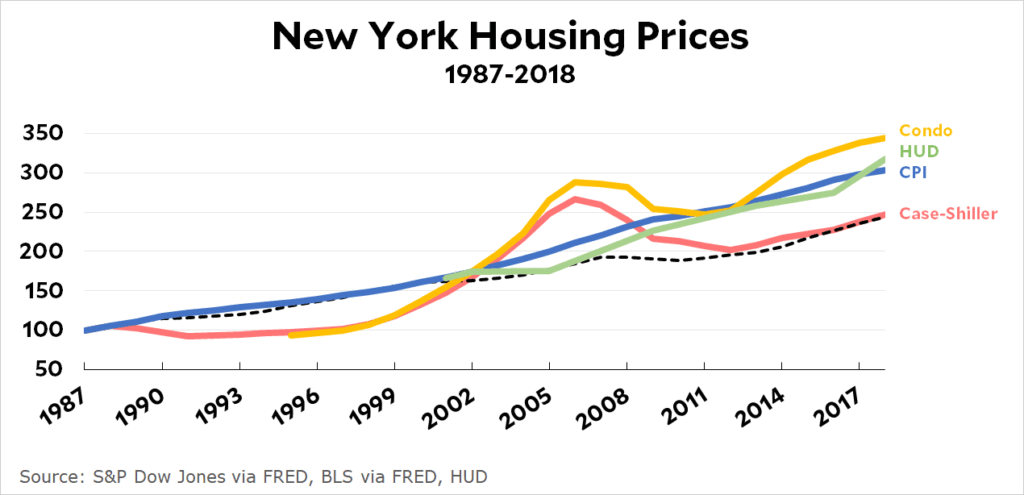
    That’s largely why real estate became viewed as a very popular investment vehicle for financial investors. The figure below illustrates an average of New York housing prices over a 30-year period, between 1987 and 2018, from different housing market segments.

    Figure 1 – New York (NYC) Housing Market Prices (1987-2018) Overview

    As one can see, prices went up across the board mostly every year, with the exception of a rocky period in the midst of the Great Recession of 2008. Therefore, having more ownership/equity in a property that’s also going to increase in value over time is a no brainer, even if you choose to move out of that property prior to paying off your mortgage.

  • NYC Real Estate Market Mid-2021: Are You Better Off Buying or Renting?

    Since New York City’s (NYC) real estate market is still experiencing a fresh post-COVID effect, you are better off buying if you have the money (and credit score). However, as is often the case, it greatly depends on your financial situation. Living in arguably the most desirable and expensive part of the world presents a financial burden to many younger adults, who are still working lower paying, entry level jobs.

    The majority of real estate property owners in New York City are of older age and in the highest income brackets (NYU Furman Center). Additionally, they are more likely to have permanent ownership of property in other locations (Goldstein, Property Nest).

    Many people view renting as ‘wasteful’ because you don’t have the benefit of acquiring equity in your property. However, the reality is for most young or middle-aged professionals, the economic opportunities – combined with the cost of living in New York City – don’t allow them to acquire enough requisite disposable income to put a down payment on a desirable apartment unit. This brings up a primary obstacle many residents of New York City see with buying a permanent unit: most people don’t view New York City as their ‘final destination’, long-term residence. In other words, when most people think about taking out a mortgage and buying a home, they’re thinking about a serious long-term commitment (emphasis on long-term). Raising kids, settling down in a permanent work situation, and finally retiring. The suburbs or a quiet town; not the most densely populated, most popular tourist destination in the world.

    While there are plenty of mechanisms available to individuals looking to get out of a 20 or 30-year mortgage after only a few years, logically, it would make sense for most to still prefer not to take on that kind of serious financial responsibility without the intent of staying in that location for a while.  

    With that being said, from the perspective of someone simply asking: “hey, would I be better off buying or renting in New York City?”, I would advise them to not be hesitant and buy if they have the money saved.

    The reason is two-fold. If you are going to live in the unit, at least initially, you’ll acquire equity simultaneously. If you find that NYC is not for you in a few years – as many inevitably do – current market prices and historic trends, combined with current rates and incentives, suggest one would be able to see a positive cash flow from subleasing or subletting their own property. Meaning, renters are consistently earning more monthly rent than their monthly mortgage payments. Alternatively, if you have no desire of becoming a landlord, contrary to ordinary homeowner’s beliefs, there is the ability to sell your mortgaged property and earn a profit. It’s extremely difficult to look at the recent data without considering the COVID-19 situation, but over a 10-year period prior to that, real estate prices were significantly increasing year-over-year.

    That’s largely why real estate became viewed as a very popular investment vehicle for financial investors. The figure below illustrates an average of New York housing prices over a 30-year period, between 1987 and 2018, from different housing market segments.

    Figure 1 – New York (NYC) Housing Market Prices (1987-2018) Overview

    As one can see, prices went up across the board mostly every year, with the exception of a rocky period in the midst of the Great Recession of 2008. Therefore, having more ownership/equity in a property that’s also going to increase in value over time is a no brainer, even if you choose to move out of that property prior to paying off your mortgage.

  • Five Key Tips to Investing in Rental Properties

    Five Key Tips to Investing in Rental Properties

    1. Stay on Top of Your Personal Debt

    Savvy investors tend to make sure they are not highly levered, especially prior to investing in any real estate property they intend to rent out. While all would agree that it’s not necessary to have 100% cash up front in many situations to make the property a great investment, it’s wise to try to pay down any personal debt you may have prior to, or after acquiring a rental property. Otherwise you may find that your expenses – especially something like a huge, unexpected medical bill – could cause you to pay a lot more in interest, thus losing profit, than you were originally seeking to.

    2. Make Sure You Can Really Afford Your Downpayment

    Whether you want to purchase a rental property for supplemental income, to diversify your investment portfolio, or as part of a longer-term investing strategy, it’s essential that when you decide to pull the trigger, you’re confident your budget can sustain the downpayment. This ties back to staying on top of your personal debt and other investments in your portfolio, but at the same time it’s a common mistake. You won’t be putting down 3-10% like you may on your personal home. With the minimum being 20% and if financing, you generally see it coming in the form of a personal loan, you can once again get into a rut with interest and possible refinancing if you can’t really afford the initial downpayment.

    3. Stay Away from Financing with High Interest Rates

    Comparatively in 2020, the cost of borrowing money has been very cheap due to economic factors from the COVID-19 pandemic, however in general loans with higher interest rates are best to avoid when looking to buy a rental property. Remember, you’re not going to get the benefit of a traditional mortgage interest rate, so be sure to stay away from personal loans (or other means of obtaining financing) that carry high interest rates.

    4. Location, Location, Location

    Investors already in the rental market are just starting to see prices stabilize, but only in certain “prime” locations. For example, if you look at various subdivisions of geographic areas within the Manhattan real estate market, you’ll find studios in the Upper East Side (for example) are now all above a ‘floor price’. However, if you look at similar studios in East Harlem, you won’t see the same uniformity. In fact, it’s very much to the contrary; there’s still high volatility in rental prices in ‘non-prime’ locations. To ensure your investment property is as immune as possible to market fluctuations resulting from uncertainty, the location of your rental property is essential to a successful return on investment.

    5. Invest in Landlord Insurance; Assume Unexpected Costs

    The two don’t necessarily go hand-in-hand (you should always assume unexpected costs), we wanted to recommend landlord insurance specifically on top of homeowners insurance. Landlord insurance generally covers property damage, lost rental income, and liability protection, in case a tenant or a visitor suffers injury as a result of property maintenance issues (for example). Depending on various factors of your rental property, the cost may be higher than you anticipate and you may be one of the people who thinks “this will never happen to me, so I don’t need it”, but in these cases it’s definitely better to be safe than sorry. Investing in a rental property is a big commitment and the landlord insurance certainly isn’t somewhere it’ll be worth it to cut costs in the long-term.