Tag: technology

  • The World’s Oldest and Largest Custodian Bank – BNY Mellon – Builds Platform to Revolutionize Digital Asset Custody Services

    BNY Mellon, founded by Alexander Hamilton in 1784 – the first US Treasury Secretary – has announced they are continuing to build out a highly advanced, robust, and secure digital assets custody business.

    “Touching more than 20% of the world’s investable assets, BNY Mellon has the scale to help our clients reimagine financial markets through blockchain technology and digital assets. We are still in the early days of this evolution, but the possibilities are exciting. Today’s announcement marks a step in what we see as an ongoing innovation journey for our firm, our clients and the rest of the financial industry.”

    -Robin Vince, CEO of BNY Mellon

    BNY’s custodianship business is based on some of the very principles Hamilton wrote about in the late 1700s. They are both the largest and the oldest custodian bank in the world, with approximately $45T (Trillion) in Assets Under Custody (AUC). With their experience, brand recognition, and unique ability to utilize economies of scale – coupled with what appears to be a recent renewed peaking interest in digital assets – this move is an example of exceptional business strategy.

    The Timing of BNY Mellon’s Announcement

    The timing of the announcement is interesting for a number of reasons. Firstly (likely the primary reason), the Sibos Update conference, which initially lasted from 10/10-10/13. BNY had a very large presence and rolled this news out in parallel. Secondly, we’re at an absolutely critical point in macroeconomic policy. Will the Fed’s decision to hike up rates to deflate the inflation work? Did they start too late? What’s the impact on US and global financial markets? Presently, those questions are central to investors every single day.

    Generally, during recessionary cyclical economic times, at-risk assets don’t do well (to say the least). Cryptocurrencies and digital assets are in the heart of today’s at-risk assets category – though that may be slowly changing. Regardless, during such a time of economic uncertainty, rolling out a high-tech, revolutionary custodianship service for digital assets is interesting. That leads me to the next timing overlap.

    The SEC’s Ongoing Persistence of Rejecting Bitcoin Spot ETF Proposals

    The SEC has been on a roll with rejecting Bitcoin spot ETFs. Coverage of this began intensifying when they rejected Grayscale GBTC’s conversion request from a SEC-approved Bitcoin Trust to an SEC-approved Bitcoin spot ETF. Grayscale immediately retained Donald Verrilli Jr., who subsequently filed a quick appeal. Verrilli is best known for making a successful oral argument to the US Supreme Court in favor of the ACA (Obamacare). Afterwards, any new Bitcoin ETF – especially spot ETFs – were widely covered by the media and enthused investors. This announcement came on October 11th, 2022, the same day WisdomTree’s Bitcoin spot ETF application was rejected by the SEC, which is also coincidentally the same date the SEC had a deadline to respond to VanEck’s appeal of their previously rejected Bitcoin spot ETF. To note, the SEC has now missed their 45-day deadline to respond.

    Bear in mind, VanEck is not heavily exposed in digital assets at all. They are a highly reputable institutional investment firm, with one SEC-approved Bitcoin Strategy ETF on the market. As all other currently SEC-approved Bitcoin ETFs, VanEck’s Strategy ETF is a Bitcoin futures ETF. Nonetheless, BNY Mellon – very likely coincidentally, admittedly – announced this launch on the same day as two highly anticipated SEC rulings on digital asset products.

    Expected Impact for the Digital Asset Market

    The impact, especially in the longer-term, is potentially massive. Let’s remember the primary, above-and-beyond, number one reason the SEC is rejecting Bitcoin spot ETFs: security. Grayscale’s SEC-approved GBTC Bitcoin Trust advertises and details the product’s custodianship. The custodian is Coinbase Custody Trust Company, LLC. In other words, at least from the branding, the custodian of the cryptocurrency product is a cryptocurrency-specific custodian. Continuing with the Grayscale example, this makes their rebuttal to the SEC more difficult. Is there any remotely tangible security added if a cryptocurrency product is in the custody of another cryptocurrency-specific firm? I don’t doubt Grayscale’s ability to make a compelling and technically robust argument, but I seriously doubt the SEC’s acceptance.

    What if the scenario remains the same, with the only change being the custodian. With very few exceptions, in my opinion nothing really changes. That is, unless the custodian is BNY Mellon. Some, including myself, might argue that turns the dynamic in the other direction. If GBTC is held in the custody of BNY Mellon, would the SEC still cite security concerns? Unimaginable. BNY Mellon’s brand is iconic when it comes to custodianship services in global banking. Through this core offering, BNY Mellon alone winds up touching over 20% – or more than 1 out of every 5 USD (or global currency equivalent) – throughout the entire world. That’s astounding. Keeping in mind they are the oldest bank and the oldest publicly traded company, BNY must be doing something right in custodianship services.

    Security Has Always Been Paramount in Custodian Banking

    With custodianship banking generally, security is definitely mission critical. BNY has provided this service, highly successfully, arguably longer than any other service offered by any institution. They’ve been evolving the custody banking sector since the late 1700s. Back to the SEC, if I’m looking at GBTC in the custody of BNY Mellon, I don’t see any compelling argument for security concerns. If anything, I’d see that as more of comical reasoning. The SEC could always pivot to another, more plausible concern if (when) that were to happen, but it’s still a huge win for the digital asset market – as well as BNY Mellon.

    As a final note here, the SEC is rejecting Bitcoin spot ETFs at an increasing rate, meaning applications are growing. More and more firms are attempting to get SEC-approved Bitcoin products into the marketplace. Clearly, they’re prognosticating an increase in investor demand for digital asset products and are attempting to respond accordingly. Let’s also be clear – investors and investment firms aren’t required to get SEC clearance to sell Bitcoin derivatives.

    That said, of course it’s highly preferred. In an asset class still largely plagued by uncertainty, SEC approval is an immediate, gigantic game-changer. BNY Mellon holding custody of digital assets on an in-house, BNY Mellon digital assets custody platform changes cryptocurrency market dynamics. It also likely puts cryptocurrency-specific custodians out of business, amongst other market effects. One would think it’d have to alter the SEC’s position substantially and broadly on digital assets. In turn, that should similarly substantially and broadly alter investor perception of digital assets.

    Could Anything Go Wrong?

    Always. On a more serious note, even Alexander Hamilton was famously quoted saying, “I never expect a perfect work from an imperfect man”. From my perspective, BNY Mellon is not only the biggest risk-taker here; they are the biggest by a landslide. This is a company that was founded by the first US Treasury Secretary and has only improved their initial, core offering over time. The SEC also isn’t raising concerns over security as a completely illegitimate excuse. We’ve seen Ethereum wallets hacked, viruses created to successfully steal Bitcoin, cyber-attacks against crypto exchanges, and more. BNY Mellon will have the sole responsibility to ensure none of that occurs on their watch, so to speak. What if they fail? That’s exactly the point at which this could all go terribly wrong.

    BNY Mellon built a brand with the core focus on custodian banking spanning the course of over 225 years. They are widely considered to be the most prestigious and critical institutional investment services firm in the world. Now they’ve made a major move into the digital asset space, an admittedly enticing and potentially extremely lucrative strategy. However, in banking, all it takes to bring down a reputation built over 225 years is one mistake in seconds.

    To be sure, there’s added nuance here. Digital assets are naturally going to be more susceptible to evolving technologies as digital assets themselves are an evolving technology. Cybersecurity preventability measures and the sophistication of cybersecurity attacks have both increased. In the age of digital transformation, I believe this is a correctly calculated risk for BNY Mellon.

    Extent a Momentary Error Could Hurt BNY Mellon’s Core Business

    While there can be little to no doubt a security issue coming from BNY’s digital asset custody platform would be detrimental to the company – potentially in a very large way – the same can be said for the likelihood of that instance actually bringing down what BNY’s built in over 225 years. Even if the world’s most secure custodian has a security malfunction, I don’t believe it would even impact their current business model. It may take them out of digital asset custody services – I think even that is reaching – but again, I don’t see it majorly tarnishing the brand.

    All-in-all, this is a win-win scenario, statistically speaking. Yes, something could go wrong. When this platform is ready for go-live and it’s used broadly, we’ll get a better sense of the impact. But BNY especially would not dramatically – out of character – launch a futuristic digital assets custody platform that didn’t meet the mark from a technology perspective.

    There shouldn’t be doubt BNY made budgetary concerns a main priority, or even an obstacle, of this project. The team they’ve assembled is comprised of the brightest, most experienced, innovative SME’s in their respective areas. This continuing work-in-progress originated in 2019 and is just now starting to be publicly rolled out in a significant way. BNY likely took 3 years to ensure they had capacity to build a product worthy of publicly announcing is work-in-progress. They notably take perfection seriously; I doubt many disbelieve they’re going to rollout an incredible product. Whether perfection in digital assets custody is attainable is a separate discussion, but if anyone could, it’s BNY Mellon.
  • The World’s Oldest and Largest Custodian Bank – BNY Mellon – Builds Platform to Revolutionize Digital Asset Custody Services

    BNY Mellon, founded by Alexander Hamilton in 1784 – the first US Treasury Secretary – has announced they are continuing to build out a highly advanced, robust, and secure digital assets custody business.

    “Touching more than 20% of the world’s investable assets, BNY Mellon has the scale to help our clients reimagine financial markets through blockchain technology and digital assets. We are still in the early days of this evolution, but the possibilities are exciting. Today’s announcement marks a step in what we see as an ongoing innovation journey for our firm, our clients and the rest of the financial industry.”

    -Robin Vince, CEO of BNY Mellon

    BNY’s custodianship business is based on some of the very principles Hamilton wrote about in the late 1700s. They are both the largest and the oldest custodian bank in the world, with approximately $45T (Trillion) in Assets Under Custody (AUC). With their experience, brand recognition, and unique ability to utilize economies of scale – coupled with what appears to be a recent renewed peaking interest in digital assets – this move is an example of exceptional business strategy.

    The Timing of BNY Mellon’s Announcement

    The timing of the announcement is interesting for a number of reasons. Firstly (likely the primary reason), the Sibos Update conference, which initially lasted from 10/10-10/13. BNY had a very large presence and rolled this news out in parallel. Secondly, we’re at an absolutely critical point in macroeconomic policy. Will the Fed’s decision to hike up rates to deflate the inflation work? Did they start too late? What’s the impact on US and global financial markets? Presently, those questions are central to investors every single day.

    Generally, during recessionary cyclical economic times, at-risk assets don’t do well (to say the least). Cryptocurrencies and digital assets are in the heart of today’s at-risk assets category – though that may be slowly changing. Regardless, during such a time of economic uncertainty, rolling out a high-tech, revolutionary custodianship service for digital assets is interesting. That leads me to the next timing overlap.

    The SEC’s Ongoing Persistence of Rejecting Bitcoin Spot ETF Proposals

    The SEC has been on a roll with rejecting Bitcoin spot ETFs. Coverage of this began intensifying when they rejected Grayscale GBTC’s conversion request from a SEC-approved Bitcoin Trust to an SEC-approved Bitcoin spot ETF. Grayscale immediately retained Donald Verrilli Jr., who subsequently filed a quick appeal. Verrilli is best known for making a successful oral argument to the US Supreme Court in favor of the ACA (Obamacare). Afterwards, any new Bitcoin ETF – especially spot ETFs – were widely covered by the media and enthused investors. This announcement came on October 11th, 2022, the same day WisdomTree’s Bitcoin spot ETF application was rejected by the SEC, which is also coincidentally the same date the SEC had a deadline to respond to VanEck’s appeal of their previously rejected Bitcoin spot ETF. To note, the SEC has now missed their 45-day deadline to respond.

    Bear in mind, VanEck is not heavily exposed in digital assets at all. They are a highly reputable institutional investment firm, with one SEC-approved Bitcoin Strategy ETF on the market. As all other currently SEC-approved Bitcoin ETFs, VanEck’s Strategy ETF is a Bitcoin futures ETF. Nonetheless, BNY Mellon – very likely coincidentally, admittedly – announced this launch on the same day as two highly anticipated SEC rulings on digital asset products.

    Expected Impact for the Digital Asset Market

    The impact, especially in the longer-term, is potentially massive. Let’s remember the primary, above-and-beyond, number one reason the SEC is rejecting Bitcoin spot ETFs: security. Grayscale’s SEC-approved GBTC Bitcoin Trust advertises and details the product’s custodianship. The custodian is Coinbase Custody Trust Company, LLC. In other words, at least from the branding, the custodian of the cryptocurrency product is a cryptocurrency-specific custodian. Continuing with the Grayscale example, this makes their rebuttal to the SEC more difficult. Is there any remotely tangible security added if a cryptocurrency product is in the custody of another cryptocurrency-specific firm? I don’t doubt Grayscale’s ability to make a compelling and technically robust argument, but I seriously doubt the SEC’s acceptance.

    What if the scenario remains the same, with the only change being the custodian. With very few exceptions, in my opinion nothing really changes. That is, unless the custodian is BNY Mellon. Some, including myself, might argue that turns the dynamic in the other direction. If GBTC is held in the custody of BNY Mellon, would the SEC still cite security concerns? Unimaginable. BNY Mellon’s brand is iconic when it comes to custodianship services in global banking. Through this core offering, BNY Mellon alone winds up touching over 20% – or more than 1 out of every 5 USD (or global currency equivalent) – throughout the entire world. That’s astounding. Keeping in mind they are the oldest bank and the oldest publicly traded company, BNY must be doing something right in custodianship services.

    Security Has Always Been Paramount in Custodian Banking

    With custodianship banking generally, security is definitely mission critical. BNY has provided this service, highly successfully, arguably longer than any other service offered by any institution. They’ve been evolving the custody banking sector since the late 1700s. Back to the SEC, if I’m looking at GBTC in the custody of BNY Mellon, I don’t see any compelling argument for security concerns. If anything, I’d see that as more of comical reasoning. The SEC could always pivot to another, more plausible concern if (when) that were to happen, but it’s still a huge win for the digital asset market – as well as BNY Mellon.

    As a final note here, the SEC is rejecting Bitcoin spot ETFs at an increasing rate, meaning applications are growing. More and more firms are attempting to get SEC-approved Bitcoin products into the marketplace. Clearly, they’re prognosticating an increase in investor demand for digital asset products and are attempting to respond accordingly. Let’s also be clear – investors and investment firms aren’t required to get SEC clearance to sell Bitcoin derivatives.

    That said, of course it’s highly preferred. In an asset class still largely plagued by uncertainty, SEC approval is an immediate, gigantic game-changer. BNY Mellon holding custody of digital assets on an in-house, BNY Mellon digital assets custody platform changes cryptocurrency market dynamics. It also likely puts cryptocurrency-specific custodians out of business, amongst other market effects. One would think it’d have to alter the SEC’s position substantially and broadly on digital assets. In turn, that should similarly substantially and broadly alter investor perception of digital assets.

    Could Anything Go Wrong?

    Always. On a more serious note, even Alexander Hamilton was famously quoted saying, “I never expect a perfect work from an imperfect man”. From my perspective, BNY Mellon is not only the biggest risk-taker here; they are the biggest by a landslide. This is a company that was founded by the first US Treasury Secretary and has only improved their initial, core offering over time. The SEC also isn’t raising concerns over security as a completely illegitimate excuse. We’ve seen Ethereum wallets hacked, viruses created to successfully steal Bitcoin, cyber-attacks against crypto exchanges, and more. BNY Mellon will have the sole responsibility to ensure none of that occurs on their watch, so to speak. What if they fail? That’s exactly the point at which this could all go terribly wrong.

    BNY Mellon built a brand with the core focus on custodian banking spanning the course of over 225 years. They are widely considered to be the most prestigious and critical institutional investment services firm in the world. Now they’ve made a major move into the digital asset space, an admittedly enticing and potentially extremely lucrative strategy. However, in banking, all it takes to bring down a reputation built over 225 years is one mistake in seconds.

    To be sure, there’s added nuance here. Digital assets are naturally going to be more susceptible to evolving technologies as digital assets themselves are an evolving technology. Cybersecurity preventability measures and the sophistication of cybersecurity attacks have both increased. In the age of digital transformation, I believe this is a correctly calculated risk for BNY Mellon.

    Extent a Momentary Error Could Hurt BNY Mellon’s Core Business

    While there can be little to no doubt a security issue coming from BNY’s digital asset custody platform would be detrimental to the company – potentially in a very large way – the same can be said for the likelihood of that instance actually bringing down what BNY’s built in over 225 years. Even if the world’s most secure custodian has a security malfunction, I don’t believe it would even impact their current business model. It may take them out of digital asset custody services – I think even that is reaching – but again, I don’t see it majorly tarnishing the brand.

    All-in-all, this is a win-win scenario, statistically speaking. Yes, something could go wrong. When this platform is ready for go-live and it’s used broadly, we’ll get a better sense of the impact. But BNY especially would not dramatically – out of character – launch a futuristic digital assets custody platform that didn’t meet the mark from a technology perspective.

    There shouldn’t be doubt BNY made budgetary concerns a main priority, or even an obstacle, of this project. The team they’ve assembled is comprised of the brightest, most experienced, innovative SME’s in their respective areas. This continuing work-in-progress originated in 2019 and is just now starting to be publicly rolled out in a significant way. BNY likely took 3 years to ensure they had capacity to build a product worthy of publicly announcing is work-in-progress. They notably take perfection seriously; I doubt many disbelieve they’re going to rollout an incredible product. Whether perfection in digital assets custody is attainable is a separate discussion, but if anyone could, it’s BNY Mellon.

  • Is India’s UPI (Unified Payments Interface) Technology Worth Selling Overseas and to Western Countries?

    The Unified Payments Interface (UPI) was created by the National Payments Corporation of India (NPCI) for purposes of “enabling digital payments and settlement systems in India, is an initiative of RBI and IBA”. As announced in Bloomberg in June 2022, the NPCI is looking to take UPI to overseas markets. This implies that a) the technology has been tested thoroughly and successfully in Indian markets and b) there is currently no real competitor to UPI in overseas markets. At one point, NPCI CEO Ritesh Shukla compared it to a “home-grown alternative to SWIFT”. For those who aren’t familiar, SWIFT is a Belgium-based cross-border payments system operator.

    Has the Product [UPI] been Thoroughly Tested in Indian Markets?

    Based on our research, yes UPI has been tested both rigorously and successfully in Indian markets.

    “We have displaced cash in India to a large extent and are now looking to repeat the success in cross-border corridors. Overseas Indians can use our rails to remit money inwards straightway into their bank accounts, and for the markets where Indians travel frequently, we will build acceptance for our instruments.”
    – NPCI CEO, Ritesh Shukla
    Tweet

    Not only has the technology behind UPI been proven and tested, but the methodology has also succeeded. At least that’s the quantitative claim Shukla’s making. The World Bank data seems to support the analysis too. Indians overseas remitted $87 billion in 2021; the biggest inflow for any country that was tracked by the World Bank.

    Under the RBI’s “Liberalized Remittance Scheme”, all resident individuals (including minors) are allowed to freely remit up to USD $250,000 per year. This is from April-March, for any permissible current or capital account transaction, or a combination of both. Further, resident individuals can avail of the foreign exchange facility, for specific purposes within the limit of USD $250,000 only. The RBI’s “Scheme” was introduced on February 4, 2004, with a limit of USD $25,000 (BusinessDesk, Bloomberg). Since then, the LRS limit has been revised in stages consistent with prevailing macro and micro economic conditions. Notably, the “Scheme” is not available to corporates, partnership firms, HUF, Trusts etc.

    Are there Any Notable Comparisons to India’s UPI Abroad (not factoring in SWIFT)?

    Of the $87 million in remittances India received in 2021, the US was the biggest source (World Bank). According to the World Bank, US remittances to India accounted for over 20% of the $87 million in 2021.

    “Flows to India (the world’s largest recipient of remittances) are expected to reach $87 billion, a gain of 4.6 per cent with the severity of COVID-19 caseloads and deaths during the second quarter (well above the global average) playing a prominent role in drawing altruistic flows (including for the purchase of oxygen tanks) to the country”.
    – World Bank Spokesperson, World Bank Migration and Development Brief, 2022
    Tweet

    In terms of total global remittances, India is followed by China, Mexico, the Philippines, and Egypt (World Bank). In India, remittances are projected to grow 3% in 2022 to $89.6 billion. This is reflective of a drop in overall migrant stock, as a large proportion of returnees from Middle Eastern countries are still awaiting return (World Bank).

    Remittances in low-and-middle-income countries are projected to have grown a strong 7.3% to reach $589 billion in 2021 (World Bank). This “return to growth” is far more robust than earlier estimates. Following the same resilience of flows in 2020, when remittances declined by only 1.7% despite a severe global recession due to COVID-19, according to estimates from the World Bank’s Migration and Development Brief. Lastly, the brief in its entirety can be found here, from the World Bank’s website.

    Outside of evaluating the micro-differences to SWIFT, there are no current notable competitors to India’s UPI we could find. Without any doubt, no possible comparisons would come close in terms of size or scale.

  • Is India’s UPI (Unified Payments Interface) Technology Worth Selling Overseas and to Western Countries?

    The Unified Payments Interface (UPI) was created by the National Payments Corporation of India (NPCI) for purposes of “enabling digital payments and settlement systems in India, is an initiative of RBI and IBA”. As announced in Bloomberg in June 2022, the NPCI is looking to take UPI to overseas markets. This implies that a) the technology has been tested thoroughly and successfully in Indian markets and b) there is currently no real competitor to UPI in overseas markets. At one point, NPCI CEO Ritesh Shukla compared it to a “home-grown alternative to SWIFT”. For those who aren’t familiar, SWIFT is a Belgium-based cross-border payments system operator.

    Has the Product [UPI] been Thoroughly Tested in Indian Markets?

    Based on our research, yes UPI has been tested both rigorously and successfully in Indian markets.

    “We have displaced cash in India to a large extent and are now looking to repeat the success in cross-border corridors. Overseas Indians can use our rails to remit money inwards straightway into their bank accounts, and for the markets where Indians travel frequently, we will build acceptance for our instruments.”
    – NPCI CEO, Ritesh Shukla
    Tweet

    Not only has the technology behind UPI been proven and tested, but the methodology has also succeeded. At least that’s the quantitative claim Shukla’s making. The World Bank data seems to support the analysis too. Indians overseas remitted $87 billion in 2021; the biggest inflow for any country that was tracked by the World Bank.

    Under the RBI’s “Liberalized Remittance Scheme”, all resident individuals (including minors) are allowed to freely remit up to USD $250,000 per year. This is from April-March, for any permissible current or capital account transaction, or a combination of both. Further, resident individuals can avail of the foreign exchange facility, for specific purposes within the limit of USD $250,000 only. The RBI’s “Scheme” was introduced on February 4, 2004, with a limit of USD $25,000 (BusinessDesk, Bloomberg). Since then, the LRS limit has been revised in stages consistent with prevailing macro and micro economic conditions. Notably, the “Scheme” is not available to corporates, partnership firms, HUF, Trusts etc.

    Are there Any Notable Comparisons to India’s UPI Abroad (not factoring in SWIFT)?

    Of the $87 million in remittances India received in 2021, the US was the biggest source (World Bank). According to the World Bank, US remittances to India accounted for over 20% of the $87 million in 2021.

    “Flows to India (the world’s largest recipient of remittances) are expected to reach $87 billion, a gain of 4.6 per cent with the severity of COVID-19 caseloads and deaths during the second quarter (well above the global average) playing a prominent role in drawing altruistic flows (including for the purchase of oxygen tanks) to the country”.
    – World Bank Spokesperson, World Bank Migration and Development Brief, 2022
    Tweet

    In terms of total global remittances, India is followed by China, Mexico, the Philippines, and Egypt (World Bank). In India, remittances are projected to grow 3% in 2022 to $89.6 billion. This is reflective of a drop in overall migrant stock, as a large proportion of returnees from Middle Eastern countries are still awaiting return (World Bank).

    Remittances in low-and-middle-income countries are projected to have grown a strong 7.3% to reach $589 billion in 2021 (World Bank). This “return to growth” is far more robust than earlier estimates. Following the same resilience of flows in 2020, when remittances declined by only 1.7% despite a severe global recession due to COVID-19, according to estimates from the World Bank’s Migration and Development Brief. Lastly, the brief in its entirety can be found here, from the World Bank’s website.

    Outside of evaluating the micro-differences to SWIFT, there are no current notable competitors to India’s UPI we could find. Without any doubt, no possible comparisons would come close in terms of size or scale.

  • Technological & Digital Disruption

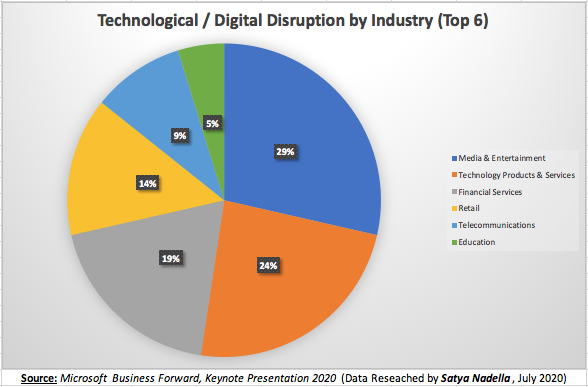
    While it’s commonly known that tech disruption is rapidly occurring, are you aware of which sectors of the US economy are being transformed the most? Initially presented in a Microsoft Business Forward forum, this research is key to assessing the sectors that need to gear up and prepare to deal with the newest technologies. The chart below substantiates just how much technological innovation and digital transformation are disrupting critical, traditional sectors within the nation’s economy.

    Top 6 Industries Impacted by Technological & Digital Disruption

    Microsoft: Top 6 Sectors Affected by Tech / Digital Disruption (Satya Nadella, 2020)

    PropTech addresses technological innovation specifically in the real estate segment. Moreover, you’ll notice that the Top 6 industries affected are most likely ones you come across in your everyday life. What does this mean for management, consumers, and the working class (specifically in these industries)? The article that complements Satya’s research shares a grim prognostication:

    “Digital disruption is well upon us. While a survey conducted by the Global Center for Digital Business Transformation for the large and mid-sized private sector companies agreed, to varying degrees, that digital disruption comes with its own set of benefits, it is also true that Digital Disruption is threatening the survival of many businesses and industries.

    Futuristic businesses and start-ups are exploring new avenues of re-inventing their business activities and industries all together to compete with and dislodge incumbents. The last decade alone has witnessed some exponential progress in technological disruption – think Airbnb, Paytm, Netflix and Uber.

    And this disruption is gradually influencing every industry, including banking, healthcare, hospitality, construction, manufacturing, packaging, logistics, and insurance amongst others (discussed in detail by Satya in Microsoft’s 2020 Keynote Forum).”

    Embee Staff

    Conclusion: What Does This Mean for Real Estate Investors?

    Succinctly, to have longevity in a given industry, the necessity for technological innovation has proven to be non-negotiable. Avoiding this reality will get you nowhere – or worse, out of business – quickly. As the abundance of digital and cloud transformation technologies are increasing, many are finding themselves playing catch-up. The information Microsoft presented suggests nearly all industries will be behind if they refuse to acknowledge technological progress. Not only acknowledge it, but make drastic changes, as necessary, to adapt alongside it.

    We’ve summarized the role technological innovation will play at length in the real estate market moving forward, specifically. Finally, ponder this. Imagine the impact to real estate markets, even globally, if critical industries and large corporations were to fall ‘behind-the-curve‘. What would this mean for CRE investors, who have continued to struggle as of late? The data study produced by Microsoft illustrates just how cataclysmic failures to adapt to new technologies – no matter the reason – can cause widespread fragility beyond the individual companies, or even those particular industry segments. It’s imperative to always look at the bigger picture. In this case, failure to adapt to new technologies will almost certainly cause broad, undesired consequences for investors.

  • Mining Bitcoin: Tech Energy and Power

    For years, Bitcoin has been popularized as the face of cryptocurrency. After Bitcoin was introduced, it received critical backing from several prominent celebrity investment advisors and other notable figures, significant popularity followed. Once Bitcoin gained a platform, it gave rise to tens of thousands of other cryptocurrencies being mined and traded daily. Whether you believe in crypto’s or not, it’s hard to argue we’re not in the middle of one of the most exciting cryptocurrency trading times. While many participate in daily trading on platforms like Robinhood, Coinbase, CashApp, etc., not many of them have any insight into the technological know-how on creating a Bitcoin, or the Bitcoin energy required.

    In reality, the computer-based miners who create bitcoins use vast amounts of electrical power and energy in the process. The energy-heavy process even leads some experts to suggest that Bitcoin harms the environment. The process, known as “mining,” requires computers around the world to complete rapid calculations to try to solve the same puzzle. It always takes 10 minutes, and the winner is rewarded with some digital bitcoin. Then a new puzzle is generated, and the whole process repeats for another 10 minutes (Bradbury, The Balance).

    Breakdown of Bitcoin’s Power & Energy Output

    As more people learn about Bitcoin and mining—and as the price of Bitcoin increases—more are using their computers to mine Bitcoins. As more people join the network and try to solve these math puzzles, you might expect each puzzle to be solved sooner, but Bitcoin is not designed that way. The software that mines bitcoin is designed so that it always will take 10 minutes for everyone on the network to solve the puzzle. As more people join the Bitcoin network and try to mine Bitcoins, it becomes harder, and more computing power and electricity are used for each Bitcoin produced. It minimizes downtime, so you can mine more efficiently. That means a near-constant cycle of electricity use.

    To understand how to calculate the electrical energy used to power the bitcoin network, you’ll need to learn how Bitcoin creation works. First, you calculate how many sums are conducted per second to solve the puzzles. Then find out how much electricity it takes to do each sum. These sums are called “hashes” (Faife, CoinDesk). In early 2020, the computers on the Bitcoin network were cranking out close to 120 exahashes per second (Redman, BTC News). To calculate the cost of how much power it would take you to create a bitcoin, you need to know a few things first (Bradbury, The Balance). First, what is the cost of electricity where you live? Second, how much power would you consume? More efficient computer equipment uses less power, which means lower power bills. The lower the price of electricity, the less cost there is to miners. This increases the value of the Bitcoin to miners where the costs are lower to produce.

    The Conclusion: To Be Determined

    This is meant to emphasize that the energy and power utilized by Bitcoin and other cryptocurrency miners is a real, potential danger to the future global environment. Conversely, it may also leave a very low impact. The price that Bitcoin extracts in terms of energy use and environmental impact depends on how useful it will be to society (Bradbury, The Balance). Judging an ever-moving target is hard. The interest in Bitcoin continues to rise, which in turn leads to more power used to serve more people in the market. Therefore, ultimately deciding whether Bitcoin mining is worth the cost to the environment is still a very open question.