Category: Digital & Tech

Our opinion and views on digital, technology, and other topics of interest to investors and enterprises. We will cut through the noise.

  • Where is the innovation in CRETech or PropTech?

    Real Estate historically has been a slow adopter of technology, but the past few years have seen explosive growth and interest in Real Estate Tech (also called PropTech or CRETech). In this article, we’ll look at the PropTech landscape and try to understand the various areas within Real Estate where innovation (or so-called innovation) is occurring. As an investor in companies or deals, we need to evaluate how technology is disrupting the sector and who the winners will be.

    What exactly is CRETech or PropTech?

    Before we dwelve deeper in the PropTech space. What exactly is PropTech? There are also other terms like CRETech, ConTech, FinTech which are used in the space. Let us level set and review PropTech’s summary from a Medium article.

    In short, PropTech stands for all the companies that are taking on the real estate industry to make it better, spurred by an ever-changing digital landscape and new consumption patterns. It is still a new trend, and its scope will surely evolve as time goes by. Today, several verticals emerge within PropTech: the real estate market per se (PropTech), smart cities and buildings, the sharing economy, the home building industry (ConTech) and finance (FinTech). Both ConTech and FinTech have very close ties with the real estate industry.

    Source: https://medium.com/@vincentlecamus/proptech-what-is-it
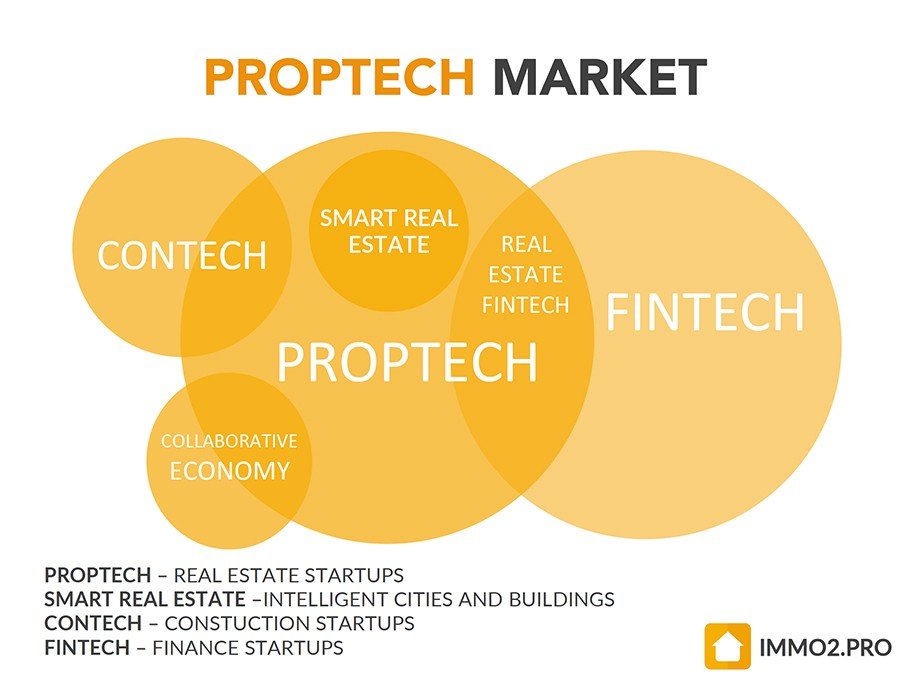
    Image for post

    For the purpose of this article, we will only look at the proptech or CREtech space as there are MANY areas within that.

    Why PropTech now?

    2020 has probably been one of the toughest years for those in Commercial Real Estate (CRE). Some property types, like office, are having an impact even WAY bigger than the Global Financial Crisis (GFC) of 2008. Why worry about PropTech when the industry is itself going through a big change? No sector is immune to technology disruption or innovation. It started with retail, digital media, financial services, and the list goes on. Real Estate actually has been slow to adopt technological change with a lot of innovation only happening in the past few years.

    You may have heard this before but COVID-19 has accelerated digital and technology transformation in the real estate industry. This sentiment is captured by Michael Beckerman in his blog:

    Thinking about my industry, real estate technology, this past year was one that experienced 10X adoption in 10 months. It was for all the wrong reasons, but the speed and pace of tech adoption were truly staggering in real estate (and in most businesses during the pandemic). Literally overnight, companies had no choice but to get their tech house in order and to scramble to adopt as many smart solutions as possible to be able to reopen in the safest and healthiest manner possible, operate effectively in a remote work environment, and meet the needs of their customer base who were demanding digital solutions to engage with.

    And as I reflect on what’s ahead for real estate tech and real estate in general, I truly believe we are about to enter the “Golden Age of Real Estate!” 

    Source: https://www.cretech.com/news/goodbye-2020-hello-golden-era-of-real-estate-2/

    Lay of the Land

    Now that we understand CRETech and its importance today, what are the various areas of innovation? CRETech is a broad area and we’re going to break it down. We’ll use the breakdown used by Venture Scanner which has research, data, and trends on 2020 real estate technology startups. Even the sample below is bound to give some a headache, but the idea is to look at the broad categories and see what kind of disruption or innovation is happening. Put another way, where is a lot of Venture Capital (VC) money flowing into?

    Long-TermSearch 
COMPASS 
Apartment List 
Quikr 
VivaReal 
zirc»mgno 
Life, Home, P&C Insurance 
dewtottacQe 
neos 
kin. 
hippo 
Jetty 
Micro Insurance 
Home Services 
houzz 
Thumbtack 
OND 
Porch 
Clutter 
REAL ESTATE 
TECHNOLOGY 
• VENTURE 
SCANNER 
Property Management 
BuildingEngines 
ResMan 
auildium• 
HOSTMAKER 
appf0110 
Manager 
Construction Management 
PROCORE 
O EquipmentShare 
KATERRA 
FIELDWIRE 
BUILDINGCONNECTED 
Opendoor 
theguarantors 
IOT Home 
@KeyMe 
Portfolio Management 
lendinvest 
roofstock 
A Netatmo 
view 
EIGHT 
SLEEP 
Facility Management 
eden ENTOUCH 
sms assist 
00 BUDDERFLY 
Osmartfrog 
tad00 
00 
Short-Term Search 
CADRE 
Venture Scanner has research, data, and trends 
on 2,020* real estate technology startups 
HouseCanary 
Hotel Tonight 
airbnb 
vacasa 
•cleartrip 
Real Estate Agent Tools 
O HomeLight 
• states title 
V Qualia 
ribbon Topa 
PLACESTER 
Commercial Search 
I Kr Space 
INDUSTRIOUS 
Obreather 
MINDSPACE 
FUNDRISE 
Indoor Mapping 
Matterport 
HOVER 
NAVVIS 
MODSY 
0000my 
The graphic above shows only a sampling of companies in each category. •Data cumulative through February 2021.

    Here are the major categories of innovation:

    • Property Search and Real Estate Agent Tools (Home, Rentals, Commercial): This spans home, rentals, vacation, office space, etc.
    • Insurance, Home Services, and Marketplaces: Our focus here is on the home, property, or rental insurance sector
    • IoT, Property & Facilities Management: IoT devices and software used to manage properties and improve efficiencies
    • Construction Management: Different from Construction Technology, which is more physical built focused
    • Portfolio Management / Investment Management: Software for managing assets, deals, and investors
    • Design and Indoor Mapping: Interior and exterior architecture and design software

    Investor Takeaways

    In this article, we looked at the definition of PropTech, the lay of the land, and the key segments. The key segments of PropTech and the companies therein give an idea of the kind of innovation disrupting the CRE industry. As an investor and sponsor, it is important to leverage the platforms that will improve the efficiency across the entire investment lifecycle as well as the property lifecycle. As real estate investors, though we don’t need to follow each company, each segment of disruption give us opportunities to leverage for our real estate portfolio.

  • How Airbnb has disrupted Commercial Real Estate (CRE)

    Airbnb has been a disruptor in the hotel industry though many may view it as just another technology marketplace or platform company like Uber. We’ll argue in this article why Airbnb is a disruptor not just in the hotel industry, but the overall commercial real estate (CRE) industry. Airbnb’s business model has ramifications that can echo past hotels and disrupt other property types in CRE in the years to come. As investors, we need to watch out for the Airbnb effect and how the industry responds.

    Airbnb and its business model

    Airbnb probably needs no introduction to many, but let us level set and review Airbnb’s summary from Wikipedia. The key points we will review are highlighted in orange.

    Airbnb… is an American vacation rental online marketplace company… Airbnb maintains and hosts a marketplace, accessible to consumers on its website or via an app. Through the service, users can arrange lodging, primarily homestays, and tourism experiences or list their properties for rental. Airbnb does not own any of the listed properties; instead, it profits by receiving commission from each booking. 

    Source: Wikipedia

    Let us also look at the numbers to get an idea of the reach of Airbnb. As of 2020, Airbnb had grown to 4 million hosts and 800 million guests in 100,000 cities in almost every country and region across the globe. The reach of Airbnb blows away the reach of traditional hotel companies like Marriott. After all, Airbnb can operate anywhere there is a house with a room to spare.

    Airbnb as yet another tech marketplace or platform

    We can use two lenses to look at Airbnb as a company and its place in the markets. The first lens is that of a technology company and the second lens is that of a real estate company. Airbnb can be viewed as a high flying technology company that went public in 2020. In and of itself, there are probably tens of other technology companies in the platform or marketplace category. Notably, Airbnb can be seen as the Uber for guest stays. In essence, just viewed as a technology company Airbnb may not come across as a significant disrupter. Here is an opinion from 2013 during the early years of Airbnb.

    Please hear me loud and clear when I say the following: disruptive innovation does not exist or apply as far as the real estate business is concerned, and it will not in the future, either. Not even in the case of Airbnb (explained below). Real estate product and its consumption are fundamentally different from non-real estate product and its consumption, and at this point in history, real estate markets are no longer likely to be disrupted.

    Source: https://www.getrefm.com/disruptive-innovation-in-real-estate-there-is-no-such-thing/

    The significance of the disruption and further potential comes into play when one looks at Airbnb from a hotel or real estate lens. How big is the disruption? Let us look at the chart below from Professor Galloway at NYU Stern School of Business. As of October 2020, around the time Airbnb went public, the projected market cap exceeded those of FIVE major hotel chains and THREE major airlines combined. The battered hotel and airlines have recovered since October 2020, but you get the idea – Airbnb is worth many major hotel chains combined.

    Source: Professor Galloway

    Airbnb’s disruption of the Hotel industry

    In the previous section, we looked at valuations and reach and saw how Airbnb easily surpasses the valuation and reach of the largest hotel chains. In this section, we will look at exactly how Airbnb has disrupted the hotel industry business model and turned it on its head.

    Asset light and Risk light

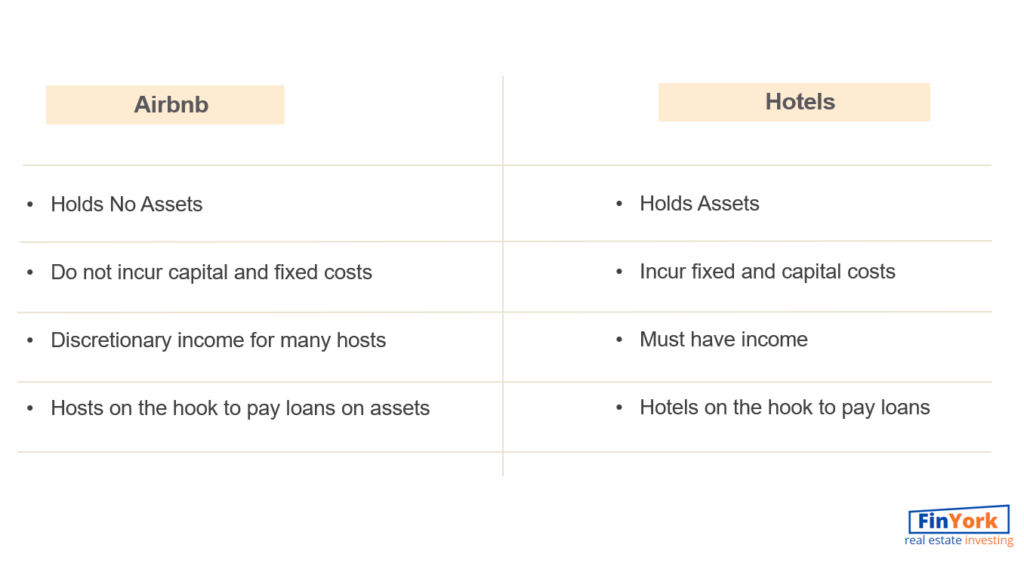
    Airbnb is a marketplace platform and does not hold real estate assets. Hotels on the other hand hold the hotel’s real assets. What this means is that hotels (or their franchisees or partners) are responsible for buying, building, and running the hotel property. In Airbnb’s case, the hosts are responsible for buying and running the assets. This leads to Airbnb being asset-light which is a huge advantage. How come? The hotels hold the real estate risk whereas the hosts (not Airbnb) hold the real estate risks. In an ironic way, Airbnb is disrupting CRE without holding ANY real estate assets. This is similar to Uber which disrupted the car ride industry without holding any cars.

    The above-mentioned asset and risk light nature of Airbnb vs Hotels have major implications for investors. The investor who invests in Airbnb stock takes limited or no real estate risk whereas an equity investor in a hotel asset takes the real estate risk. As it happened during COVID-19, the hotels faced a deep loss of revenue when stays come to a screeching halt. The hotels still had real estate expenses and loan obligations to run minimum operations. Airbnb stays also came to a screeching halt, but it didn’t have any real estate expenses or loan obligations. Its hosts had.

    Agile, Lean and easily scalable

    As we saw previously, Airbnb has no real estate obligations to build or maintain the asset, raise capital or get a loan. But, Airbnb has a powerful technology platform and spends most of its money on R&D and improving the platform. This makes Airbnb agile and lean. Airbnb can also scale up or down its business in little time as it has no real assets.

    When the COVID-19 pandemic started, both Airbnb and hotels took a big hit. But, Airbnb was able to recover way faster. More so, Airbnb was even able to go to the public markets with an IPO. Airbnb has disrupted the hotel business model to such an extent that hotels are now providing Airbnb-like platforms i.e. the hotels just act as intermediaries but provide some basic branding and consistent service. The table below summarizes salient features of Airbnb and Hotels business models we reviewed.

    More CRE disruption to come?

    Disrupting hotels which is a major CRE property type is one thing, but disrupting the whole CRE is at a different level altogether. In our opinion, Airbnb has the potential to disrupt the rest of CRE as well. COVID-19 and Airbnb’s potential should be a cause for concern for many players in CRE. The CRE industry, particularly office and retail, is facing a big crisis with the pandemic. Will it provide an opening for disruptors like Airbnb or other players? It will be a mistake for the CRE industry to treat Airbnb as just a hotel company for the reasons mentioned below.

    From hotel to other property types

    We’ve argued so far how Airbnb has already disrupted the hotel industry. Why can’t it do the same for offices or retail or for that matter any property type? COVID-19 has actually accelerated the importance of homes. Which real estate player is better positioned to leverage the home as an asset than Airbnb? Let us take a few scenarios which may seem a stretch but quite possible:

    • WIth WFH, people start using a part of their homes as a gathering place to work
    • People start using their spare basement, yard, or other spaces for group exercises
    • How about having dinner gatherings at someone’s home than restaurants?

    Who can create and capitalize on these trends? Startups or established players like Airbnb that have a platform. The above will reduce the need for a traditional office or retail property type and increase the need for a technology platform that can facilitate the above. Let us take a couple of different scenarios:

    • Can small office landlords share their existing space using an Airbnb like platform (similar to WeWork)?
    • Can small retail shops share their existing space using an Airbnb like platform?

    There is nothing stopping Airbnb from providing the conventional marketplace for office, retail, and other property types? In essence, it can become the Shopify equivalent for the CRE Amazons of the world.

    Shorter Leases

    Another key differentiator for Airbnb is that it provides a way for shorter leases or stays to guests across millions of assets. At the surface, this may not appear to be a big deal. So what? Most of Commercial Real Estate is built around leases that run into years. For e.g. you may have signed an annual lease for your apartment. Retail, industrial and office leases run into many many years. The penalty for breaking the leases are so high that many tenants hesitate to break the leases.

    With this background, Airbnb provides pretty much provides short leases to tenants. Yes, hotels also provide short stays but their model has not been transferred to other property types because the business model cannot work. Airbnb can make that business model work for other property types like an office. For e.g. similar to WeWork Airbnb has the platform to provide shorter office leases to office goers. Airbnb has thus built a transferable platform to further disrupt CRE.

    Investor Takeaways

    In this article, we’ve looked at Airbnb as a marketplace platform and how it has disrupted the hotel industry by being asset-light and easily scalable. We also looked at how Airbnb has the platform and potential to disrupt the rest of the CRE industry property types as well. As a real estate investor, one has to closely watch Airbnb’s entry into other property types as well as newer behavior and trends that are arising, accelerated by the pandemic. It may not be enough for an investor to just look at the numbers and evaluate deals. They also need to answer the question – Can Airbnb or a similar player disrupt this space to affect my bottomline?

  • Digital Maturity of your enterprise

    Digital Maturity of your enterprise

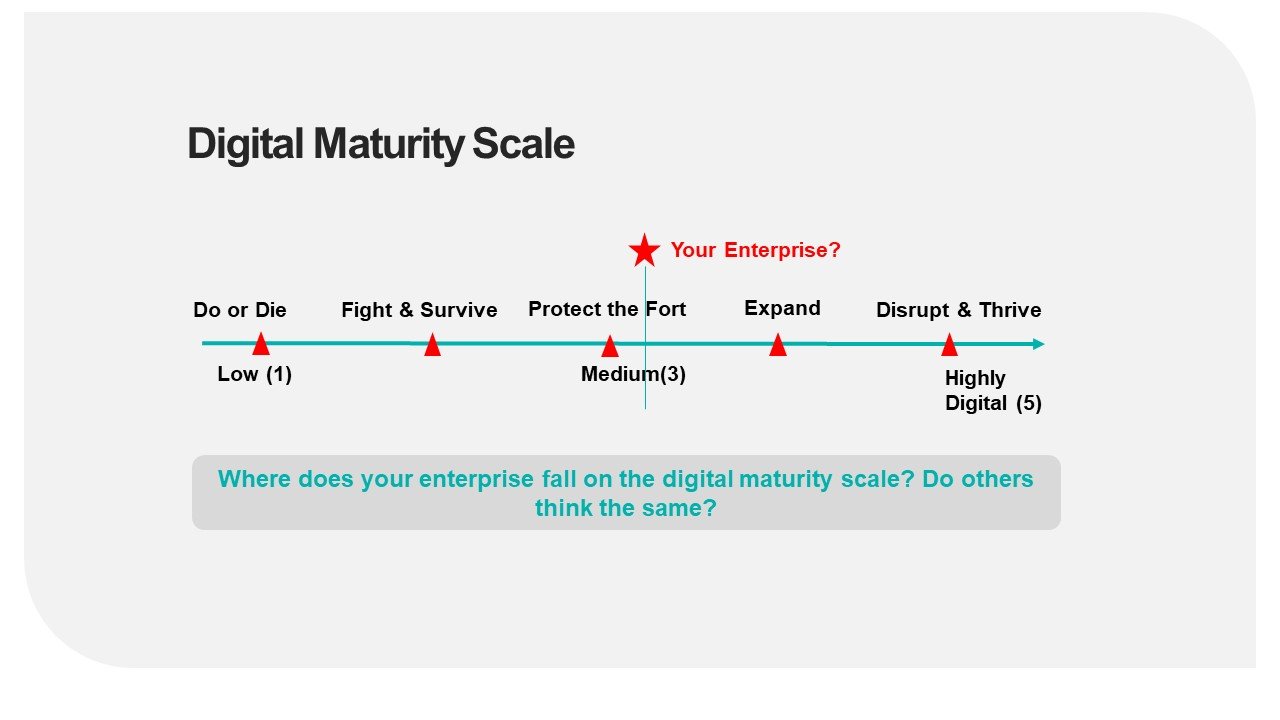
    Even before your organization starts to invest in digital, it needs to assess where it falls in the digital spectrum. This is an important step in digital strategy. As a starting point for your organization’s digital journey, see where you place on the digital maturity scale:

    1. Do or Die – Competition or disruption has already squashed the industry, organization, or product. This is a “do or die” situation for the company to reinvent its business model.
    2. Fight and survive – The business is not in imminent danger, but it is very clear that the business needs to be transformed and there is pressure from various constituents (board, shareholders) for change.
    3. Protect the Fort – Business has some competitive advantage that will take years to disrupt, but the possibility of digital disruption remains. Organizations have a sense of security and may even be complacent.
    4. Land/Expand – These are visionary companies that see opportunities in their industry to build or acquire and add value to customers and increase their market share.
    5. Disrupt/Build and Thrive – These are businesses that go after major problems in industries and disrupt the market. Typically, these are digital natives (i.e. built with digital vision).

    Honestly evaluating your enterprise’s current digital maturity will serve as the starting point for your digital strategy. The next step will be to define where you want to be on the digital maturity scale in the future and how you can get there.

  • Six design principles for digital and technology projects

    Six design principles for digital and technology projects

    Many of us are aware of the benefits of following design principles in technology and digital projects. Design principles:
    1) Provide guidelines to design solutions
    2) Help with consensus building
    3) Speed decision making

    For e.g. when different people have differing views, running against the design principles helps the team narrow the design options and choose the recommended solution.

    Here are the six design principles for technology projects based on our experience. Most principles can be applied to any digital, technology and construction project and across many industries in addition to real estate.

    1) Requirements or design should clearly demonstrate value i.e. usefulness to users
    2) Follow industry best practices – Many have walked through this path before, there is no need to “reinvent the wheel” unless it is a competitive differentiator
    3) Differentiate between business “need” and “want” and prioritize
    4) Keep it simple – Solution should be simple for users to adopt and these are usually the best solutions
    5) Leverage platform capabilities “out of the box” – Avoid customization unless it is to implement best practices; this helps to keep the solution simple and standard
    6) Don’t aim for perfection – Don’t let perfection be the enemy of good as it isn’t attainable

  • COVID-19 and Digital Priorities for Enterprises

    COVID-19 and Digital Priorities for Enterprises

    Over the course of two weeks in March 2020, we’ve had the opportunity to discuss with 20+ technology leaders the state of Digital and Technology, especially the impact of the global pandemic on Digital and Technology priorities. Organizations all over the world will be revisiting their priorities and we felt it will be good for us to evaluate the impact and prepare ourselves for the road ahead. In order to do that, every organization in real estate and other industries has to answer the following question: What areas of digital and technology to focus on in the coming two years?

    The answer to the above question is the objective of this article. We will dive deeper into what we believe are the top 10 digital and technology focus areas for enterprises and rank priorities. Some feel that digital and tech has been a big help – for business continuity as well as connecting people – during these trying times and some feel that some enterprises will weather through these trying times and emerge stronger.

    Before we go further, we’d like to call out a few things. If not anything, this article is a place to collect our thoughts and synthesize the various viewpoints; We do hope some can benefit from the collective experience and viewpoint provided. To remain agnostic, we’ve avoided naming organizations or products.

    Impact Scorecard

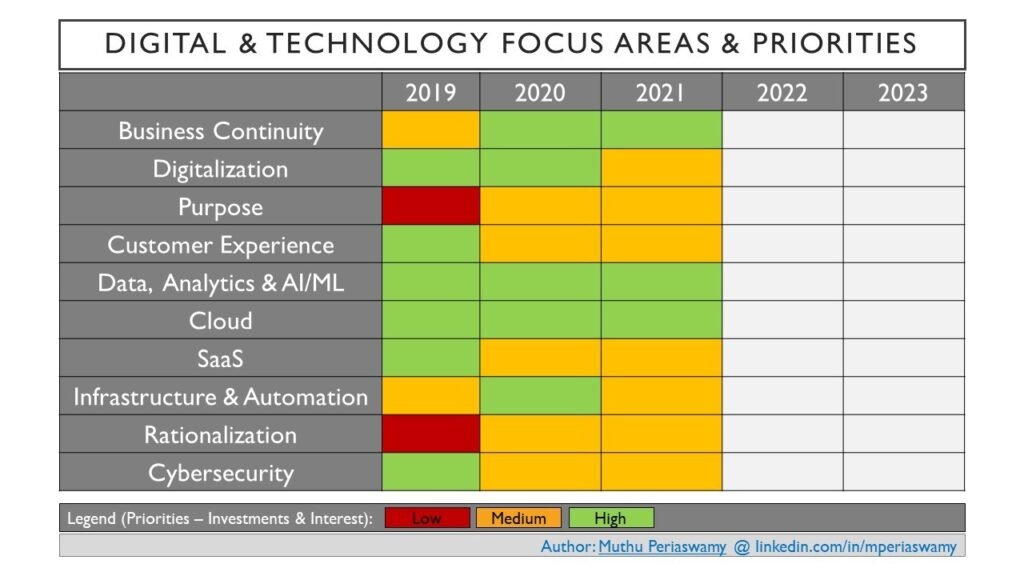
    Top 10 Digital & Technology focus areas for organizations have been identified and listed. It is a tough exercise to keep the list of focus areas to 10 and we had to drop a few areas like regulations and API economy to keep the list to the top 10. The following chart summarizes those focus areas and a gauge of the likely 2020 and 2021 priority – investment and interest – in those areas. The priorities are categorized into low, medium, and high. The priorities are relative to each other in the list. Our take on 2019 priorities is also provided to serve as a baseline.

    Top 10 Focus Areas

    Let us dig into all of the focus areas as they need an explanation. Some focus areas may be controversial and hence additional commentary for those:

    1. Business Continuity – #1 High priority in 2020. The first and foremost thing on every executive’s mind will be to ensure that their organization does business (if they can) without any disruption. The organization’s business continuity plans will be thoroughly tested and many weaknesses will arise that organizations will fix as soon as they possibly can.
    2. Digitalization – High priority in 2020. Digitalization will be a tale of two worlds, with digitalization actually increasing for use cases that support business continuity and mobility vs. digitalization decreasing for use cases with poor business cases and large budgets. Overall, new or existing initiatives to address #1 above will keep digitalization a high priority this year.
    3. Purpose – Medium priority in 2020. There will be an awakening of sorts and people (and hence organizations) will clamor to incorporate ESG – Environmental, Social, and Governance – in their business. Technology will enable businesses to be more purpose-driven, particularly the social impact part (the S in ESG). It remains to be seen what shape or form it will take, but the debates and discussions will happen.
    4. Customer Experience (CX) – Medium priority in 2020. Organizations can be expected to continue the customer focus, but with two changes. First, there will be less tolerance for big spending on customer acquisition, retention, and CX delivery. Pragmatism will creep in and key tenets of CX – Reliability, Trust, etc. – will be prioritized. Second, expect some significant rethinking on how CX will coexist with social impact i.e #4 above.
    5. Data, Analytics, and Machine Learning – High priority in 2020. The importance of data will only grow, but the appetite for big data initiatives with big budgets will reduce. Cheap analytics (mostly cloud-based) will lead the way and will get the job done. Expect AI and ML to be bundled along with Analytics or other products/services.
    6. Cloud – High priority in 2020. Public cloud adoption and the automation of infrastructure and deployment will only accelerate as organizations focus on bottom-line and efficiency. Cloud-native architecture and deployment will see a big uptick. Another factor is that cloud providers have better reliability and security than many organizations and can enable business continuity. Cloud will be a high priority.
    7. SaaS – Medium priority in 2020. Cross-industry horizontal SaaS (for e.g. human capital management, CRM) are well entrenched in many organizations and that is not going to change. But, expect competitive pricing from nimbler but reliable SaaS providers and a lot of consolidation. Industry-specific SaaS adoption (for e.g. wealth management) will accelerate and consolidate around the leaders.
    8. Infrastructure & Automation – High priority in 2020. Workloads are increasingly moving to cloud and SaaS, but a significant amount of on-premise infrastructure needs to run smoothly to enable business continuity. Some Automation areas will see an increase (for e.g. CI/CD), whereas some areas may plateau (for e.g. Robotic Process Automation) as it will be difficult to show return on investment.
    9. Rationalization – Medium priority in 2020. The need for cost-savings and efficiency will result in many organizations streamlining their tech stack and sunsetting software and infrastructure that have been kept around. This effort may go by a new catchy name, but we should expect organizations to undertake this during tough times.
    10. Cybersecurity – Medium priority in 2020. The importance of cybersecurity will remain, but we should expect more scrutiny of investments and results. Cybersecurity was probably the #1 issue for many organizations in 2019, but survival (i.e. keep business running) will be #1 issue in 2020.

    Takeaways

    In this article, we looked at the top 10 digital and technology focus areas of organizations across industries. In summary, organizations will prioritize business continuity, cloud, data, and rethink social impact (ESG) in 2020!