Category: Digital & Tech

Our opinion and views on digital, technology, and other topics of interest to investors and enterprises. We will cut through the noise.

  • Why the SEC will Ultimately Deny VanEck’s Third Application for a Bitcoin Spot ETF and What it Means for Digital Assets

    Late last month, August 2022, the SEC announced a 45-day delay to rule on VanEck’s third Bitcoin Spot ETF application. This comes on the heels of the SEC denying Grayscale’s GBTC – an SEC backed Bitcoin Trust – conversion to a spot ETF, as well as Bitwise Asset Management’s application for a spot ETF, on the same day in late June 2022. VanEck currently has an SEC-backed Bitcoin futures ETF, the “VanEck Bitcoin Strategy ETF” (Cboe: XBTF). Their two previous applications for a Bitcoin spot ETF were rejected first in 2017, then late in 2021. VanEck is considered somewhat of an “investment giant”, with roughly $65B currently in AUM.

    Grayscale, with roughly $20M in AUM and a digital asset manager giant themselves, a subsidiary of Digital Currency Group (DCG) – who’s also the parent company of CoinDesk – sued the SEC immediately after they rejected the GBTC’s conversion from a SEC-backed Bitcoin Trust to a SEC-backed spot ETF. A ruling from a Federal Appellate Court is expected sometime in Q4 2023 or Q1 2024.

    Why Will the SEC Reject VanEck’s Application for a Bitcoin Spot ETF a Third Time?

    A better way to phrase the question is: why wouldn’t they? Has anything dramatically changed about either the SEC’s mandates, Bitcoin, market conditions, or is VanEck’s application unique? No, for all the above. VanEck’s Bitcoin spot ETF, which they’ve proposed to list on the Cboe BZX Exchange, would still create direct Bitcoin ownership for investors who purchased it. In my opinion, the SEC’s had to issue a 45-day delay because VanEck’s argument appears to differ from Grayscale’s. VanEck isn’t relying on a futures versus spot Exchanged Traded Fund [ETF] derivative comparison. Rather, they’re urging the SEC to reconsider because investors can access Bitcoin spot ETFs through our neighbors in Canada.

    They’re not wrong. As early as February 2021, Canada became one of the first countries in the world to place a Bitcoin spot ETF on one of their national exchanges. But given that was back in February 2021, the question remains: what’s changed? It’s completely unrealistic for the SEC to admit they weren’t aware of a Bitcoin spot ETF on a Canadian exchange. Hypothetically, it would very likely give Grayscale the green light to pursue further, more substantial legal action against the SEC.

    At the time Grayscale’s GBTC was rejected, many analysts cited the heightened potential for fraud and malpractice amongst digital assets being a key reason institutional investors, who generally purchase far more spot products than futures derivatives (as part of their traditional investment strategies), should not get access to an SEC-backed Bitcoin spot ETF yet. They said digital currency exchanges needed total transparency inside their marketplaces, like the DOW and NASDAQ. While this flies in the face of many reasons investors purchase digital assets and it’s not practical, it didn’t matter. That’s what the institutional investor community who was with the SEC just two months back demanded. VanEck is not purely a digital asset manager like Grayscale and in terms of AUM, they’re over 3 times larger.

    As another interesting reference point VanEck currently has 3 CO (Commodity) ETFs. The first is XBFT (Bitcoin Strategy ETF) and the second is OUNZ (VanEck Merk Gold ETF). XBFT has $19.2M in total net assets, while OUNZ has $600.4M. Interestingly, VanEck offers 65 EFT products and only 3 fall in the Commodities Asset Class. The other 62 are split between Fixed Income (Corporate, International, & Municipal Bonds, Rates products, etc.) and Equity ETFs. VanEck’s GDX has $9.4B in total net assets, while their ITM has 1,939 holdings (September 2, 2022). The XBFT has just $19.2M in total net assets and only 8 people holding it (September 2, 2022). Of the roughly $65B VanEck has in AUM, XBFT – a Bitcoin futures ETF – represents around .002% of their investment portfolio.

    Concisely, VanEck is a bigger, more established firm that has broader appeal to institutional investors already compared to Grayscale, who owns roughly 3.5% of all of Bitcoin and is purely a digital asset manager. They have the first SEC-approved Bitcoin Trust ETF with GBTC, trading on the NASDAQ. They are doing their best to bring digital assets to institutional investors. That’s why they’ve gone all out for a Bitcoin spot ETF, whereas VanEck seems to have strategically made a push when they’ve felt they had a compelling case.

    Does the SEC’s 45-Delay Mean VanEck has a Real Chance?

    I believe it means they have a better chance, but will ultimately suffer the same fate as Grayscale and Bitwise. I don’t even think it gives them much of a better chance; only if the SEC makes an unexpected blunder. Nothing has changed about their concerns related to GBTC that would warrant VanEck’s application to get approved.

    “The Commission [SEC] finds that it is appropriate to designate a longer period within which to take action on the proposed rule change so that it has sufficient time to consider the proposed rule change and the issues raised therein.”
    -SEC Spokesperson, in a letter to VanEck (August 2022)
    Tweet

    The verbiage in this quote seems to be hinting that the SEC is actually considering accepting VanEck’s argument. However, the SEC issuing a delay on a ruling isn’t exactly breaking news. They’ve shot down over a dozen attempts at a Bitcoin spot ETF in the last 12-month calendar year alone. There is no new information to indicate Bitcoin is any less susceptible to fraud – thereby posting inherent investor risk – than two months ago. The SEC is buying time in hopes of making a more compelling case regarding Bitcoin spot ETF’s in Canadian markets. What’s going to make more headlines in 45 days, the macroeconomic conditions from rising rates, inflation, and other recessionary indicators, or the SEC rejected the 15th (or so) Bitcoin spot ETF in the last year? After all, the SEC isn’t completely unaware of the current dynamics in financial markets.

    If VanEck is Ultimately Denied, What Does that Mean for Cryptocurrency?

    The overall impact is unlikely to be large, unless the SEC gets unpredictable here. Assuming they stay consistent with their rationale, this matter will go back to the DC Appellate Courts. But if you’re an institutional investor of SEC-approved Bitcoin assets, you’re not going to be majorly impacted by this. Inflation and rising interest rates? That will likely negatively impact at risk assets across the board and digital assets are certainly in that category. But the long-term ramifications for Bitcoin from this latest SEC ruling are likely to be very minimal.

    Just to end with a key point we just touched on, watch out for at risk assets considering this is very likely going to be the realest felt recession since 2008. There won’t be a major economic downturn because we’ve learned our lessons from 2008, but investors will sell off at-risk assets as soon as financial markets show signs of destabilization. Digital assets in an investor’s portfolio will be one of the first to go. Combined with the seasonality of Bitcoin slumps, expect the price to drop below 15,000 and who knows how much lower. How much lower would it take for the strongest crypto asset enthusiasts to wave the red flag? Would that ever happen? Only time will tell, but again, considering we have a lot of indications a recession is coming, taking a bullish position on Bitcoin in the short-term is unwise at best.
  • Why the SEC will Ultimately Deny VanEck’s Third Application for a Bitcoin Spot ETF and What it Means for Digital Assets

    Late last month, August 2022, the SEC announced a 45-day delay to rule on VanEck’s third Bitcoin Spot ETF application. This comes on the heels of the SEC denying Grayscale’s GBTC – an SEC backed Bitcoin Trust – conversion to a spot ETF, as well as Bitwise Asset Management’s application for a spot ETF, on the same day in late June 2022. VanEck currently has an SEC-backed Bitcoin futures ETF, the “VanEck Bitcoin Strategy ETF” (Cboe: XBTF). Their two previous applications for a Bitcoin spot ETF were rejected first in 2017, then late in 2021. VanEck is considered somewhat of an “investment giant”, with roughly $65B currently in AUM.

    Grayscale, with roughly $20M in AUM and a digital asset manager giant themselves, a subsidiary of Digital Currency Group (DCG) – who’s also the parent company of CoinDesk – sued the SEC immediately after they rejected the GBTC’s conversion from a SEC-backed Bitcoin Trust to a SEC-backed spot ETF. A ruling from a Federal Appellate Court is expected sometime in Q4 2023 or Q1 2024.

    Why Will the SEC Reject VanEck’s Application for a Bitcoin Spot ETF a Third Time?

    A better way to phrase the question is: why wouldn’t they? Has anything dramatically changed about either the SEC’s mandates, Bitcoin, market conditions, or is VanEck’s application unique? No, for all the above. VanEck’s Bitcoin spot ETF, which they’ve proposed to list on the Cboe BZX Exchange, would still create direct Bitcoin ownership for investors who purchased it. In my opinion, the SEC’s had to issue a 45-day delay because VanEck’s argument appears to differ from Grayscale’s. VanEck isn’t relying on a futures versus spot Exchanged Traded Fund [ETF] derivative comparison. Rather, they’re urging the SEC to reconsider because investors can access Bitcoin spot ETFs through our neighbors in Canada.

    They’re not wrong. As early as February 2021, Canada became one of the first countries in the world to place a Bitcoin spot ETF on one of their national exchanges. But given that was back in February 2021, the question remains: what’s changed? It’s completely unrealistic for the SEC to admit they weren’t aware of a Bitcoin spot ETF on a Canadian exchange. Hypothetically, it would very likely give Grayscale the green light to pursue further, more substantial legal action against the SEC.

    At the time Grayscale’s GBTC was rejected, many analysts cited the heightened potential for fraud and malpractice amongst digital assets being a key reason institutional investors, who generally purchase far more spot products than futures derivatives (as part of their traditional investment strategies), should not get access to an SEC-backed Bitcoin spot ETF yet. They said digital currency exchanges needed total transparency inside their marketplaces, like the DOW and NASDAQ. While this flies in the face of many reasons investors purchase digital assets and it’s not practical, it didn’t matter. That’s what the institutional investor community who was with the SEC just two months back demanded. VanEck is not purely a digital asset manager like Grayscale and in terms of AUM, they’re over 3 times larger.

    As another interesting reference point VanEck currently has 3 CO (Commodity) ETFs. The first is XBFT (Bitcoin Strategy ETF) and the second is OUNZ (VanEck Merk Gold ETF). XBFT has $19.2M in total net assets, while OUNZ has $600.4M. Interestingly, VanEck offers 65 EFT products and only 3 fall in the Commodities Asset Class. The other 62 are split between Fixed Income (Corporate, International, & Municipal Bonds, Rates products, etc.) and Equity ETFs. VanEck’s GDX has $9.4B in total net assets, while their ITM has 1,939 holdings (September 2, 2022). The XBFT has just $19.2M in total net assets and only 8 people holding it (September 2, 2022). Of the roughly $65B VanEck has in AUM, XBFT – a Bitcoin futures ETF – represents around .002% of their investment portfolio.

    Concisely, VanEck is a bigger, more established firm that has broader appeal to institutional investors already compared to Grayscale, who owns roughly 3.5% of all of Bitcoin and is purely a digital asset manager. They have the first SEC-approved Bitcoin Trust ETF with GBTC, trading on the NASDAQ. They are doing their best to bring digital assets to institutional investors. That’s why they’ve gone all out for a Bitcoin spot ETF, whereas VanEck seems to have strategically made a push when they’ve felt they had a compelling case.

    Does the SEC’s 45-Delay Mean VanEck has a Real Chance?

    I believe it means they have a better chance, but will ultimately suffer the same fate as Grayscale and Bitwise. I don’t even think it gives them much of a better chance; only if the SEC makes an unexpected blunder. Nothing has changed about their concerns related to GBTC that would warrant VanEck’s application to get approved.

    “The Commission [SEC] finds that it is appropriate to designate a longer period within which to take action on the proposed rule change so that it has sufficient time to consider the proposed rule change and the issues raised therein.”
    -SEC Spokesperson, in a letter to VanEck (August 2022)
    Tweet

    The verbiage in this quote seems to be hinting that the SEC is actually considering accepting VanEck’s argument. However, the SEC issuing a delay on a ruling isn’t exactly breaking news. They’ve shot down over a dozen attempts at a Bitcoin spot ETF in the last 12-month calendar year alone. There is no new information to indicate Bitcoin is any less susceptible to fraud – thereby posting inherent investor risk – than two months ago. The SEC is buying time in hopes of making a more compelling case regarding Bitcoin spot ETF’s in Canadian markets. What’s going to make more headlines in 45 days, the macroeconomic conditions from rising rates, inflation, and other recessionary indicators, or the SEC rejected the 15th (or so) Bitcoin spot ETF in the last year? After all, the SEC isn’t completely unaware of the current dynamics in financial markets.

    If VanEck is Ultimately Denied, What Does that Mean for Cryptocurrency?

    The overall impact is unlikely to be large, unless the SEC gets unpredictable here. Assuming they stay consistent with their rationale, this matter will go back to the DC Appellate Courts. But if you’re an institutional investor of SEC-approved Bitcoin assets, you’re not going to be majorly impacted by this. Inflation and rising interest rates? That will likely negatively impact at risk assets across the board and digital assets are certainly in that category. But the long-term ramifications for Bitcoin from this latest SEC ruling are likely to be very minimal.

    Just to end with a key point we just touched on, watch out for at risk assets considering this is very likely going to be the realest felt recession since 2008. There won’t be a major economic downturn because we’ve learned our lessons from 2008, but investors will sell off at-risk assets as soon as financial markets show signs of destabilization. Digital assets in an investor’s portfolio will be one of the first to go. Combined with the seasonality of Bitcoin slumps, expect the price to drop below 15,000 and who knows how much lower. How much lower would it take for the strongest crypto asset enthusiasts to wave the red flag? Would that ever happen? Only time will tell, but again, considering we have a lot of indications a recession is coming, taking a bullish position on Bitcoin in the short-term is unwise at best.
  • Is India’s UPI (Unified Payments Interface) Technology Worth Selling Overseas and to Western Countries?

    The Unified Payments Interface (UPI) was created by the National Payments Corporation of India (NPCI) for purposes of “enabling digital payments and settlement systems in India, is an initiative of RBI and IBA”. As announced in Bloomberg in June 2022, the NPCI is looking to take UPI to overseas markets. This implies that a) the technology has been tested thoroughly and successfully in Indian markets and b) there is currently no real competitor to UPI in overseas markets. At one point, NPCI CEO Ritesh Shukla compared it to a “home-grown alternative to SWIFT”. For those who aren’t familiar, SWIFT is a Belgium-based cross-border payments system operator.

    Has the Product [UPI] been Thoroughly Tested in Indian Markets?

    Based on our research, yes UPI has been tested both rigorously and successfully in Indian markets.

    “We have displaced cash in India to a large extent and are now looking to repeat the success in cross-border corridors. Overseas Indians can use our rails to remit money inwards straightway into their bank accounts, and for the markets where Indians travel frequently, we will build acceptance for our instruments.”
    – NPCI CEO, Ritesh Shukla
    Tweet

    Not only has the technology behind UPI been proven and tested, but the methodology has also succeeded. At least that’s the quantitative claim Shukla’s making. The World Bank data seems to support the analysis too. Indians overseas remitted $87 billion in 2021; the biggest inflow for any country that was tracked by the World Bank.

    Under the RBI’s “Liberalized Remittance Scheme”, all resident individuals (including minors) are allowed to freely remit up to USD $250,000 per year. This is from April-March, for any permissible current or capital account transaction, or a combination of both. Further, resident individuals can avail of the foreign exchange facility, for specific purposes within the limit of USD $250,000 only. The RBI’s “Scheme” was introduced on February 4, 2004, with a limit of USD $25,000 (BusinessDesk, Bloomberg). Since then, the LRS limit has been revised in stages consistent with prevailing macro and micro economic conditions. Notably, the “Scheme” is not available to corporates, partnership firms, HUF, Trusts etc.

    Are there Any Notable Comparisons to India’s UPI Abroad (not factoring in SWIFT)?

    Of the $87 million in remittances India received in 2021, the US was the biggest source (World Bank). According to the World Bank, US remittances to India accounted for over 20% of the $87 million in 2021.

    “Flows to India (the world’s largest recipient of remittances) are expected to reach $87 billion, a gain of 4.6 per cent with the severity of COVID-19 caseloads and deaths during the second quarter (well above the global average) playing a prominent role in drawing altruistic flows (including for the purchase of oxygen tanks) to the country”.
    – World Bank Spokesperson, World Bank Migration and Development Brief, 2022
    Tweet

    In terms of total global remittances, India is followed by China, Mexico, the Philippines, and Egypt (World Bank). In India, remittances are projected to grow 3% in 2022 to $89.6 billion. This is reflective of a drop in overall migrant stock, as a large proportion of returnees from Middle Eastern countries are still awaiting return (World Bank).

    Remittances in low-and-middle-income countries are projected to have grown a strong 7.3% to reach $589 billion in 2021 (World Bank). This “return to growth” is far more robust than earlier estimates. Following the same resilience of flows in 2020, when remittances declined by only 1.7% despite a severe global recession due to COVID-19, according to estimates from the World Bank’s Migration and Development Brief. Lastly, the brief in its entirety can be found here, from the World Bank’s website.

    Outside of evaluating the micro-differences to SWIFT, there are no current notable competitors to India’s UPI we could find. Without any doubt, no possible comparisons would come close in terms of size or scale.

  • Is India’s UPI (Unified Payments Interface) Technology Worth Selling Overseas and to Western Countries?

    The Unified Payments Interface (UPI) was created by the National Payments Corporation of India (NPCI) for purposes of “enabling digital payments and settlement systems in India, is an initiative of RBI and IBA”. As announced in Bloomberg in June 2022, the NPCI is looking to take UPI to overseas markets. This implies that a) the technology has been tested thoroughly and successfully in Indian markets and b) there is currently no real competitor to UPI in overseas markets. At one point, NPCI CEO Ritesh Shukla compared it to a “home-grown alternative to SWIFT”. For those who aren’t familiar, SWIFT is a Belgium-based cross-border payments system operator.

    Has the Product [UPI] been Thoroughly Tested in Indian Markets?

    Based on our research, yes UPI has been tested both rigorously and successfully in Indian markets.

    “We have displaced cash in India to a large extent and are now looking to repeat the success in cross-border corridors. Overseas Indians can use our rails to remit money inwards straightway into their bank accounts, and for the markets where Indians travel frequently, we will build acceptance for our instruments.”
    – NPCI CEO, Ritesh Shukla
    Tweet

    Not only has the technology behind UPI been proven and tested, but the methodology has also succeeded. At least that’s the quantitative claim Shukla’s making. The World Bank data seems to support the analysis too. Indians overseas remitted $87 billion in 2021; the biggest inflow for any country that was tracked by the World Bank.

    Under the RBI’s “Liberalized Remittance Scheme”, all resident individuals (including minors) are allowed to freely remit up to USD $250,000 per year. This is from April-March, for any permissible current or capital account transaction, or a combination of both. Further, resident individuals can avail of the foreign exchange facility, for specific purposes within the limit of USD $250,000 only. The RBI’s “Scheme” was introduced on February 4, 2004, with a limit of USD $25,000 (BusinessDesk, Bloomberg). Since then, the LRS limit has been revised in stages consistent with prevailing macro and micro economic conditions. Notably, the “Scheme” is not available to corporates, partnership firms, HUF, Trusts etc.

    Are there Any Notable Comparisons to India’s UPI Abroad (not factoring in SWIFT)?

    Of the $87 million in remittances India received in 2021, the US was the biggest source (World Bank). According to the World Bank, US remittances to India accounted for over 20% of the $87 million in 2021.

    “Flows to India (the world’s largest recipient of remittances) are expected to reach $87 billion, a gain of 4.6 per cent with the severity of COVID-19 caseloads and deaths during the second quarter (well above the global average) playing a prominent role in drawing altruistic flows (including for the purchase of oxygen tanks) to the country”.
    – World Bank Spokesperson, World Bank Migration and Development Brief, 2022
    Tweet

    In terms of total global remittances, India is followed by China, Mexico, the Philippines, and Egypt (World Bank). In India, remittances are projected to grow 3% in 2022 to $89.6 billion. This is reflective of a drop in overall migrant stock, as a large proportion of returnees from Middle Eastern countries are still awaiting return (World Bank).

    Remittances in low-and-middle-income countries are projected to have grown a strong 7.3% to reach $589 billion in 2021 (World Bank). This “return to growth” is far more robust than earlier estimates. Following the same resilience of flows in 2020, when remittances declined by only 1.7% despite a severe global recession due to COVID-19, according to estimates from the World Bank’s Migration and Development Brief. Lastly, the brief in its entirety can be found here, from the World Bank’s website.

    Outside of evaluating the micro-differences to SWIFT, there are no current notable competitors to India’s UPI we could find. Without any doubt, no possible comparisons would come close in terms of size or scale.

  • Grayscale Investments, LLC Presents: Grayscale Bitcoin Trust (GBTC), Bitcoin’s First Spot ETF?

    Amongst the latest “hot topics” in the Financial Technology (FinTech) space is a cryptocurrency product aimed at changing the receptiveness of the international investment community to cryptocurrencies. Grayscale Investments, LLC has created the GBTC (Grayscale Bitcoin Trust), in an attempt to make a cryptocurrency product more marketable to institutional investors, pension funds, and other more traditional investment vehicles. Whether this approach will work in the long-term seems to be very hotly contested at the moment, for a number of reasons.

    The Grayscale Bitcoin Trust (GBTC)

    Surprisingly – though maybe not to many in the crypto community – Grayscale largely markets the GBTC for its “robust security and storage”. You would think that as an asset manager, even a crypto asset manager, Grayscale would be more excited about presenting numbers that investors are typically hungry for. However, they lead by offering the following:

    “Grayscale Bitcoin Trust’s assets are stored in offline or “cold” storage with Coinbase Custody Trust Company, LLC, as Custodian. The Custodian is a fiduciary under § 100 of the New York Banking Law and a qualified custodian for purposes of Rule 206(4)-2(d)(6) under the Investment Advisers Act of 1940, as amended.”

    Grayscale Investments, LLC (2022)

    Additional benefits, advertised by Grayscale, to purchase the GBTC include tax-advantaged account eligibility, “titled, auditable ownership [of a crypto asset] through a traditional investment vehicle”, publicly quoted price (OTCQX®: GBTC), and support from a network of trusted providers (this is where they let you know they have hired global financial services legal tycoon Davis Polk & Wardwell LLP). Why is that relevant?

    The SEC’s Ruling on Grayscale’s Bitcoin Spot ETF

    At the top of Grayscale’s website, you’ll see a banner with a hyperlink stating, “We’ve received a decision in our application to convert GBTC to an ETF”. That’s the real storyline here. It’s not the GBTC, it’s the fact that the SEC has disallowed Grayscale to convert the GBTC into a Bitcoin spot ETF. The concise version of the SEC’s 86-page decision can be captured in the following paragraph:

    “This order disapproves the proposed rule change, as modified by Amendment No. 1. The Commission concludes that NYSE Arca has not met its burden under the Exchange Act and the Commission’s Rules of Practice to demonstrate that its proposal is consistent with the requirements of Exchange Act Section 6(b)(5), which requires, in relevant part, that the rules of a national securities exchange be ‘designed to prevent fraudulent and manipulative acts and practices’ and ‘to protect investors and the public interest.’’’

    SEC, Release No. 34-95180; File No. SR-NYSEArca-2021-90 (July 22, 2022)

    Grayscale immediately responded by hiring former U.S. Solicitor General, Donald B. Verrilli, Jr. – best known for arguing President Obama’s ACA (Affordable Care Act) successfully before the US Supreme Court – who filed an appeal of the SEC’s ruling. Grayscale says they had no choice but to escalate the matter, given the “SEC’s arbitrary and capricious actions and discriminatory treatment of issuers”. The appeal seems to be almost exclusively relying on the argument that the SEC has allowed multiple Bitcoin futures ETFs into the marketplace. Furthermore, since their treatment of futures and spots of derivatives is generally similar, they are unjustly denying investors access to a new marketplace: Bitcoin spot ETFs. GBTC has the potential to become the first Bitcoin spot ETF to be approved by the SEC.

    A High-Level Look at GBTC’s Financials

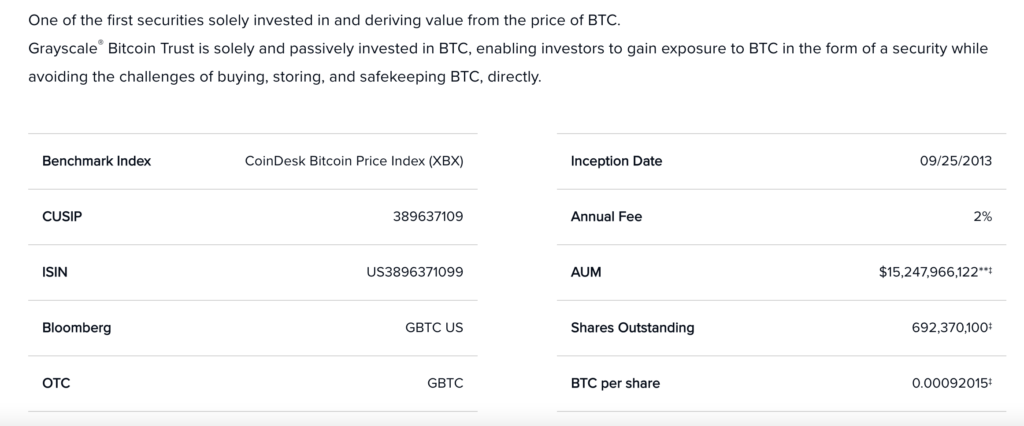
    Below you can see some basic financials on GBTC from Grayscale’s website. They include the CUSIP (389637109), where we’ll use Bloomberg to investigate GBTC’s high-level financials.

    Source: Grayscale Investments, LLC (August 2022)

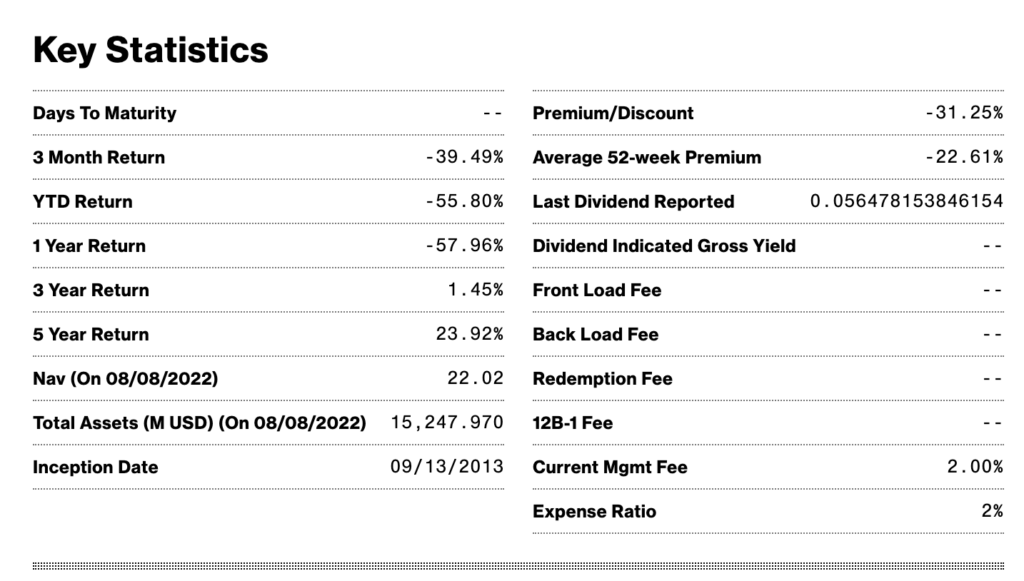
    The “Key Statistics” from Bloomberg for CUSIP 389637109 as of Tuesday August 9th, 2022 (GBTC US) are below.

    Source: Bloomberg L.P. (August 2022)

    Looking at the YTD, 1-year, 3-year, and 5-year average returns, in the context of converting this Bitcoin asset to a spot ETF, is the SEC wrong when they say Grayscale is breaking an SEC rule that “requires, in relevant part, that the rules of a national securities exchange be ‘designed to prevent fraudulent and manipulative acts and practices’ and ‘to protect investors and the public interest’”? In other words, is introducing a Bitcoin spot ETF into the marketplace more dangerous than a Bitcoin futures ETF?

    Bitcoin Futures ETFs vs. Bitcoin Spot ETFs

    While we’re not opining on a question that’s currently an open legal issue, perhaps understanding the difference would help. A spot Bitcoin ETF brings many (almost all) of the benefits of a futures ETF. Some include investing in Bitcoin without using an exchange, paying less in fees than on a crypto exchange, and streamlining the overall process (Moeller, Cointelegraph). However, a spot ETF invests in Bitcoin on the spot.

    With a Bitcoin spot ETF, you invest in Bitcoin at its spot price, meaning buyers will be holding Bitcoin within their portfolio. In practice, it’d be very much like buying a stock. Crypto enthusiasts view a spot ETF as a more legitimate method of investment, therefore Bitcoin would become more legitimized with a SEC-approved Bitcoin spot ETF product.

    Futures are defined as “derivative financial contracts that obligate parties to buy or sell an asset at a predetermined future date and price” (Investopedia, 2022). So, what’s the key difference? With a Bitcoin spot ETF, you have immediate ownership of Bitcoin. When you purchase a Bitcoin futures ETF, you’re effectively just betting on the market, depending on if you choose to take a long or short position. But purchasing a Bitcoin futures ETF by no means entails immediate ownership of Bitcoin as an asset. If you’re going to purchase a SEC-approved Bitcoin spot ETF in the future, as one does not exist today, it’s critical to understand you’ll immediately add Bitcoin to your asset portfolio.

    GBTC’s Primary Differentiator: Security

    That seems to circle back to Grayscale’s initial pitch of the GBTC having “robust security and storage”. The SEC appears to be making less of a comment on the GBTC than they are about Bitcoin in general. A Bitcoin spot ETF can only be rejected for the reasons given by the SEC if they felt that Bitcoin was too susceptible to “fraudulent and manipulative acts”. Through strategic marketing, Grayscale is looking to differentiate their potential Bitcoin spot ETF product as completely secure. Furthermore, they’ve had the longest and most hopeful petition to the SEC for a Bitcoin spot ETF, with initial efforts dating back to 2016 (Moeller, Cointelegraph). Over six years later, Grayscale remains just as committed to convert the GBTC to Bitcoin’s first SEC-approved spot ETF. Whether or not they’ll be successful is still very much an open question. It’s worth noting that Grayscale’s Bitcoin Trust (GBTC) is the world’s only SEC-approved, publicly traded “Bitcoin Trust”. A “Bitcoin Trust” can be very closely compared to a private-placement trust. It trades just like a stock over the counter. That existing confidence, along with potential first-mover market advantage, would certainly give Grayscale a huge reason to seek to overturn the SEC’s latest official ruling.

    For reference, if you want to investigate a few of the best-known Bitcoin futures ETFs, they include ProShares BITO Bitcoin futures ETF, Valkyrie Bitcoin Strategy ETF, and VanEck Bitcoin Strategy ETF. The ProShares BITO Bitcoin futures ETF currently holds around $1B in investments (Moeller, Cointelegraph). For a look closer at information and BITO’s financials, they’re listed on the New York Stock Exchange (NYSE: Arca). For additional information on Grayscale Investments or the GBTC, their website can be found here.

  • Grayscale Investments, LLC Presents: Grayscale Bitcoin Trust (GBTC), Bitcoin’s First Spot ETF?

    Amongst the latest “hot topics” in the Financial Technology (FinTech) space is a cryptocurrency product aimed at changing the receptiveness of the international investment community to cryptocurrencies. Grayscale Investments, LLC has created the GBTC (Grayscale Bitcoin Trust), in an attempt to make a cryptocurrency product more marketable to institutional investors, pension funds, and other more traditional investment vehicles. Whether this approach will work in the long-term seems to be very hotly contested at the moment, for a number of reasons.

    The Grayscale Bitcoin Trust (GBTC)

    Surprisingly – though maybe not to many in the crypto community – Grayscale largely markets the GBTC for its “robust security and storage”. You would think that as an asset manager, even a crypto asset manager, Grayscale would be more excited about presenting numbers that investors are typically hungry for. However, they lead by offering the following:

    “Grayscale Bitcoin Trust’s assets are stored in offline or “cold” storage with Coinbase Custody Trust Company, LLC, as Custodian. The Custodian is a fiduciary under § 100 of the New York Banking Law and a qualified custodian for purposes of Rule 206(4)-2(d)(6) under the Investment Advisers Act of 1940, as amended.”

    Grayscale Investments, LLC (2022)

    Additional benefits, advertised by Grayscale, to purchase the GBTC include tax-advantaged account eligibility, “titled, auditable ownership [of a crypto asset] through a traditional investment vehicle”, publicly quoted price (OTCQX®: GBTC), and support from a network of trusted providers (this is where they let you know they have hired global financial services legal tycoon Davis Polk & Wardwell LLP). Why is that relevant?

    The SEC’s Ruling on Grayscale’s Bitcoin Spot ETF

    At the top of Grayscale’s website, you’ll see a banner with a hyperlink stating, “We’ve received a decision in our application to convert GBTC to an ETF”. That’s the real storyline here. It’s not the GBTC, it’s the fact that the SEC has disallowed Grayscale to convert the GBTC into a Bitcoin spot ETF. The concise version of the SEC’s 86-page decision can be captured in the following paragraph:

    “This order disapproves the proposed rule change, as modified by Amendment No. 1. The Commission concludes that NYSE Arca has not met its burden under the Exchange Act and the Commission’s Rules of Practice to demonstrate that its proposal is consistent with the requirements of Exchange Act Section 6(b)(5), which requires, in relevant part, that the rules of a national securities exchange be ‘designed to prevent fraudulent and manipulative acts and practices’ and ‘to protect investors and the public interest.’’’

    SEC, Release No. 34-95180; File No. SR-NYSEArca-2021-90 (July 22, 2022)

    Grayscale immediately responded by hiring former U.S. Solicitor General, Donald B. Verrilli, Jr. – best known for arguing President Obama’s ACA (Affordable Care Act) successfully before the US Supreme Court – who filed an appeal of the SEC’s ruling. Grayscale says they had no choice but to escalate the matter, given the “SEC’s arbitrary and capricious actions and discriminatory treatment of issuers”. The appeal seems to be almost exclusively relying on the argument that the SEC has allowed multiple Bitcoin futures ETFs into the marketplace. Furthermore, since their treatment of futures and spots of derivatives is generally similar, they are unjustly denying investors access to a new marketplace: Bitcoin spot ETFs. GBTC has the potential to become the first Bitcoin spot ETF to be approved by the SEC.

    A High-Level Look at GBTC’s Financials

    Below you can see some basic financials on GBTC from Grayscale’s website. They include the CUSIP (389637109), where we’ll use Bloomberg to investigate GBTC’s high-level financials.

    Source: Grayscale Investments, LLC (August 2022)

    The “Key Statistics” from Bloomberg for CUSIP 389637109 as of Tuesday August 9th, 2022 (GBTC US) are below.

    Source: Bloomberg L.P. (August 2022)

    Looking at the YTD, 1-year, 3-year, and 5-year average returns, in the context of converting this Bitcoin asset to a spot ETF, is the SEC wrong when they say Grayscale is breaking an SEC rule that “requires, in relevant part, that the rules of a national securities exchange be ‘designed to prevent fraudulent and manipulative acts and practices’ and ‘to protect investors and the public interest’”? In other words, is introducing a Bitcoin spot ETF into the marketplace more dangerous than a Bitcoin futures ETF?

    Bitcoin Futures ETFs vs. Bitcoin Spot ETFs

    While we’re not opining on a question that’s currently an open legal issue, perhaps understanding the difference would help. A spot Bitcoin ETF brings many (almost all) of the benefits of a futures ETF. Some include investing in Bitcoin without using an exchange, paying less in fees than on a crypto exchange, and streamlining the overall process (Moeller, Cointelegraph). However, a spot ETF invests in Bitcoin on the spot.

    With a Bitcoin spot ETF, you invest in Bitcoin at its spot price, meaning buyers will be holding Bitcoin within their portfolio. In practice, it’d be very much like buying a stock. Crypto enthusiasts view a spot ETF as a more legitimate method of investment, therefore Bitcoin would become more legitimized with a SEC-approved Bitcoin spot ETF product.

    Futures are defined as “derivative financial contracts that obligate parties to buy or sell an asset at a predetermined future date and price” (Investopedia, 2022). So, what’s the key difference? With a Bitcoin spot ETF, you have immediate ownership of Bitcoin. When you purchase a Bitcoin futures ETF, you’re effectively just betting on the market, depending on if you choose to take a long or short position. But purchasing a Bitcoin futures ETF by no means entails immediate ownership of Bitcoin as an asset. If you’re going to purchase a SEC-approved Bitcoin spot ETF in the future, as one does not exist today, it’s critical to understand you’ll immediately add Bitcoin to your asset portfolio.

    GBTC’s Primary Differentiator: Security

    That seems to circle back to Grayscale’s initial pitch of the GBTC having “robust security and storage”. The SEC appears to be making less of a comment on the GBTC than they are about Bitcoin in general. A Bitcoin spot ETF can only be rejected for the reasons given by the SEC if they felt that Bitcoin was too susceptible to “fraudulent and manipulative acts”. Through strategic marketing, Grayscale is looking to differentiate their potential Bitcoin spot ETF product as completely secure. Furthermore, they’ve had the longest and most hopeful petition to the SEC for a Bitcoin spot ETF, with initial efforts dating back to 2016 (Moeller, Cointelegraph). Over six years later, Grayscale remains just as committed to convert the GBTC to Bitcoin’s first SEC-approved spot ETF. Whether or not they’ll be successful is still very much an open question. It’s worth noting that Grayscale’s Bitcoin Trust (GBTC) is the world’s only SEC-approved, publicly traded “Bitcoin Trust”. A “Bitcoin Trust” can be very closely compared to a private-placement trust. It trades just like a stock over the counter. That existing confidence, along with potential first-mover market advantage, would certainly give Grayscale a huge reason to seek to overturn the SEC’s latest official ruling.

    For reference, if you want to investigate a few of the best-known Bitcoin futures ETFs, they include ProShares BITO Bitcoin futures ETF, Valkyrie Bitcoin Strategy ETF, and VanEck Bitcoin Strategy ETF. The ProShares BITO Bitcoin futures ETF currently holds around $1B in investments (Moeller, Cointelegraph). For a look closer at information and BITO’s financials, they’re listed on the New York Stock Exchange (NYSE: Arca). For additional information on Grayscale Investments or the GBTC, their website can be found here.

  • What Happened to the Cryptocurrency Market on Black Friday?

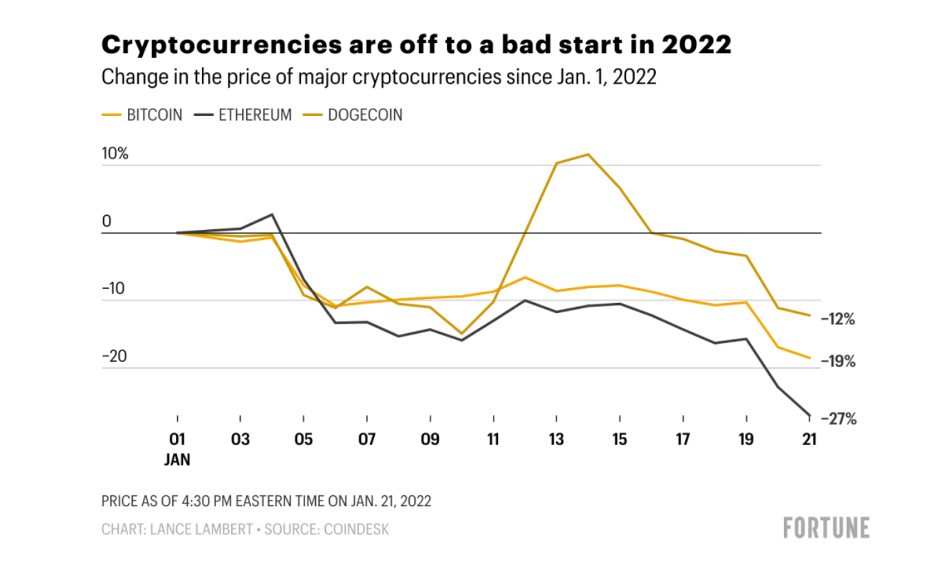
    On a Friday that surely won’t be forgotten anytime soon, on January 21st, 2022, according to CoinMarketCap, cryptocurrencies lost $205 billion in combined market capitalization. Bitcoin was trading at $38,440 as of 10AM Eastern Time on the day many are already calling “Black Friday”. This represents a 16.6% year-to-date drop for the most widely recognized cryptocurrency (Morris, Fortune). Furthermore, Bitcoin has already successfully erased 75% of their gains from 2021 and we’re less than a month into 2022.

    Additional noteworthy cryptocurrencies that suffered substantial setbacks were Ethereum, Solana, and Cardano. Ethereum is especially relevant here, as they received a monumental endorsement from Goldman Sachs in mid-2021. It plummeted 13.5% on Black Friday (-24% YTD), while Solana crashed 16% the same day (-30% YTD), and Cardano dropped 15% (Morris, Fortune). Cardano is also unique since their early gains make their current -8.5% YTD slip seem almost unscathed by comparison.

    Fortune

    Dodgecoin and Shiba Inu, classified as “meme coins”, weren’t exempt from the carnage either, falling 10% and 13%, respectively (Shrivastava, Yahoo Finance). According to CoinMarketCap, judging by overall market cap, they are by far the two largest meme coins. With that, let’s dig into the question investors around the world are actively pondering; what happened?

    Russia’s Central Bank Proposed a Cryptocurrency Ban

    Let’s start with the most obvious. On Black Friday, Reuters reported Russia, one of the world’s largest economies the third-largest Bitcoin miner in the world, proposed banning the use and mining of cryptocurrencies via their central bank. This is eerily similar to a move China pulled at the end of May 2021. We similarly witnessed Bitcoin and other major crypto’s suffer short-term dips, while quickly rebounding in the immediate weeks that followed.

    Russia’s central bank argued cryptocurrencies pose a substantial threat to the country’s financial stability. Additionally, they highlighted reasons pertaining to citizens’ wellbeing and its monetary policy sovereignty (Reuters). Ultimately, Russia’s central bank didn’t mince words, concluding with:

    “The best solution is to introduce a ban on cryptocurrency mining in Russia”

    -The Central Bank of Russian Federation (CBR)

    What’s lacking coverage right now is Russia has been arguing against cryptocurrency adoption for years. Russia’s been extremely vocal in raising concerns about the ease of cryptocurrency markets being used for money laundering and even financing global terrorism. It wasn’t until 2020 that they were given legal status, despite still being banned as a means of payment.

    Specific to events that unfolded on Black Friday, Russia’s central bank focused heavily on the long-term stability of cryptocurrencies. To be blunt, it tore them apart. The central bank determined their rapid growth was reflective of potentially perilous instability. Essentially, the central bank issued stern warnings of the cryptocurrency market being one enormous bubble. They went so far as to indicate cryptocurrencies carried similar characteristics to a financial pyramid.

    Large Market Liquidations Led by Bitcoin

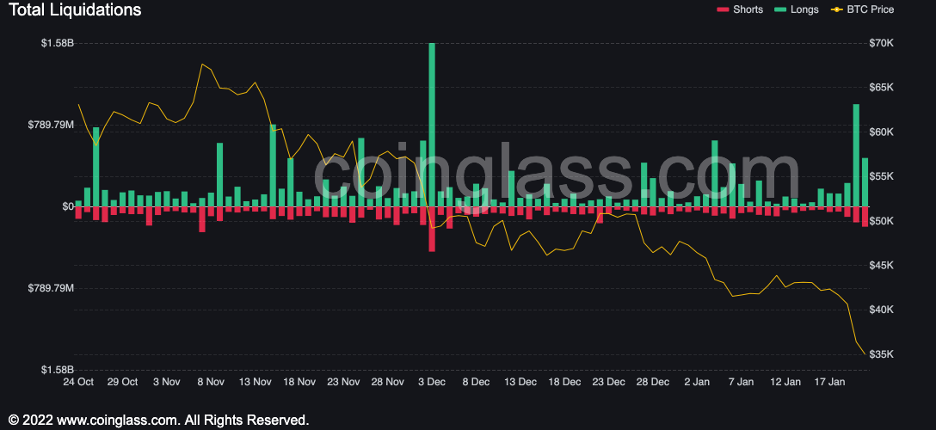
    As one would expect, Black Friday was one of the highest ever single-day cryptocurrency liquidations. The significance of losing a combined $205 billion in market capitalization over a 24-hour period cannot be underscored. Leading that effort was Bitcoin, with Ethereum not far behind. The two lost over $281 billion and $207 billion in 24 hours, respectively.

    The below chart, derived from CoinGlass Liquidation Data, does an excellent job in illustrating how Bitcoin’s price is impacted by investors taking a short position on crypto’s. As investors begin to show skepticism, it appears Bitcoin (BTC) begins to snowball downwards at an increasing rate.

    CoinGlass

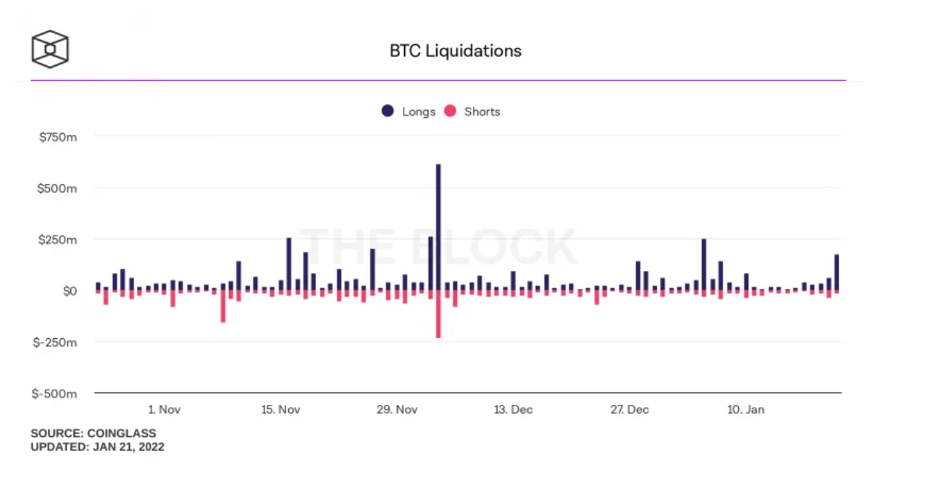
    As the largest and most well-known cryptocurrency, historically Bitcoin’s performance dictates the overall crypto market trend. The same proved to be true on Black Friday.

    CoinGlass/Yahoo Finance

    Wall Street’s Weak Overall Weekly Performance

    Looking to recent history again, the US stock market performance has had a direct relationship with the crypto market’s performance. Before Black Friday, the S&P 500 Index (SPX) dropped nearly 4% over the course of 72 hours (Shrivastava, Yahoo Finance). When this was covered in real-time by Yahoo Finance, MacroAxis’ model had a maximum correlation of 0.59 between BTC and SPX. This is considered a significant correlation. The macroeconomic models from MacroAxis now show an existing correlation as high as 0.64, a stunning daily increase.

    While Russia’s central bank is undeniably the primary catalyst, Bitcoin’s rapid liquidation created an expected snowball effect. That made for terrible timing for historically safe, reliable US stock market investments to have a noticeably subpar week. Many investors, who were already feeling the pressure of safer investments in their portfolio losing value, were put in an even more precarious situation with their more speculative investments nosediving, causing many to quickly liquidate before further damage was done.

    Unsurprisingly, what’s next for Bitcoin and the cryptocurrency market is continuing to be widely debated. Multiple highly credible analysts and institutions remain firmly bullish, claiming Bitcoin will surpass $100,000. While a very wide network of high-net-worth individuals and financial giants still backing Bitcoin and crypto’s exists, it’s hard to imagine we won’t see another rebound yet again.

  • What Happened to the Cryptocurrency Market on Black Friday?

    On a Friday that surely won’t be forgotten anytime soon, on January 21st, 2022, according to CoinMarketCap, cryptocurrencies lost $205 billion in combined market capitalization. Bitcoin was trading at $38,440 as of 10AM Eastern Time on the day many are already calling “Black Friday”. This represents a 16.6% year-to-date drop for the most widely recognized cryptocurrency (Morris, Fortune). Furthermore, Bitcoin has already successfully erased 75% of their gains from 2021 and we’re less than a month into 2022.

    Additional noteworthy cryptocurrencies that suffered substantial setbacks were Ethereum, Solana, and Cardano. Ethereum is especially relevant here, as they received a monumental endorsement from Goldman Sachs in mid-2021. It plummeted 13.5% on Black Friday (-24% YTD), while Solana crashed 16% the same day (-30% YTD), and Cardano dropped 15% (Morris, Fortune). Cardano is also unique since their early gains make their current -8.5% YTD slip seem almost unscathed by comparison.

    Fortune

    Dodgecoin and Shiba Inu, classified as “meme coins”, weren’t exempt from the carnage either, falling 10% and 13%, respectively (Shrivastava, Yahoo Finance). According to CoinMarketCap, judging by overall market cap, they are by far the two largest meme coins. With that, let’s dig into the question investors around the world are actively pondering; what happened?

    Russia’s Central Bank Proposed a Cryptocurrency Ban

    Let’s start with the most obvious. On Black Friday, Reuters reported Russia, one of the world’s largest economies the third-largest Bitcoin miner in the world, proposed banning the use and mining of cryptocurrencies via their central bank. This is eerily similar to a move China pulled at the end of May 2021. We similarly witnessed Bitcoin and other major crypto’s suffer short-term dips, while quickly rebounding in the immediate weeks that followed.

    Russia’s central bank argued cryptocurrencies pose a substantial threat to the country’s financial stability. Additionally, they highlighted reasons pertaining to citizens’ wellbeing and its monetary policy sovereignty (Reuters). Ultimately, Russia’s central bank didn’t mince words, concluding with:

    “The best solution is to introduce a ban on cryptocurrency mining in Russia”

    -The Central Bank of Russian Federation (CBR)

    What’s lacking coverage right now is Russia has been arguing against cryptocurrency adoption for years. Russia’s been extremely vocal in raising concerns about the ease of cryptocurrency markets being used for money laundering and even financing global terrorism. It wasn’t until 2020 that they were given legal status, despite still being banned as a means of payment.

    Specific to events that unfolded on Black Friday, Russia’s central bank focused heavily on the long-term stability of cryptocurrencies. To be blunt, it tore them apart. The central bank determined their rapid growth was reflective of potentially perilous instability. Essentially, the central bank issued stern warnings of the cryptocurrency market being one enormous bubble. They went so far as to indicate cryptocurrencies carried similar characteristics to a financial pyramid.

    Large Market Liquidations Led by Bitcoin

    As one would expect, Black Friday was one of the highest ever single-day cryptocurrency liquidations. The significance of losing a combined $205 billion in market capitalization over a 24-hour period cannot be underscored. Leading that effort was Bitcoin, with Ethereum not far behind. The two lost over $281 billion and $207 billion in 24 hours, respectively.

    The below chart, derived from CoinGlass Liquidation Data, does an excellent job in illustrating how Bitcoin’s price is impacted by investors taking a short position on crypto’s. As investors begin to show skepticism, it appears Bitcoin (BTC) begins to snowball downwards at an increasing rate.

    CoinGlass

    As the largest and most well-known cryptocurrency, historically Bitcoin’s performance dictates the overall crypto market trend. The same proved to be true on Black Friday.

    CoinGlass/Yahoo Finance

    Wall Street’s Weak Overall Weekly Performance

    Looking to recent history again, the US stock market performance has had a direct relationship with the crypto market’s performance. Before Black Friday, the S&P 500 Index (SPX) dropped nearly 4% over the course of 72 hours (Shrivastava, Yahoo Finance). When this was covered in real-time by Yahoo Finance, MacroAxis’ model had a maximum correlation of 0.59 between BTC and SPX. This is considered a significant correlation. The macroeconomic models from MacroAxis now show an existing correlation as high as 0.64, a stunning daily increase.

    While Russia’s central bank is undeniably the primary catalyst, Bitcoin’s rapid liquidation created an expected snowball effect. That made for terrible timing for historically safe, reliable US stock market investments to have a noticeably subpar week. Many investors, who were already feeling the pressure of safer investments in their portfolio losing value, were put in an even more precarious situation with their more speculative investments nosediving, causing many to quickly liquidate before further damage was done.

    Unsurprisingly, what’s next for Bitcoin and the cryptocurrency market is continuing to be widely debated. Multiple highly credible analysts and institutions remain firmly bullish, claiming Bitcoin will surpass $100,000. While a very wide network of high-net-worth individuals and financial giants still backing Bitcoin and crypto’s exists, it’s hard to imagine we won’t see another rebound yet again.

  • Technological & Digital Disruption

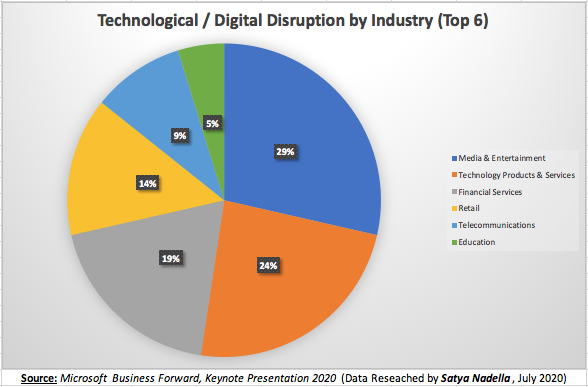
    While it’s commonly known that tech disruption is rapidly occurring, are you aware of which sectors of the US economy are being transformed the most? Initially presented in a Microsoft Business Forward forum, this research is key to assessing the sectors that need to gear up and prepare to deal with the newest technologies. The chart below substantiates just how much technological innovation and digital transformation are disrupting critical, traditional sectors within the nation’s economy.

    Top 6 Industries Impacted by Technological & Digital Disruption

    Microsoft: Top 6 Sectors Affected by Tech / Digital Disruption (Satya Nadella, 2020)

    PropTech addresses technological innovation specifically in the real estate segment. Moreover, you’ll notice that the Top 6 industries affected are most likely ones you come across in your everyday life. What does this mean for management, consumers, and the working class (specifically in these industries)? The article that complements Satya’s research shares a grim prognostication:

    “Digital disruption is well upon us. While a survey conducted by the Global Center for Digital Business Transformation for the large and mid-sized private sector companies agreed, to varying degrees, that digital disruption comes with its own set of benefits, it is also true that Digital Disruption is threatening the survival of many businesses and industries.

    Futuristic businesses and start-ups are exploring new avenues of re-inventing their business activities and industries all together to compete with and dislodge incumbents. The last decade alone has witnessed some exponential progress in technological disruption – think Airbnb, Paytm, Netflix and Uber.

    And this disruption is gradually influencing every industry, including banking, healthcare, hospitality, construction, manufacturing, packaging, logistics, and insurance amongst others (discussed in detail by Satya in Microsoft’s 2020 Keynote Forum).”

    Embee Staff

    Conclusion: What Does This Mean for Real Estate Investors?

    Succinctly, to have longevity in a given industry, the necessity for technological innovation has proven to be non-negotiable. Avoiding this reality will get you nowhere – or worse, out of business – quickly. As the abundance of digital and cloud transformation technologies are increasing, many are finding themselves playing catch-up. The information Microsoft presented suggests nearly all industries will be behind if they refuse to acknowledge technological progress. Not only acknowledge it, but make drastic changes, as necessary, to adapt alongside it.

    We’ve summarized the role technological innovation will play at length in the real estate market moving forward, specifically. Finally, ponder this. Imagine the impact to real estate markets, even globally, if critical industries and large corporations were to fall ‘behind-the-curve‘. What would this mean for CRE investors, who have continued to struggle as of late? The data study produced by Microsoft illustrates just how cataclysmic failures to adapt to new technologies – no matter the reason – can cause widespread fragility beyond the individual companies, or even those particular industry segments. It’s imperative to always look at the bigger picture. In this case, failure to adapt to new technologies will almost certainly cause broad, undesired consequences for investors.

  • The Future of Capital Markets Technology

    Capital Markets are where savings and investments are channeled between suppliers, people, or institutions with capital to lend or invest — as well as those in need (Hayes, Investopedia). Suppliers typically include banks and investors while those who seek capital are businesses, governments, and individuals. Capital markets are composed of primary and secondary markets.

    The most common capital markets are the stock market and the bond market. However other, more complex, markets include the CRE (Commercial Real Estate) Market, Equity Capital Market (ECM), as well as many others that are typically geared towards a specific investor. Therefore there is not as much trading volume or frequency, since the broader excitement is not the same. Even though real estate is the world’s largest asset class, we’ve seen a recent decline in CRE investment. Medium recently posted an article detailing the advantages of a platform called Beacon Platform, Inc, which was a critical, major acquisition for Centena.

    Medium: Modernizing the Capital Markets Technology Stack: Centana’s Investment in Beacon Platform, Inc.

    Why do customers choose Beacon?

    Time-to-Value and ROI. Today, companies continue to deal with cumbersome internal applications that have been stitched together, often with legacy code and/or 3rd party vendors in the Trading and Risk Management space, which are “black box” and difficult, if not impossible, to alter.

    Beacon’s entire code base is flexible and transparent (i.e. the code is made available to customers) and seamlessly integrates with existing software and other 3rd party solutions (like Murex and Calypso), or in-house proprietary solutions, which helps drive quick time-to-value and high utility.

    In a fraction of the time and cost of alternative solutions, Beacon has helped customers achieve objectives such as migrating workloads to the cloud, expanding into new markets, upgrading legacy code by placing it within a modern developer wrapper and extending analytics and applications to customers’ end-users.

    -Matt Alfieri
    Key Takeaways

    When it comes to capital markets technology, the evolving nature of the tech space all but ensures we will see new technologies introduced into capital markets operations. Additionally, while this may sound like an advertisement for Beacon (though FinYork has absolutely no affiliation to it), the critical feature to note is this is an exemplary illustration of where capital markets technology appears to be heading.

    Vertical SaaS or cloud industry solutions, instead of legacy or proprietary in-house solutions, are showing us that they’re easier to replace than many executives originally thought. You should expect to see a similar effect here as with PropTech, as it becomes more widely available and accepted by savvy executives and high net worth real estate investors. You definitely do not want to be the firm who is continuing to use antiquated capital markets technologies. This puts you at an immediate, huge disadvantage. It makes it that much harder to catch up with your competitors, who have a leg-up as they’ve already implemented innovative technologies.

    All this goes to say that SaaS, digital transformation, cloud technologies, PropTech, and even niche technologies that aim to improve efficiency in capital markets are going to play an integral part of the future. The success of firms who will adapt them largely depends on the success those firms will have in the implementation process. To be sure, capital markets technology is only going to continue getting more efficient, robust, and easier to adapt.