Tag: how to invest in real estate

  • Four Major Valuation Methods Explained: Commercial Real Estate (CRE)

    From the perspective of investors, coming up with an accurate property valuation is the most significant factor in making investment decisions. Commercial real estate (CRE) investment has become increasingly popular in the past few decades. That’s because it’s viewed as an excellent vehicle for corporate and public wealth investors to achieve stable returns.

    In this post, we’ll look at four primary valuation methods investors use when looking at CRE proposals. It should be no surprise that technology deeply impacts a potential CRE investment valuation. It’s truly astounding how powerful software solutions can support the consistency, transparency, and standardization across the valuation industry.

    Cost Approach

    The cost approach involves estimating a rough total budget for how much the structure would cost to build from scratch. The cost approach accounts for the original value of the land, plus the cost to build the structure from the ground up. Investors typically look at this approach to see if it’s financially more profitable to develop a new property, versus buying an existing one. The cost approach is comprised of two major methods:

    • Reproduction Method – Costs of rebuilding an exact replica of the existing structure, using the same materials, construction methods, etc.
    • Replacement Method – Costs of rebuilding a new structure with brand new materials, construction methods, designs, etc.

    This logic is generally sound. However, it’s critical to note this method does not account for additional effort of development and construction involved in building a property from the ground up. Similarly, it does not account for the long-term cash flow of a given CRE project.

    Sales Comparison Approach

    Comparisons between key market factors are one of the most important inputs to any valuation method. Furthermore, sales comparisons are usually the source of information, such as cost of reproduction, current market capitalization rate, loan-to-value ratios, and others (Atlus Group). Prospective buyers use this approach to compare current CRE listings to recently sold projects. Though this list isn’t exhaustive, it includes major components of the sales comparison approach:

    • Price per square foot
    • Capitalization rate
    • Price per unit (multifamily CRE)
    • Price per key (hospitality CRE)
    • Physical condition
    • Location
    • Tenant profiles (income, credit quality, cash flow stability, etc.)
    • Income (financial statements)

    The closer in similarity a prospective CRE property is to a comparable sale – especially a recent one – referencing the above components, the more effective this approach tends to be. Finally, once the quantitative characteristics of the perspective CRE property are compared, there is a qualitative analysis to ensure any more or less favorable attributes are accounted for. These adjustments are an essential precaution, if using this valuation method for CRE purchases.

    One notable downside to this method is a lack of analysis of any long-term cash flows or property valuation.

    Capitalization Rate Approach (Income Capitalization)

    The “cap rate” approach is one of the most popular methods of property valuation. It’s very frequently used by analysts in both the lending world and intended acquisitions (Atlus Group). When you hear real estate professionals mention what a property “traded at”, they’re almost always citing either the cap rate, or the price per square foot, a property sold for.

    The formula for calculating cap rate is simple. It’s equal to the net operating income (NOI) of the property, divided by the capitalization rate. The outcome represents the ownership’s approximate value of the property, based on the first year’s expected cash flow.

    Like the Sales Comparison Approach, this tool is most valuable to estimate the current value of CRE properties. Furthermore, it’s even more useful if the property has relatively stable and easily predictable cash flow. New, complex projects that have essentially zero NOI are not good candidates for this valuation approach. In such circumstances, investors are much more likely to turn to the Discounted Cash Flow Approach.

    Discounted Cash Flow Approach

    While the three previously detailed CRE valuation methods are undoubtably useful under certain conditions, they share a major drawback. Each of first three valuation methods estimate the value of a CRE property at a specific point in time. This is in fact a major drawback for real estate investors, who are rarely investing primarily for short-term gains.

    Suppose an example of a long-term, direct real estate investor, looking to maximize their return of a 10-year period. The below formula, taken from Investopedia shows the common formula for the Discounted Cash Flow (DCF) approach.

    Source: Sabrina Jiang, Investopedia (2021)

    Investors utilize this method to factor in both the delta of the initial buying price and the value of the property after ten years, in addition to the net present value (NPV) of any cash flows that come in from owning that property over 10 years. This gives real estate investors a great formula to input prognostications, then make transactions based on those forecasts.

    Reverting to the drawbacks of point-in-time valuations, firstly, it’s critical to understand fundamental psychology real estate investors utilize. Typically, real estate investors have a longer-term vision, especially compared to investors who purchase various securities. This makes a point-in-time valuation much less relevant, since in the long-run real estate investors are not just looking at an easily predictably present value. As we saw in 2008 most famously and during the COVID-19 pandemic most recently, real estate prices can tank from unrelated market activities, political changes, or even a completely unexpected global health pandemic (Altus Group).

    Conclusion

    Long-term volatility concerns necessitate real estate investors to rely on more than increases in value over time. This is a primary explanation why investors generally rely on the cash flow, plus a final value increase. If an investor holds a property for ten years from purchase to sale, as an example, the overall return will be a combination of cash flow from all ten years of ownership, plus any difference between the initial purchase price and the ultimate sale price.

    The cost, sales comparison, and capitalization rate approaches all fail to account for both potential changes in the cash flow, or value of the property, over the investment hold period. Hypothetically, if an investor knows that in year three of the hold period, a major tenant is going to vacate the property and cause a significant decrease in the property’s cash flow for the period, this clearly negatively impacts the overall return the investor attains. The only valuation method that takes into consideration time value of money and captures the future performance of the property is the DCF method.

    The DCF method predicts future cash flows over an estimated property hold period. This includes both annual cash flow and profit at the time of sale. Many practitioners found that attempting to accurately predict revenue, expenses, and the future value of the property at the time of sale, is actually quite difficult. It essentially forces them forces them to think deeply and more critically. Long-term risk factors, management, quality of tenants, and trends in the real estate market suddenly appear on their immediate radar.

    While not perfect (valuation models are not a crystal ball), the DCF method is generally preferred by real estate investors. Bluntly, the DCF approach best matches the reality of the investment, compared to the others discussed above.

    The Closing Argument to Real Estate Investors (Primarily CRE Investors)

    Selecting the best-fit valuation method is akin to choosing the right tool for a homeowner’s repair project. Most of the decision is decided on a case-by-case basis, based on the best information available. With the varying subjective methods and information, asset appraisal in the world of commercial is part formula, part art form.

    In practicality, most appraisers don’t limit themselves to one method, instead taking an average of two or more methods. It’s hardly surprising appraisers have toned down their aggressive approach, especially compared to nearly 15 years ago. After the catastrophic downward spiral of 2008, the more analysis real estate investment projects undergo, the better. To build on the methods discussed, a well-known method rapidly gaining increasing popularity is called the stress test. Perhaps this test is more commonly referenced in the investment banking sector, namely to monitor volatility ratios of aggressive investment banks who also hold client checking and other deposit accounts, to ensure we don’t need to worry about anymore “bank runs”, but nonetheless the same logic applies to the real estate sector and it’s played an indispensable component to accurate real estate valuations. 

    If you take nothing else away from this article, use the DCF Method whenever possible. Especially in today’s ever-changing real estate market, periodic cash flows are a must to have a successful, long-term real estate holding. As with any other investment, do your due diligence, ensure you have the right team around you, and take calculated, well-thought risks. Good luck to all continuing to navigate the post COVID-19 real estate landmine!
  • NYC’s Real Estate Market: Roaring Housing Prices Show No Signs of Slowdown

    “The story that I’m seeing across the board: All segments are transacting. New York [real estate] is back, and people want to be here.”

    – Christopher Kromer, Brown Harris Stevens

    Statistically, that’s an excellent summation of New York City’s real estate market. While real estate was least of all financial asset classes hit by the COVID-19 pandemic, it’s not really “recovering”. Quite amazingly, it’s heating up. It has been for months now, but experts predict that was just a warm up (Singh, CNBC).

    “We’re coming off a record number of signed contracts in the second quarter, and what’s driving that is buyers are seeing value. They’re sensing opportunity, and there’s a real sense of hope for an economic boom in September when it opens up.”

    – Christopher Kromer, Brown Harris Stevens

    In other words, even reasonable rental prices are getting nearly impossible to find almost anywhere in New York City. The buyer’s market is a different story. As Kromer put it, “For the most part, if you’re buying today, it’s probably less expensive than it would have been three or four years ago”. For these purposes, suppose we break New York City’s real estate market into two distinct elements. The profit opportunity for cash buyers has been there and will continue to be there for a prolonged time. Conversely, the residential real estate market for renters, who are mostly living paycheck-to-paycheck, is a nightmare (Nasdaq).

    A Contradictory Study

    Although, a recent Douglas Elliman and Miller Samuel report appeared to somewhat contradict this philosophy. The report showed median resale prices for Manhattan apartments reached an all-time high in Q2 2021 (Douglas Elliman). Average sale prices rose 12% in the quarter (Douglas Elliman). They topped $1.9 million and there was also a 150% gain in sales during that same time period, compared to 2020. In Q2 of 2020, Manhattan apartment sales had their largest percentage decline in 30 years. Residents fled Manhattan during the COVID-19 pandemic, so brokers largely weren’t even able to show apartments to prospective buyers.

    Kromer had a response to the data presented by the Douglas Elliman and Miller Samuel report.

    “I think it’s probably tilted with a lot of high-end closings. The luxury market has been booming lately with a lot of discounts.”

    – Christopher Kromer, Brown Harris Stevens

    The recent activity in Manhattan’s luxury housing market still hasn’t wiped away the excess inventory created by COVID-19. In the luxury market, sellers are coming down on asking prices to meet buyers on their side. This in turn gives buyer’s even more buying power because they have options.

    “What’s driving this are more realistic sellers and softer prices. We still are at near-record levels of inventory. So, the sellers are going down to meet the buyers at their prices. The buyers have options.”

    – Christopher Kromer, Brown Harris Stevens

    Moving Beyond Manhattan

    Astoundingly, markets in the outer boroughs of New York, such as Brooklyn, showed far more resilience through the pandemic. This is again compared to the luxury, upscale housing market in Manhattan; a very significant geographic market difference.

    “People were looking for value, for space and less dense areas, and you did not see the discounts that you saw in Manhattan in the outer boroughs”.

    – Christopher Kromer, Brown Harris Stevens

    A few of Kromer’s own listings in Queens and Brooklyn recently sold above asking price, after receiving multiple offers. One two-bedroom co-op in Brooklyn even sold at roughly 8-9% above the price it sold at three years ago.

    “A single-family home in Queens was overwhelmed with interest. We had about 50 showings within the first week, with it selling for about 10% above the asking price”.

    – Christopher Kromer, Brown Harris Stevens

    In Conclusion

    Despite the study from Douglas Elliman and Miller Samuel, data shows NYC’s housing market is prospering. Housing rental prices on luxurious Manhattan properties are barely affordable. Rental prices outside the heart of New York are still steep and the availability of affordable housing is shrinking. This is nearly all attributed to the “buyer’s market” NYC real estate is clearly in the midst of. Prospective renters need to act fast to avoid losing out on any decent affordable housing in the five boroughs. Prices will only continue to increase, while availability will only continue to decrease.

  • How to Best Invest in Real Estate in the Midwest

    The most surprising feature about housing markets in the Midwest is that home prices – in most of them – are still below the level where local incomes dictate they should be (Winzer, Forbes). If you’re a real estate investor, this means two things. Firstly, there are bargains still available in these markets. Secondly, demand for housing not been very strong, at least not yet.

    Midwest Housing Market Overview

    The lack of rebound in the Midwest housing market following 2008 is largely due to the specific types of local economic growth that prevailed before that (Winzer, Forbes). The housing recession came coupled with a lengthy, slow decline in manufacturing. The availability of an educated but low-cost labor force had encouraged the growth of big financial operations in Des Moines, Minneapolis, Omaha, Sioux Falls and Green Bay. However, manufacturing still has a large role in Fayetteville, Davenport, Peoria, Rockford, Gary, Fort Wayne, South Bend, Wichita, Milwaukee and Green Bay (Millsap, Forbes).

    This makes these markets a bit riskier to invest in. The markets with a large finance sector are also risky because automation is responsible for an increasing amount of work. Despite structural problems, growth is now returning to many Midwest markets, as it did prior to COVID-19. Especially in areas that function as regional centers – Fayetteville and Peoria, for example – the expansion of jobs is due to an increase in healthcare and business services. Similarly, to the country, these services are becoming concentrated in large urban centers, creating opportunities for investors in rental housing.

    An uncharacteristic feature housing investors contend with is many Midwest markets have agricultural roots, with manufacturing later added on top. Since land was readily and easily available during their growth, they tend to be spread out. This combination produces low home prices, but increased difficulty for investors to select a locality. After all, the saying “real estate is about location, location, location”, rings true in most cases.

    Now that we’ve established some fundamental generalities, let’s get to the specifics and numbers.

    Established Demand

    Fort Wayne, Kansas City, Indianapolis, Green Bay, Springfield, Fayetteville, Gary and South Bend.

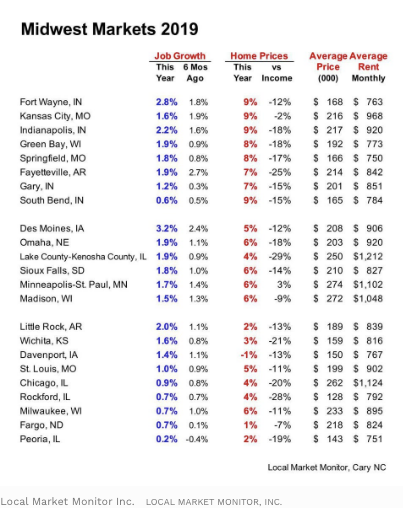
    In these markets, it appears home prices increased relatively broadly in the past year, indicating good demand not just for single-family homes, but rentals as well. With prices still well below income levels and above average job growth, demand is likely to keep raising prices higher. Though the trend depicted below shows the housing market pre-COVID, that trend is pretty much identical today. The housing market didn’t really suffer the same volume of consequences as other markets, but the small parts that did are steadily recovering (Winzer, Forbes).

    Source: Local Market Monitor, Inc.

    South Bend and Gary are at the bottom of this list because their job growth had been less reliable. Before bargains evaporate, investors should move quickly into these markets. Straight, single-family rentals – with minor improvements – are the best bet (Winzer, Forbes).

    Growing Demand

    Des Moines, Omaha, Lake County-Kenosha County, Sioux Falls, Minneapolis, Madison.

    These markets are showing solid job growth, but only moderate increases in demand thus far. Apartments appear to be a good investment in Lake County-Kenosha County and Minneapolis, due to higher density and prices. Since their dependence on the financial sector is comparably very high, most of these markets are also slightly riskier, so investors should be very careful to find properties towards the middle of the renter pool and definitely avoid the higher end.

    Uncertain Demand

    Little Rock, Wichita, Davenport, St. Louis, Chicago, Rockford, Milwaukee, Fargo, Peoria.

    In these markets either demand or job growth are weak, or even more likely, both. Low home prices are also far more commonly found in these markets. This may tempt investors to purchase a low-cost property and rent it out for cheap, without spending another dime. However, renting at the low-end is a specialty that most investors should avoid. In uncertain real estate markets, it makes sense to first look for the safest geographic areas in that market. Then you can perhaps expand and renovate a really inexpensive property, turning it into a profitable rental. That definitely involves more work, but it has potential to give you a bigger return for less risk.

    The Bottom Line

    Concisely, there’s clearly room for excellent returns on housing market investments in the Midwest. While some areas have more opportunity, depending on what strategy you choose, there’s solid return on investment potential all-around. The more time that passes from the start of the COVID-19 pandemic, the less attractive prospects will exist. Active real estate investors would be wise to look strongly into the Midwest and move quickly on specifically the kinds of properties with the features described above. Considering the housing rental market is excellent and still growing, there are definite, safe strategies to fall back on.

  • How to Best Invest in Real Estate in the Midwest

    The most surprising feature about housing markets in the Midwest is that home prices – in most of them – are still below the level where local incomes dictate they should be (Winzer, Forbes). If you’re a real estate investor, this means two things. Firstly, there are bargains still available in these markets. Secondly, demand for housing not been very strong, at least not yet.

    Midwest Housing Market Overview

    The lack of rebound in the Midwest housing market following 2008 is largely due to the specific types of local economic growth that prevailed before that (Winzer, Forbes). The housing recession came coupled with a lengthy, slow decline in manufacturing. The availability of an educated but low-cost labor force had encouraged the growth of big financial operations in Des Moines, Minneapolis, Omaha, Sioux Falls and Green Bay. However, manufacturing still has a large role in Fayetteville, Davenport, Peoria, Rockford, Gary, Fort Wayne, South Bend, Wichita, Milwaukee and Green Bay (Millsap, Forbes).

    This makes these markets a bit riskier to invest in. The markets with a large finance sector are also risky because automation is responsible for an increasing amount of work. Despite structural problems, growth is now returning to many Midwest markets, as it did prior to COVID-19. Especially in areas that function as regional centers – Fayetteville and Peoria, for example – the expansion of jobs is due to an increase in healthcare and business services. Similarly, to the country, these services are becoming concentrated in large urban centers, creating opportunities for investors in rental housing.

    An uncharacteristic feature housing investors contend with is many Midwest markets have agricultural roots, with manufacturing later added on top. Since land was readily and easily available during their growth, they tend to be spread out. This combination produces low home prices, but increased difficulty for investors to select a locality. After all, the saying “real estate is about location, location, location”, rings true in most cases.

    Now that we’ve established some fundamental generalities, let’s get to the specifics and numbers.

    Established Demand

    Fort Wayne, Kansas City, Indianapolis, Green Bay, Springfield, Fayetteville, Gary and South Bend.

    In these markets, it appears home prices increased relatively broadly in the past year, indicating good demand not just for single-family homes, but rentals as well. With prices still well below income levels and above average job growth, demand is likely to keep raising prices higher. Though the trend depicted below shows the housing market pre-COVID, that trend is pretty much identical today. The housing market didn’t really suffer the same volume of consequences as other markets, but the small parts that did are steadily recovering (Winzer, Forbes).

    Source: Local Market Monitor, Inc.

    South Bend and Gary are at the bottom of this list because their job growth had been less reliable. Before bargains evaporate, investors should move quickly into these markets. Straight, single-family rentals – with minor improvements – are the best bet (Winzer, Forbes).

    Growing Demand

    Des Moines, Omaha, Lake County-Kenosha County, Sioux Falls, Minneapolis, Madison.

    These markets are showing solid job growth, but only moderate increases in demand thus far. Apartments appear to be a good investment in Lake County-Kenosha County and Minneapolis, due to higher density and prices. Since their dependence on the financial sector is comparably very high, most of these markets are also slightly riskier, so investors should be very careful to find properties towards the middle of the renter pool and definitely avoid the higher end.

    Uncertain Demand

    Little Rock, Wichita, Davenport, St. Louis, Chicago, Rockford, Milwaukee, Fargo, Peoria.

    In these markets either demand or job growth are weak, or even more likely, both. Low home prices are also far more commonly found in these markets. This may tempt investors to purchase a low-cost property and rent it out for cheap, without spending another dime. However, renting at the low-end is a specialty that most investors should avoid. In uncertain real estate markets, it makes sense to first look for the safest geographic areas in that market. Then you can perhaps expand and renovate a really inexpensive property, turning it into a profitable rental. That definitely involves more work, but it has potential to give you a bigger return for less risk.

    The Bottom Line

    Concisely, there’s clearly room for excellent returns on housing market investments in the Midwest. While some areas have more opportunity, depending on what strategy you choose, there’s solid return on investment potential all-around. The more time that passes from the start of the COVID-19 pandemic, the less attractive prospects will exist. Active real estate investors would be wise to look strongly into the Midwest and move quickly on specifically the kinds of properties with the features described above. Considering the housing rental market is excellent and still growing, there are definite, safe strategies to fall back on.

  • The United States NO LONGER Leads the World in CRE Investing

    It’s been covered extensively, but the COVID-19 pandemic has not been kind to CRE investment. Unfortunately, from looking at Real Capital Analytics CRE investment numbers for July 2021 and the general trajectory over a longer-term period, the CRE investing landscape in the US is not likely to change anytime soon (Clark, 2021). That considers far more than the decline in CRE investment we witnessed during the COVID-19 pandemic. It largely considers the reality that the world’s leading financial giants are contemplating a permanent hybrid work schedule. Real estate still continued to dominate as an investor-friendly asset class, in fact the largest in the world. However there’s no doubt CRE subsector investment dropped significantly and is continuing to, as a result of the pandemic. 

    How the US Fell Behind in CRE Investment

    When the COVID-19 pandemic created a recessionary period March 2020 for the United States economy, the EU began flourishing. According to the same Real Capital Analytics report, “US investment volume for deals priced $10 million and greater slipped behind those in Europe by $19 billion” (Clark, 2021). Unfortunately for the US economy, this occurred in simultaneous months. As soon as the EU began to pick up momentum in deals, they grew quicker and larger. The United States economy – largely attributed to government political infighting – was placed on the back burner at that time. Then President Trump was in the heat of his re-election celebrations, until a global pandemic that’s been pegged as worse than the Spanish Flu, came around (Cox, USA Today).

    This understandably sidetracked the Trump administration into both shock and damage control. While lawmakers in the United States were looking for who to blame for the pandemic’s “miss”, a Brookings University study concluded other countries were busy seizing on the opportunity to attract new business. Predominantly African countries, but definitely also many of those previously really hurting in the EU. 

    Jim Costello, Senior Vice President at Real Capital Analytics, described how investors are facing greater uncertainty around “underwriting future income trends for a property” because of the then relatively novel coronavirus.

    “The social safety nets of European countries can look more expensive, but in a time of crisis, they can also help investors understand how economic losses will be distributed. A single large entity-level transaction boosted quarterly European deal activity ahead of that of the US in late 2017, but otherwise the U.S. has been a larger investment market.”

    – Jim Costello, Real Capital Analytics

    Where CRE Investment in the US Currently Stands and the Outlook Moving Forward

    It’s worth noting the report states that in under normal circumstances, the US is the world’s “most liquid region” for commercial real estate activity. However, in the second quarter of the 2020, Europe moved past the US as a “hub for investment” (Clark, 2021). The trend is yet to discontinue. As CRE investing, raising capital through debt issuances, crowdfunding, and other methods of obtaining credit for CRE projects are rapidly declining, investor confidence is dropping in parallel. While data hasn’t favored bullish CRE investors since the onset of COVID-19, we’ve continued to cover hypothetical positive CRE resurgences.

    Nearing the conclusion of Jim Costello’s findings, different calculations tell the same story. Commercial real estate holdings in the US are not the most advisable investment presently (Costello, 2021). The early figures for July show a double-digit decline in the number of commercial real estate deals in the US. However, deal volume for July is projected to be more than $10 billion. In 2009 – the last officially recorded recession – deal activity averaged around $6 billion per month for the whole year and was closer to $5 billion for July (Costello, 2021).

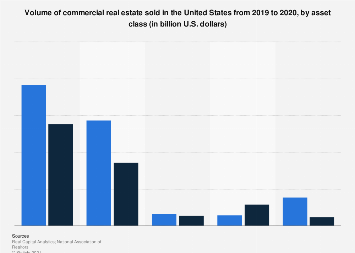
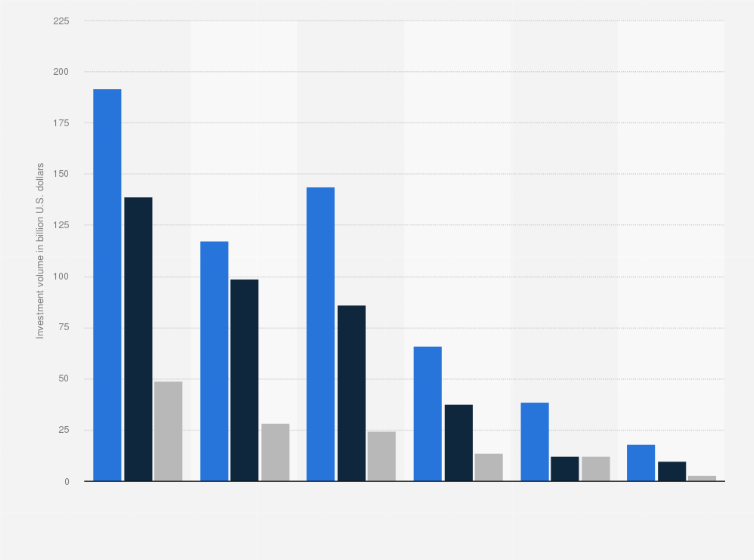
    The findings Jim Costello referred to align with data collected by Statista, a well-known statistics portal for large market data.

    Figure 1 – Commercial Real Estate Investment Volume in US, 2019-2020 ($B of USD)
    Source: Statista Consumer Data, 2021
    Figure 2 – Totaled Values of Commercial Real Estate Sold in US, 2019-2020 ($B of USA)
    Source: Statista Consumer Data, 2021

    “So while conditions in the US are poor, as of yet, investment activity is not as bad as the last downturn, the commercial real estate data suggests that there is less confidence in the US at the moment.”

    – Jim Costello, Real Capital Analytics

    Those final words from Jim Costello in this piece concisely summarize the point we’ve been driving home. While you may not agree with Jim’s rationale, the data does not lie. CRE investments in the US have been going downward since the start of COVID-19 and furthermore, the vast majority of reputable real estate financial analysts would not agree CRE is the best real estate vehicle to invest in at this time, at least relatively passively. It’s perhaps most important to conclude by reminding investors of the 2008 recession, ultimately collapsing from a massive residential housing market bubble. The lessons of 2008 not only taught investors, but also regulators to be vigilant of potential bubbles with systemic risks. However in this case, all the experts suggest the “crash” of US CRE investing during COVID-19 had to do with consumer confidence.

    Once it began to fall, CRE investing opportunities essentially bottomed out because investors ran to relocate their assets. From placing investments much more frequently in REITS and other well diversified real estate vehicles, direct CRE investors became harder and harder to come by. When you add hybrid work schedules, to a push for more productive work-at-home time, and bottom line cost cuts from closing down “brick-and-mortar” offices, at best, the uncertainty of the delta variant in the COVID-19 virus is continuing to hold back CRE investing in the US. At worst – or most likely – CRE investing in the US is, at least temporarily, does not appear to favor any realistic bullish outlook.

  • Study Finds Long, Working Hours Kill Nearly a Million Individuals a Year

    According to the WHO (World Health Organization), long-working hours are directly attributed to the death’s of thousands, upon thousands, upon thousands in global cities (check out this past year, alone). We’re talking about nearly a million people in 2016 alone. The study – again conducted by the incredibly prestigious WHO and cited in BBC News – has some truly alarming statistics. This global survey contains data that is some of the first of its kind and begins gathering data to reach the hypothesis that was likely reached as early as 2016 (BBC News Service).

    As this research was being conducted all the way dating back to 2016, it’s vital to note this takes into account labor market conditions mostly prior to the global, COVID-19 pandemic. Following the aftermath of the pandemic, we’ve seen companies adapt more of a hybrid office schedule for employees. We’ve even seen some companies abandon office schedules altogether (at least for the time being). Perhaps once these working conditions began, it was somewhat refreshing to those who commuted to the office everyday. However, as other studies have shown, while many really didn’t mind working from home, some individuals who were previously content with their weekly schedules became increasingly uncomfortable. Nonetheless, as labor market conditions are returning closer to pre-pandemic times, we can likely expect to see a bit more hybrid working schedules, but largely the same pre-pandemic conditions as in 2016 (BBC News Service).

    Some Alarming Conclusions

    Referring back to that 2016 study done by the WHO and initially reported on by BBC News, of the various alarming statistics, the very first one jumps out: 745,000 people died in 2016 as a result of stroke and heart disease due to long working hours. The article goes on to cite several egregious examples of worker abuse. Lora Jones, a 22 year-old described her initial role at a digital marketing firm as “cult-like”, regarding their adherence to a 72-hour minimum work week (Jones, BBC News).

    While this may not surprise many, Goldman Sachs was thrown under the rug for overworking entry-level analysts. One report details entry-level analysts joining together to have a discussion with their managers at Goldman. They asked for an 80-hour work week cap, calling their current working conditions “abusive” and even “inhumane”. Nonetheless, in a subsequent BBC Report, Goldman CEO David Solomon had no problem with – now – a 95-hour work week. While applauding the courage of the entry-level personnel, Solomon noted “going an extra mile can go a long way”. Everyone reading this should understand the meaning of that pretty clearly.

    Furthermore, the research compared those working a 55-hour work week with those working 35-40 hours. It found that those working a 55-hour work week had a 35% higher risk of stroke and a 17% higher risk of dying from heart disease, compared to those working 35-40 hours.

    A final study, conducted by the International Labour Organization (ILO), concluded men were clearly at a higher risk. Specifically, they reported nearly three quarters of those that died due to working long hours were middle-aged or older men.

    What Will The Future Impact Be?

    BBC News continued with additional regurgitations of the same message; there’s a renewed interest in debating US working class conditions. Reports not cited by BBC show CEOs and executives taking great interest in the happiness of their everyday staff. With that, it’s important to note we’re not suggesting these BCC reports are fair portrayals of the average executive attitude, or average company culture. As we noted in the beginning, a key impact will be many companies adapting a hybrid work routine. This should appease both employees who don’t mind working from home and those who want to be in the office.

    While hybrid work schedules aren’t necessarily great news for CRE investors, they are already a reality. This isn’t something companies are considering doing in the long-run; this is something several big companies have pledged to. The list is likely to only keep growing. These positive changes, combined with a renewed interest in publicly debating this topic, bodes well for the working class. For bullish CRE investors, perhaps not so much.

  • Technological & Digital Disruption

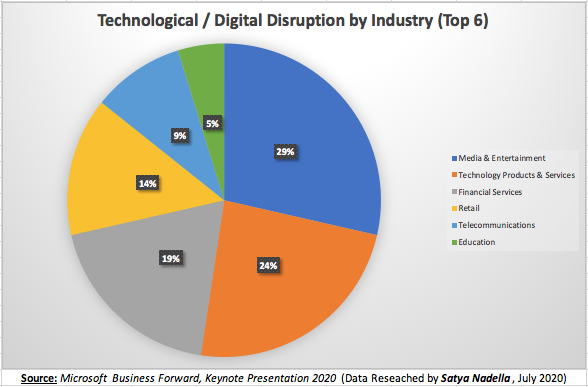
    While it’s commonly known that tech disruption is rapidly occurring, are you aware of which sectors of the US economy are being transformed the most? Initially presented in a Microsoft Business Forward forum, this research is key to assessing the sectors that need to gear up and prepare to deal with the newest technologies. The chart below substantiates just how much technological innovation and digital transformation are disrupting critical, traditional sectors within the nation’s economy.

    Top 6 Industries Impacted by Technological & Digital Disruption

    Microsoft: Top 6 Sectors Affected by Tech / Digital Disruption (Satya Nadella, 2020)

    PropTech addresses technological innovation specifically in the real estate segment. Moreover, you’ll notice that the Top 6 industries affected are most likely ones you come across in your everyday life. What does this mean for management, consumers, and the working class (specifically in these industries)? The article that complements Satya’s research shares a grim prognostication:

    “Digital disruption is well upon us. While a survey conducted by the Global Center for Digital Business Transformation for the large and mid-sized private sector companies agreed, to varying degrees, that digital disruption comes with its own set of benefits, it is also true that Digital Disruption is threatening the survival of many businesses and industries.

    Futuristic businesses and start-ups are exploring new avenues of re-inventing their business activities and industries all together to compete with and dislodge incumbents. The last decade alone has witnessed some exponential progress in technological disruption – think Airbnb, Paytm, Netflix and Uber.

    And this disruption is gradually influencing every industry, including banking, healthcare, hospitality, construction, manufacturing, packaging, logistics, and insurance amongst others (discussed in detail by Satya in Microsoft’s 2020 Keynote Forum).”

    Embee Staff

    Conclusion: What Does This Mean for Real Estate Investors?

    Succinctly, to have longevity in a given industry, the necessity for technological innovation has proven to be non-negotiable. Avoiding this reality will get you nowhere – or worse, out of business – quickly. As the abundance of digital and cloud transformation technologies are increasing, many are finding themselves playing catch-up. The information Microsoft presented suggests nearly all industries will be behind if they refuse to acknowledge technological progress. Not only acknowledge it, but make drastic changes, as necessary, to adapt alongside it.

    We’ve summarized the role technological innovation will play at length in the real estate market moving forward, specifically. Finally, ponder this. Imagine the impact to real estate markets, even globally, if critical industries and large corporations were to fall ‘behind-the-curve‘. What would this mean for CRE investors, who have continued to struggle as of late? The data study produced by Microsoft illustrates just how cataclysmic failures to adapt to new technologies – no matter the reason – can cause widespread fragility beyond the individual companies, or even those particular industry segments. It’s imperative to always look at the bigger picture. In this case, failure to adapt to new technologies will almost certainly cause broad, undesired consequences for investors.

  • Investigating a Critic of Real Estate Investing

    While real estate continues to be the biggest asset class in the world, there are still asset managers who are skeptical about recommending it to their clients as an investment vehicle. As Andy Rachleff puts it:

    One of the most common pieces of financial advice our clients hear from their friends and family is to invest their excess cash in rental properties. Unfortunately, this is terrible advice for all but a lucky few.


    Andy Rachelff

    The piece goes on to give four distinct reasons for critics’ deviation from traditional logic. Let’s break it down one by one.

    Income Isn’t Guaranteed

    While this is true, this is true when it comes to any financial investment vehicle. According to the National Council of Real Estate Investment Fiduciaries (NCREIF), as of Q1 2021 the average 25-year return for private commercial real estate properties held for investment purposes slightly outperformed the S&P 500 Index, with average annualized returns of 10.3% and 9.6%, respectively. Residential and diversified real estate investments also averaged returns of 10.3% (NCREIF). Keep in mind, this data takes into account both the 2008 financial crisis and the COVID-19 pandemic. Each calamity gravely deflated assets in the real estate market. So while it’s certainly true that income isn’t guaranteed, over a 25-year period both commercial and residential real estate holdings outperformed the S&P 500 Index. While income is almost never guaranteed, this should make you feel more at ease about investing your money in the real estate sector.

    It’s Hard To Generate A Compelling Return

    Another generic statement that can be said about almost any investment vehicle. If generating a compelling return was easy, everyone would follow the same system. When you invest in real estate, whether it be through direct property management or a REIT, you still maintain some level of ownership over a physical asset. Conversely, with stocks, as an example, you own a piece of a publicly traded company that has a board of directors, executives, and senior management controlling the day-to-day operations. In other words, your money is in the hand’s of others. With the majority of real estate investment vehicles, you are in control. Therefore, you are the one who has the ability to make decisions that generate a more compelling return, versus leaving those decisions in other people’s hands. It’s easier to generate a compelling return when you have control because at the end of the day, no one will care as much about your money as yourself. Additionally, the under 8% net over eight years earned by Weatherfront’s portfolio is not only a logical fallacy as it is only one data point, but their complaint is largely surrounding the tax structure of rental properties investors will have to pay. It is anecdotal data tailored to disprove a very generic argument to begin with.

    It’s Better To Diversify Your Portfolio

    In this section, the writer essentially makes a compelling argument to investing in a REIT versus direct real estate investing. While we’ve covered both strategies in depth, it’s true that in the long-term a REIT, REIG, or some form of pooled investment will mitigate your portfolio’s risk. This is especially true for individual properties that “fall out of favor”, sometimes due to external factors (i.e. COVID-19 pandemic). The writer correctly points out the substantial risk in a situation where you have enough capital to invest in only one property and advises you against it, but then makes a perfect argument for how to actually diversify your capital within the real estate market. After all, diversification is cited by a vast majority a major benefit to the real estate investment sector. Irrespective of how much money you have to invest upfront, you have control over how much risk you want to take on. Therefore you can choose to diversify your real estate portfolio, or you can put all your eggs in one basket. We are in agreement with Weatherfront that the latter generally isn’t advisable.

    Liquidity Matters

    Depending on what approach you take to real estate investing, the writer has a point. If you take a direct approach to real estate investing, you can easily get stuck with an undesirable property. Alternatively, investing in a real estate index fund, gives you the same liquidity as investing in any other index or stock. Nowadays, it’s very rare to see an investor take all their excess investment capital and tie it down in one property. If they do, they’re doing so at their own peril. With so much data available that shows national long-term economic growth is cyclical, one would have to have a very high appetite for risk to directly invest in a single property. Diversification has been proven to be an essential component to any successful investment portfolio.

    Concisely, do we agree with the critic’s assertion to avoid investing in real estate holdings? No, we don’t. While the writer points out some opportunities to improve your real estate investment strategy, they don’t provide a compelling argument to avoid investing in the entire segment. While some data is anecdotal and some is actual, they make a good case to be wary of rental properties. At the same time, they make a great case for diversification through REITs and other real estate index funds. The fact is there will always be critics and skeptics of any investment choices. There are analysts who are paid to do just that. However real estate has been the world’s largest asset class for awhile and it isn’t going anywhere. For investors, it would be wise to embrace that and research the abundant amount of strategies available within the real estate segment. Diversification will always be critical. Especially if you’re not currently invested in the real estate market, it would be prudent to look into various strategies because you’re all but sure to find some that suit either your short or long-term goals.

  • Investigating a Critic of Real Estate Investing

    While real estate continues to be the biggest asset class in the world, there are still asset managers who are skeptical about recommending it to their clients as an investment vehicle. As Andy Rachleff puts it:

    One of the most common pieces of financial advice our clients hear from their friends and family is to invest their excess cash in rental properties. Unfortunately, this is terrible advice for all but a lucky few.


    Andy Rachelff

    The piece goes on to give four distinct reasons for critics’ deviation from traditional logic. Let’s break it down one by one.

    Income Isn’t Guaranteed

    While this is true, this is true when it comes to any financial investment vehicle. According to the National Council of Real Estate Investment Fiduciaries (NCREIF), as of Q1 2021 the average 25-year return for private commercial real estate properties held for investment purposes slightly outperformed the S&P 500 Index, with average annualized returns of 10.3% and 9.6%, respectively. Residential and diversified real estate investments also averaged returns of 10.3% (NCREIF). Keep in mind, this data takes into account both the 2008 financial crisis and the COVID-19 pandemic. Each calamity gravely deflated assets in the real estate market. So while it’s certainly true that income isn’t guaranteed, over a 25-year period both commercial and residential real estate holdings outperformed the S&P 500 Index. While income is almost never guaranteed, this should make you feel more at ease about investing your money in the real estate sector.

    It’s Hard To Generate A Compelling Return

    Another generic statement that can be said about almost any investment vehicle. If generating a compelling return was easy, everyone would follow the same system. When you invest in real estate, whether it be through direct property management or a REIT, you still maintain some level of ownership over a physical asset. Conversely, with stocks, as an example, you own a piece of a publicly traded company that has a board of directors, executives, and senior management controlling the day-to-day operations. In other words, your money is in the hand’s of others. With the majority of real estate investment vehicles, you are in control. Therefore, you are the one who has the ability to make decisions that generate a more compelling return, versus leaving those decisions in other people’s hands. It’s easier to generate a compelling return when you have control because at the end of the day, no one will care as much about your money as yourself. Additionally, the under 8% net over eight years earned by Weatherfront’s portfolio is not only a logical fallacy as it is only one data point, but their complaint is largely surrounding the tax structure of rental properties investors will have to pay. It is anecdotal data tailored to disprove a very generic argument to begin with.

    It’s Better To Diversify Your Portfolio

    In this section, the writer essentially makes a compelling argument to investing in a REIT versus direct real estate investing. While we’ve covered both strategies in depth, it’s true that in the long-term a REIT, REIG, or some form of pooled investment will mitigate your portfolio’s risk. This is especially true for individual properties that “fall out of favor”, sometimes due to external factors (i.e. COVID-19 pandemic). The writer correctly points out the substantial risk in a situation where you have enough capital to invest in only one property and advises you against it, but then makes a perfect argument for how to actually diversify your capital within the real estate market. After all, diversification is cited by a vast majority a major benefit to the real estate investment sector. Irrespective of how much money you have to invest upfront, you have control over how much risk you want to take on. Therefore you can choose to diversify your real estate portfolio, or you can put all your eggs in one basket. We are in agreement with Weatherfront that the latter generally isn’t advisable.

    Liquidity Matters

    Depending on what approach you take to real estate investing, the writer has a point. If you take a direct approach to real estate investing, you can easily get stuck with an undesirable property. Alternatively, investing in a real estate index fund, gives you the same liquidity as investing in any other index or stock. Nowadays, it’s very rare to see an investor take all their excess investment capital and tie it down in one property. If they do, they’re doing so at their own peril. With so much data available that shows national long-term economic growth is cyclical, one would have to have a very high appetite for risk to directly invest in a single property. Diversification has been proven to be an essential component to any successful investment portfolio.

    Concisely, do we agree with the critic’s assertion to avoid investing in real estate holdings? No, we don’t. While the writer points out some opportunities to improve your real estate investment strategy, they don’t provide a compelling argument to avoid investing in the entire segment. While some data is anecdotal and some is actual, they make a good case to be wary of rental properties. At the same time, they make a great case for diversification through REITs and other real estate index funds. The fact is there will always be critics and skeptics of any investment choices. There are analysts who are paid to do just that. However real estate has been the world’s largest asset class for awhile and it isn’t going anywhere. For investors, it would be wise to embrace that and research the abundant amount of strategies available within the real estate segment. Diversification will always be critical. Especially if you’re not currently invested in the real estate market, it would be prudent to look into various strategies because you’re all but sure to find some that suit either your short or long-term goals.

  • The Future of Capital Markets Technology

    Capital Markets are where savings and investments are channeled between suppliers, people, or institutions with capital to lend or invest — as well as those in need (Hayes, Investopedia). Suppliers typically include banks and investors while those who seek capital are businesses, governments, and individuals. Capital markets are composed of primary and secondary markets.

    The most common capital markets are the stock market and the bond market. However other, more complex, markets include the CRE (Commercial Real Estate) Market, Equity Capital Market (ECM), as well as many others that are typically geared towards a specific investor. Therefore there is not as much trading volume or frequency, since the broader excitement is not the same. Even though real estate is the world’s largest asset class, we’ve seen a recent decline in CRE investment. Medium recently posted an article detailing the advantages of a platform called Beacon Platform, Inc, which was a critical, major acquisition for Centena.

    Medium: Modernizing the Capital Markets Technology Stack: Centana’s Investment in Beacon Platform, Inc.

    Why do customers choose Beacon?

    Time-to-Value and ROI. Today, companies continue to deal with cumbersome internal applications that have been stitched together, often with legacy code and/or 3rd party vendors in the Trading and Risk Management space, which are “black box” and difficult, if not impossible, to alter.

    Beacon’s entire code base is flexible and transparent (i.e. the code is made available to customers) and seamlessly integrates with existing software and other 3rd party solutions (like Murex and Calypso), or in-house proprietary solutions, which helps drive quick time-to-value and high utility.

    In a fraction of the time and cost of alternative solutions, Beacon has helped customers achieve objectives such as migrating workloads to the cloud, expanding into new markets, upgrading legacy code by placing it within a modern developer wrapper and extending analytics and applications to customers’ end-users.

    -Matt Alfieri
    Key Takeaways

    When it comes to capital markets technology, the evolving nature of the tech space all but ensures we will see new technologies introduced into capital markets operations. Additionally, while this may sound like an advertisement for Beacon (though FinYork has absolutely no affiliation to it), the critical feature to note is this is an exemplary illustration of where capital markets technology appears to be heading.

    Vertical SaaS or cloud industry solutions, instead of legacy or proprietary in-house solutions, are showing us that they’re easier to replace than many executives originally thought. You should expect to see a similar effect here as with PropTech, as it becomes more widely available and accepted by savvy executives and high net worth real estate investors. You definitely do not want to be the firm who is continuing to use antiquated capital markets technologies. This puts you at an immediate, huge disadvantage. It makes it that much harder to catch up with your competitors, who have a leg-up as they’ve already implemented innovative technologies.

    All this goes to say that SaaS, digital transformation, cloud technologies, PropTech, and even niche technologies that aim to improve efficiency in capital markets are going to play an integral part of the future. The success of firms who will adapt them largely depends on the success those firms will have in the implementation process. To be sure, capital markets technology is only going to continue getting more efficient, robust, and easier to adapt.