Tag: investing

  • What is a Private Equity Real Estate Fund?

    In the simplest terms, a real estate private equity fund is a partnership established to raise equity for ongoing real estate investments (Bond, NAIOP). A general partner (GP), most frequently referred to as the “sponsor”, creates the fund. The sponsor asks investors, known as limited partners (LPs), to invest equity in the fund or partnership. Those funds, along with money borrowed from commercial banks, investment banks, public institutions, asset managers, and other lenders, are supposed to be invested in a variety of real estate development or acquisition opportunities.

    Typically, the LPs provide the bulk of the equity capital and are passive investors, who have actively chosen to invest in an offering, which was presented by the sponsor. LPs earn an early return of capital and a preferred return on capital invested (Bond, NAIOP). Sponsors are in charge of providing the equity capital, securing investment opportunities, managing the real estate and the fund, and earning fees (that typically are based on performance).

    A real estate private equity fund differs from capital that comes from friends and family and joint ventures. A differentiating example of a joint venture could be among a landowner, a developer, and a money partner. None could complete the investment without the others, and the joint venture is specific to just one investment. Real estate private equity funds, on the other hand, are created to invest in a series of deals with a standardized risk and reward structure created for the overall fund in which the sponsor and LP participate unequally (Bond, NAIOP).

    What are the Sponsor’s Motivations?

    While there are arguments for a laundry list of motivations, we’ll highlight the general motivating factors for sponsors.

    • Diversify and expand funding sources, as well as holdings

    A sponsor with a pipeline of potential investments can use a fund to take advantage of a portfolio consisting of a variety of deals that would not otherwise be available. The capital-raising strategy should, however, focus on the sponsor’s history, the experience of the team, the potential for returns, alignment of interests and clearly identified opportunities. The most reputable developers with the best track records are able to find investment opportunities in their home markets that are outside their traditional property type focus, opportunities outside their historical geographic focus, or some combination of both (Bond, NAIOPI). A private equity fund has the potential to provide the scale that will allow the sponsor to fully take advantage of these opportunities, thereby generating returns over a much larger capital base and likely even lowering the risk of the firm.

    • Invest in larger and higher quality projects

    A sponsor that has capital constraints can use funds to invest in larger and more complex projects. Conversely, more partners also enable the developer to share the risks with their investors to create a better risk-return balance on large, complex projects that the sponsor would not be able to take on alone.

    • Obtain better terms from banks and other lenders.
    • Provide an alternative to mezzanine capital.
    • Develop projects using fund-level financing in lieu of project-by-project financing.
    • Earn fees from the fund, including a promoted interest. 

    The “Three Key” Considerations to a Private Equity Real Estate Fund

    While an argument could be made for a myriad of factors that are critical to take into account when setting up a private equity fund, three key considerations standout. These are pillars to success in establishing the fund and efficiently raising capital from the limited partners.

    1) Amount of Equity Capital to Raise

    The first consideration is the amount of equity capital that ought to be raised. This should include organizational fees. The minimum private equity fund size is generally considered to be $20 million. While organizational costs are generally proportional to fund size, the floor for organizational fees is about $400,000. While the sponsor recoups these fees from the fund once the capital is raised, the sponsor must carry these costs during the fund’s formation period. Examples of these costs include: formation costs for the legal entity or entities, filing fees, accounting fees, regulatory brokerage costs, clearing costs and the cost of producing marketing documents (Bond, NAIOP).

    While the fund’s equity capital is typically combined with debt capital to create a total pool for investing, a successful fund needs to balance potential deal flow with the fund’s size to ensure that the fund can produce sustainable returns for the LPs, and that it doesn’t become too small, such that a follow-on fund might need to be launched. The timing of flows to and from the fund should also be considered. In general, LPs begin earning a preferred return on their capital as soon as the funds are invested. Therefore, in addition to obtaining a commitment from each LP for the total investment amount, astute sponsors stage the pay-in to match the fund’s anticipated timing of investments.

    2) Realistic Amount of Time, Energy, and Seed Funding Required

    Sponsors must be clear-eyed about the time, energy and seed funding required to launch a fund (Bond, NAIOP). The sponsor is responsible for all aspects of the fund: organizing the fund, which includes generating a partnership agreement, offering and subscription documents; securing investment opportunities; securing loans and other financing; managing the fund; operating the properties; preparing partners’ tax returns; and responding to accounting and audit matters, and this is to name only a few of the highlights. These responsibilities put the sponsor is under a constant, daunting amount of pressure. You may have the financial acumen, but you may not have other traits essential to being a successful sponsor.

    3) Clear Investment Fund Strategy

    It’s imperative for sponsors to have a clear and easily understood investment fund strategy. This differs from the market fundamentals, property type, and location strategies that dominate traditional real estate investing assessments. Though experienced sponsors and the largest funds may be able to raise funds for a “blind pool” – a fund for which no individual investments are identified – first-time sponsors typically must identify specific investments that are included in the fund’s offering memorandum.

    Concisely, there’s a lot of complexity to operating or owning a private equity fund that we didn’t get to. However, our goal was to cover the core basics. What is a private equity fund, how is it set up, and what are the key takeaways? We hope this piece was helpful and educational for those interested in private equity.
  • As Fall 2021 Approaches, Will the Housing Market Cool Off?

    Today’s hot housing market is one of the peculiar outliers to the pandemic (Campisi, Forbes). Housing supply was already low before COVID-19, however it was even further hampered, as lockdowns took place, enticing people to begin looking for new homes. Experts have attributed this to a desire to leave populated cities for better home offices during the pandemic.

    The Federal Reserve’s steps in 2020 to keep financial markets liquid and ensure mortgage rates stayed low have continued. The Federal Reserve really deserves tremendous credit for keeping the housing market solidly afloat, virtually throughout the entire pandemic.

    Housing prices nationwide, including distressed sales, grew by 17.2% in June 2021 compared with June 2020 (CoreLogic). According to the latest CoreLogic housing market report, that’s a record high. While there have undoubtedly been “hot seller’s markets” in the past, experts argue they don’t quite compare to the current market, where more than 50% of homes for sale have fetched over the asking price (Campisi, Forbes).

    “We’ve been tracking housing prices for over 20 years, and we’ve never seen anything like this.”


    – Frank Nothaft, Chief Economist at CoreLogic

    Historically, the fall ushers in less competition and thereby better deals, as children return to school and the holidays overtake schedules. But the pandemic altered that trend last year, and many cities are going through double-digit percentage increases in housing prices (Campisi, Forbes).

    Are Housing Prices Starting to Slow Down?

    While a full-fledged celebration might be too easy, prospective homebuyers can breathe a little easier. Based on predictions from real estate experts, prices are beginning to decelerate in some areas. As more inventory of single-family homes becomes available, investors can expect consumer prices to decrease further. According to the National Association of Realtors (NAR), unsold homes rose 3.3% to 1.25 million from May to June this year (National Association of Realtors). Marginally increased inventory isn’t enough to handle demand; it might give buyers hope and potentially buying leverage with more options.

    “Mortgage applications have dropped to an 18-month low, and we are seeing some real buyer fatigue in the market. Sellers are responding to lower buyer enthusiasm with price reductions.”


    – Tamar Asken, Real Estate Agent at Avenue 8, Los Angeles

    In Northern Virginia, housing prices increased 10.9% year-over-year (YOY) in June 2021, compared to the same time last year. The more affordable areas of Northern Virginia, like Fairfax City, saw a sharper rise in YOY median housing price gains like 15.1%, compared to their more expensive nearby areas like Falls Church, which experienced a significantly smaller rise of just 3.2% (Andrews, Virginia Business).

    “The market in Northern Virginia has slowed significantly during the past month, with fewer offers and longer days on market. While this would be a normal pattern in a typical year, given the intensity of the spring market, it is surprising. It could well be due to an uptick in travel as pandemic restrictions eased.”


    –Ryan McLaughlin, CEO at the Northern Virginia Association of Realtors (NVAR)

    Buyer Behavior is Becoming More Predictable and Rationale

    Succinctly, consumers flocked out to the real estate market last year (Lake, Forbes). As demand for houses picked up, interested buyers have pulled out all the stops to outbid the competition.

    This caused all sorts of strange and certainly even reckless behavior, including buyers forgoing contingencies in the sales contract meant to protect themselves and their earnest money, which can amount to thousands of dollars (Treece, Forbes). Some buyers were using retirement savings, while others were getting loans, so they could appear to be all-cash buyers.

    The good news is that experts seem to agree this “go-for-broke” approach could be declining. Whether it’s because inventory is beginning to ramp up or home prices are flattening, some buyers realize that they might be putting too much on the line. Even Asken says she is noticing that more buyers are now proceeding with caution. Keep in mind she works at a real estate company based in Los Angeles, a notoriously expensive and competitive market.

    “I do not see the same level of desperation and urgency we saw a few months ago. After large price increases, many properties just don’t feel like such a good deal anymore.”


    – Tamar Asken, Real Estate Agent at Avenue 8, Los Angeles

    Mortgage Rates and Housing Price Forecasts for Fall 2021

    While history generally indicates that during a fall is when you can get a better deal on real estate, last year contested all trends with enormous housing market sales growth recorded in the fall season. So, are we likely to see a repeat later this year? Some experts claim demand will go back to its usual cooling-off period in the fall, noting the recent expansion of inventory and retreating home prices (Ralph B. McLaughlin, Chief Economist & SVP of Analytics, Haus, Inc.).

    “I think it’s absolutely likely that price growth will slow throughout the end of the year, as they’re already slowing from their peak in June. We expect price growth to moderate to the mid-high single digits by December.”


    – Ralph B. McLaughlin, Chief Economist & SVP of Analytics, Haus, Inc.

    Nevertheless, McLaughlin added that he doesn’t expect inventory to recover fully until next spring. This is instructive specifically for current, prospective buyers. The best course of action for patiently waiting buyers is to start getting their finances in order now. Waiting to do that until a deal comes along often means you’ll be too late. This is a good time to work on your credit score. A higher score means lower interest rates, which extends to a lower monthly payment. Keep in mind that as home prices rise, so does your down payment requirement. While we’re yet to see a true “cool off” in the housing market, there is plenty of reason to suspect it will continue to slow down substantially.

  • Twitter is the Ultimate Cryptocurrency Stock to BUY NOW

    Twitter (NYSE:TWTR) shares have soared more than 55% and counting in the past year, 2021 (Sun, The Motley Fool). An iconic platform best known as a micro-blogging social network, Twitter is quickly evolving. Moreover, it’s developing into something that’s likely even more influential and lucrative with the rise of cryptocurrencies. 

    Back in July 2021, Chief Executive Officer (CEO) Jack Dorsey announced that Bitcoin would become a “big part” of Twitter, specifically via integration with the company’s products and services. While this may not be well-known to investors, Twitter has already seen a huge rise in its bottom line due to the influx of cryptocurrency developers (Sun, The Motley Fool).

    An Extremely Unique Advantage for Twitter

    Unlike with stocks, there isn’t a centralized Securities and Exchange Commission (SEC) database (called EDGAR), where investors can go and get the latest information and financials for cryptocurrencies; until now. Twitter is quickly beginning to play the role of a “decentralized SEC” for the crypto community. Users can follow developer teams on Twitter, thereby getting the newest information on material changes in protocol, new partnerships, and significant events (the equivalent of 8-Ks at the SEC), as well as regular financial reports (10-Qs and 10-Ks). Furthermore, individuals can even report cryptocurrency tweets deemed to be scams or pump-and-dump schemes. A common practice in the vast majority of equity markets, this leads to a prototype of self-regulation (CFA Institute).

    Due to this phenomenon, Twitter is becoming exceedingly popular among altcoin networks such as Ethereum, Avalanche, Solana, Reserve Rights, Chainlink, Monero, and PirateChain, amongst many others. Their setup has attracted likely millions of users specifically desiring to stay up-to-date with the development of their latest tokens. Twitter’s capitalized on this financially by charging developers to promote their accounts via advertisement spending. Developers are incentivized into this because traffic is organic and directly within their target audience. Through this process, Twitter doesn’t even need to spend money on their own advertising. Celebrities, such as Tesla’s CEO Elon Musk, repeatedly use the platform to tout digital currencies such as Dogecoin to his fans, obviously generating substantial viewing activity.

    Financials Back Up Recent Boost in Success and Future Hype for Twitter

    During the second quarter of 2021, Twitter grew its monetizable daily active user base by 10.8% year over year to 206 million (Twitter, Inc – Financial Information). During the same time, revenue grew by a stunning 74% to $1.19 billion (Twitter, Inc – Financial Information). The company’s earnings have recouped their losses from the pandemic recession. Moreover, they more than doubled in the quarter ending June 30th (Twitter, Inc – Financial Information). They’re very clearly currently on track for stellar growth.

    Additionally, Twitter is doing well in terms of liquidity, with cash and investments outweighing its debt plus convertible notes by a factor of two (Twitter, Inc – Financial Information). Most experts agree it is both a great tech and crypto stock to buy at 10 times revenue. Expect continued profits and share gains as part of the boom in cryptocurrencies.

  • Twitter is the Ultimate Cryptocurrency Stock to BUY NOW

    Twitter (NYSE:TWTR) shares have soared more than 55% and counting in the past year, 2021 (Sun, The Motley Fool). An iconic platform best known as a micro-blogging social network, Twitter is quickly evolving. Moreover, it’s developing into something that’s likely even more influential and lucrative with the rise of cryptocurrencies. 

    Back in July 2021, Chief Executive Officer (CEO) Jack Dorsey announced that Bitcoin would become a “big part” of Twitter, specifically via integration with the company’s products and services. While this may not be well-known to investors, Twitter has already seen a huge rise in its bottom line due to the influx of cryptocurrency developers (Sun, The Motley Fool).

    An Extremely Unique Advantage for Twitter

    Unlike with stocks, there isn’t a centralized Securities and Exchange Commission (SEC) database (called EDGAR), where investors can go and get the latest information and financials for cryptocurrencies; until now. Twitter is quickly beginning to play the role of a “decentralized SEC” for the crypto community. Users can follow developer teams on Twitter, thereby getting the newest information on material changes in protocol, new partnerships, and significant events (the equivalent of 8-Ks at the SEC), as well as regular financial reports (10-Qs and 10-Ks). Furthermore, individuals can even report cryptocurrency tweets deemed to be scams or pump-and-dump schemes. A common practice in the vast majority of equity markets, this leads to a prototype of self-regulation (CFA Institute).

    Due to this phenomenon, Twitter is becoming exceedingly popular among altcoin networks such as Ethereum, Avalanche, Solana, Reserve Rights, Chainlink, Monero, and PirateChain, amongst many others. Their setup has attracted likely millions of users specifically desiring to stay up-to-date with the development of their latest tokens. Twitter’s capitalized on this financially by charging developers to promote their accounts via advertisement spending. Developers are incentivized into this because traffic is organic and directly within their target audience. Through this process, Twitter doesn’t even need to spend money on their own advertising. Celebrities, such as Tesla’s CEO Elon Musk, repeatedly use the platform to tout digital currencies such as Dogecoin to his fans, obviously generating substantial viewing activity.

    Financials Back Up Recent Boost in Success and Future Hype for Twitter

    During the second quarter of 2021, Twitter grew its monetizable daily active user base by 10.8% year over year to 206 million (Twitter, Inc – Financial Information). During the same time, revenue grew by a stunning 74% to $1.19 billion (Twitter, Inc – Financial Information). The company’s earnings have recouped their losses from the pandemic recession. Moreover, they more than doubled in the quarter ending June 30th (Twitter, Inc – Financial Information). They’re very clearly currently on track for stellar growth.

    Additionally, Twitter is doing well in terms of liquidity, with cash and investments outweighing its debt plus convertible notes by a factor of two (Twitter, Inc – Financial Information). Most experts agree it is both a great tech and crypto stock to buy at 10 times revenue. Expect continued profits and share gains as part of the boom in cryptocurrencies.

  • The United States NO LONGER Leads the World in CRE Investing

    It’s been covered extensively, but the COVID-19 pandemic has not been kind to CRE investment. Unfortunately, from looking at Real Capital Analytics CRE investment numbers for July 2021 and the general trajectory over a longer-term period, the CRE investing landscape in the US is not likely to change anytime soon (Clark, 2021). That considers far more than the decline in CRE investment we witnessed during the COVID-19 pandemic. It largely considers the reality that the world’s leading financial giants are contemplating a permanent hybrid work schedule. Real estate still continued to dominate as an investor-friendly asset class, in fact the largest in the world. However there’s no doubt CRE subsector investment dropped significantly and is continuing to, as a result of the pandemic. 

    How the US Fell Behind in CRE Investment

    When the COVID-19 pandemic created a recessionary period March 2020 for the United States economy, the EU began flourishing. According to the same Real Capital Analytics report, “US investment volume for deals priced $10 million and greater slipped behind those in Europe by $19 billion” (Clark, 2021). Unfortunately for the US economy, this occurred in simultaneous months. As soon as the EU began to pick up momentum in deals, they grew quicker and larger. The United States economy – largely attributed to government political infighting – was placed on the back burner at that time. Then President Trump was in the heat of his re-election celebrations, until a global pandemic that’s been pegged as worse than the Spanish Flu, came around (Cox, USA Today).

    This understandably sidetracked the Trump administration into both shock and damage control. While lawmakers in the United States were looking for who to blame for the pandemic’s “miss”, a Brookings University study concluded other countries were busy seizing on the opportunity to attract new business. Predominantly African countries, but definitely also many of those previously really hurting in the EU. 

    Jim Costello, Senior Vice President at Real Capital Analytics, described how investors are facing greater uncertainty around “underwriting future income trends for a property” because of the then relatively novel coronavirus.

    “The social safety nets of European countries can look more expensive, but in a time of crisis, they can also help investors understand how economic losses will be distributed. A single large entity-level transaction boosted quarterly European deal activity ahead of that of the US in late 2017, but otherwise the U.S. has been a larger investment market.”

    – Jim Costello, Real Capital Analytics

    Where CRE Investment in the US Currently Stands and the Outlook Moving Forward

    It’s worth noting the report states that in under normal circumstances, the US is the world’s “most liquid region” for commercial real estate activity. However, in the second quarter of the 2020, Europe moved past the US as a “hub for investment” (Clark, 2021). The trend is yet to discontinue. As CRE investing, raising capital through debt issuances, crowdfunding, and other methods of obtaining credit for CRE projects are rapidly declining, investor confidence is dropping in parallel. While data hasn’t favored bullish CRE investors since the onset of COVID-19, we’ve continued to cover hypothetical positive CRE resurgences.

    Nearing the conclusion of Jim Costello’s findings, different calculations tell the same story. Commercial real estate holdings in the US are not the most advisable investment presently (Costello, 2021). The early figures for July show a double-digit decline in the number of commercial real estate deals in the US. However, deal volume for July is projected to be more than $10 billion. In 2009 – the last officially recorded recession – deal activity averaged around $6 billion per month for the whole year and was closer to $5 billion for July (Costello, 2021).

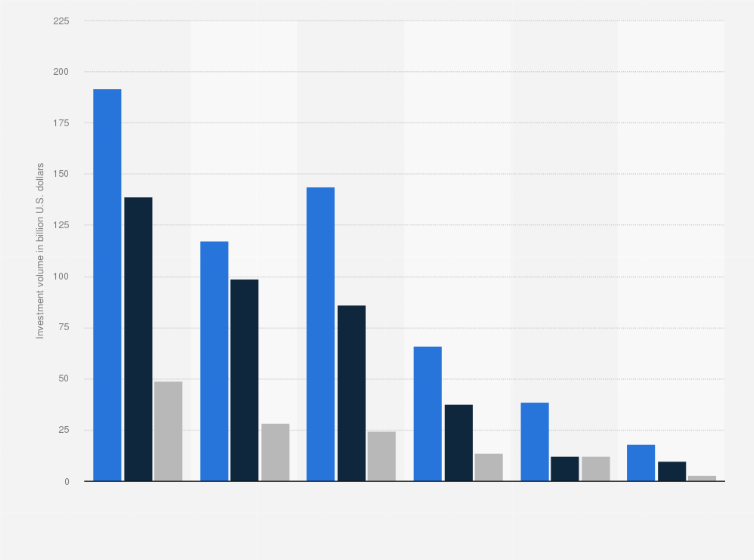
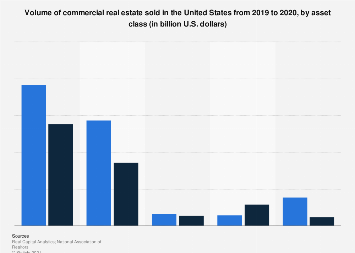
    The findings Jim Costello referred to align with data collected by Statista, a well-known statistics portal for large market data.

    Figure 1 – Commercial Real Estate Investment Volume in US, 2019-2020 ($B of USD)
    Source: Statista Consumer Data, 2021
    Figure 2 – Totaled Values of Commercial Real Estate Sold in US, 2019-2020 ($B of USA)
    Source: Statista Consumer Data, 2021

    “So while conditions in the US are poor, as of yet, investment activity is not as bad as the last downturn, the commercial real estate data suggests that there is less confidence in the US at the moment.”

    – Jim Costello, Real Capital Analytics

    Those final words from Jim Costello in this piece concisely summarize the point we’ve been driving home. While you may not agree with Jim’s rationale, the data does not lie. CRE investments in the US have been going downward since the start of COVID-19 and furthermore, the vast majority of reputable real estate financial analysts would not agree CRE is the best real estate vehicle to invest in at this time, at least relatively passively. It’s perhaps most important to conclude by reminding investors of the 2008 recession, ultimately collapsing from a massive residential housing market bubble. The lessons of 2008 not only taught investors, but also regulators to be vigilant of potential bubbles with systemic risks. However in this case, all the experts suggest the “crash” of US CRE investing during COVID-19 had to do with consumer confidence.

    Once it began to fall, CRE investing opportunities essentially bottomed out because investors ran to relocate their assets. From placing investments much more frequently in REITS and other well diversified real estate vehicles, direct CRE investors became harder and harder to come by. When you add hybrid work schedules, to a push for more productive work-at-home time, and bottom line cost cuts from closing down “brick-and-mortar” offices, at best, the uncertainty of the delta variant in the COVID-19 virus is continuing to hold back CRE investing in the US. At worst – or most likely – CRE investing in the US is, at least temporarily, does not appear to favor any realistic bullish outlook.

  • Study Finds Long, Working Hours Kill Nearly a Million Individuals a Year

    According to the WHO (World Health Organization), long-working hours are directly attributed to the death’s of thousands, upon thousands, upon thousands in global cities (check out this past year, alone). We’re talking about nearly a million people in 2016 alone. The study – again conducted by the incredibly prestigious WHO and cited in BBC News – has some truly alarming statistics. This global survey contains data that is some of the first of its kind and begins gathering data to reach the hypothesis that was likely reached as early as 2016 (BBC News Service).

    As this research was being conducted all the way dating back to 2016, it’s vital to note this takes into account labor market conditions mostly prior to the global, COVID-19 pandemic. Following the aftermath of the pandemic, we’ve seen companies adapt more of a hybrid office schedule for employees. We’ve even seen some companies abandon office schedules altogether (at least for the time being). Perhaps once these working conditions began, it was somewhat refreshing to those who commuted to the office everyday. However, as other studies have shown, while many really didn’t mind working from home, some individuals who were previously content with their weekly schedules became increasingly uncomfortable. Nonetheless, as labor market conditions are returning closer to pre-pandemic times, we can likely expect to see a bit more hybrid working schedules, but largely the same pre-pandemic conditions as in 2016 (BBC News Service).

    Some Alarming Conclusions

    Referring back to that 2016 study done by the WHO and initially reported on by BBC News, of the various alarming statistics, the very first one jumps out: 745,000 people died in 2016 as a result of stroke and heart disease due to long working hours. The article goes on to cite several egregious examples of worker abuse. Lora Jones, a 22 year-old described her initial role at a digital marketing firm as “cult-like”, regarding their adherence to a 72-hour minimum work week (Jones, BBC News).

    While this may not surprise many, Goldman Sachs was thrown under the rug for overworking entry-level analysts. One report details entry-level analysts joining together to have a discussion with their managers at Goldman. They asked for an 80-hour work week cap, calling their current working conditions “abusive” and even “inhumane”. Nonetheless, in a subsequent BBC Report, Goldman CEO David Solomon had no problem with – now – a 95-hour work week. While applauding the courage of the entry-level personnel, Solomon noted “going an extra mile can go a long way”. Everyone reading this should understand the meaning of that pretty clearly.

    Furthermore, the research compared those working a 55-hour work week with those working 35-40 hours. It found that those working a 55-hour work week had a 35% higher risk of stroke and a 17% higher risk of dying from heart disease, compared to those working 35-40 hours.

    A final study, conducted by the International Labour Organization (ILO), concluded men were clearly at a higher risk. Specifically, they reported nearly three quarters of those that died due to working long hours were middle-aged or older men.

    What Will The Future Impact Be?

    BBC News continued with additional regurgitations of the same message; there’s a renewed interest in debating US working class conditions. Reports not cited by BBC show CEOs and executives taking great interest in the happiness of their everyday staff. With that, it’s important to note we’re not suggesting these BCC reports are fair portrayals of the average executive attitude, or average company culture. As we noted in the beginning, a key impact will be many companies adapting a hybrid work routine. This should appease both employees who don’t mind working from home and those who want to be in the office.

    While hybrid work schedules aren’t necessarily great news for CRE investors, they are already a reality. This isn’t something companies are considering doing in the long-run; this is something several big companies have pledged to. The list is likely to only keep growing. These positive changes, combined with a renewed interest in publicly debating this topic, bodes well for the working class. For bullish CRE investors, perhaps not so much.

  • Technological & Digital Disruption

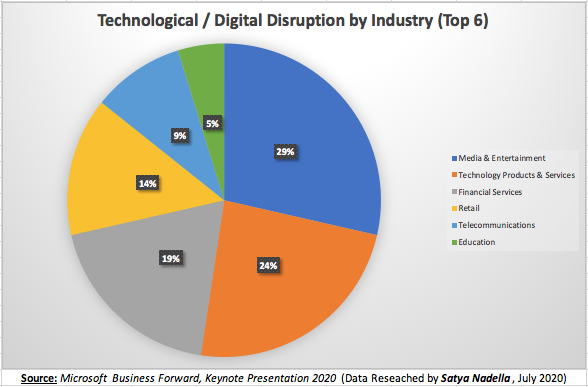
    While it’s commonly known that tech disruption is rapidly occurring, are you aware of which sectors of the US economy are being transformed the most? Initially presented in a Microsoft Business Forward forum, this research is key to assessing the sectors that need to gear up and prepare to deal with the newest technologies. The chart below substantiates just how much technological innovation and digital transformation are disrupting critical, traditional sectors within the nation’s economy.

    Top 6 Industries Impacted by Technological & Digital Disruption

    Microsoft: Top 6 Sectors Affected by Tech / Digital Disruption (Satya Nadella, 2020)

    PropTech addresses technological innovation specifically in the real estate segment. Moreover, you’ll notice that the Top 6 industries affected are most likely ones you come across in your everyday life. What does this mean for management, consumers, and the working class (specifically in these industries)? The article that complements Satya’s research shares a grim prognostication:

    “Digital disruption is well upon us. While a survey conducted by the Global Center for Digital Business Transformation for the large and mid-sized private sector companies agreed, to varying degrees, that digital disruption comes with its own set of benefits, it is also true that Digital Disruption is threatening the survival of many businesses and industries.

    Futuristic businesses and start-ups are exploring new avenues of re-inventing their business activities and industries all together to compete with and dislodge incumbents. The last decade alone has witnessed some exponential progress in technological disruption – think Airbnb, Paytm, Netflix and Uber.

    And this disruption is gradually influencing every industry, including banking, healthcare, hospitality, construction, manufacturing, packaging, logistics, and insurance amongst others (discussed in detail by Satya in Microsoft’s 2020 Keynote Forum).”

    Embee Staff

    Conclusion: What Does This Mean for Real Estate Investors?

    Succinctly, to have longevity in a given industry, the necessity for technological innovation has proven to be non-negotiable. Avoiding this reality will get you nowhere – or worse, out of business – quickly. As the abundance of digital and cloud transformation technologies are increasing, many are finding themselves playing catch-up. The information Microsoft presented suggests nearly all industries will be behind if they refuse to acknowledge technological progress. Not only acknowledge it, but make drastic changes, as necessary, to adapt alongside it.

    We’ve summarized the role technological innovation will play at length in the real estate market moving forward, specifically. Finally, ponder this. Imagine the impact to real estate markets, even globally, if critical industries and large corporations were to fall ‘behind-the-curve‘. What would this mean for CRE investors, who have continued to struggle as of late? The data study produced by Microsoft illustrates just how cataclysmic failures to adapt to new technologies – no matter the reason – can cause widespread fragility beyond the individual companies, or even those particular industry segments. It’s imperative to always look at the bigger picture. In this case, failure to adapt to new technologies will almost certainly cause broad, undesired consequences for investors.

  • Key Players in the CRE Market

    Many property types within the Commercial Real Estate (CRE) market are generally agreed to have had a poor performance the past few years, largely due to the COVID-19 pandemic restrictions. Particularly, office and retail property types. The real question investors are asking themselves is whether or not it has the potential for an emphatic return, or if a commercial real estate focus is not likely to be a great long-term investing strategy. The opportunities for successful CRE investments are still there. There are still plenty of marketplaces exclusively geared towards CRE investment, which have uniquely positioned themselves in the broader real estate investing market.

    Before committing your resources to a given investment strategy, new investors should understand who the market players are for a CRE deal. Below is a thoroughly compiled list of the key players (roles) in the commercial real estate market, which then goes onto provide an additional link to a description of each role.

    Key Players in CRE :
    • Buyer & Seller
    • Brokers: Buy-side and Sell-side
    • Legal Counsel: Buy-side, Sell-side, and Lender Counsel
    • Mortgage Broker
    • Lender/Loan Officer
    • Title Company
    • Capital Partners/Investors
    • Property Management
    • Insurance Provider
    • Appraiser & Surveyor
    • Environmental Consultant
    • Accountant: Buy-side and Sell-side

    The following article shares a useful and detailed look at the key players in CRE. Refer to the link below. It provides key details about the key players in CRE’s marketplace.

    What Are The Key Players And What Are Their Roles In A Commercial Real Estate Transaction

    As a commercial real estate investor, either as a buyer or as a seller, you work with multiple parties to move a deal from discovery through to closing. To manage a deal process efficiently, it is of utmost importance to understand all of the key players in a commercial real estate transaction.

    GerCNergy.com (Administrator)
    https://getcnergy.com/knowledge-base/key-players-in-a-commercial-real-estate-transaction/
    Summary

    The above players all comprise parts of the CRE deal. It is important for a sophisticated investor to be familiar with the various players as they can understand the dynamics of a deal and align with the sponsors who will work with most of the players mentioned.

  • Key Players in the CRE Market

    Many property types within the Commercial Real Estate (CRE) market are generally agreed to have had a poor performance the past few years, largely due to the COVID-19 pandemic restrictions. Particularly, office and retail property types. The real question investors are asking themselves is whether or not it has the potential for an emphatic return, or if a commercial real estate focus is not likely to be a great long-term investing strategy. The opportunities for successful CRE investments are still there. There are still plenty of marketplaces exclusively geared towards CRE investment, which have uniquely positioned themselves in the broader real estate investing market.

    Before committing your resources to a given investment strategy, new investors should understand who the market players are for a CRE deal. Below is a thoroughly compiled list of the key players (roles) in the commercial real estate market, which then goes onto provide an additional link to a description of each role.

    Key Players in CRE :
    • Buyer & Seller
    • Brokers: Buy-side and Sell-side
    • Legal Counsel: Buy-side, Sell-side, and Lender Counsel
    • Mortgage Broker
    • Lender/Loan Officer
    • Title Company
    • Capital Partners/Investors
    • Property Management
    • Insurance Provider
    • Appraiser & Surveyor
    • Environmental Consultant
    • Accountant: Buy-side and Sell-side

    The following article shares a useful and detailed look at the key players in CRE. Refer to the link below. It provides key details about the key players in CRE’s marketplace.

    What Are The Key Players And What Are Their Roles In A Commercial Real Estate Transaction

    As a commercial real estate investor, either as a buyer or as a seller, you work with multiple parties to move a deal from discovery through to closing. To manage a deal process efficiently, it is of utmost importance to understand all of the key players in a commercial real estate transaction.

    GerCNergy.com (Administrator)
    https://getcnergy.com/knowledge-base/key-players-in-a-commercial-real-estate-transaction/
    Summary

    The above players all comprise parts of the CRE deal. It is important for a sophisticated investor to be familiar with the various players as they can understand the dynamics of a deal and align with the sponsors who will work with most of the players mentioned.

  • How big is the real estate sector in S&P 500?

    Commercial Real Estate (CRE) Investor Question #91: How big is the real estate sector in S&P 500?

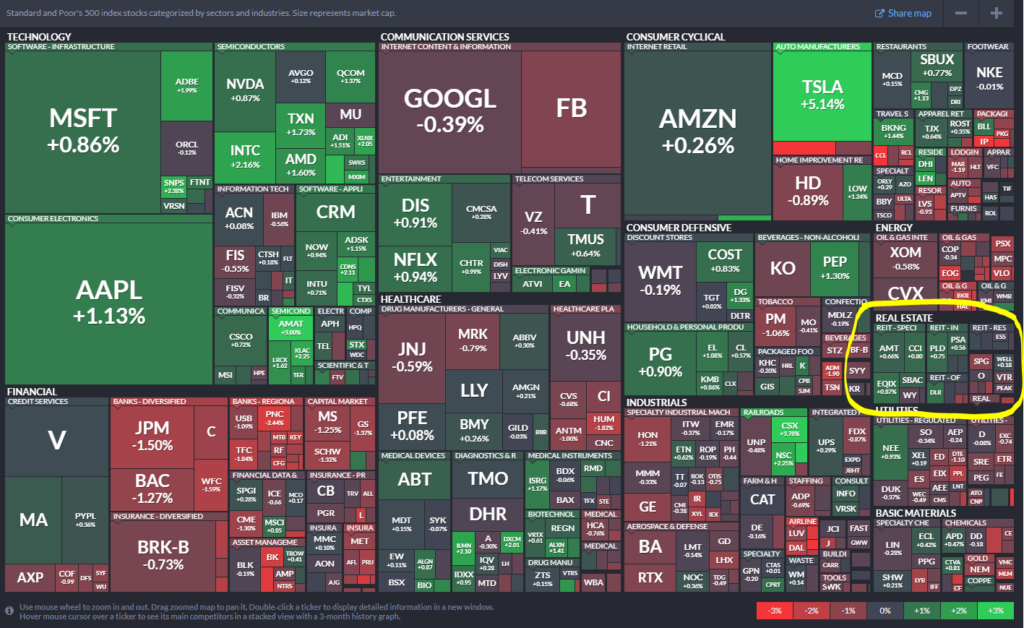
    The following illustration gives an idea of the size of the real estate sector (circled in yellow) within the S&P 500. Going by market size, it is one of the smallest sectors in S&P 500 as of March 2021. Technology is the biggest sector. The real estate sector consists of REITs across multiple property types like Industrial, Multifamily, Office, etc.

    Source: Finviz S&P 500 composition and the Real Estate sector