Tag: investing

  • Rental Yield vs. Cap Rate?

    Commercial Real Estate (CRE) Investor Question #90: What is the difference between rental yield and cap rate?

    Rental yield is the net amount of money a landlord receives in rent over one year (after deducting operating expenses), shown as a percentage of the amount of money invested in the property.

    So, Rental Yield = (Net Annual Rental Income / Cost) X 100

    Note that rental yield is calculated on Net Operating Income without considering interest payment, tax and depreciation.

    Cap rate (or capitalization rate) is the ratio between the net operating income produced by a real estate asset and its cost (or current market value).

    So, Cap Rate = Net Operating Income / Value (or cost)

    If you notice, both rental yield and cap rate appears to be same!

    Rental yield is used to calculate the yield (return) of an asset whereas the cap rate is used to find the value (capitalized value) of an income generating real estate asset.

    Source: https://www.feasibility.pro/real-estate-analyst-interview-questions-answers/
  • Rental Yield vs. Cap Rate?

    Commercial Real Estate (CRE) Investor Question #90: What is the difference between rental yield and cap rate?

    Rental yield is the net amount of money a landlord receives in rent over one year (after deducting operating expenses), shown as a percentage of the amount of money invested in the property.

    So, Rental Yield = (Net Annual Rental Income / Cost) X 100

    Note that rental yield is calculated on Net Operating Income without considering interest payment, tax and depreciation.

    Cap rate (or capitalization rate) is the ratio between the net operating income produced by a real estate asset and its cost (or current market value).

    So, Cap Rate = Net Operating Income / Value (or cost)

    If you notice, both rental yield and cap rate appears to be same!

    Rental yield is used to calculate the yield (return) of an asset whereas the cap rate is used to find the value (capitalized value) of an income generating real estate asset.

    Source: https://www.feasibility.pro/real-estate-analyst-interview-questions-answers/
  • Is real estate a good hedge against inflation?

    Commercial Real Estate (CRE) Investor Question #89: Is real estate / housing a good hedge against inflation?

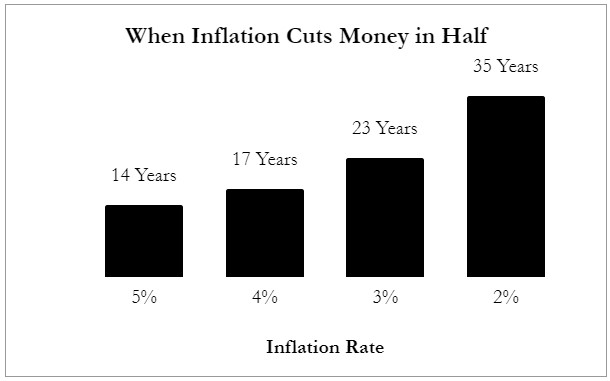
    Yes, real estate or housing is a good hedge against inflation. Ben Carlson, a popular portfolio manager has an in-depth article on this question. Here’s a picture from his book on how inflation “destroys” wealth. On the flip side, having a mortgage can help counteract those interest payments over time.

    Source: https://awealthofcommonsense.com/2021/03/why-housing-is-a-good-hedge-against-inflation/
  • Property Valuation and Methods?

    Commercial Real Estate (CRE) Investor Question #88: What are the key elements of property value? What are the top valuation methods?

    Real Estate Property Value consists of the following key elements:

    Demand: the desire or need for ownership supported by the financial means to satisfy the desire.

    Utility: the ability to satisfy future owners’ desires and needs.

    Scarcity: the finite supply of competing properties.

    Transferability: the ease with which property ownership rights are transferred.

    Source: Reonomy

    The key methods of property valuation, some of which we’ve seen earlier, are:

    • Income Approach – Based on income generated by the property
    • Sales Comparision Method – Based on comparable (comps) property sales
    • Cost Method – Based on the cost of building

    A detailed article on the above methods is available at Reonomy!

  • How to invest in REITs?

    Commercial Real Estate (CRE) Investor Question #87: I would like to get exposure to real estate asset class through REITs. Where do I start?

    We’ve seen that REITs or REIT funds are a popular way to invest in real estate as they behave like stocks and can be bought through various brokerages. Many of the brokerages (for e.g. Fidelity, Merrill, Charles Schwab et.) also provide material and research on REITs as they do for stocks of companies.

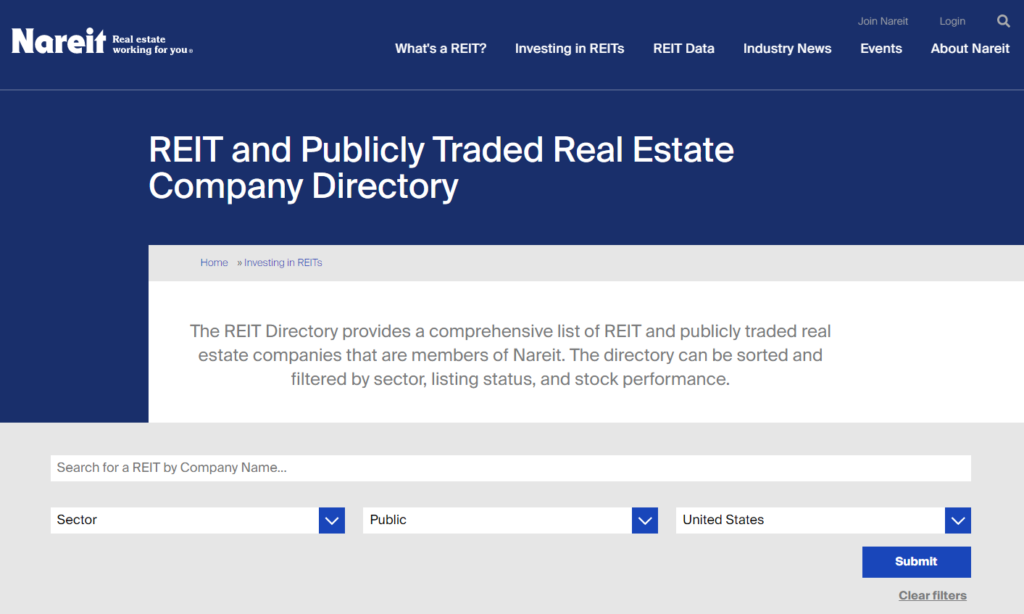
    You can research and trade with your brokerage. Another great resource to understand the world of REITs is Nareit. It provides a listing or directory of REITs and you can search and research based on various criteria as shown below.

    Source: Nareit

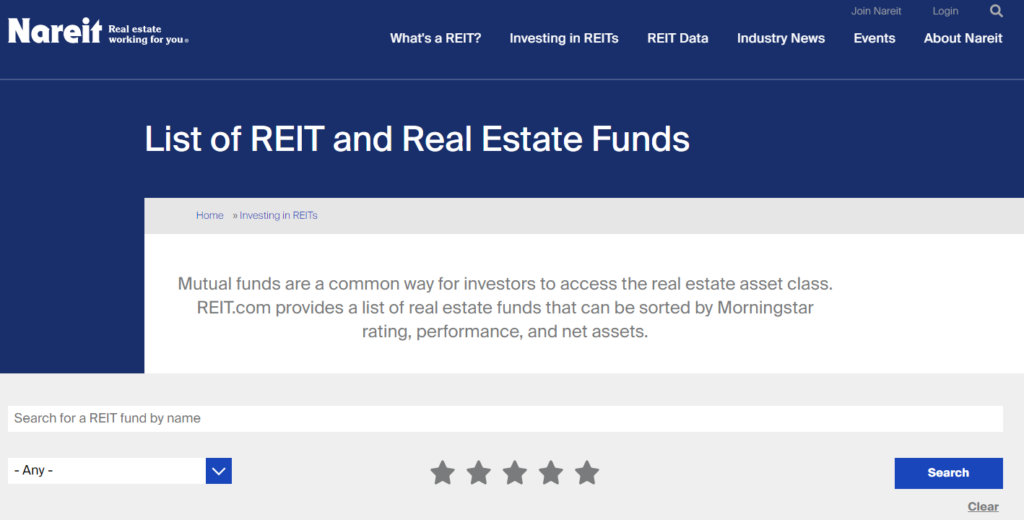
    Nareit also provides a list of REIT funds in addition to various other resources to get started with your research.

    Source: https://www.reit.com/investing/reit-funds
  • What is Preferred Equity?

    Commercial Real Estate (CRE) Investor Question #86: What is preferred equity and should I invest in preferred equity?

    We’ve seen the CRE capital stack in a previous post and how preferred equity is a part of it. We’ve seen that preferred equity is a debt/equity hybrid that resides in the third position of the capital stack.  It is more senior than common equity but less senior than all forms of debt (Senior and Mezzanine).

    It is important to understand the risk and characteristics of preferred equity compared to the rest of the stack. PropertyMetrics explains preferred equity in detail and compares it to the rest of the capital stack.

    Risk level, repayment prioritization, and return expectations:

    Risk Level:Medium – High
    Repayment Prioritization:3rd
    Return Expectations:8% – 10% + “Kicker”
    Source: https://propertymetrics.com/blog/capital-stack/

    Characteristics of Preferred Equity

    Further explanation of preferred equity can be found in the same article. We highly recommend going through the entire article and getting familiar with the capital stack and preferred equity in particular.

    Preferred equity serves a similar function to mezzanine debt in that it is meant to fill the gap between senior debt and common equity

    In return for the risk associated with making a preferred equity investment, the investor is compensated with a steady return in the form of annual payments (like debt) as well as an opportunity to participate in the upside of the project should it meet certain performance goals (like equity).  

    The performance goals are clearly outlined in the investment contract and typically establish a threshold, above which an equity “kicker” allows the preferred equity holder to participate in additional profits.

    Source: https://propertymetrics.com/blog/capital-stack/


  • What is Preferred Equity?

    Commercial Real Estate (CRE) Investor Question #86: What is preferred equity and should I invest in preferred equity?

    We’ve seen the CRE capital stack in a previous post and how preferred equity is a part of it. We’ve seen that preferred equity is a debt/equity hybrid that resides in the third position of the capital stack.  It is more senior than common equity but less senior than all forms of debt (Senior and Mezzanine).

    It is important to understand the risk and characteristics of preferred equity compared to the rest of the stack. PropertyMetrics explains preferred equity in detail and compares it to the rest of the capital stack.

    Risk level, repayment prioritization, and return expectations:

    Risk Level:Medium – High
    Repayment Prioritization:3rd
    Return Expectations:8% – 10% + “Kicker”
    Source: https://propertymetrics.com/blog/capital-stack/

    Characteristics of Preferred Equity

    Further explanation of preferred equity can be found in the same article. We highly recommend going through the entire article and getting familiar with the capital stack and preferred equity in particular.

    Preferred equity serves a similar function to mezzanine debt in that it is meant to fill the gap between senior debt and common equity

    In return for the risk associated with making a preferred equity investment, the investor is compensated with a steady return in the form of annual payments (like debt) as well as an opportunity to participate in the upside of the project should it meet certain performance goals (like equity).  

    The performance goals are clearly outlined in the investment contract and typically establish a threshold, above which an equity “kicker” allows the preferred equity holder to participate in additional profits.

    Source: https://propertymetrics.com/blog/capital-stack/


  • What exactly does an investor do?

    Whether investors like it or not, investing may be considered as a “lifestyle” job and may not get recognition for the hard work that goes into it. As an investor, don’t underestimate the investing process, the work involved, and above all your self-worth!

    If you were to go by general media, investing may come across as one of the easiest jobs on the earth. Popular culture doesn’t necessarily associate investing activities with skill or hard work. Moreover, the association with money may even lead some to think that investing is bad or greedy. Depending on personal situations, some tend not to have positive associations when it comes to investing.

    Before we look at society’s take on investing, what is your personal take on investing? Is it positive or negative? It is great if you have a favorable opinion on investing. Congrats! If you don’t have a favorable opinion of investing, there is some work to do. Because that is a big hurdle we need to overcome. Hope this article helps serves as an encouragement to many. We will address head-on the stereotypical take on investing and help wannabe investors overcome any negative thinking.

    How does the world see investors?

    For the most part, the world (i.e. primarily your family and friends) may see investing as an activity to multiply money i.e. becoming rich. The focus is on the results, becoming rich, then the process itself. The world may look up to rich people as aspirational, but still, the investors don’t get much love.

    If you’re an investor, should you worry about what the world thinks of investing? Not really. The real question is do you enjoy the investing process or work? Do you find it challenging? Like becoming a pro athlete, becoming a good investor is no small thing. Only the good ones succeed in the long run.

    If you listen to a leader in any field, one of the biggest aspects of success is working hard and long. The common lore is also that hard work and persistence lead to great success. It is tough not to agree, but what exactly is hard work in today’s age? In the decades past, a farmer who works in the field 10+ hours a day would be hard work. A factory worker working 10+ hours a day would be hard work.

    Historically, humans have been laborers or workers working in the field or factory for the entire day. Physical work was associated with hard work and is associated to this day. The physically demanding work is clearly attributed to hard work. But, what is hard work in today’s non-agricultural economy? Let us go through a few examples:

    • A Singer who creates music and works on it for 10+ hours a day in her studio. Is that hard work?
    • A Writer who writes a book working on it 10+ hours a day sitting at his computer. Is that hard work?
    • A Doctor seeing patients in his office for 10+ hours a day. Is that hard work?

    If you believe any of the above is hard work, then without doubt investing is also hard work. Investing involves a lot of learning, analysis, research, due diligence, writing and decision making. If you consider any of the above as hard work, investing also demands equal attention and work. It makes it all the more better if you actually enjoy it.

    Entrepreneurs, Workers and Investors

    We love entrepreneurial stories and successes. We love to hear success stories and everyone aspires to be rich. Let us take a tech entrepreneur. For the most part, the founder is going to develop on his own or with a team. Society traditionally attributes hard work with workers, creators, or producers. You produced grains, software, music, etc. Along those lines, investors don’t produce but invest in producers. And hence it becomes a comparison of the hard work of an entrepreneur vs. worker vs. an investor.

    For an investor, where is the hard work? The hard work is in keeping up to date on the markets, trends, finding deals, researching deals, doing due diligence, and talking to various stakeholders (legal, etc.) throughout the process. If you look at 20 real estate deals, you may be lucky if you proceed with one. Many hours need to be spent on research and following trends for one investing idea. You will have nothing to show for, say, 9 of 10 investing ideas. Even the one that you have invested in may not work out as planned.

    Even long-term investors (similar to writers etc.) sometimes may feel that they have wasted time pursuing all those opportunities. Many times our thesis may prove wrong and in those cases, it is a double whammy. You’ve lost both time and capital. That is a hard feeling.

    Investing as a habit and mindset

    Investors cannot change what others think of active or passive investors. Not everyone is going to become Warren Buffet. We don’t think anyone should care what others think of their profession or them. Be true to yourself, you know the hard work that you put in to get that one out of ten deals that returns 2x. Don’t be hard on yourself, especially during trying times.

    Here’s the habit of Warren Buffett, one of the prolific investors. Here’s his habit even after he’s worth $80B or more. Luck plays a role, but can anyone argue against his habits and investing methods that made him the investor he is today?

    Once he’s in the office, he hits the books. CNBC reported that Buffett estimates he spends 80 percent of his day reading. He recommends that people try to read at least 500 pages a day.

    Source: https://www.afr.com/work-and-careers/management/inside-warren-buffetts-daily-work-routine-from-645am-to-1045pm-20170906-gybn7t

    In addition to forming an investing habit, our mindset plays a critical role. If our mind is not into the job at hand, then it is hard for us to become an expert. We may have some doubts initially, but even after some time if we don’t get over our negative associations with investing, it is hard to excel in that field. It is hard to reach the destination when we are swimming against the tide (our mind).

    Talking about mindset, it is important to talk about an investor’s emotions and how an investor needs to be objective. An investor is simply put, a capital allocator i.e. you put money behind businesses or activities that give the most return on the capital. But, investing is also behavioral i.e. you’ve to fight your own emotions when investing. Emotions make you thrive in a sport or art. It is actually the opposite in investing. Don’t get attached to your investments. You can be passionate about investing, but you cannot be passionate about your investments.

    Takeaways

    Hope this article provides encouragement to many on the journey as investors. It is a journey, it is not “easy” work and people have to develop good investing habits. In addition to developing good investing habits, investors also need to check in their emotions and make behavioral changes. As investors face the quandary of not becoming attached to their investments. If it doesn’t make business sense, be ready to part with an investment at a loss or sell when the entire market is extremely bullish. If you’ve aspirations to become a good investor, start immediately and spend some time every day learning, investing, and building good habits!