Category: Ideas

Round up of investing ideas and insights that we can actually put to use to invest.

  • What is a Tri-Party Repo (TREPS)and How Did the Market Operate?

    What is a Tri-Party Repo (TREPS)and How Did the Market Operate?

    The simplest way to understand a tri-party repo (TREPS) is to think of it as a simple repurchase agreement between two parties, where a third-party – historically a very large and reputable bank (only JPM Chase or BNY Mellon, during the time these transactions were widely common) – processes administrative work and even guarantees the cash provided by Company A to Company B and the collateral Company B secures the cash from Company A with. These third parties, commonly referred to as clearing banks, also performed valuation services to ensure the collateral put up by Company B was within the approximate fair market value of the cash lent by Company A.

    Tri-Party Repos in the Derivative Era

    These transactions actually became popular at the “boom” of the derivative trading era – even though they had a comparatively low-yield percentage for both companies – mainly because of mechanics of how these transactions occurred. They were typically cleared and settled overnight, so the investment banker would have the cash available in the morning when the trading day began. The “unwinding” process of this repo would also happen after the trading day was complete; the dealer (Company B) would finance the broker (Company A) with cash and the third-party clearing bank would take care of the rest for a small fee.

    To be clear, the responsibilities of the clearing banks weren’t minuscule, they were tasked with: taking custody of the securities involved in the repo, valuing the securities and making sure that the specified margin is applied, settling the transaction on their books, and offer services to help dealers optimize the use of their collateral. However as mentioned, to give dealers access to their securities during the day, the clearing banks settle all repos very early each day, returning cash to cash investors and collateral to dealers. This would lead to a delay in real-time settlement, therefore in reality the clearing banks wind up extending hundreds of billions of intraday credit to the dealers until new repos are settled in the evening.

    Role in 2008 Financial Crisis

    It’s argued by many to have played an underscored role in the 2008 US Financial Crisis, primarily because between 2007-2009 these repurchase agreements became a common daily routine for almost all of the largest brokers and dealers in the world. This was for several logical reasons. Firstly, it made sense for securities brokers to engage in because they have access to cash immediately, the second the daily trading day begins.

    It equally makes sense for dealers. They are receiving a profit from lending cash and they have the comfort of knowing their cash is backed by collateral that was signed off on by either JPMC or BNYM. Finally, it makes sense for the clearing bank to use their economies of scale and human resources to make a couple percentage points. At the time this was thought to be routine administrative clearing bank procedure. However, it turned out to be a much bigger nightmare than ever imagined.

    The nightmare catch is best described by the following scenario. Contemplate what happens if you have a very large and highly levered broker, like Bear Sterns as the famous example. You then encounter a situation where financial markets they have heavy exposure in drop sharply. The collateral a broker like Bear Sterns would put up would be in the form of a portfolio of securities. They wouldn’t contribute any physical assets, or guaranteed/risk-less investments (like T-Notes).

    Where Systemic Financial Fragility and Potential Crisis Begins

    Now you have a situation where the dealer (Company B) may not feel as comfortable providing liquid cash financing to Bear Sterns anymore. Then you essentially have the clearing bank – JPM Chase or BNY Mellon – incurring the loss because the process was done so hastily. They almost certainly never took the time to deeply look into whether the collateral put up by Bear Sterns was equal in liquid valuation to the cash provided by their various dealers (who by the way would usually be institutions like secondary education private schools, or institutions in a medical (or other) field with a surplus of cash), so the settlement process only occurred on paper for them.

    When things went south, even though the clearing banks do not match dealers with cash investors. Nor do they play the role of broker in that market. They had to settle disproportionately valued securities with the most liquid form of financial currency: cash. Looking at Bear Sterns, they would’ve used dozens of cash lenders to diversify. Even more so the clearing banks would be incentivized to not look too closely at their spotted collateral. Picture what happens if you have Lehman Brothers, Goldman Sachs, and Morgan Stanley incurring the same scenarios. The same day, as well. Of course Goldman Sachs and Morgan Stanley are two of the most prestigious investment banks in the world. Likely not enough of their total portfolio was invested in the tri-party repo market to cause them to fail.

    Conclusion

    However when that market did ultimately fail, things went that route for Lehman and Bear Sterns. Concisely, while on the surface a tri-party repo is a simple repurchase agreement where a third party provides administrative surfaces at a small fee for the two companies engaged in the repo, understanding the mechanics of it are invaluable to appreciating how some financial markets collapsed so rapidly in late 2008.

  • Five Key Tips to Investing in Rental Properties

    Five Key Tips to Investing in Rental Properties

    1. Stay on Top of Your Personal Debt

    Savvy investors tend to make sure they are not highly levered, especially prior to investing in any real estate property they intend to rent out. While all would agree that it’s not necessary to have 100% cash up front in many situations to make the property a great investment, it’s wise to try to pay down any personal debt you may have prior to, or after acquiring a rental property. Otherwise you may find that your expenses – especially something like a huge, unexpected medical bill – could cause you to pay a lot more in interest, thus losing profit, than you were originally seeking to.

    2. Make Sure You Can Really Afford Your Downpayment

    Whether you want to purchase a rental property for supplemental income, to diversify your investment portfolio, or as part of a longer-term investing strategy, it’s essential that when you decide to pull the trigger, you’re confident your budget can sustain the downpayment. This ties back to staying on top of your personal debt and other investments in your portfolio, but at the same time it’s a common mistake. You won’t be putting down 3-10% like you may on your personal home. With the minimum being 20% and if financing, you generally see it coming in the form of a personal loan, you can once again get into a rut with interest and possible refinancing if you can’t really afford the initial downpayment.

    3. Stay Away from Financing with High Interest Rates

    Comparatively in 2020, the cost of borrowing money has been very cheap due to economic factors from the COVID-19 pandemic, however in general loans with higher interest rates are best to avoid when looking to buy a rental property. Remember, you’re not going to get the benefit of a traditional mortgage interest rate, so be sure to stay away from personal loans (or other means of obtaining financing) that carry high interest rates.

    4. Location, Location, Location

    Investors already in the rental market are just starting to see prices stabilize, but only in certain “prime” locations. For example, if you look at various subdivisions of geographic areas within the Manhattan real estate market, you’ll find studios in the Upper East Side (for example) are now all above a ‘floor price’. However, if you look at similar studios in East Harlem, you won’t see the same uniformity. In fact, it’s very much to the contrary; there’s still high volatility in rental prices in ‘non-prime’ locations. To ensure your investment property is as immune as possible to market fluctuations resulting from uncertainty, the location of your rental property is essential to a successful return on investment.

    5. Invest in Landlord Insurance; Assume Unexpected Costs

    The two don’t necessarily go hand-in-hand (you should always assume unexpected costs), we wanted to recommend landlord insurance specifically on top of homeowners insurance. Landlord insurance generally covers property damage, lost rental income, and liability protection, in case a tenant or a visitor suffers injury as a result of property maintenance issues (for example). Depending on various factors of your rental property, the cost may be higher than you anticipate and you may be one of the people who thinks “this will never happen to me, so I don’t need it”, but in these cases it’s definitely better to be safe than sorry. Investing in a rental property is a big commitment and the landlord insurance certainly isn’t somewhere it’ll be worth it to cut costs in the long-term.

  • Did the Economic Slowdown (as a Result of COVID-19) Actually Impact CRE Positively?

    Did the Economic Slowdown (as a Result of COVID-19) Actually Impact CRE Positively?

    Succinctly, of course not. However, one may argue that the COVID-19 pandemic did create an opportunity for the CRE (Commercial Real Estate) market to generate innovative opportunities for at least this coming year. Some of the opportunities are lessons carried from 2020, when we saw CRE begin to show signs of gradual recovery before returning [Forbes Real Estate Council]. John D’Angelo, Deloitte Consulting’s U.S. Real Estate Leader agreed that at least a few emerging CRE trends will contribute to a recovery in 2021.

    Firstly, global CRE Corporations are researching how to attack the following:

    • Continuously evolving behavioral trends post COVID-19
    • Establishing more secure building spaces
    • Optimal efficiency
    • Improving in recognizing challenges, vulnerabilities, and risks at the early portfolio level

    CRE Corporations especially should be working extra hard to familiarize themselves with the results of this research as these are important trends that will likely impact the CRE market as a whole. Those who understand these trends will be able to provide their clients a better experience with access to this knowledge and, therefore, result in steady sales.

    Secondly (and in fact surprisingly), due to the pandemic, lockdowns have led more companies to have their employees working from home. While it may seem like there would be no use for office space in 2021, there are actually several opportunities in the CRE market for commercial offices that were not there before. Vacancies in high-traffic areas make this the perfect time for commercial owners who are looking to expand.

    While many businesses are still waiting to bring their employees back to the office, there are undoubtedly several good reasons for having an office in a post-COVID environment. In an office, employees have more space to work collaboratively, increasing cooperation and efficiency. CRE owners and investors would be wise to acknowledge the fact that even during the pandemic, there are still business owners out there looking for affordable office space and certainly have this in mind as they make their investment decisions this year.

    Finally, when it comes to e-commerce, an already growing sector prior to 2020, boomed during the pandemic [Forbes Real Estate Council]. In response, retail stores and third-party logistics businesses are not only growing or optimizing their fulfillment center footprints, but many of them are also switching from a “just-in-time” inventory model, to a “just-in-case” approach as they aim to prevent the shortages of goods encountered throughout 2020. As this trend continues, many online shops nationwide will need to lease a warehouse for their growing businesses. This will certainly lead to a steady increase in leasing opportunities in the CRE market that both owners and investors should take advantage of.

  • Did the Economic Slowdown (as a Result of COVID-19) Actually Impact CRE Positively?

    Did the Economic Slowdown (as a Result of COVID-19) Actually Impact CRE Positively?

    Succinctly, of course not. However, one may argue that the COVID-19 pandemic did create an opportunity for the CRE (Commercial Real Estate) market to generate innovative opportunities for at least this coming year. Some of the opportunities are lessons carried from 2020, when we saw CRE begin to show signs of gradual recovery before returning [Forbes Real Estate Council]. John D’Angelo, Deloitte Consulting’s U.S. Real Estate Leader agreed that at least a few emerging CRE trends will contribute to a recovery in 2021.

    Firstly, global CRE Corporations are researching how to attack the following:

    • Continuously evolving behavioral trends post COVID-19
    • Establishing more secure building spaces
    • Optimal efficiency
    • Improving in recognizing challenges, vulnerabilities, and risks at the early portfolio level

    CRE Corporations especially should be working extra hard to familiarize themselves with the results of this research as these are important trends that will likely impact the CRE market as a whole. Those who understand these trends will be able to provide their clients a better experience with access to this knowledge and, therefore, result in steady sales.

    Secondly (and in fact surprisingly), due to the pandemic, lockdowns have led more companies to have their employees working from home. While it may seem like there would be no use for office space in 2021, there are actually several opportunities in the CRE market for commercial offices that were not there before. Vacancies in high-traffic areas make this the perfect time for commercial owners who are looking to expand.

    While many businesses are still waiting to bring their employees back to the office, there are undoubtedly several good reasons for having an office in a post-COVID environment. In an office, employees have more space to work collaboratively, increasing cooperation and efficiency. CRE owners and investors would be wise to acknowledge the fact that even during the pandemic, there are still business owners out there looking for affordable office space and certainly have this in mind as they make their investment decisions this year.

    Finally, when it comes to e-commerce, an already growing sector prior to 2020, boomed during the pandemic [Forbes Real Estate Council]. In response, retail stores and third-party logistics businesses are not only growing or optimizing their fulfillment center footprints, but many of them are also switching from a “just-in-time” inventory model, to a “just-in-case” approach as they aim to prevent the shortages of goods encountered throughout 2020. As this trend continues, many online shops nationwide will need to lease a warehouse for their growing businesses. This will certainly lead to a steady increase in leasing opportunities in the CRE market that both owners and investors should take advantage of.

  • Can you leverage migration patterns for investing?

    Demographics and in particular net migration plays an outsized role in Real Estate. In this article, we’ll look at the key factors affecting real estate and why net migration is a good indicator to follow for real estate investors.

    We’ll delve into why net migration is actually a great indicator for the top states, counties, and towns to invest in. We’ll look at some migration reports from 2020 and see if they can form the basis of some investment ideas in 2021 and beyond.

    Key Pillars of Real Estate Investing

    Real Estate business and investing is impacted by multiple factors, but we can group them into three major categories:

    • Demographics
      • Population Growth, Urbanization/Sub-urbanization, and Migration
      • Employment Growth
      • Income/Cost of living
    • Economic
      • Supply & Demand
      • Infrastructure – Technology / Transportation
      • Fiscal and monetary policies (for e.g. interest rates)
    • Incentives
      • Affordable housing policies
      • Tax and Federal housing incentives
      • State and local incentives and policies

    For an individual investor, keeping track of the above can be overwhelming though some of the policies and economics may remain the same over years or even decades. Still, it is a stretch for individual investors. In this article, we’ll focus on demographics and see if net migration can be a proxy (or close to a proxy) to find states or cities to invest in.

    Demographics and demographic trends

    Our focus will be on demographics and in particular net migration in this article. Why is demographics a key pillar and why should we focus on that? Because demographics is all about the consumers i.e. tenants. One can have the best economic climate and the greatest policies, but at the end of the day a customer has to rent real estate and that is driven by demographics makeup. First, let us see the definition of demographics.

    Demographics are the data that describes the composition of a population, such as age, race, gender, income, migration patterns, and population growth. These statistics are an often overlooked but significant factor that affects how real estate is priced and what types of properties are in demand

    Source: https://www.investopedia.com/articles/mortages-real-estate/11/factors-affecting-real-estate-market.asp

    A customer (i.e. tenant) has to rent real estate in a given location and demographics is all about the customers. Investors should look at demographics at a given point of time as well as over a period of time (i.e. trends). It is also good to remember that many demographical trends were already underway and they only got accelerated due to the global pandemic in 2020.

    Net Migration and Migration Trends

    Investors realize that certain states or cities are growing because they see or hear about many moving to those places. For e.g. many people in New York realize that a lot of jobs are moving to the south, particularly Florida, and people follow those jobs. Net migration in certain regions, states, and cities surpass those of poorly faring places.

    Savills, the International real estate firm has done studies on the reasons for migration throughout the world. Here is the summary of the impact of migration on real estate.

    In-migration has a major impact on real estate as demand for both residential and commercial space increases. If supply is unable to match the demand, this often results in pressure on prices. We have analyzed data from Oxford Economics to understand which cities are expected to attract the largest net migration over the next five years as a percentage of their population.

    Source: https://www.savills.com/impacts/social-change/the-impact-of-migration-on-real-estate.html

    Savills has the following take on the reasons major cities are seeing a lot of net migration:

    • Europe: Swiss Cities in demand
    • Asia: Attracting talent
    • North America: Quality of life

    We’ll look at net migration data and statistics on the following factors in US and see if we see some patterns that will give some ideas on locations to invest.

    • Flight to suburbs and smaller cities
    • Flight to quality of life
    • Flight to “business” friendly and no-tax states

    Net migration to secondary cities and suburbs

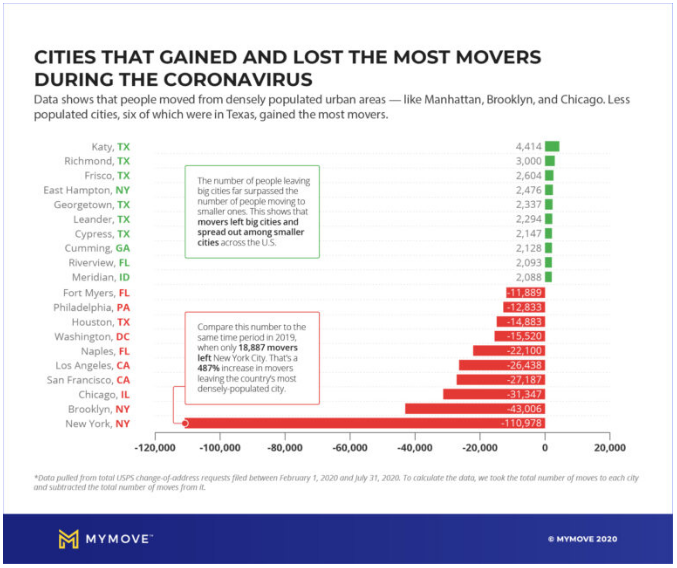
    Mymove has studied migration patterns in 2020 with the COVID pandemic and over 15.9 million have moved during the pandemic based on USPS data. Urban density has been a big reason for people to move to smaller cities and suburbs. As you can see from the chart below, big cities have had a large outflow in the first half of 2020. This has resulted in rent reduction in dense and pricey cities, but the opposite in smaller cities and suburban places.

    CITIES THAT GAINED AND LOST THE MOST MOVERS 
DURING THE CORONAVIRUS 
Data shows that people moved from sely populated urban areas — like Manhattan, Brooklyn. and Chicago. Less 
cities, six of which were in Texas, gained the most movers. 
Katy, TX 
Richmond, TX 
East Hampton. NY 
Leander, TX 
cypress. TX 
Cumming, GA 
Meridian. ID 
Myers. 
Philadelphia. PA 
Houston. 
TX 
Washington, DC 
Naples, 
FL 
LOS CA 
San Vrancisco. 
CA 
NY 
New York. 
-120n 
lett big cit•s 
cit*sacrcssmeUS 
20'9. 
18.887 —S 
lett ( 
2,476 
2,29a 
2,093 • 
20s* • 
20.000 
7070 
M MYMOVE-

    Net migration to “business” friendly or no-tax states

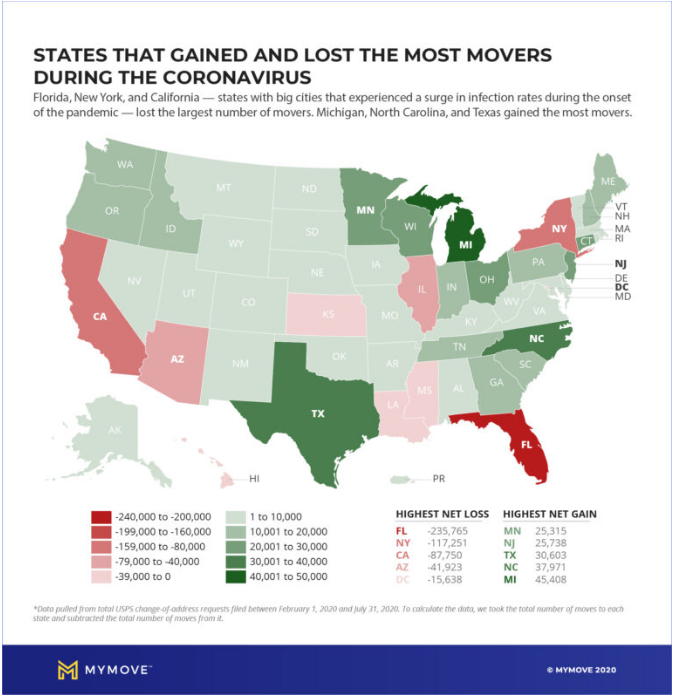
    In the 20th century, people migrated to cities like New York or Los Angeles for better opporunities, but in the past couple of decades states like Texas have been able to lure many people with their “business” friendly or no-tax policies. Florida and Arizona are also considered “business” and tax friendly states and hence the net migration needs to be reviewed further.

    STATES THAT GAINED AND LOST THE MOST MOVERS 
DURING THE CORONAVIRUS 
Florida , New York, and California — states with big cities that experienced a surge in infection rates during the onset 
of the pandemic — lost the largest number of movers. Michigan, North Carolina, and Texas the most movers. 
NJ 
HIGHEST NET GAIN 
-199,000 to 
S9,ocoto -go,ooo 
-79,000 to 40,000 
-39.000 to O 
M MYMOVE• 
to 10,ooo 
10,001 to 
20,001 to 30,000 
30,001 to 40,000 
40,001 to 50,000 
PR 
HIGHEST NET Loss 
-235.765 
-15.638 
MN 
TX 
NC 
30.603

    Net Migration for quality of life

    Quality of life is primarily defined by cost of living and access to amenities that people are looking for. Savills Research shows the top 10 cities for net migration in the US. The results should not be surprising for many. We see cities in Texas, Flordia and Georgia that have attracted sizable new population. This should give investors some ideas about places to invest.

    Source: Savills Research using Oxford Economics  Note: Only cities with GDP greater than $50bn considered

    Investor Takeaways

    In summary, we’ve seen how demographics is a key pillar of real estate investing. We’ve seen how net migration is a great indicator or proxy of demographics and even attractiveness of investment locations. We’ve also looked at migration patterns in US to help investors find states and cities that may be attractive investing targets.

    Though net migration data should not be looked at on its own, looking at migration along with other key data will net investors some good investment locations and ideas. The action items for investors are to answer the questions: Do the locations you want to invest in have these positive migration characteristics? Can you update your investment thesis based on these locations?

  • Can you leverage migration patterns for investing?

    Demographics and in particular net migration plays an outsized role in Real Estate. In this article, we’ll look at the key factors affecting real estate and why net migration is a good indicator to follow for real estate investors.

    We’ll delve into why net migration is actually a great indicator for the top states, counties, and towns to invest in. We’ll look at some migration reports from 2020 and see if they can form the basis of some investment ideas in 2021 and beyond.

    Key Pillars of Real Estate Investing

    Real Estate business and investing is impacted by multiple factors, but we can group them into three major categories:

    • Demographics
      • Population Growth, Urbanization/Sub-urbanization, and Migration
      • Employment Growth
      • Income/Cost of living
    • Economic
      • Supply & Demand
      • Infrastructure – Technology / Transportation
      • Fiscal and monetary policies (for e.g. interest rates)
    • Incentives
      • Affordable housing policies
      • Tax and Federal housing incentives
      • State and local incentives and policies

    For an individual investor, keeping track of the above can be overwhelming though some of the policies and economics may remain the same over years or even decades. Still, it is a stretch for individual investors. In this article, we’ll focus on demographics and see if net migration can be a proxy (or close to a proxy) to find states or cities to invest in.

    Demographics and demographic trends

    Our focus will be on demographics and in particular net migration in this article. Why is demographics a key pillar and why should we focus on that? Because demographics is all about the consumers i.e. tenants. One can have the best economic climate and the greatest policies, but at the end of the day a customer has to rent real estate and that is driven by demographics makeup. First, let us see the definition of demographics.

    Demographics are the data that describes the composition of a population, such as age, race, gender, income, migration patterns, and population growth. These statistics are an often overlooked but significant factor that affects how real estate is priced and what types of properties are in demand

    Source: https://www.investopedia.com/articles/mortages-real-estate/11/factors-affecting-real-estate-market.asp

    A customer (i.e. tenant) has to rent real estate in a given location and demographics is all about the customers. Investors should look at demographics at a given point of time as well as over a period of time (i.e. trends). It is also good to remember that many demographical trends were already underway and they only got accelerated due to the global pandemic in 2020.

    Net Migration and Migration Trends

    Investors realize that certain states or cities are growing because they see or hear about many moving to those places. For e.g. many people in New York realize that a lot of jobs are moving to the south, particularly Florida, and people follow those jobs. Net migration in certain regions, states, and cities surpass those of poorly faring places.

    Savills, the International real estate firm has done studies on the reasons for migration throughout the world. Here is the summary of the impact of migration on real estate.

    In-migration has a major impact on real estate as demand for both residential and commercial space increases. If supply is unable to match the demand, this often results in pressure on prices. We have analyzed data from Oxford Economics to understand which cities are expected to attract the largest net migration over the next five years as a percentage of their population.

    Source: https://www.savills.com/impacts/social-change/the-impact-of-migration-on-real-estate.html

    Savills has the following take on the reasons major cities are seeing a lot of net migration:

    • Europe: Swiss Cities in demand
    • Asia: Attracting talent
    • North America: Quality of life

    We’ll look at net migration data and statistics on the following factors in US and see if we see some patterns that will give some ideas on locations to invest.

    • Flight to suburbs and smaller cities
    • Flight to quality of life
    • Flight to “business” friendly and no-tax states

    Net migration to secondary cities and suburbs

    Mymove has studied migration patterns in 2020 with the COVID pandemic and over 15.9 million have moved during the pandemic based on USPS data. Urban density has been a big reason for people to move to smaller cities and suburbs. As you can see from the chart below, big cities have had a large outflow in the first half of 2020. This has resulted in rent reduction in dense and pricey cities, but the opposite in smaller cities and suburban places.

    CITIES THAT GAINED AND LOST THE MOST MOVERS 
DURING THE CORONAVIRUS 
Data shows that people moved from sely populated urban areas — like Manhattan, Brooklyn. and Chicago. Less 
cities, six of which were in Texas, gained the most movers. 
Katy, TX 
Richmond, TX 
East Hampton. NY 
Leander, TX 
cypress. TX 
Cumming, GA 
Meridian. ID 
Myers. 
Philadelphia. PA 
Houston. 
TX 
Washington, DC 
Naples, 
FL 
LOS CA 
San Vrancisco. 
CA 
NY 
New York. 
-120n 
lett big cit•s 
cit*sacrcssmeUS 
20'9. 
18.887 —S 
lett ( 
2,476 
2,29a 
2,093 • 
20s* • 
20.000 
7070 
M MYMOVE-

    Net migration to “business” friendly or no-tax states

    In the 20th century, people migrated to cities like New York or Los Angeles for better opporunities, but in the past couple of decades states like Texas have been able to lure many people with their “business” friendly or no-tax policies. Florida and Arizona are also considered “business” and tax friendly states and hence the net migration needs to be reviewed further.

    STATES THAT GAINED AND LOST THE MOST MOVERS 
DURING THE CORONAVIRUS 
Florida , New York, and California — states with big cities that experienced a surge in infection rates during the onset 
of the pandemic — lost the largest number of movers. Michigan, North Carolina, and Texas the most movers. 
NJ 
HIGHEST NET GAIN 
-199,000 to 
S9,ocoto -go,ooo 
-79,000 to 40,000 
-39.000 to O 
M MYMOVE• 
to 10,ooo 
10,001 to 
20,001 to 30,000 
30,001 to 40,000 
40,001 to 50,000 
PR 
HIGHEST NET Loss 
-235.765 
-15.638 
MN 
TX 
NC 
30.603

    Net Migration for quality of life

    Quality of life is primarily defined by cost of living and access to amenities that people are looking for. Savills Research shows the top 10 cities for net migration in the US. The results should not be surprising for many. We see cities in Texas, Flordia and Georgia that have attracted sizable new population. This should give investors some ideas about places to invest.

    Source: Savills Research using Oxford Economics  Note: Only cities with GDP greater than $50bn considered

    Investor Takeaways

    In summary, we’ve seen how demographics is a key pillar of real estate investing. We’ve seen how net migration is a great indicator or proxy of demographics and even attractiveness of investment locations. We’ve also looked at migration patterns in US to help investors find states and cities that may be attractive investing targets.

    Though net migration data should not be looked at on its own, looking at migration along with other key data will net investors some good investment locations and ideas. The action items for investors are to answer the questions: Do the locations you want to invest in have these positive migration characteristics? Can you update your investment thesis based on these locations?

  • What exactly does an investor do?

    Whether investors like it or not, investing may be considered as a “lifestyle” job and may not get recognition for the hard work that goes into it. As an investor, don’t underestimate the investing process, the work involved, and above all your self-worth!

    If you were to go by general media, investing may come across as one of the easiest jobs on the earth. Popular culture doesn’t necessarily associate investing activities with skill or hard work. Moreover, the association with money may even lead some to think that investing is bad or greedy. Depending on personal situations, some tend not to have positive associations when it comes to investing.

    Before we look at society’s take on investing, what is your personal take on investing? Is it positive or negative? It is great if you have a favorable opinion on investing. Congrats! If you don’t have a favorable opinion of investing, there is some work to do. Because that is a big hurdle we need to overcome. Hope this article helps serves as an encouragement to many. We will address head-on the stereotypical take on investing and help wannabe investors overcome any negative thinking.

    How does the world see investors?

    For the most part, the world (i.e. primarily your family and friends) may see investing as an activity to multiply money i.e. becoming rich. The focus is on the results, becoming rich, then the process itself. The world may look up to rich people as aspirational, but still, the investors don’t get much love.

    If you’re an investor, should you worry about what the world thinks of investing? Not really. The real question is do you enjoy the investing process or work? Do you find it challenging? Like becoming a pro athlete, becoming a good investor is no small thing. Only the good ones succeed in the long run.

    If you listen to a leader in any field, one of the biggest aspects of success is working hard and long. The common lore is also that hard work and persistence lead to great success. It is tough not to agree, but what exactly is hard work in today’s age? In the decades past, a farmer who works in the field 10+ hours a day would be hard work. A factory worker working 10+ hours a day would be hard work.

    Historically, humans have been laborers or workers working in the field or factory for the entire day. Physical work was associated with hard work and is associated to this day. The physically demanding work is clearly attributed to hard work. But, what is hard work in today’s non-agricultural economy? Let us go through a few examples:

    • A Singer who creates music and works on it for 10+ hours a day in her studio. Is that hard work?
    • A Writer who writes a book working on it 10+ hours a day sitting at his computer. Is that hard work?
    • A Doctor seeing patients in his office for 10+ hours a day. Is that hard work?

    If you believe any of the above is hard work, then without doubt investing is also hard work. Investing involves a lot of learning, analysis, research, due diligence, writing and decision making. If you consider any of the above as hard work, investing also demands equal attention and work. It makes it all the more better if you actually enjoy it.

    Entrepreneurs, Workers and Investors

    We love entrepreneurial stories and successes. We love to hear success stories and everyone aspires to be rich. Let us take a tech entrepreneur. For the most part, the founder is going to develop on his own or with a team. Society traditionally attributes hard work with workers, creators, or producers. You produced grains, software, music, etc. Along those lines, investors don’t produce but invest in producers. And hence it becomes a comparison of the hard work of an entrepreneur vs. worker vs. an investor.

    For an investor, where is the hard work? The hard work is in keeping up to date on the markets, trends, finding deals, researching deals, doing due diligence, and talking to various stakeholders (legal, etc.) throughout the process. If you look at 20 real estate deals, you may be lucky if you proceed with one. Many hours need to be spent on research and following trends for one investing idea. You will have nothing to show for, say, 9 of 10 investing ideas. Even the one that you have invested in may not work out as planned.

    Even long-term investors (similar to writers etc.) sometimes may feel that they have wasted time pursuing all those opportunities. Many times our thesis may prove wrong and in those cases, it is a double whammy. You’ve lost both time and capital. That is a hard feeling.

    Investing as a habit and mindset

    Investors cannot change what others think of active or passive investors. Not everyone is going to become Warren Buffet. We don’t think anyone should care what others think of their profession or them. Be true to yourself, you know the hard work that you put in to get that one out of ten deals that returns 2x. Don’t be hard on yourself, especially during trying times.

    Here’s the habit of Warren Buffett, one of the prolific investors. Here’s his habit even after he’s worth $80B or more. Luck plays a role, but can anyone argue against his habits and investing methods that made him the investor he is today?

    Once he’s in the office, he hits the books. CNBC reported that Buffett estimates he spends 80 percent of his day reading. He recommends that people try to read at least 500 pages a day.

    Source: https://www.afr.com/work-and-careers/management/inside-warren-buffetts-daily-work-routine-from-645am-to-1045pm-20170906-gybn7t

    In addition to forming an investing habit, our mindset plays a critical role. If our mind is not into the job at hand, then it is hard for us to become an expert. We may have some doubts initially, but even after some time if we don’t get over our negative associations with investing, it is hard to excel in that field. It is hard to reach the destination when we are swimming against the tide (our mind).

    Talking about mindset, it is important to talk about an investor’s emotions and how an investor needs to be objective. An investor is simply put, a capital allocator i.e. you put money behind businesses or activities that give the most return on the capital. But, investing is also behavioral i.e. you’ve to fight your own emotions when investing. Emotions make you thrive in a sport or art. It is actually the opposite in investing. Don’t get attached to your investments. You can be passionate about investing, but you cannot be passionate about your investments.

    Takeaways

    Hope this article provides encouragement to many on the journey as investors. It is a journey, it is not “easy” work and people have to develop good investing habits. In addition to developing good investing habits, investors also need to check in their emotions and make behavioral changes. As investors face the quandary of not becoming attached to their investments. If it doesn’t make business sense, be ready to part with an investment at a loss or sell when the entire market is extremely bullish. If you’ve aspirations to become a good investor, start immediately and spend some time every day learning, investing, and building good habits!

  • Considerations for CRE Investing

    Have you thought about the first thing you notice when you shop for an item? It is very likely that you look for the price tag. We look for the price tag even if money is not a concern. Let us suggest a mental exercise. Please think about an investment (any) and take note of the first few things that come to your mind.

    Many of us will think of profit first i.e. how much money will we make off the investment? After all, isn’t that the purpose of investing? Here’s where investors differ in their sophistication. When it comes to real estate investing, price or valuation is an important factor, but not the only factor. Outside of valuation, there are four key factors that are key to real estate investing: Time horizon, Liquidity, Risk Tolerance, and Property Type. We’ll get into each one of these in detail.

    Time Horizon and Liquidity

    What is your time horizon to invest? Are you looking for monthly returns or can you wait for years or decades as you build your retirement money? If you’re looking for monthly or quarterly returns you can get it from dividend yielding REITs or stabilized assets that provide monthly cash flow from operations that can be distributed to investors.

    Would you be dipping into the investments for emergencies? Many real estate investments are illiquid in that it may take months or years to get out of the investment. For e.g. if you’re investing in a private real estate fund or syndication it is likely that you’d have to hold the investment for 3-7 years. You do have some options, limited though, if you’d like the RE investments to be liquid. For e.g.  Publicly traded REIT securities.

    Location, Location, Location

    Your are sure to have this common refrain in residential real estate that it is all about the location. This is true across the entire asset class and the location will determine the risk, price and quality of assets. The key differentiator for an investor is to identify the next hot location rather than the ones already popular. That is how an investor will make money by betting on new up and coming locations.

    Property Types

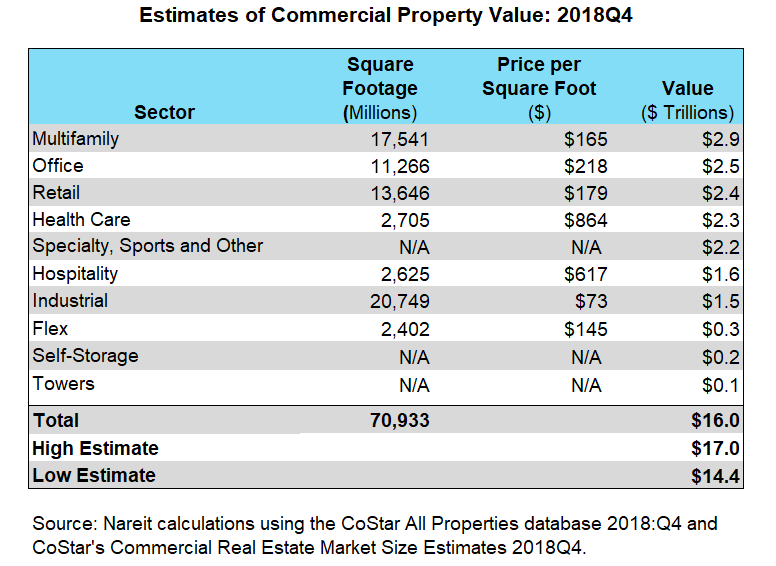
    Property types have different risk/reward profiles and hence it is important to understand and appreciate the property type in question. It is key to understand the different types of property types, not to just understand the lay of the land, but also to form your investing approach and nail down the basics. The following chart from NAREIT captures the different property types. The major property types are Multi-family, Office, Retail, Health Care, Specialty, Hospitality, and Industrial.

    It is common to start with one property type, learn the basics, and then add other property types to diversify. Many of the CRE concepts are applicable to all property types and each property type will have its specialization, differentiators or nuances. We will start seeing that there are many similarities, but there are also differences across property types. The key investment criteria is that they will have different risk profiles that the investor needs to understand. Multifamily has a different risk profile than Office, with different factors affecting the rent and prices. Commensurate with the risk, the investment rewards will also be different across property types.

    Risk tolerance

    We have discussed risk tolerance in prior posts as risk/reward is the bedrock of investing. Your tolerance of risk is going to make or break many investment decisions to see if you get to enjoy it or regret it. Combined with the above factors, like low liquidity, one bad investment can make you suffer for months or years. There is no stop loss on real estate like stocks.

    The property type will dictate the risk, IRR, cap rate etc. and determine your returns and hence it is very important. For e.g. you may have heard about the retail “apocalypse” in all of main stream media and intuitively understand that retail property type is working through some issues. At the same time, you may have heard about the affordability crisis in many cities and may understand that there is not enough supply of houses.

    Quality of Assets

    A given asset in a property type can be further sub-categorized and the category may have its own nuances. You may have heard class A, B or C for multi-families. In general,

    • Class A – Newer properties in desirable “hot” locations. Rents are the highest and therefore prices are the highest.
    • Class B – Middle of the road properties, usually more than 20 years old, in solid locations. Rents are middle range and hence prices are also similar.
    • Class C – Older properties in neighborhoods, may not be in great condition and less desirable than Class B locations. Rents are the lowest and prices are also the lowest.

    It is important for investors because as mentioned in the description, risk, rent, price and returns vary by the class of property in big ways.

    Takeaways

    Even within the asset class of Commercial Real Estate, an investor has multiple considerations to evaluate risk and do the due diligence. Some are common across the entire asset class and some are different across the property types within the CRE asset class. The common key considerations are the long time horizons and illiquid nature of the asset. The other considerations are risk tolerance for each property type and the quality of assets within the property type.

  • Considerations for CRE Investing

    Have you thought about the first thing you notice when you shop for an item? It is very likely that you look for the price tag. We look for the price tag even if money is not a concern. Let us suggest a mental exercise. Please think about an investment (any) and take note of the first few things that come to your mind.

    Many of us will think of profit first i.e. how much money will we make off the investment? After all, isn’t that the purpose of investing? Here’s where investors differ in their sophistication. When it comes to real estate investing, price or valuation is an important factor, but not the only factor. Outside of valuation, there are four key factors that are key to real estate investing: Time horizon, Liquidity, Risk Tolerance, and Property Type. We’ll get into each one of these in detail.

    Time Horizon and Liquidity

    What is your time horizon to invest? Are you looking for monthly returns or can you wait for years or decades as you build your retirement money? If you’re looking for monthly or quarterly returns you can get it from dividend yielding REITs or stabilized assets that provide monthly cash flow from operations that can be distributed to investors.

    Would you be dipping into the investments for emergencies? Many real estate investments are illiquid in that it may take months or years to get out of the investment. For e.g. if you’re investing in a private real estate fund or syndication it is likely that you’d have to hold the investment for 3-7 years. You do have some options, limited though, if you’d like the RE investments to be liquid. For e.g.  Publicly traded REIT securities.

    Location, Location, Location

    Your are sure to have this common refrain in residential real estate that it is all about the location. This is true across the entire asset class and the location will determine the risk, price and quality of assets. The key differentiator for an investor is to identify the next hot location rather than the ones already popular. That is how an investor will make money by betting on new up and coming locations.

    Property Types

    Property types have different risk/reward profiles and hence it is important to understand and appreciate the property type in question. It is key to understand the different types of property types, not to just understand the lay of the land, but also to form your investing approach and nail down the basics. The following chart from NAREIT captures the different property types. The major property types are Multi-family, Office, Retail, Health Care, Specialty, Hospitality, and Industrial.

    It is common to start with one property type, learn the basics, and then add other property types to diversify. Many of the CRE concepts are applicable to all property types and each property type will have its specialization, differentiators or nuances. We will start seeing that there are many similarities, but there are also differences across property types. The key investment criteria is that they will have different risk profiles that the investor needs to understand. Multifamily has a different risk profile than Office, with different factors affecting the rent and prices. Commensurate with the risk, the investment rewards will also be different across property types.

    Risk tolerance

    We have discussed risk tolerance in prior posts as risk/reward is the bedrock of investing. Your tolerance of risk is going to make or break many investment decisions to see if you get to enjoy it or regret it. Combined with the above factors, like low liquidity, one bad investment can make you suffer for months or years. There is no stop loss on real estate like stocks.

    The property type will dictate the risk, IRR, cap rate etc. and determine your returns and hence it is very important. For e.g. you may have heard about the retail “apocalypse” in all of main stream media and intuitively understand that retail property type is working through some issues. At the same time, you may have heard about the affordability crisis in many cities and may understand that there is not enough supply of houses.

    Quality of Assets

    A given asset in a property type can be further sub-categorized and the category may have its own nuances. You may have heard class A, B or C for multi-families. In general,

    • Class A – Newer properties in desirable “hot” locations. Rents are the highest and therefore prices are the highest.
    • Class B – Middle of the road properties, usually more than 20 years old, in solid locations. Rents are middle range and hence prices are also similar.
    • Class C – Older properties in neighborhoods, may not be in great condition and less desirable than Class B locations. Rents are the lowest and prices are also the lowest.

    It is important for investors because as mentioned in the description, risk, rent, price and returns vary by the class of property in big ways.

    Takeaways

    Even within the asset class of Commercial Real Estate, an investor has multiple considerations to evaluate risk and do the due diligence. Some are common across the entire asset class and some are different across the property types within the CRE asset class. The common key considerations are the long time horizons and illiquid nature of the asset. The other considerations are risk tolerance for each property type and the quality of assets within the property type.

  • Why NOT to invest in Commercial Real Estate?

    Why NOT to invest in Commercial Real Estate?

    We’ve seen the reasons to invest in Commercial Real Estate (CRE) in a previous article. Though we believe that every investor should have access to Commercial Real Estate as an asset class, it may not be a good asset class to invest in for some investors due to certain characteristics of the real estate asset class. The purpose of this article is to go through the major reasons NOT to invest in real estate. This way an investor can evaluate for herself the pros and cons of investing in real estate and make an informed decision about real estate investing.

    Long term horizon and illiquid

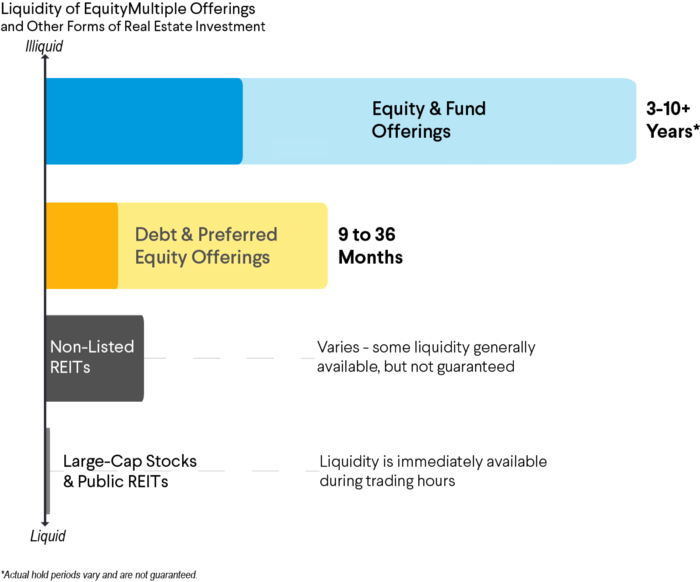
    First and foremost, Real Estate is the least liquid of the major asset classes i.e. you may not be able to take out your money immediately when you need it. This applies to real estate private equity, syndicates, or investing directly in the assets (not through REITs). You could sell your stocks or bonds and cash it in a matter of hours, in real estate it will take months.

    Real Estate also has evolved over the decades and the liquidity problem is solved by public REITs. REITs maybe an ideal vehicle for investors who want to invest in real estate, but want liquidity. REITs behave like securities and hence investors can buy and sell like any of their favorite stocks. REITs in turn have to buy and sell capital and illiquid assets which may take months.

    Source: https://equitymultiple.medium.com/illiquid-assets-an-introduction-eede56c1e947

    The above chart from EquityMultiple real estate platform goes into the various offerings and the liquidity aspect. If an investor doesn’t have the appetite for the long-term and illiquid nature of the real estate, it is best to think of alternatives.

    Capital intensive

    Real Estate, by definition, is capital intensive. Though real estate can use leverage, an investor may still need to layout significant capital for many real estate types. Here are the top three CRE sales in NYC in 2020 to give an idea of the capital-intensive nature of CRE:

    424 Fifth Avenue | $978 million
    Buyer: Amazon
    Seller: WeWork, Rhône Group
    Brokerage: N/A

    410 Tenth Avenue | $952.5 million
    Buyer: 601W Companies
    Seller: SL Green Realty
    Brokerage: CBRE

    330 Madison Avenue | $900 million
    Buyer: Munich RE
    Seller: Abu Dhabi Investment Authority
    Brokerage: CBRE

    Source: The Real Deal

    All of us will agree that raising $978 million is no small capital raise even for large institutions though there will be multiple sources of capital including debt. There are options for investors to invest in real estate without a large capital commitment (e.g. REITs), but we need to keep in mind that real estate projects and assets are very capital intensive directly or indirectly.

    Risk tolerance and scars from global financial crisis

    The first rule of investment is don’t lose money. And the second rule of investment is don’t forget the first rule. And that’s all the rules there are.

    Warren Buffett

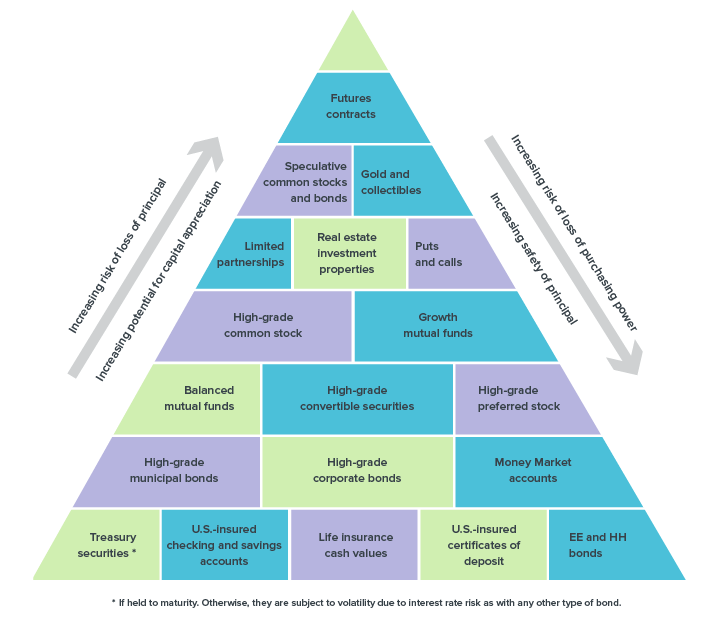
    Is real estate a good investment for a risk-averse person? All asset classes have varying levels of risk, but let us address real estate in this article when compared to other asset classes. The chart below from Smart About Money illustrates the risk of loss of principal and increasing potential for capital appreciation in the chart below.

    Source: Smart About Money Determining Your Risk Tolerance

    There can be a wide variety of risk level within the real estate property types and deals, but real estate as an asset class falls somewhere in the middle of the risk spectrum i.e. there is a probability that you could lose your entire money and even more. For e.g. you could lose your equity money and a lot more if you’ve provided a loan guarantee and the deal goes way south.

    The residential Real Estate sector was a trigger for the Global Financial Crisis and it affected millions of people. People who remember it well may not have a good association with real estate and may have developed a risk-aversion. If you’re one such individual, there is a lot of preparation and groundwork that needs to be done even before you invest your $ in real estate.

    Investor Takeaways

    This article is the yin to the yang of ‘Why bother to invest in Commercial Real Estate?” We’ve looked into three major reasons NOT to invest in real estate. First, the illiquid nature of real estate for private placements and direct holding of assets. Second, the capital intensive nature of real estate outside of REITs. Third, is the relatively higher risk tolerance needed for investors compared to some other asset classes. It is best for an investor to consider their financial situation, understand the risks involved before proceeding (or not) with investing in real estate.